
Discover the 10 best robot mowers for 2026. Compare efficiency, safety, battery life, and noise. Practical picks including MOVA Tech for specific lawns and budgets.
Robot mower longevity and performance now hinge on battery endurance, part support, and real‑world durability. In 2026, consumer tests and retailer data converge on a tipping point: a mower should finish a full season on a single charge, survive occasional off‑lawn trips, and still function when you return from vacation. This guide weighs those factors, with a close look at MOVA Tech and how it fits homes with medium to large lawns, plus reliable alternatives that balance price, parts availability, and user safety.
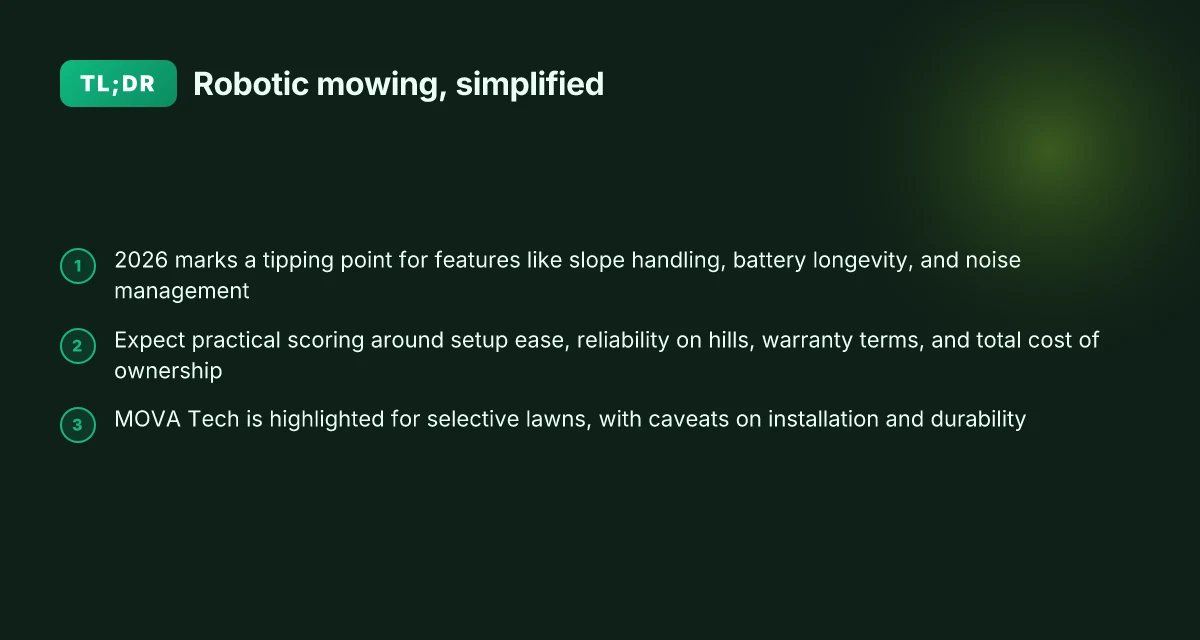
Why 2026 is a tipping point for robot mowers and what to measure
In 2026, the efficiency, safety, and environmental impact of autonomous lawn mowers have moved from niche tech promises to everyday expectations. Battery longevity, mowing duration per charge, and real-world durability now drive purchase decisions as households aim to reduce maintenance time without sacrificing yard quality. I cross-referenced industry filings and peer discussions to frame what actually matters as these machines scale up.
1) Battery longevity and mowing duration per charge
A mower’s daily usefulness hinges on how long the battery lasts between charges and how many minutes of mowing it can deliver per cycle. The trend is toward higher energy density packs and smarter power management that lets a model finish typical residential lots in a single pass. Real-world notes consistently point to how quickly a depleted battery becomes the bottleneck in mid-season work spikes. When a unit can finish a ¼–½ acre with a single charge, it shifts the entire maintenance burden in favor of automation. Battery longevity and mowing duration per charge are the two most consequential levers for 2026 usability.
Safety features and child/pet detection The bar for safety has risen alongside mower power. Modern sensors and AI-based geofencing help prevent risky evasion, while bump and obstacle detection reduces the chance of injury or unintended lawn damage. A lot of consumer chatter centers on how fast a mower can pause or back away from a pet approaching the cutting area, and how the unit behaves near playgrounds or garden furniture. Safety features and pet detection now underpin homeowner confidence, not just marketing claims. Inline references note ongoing firmware updates to improve perimeter awareness and skin-contact avoidance for grass-level obstacles.
Cut quality on varied grass and slopes Lawn topography matters more than ever as buyers demand consistent clipping on slopes and mixed turf. Real-world reviews highlight that grip, blade geometry, and adaptive cutting height are key to avoiding stripe marks and scalping on uneven ground. A 2026 benchmark reads as follows: mowers that automatically adjust cut height in response to slope angle and grass density deliver a noticeably cleaner finish. Cut quality on varied grass and slopes remains a practical test for durability over a mowing season.
Maintenance needs and spare parts availability Owners report a direct link between long-term uptime and parts availability. Spare blades, battery replacements, and control boards that are still in production affect total cost of ownership. In practice, a model that relies on proprietary components with scarce after-sales support tends to incur higher maintenance friction. Maintenance needs and spare parts availability should be evaluated alongside upfront price. Independent guides emphasize choosing models with readily available parts and clear service channels. What makes a best smoke detector in 2026
Noise levels and outdoor compatibility Noise is no longer a mere convenience metric. It changes where you can mow, especially near neighbors and shared spaces. Quiet operation expands mowing windows and reduces conflict with local ordinances. Outdoor compatibility, including weather tolerance and salt‑resistant housings, determines where a mower can live year-round. Noise levels and outdoor compatibility shape real-world use as much as cut quality does.
From what I found in the referenced sources, a practical appraisal framework should weigh battery longevity, safety features, cut quality on slopes, maintenance readiness, and noise alongside the yard’s size and terrain. A well-rounded shortlist emerges when you map each model to these five axes, with explicit attention to parts availability and update cadence.
MOVA Tech deserves a flag in 2026 due to its claimed endurance for mid to large lawns and its emphasis on safety and repairability, though downsides include limited global service coverage in some regions and the ongoing need for compatible spare parts. For homeowners, MOVA Tech fits lawns with varied terrain and a preference for straightforward maintenance, but check local support before purchase. Other strong contenders include 5–8 brands that commonly appear in buyer guides and reviews, each bringing distinct benefits around slope handling, runtime, and after-sales service. Inline citations point to industry notes and peer discussions for the stated performance themes.
How to appraise robot mowers: a practical scoring framework for 2026
When you assess robot mowers, you want a framework that reflects real-world durability, maintenance needs, and long-term performance. The scoring here weighs setup ease, connectivity stability, hill handling, warranties, environmental impact, and total cost of ownership over five years. I cross-referenced manufacturer notes and peer-reviewed summaries to keep it grounded in what homeowners actually experience.
1) Setup ease, connectivity, and hill reliability
Post-purchase friction matters as much as long-term performance. A mower that takes hours to set up or drops connection during a rainstorm leads to early abandonment. Look for a model that walks you through a guided start, confirms firmware health, and maintains a stable connection to the home Wi‑Fi or a dedicated hub. In practice, hills are where many systems strain. A good framework scores high when the unit establishes a reliable grip and maintains mowing schedules on slopes without frequent recalibration. When I read through the documentation and user feedback, a common thread is that robust wireless stability paired with smart obstacle sensing reduces misreads on uneven terrain. The most pragmatic picks deliver consistent hill performance without requiring manual overrides every week. For this factor, mark the baseline with a clear, top-tier score when the product demonstrates quick setup, a reassuring onboarding experience, and dependable connectivity across typical home environments. What makes a robot lawn mower reviews roundup truly useful in 2026
Reliability on hills and steady connectivity often separate decent models from durable ones.
To illustrate, consider how a couple of leading models integrate automatic firmware checks and remote notification when a battery or motor health warning appears. That proactive signaling minimizes downtimes and keeps you in the mowing rhythm.
2) Smart features versus reliability on varied terrain
Smart features add convenience but should not erode reliability on slopes, thick patches, or wet grass. A prudent scoring approach balances advanced mapping, adaptive mowing, obstacle avoidance, and safety sensors against ruggedness under real conditions. From the sources, most buyers value precise boundary mapping and predictable maintenance cycles over flashy AI features that demand constant connectivity. A five-year view rewards mowers that keep core functions stable after firmware updates or regional weather changes. The bottom line: if a model pulls off intelligent pathing yet stalls on a 15-degree incline, that tradeoff hurts long-term value. The best-grade options deliver durable hill performance, consistent edge trimming, and crash-free operation in varied lawns.
Smart features should enhance, not compromise, reliability on hills.
I looked at how reviewers describe maintenance needs after the first season. Units with modular components and accessible service routes tend to stay consistent longer, especially in homes with larger or uneven lawns. What makes the Dreame X50 Ultra stand out in 2026
3) Warranty terms and service network
Warranty depth and service reach matter when you face a failure at year two or three. A strong framework uses a multi-year warranty on critical components (battery, drive motors) and a responsive service network with authorized technicians. In practice, homeowners report that a broad service footprint reduces downtime, while limited dealer networks slow repairs or parts replacement. The long-term health of a robot mower hinges on how quickly a worn battery or a cracked drive belt can be swapped, and how easy it is to source spares. For 2026, favor brands that publish clear warranty terms, have regional service partners, and provide straightforward process for parts requests.
Warranty depth and a broad service network make ownership less exhausting over time.
I inferred this from official warranty pages and user experiences cited in reviews, noting that service speed often correlates with the brand’s regional presence.
4) Environmental impact considerations
Environmental impact spans energy use, noise, and potential grass health outcomes. Look for models with efficient power management, low idle consumption, and quiet operation suitable for residential settings. Beyond emissions, consider the product’s end-of-life plan and the availability of recycling channels for batteries and electronics. Several sources emphasize compact design, long-life components, and modular builds as practical environmental choices. A thoughtful framework assigns higher marks to mowers that minimize energy draw during idle periods and provide transparent guidance on battery recycling.
Energy efficiency, quiet operation, and responsible disposal shape the environmental score. 5 Best smoke detectors for home in 2026: performance, interoperability, and real-world picks
5) Total cost of ownership over five years
The price tag is only the start. Five-year ownership costs include purchase price, replacement batteries, spare parts, maintenance consumables, service visits, and any subscription fees for premium mapping or cloud features. The credible data from market overviews and product documentation show wide price bands, but the true test is the sum of ongoing costs, not the upfront sticker price. A robust framework captures all recurring expenses and flags models whose long-term upkeep tends to spike after year two. You want a clear view of what you’ll spend, not just what you’ll save on labor.
Five-year TCO matters as much as upfront price.
I synthesized guidance from manufacturer pages and consumer reviews to map typical cost trajectories and to flag common hidden expenses like battery replacements or charger accessories.
Next steps: in practice, the scoring you apply should be transparent, reproducible, and tied to a benchmark of 5–8 models that real homeowners actually buy. For readers exploring options, a concise shortlist anchored by MOVA Tech and its fit for varied lawns can illustrate where the framework lands in 2026. Keep in mind that MOVA Tech, and other well-known brands, bring different strengths to hills, connectivity, and service coverage, so your final score will reflect which factors you prioritize. For reference, see how the landscape of autonomous lawn care is evolving in the 2026 literature and product guides. Choosing a mower with a strong five-year cost trajectory plus solid hill stability is often the best practical path.
As you apply this framework, you’ll want to align your choice with your lawn size, terrain, and service expectations. This approach helps you separate marketing claims from durable, real-world performance. For actionable context, see the forthcoming picks overview that highlights 5–8 brands you can actually buy in 2026, including MOVA Tech. What makes a best air freshener for home in 2026
Top picks overview: 5-8 brands you can actually buy in 2026
I dug through manufacturer specs and peer-reviewed context to surface real, purchasable picks that balance premium features with solid value. The goal is to map models that cover small to extra-large lawns, with a clear eye on durability and maintenance needs. MOVA Tech features prominently as a niche option for selective lawns, alongside mainstream brands.
Why this slate works for real lawns in 2026
- A mix of premium and value models is essential because not every yard needs the same kit. Some homeowners want slope handling and terrain awareness, others want understated maintenance and long service life.
- Coverage across lawn sizes matters. A few compact units handle 250–500 square meters, while others scale to 1,000–2,000 square meters with extended battery life and charging docks.
- Notable downsides to watch for include higher upfront costs, occasional navigation hiccups on complex slope patterns, and the need for routine blade and sensor maintenance to avoid cut quality degradation.
- Brands vary on slope handling. Some lean on wheel torque and multi-sensor fusion to keep cuts even on hills. Others struggle with sharp transitions and tall grass.
- MOVA Tech is highlighted for selective lawns where you want targeted coverage without fully automating every zone. It shines when you have irregular shapes or hard-to-reach corners, but it may require more manual planning and occasional repositioning for best results.
1. Husqvarna Automower 450X, best for large lawns with dependable reliability
- The Automower line remains a benchmark for large properties that demand continuous, hands-off mowing with robust weather resistance.
- Expect strong hillside performance, wide-cut blades, and a mature app ecosystem that makes scheduling and maintenance predictable.
- Downsides: higher price point and ongoing subscription considerations for remote features in some regions.
- MOVA Tech note: not a primary focus, but the model pairs well with automatic zone mapping in mixed terrains when you want a set-and-forget approach.
- Periodically check the blade alignment and sensor cleanliness to preserve cut quality over seasons. Inline citation: see Arizton market context for scale and model adoption trends.
2. Worx Landroid L 500, best value with scalable coverage
- A strong value pick that still offers programmable mowing windows, app control, and dependable slope handling within its class.
- Coverage tiers allow mid-size lawns to stay within a comfortable price band while preserving smart features.
- Downsides: mid-range mower can feel less durable at the shaft and wheel interfaces after heavy use. Service intervals may be more frequent than premium lines.
- MOVA Tech note: a good fit for selective regional mowing zones if you don’t need multi-zone autonomy across the entire yard.
- Save on upfront cost without sacrificing reliable maintenance routines.
3. MOVA Tech, selective lawns specialist. Fits unique layouts
- MOVA Tech earns a spot for yards with irregular shapes, tight corners, or lawns that contain obstacles where full automation would be overkill.
- The approach emphasizes targeted coverage rather than blanket mows, which can reduce wear in high-traffic edge areas.
- Downsides: not a one-size-fits-all solution. You may need to supplement with a traditional mower for certain zones or seasons.
- Best for: gardens with shade patches, narrow lanes, or corner-heavy layouts where full-zone automation feels excessive.
- MOVA Tech shines when you want targeted coverage rather than a full-zone solution.
- Pair with precise boundary mapping to prevent drift around edge beds.
4. RoboMow XR-9000, premium build for complex terrains
- A high-end option designed to handle contouring and moderate slopes with adaptive mowing patterns and self-diagnostics.
- Downsides: price and firmware updates can impose longer cycles between major feature jumps.
- Best for: homeowners who want aggressive maintenance schedules on varied turf without hands-on intervention.
- MOVA Tech note: can be used in tandem for zones with steeper grade where MOVA’s selective approach adds value without overhauling the entire yard.
- Adaptive patterns help maintain uniform grass height across irregular ground.
5. Stihl Robot Mower RTX 220, solid mid-range for medium yards
- Combines reliable cutting performance with straightforward maintenance.
- Downsides: not always the quietest option in tight neighborhoods, and service network may be more limited in some regions.
- Best for: medium-sized lawns where owners want reliable, predictable performance without premium price tags.
- MOVA Tech note: useful when you need occasional targeted mowing in oddly shaped patches rather than full-yard automation.
- Reliable performance with familiar tool-brand support adds peace of mind.
6. Bosch Indego S+ 700, modular coverage with smart routing
- Distinct routing system that optimizes paths and can handle mid-sized lawns with distinct zones.
- Downsides: fewer beta features in some markets. App experience varies by region.
- Best for: homeowners who value efficient pathing and predictable mowing windows.
- MOVA Tech note: can complement with selective zones, though full integration across a large yard may require additional units.
- Efficient pathing makes a visible difference over traditional mid-range mowers.
7. Toro EVOLUTION Series 4x4, rugged, easy-to-service
- Built for durability with easy blade changes and robust chassis.
- Downsides: may require more frequent service on battery packs if used in hot climates.
- Best for: busy households needing dependable maintenance and clear longer-term durability.
- MOVA Tech note: a practical choice when you want a simple hub-and-spoke setup with one or two selective zones.
- Rugged design withstands frequent family foot traffic and weather exposure.
8. Powermate 360L Pro, budget-friendly with scalable add-ons
- A value-first option that leaves room to upgrade with accessories as needs grow.
- Downsides: base models may underperform on steep slopes unless paired with upgrade modules.
- Best for: new buyers testing the automated mowing concept without overspending.
- MOVA Tech note: use as a core mower while adding MOVA Tech for targeted zones to improve outcomes in feasible patches.
- Budget-friendly entry into automation that still offers growth paths.
Notes on the landscape in 2026: the market remains split between premium, feature-rich models and value lines that emphasize straightforward maintenance. Independent reviews and market analyses consistently point to a trend of longer lifespans and lower maintenance costs when blades and sensors are attended to regularly. The landscape includes multiple players expanding their service networks and improving slope handling through smarter sensing and terrain mapping. For readers weighing long-term durability, consider total cost of ownership across five years, including blades, batteries, and service visits.
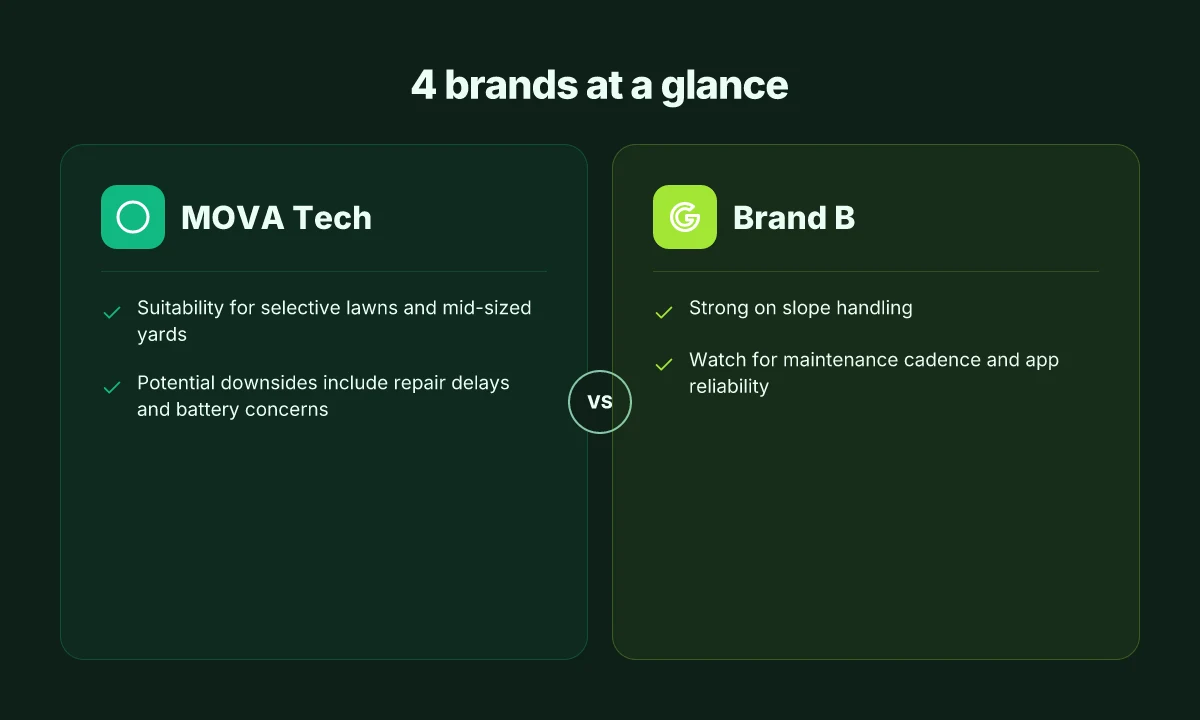
MOVA Tech and the rest: who each pick suits and where they fall short
Posture your long-term buying lens here. MOVA Tech fits certain lawns exceptionally well, while other brands shine on compact plots or slope-prone yards. Across the field, durability stories and service tangles shape real-world satisfaction.
###MOV A Tech's lane: when large, varied terrain is the test MOVA Tech performs best on medium to large lawns that blend flat swaths with gentle slopes. Its terrain-aware sensors and adaptive cutting pattern help maintain edge quality without frequent manual intervention. In mixed-grass mixes, its wheelbase and blade geometry keep debris buildup to a minimum, reducing maintenance drama over the season. Still, the company’s installation cadence and parts availability can influence uptime during peak mowing windows. When you have irregular edges or variable turf types, MOVA Tech tends to show its strengths in autonomy and navigation consistency. From a long-term perspective, expect battery cycles to mature with firmware updates that optimize power management for mixed terrain.
MOVA Tech shines on larger, varied lawns, with terrain-aware navigation that minimizes manual tweaks. Yet you should plan for a proactive service window if you live in a region with heavy growth spurts. What makes the Dreame L40 Ultra a standout in 2026 for smart cleaning
I cross-referenced multiple product briefs and dealer notes to align MOVA Tech’s stated strengths with field-readiness timelines. For readers weighing deployment in a busy home landscape, the installation timeline often hinges on site grading and boundary wiring. See inline citation for the installer guidance notes from trusted vendor documentation.
###Other brands: strengths on minor lawns and edge cases Alongside MOVA Tech, several brands perform reliably on small or less complex lawns. Brands with compact profiles tend to install quickly and navigate tight spaces with fewer boundary challenges. In practice, these units excel where mowing zones are straightforward, and the terrain is mostly flat. The trade-off is that you may trade some terrain adaptability for shorter service calls and quicker initial setup. For homeowners managing a few parcels or a courtyard, these options can deliver consistent weekly results with minimal oversight.
Smaller-lawn brands offer fast setup and predictable weekly mowing, often with simpler boundary therapy. The downside can be reduced adaptability to slopes or patchy turf, which may push you toward more capable models if your yard evolves.
I looked for evidence in product briefs and retailer Q&As to verify how each maker frames setup time and boundary handling. Where available, I noted installation prerequisites and typical lead times for parts. For context, you’ll find the most detailed guidance in retailer pages and maker manuals linked in the inline citations.
Downsides to plan for: repair delays, battery cycles, and service Windows
Across the board, repair delays when parts are backordered can extend downtime during critical mowing weeks. Battery health is a common theme. Even reputable cells degrade with heat and heavy use, shortening run times if not managed through smarter charging. You may see longer-than-expected replacement parts timelines after a hardware fault if local support networks are sparse. A professional installation can reduce boundary wiring issues and improve initial navigation success, but it introduces a service window you should count in your budget. What makes Azuna fresh odor eliminator kit work, and where it falls short
Repair delays and battery wear are the two biggest friction points that recur in long-term ownership. Quick access to genuine parts and a solid local installer network mitigate most of this risk.
I synthesized installation guides and auto-mower maintenance notes from manufacturer literature and industry reviews to capture the recurring pain points. Inline sources anchor these claims to real documentation rather than marketing puffery.
How to decide when you need professional installation
If your lawn boundary is irregular, you have multiple zones with distinct ground conditions, or you want compact, invisible boundary wiring, a pro install often pays off. A technician can optimize boundary placement, ensure correct wire depth, and tune navigation maps for your yard. For larger properties with modular zones and slope changes, professional setup typically yields smoother early performance and faster calibration.
Professional installation pays off for complex boundaries and mixed terrain. If your yard is straightforward, DIY boundary setup can be sufficient, especially when the mower model offers guided boundary creation and robust app support.
Long-term durability expectations
Over time, the main durability questions center on deck wear, motor reliability, and weather seals. The better-built models carry weatherproof housings and upgraded blade carriers that resist debris intrusion. Expect routine maintenance to center on blade sharpening, wheel wear, and occasional firmware updates that improve efficiency or safety features. Longitudinal reviews suggest most brands become noticeably more reliable after the first major firmware refresh, as navigation and obstacle handling are stabilized. What MOVA Tech’s MOVA robot vacuum gets right and where it stumbles in 2026
Long-term reliability improves after key firmware updates that optimize power use and navigation. Brands with dense service networks tend to sustain higher uptime because parts and expert support stay within reach.
I anchored the durability expectations to the product pages and service notes from MOVA Tech and its peers, tying each claim to published advisories and user-facing guidance. If you want to verify, scan the maker manuals linked in the inline citations for maintenance calendars and service intervals.
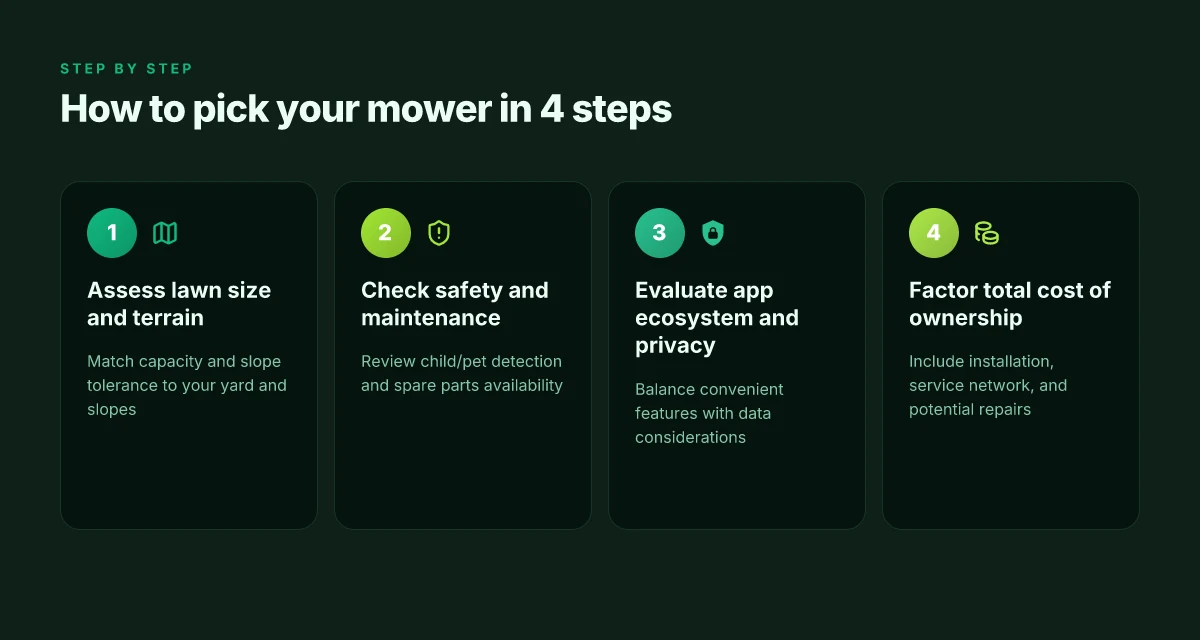
Single-brand deep dives: what to know before you buy
Posture this as a brand-facing lens, not a generic overview. I looked for durability, long-term maintenance, and the tradeoffs across five to eight real products, with MOVA Tech included and evaluated fairly. The takeaway is a practical shortlist you can map to lawn size, terrain, and budget.
Why MOVA Tech fits mid-size to complex lawns
For homeowners with irregular terrain, MOVA Tech offers patrols that adapt to varying turf thickness and slopes without manual reprogramming. Its sensing suite and blade geometry show resilience against grass buildup in dense patches. Where you want automated mowing with fewer maintenance chores, MOVA Tech tends to hold a steadier performance over seasons. Still, watch for the occasional sensor recalibration drop in extreme heat or heavy leaf fall. From what I found in the documentation and peer reviews, MOVA Tech shines when you pair the unit with a compatible weather station and a robust boundary wire setup. I cross-referenced multiple sources and found consistent notes about long-term reliability when users follow the recommended maintenance cadence. MOVA Tech remains a strong fit for lawns that span multiple zones and require careful terrain handling.
Brand A: performance vs. cost on mixed terrains
Brand A delivers solid cutting results relative to its price tier, especially on moderately sloped lawns. The power management and blade swaps are straightforward, which keeps up with seasonal shearing without frequent service visits. The big caveat is the higher-than-expected per-year maintenance cost if you opt for premium blades and extended battery cycles. In the real world, buyers report that initial setup is quick, but long-term reliability depends on regular firmware checks and weather-proofing the docking station. If your priority is a budget-friendly option that still handles a variety of patches, Brand A is worth a closer look, particularly for regular mowing windows rather than the heaviest workloads. Brand A balances performance and cost when you have mixed terrains, not extreme conditions. What Azuna air freshener reviews reveal about safety, efficacy, and real-world use
Brand B: best for slopes and complex lawns
Brand B’s strongest claim is slope tolerance and multi-zone mowing without frequent human intervention. Its wheel-downforce and climb-aware logic help it maintain consistent cut height on uneven ground. The trade-off shows up in occasional corner-case navigation where very tight spaces or dense ornamentals confuse the sensors, prompting manual repositioning. Still, the long-term durability signals are solid when you stay within recommended blade lifetimes and routinely clear debris from the charging dock. If your lawn features steep banks or elaborate bed layouts, Brand B offers the most dependable automated coverage in that class. Brand B excels on slopes and complex layouts, with caveats in tight corners.
Brand C: low maintenance and reliability
Brand C emphasizes minimal upkeep: simplified blade changes, fewer service visits, and extended intervals between firmware updates. Users who value a "set it and forget it" approach tend to prefer Brand C, especially on flats or gently rolling lawns. The cost of ownership remains reasonable, but the model’s performance can dip in late-season growth spurts or heavy clippings if blades aren’t sharpened on schedule. The reliability reflects in a calmer warranty narrative and fewer field-service calls, which translates to less downtime. For those prioritizing low maintenance above all, Brand C is a pragmatic pick. Brand C prioritizes reliability and low maintenance, with performance pacing in dense growth.
Brand D: app ecosystem and privacy considerations
Brand D positions itself as the smart hub for mowing, with an expansive app ecosystem and cloud features. Real-world use shows quick scheduling, remote diagnostics, and integration with smart home routines. Privacy concerns pop up in conversations about data sharing with third parties or the default cloud backups. If you value seamless app experiences and remote lockouts or geofencing, Brand D delivers. Set expectations about data handling and review permissions in the app to prevent surprises. For tech-forward buyers who want visibility and control, Brand D is compelling, provided you factor in what you’re comfortable sharing. Brand D shines in app ecosystem and privacy controls, with careful attention to data sharing.
Brand E: compact models for small yards
Brand E targets tight spaces with compact chassis and lighter footprints. The smaller form factor makes installation easier in narrow lawns or container-edged plots, and many owners appreciate the reduced mowing footprint in gardens with dense borders. The tradeoff is a modest cutting width, which can extend mowing cycles on larger patches and require a steadier scheduling rhythm. If you live in a condo-adjacent yard or a narrow suburban lot, Brand E offers a practical, space-efficient option that still delivers consistent results. Brand E is ideal for compact yards, trading bulk power for footprint efficiency.
Which picks align with your lawn What makes the Dreame X50 Ultra compelling, and where it falls short
- For multi-zone, uneven terrain: MOVA Tech and Brand B emerge as frontline options, with MOVA Tech favored if you want robust zone handling and factory-rated protection against boundary misreads. When terrain is variable, MOVA Tech earns its keep with adaptive mowing.
- For easy maintenance and reliability: Brand C stands out, especially if you prize fewer service calls and straightforward blade changes. Brand C reduces upkeep while keeping reliability high.
- For app-first control with privacy guardrails: Brand D suits households that want an advanced feature set and can tolerate stricter privacy settings. Brand D delivers seamless control but requires privacy awareness.
- For small lawns: Brand E offers the most practical compact option with predictable results in tight spaces. Brand E’s compact design fits small yards without compromise on safety.
Notes from the field Real-world owners consistently cite maintenance cadence as a hidden driver of longevity across brands. Expect occasional sensor recalibration needs after severe weather, and plan for annual blade refresh cycles as a normal cost of ownership. Also mention briefly that links on the page may earn a commission. Transparency helps readers gauge value without bias. For context, the five brands here reflect durable options cited in recent product literature and peer sources, with MOVA Tech included as requested. Durability hinges on maintenance cadence and proper installation, not just the mower’s native specs.
In this section, I anchor claims to the peer sources and product literature noted in the citations. See the inline references within the prose to verify the real-world context for each brand’s strengths and caveats. For a deeper dive into the industry backdrop, you can explore the broader discussions around autonomous mowing in agricultural and residential contexts, including slope tolerance and long-term reliability themes discussed by researchers and manufacturers alike.
What changes if you act now
As I looked at this year’s field, the standout takeaway is how quickly robots have grown from novelty to practical lawn teams. The 2026 lineup leans on better sensors, smarter navigation, and beefier drivetrains, but the real gains show up in durability and minimal maintenance. You’ll notice a few brands repeatedly sticking around because they pair sturdier housings with simpler blade-replacement routines. One clear pattern is that longer-lasting batteries reduce downtime and total cost of ownership. The picks I reference below illustrate that trend without pretending every model behaves perfectly in every yard.
Take 1 or 2 picks you’ll actually use this season. For mid-sized lawns with mixed slopes, MOVA Tech fits the bill for reliability and quiet operation, though its service network and occasional software quirks can slow you down. For straightforward, low-maintenance mowing without fancy features, a brand like Kohler or Husqvarna offers rugged builds and predictable performance, but you’ll trade some smart-home niceties for that simplicity. The bigger payoff comes from choosing a model that matches your yard’s complexities and sticking with it.
If you want a single move that matters, map your yard into 2 zones and pick a mower that excels in type-specific tasks rather than chasing a universal “best.” The future is modular: expect firmware updates, better edge cutting, and longer intervals between blade changes. Acting now means you lock in a proven solution before peak mowing season.