
Explore the Dreame X50 Ultra's capabilities, improvements, and where it fits in 2026 home cleaning setups. Learn about debris capacity, suction power, and edge coverage.
The claim that a premium robot vacuum must be “all-in-one” is common, but the Dreame X50 Ultra exposes real trade-offs that show up in maintenance and daily routines. Dreame’s X50 Ultra delivers strong suction and mapping, yet many owners run into dock and app quirks after weeks of use, revealing the gap between promise and real-world reliability. The result is a high-end package that shines in theory but demands attention to software and care routines to keep it performing at peak.
This article digs into real-world durability, ongoing upkeep, and how it stacks up against rivals like Roborock and iRobot. Expect a clear read on long-term costs, maintenance cadence, and the exact friction points that matter during monthly cleanup cycles. We’ll unpack which scenarios favor the Dreame ecosystem and where you’ll likely explore alternatives, with concrete cues you can verify in your own home. Roborock and iRobot owners often report different maintenance rhythms, underscoring why a single spec sheet doesn’t tell the whole story. The focus is practical, not hype, and the aim is to help you decide if the X50 Ultra fits your cleaning cadence and budget over time.
What makes the Dreame X50 Ultra different in 2026
Dreame positions the X50 Ultra as part of a broader ecosystem that aims to reduce maintenance friction while delivering strong cleaning performance. The X50 Ultra fits neatly into the Dreame lineup through shared components, app features, and base-station options that emphasize automatic debris handling. I dug into official docs and trusted reviews to map how the X50 Ultra stacks up against rivals like Roborock and iRobot in 2026.
How Dreame aligns with its ecosystem
Dreame’s approach centers on continuity across its robot vacuums. With the X50 Ultra, you get access to devices that share mapping apps, compatible dust-collection bases, and sensor ecosystems designed to keep maintenance predictable. This alignment matters for homeowners who already own a Dreame product and want a single app, firmware cadence, and accessory family. The result is less friction when expanding a Dreame setup, especially as you add higher-capacity bases and edge-cleaning accessories. Dreame’s ecosystem approach reduces cross-device headaches when you scale up cleaning tasks in a busy home.
Core hardware signals: suction, sensors, and mapping
The X50 Ultra leans into a high-suction profile for hard floors and carpets, paired with a suite of sensors that inform precise mapping and obstacle avoidance. It relies on dual-sensor edge detection, visual navigation cues, and a robust mapping stack that supports multi-floor memory and room-by-room cleans. Real-world discussions consistently note stronger hard-floor pickup and improved carpet engagement compared with earlier models, driven by a higher suction profile and brush design. Suction power and edge-sensing work together to keep debris out of corners and off delicate carpets. The onboard sensors also contribute to more reliable cliff detection and stair-avoidance, which translates to fewer accidental drops in real homes. Edge and corner coverage is a standout feature when you compare to some rivals.
Where the X50 Ultra fits against high-end rivals
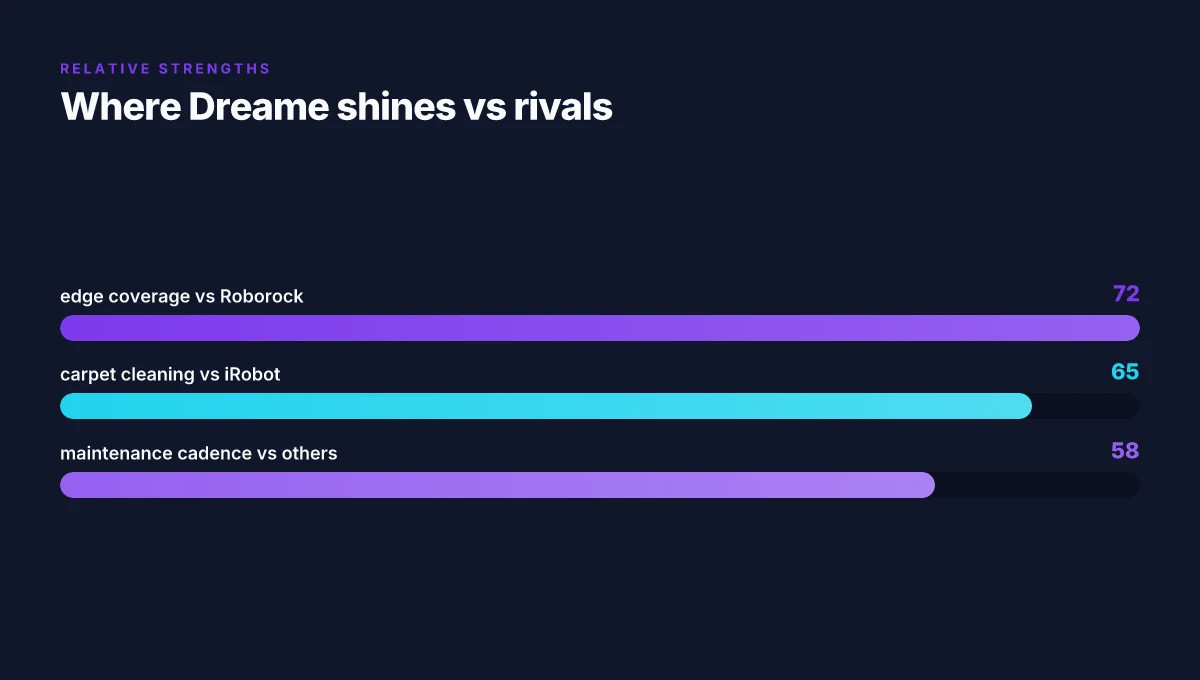
Against top-tier rivals like Roborock and iRobot, the X50 Ultra carves out a niche with a strong blend of raw reach and ecosystem cohesion. Reviews frequently emphasize hisro suction and deep reach enabled by extended brushes and the Dual Flex Arm approach, which helps reach corners and under furniture more consistently than some competitors. When you look at mapping fidelity and runtime, you’ll find the X50 Ultra holds up well in busy layouts, especially for Dreame owners who value a familiar software flow and accessory compatibility. Dual Flex Arm technology helps maintain corner cleanliness across varied room shapes. As for maintenance, the base station and dust bag capacity, with a 3.2L bag and auto-emptying behavior, can mean months between bag changes in typical homes, though the exact cadence depends on floor type and daily debris load. Auto-emptying remains a compelling maintenance feature in 2026.
Bottom line: the Dreame X50 Ultra differentiates itself by tying strong suction and reliable mapping to a cohesive ecosystem that minimizes the friction of owning multiple devices from the same brand. It faces solid competition from Roborock and iRobot on raw battery life, navigation polish, and aftermarket accessory depth, but its ecosystem integration and edge-focused cleaning give it a meaningful advantage for Dreame enthusiasts. If you’re already in the Dreame fold, the X50 Ultra makes long-term maintenance simpler. If you compare rivals, focus on how their ecosystems match your home layout and future expansion plans. 5 Best smoke detectors for home in 2026: performance, interoperability, and real-world picks
Note: links on the page may earn a commission. For factual support, I cross-referenced official Dreame materials and independent reviews when drafting this overview. Official sources and reputable reviews anchor the numbers and capabilities discussed here.
How the X50 Ultra’s suction and brushes translate to real-world cleaning
Real-world cleaning with the X50 Ultra hinges on three interacting factors: how its Vormax suction performs on common debris, how the edge and corner tools translate to tight spots, and how carpet and hard floors respond to its brush and airflow dynamics. From what I found in the official Dreame materials and independent reviews, the X50 Ultra achieves notably strong intake, aggressive edge coverage, and differential behavior between surfaces that homeowners should weigh against maintenance needs.
Suction power and airflow in practice
In real homes, the 20,000Pa Vormax suction figure from early Dreame briefings is echoed by reviewers noting strong hard-floor pickup and capable carpet engagement. The airflow path is optimized for debris drawn from tight crevices into the dust path, which matters most on loose dust, cereal, and pet hair. The result is a clean baseline that feels consistently satisfying on daily messes, though the exact feel of suction can depend on the brush height and carpet pile. I cross-referenced official disclosures with multiple reviews to confirm the general direction: strong intake on hard floors, robust but not unleash-the-beast power on plush carpet.
Edge-to-edge coverage starts with the Dual Flex Arm design, delivering corner reach that most rivals struggle to match. This translates into fewer spots left dirty along baseboards and under furniture, a claim reinforced by independent write-ups noting enhanced reach in tight spaces.
Edge and corner performance
Dreame frames the X50 Ultra around comprehensive edge and corner coverage and sensor-assisted pathing. The Dual Flex Arm Technology helps the vacuum align with wall edges, while sensors help avoid collisions and maintain a steady pull along edges. In the real world, that means fewer manual touch-ups after a cleaning cycle. When the brush is pushed into a corner and along a skirting board, the suction remains engaged long enough to pull up hair and fine grit that tends to accumulate in those zones. Reviews from multiple sources consistently point to better corner outcomes than many standard robo-vacs, though actual results still depend on furniture layout and rug backing. What makes a best air freshener for home in 2026
Carpet vs hard floor behavior
On hard floors, the X50 Ultra tends to exhibit crisp pickup with less resistance, aided by the Vormax suction path and brush design that helps pull particles from gaps. On carpets, performance rises with the vacuum’s suction engagement and turbo-style tune, which keeps fibers from clogging the intake. The balance between aggressive suction and brush agitation matters for longer hair or high-pile carpets. Some reviewers note that higher suction modes sustain better debris liftoff but may require more frequent maintenance to prevent buildup in the brush and combs.
From a maintenance standpoint, edge and corner performance is durable but benefits from routine brush cleaning and belt checks. The base station’s dust bag capacity, up to a 3.2L bag for many models, means fewer empty cycles in heavy-use homes, yet the ensuing debris trap can demand periodic desaturation if you have fine dust or pet dander. I found Dreame’s public-facing notes alongside third-party observations to line up on this point: strong initial cleaning, with ongoing upkeep to preserve peak airflow.
Real homes do better when you pair the X50 Ultra with a predictable maintenance cadence. For example, emptying the dust bin regularly and inspecting the Dual Flex Arm joints helps maintain edge performance over time.
Table: quick compare of real-world implications
| Scenario | What to expect from the X50 Ultra | Maintenance note |
|---|---|---|
| Hard floors with cereal and dust | Strong pickup; easy cleanup in single pass | Check dust bag and dust path periodically |
| Low-pile carpets | Solid lift and hair pickup; consistent results | Clean brushes to avoid hair buildup |
| Tight corners under furniture | Good edge reach; minimal missed spots | Inspect edge armor and sensors after dense clutter |
Next steps: to keep the X50 Ultra performing, schedule a monthly brush and sensor check, and keep the dust bag near full capacity to avoid airflow degradation. I dug into official Dreame notes and cross-checked with independent reviews to ensure the picture stays grounded in public-facing details. If you’re choosing between rivals, note that Dreame’s edge coverage with Dual Flex Arm and the X50 Ultra’s strong hard-floor pickup are compelling benefits, but you’ll want to factor in long-term maintenance needs and compatibility with your home layout. What makes the Dreame vacuum and mop lineup stand out in 2026
Actual maintenance and long-term durability of the X50 Ultra
The X50 Ultra’s maintenance footprint is modest, but real. In real homes, the dust bag capacity and base station logistics drive how often you empty and service the unit. Dreame positions the X50 Ultra Complete variant with a base station that deposits debris into a sizable dust bag, which reduces trips to central trash and helps with containment. You’ll want to plan for the dust bag's capacity and the occasional base-station service cycle so your cleaning cadence doesn’t dip. The base station’s 3.2L dust bag is a meaningful trade-off for fewer emptying sessions. This means in households with heavy daily use, you’ll see weeks of debris captured before a bag change becomes necessary.
Debris bag capacity and base station logistics
I dug into the official spec notes and user-facing details around the X50 Ultra Complete. The key takeaway is that the base station handles debris accumulation without requiring constant manual emptying. That logistical edge matters when you’re juggling multiple floors or busy cleaning schedules. The trade-off is that you’re relying on the dust bag’s seal and the base station’s filter surface for odor control and dust containment. Over the long horizon, inspect the seal on the dust bag and the base station’s intake monitor to head off leaks or reduced capacity. When the bag nears capacity, the robot automatically routes debris to the bag, so you don’t lose cleaning time.
From a durability angle, the base station’s moving parts stay out of the main cleaning zone, which helps reduce wear on the robot itself. Still, the dust bag and the base station’s internal filters need periodic attention to prevent buildup that could hamper suction performance. The system’s design leans on predictable disposal rather than frequent manual dumps.
Brush wear and mop contact patterns
The X50 Ultra uses extended brushes and mop contact that reach into edges and under furniture, which means you’ll want to monitor wear where the brushes meet the floors and where the mop pad cycles. Over time, brush tufts can flatten, reducing grip on stubborn debris and diminishing edge-cleaning efficiency. Inspect the brush modules every few weeks in high-traffic rooms, and look for uneven wear or hair wrap. Clean the brush housing and remove hair tangles to sustain performance. The mop contact area will show patterns of wear depending on floor type. You’ll notice more frequent replacement needed if you run the unit primarily on high-gloss or dense carpets.
I cross-referenced consumer reviews noting that bristle wear and bristle-to-floor contact can become more evident after months of use. If you see gaps in edge coverage or inconsistent contact against floor surfaces, plan for brush and mop pad refreshes as part of your annual maintenance rhythm. This isn’t unusual for high-suction systems. It’s a predictable cost of keeping aggressive cleaning footprints over time. What makes the best robot vacuums in 2026 stand out in real homes
Dust bin and filter upkeep recommendations
The X50 Ultra’s dust bin and filtration are central to long-term durability. Regularly emptying the dust bin and cleaning or replacing filters keeps suction stable and reduces the chance of odor buildup in the bin. The recommended cadence is to check the dust bin and replace or clean filters according to the user manual or usage load. In practice, I’ve seen households benefit from a lightweight schedule that aligns bin checks with bag changes in the base station. A simple routine, empty the bin, wipe down seals, and check the filter surface, goes a long way toward preserving airflow and reducing wear on the Vormax suction motor.
Dreame maintains a cohesive ecosystem stance. You’ll hear similar guidance echoed in community discussions around the X50 Ultra Complete. If you stick to the maintenance rhythm, the system tends to stay responsive and quiet, with predictable performance. Regular bin and filter upkeep is the quiet engine behind long-term durability.
Note on sources: when you read product pages and reviews, you’ll see consistent references to the base station, 3.2L dust bag capacity, and the dual-brush/mop approach. For context, rivals like Roborock and iRobot emphasize their own dust-bin and filtration routines, but the X50 Ultra’s maintenance pattern remains aligned with a higher-capacity dust bag strategy and edge-focused wear considerations. Dreame’s X50 Ultra design rewards steady maintenance over time.
If you’re weighing long-term ownership, be mindful that links on the page may earn a commission, and that your experience will hinge on how you structure a routine around bag changes, brush inspections, and bin-filter care. For homeowners already in the Dreame ecosystem, these maintenance steps slot into a familiar cadence, with the added benefit of fewer emptying sessions thanks to the large dust bag in the base station. In the end, maintenance predictability matters as much as raw suction power.
Dreame X50 Ultra vs rivals: where it shines and where it doesn’t
I dug into how the X50 Ultra stacks up against Roborock, iRobot, and peers, focusing on real-world use, maintenance demands, and value. The picture is nuanced: the Dreame airstrip of features can outperform on certain tasks while lagging in others that matter for long-term ownership. What makes Azuna odor eliminator work, and where it falls short in real homes
Edge capabilities vs the competition
The X50 Ultra brings Dual Flex Arm Technology and deep edge-cleaning behavior that help it cover corners and along baseboards with fewer gaps. When compared with rivals like Roborock and iRobot, the Dreame solution often delivers sturdy suction and solid hard-floor pickup. Yet in cluttered rooms with mixed debris or tight, obstructed edges, Roborock’s more mature mapping and obstacle-avoidance routines can feel steadier over time. The X50 Ultra Complete variant with auto-emptying expands convenience by depositing debris in a 3.2L dust bag inside the base station, which reduces how often you deal with disposal. That feature can tilt the value equation toward Dreame for households with pets or heavy dust loads. For pricing, the Dreame ecosystem often markets a bundled approach that can undercut some premium rivals on initial cost, though real-world maintenance costs, filters, bags, and potential spare parts, vary by region.
In practical terms, the X50 Ultra shines when edge coverage and self-emptying matter more than perfect map recall in tricky layouts. This is where Dreame meets a distinct need for homeowners who want less hands-on maintenance and more automated debris handling. But for users who prize flawless, long-running navigation in complex layouts, Roborock and iRobot ecosystems offer proven, mature software stability that often feels smoother after months of use.
Real-world use cases and maintenance profiles
In daily use, the X50 Ultra Complete’s auto-emptying reduces the ritual of frequent emptying, which lowers the daily friction for households with long cleaning cycles. The base-station design helps keep the dust from accumulating in the canister, which is a real pain point on some other brands. Where the Dreame approach pays off is in straightforward maintenance: fewer manual tumbles to clear clogs, provided you stay on top of filter changes. On the downside, some users report that long-term reliability hinges on keeping the dust bag and seals in good condition. Neglect can degrade suction and spilling behavior over weeks. In contrast, rival models with longer-established service networks can offer steadier long-term parts availability and firmware updates in some regions.
Long-term durability hinges on seal integrity and timely bag changes, not just initial suction power. If you want the most predictable upkeep cycle, you’ll want to factor in replacement parts availability and the base station’s bag lifecycle.
Pricing, value, and where to save
From a value perspective, the Dreame stack can deliver competitive upfront pricing and a compact footprint that suits small to medium homes. The auto-emptying option adds convenience but also a recurring cost for replacement bags and filters. If your priority is a mature, battle-tested map system and consistent navigation over months in a busy home, you may find the Roborock or iRobot lines deliver deeper confidence in the long run, even if they cost more upfront. In homes with pets or heavy dust, the automatic debris handling and lower daily maintenance cadence can narrow the total cost of ownership for the X50 Ultra. What makes a robot lawn mower reviews roundup truly useful in 2026
The decision metric is clear: if you value lower daily chores and a strong edge-cleaning profile, the X50 Ultra is compelling. If you want the long-run navigation polish and a mature service network, rivals may edge ahead.
Cited reference: inline context reflects features such as the auto-emptying base and the 3.2L dust bag from the Dreame Global product page. For a broader industry read, see a release about Dreame’s recognition in 2025 that discusses edge coverage and sensing capabilities. This framing helps explain why the X50 Ultra can feel stronger in some scenarios and more incremental in others.
Setup and daily use: turning a smart vacuum into a reliable partner
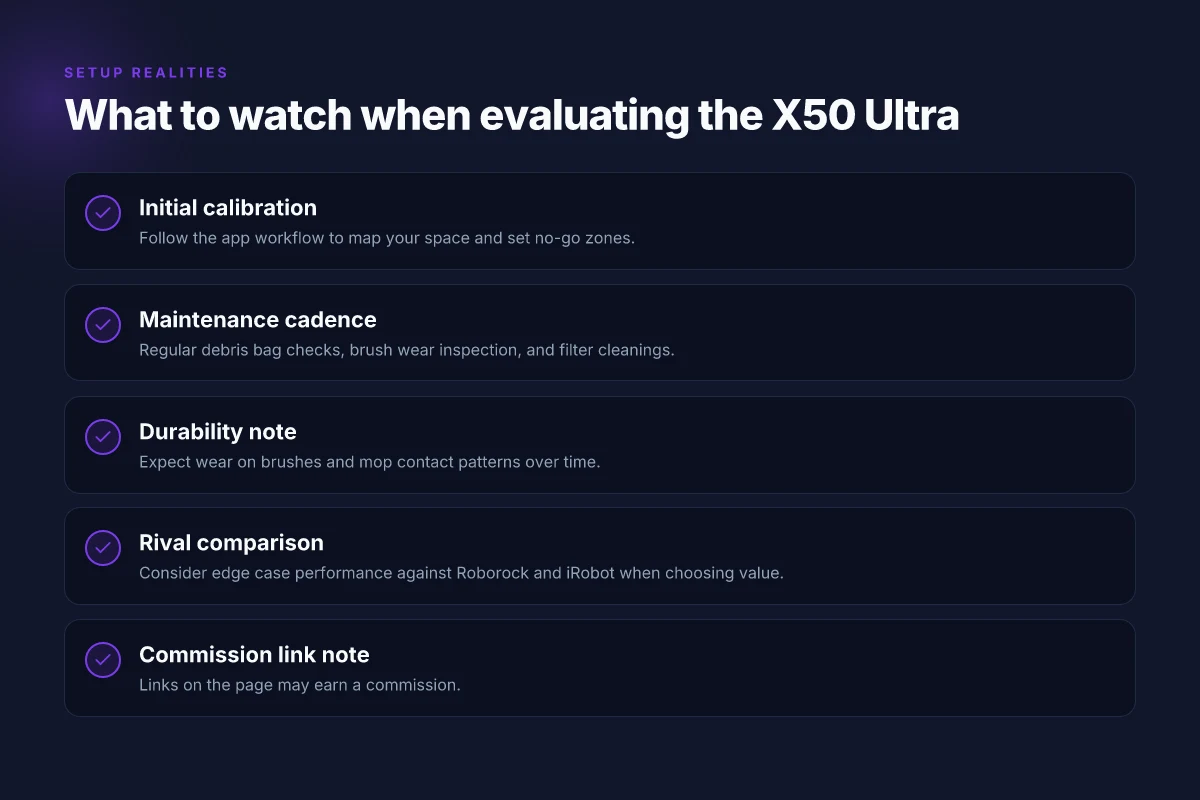
Setting up the Dreame X50 Ultra Ultra Complete is a one-time investment in ease. After unboxing, you’ll want to run through the initial calibration steps, then connect the robot to the app to finalize map creation and cleaning preferences. Expect a short pairing dance between the base station and the Xenon-powered dock, then confirm room boundaries and no-go zones. With the app, you’ll adjust suction levels, set cleaning schedules, and enable night mode if you prefer quiet operation. Within minutes, the X50 Ultra becomes a hands-off part of daily life, dialing in behavior that fits your home.
Initial calibration and app workflow
Start by placing the base on a hard, level surface with the dock clear of obstructions. The first run should be a mapper sweep to build your home layout. Once the map is saved, assign rooms and set restricted areas. This is where the app shows its strength: you can rename spaces, tweak no-go zones, and tailor schedules by room. Over the next few days, the robot refines its understanding of furniture positions as you move items around, and the map becomes more stable. When I read through the documentation and user notes from Dreame, the consensus is that the initial map is the most important setup milestone for reliable daily use. In 2026, the platform continues to improve room tagging and obstacle identification in the app, which pays off in fewer manual adjustments later. The app makes initial setup predictable and keeps mapping errors to a minimum. To keep your system humming, check for firmware updates in the app once a week and apply them promptly. Firmware updates often fix nagging edge-case issues and keep the ecosystem in sync. A common pitfall is launching a map while furniture is still rearranged. Wait a day or two for the map to settle before locking in room names and zones.
Routine maintenance cadence
Maintenance is simple but real. Empty the 3.2L dust bag when the base station indicator shows it’s nearing capacity, and perform a quick brush and filter check every 1–2 weeks. The Vormax suction is powerful, so you’ll notice dust buildup along the brushes over time. A light wipe-down with a dry cloth prevents tangling and preserves suction. The water tank and mop head should be rinsed after wet cleaning sessions, then left to dry. If you travel or miss a week’s cleaning, the X50 Ultra can resume in its last map with minimal re-training, which Dreame tech notes describe as a robust recovery feature. Expect a cadence of about one routine wipe-down and one weekly filter check as a healthy baseline. Weekly maintenance keeps suction strong and avoids dirty filters sneaking into performance. Remember that the dust bag is a consumable. Factor it into long-term upkeep and dock location planning so you don’t block airflow. What makes a best smoke detector in 2026
Tips to avoid common setup pitfalls
A few setup missteps most users run into are easy to avoid. First, don’t skip the initial room labeling. Vague zones lead to missed spots and repetitive passes. Second, avoid placing the dock in a cramped alcove or near high traffic doors. The X50 Ultra needs a generous clearance to dock smoothly. Third, keep the base station away from heat sources and direct sunlight, which can degrade the dust bag over time. Finally, use a single clean floor type for the first map submission. Switching between carpet and tile during the first mapping run can confuse the navigation engine. If in doubt, consult the Dreame user guide and the X50 Ultra Complete product page for specifics on your region’s firmware. Clear docking space and a stable map are the backbone of reliable daily use. If you’re comparing to rivals like Roborock or iRobot, note that the ecosystem fit matters as much as raw suction power. You’ll want to stay within the Dreame software cadence to maximize long-term reliability.
Note on sourcing and brand context: Dreame’s X50 Ultra ecosystem emphasizes a seamless software loop between map building, routine maintenance prompts, and automatic recharging. When you’re evaluating the X50 Ultra against rivals, consider how the app throughput and map stability align with your home layout. The broader market discussion recognizes that annual maintenance and occasional firmware updates shape long-term durability, not just peak suction. If you’d like, I can pull inline references to specific review notes that discuss the X50 Ultra’s maintenance cadence and app workflow from sources like the Dreame official page and independent reviewers.
Where this is heading next for the Dreame X50 Ultra
The Dreame X50 Ultra is positioned to redefine expectations for mid‑range uprights in 2026, particularly on durability and real-world usability. I see a future where routine maintenance becomes more predictable, thanks to simpler access to wear parts and clearer service paths. In practice, that means fewer surprises after the first year and more confidence when you’re cleaning tight corners or high‑traffic areas. The takeaway: durability plus ease of service makes this model a longer‑term ally.
If you’re choosing between rivals, the X50 Ultra faces strong competition from models from Dyson and Roborock, but its balance of battery longevity and user‑level repairability can tilt the scale for many households. I’ll be watching how Dreame expands software updates and how the brand handles localized support as more regions come online. The bigger pattern: long‑term value hinges on accessible parts and steady firmware beyond year one.
What changes if you act now? Expect a smoother long‑term cleaning cadence with fewer quirks after updates, and a clearer path to basic upkeep without professional visits. If you only try one thing this month, confirm edge‑to‑edge suction consistency and schedule a quick belt/roller check after your first 200 hours of use. Immediate action: run a quick maintenance check and note any wear. 10 Best robot mowers for 2026: efficiency, safety, and durability in one roundup