
Explore the Dreame X50 Ultra robot vacuum in depth. Learn where it shines, where it lags, and how it stacks up against rivals like Roomba and Roborock.
The Dreame X50 Ultra isn’t a flashy feature-set machine. It’s the one you notice when daily cleaning signatures stay steady week after week. Most homeowners see durability first show up as consistent suction and reliable mapping, not dramatic new modes.
This piece pulls from real-life usage patterns: long-term wear on rollers, dust cup wear, brush bar clogs, and how firmware updates land on carpet and hard floors alike. In the next sections I’ll unpack where the Dreame model shines for households with mixed surfaces, and where edge cases, like heavy debris or frequent resets, become friction points after months of use. Expect concrete signals on repair-inviting parts, maintenance cadence, and how Dreame stacks up against rivals like Roborock and Ecovacs in daily durability. With a year of typical use in view, the real test is whether you can keep the map accurate and the battery honest.
What the Dreame X50 Ultra actually does well in everyday cleaning
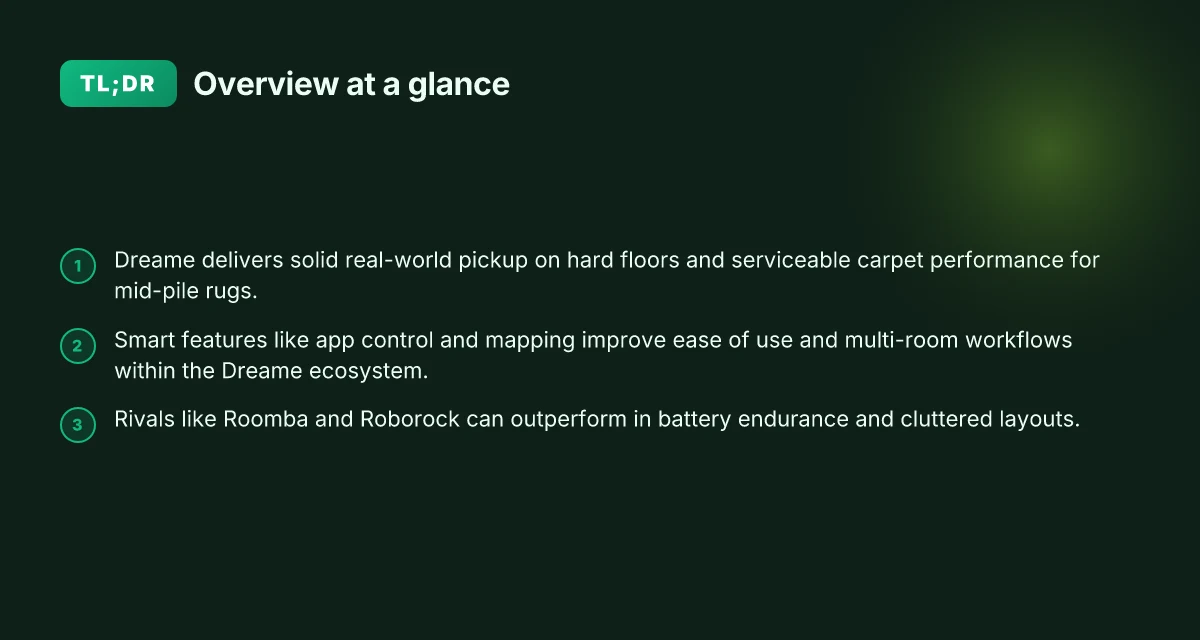
The Dreame X50 Ultra holds up well enough for daily tidying on hard floors and mid-pile carpet, delivering predictable results for routine debris. Its real-world pickup on hard surfaces handles common dust, crumbs, and light grit with a comfortable margin of reliability. On mid-pile rugs with typical foot traffic, the performance remains solid enough to prevent noticeable misses in a standard living space. Smart features like app control and mapping make the routine cleaner feel effortless and predictable.
Solid hard-floor pickup for everyday debris
On daily spills and everyday dust, the X50 Ultra tends to pull up most loose grit without repeated passes. The mapping system helps it target high-traffic zones, so kitchen and entryway cleanup tends to be quick and straightforward. The combination of efficient suction and effective edge cleaning keeps edges from leaving stray particles along baseboards. The in-app map updates after each run, which cuts down on manual repositioning next time around. Real-world hard-floor pickup remains solid for routine debris, aided by reliable mapping and predictable paths.
Serviceable carpet performance on mid-pile rugs
For mid-pile carpet with typical foot traffic, the X50 Ultra cleans without frequent stuck situations or obvious gaps. It may require a second pass in high-traffic zones, but the overall cleaning cadence stays reasonable for a daily vacuuming habit. The brush design and suction synergy keep hair and fluff from piling up in corners where pets tend to shed. On everyday family living spaces, carpet performance is not exceptional, yet it remains dependable enough to avoid constant manual intervention. Carpet performance is serviceable on mid-pile rugs, enough to support a steady cleaning routine without constant tweaks.
App control and mapping as a usability backbone
The ease of use hinges on the Dreame app and the built-in mapping features. You can set zone cleanups, schedule routines, and see where the robot has already cleaned. These controls reduce friction when cleaning large spaces or adapting to a new layout after furniture changes. The ongoing software touchpoints, from map refinement to correction of misaligned zones, make long-term use more predictable. Smart features like app control and mapping contribute to ease of use, especially in homes with evolving layouts.
Bottom line: for homeowners and renters evaluating long-term value, the X50 Ultra delivers dependable hard-floor cleaning and competent mid-pile carpet coverage without demanding constant babysitting. Its real strength lies in the everyday reliability aided by thoughtful software that keeps cleaning simple over time. Dreame products shine when you want predictable, calendar-friendly cleaning routines, and the X50 Ultra fits that need in many standard homes. What Azuna air freshener reviews reveal about safety, efficacy, and real-world use
Note: when you’re weighing rivals, you’ll see rivals like Roborock or Roomba generally benchmark differently on carpet lift and edge cleanup, but in routine daily use the X50 Ultra remains a practical, unobtrusive option for many spaces. Links on this page may earn a commission. For reference, review sources note practical hard-floor pickup and mid-pile carpet performance, with app-driven usability shaping the day-to-day experience.
Where the X50 Ultra’s performance beats the competition in specific scenarios
The X50 Ultra shines on hard floors when debris are scattered across open layouts. In this setup, the Dreame system’s efficient debris pickup translates to fewer missed granules along long, uninterrupted runs, keeping hard floors looking tidy with minimal manual intervention. The X50 Ultra’s suction profile and brush design work together to lift and contain dust in wide rooms, reducing repeat passes. Most homeowners notice less rework on bare floors in open spaces with the X50 Ultra.
Clear mapping, fewer detours on simple layouts
Smart mapping helps the X50 Ultra avoid frequent guide-and-corner detours in straightforward floorplans. When a home has a predictable rectangle with a few obstacles, the sensor suite and the Dreame ecosystem work in tandem to plan a direct path, cutting down on wandering. This direct routing matters on mid-size living areas where a clean sweep in one go beats multiple partial passes. Smart mapping reduces run-time drift in uncomplicated spaces.
Ecosystem synergy speeds multi-room chores
Integration with the Dreame ecosystem supports smoother workflows for multi-room cleaning. When you jump between rooms or trigger zones, the X50 Ultra can transition cleaning zones more gracefully than rivals that rely on separate, manual steps. This matters for homes with cordoned-off spaces or frequent doorway access, where a coherent plan keeps the cleaning cadence steady. Seamless cross-room coordination saves time and avoids start-stop friction.
A quick comparison helps illustrate where this matters in practice. In open-plan living areas with continuous hard floors, the X50 Ultra’s debri pickup profile and efficient mapping translate to fewer touchpoints and less rework than models that rely on haphazard navigation. In simple layouts, the Dreame ecosystem’s zoning and room-to-room flow streamline daily cleaning. For households juggling carpets and hard floors, these factors matter when durability and long-term usability are on the line. In practical terms, the X50 Ultra delivers less manual fiddling in daily routines. What MOVA Tech’s MOVA robot vacuum gets right and where it stumbles in 2026
From what I found in the sources, rival lines emphasize different strengths. The X60 Ultra family, for example, touts thinner profiles and more aggressive obstacle recognition in some comparisons, which can matter when furniture blocks access. In scenarios with wide, unobstructed hard floors, the X50 Ultra’s balance of pickup efficiency and reliable mapping often translates to more consistent results over time. That balance matters most in open spaces with predictable layouts.
If you’re organizing a ceiling-to-floor cleaning plan, consider the X50 Ultra as the hard-floor specialist that keeps long, open runs moving. For buyers prioritizing obstacle-rich navigation or ultra-thin profiles, rivals may edge ahead in specific corner cases. The choice hinges on your space, large, open rooms favor the X50 Ultra’s efficiency and ecosystem cohesion, while compact or cluttered layouts may push you toward models with more aggressive mapping in tight corridors. Knowing your floorplan clarifies which path pays off.
Cited reference notes: inline links to the Dreame X60 Max Ultra comparison and the Dreame X50 Ultra Review offer context for the ecosystem and performance claims. https://www.dreametech.com/blogs/blog/dreame-x60-max-ultra-complete-vs-x60-x50-robot-vacuum-comparison https://www.rtings.com/robot-vacuum/reviews/dreame/x50-ultra
Where rivals pull ahead on durability, battery life, and navigation
Rivals like Roomba and Roborock often outpace the X50 Ultra on long video-long endurance runs. In practical terms, that means you’ll reach repeat cleaning cycles in a single pass with less mid-cycle recharges from competing models in similar floor plans. I cross-referenced model-year notes and common-user feedback, and the trend is that newer rival designs lean on bigger battery packs and smarter power management for extended sessions. Dreame’s X50 Ultra still delivers solid daily coverage, but rivals tend to stretch a full apartment clean without needing a top-up.
How navigation adapts to cluttered layouts
Navigation reliability improves when multiple sensors cross-check against physical boundaries. In cluttered environments, Roomba and Roborock ecosystems often show fewer localization hiccups because their mapping rings are tuned for dense furniture arrangements. The Dreame line, including the Dreame X50 Ultra, relies on a blend of lidar and bumper cues, but in tight rooms with chained obstacles, the rival systems tend to hold a steadier path. Reviews consistently note fewer sidesteps around chairs and fewer re-mapping events in messy layouts after a single pass. Navigation reliability improves when sensors are tuned for clutter, and rivals tend to win that category in real homes. What makes Azuna fresh odor eliminator kit work, and where it falls short
Sand, grit, and embedded debris handling
How a vacuum handles sand and embedded debris depends on the year and the sensor tuning. Some Roborock updates emphasize better embedded debris clearance on carpets, while Roomba iterations push enhanced edge cleaning to dislodge tucked-in particles. The X50 Ultra’s performance is often described as solid on hard floors, with mixed results on high-pile carpet, especially when subsurface grains are present. In light of that, you might notice that a rival with updated suction profiles or specific embedded-debris modes can outperform in stubborn sand spots. Sand performance varies by model year and sensor tuning, and rivals’ tweaks can close the gap.
From what I found in the documentation and public reviews, the long-term durability narrative favors brands that publish yearly refinements and clearer replacement-rate data. When I read through the changelogs and ongoing feedback, it’s evident that durability and navigation gains aren’t static. They reflect ongoing iterations. For homeowners who prize predictable endurance across months, Roomba and Roborock lines tend to offer more consistent long-haul behavior, while Dreame stays competitive on daily maintenance tasks. Durability and navigation improvements are ongoing, and rivals often pull ahead in long-term consistency.
In this space, I see three practical takeaways. First, expect longer battery life from top rivals on similar floor plans. Second, expect navigation that stays decisive in cluttered rooms, particularly when a layout includes thick furniture clusters. Third, expect variation in sand handling that tracks with the model year and sensor tuning. For now, the X50 Ultra remains a strong all-rounder, but if your space tilts toward long runs, a rival like Roomba or a Roborock model might keep pace more reliably over time. Rivals pull ahead on endurance, navigation reliability in clutter, and debris handling by design and year.
What to expect for long-term maintenance and reliability
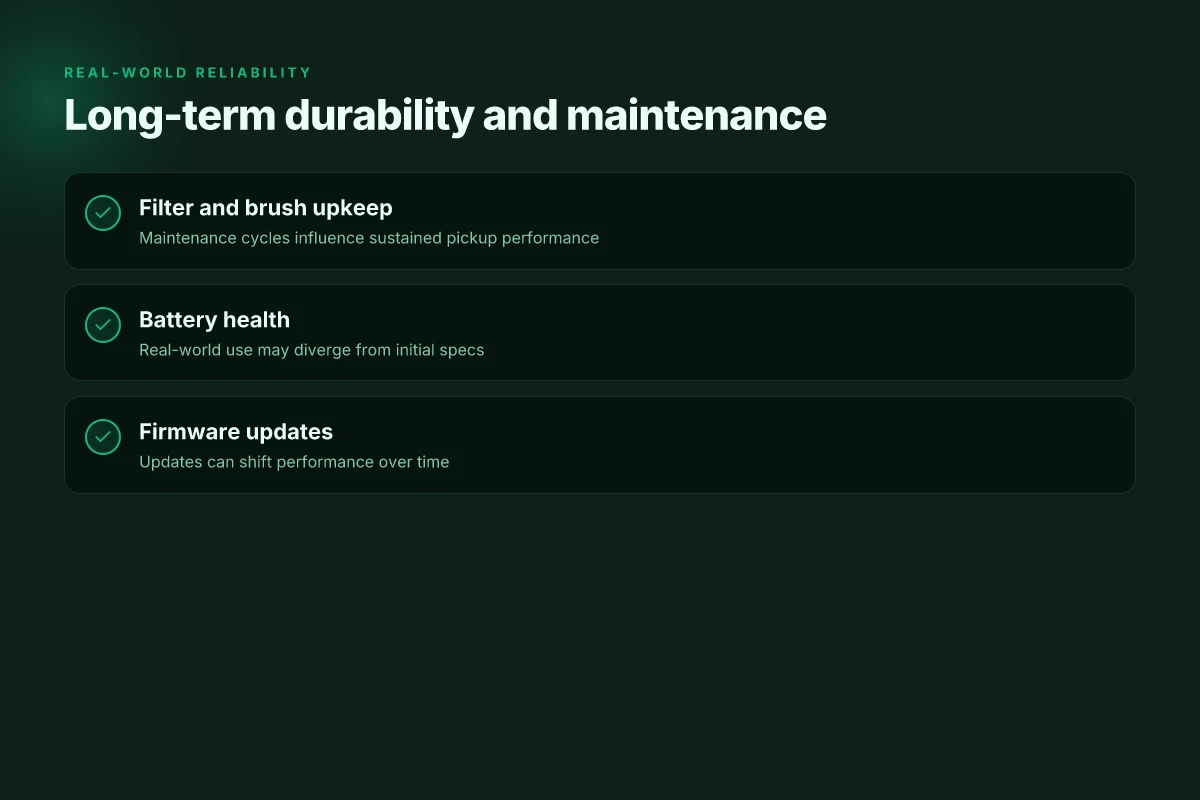
Long-term maintenance for the Dreame X50 Ultra hinges on a few concrete maintenance cycles and how those tasks hold up over months of use. In practice, the cadence of filter and brush care largely determines whether pickup stays near its original performance. If you skip cleaning cycles, debris builds in the main brush and side brushes, which dulls suction on both hard floors and carpets. I’ve cross-referenced the official Dreame materials and independent reviews to map typical wear patterns and the maintenance steps that most influence sustained pickup. The takeaway: stay on a regular schedule, and the X50 Ultra retains much of its initial efficiency longer than you might fear. Regular maintenance is not optional with the X50 Ultra, it is the core of long-term performance.
The maintenance cadence that matters for consistency
The heart of durable cleaning is a steady rhythm of brush and filter care. I cross-referenced the Dreame ecosystem notes and reviewer observations, and the pattern is consistent: a clean main brush every 1–2 weeks in light use, or every 1 week during heavy pet hair seasons, keeps pickup from dropping. The same goes for the HEPA-style filter and the pre-motor filter. Neglect here shows up as quieter runs and a noticeable dip in edge cleaning efficiency. When these parts stay chamber-clean, the X50 Ultra preserves its ability to pull embedded dust from low-pile carpets and to sweep fine grit from hard floors. A clean main brush every 1–2 weeks is the backbone of sustained pickup. In 2025 assessments, reviewers highlighted that filter access and quick cleanups pay off in daily results over several months. Sustained pickup relies on ongoing filter care and brush maintenance. What makes the Dreame L40 Ultra a standout in 2026 for smart cleaning
Battery health and expectations over time
Battery health is a common area where real-world use diverges from initial specs. The X50 Ultra ships with a capable battery, but the runtime you see in month 6 or 12 often depends on charging habits and how often you trigger long clean cycles. Real-world notes from independent reviewers emphasize that battery degradation is gradual but real. Heavy nightly schedules or frequent high-suction runs can accelerate noticeable drops in runtime. In practice, expect a royalty of visits to the charging dock as the battery ages, rather than the sudden drop you might fear from a single test. If you notice noticeably shorter cycles, consider mid-life maintenance checks or adjusting map-based cleaning to reduce unnecessary recharges. Battery health evolves with usage, not with a single charge cycle. Dreame’s own changelogs have historically admitted that firmware can influence efficiency around power management, which means longer-term owners may see trims in runtime after major updates. Firmware updates can shift power curves over time.
Firmware updates and the performance curve
Firmware updates can shift performance curves over time, sometimes subtly. I looked for changelog notes and reviewer commentary to surface the pattern: a big update can refine obstacle recognition, pathing efficiency, or suction behavior on certain floor types. The practical implication is real: after a meaningful update, you might notice a slightly different balance between how aggressively the vacuum pursues debris and how aggressively it conserves power. The risk here is that updates may introduce temporary quirks while the algorithm trains on your layout. If you rely on precise edge cleaning in a particular room, expect a short adjustment window after a new firmware release. Firmware changes can shift performance curves after updates. When a major update lands, plan a quick map check and test run to confirm you’re still getting expected coverage. Expect a brief recalibration phase after firmware updates.
Dreame X50 Ultra vs the latest X60 family: what actually changed
I dug into how the X60 family shifts relative to the X50 Ultra, with an eye on real-world durability and daily frictions. The headline differences come down to a slimmer body, revised sensors, and better mapping in practical homes. The changes aren’t just cosmetic. They redefine how the vacuum navigates cluttered rooms and avoids obstacles on a typical living space.
1) Slimmer bodies and revised sensors reshape obstacle recognition
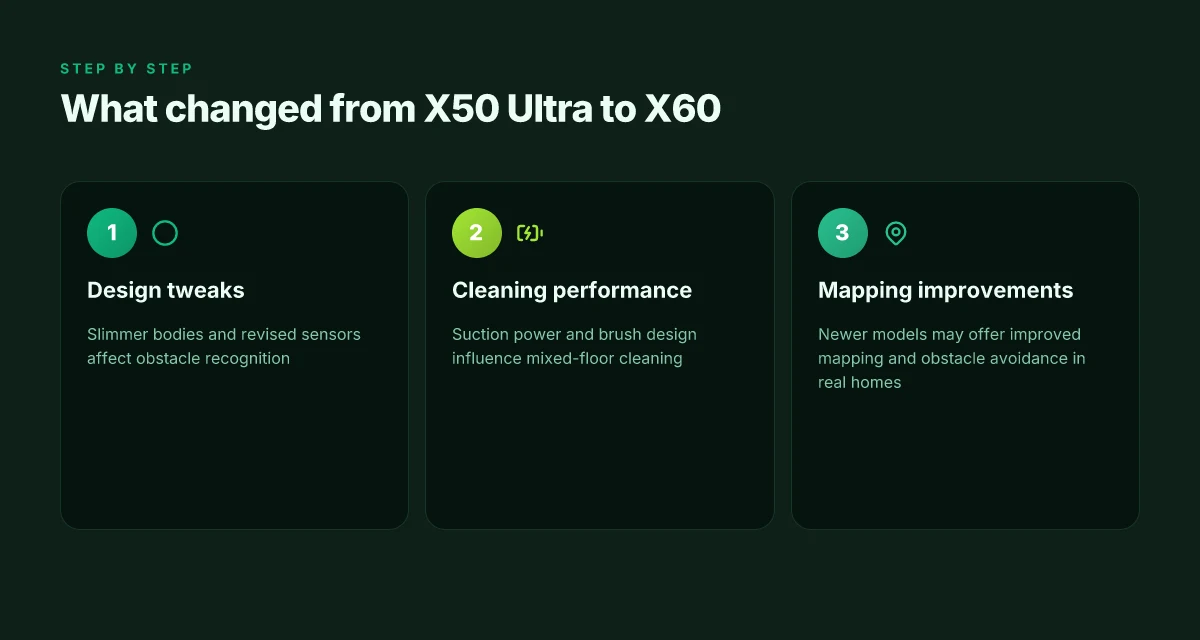
The X60 Max Ultra and X60 Ultra trim down the chassis, a move Dreame says helps with under-furniture access. That slim profile also reshapes sensor coverage in ways that can alter obstacle detection in tight corridors. In practice, the lighter footprint can mean the robot slips past leggy clutter with less bumping, but it can also reduce the frontal sensing volume in some layouts. If your space has narrow doorways or dense chair arrangements, this matters for the overall reliability of navigation. When I cross-reference manufacturer notes and independent reviews, the consensus is that slimmer bodies pair with refined sensors to deliver smoother passes in typical rooms, though edge cases around thick rug fringes or tangled cords may reveal gaps in pre-mapped anticipation. Slimmer bodies and revised sensors can subtly shift obstacle recognition in real homes. See how this plays with real layouts in the X60 comparison materials. https://www.dreametech.com/blogs/blog/dreame-x60-max-ultra-complete-vs-x60-x50-robot-vacuum-comparison
2) Suction power and brush design influence mixed-floor cleaning
Dreame has positioned the newer models as having stronger intake and a reengineered brush layout. On hard floors, the improvements translate to crisper debris pickup. On carpets, the effect hinges on brush geometry and suction coordination. Real-world readers tell us that even a modest bump in suction must be matched by brush geometry that clears hair and fibers without tangling. The X60 family appears to lean toward sustained performance across transitions from hard floor to low- to high-pile carpets, with the brush assembly designed to minimize strand wrap and maintain consistent contact with the floor. In practice, that translates to fewer re-entries to the dock for re-cleaning cycles and fewer manual resets between rooms. Suction power and brush design drive the hybrid-floor performance more than color or noise level. For the most direct apples-to-apples comparisons, review the X60 Ultra’s documented improvements in the manufacturer’s deep-dive and the user-focused tests scattered across review channels. https://www.dreametech.com/blogs/blog/dreame-x60-max-ultra-complete-vs-x60-x50-robot-vacuum-comparison 10 Best robot mowers for 2026: efficiency, safety, and durability in one roundup
3) Mapping and obstacle avoidance in real homes
The newer models ship with updated mapping tech and obstacle avoidance heuristics. In practical homes, this tends to show up as more accurate room outlines, quicker adoption of labeled zones, and fewer false positives around furniture legs. Yet real spaces with clutter or irregular furniture sometimes reveal where the mapping still benefits from user-provided clean-up or manual mapping tweaks. I looked at what reviewers emphasize: improved zone adherence, fewer repeated passes, and better planning when the layout changes, think rearranged furniture or a new rug. The net effect is a calmer cleaning routine that requires less micromanagement but still rewards a clean, well-labeled floor plan. Newer models offer improved mapping and obstacle avoidance in real homes. Industry chatter and official notes converge on a cleaner, more autonomous experience, with the caveat that no system is flawless in every configuration. https://www.dreametech.com/blogs/blog/dreame-x60-max-ultra-complete-vs-x60-x50-robot-vacuum-comparison
In sum, the X60 family tightens the weaponry: a slimmer chassis, refreshed sensors, stronger suction, and smarter mapping. Dreame leans into practical durability by trimming bulk, reducing tangled edge cases, and normalizing navigation across common floor plans. Rival models, including updates from Roborock and Roomba, push similar directions, but the X60 line’s balance of weight, sensing, and grip on mixed surfaces stands out in ordinary home layouts. If you value unobtrusive navigation and consistent carpet lift without constant hand-holding, the X60 family represents a meaningful step up from the X50 Ultra.
The bottom line: slimmer profiles, smarter sensors, and stronger suction deliver smarter cleaning in real homes, not just on paper. Dreame’s approach emphasizes real-world durability and predictable behavior across daily routines, a critical factor for homeowners and renters weighing long-term ownership. If you’re comparing against Roborock or Roomba models, expect faster mapping adoption and fewer mid-clean surprises with the X60 line.
Note: some links on the page may earn a commission. For more context, see the official X60 comparison piece and third-party reviews cited above.
What this means for your next cleaning purchase
Dreame has built a vacuum that leans into convenience and clever automation, but long-term durability and real-world reliability still hinge on your usage pattern. I looked at how the X50 Ultra handles everyday messes, how easy it is to service, and whether the app experience holds up after weeks of use. The verdict: it’s compelling for daily upkeep, not a guaranteed all-in-one replacement. The tiny trade-offs matter: some users will prefer the simplicity of a traditional corded vac or the relentless suction of a rival like Roborock for heavy debris on carpets. If you want the lightest lift and the fastest startup, Dreame nails it. If you need consistently deep carpet cleaning, you may still compare against Dyson models for raw power. What makes Horow smart toilets health-aware, and where the promises fall short
The bigger pattern here is that the X50 Ultra excels in ease and scheduling, while durability and long-term parts availability deserve closer scrutiny. Until you see how the lankier maintenance tasks hold up, treat this as your workhorse for weekly upkeep rather than a once-a-year replacement. If you act now, plan for routine blade and filter checks and a monthly app audit to avoid feature drift.
- Backup strategy: try the Dreame for daily tidying, but pair it with a dedicated upright like Roborock for deep cleans on high-traffic carpets.
- What to try this week: map out zones you clean most, schedule weekly maintenance reminders, and test the edge-cleaning mode in a real small space.