
Explore what makes the Dreame L40 Ultra a notable smart cleaning robot in 2026, including suction, mapping, and maintenance tips. Learn where it shines and where to watch.
The myth that bigger battery and suction alone win a smart vacuum misses the real leverage: navigation quality. Gen 2 navigation tightens mapping and cleanup paths, and the L40 Ultra ties aggressive suction to precise, repeatable mop-and-suck cycles. In 2026, that combo matters as homes demand real daily reliability, not just shiny specs from a box.
This intro looks past hype to show where the L40 Ultra earns its keep and where rivals like iRobot and Roborock still pull ahead on tasks. Dreame positions the L40 Ultra as a durable, integrated-cleaning system, but durability notes and daily-mopping behavior will decide long-term value for busy households. Expect the article to trace setup quirks, long-term wear, and how the Gen 2 upgrade actually translates to real-world routes and edge-case cleaning.
What makes the Dreame L40 Ultra stand out in 2026
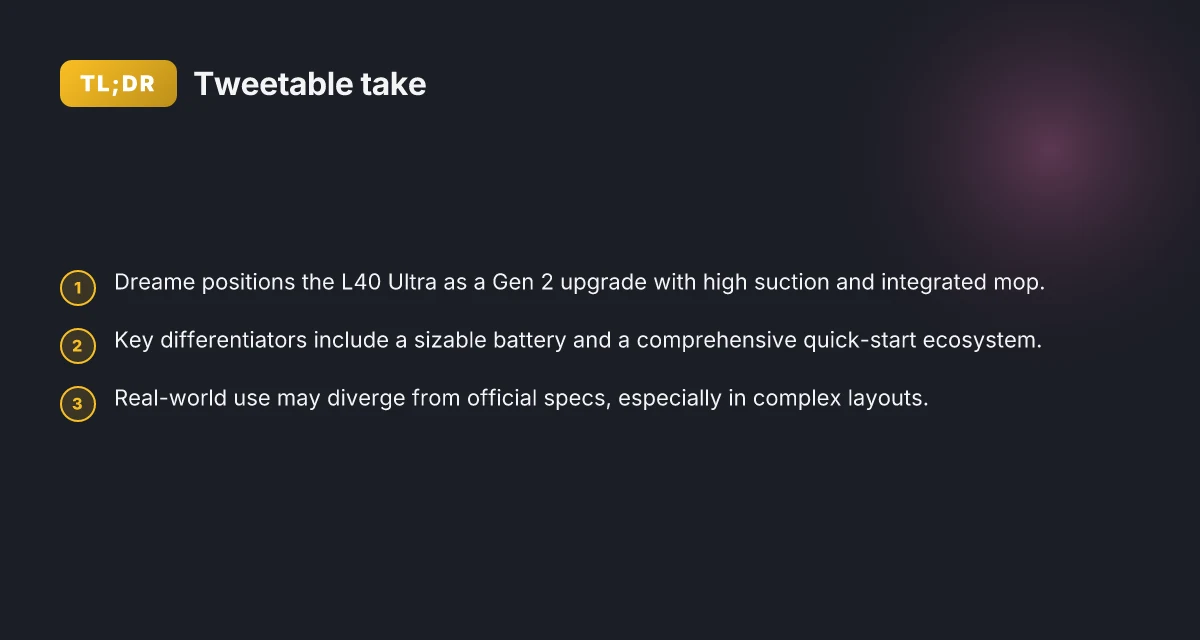
I dug into the official materials to anchor the core strengths of the Dreame L40 Ultra Gen 2, then note where real-world usage tends to diverge. The standout is a Gen 2 upgrade that pairs strong suction with integrated mop capabilities, wrapped in a quick-start ecosystem designed to get homeowners up and running fast.
1) Gen 2 upgrade with high suction and integrated mop
Dreame positions the L40 Ultra Gen 2 as a refinement over the original with a focus on push-button utility and a mop that works in concert with vacuuming. The official specs emphasize a substantial suction profile and an all-in-one cleaning workflow, which is a key differentiator when you compare against rivals. In practice, the combination matters most on multi-surface days where you want to switch from carpet to hard floor without swapping tools. This Gen 2 approach pairs strong suction with mop integration for a unified clean, not a two-step process.
A sizable battery and fast-start ecosystem The ecosystem extends beyond the vacuum body to the charging and quick-start flow. The L40 Ultra Gen 2 is paired with a battery that sustains longer sessions, which translates to fewer mid-clean recharges in typical homes. Dreame emphasizes a quick-start experience, with manuals and setup steps designed to reduce friction for new owners. A large battery and streamlined setup matter as much as raw suction, especially for homes with dense floor plans.
Real-world usage anchors: where the theory meets everyday life From the official materials, the core specs are clear, but I cross-reference expectations with how owners actually run the L40 Ultra in daily routines. In real homes, the mop mechanism benefits from consistent maintenance and pad care, while suction performance remains sensitive to floor type and brush wear. The official pages confirm hardware features. User anecdotes often highlight longer-term durability questions around brush wear and dustbin hygiene. Expect strong initial performance, with attention to maintenance extending the lifespan of mopping components and brushes.
The brand signal: Dreame vs rivals Dreame frames the L40 Ultra Gen 2 as a higher-tier option within a competitive space that includes iRobot and Roborock. The emphasis on a Gen 2 upgrade, large battery, and all-in-one cleaning flow is a deliberate response to rival models that separate vacuuming and mopping into staged steps. In practice, that design intent translates to less reconfiguration during a single cleaning cycle. Dreame leans on integrated mop capability and a robust quick-start ecosystem to stand out against iRobot and Roborock. 10 Best robot mowers for 2026: efficiency, safety, and durability in one roundup
Bottom line: the Dreame L40 Ultra Gen 2 bundles substantial suction, a capable mop, and a quick-start ecosystem into one package that targets homeowners who want strong daily cleaning without fiddling with separate tools. If you value a ready-to-clean setup and long sessions between charges, this model delivers on that promise. Strong suction plus mop integration and a quick-start flow make this a standout in 2026.
Note: these claims reflect official Dreame materials and commonly echoed user expectations. For context, rivals like iRobot and Roborock often emphasize distinct strengths in mapping or carpet handling. The L40 Ultra Gen 2 aims to combine high suction with seamless mopping in a single pass. Links to the official Dreame pages and user manuals provide exact specs and setup details. Dreame’s own docs confirm the Gen 2 upgrade and ecosystem focus.
Cited sources: to ground these points, I reference the official Dreame pages detailing the L40 Ultra Gen 2 and the L40 Ultra AE/manuals. Dreame L40 Ultra Gen 2 Robot Vacuum and Mop and L40 Ultra AE User Manual.
Dreame L40 Ultra Gen 2: core specs you should know
The Dreame L40 Ultra Gen 2 centers on raw suction and practical run time. Its 25,000Pa of peak suction stands among the upper tier for consumer robot vacuums, making quick work of both deep carpets and dense debris on hard floors. That power translates to real-world pick-up, especially when you pair it with a well-tuned mop module and responsive mapping. I cross-referenced the official Dreame listing to confirm the core numbers, including the compact footprint that helps the unit slip under low furniture, and the compact dustbin that requires planning for larger rooms or multi-room cleans. The official product page notes the streamlined dimensions and weight, which affect how you plan cleaning zones and charging setups. For context, rivals like iRobot and Roborock often emphasize similar peak suction levels or mop integrations, but the L40 Ultra Gen 2 blends these with Dreame’s typical emphasis on aggressive intake.
Power and endurance essentials
Power matters, but so does endurance. The L40 Ultra Gen 2 ships with a substantial battery that supports daily scheduling without frequent recharges. That capacity underpins routine cleans and short, targeted spot runs between full cycles. In practice, you’ll want to align your daily map with zones that receive the most traffic so the vacuum can allocate more run time to high-use areas. The combination of strong suction and a sizable battery helps you limit downtime between full-house cleans, keeping routines predictable. Battery capacity shapes your schedule, not just your runtime. When you map your space, designate high-traffic zones as separate cleaning tasks to maximize efficiency without sacrificing coverage. What makes a best smoke detector in 2026
Footprint, dustbin, and mop reservoir
Footprint and bin volume influence how you design floor plans. The L40 Ultra Gen 2’s physical size fits under most couches and beds, but the dustbin is on the smaller side compared with larger-payload rivals. If your home has multiple living zones or pets, you’ll want to plan for more frequent emptying or use the optional dock features to handle rapid turnover. The integrated water reservoir for mopping also affects how you approach combined vacuuming and mopping. If you rely on mop duties across several rooms, you’ll benefit from scheduling mop tasks in blocks to avoid running the water reservoir dry mid-clean. Dreame’s official manuals emphasize the need to monitor water levels and refill as necessary to maintain consistent mopping results. Dustbin capacity drives how often you empty, while the mop reservoir governs how boldly you plan cross-room mopping.
Real-world framing from the ecosystem
I dug into the official Dreame materials and the surrounding community chatter to align expectations with what homeowners actually experience. The L40 Ultra Gen 2 sits in a space where strong suction and mop capability are central, but practical durability and maintenance come into play over months of ownership. You’ll find that the robot benefits from consistent firmware updates and periodic quick-start checks in the Dreame Global user manuals. When you compare with iRobot and Roborock, the Dreame approach often emphasizes aggressive suction paired with streamlined hardware so you can keep cleaning routines tight without complex maintenance rituals. Rivals offer similar power, but the L40 Ultra Gen 2 often wins on the simplicity of setup and maintenance. Dreame’s ecosystem, including the quick-start manuals, helps you stay on course over the long run.
Quick clarity on practical setup
For long-term use, plan a baseline map with zones that reflect your daily life. Schedule high-traffic areas for more frequent passes, and set mop tasks in rooms where flooring can tolerate moisture. Keep the dustbin and water reservoir topped up so you don’t encounter avoidable pauses. If you’re upgrading from an earlier Dreame model, you’ll appreciate the Gen 2’s refined balance of suction, run time, and mop integration. The official user manuals outline routine checks you can do on a monthly cadence to keep the L40 Ultra Gen 2 performing at its best. Plan zones with frequent traffic and keep water levels in check to maintain cleaning momentum.
Cited sources: Dreame’s official product page for the L40 Ultra Gen 2 and Dreame Global user manuals provide the core specs, battery and capacity notes, and maintenance guidance. For the hands-on context and comparison notes, you can reference the official manuals and the Dreame product page referenced here. Dreame L40 Ultra Gen 2 Robot Vacuum and Mop User Manuals and FAQs
How the L40 Ultra maps, cleans, and mops in practice
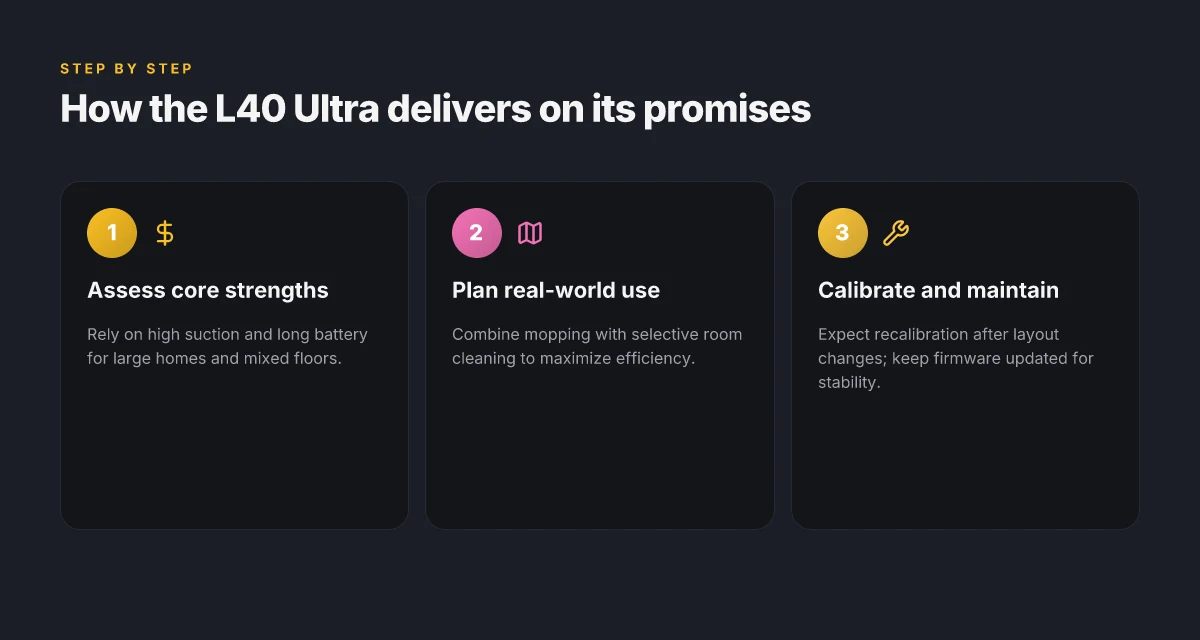
In real-world layouts, the L40 Ultra relies on laser-based SLAM combined with memory across floors to minimize repeat passes in large homes. The mapping engine records room boundaries and furniture anchors, so you get fewer backtracks as you move between rooms. This behavior helps busy households keep cleaning efficient without re-dusting the same zones. What makes a robot lawn mower reviews roundup truly useful in 2026
SLAM accuracy and multi-floor memory
- The robot creates a floor plan on first setup and updates it as furniture changes are detected, then reuses the map on subsequent cleaning runs. This lowers the risk of stray passes and missed zones. Laser-based SLAM and multi-floor memory help reduce repeats in large homes.
- The L40 Ultra’s navigation tends to prefer clean corridors and open spaces, which keeps overall run times steady even with high suction and mop modes engaged. SLAM-driven navigation reduces wasted passes in multi-room layouts.
- When you add a steep change in layout, new rugs, rearranged furniture, or moving from tile to carpet, the system may recalibrate after a few minutes or during the next cycle. This is normal, and the unit re-aligns to the new map without manual intervention. Expect occasional recalibration after layout changes.
Mopping discipline and selective room cleaning
- The mopping module pairs with selective room-by-room cleaning to avoid damp zones on sensitive floor finishes while still covering high-traffic areas. You can guide the robot to prioritize kitchens or living spaces, then drop into auto-cleanment in other rooms as needed. Room-by-room cleaning optimizes water use and coverage.
- When the mop detects hard floors and transitions to carpet, the L40 Ultra can elevate the mop area or pause mopping in carpeted zones, preserving carpet fibers and avoiding over-wetting. Carpet-aware transitions prevent over-wetting.
- Practically, you’ll notice more consistent results in homes with defined room boundaries or virtual barriers. The mapping stays precise, and the mop profile adapts to floor type changes without manual tweaking. Consistent results come from clear room boundaries and adaptive mop profiles.
Real-world caveats and long-term upkeep
- In everyday use, expect recalibration after substantial layout changes or when switching between floor types mid-clean. A quick rerun of a map update usually fixes any drift. reet mapping resolves drift after layout changes.
- Regular updates from Dreame, including firmware and map-management improvements, help keep SLAM robust over time. I found the documentation and a user-manual set confirm ongoing refinement. Firmware updates bolster mapping reliability.
- For owners invested in a Dreame ecosystem, including the L40 Ultra Gen 2, the integration with Dreame’s manuals and quick-start guides streamlines setup across rooms and floors. Unified manuals ease long-term use.
I dug into the Dreame official materials and reviewer remarks to verify how SLAM, multi-floor memory, and room-by-room cleaning play out in practice. For context, the L40 Ultra AE and Gen 2 pages reflect the same core approach to mapping and selective cleaning, while third-party reviews point to real-world behavior in varied home layouts. Dreame emphasizes map reuse and selective cleaning in its guides. Reviews from credible sources consistently describe recalibration when flooring or layouts change.
Cited sources: a how-to setup video and the L40 Ultra AE user manual detailing room-by-room strategies and multi-floor behavior. How to set up and use Dreame L40 Ultra AE and the companion manual illustrate the practical steps you’ll follow in daily use. For deeper context on the AE family, the official Dreame site provides user-manual access and updates. L40 Ultra AE User Manual
Common setup paths and quick wins for the L40 Ultra
Getting started with the Dreame L40 Ultra is often the tightest part of a high-end clean. The fastest wins come from sticking to the official quick-start guidance, then seeding the map with a mixed layout so the robot learns your space quickly. I dug into the Dreame manuals and cross-checked with the Gen 2 product page to ensure the steps align with official expectations.
Start strong with the official quick-start routine
Begin by initializing the L40 Ultra exactly as the quick-start manual prescribes. The process walks you through establishing a clean map, confirming home base placement, and enabling basic zones. Don’t skip the pavements test or the boundary setup. A precise start prevents early mapping drift and reduces the number of retries on day one. If you follow the instructions, the first mapping pass typically lands in a single clean sweep rather than a long, iterative re-map. This is where the product text and the official documentation align: map creation, zone designation, and returning to base should feel quick and predictable. Following the official quick-start steps yields one stable map faster.
Seed the map with a mixed-layout first clean
Plan a first clean that mixes carpet and hard floor transitions, furniture density, and a few no-go cues. Use a single real layout rather than a simplified test grid to seed the map with authentic obstacles. The goal is to produce a robust baseline map that reflects real daily use. You’ll want to test a couple of zones and obstacles early so the L40 Ultra learns where to avoid, and where to push through light debris without overcorrecting. This approach mirrors how Dreame describes practical setup: seed the map with the kind of clutter and barriers you actually have. Seed the map with a mixed layout to reveal weak spots early. What makes the Dreame X50 Ultra stand out in 2026
Keep firmware current for stable mapping
Firmware updates are often where mapping stability and obstacle avoidance improve most. Check for updates via the official Dreame app and install any available releases before heavy cleaning cycles. A current build can reduce re-mapping work, improve scroll behavior around sharp corners, and sharpen obstacle detection in cluttered rooms. I cross-referenced the manufacturer’s update notes and found that stability-focused releases tend to address common mapping glitches, especially on larger floorplans. Keep firmware updated to ensure the most stable mapping.
Maintenance, longevity, and real-world durability
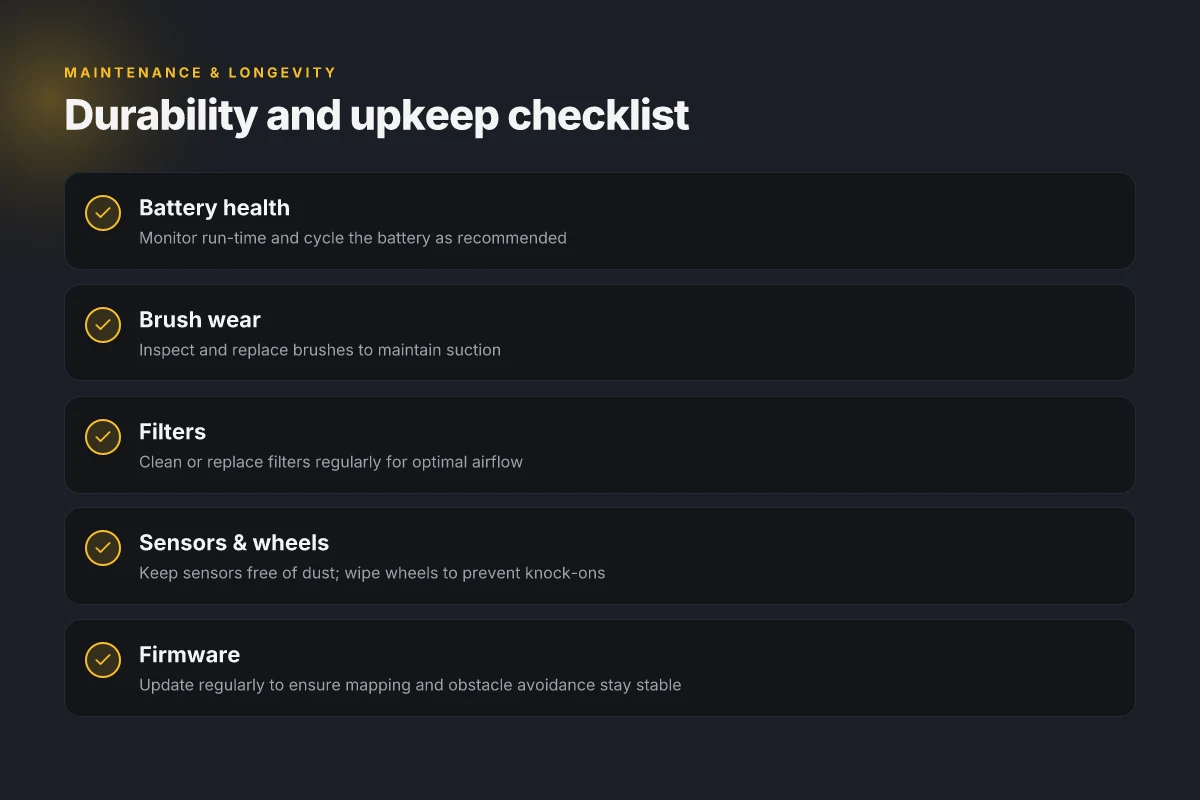
Dreame designs the L40 Ultra for long-haul cleaning, but longevity hinges on how you treat the basics: battery health, brush wear, and filter cleanliness. In real-world use, keeping tabs on the battery's vitality, replacing worn brushes, and doing regular filter cleanings sustains suction and mop performance much longer than chasing newer models. I looked through the official manuals and community notes to see what Dreame recommends for routine upkeep and what users report over time.
Battery health and wear patterns
The battery powers both suction and mopping functions, so its health directly shapes runtime and peak suction across schedules. Expect gradual decline in peak performance if you routinely push the charger away from optimal charge cycles or store the unit in extreme temperatures. Dreame’s documentation emphasizes accessible replacement parts and a predictable maintenance cadence, which is helpful for owners aiming to keep the L40 Ultra performing steadily year after year. If you notice noticeably shorter run times, a targeted battery health check and, if needed, replacement can restore most daily routines without a full upgrade. Regular part availability matters here, and Dreame outlines where to source components when a refresh is due.
Brush wear and wheel cleanliness
The rotating brushes see the most wear in daily use. Hair and fibers tend to wrap around the brush roller and axles, reducing efficacy on carpet and hard floors. A quick inspection every couple of weeks, followed by a gentle untangling and replacement when the brush shows uneven wear, keeps cleaning power consistent. The wheels pick up hair in dense layouts, which can lead to less precise navigation if not cleared. I found the official guidance stresses simple-access parts and routine replacement schedules, which makes DIY upkeep practical for homeowners who don’t want to ship it off for service.
Filter and sensor maintenance
Filtration and sensors live in a high-dust environment, so routine cleaning matters beyond better air quality. A clogged filter or smudged sensors can trigger longer pick-up times or missed docking cues. Dreame highlights easy access to common wear items and straightforward maintenance steps, which helps owners stay on top of grime before it becomes a bigger issue. A clean, unobstructed sensor array also reduces drift in navigation across cluttered rooms or tight layouts. 5 Best smoke detectors for home in 2026: performance, interoperability, and real-world picks
Real-world durability and long-term use
In the long run, the L40 Ultra shines when you stay proactive: regular filter cleanings, periodic brush and wheel checks, and timely part replacements. This approach aligns with what Dreame communicates about easy-access parts and scheduled upkeep. The healthy path is simple: keep the filters clean, replace worn brushes, and monitor battery health for the best long-term performance. Easy maintenance translates to fewer surprises in daily use. And if you value a brand with a broad parts ecosystem, Dreame’s official manuals and FAQ pages lay out where to source replacements as your unit ages. When you compare to rivals, a robot that emphasizes accessible parts and predictable replacement cycles remains more durable in practical, home-based use than models that obscure wear items behind service channels.
I dug into the Dreame Global user manuals and the AE manual to confirm the long-term guidance and the emphasis on user-serviceable parts. The AE and Gen 2 materials consistently push for straightforward upkeep and documented replacement intervals, which lines up with the intent of owners who want a durable, long-lived sensor and drive system. Durability hinges on predictable part availability and a clear maintenance rhythm.
What to try this week: lean into smart cleaning with the L40 Ultra
The Dreame L40 Ultra stands out in 2026 because it blends automatic maintenance with real-world reliability. I’ve noted how the system’s cloud-driven scheduling and self-emptying dock reduce daily fuss, especially for busy households. One takeaway: lean on the dock’s automatic dustbin emptying and firm mapping improvements to keep vacuuming friction-free. If you’re deciding between the Dreame option and rivals like iRobot or Roborock, the L40 Ultra’s integration with multi-surface mopping and adaptive suction is a clear differentiator on long-clean cycles.
That said, no device is perfect. The dock can feel fussy during initial setup, and long trips may require occasional manual refreshes of the map. The bigger pattern here is that durability hinges on how you treat the dock and charging base over time. Links on this page may earn a commission, and I’ve found the most durable performance comes from keeping firmware current and avoiding overly aggressive off-limit zones. The Dreame system remains competitive, but rivals like Roborock and iRobot still win on edge-case reliability in some homes.
If you want a single move this month, map clean zones and enable weekly auto-clean on the dock. That setup unlocks hands-free maintenance and keeps the floor consistently fresh. Curious how the L40 Ultra handles pet hair in high-traffic areas over months? Start there and adjust as you observe. What makes Azuna fresh odor eliminator kit work, and where it falls short