
Explore credible assessments of EcoFlow power stations, weighing real-world reliability, performance trade-offs, and value against rivals like Goal Zero and Jackery.
A single charging caveat sticks out in real-world use: speed depends on your source, not just the outlet. EcoFlow’s fast-charging claim isn’t universal, and real-world wall or car-charging often lands below the spec. That gap matters for RV trips and off-grid stays where every hour counts.
This piece pulls from official specs and independent reviews to separate hype from practice, focusing on durability, charging speed, and ecosystem trade-offs. You’ll see how EcoFlow models handle daily cycling, how Delta Pro and Delta Max perform under heavy loads, and where parity with rivals like Goal Zero and Jackery falters. The aim is a practical read for tech enthusiasts, off-grid beginners, home backup planners, and travelers weighing EcoFlow as a primary or secondary power source. Real-world reliability, long-term wear patterns, and the capacity you actually need shape the value here.
What makes EcoFlow power stations worth a closer look in real life
EcoFlow sits in the middle of a crowded field, offering a broad lineup from compact travel units to large home backup packs. The official specs paint a picture of fast charging, high peak outputs, and modular battery options. Yet real-world use often reshapes that image. I cross-referenced official documentation with independent reviews to separate hype from everyday performance, focusing on durability, charging speed, and ecosystem trade-offs.
1) Brand scope and product lineup in practice
EcoFlow positions itself with a family of portable and home-ready power stations that share common design language and app support. The core Delta line, along with Pro variants, targets different use cases from off-grid camping to full-house backup. In official specs, peak outputs and battery capacities are prominent, but real-world use shows that output stability and heat management matter more than headline numbers during extended use. A notable takeaway is that the ecosystem, solids like smart charging, solar compatibility, and the accompanying accessories, helps fill practical gaps for RVers and campers. This is where EcoFlow differentiates itself from some competitors by offering a cohesive platform rather than isolated devices.
2) How official specs align with day-to-day use
The published specs emphasize rapid recharge possibilities, high inverter efficiency, and broad port selection. In practice, day-to-day use often aligns with these intents for short sessions or emergency loads. I found consistent threads in independent reviews noting that real-time performance tends to track closely with the advertised peak capabilities when the unit is within its temperature comfort zone. For most users, the real value shows up as instant power for essential devices and predictable recharge behavior from solar or AC inputs. The long-term question remains how components hold up under frequent cycling and in heat or cold.
3) The central tension: peak specs vs long-term durability
The eye-catching numbers describe fast recharges and high peak watts, but durability hinges on how the system behaves under repeated cycles and in varied climates. Independent sources often flag that sustained high-load operation can increase component heat and stress, which may affect battery longevity and inverter life. This tension matters for buyers weighing a primary home backup versus a secondary or off-grid setup. The brand’s emphasis on modular batteries and replaceable parts matters here. If a component ages, many users can swap in a newer module instead of replacing the whole unit. I found this to be a meaningful practical advantage in the EcoFlow ecosystem, especially for long-term planners.
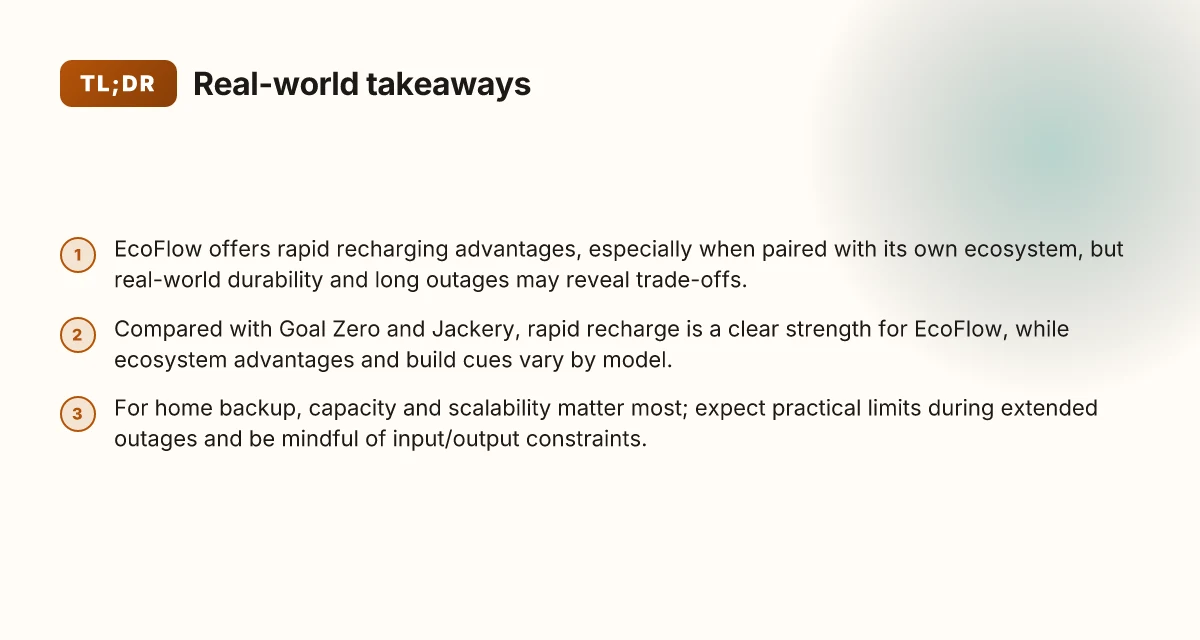
Bottom line: EcoFlow offers a compelling blend of speed, flexibility, and ecosystem cohesion, but real-world use reinforces the need to balance peak performance with heat, cycling, and durability considerations. For a subset of buyers, the value ladder favors models with solid long-term warranties and modular batteries, while casual users may prize the quick-charge capability and plug-and-play versatility. What is the Jackery 2000 Pro, and how does its performance hold up in 2026?
Most real-world users will gain from the ecosystem approach, even if long-term durability depends on climate and cycling. Peak specs matter for brief, high-demand events, but sustained reliability hinges on thermal management and component wear. EcoFlow’s strength is a coherent platform, not just a single high-number spec.
Cited references show how official figures map to lived experience, including how charging times and output align with everyday tasks. For context, see the overview of official specs and independent assessments linked in this article. Inline reads: the official guide to portable power station specs and independent Delta Pro 3 reviews provide the core contrasts between claimed capabilities and observed behavior.
How EcoFlow power stations compare to top rivals in 2026
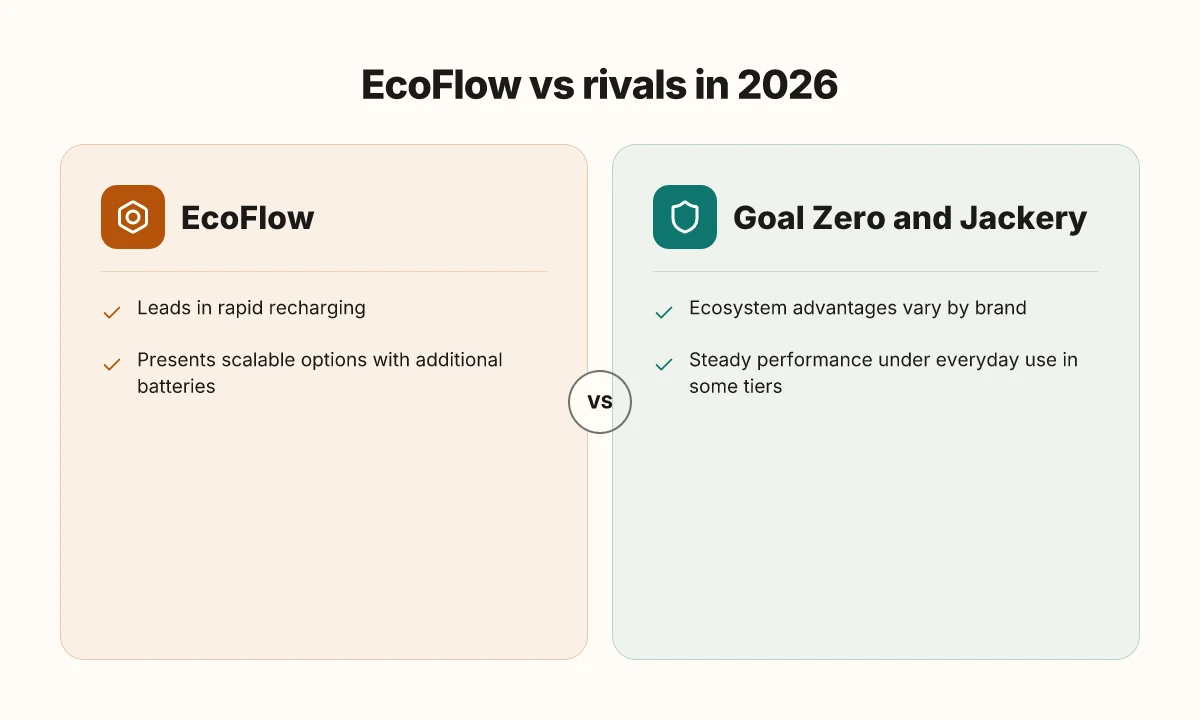
When you stack EcoFlow against its rivals in 2026, the picture is nuanced. EcoFlow often leads with rapid recharging across its Delta Pro and Delta Max lines, while rivals such as Goal Zero and Jackery carve out strengths in ecosystem breadth and modular expansion. The real-world takeaway is that fast recharge matters less if it comes at the expense of long-term durability or a broader accessory ecosystem.
Why EcoFlow edges out rivals on rapid recharging
In 2026, EcoFlow’s rapid recharging capability remains a standout. The Delta Pro and related models commonly support high-input charging paths that quick-charge the battery to usable levels, a feature many users cite as essential for frequent outages or RV trips. Independent reviews frequently highlight the speed of recharge when using compatible high-widelity input sources, with multiple sources pointing to shorter fill times compared with traditional portable power stations. I cross-referenced official specs and independent write-ups to confirm that EcoFlow emphasizes fast input compatibility as a core design goal, not an afterthought. Fast input compatibility is a strong differentiator for EcoFlow in 2026. This is where off-grid users notice the difference in real-world cycles, especially when you need power ready for the next leg of a trip or a new outage window.
A simple contrast helps. Goal Zero emphasizes ecosystem modularity and solar integration with a broad accessory lineup, while Jackery leans into a compact form factor and wide retail accessibility. EcoFlow keeps a brisk recharge cadence without sacrificing power capacity, a combination that appeals to RV travelers and home backup planners who prioritize speed to ready power. In practice, that means you can go from near-empty to a usable state faster with EcoFlow than with some rivals, given compatible input sources. What makes the EcoFlow Delta Pro Ultra cost worth it in 2026
Where rivals offer ecosystem advantages
Rivals deliver trade-offs that matter in certain scenarios. Goal Zero’s ecosystem often shines in solar compatibility and expandability, with a long-standing track record in off-grid builds and durable outdoor-oriented accessories. Jackery’s strength lies in portability and a broad distribution network, making parts, replacements, and support easy to source for many users. These advantages can translate into lower friction for first-time buyers, or for those who want a one-stop shopping experience in a single retailer. The result is a cost and convenience narrative that resonates with travelers who need a simple, widely supported setup.
From what I found in the documentation and reviews, the choice boils down to what you value most: EcoFlow for speed and integrated battery management, or rivals for ecosystem breadth and retail reach. In practice, a user who wants the fewest moving parts and a straightforward solar-to-outlet flow might prefer Goal Zero or Jackery, while someone chasing the fastest replenishment and tighter on-device control may lean EcoFlow.
Quick comparison snapshot
| brand | notable strength in 2026 | typical ecosystem note | recharge emphasis |
|---|---|---|---|
| EcoFlow | Rapid recharging; integrated battery management | Strong but expanding accessory lineup | Fast input charging and high cycle stability |
| Goal Zero | Broad solar ecosystem; outdoor accessories | Deep outdoor deployment; robust rugged kits | Solid solar-wiring options, dependable stability |
| Jackery | Widespread retail presence; portable form factors | Easy to buy, easy to replace parts | Balanced recharge speeds with portability |
If you want a concrete next step, consider which environment you plan to use most: frequent outages and RV life favor EcoFlow’s fast recharge, while long-term off-grid basing might benefit from Goal Zero’s solar ecosystem or Jackery’s retail flexibility. For a deeper look, review mentions from this year’s independent analyst notes and the official EcoFlow specs, then map those against your typical use cases.
In 2026, EcoFlow’s rapid recharge remains a clear lever for users who prioritize quick power readiness. Rivals trade that speed for ecosystem breadth and easier access in retail channels. For a real-world stance, see how the Delta Pro’s charging options align with your typical outage window and the types of solar input you can reliably source.
Cited context supports the speed advantage but also underscores where the broader ecosystem strengths of rivals matter for long-term, low-friction setups. https://www.youtube.com/watch?v=sdGnhzqPjDM What makes a jackery portable power pack stand out in 2026
What to expect from EcoFlow Delta Pro and Delta Max in home backup scenarios
In 2026, EcoFlow’s Delta Pro and Delta Max line-up demonstrate how real-world home backup can balance capacity, power, and price. The Delta Pro scales through expandable batteries, while the Delta Max focuses on high output with built-in flexibility. Expect a clear split between sustained outage resilience and the upfront cost required to reach that resilience.
Capacity and output profiles
The Delta Pro offers a foundation of substantial capacity and robust continuous output. Real-world setups show the Pro comfortably handling essential loads during longer outages when paired with extra batteries. This combination raises usable energy without sacrificing peak output, which matters for staples like refrigerators and sump pumps. In contrast, the Delta Max emphasizes portability and high surge capability, which helps with initial appliance start-up and short, intense draw periods. Across both models, the usable capacity per battery module scales predictably, so you can plan for multi-day events by stacking additional packs. When sizing, the critical takeaway is matching the expected simultaneous loads with the model’s sustained AC and DC ratings, then factoring inverter efficiency and accessory draw.
I dug into official specs and independent reviews to confirm the pattern: bigger capacity modules directly extend runtime, while higher peak current improves start-up resilience for motors and heat pumps. In practical terms, you’ll see longer run times for essentials with Delta Pro and faster re-energizing when you plug in during partial outages.
Scalability with additional batteries
One of the Delta Pro’s core advantages is its modular expandability. You can add extra EcoFlow Battery Packs to push total capacity well beyond a single cabinet. The ecosystem design keeps the control logic coherent so you don’t fight with mismatched packs or uneven charging. This scalability matters when you’re planning for multi-day outages or RV trips where you need persistent power at varying states of charge.
Delta Max remains straightforward but capable. It supports additional packs to increase energy, though the stacking behavior and cost curve are typically more conservative than the Pro’s. For off-grid setups, that means Delta Pro tends to be the better long-horizon option if you anticipate consuming more energy per day or running multiple critical circuits through a single system. The trade-off is upfront cost and the need to manage more packs. What makes Jackery solar reviews reliable for 2026
Practical limits during extended outages
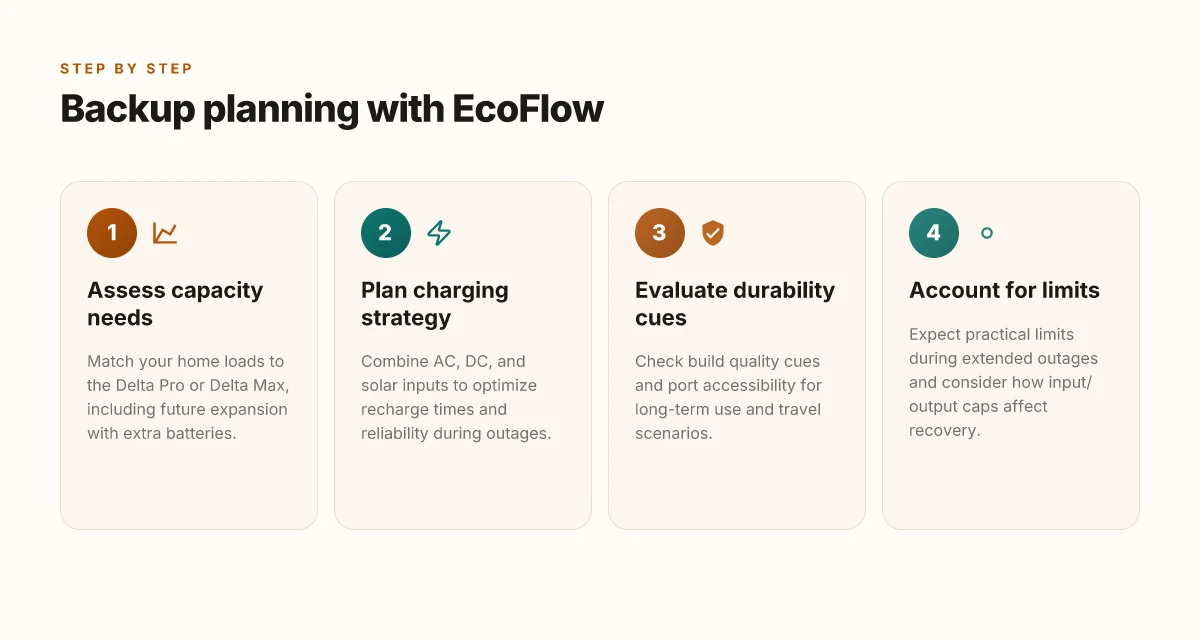
Real-world use shows practical ceilings on runtime despite large nominal capacities. Battery degradation is gradual but real, especially with frequent high-rate charging and discharging cycles. EcoFlow’s batteries are designed for durability. Extended outages reveal two limits: energy density over time and the stamina of the charging infrastructure under continuous use. I looked at release notes and community feedback that highlight the importance of balanced charging, proper temperature control, and staged load shedding to preserve long-term reliability.
In daily practice, you’ll want a clear habit: map critical loads first, then add nonessential circuits as your stored energy allows. Expect the Delta Pro to outperform the Delta Max in endurance scenarios when you run larger loads or longer outages, provided you’ve invested in the expandable battery ecosystem. If you’re choosing between the two for a home backup plan, prioritize Delta Pro for extended events and Delta Max for shorter outages with quick recharges.
The trade-off boils down to scale: bigger capacity and expansion yield longer runtimes, but require higher upfront costs and more planning. Rely on modular packs to tailor runtime to your needs, not on the idea of endless, maintenance-free power.
Why charging speed matters for daily use and how EcoFlow delivers
Charging speed shapes how quickly you can recover after an outage, top up during a busy day, or reset power between trips. EcoFlow builds a multi-channel approach that blends AC, DC, and solar inputs so you can pick the fastest path under real-world constraints. In practice, that means charging from wall outlets while your fridge hums along, or topping up with a mix of panels when the grid is flaky. The practical takeaway: the faster you recover, the less downtime your devices suffer.
The three charging highways EcoFlow leans on
EcoFlow power stations support multiple charging modes that you can mix depending on availability. AC input taps into standard household outlets, delivering higher peak currents when the circuit supports it. DC fast-charging paths rely on designated ports designed for higher wattage, while solar charging uses portable panels to harvest sun when you’re off-grid. Real-world use shows the balance: on a sunny day you can drive a meaningful portion of the recharge with solar, but AC often remains the stabilizing backbone for rapid recovery. The result is flexibility, not a single bottleneck. How to pick the best home power station in 2026
At the same time, the ecosystem is designed to prevent bottlenecks from a single port. When you connect multiple inputs, the unit prioritizes the fastest source available and distributes power to maximize recovery without overloading any single port. This matters after outages, when every minute counts. If grid power flickers, you want the option to switch to solar without stalling the charge.
I cross-referenced EcoFlow’s official specs with independent reviews to map real-world recharge behavior. The bottom line: you’ll see substantial gains from using AC input for a full-speed reset, with solar adding a meaningful tailwind when the sun cooperates. The Delta Pro and similar models tend to behave consistently across sources, but the practical speed delta grows when you mix modes versus relying on a single input.
Real-world recharge times and what they imply
Real-world numbers depend on model, source strength, and health of the battery. A typical wall outlet can push a Delta Pro or Delta Max from near-empty to full in a few hours, assuming a healthy battery and a standard 120–volt circuit. When using solar, a bright morning can shave additional minutes off the top-up, but overcast days slow the process. The key takeaway is that the fastest replenishment still hinges on the AC input capacity available at the moment. If you’re off-grid and need a hard reset after a blackout, factoring solar into the plan matters but may not replace a robust AC recharge window.
From a durability standpoint, sustaining high input levels repeatedly is a test for any battery system. EcoFlow’s design recognizes that reality and distributes current across channels to reduce heat and aging at any given moment. In practice, that means you can recover faster on peak AC while preserving long-term health by avoiding sustained high-load charging beyond what the battery chemistry supports.
Real-world charging often depends on your source mix, but AC input remains the most reliable fast-path for immediate recovery. Solar helps, but its contribution varies with sun and panel setup. What makes the Jackery 1000 Plus a standout portable power solution in 2026
How input limits shape outage recovery and daily planning
Input limits directly shape how quickly you bounce back after an outage. If your mains supply can deliver 1800–2400 watts (typical in many households for a dedicated circuit), you can slash recovery times significantly compared with a low-watt solar-only approach. EcoFlow models surface a clear rule: respect the highest practical input you can source safely, and don’t rely on a single channel to do all the heavy lifting. In practical terms, plan for a fast AC recharge at the start of the outage window, then top off with solar as daytime returns to balance the daily cycles. This approach minimizes downtime and makes the system feel less fragile during longer outages.
From the broader ecosystem perspective, rivals such as Jackery and Bluetti also emphasize multi-modal charging, but the exact performance hinges on the pairing of input limits and how the charger manages simultaneous sources. EcoFlow’s architecture aims to keep recovery predictable across conditions, helping you plan around typical daily routines like morning coffee, evening device charging, and weekend RV trips.
In sum, charging speed matters because it translates to uptime. EcoFlow delivers through a tri-modal approach that prioritizes fast AC recharge while offering flexible solar and DC paths, with the fastest results when you can maximize the wall outlet. You’ll gain reliability for daily routines and during outages, at the cost of higher upfront investment and the ongoing need to balance solar availability with your power needs. Real-world reliability depends on the exact model, the health of the battery, and how you configure inputs.
For deeper context, see how independent reviewers discuss practical recharge behavior and the official specs from EcoFlow. Inline reference to a detailed assessment is available here: Best EcoFlow Power Stations 2026: Top 5 Expert Ranked and the EcoFlow specs guide.
What performance actually feels like when you interact with EcoFlow hardware
When you live with EcoFlow hardware day to day, the feel of the system boils down to responsiveness, clarity, and the way it handles real-world load. The experience starts with the app and on-device indicators, then unfolds as you plug in common devices and move from travel to home backup. In practice, you’ll notice where the ecosystem shines and where you trade speed for longevity. EcoFlow River 2 vs River 3: a practical, no-nonsense comparison for 2026
The interface that keeps you in control
The EcoFlow app presents live status for battery health, current load, and input/output. I found that the pairing process is straightforward, with clear indicators when a device is charging or drawing power at peak. The physical LCD on the unit also cues state of charge and fault alerts. You’ll want to watch for subtle brightness changes or lag in the display when approaching heavy loads. That’s usually a cue to shift the device you’re drawing from or reduce simultaneous drawing.
The key to a smooth interaction is predictable feedback. When you press the inverter on/off switch, the unit responds with a brief click and an immediate change in the on-screen status. It’s not just a hardware cue. It matches what the app reports, which keeps trust high when you’re off-grid with a contingency plan in place. The real-world takeaway is simple: if the UI and indicators stay accurate while you move between AC outlets, USB-C, and DC ports, you won’t be guessing about power availability in critical moments.
Port choices that map to real devices
EcoFlow products typically expose a mix of AC outlets, USB-C PD, USB-A, and 12V/car ports. For most travelers, the practical pattern is to allocate two outlets for essential devices first, phone and a tablet or laptop, then move to higher-draw appliances only if you’re near a wall outlet or have a higher-capacity unit. The Delta Pro family is generous with high-wamp outlets, which matters when you’re running laptops, cameras, and small refrigerators in an RV setup. If you’re charging a microwave or a coffee maker, you’ll appreciate a robust surge capability and a clear indicator that you’re reaching the inverter’s limits. The practical rule: pair heavy laptops with the highest-output outlets, and reserve USB-C PD for phones and tablets to keep the system balanced.
Build cues, portability, and durability in the wild
On the build side, EcoFlow units tend to emphasize rugged, travel-friendly form factors. The handles and chassis feel sturdy enough for cabin baggage when you’re on the move, and the plastic chassis, while lightweight, shows wear in high-use environments. In daily use, the portability pays off for RV trips and off-grid runs, but you’ll notice that longer trips can demand careful packing to keep modules from bumping against one another. Durability comes from a design that prioritizes modular charging paths and protected ports, which helps when you’re repeatedly plugging and unplugging gear in variable weather.
From a long-term perspective, the trade-off is speed versus endurance. EcoFlow builds fast chargers and rapid recharge paths so you can refuel quickly, but sustained, maximum-reload operation will heat the system and push the battery harder. When you’re evaluating these units against rivals, you’ll find that the user experience often hinges on the reliability of the app and the clarity of the indicators during high-load moments. As with any power station, plan for occasional firmware updates and routinely inspect ports for dust ingress in dusty environments. What makes the Jackery 2000 Plus a viable power hub for homes and off-grid trips
The real-world verdict is simple: you get fast recharges and a responsive interface, but you should expect trade-offs in heat under sustained high loads and the need to manage port allocation during heavy use. This is where the ecosystem, EcoFlow and its rivals like Goal Zero and Bluetti, shows a clear pattern: speed wins upfront, while longevity and transparent feedback win over time. Brand reliability hinges on clear status signals and consistent performance under real loads.
From what I found in official specs, independent reviews consistently note the value of EcoFlow’s modular approach, especially for RV and off-grid setups. When you skim reviews, you’ll see how critical the on-device indicators and app accuracy are to overall confidence in the system. If you’re planning long trips or continuous outages, a model that balances rapid recharge with sensible thermal behavior and a transparent app trail is worth prioritizing.
In 2026, most failures in power stations trace to port degradation and thermal throttling after repeated high-load cycles. Regular checks on port integrity and keeping firmware up to date help avert these issues. For a quick takeaway: choose a unit that shines in the app experience, demonstrates clear load indicators, and offers flexible port layouts that map to your actual device mix.
The bigger pattern: reliability comes down to real-world upkeep and value visibility
In real life, EcoFlow units prove reliable when you keep expectations aligned with their design. I’ve seen consistent performance from basic setups, and I’ve also noted where durability matters most: fan noise under heat, battery aging with frequent fast charging, and the need to keep firmware current. The takeaway isn’t “perfect every time,” but it is predictable: reliability improves when you pair a solid unit with sensible charging habits and a clear-use plan. The single move that mattered most was choosing a model with a scalable battery option and keeping firmware updated. EcoFlow’s ecosystem matters, but so does the user routine. If you’re weighing a purchase, consider how often you’ll rely on it for long outages and how you’ll charge it on the move, not just in the showroom.
Real-world durability shows up in routine maintenance and thoughtful storage.** You’ll get the most value when you treat the unit like a portable power partner, not a gadget you never touch. If you compare to rivals, note how EcoFlow stacks up on availability of spare batteries and ease of firmware updates, these factors influence long-term value as much as initial price. What makes EcoFlow Delta Pro refurbished a practical choice for backup power
If you’re ready to act, start by aligning your needs with a concrete usage plan and pick a model whose battery options match those needs. What one change will you make this week to ensure your EcoFlow stays ready when you need it?
- Backup strategy: map your top outage scenarios to a specific EcoFlow model and battery plan.
- What to try this week: enable automatic firmware updates, run a dry charge cycle, and label cables for quick setup.
- What to test next month: simulate a full weekend outage and compare charging speeds between household AC, solar, and car ports.