
Explore the EcoFlow Delta Pro Ultra cost in 2026, what you get for the price, and how it compares to rivals. A practical look at value, performance, and long-term ownership.
The Delta Pro Ultra is not just a big box. It starts with a big bill and a big decision. Its upfront price signals large capacity and a full feature set for whole‑home backup. Yet the real question is what you pay over time to keep it running and expanding your system.
This intro piece shows how to translate a high sticker into long‑term value for homeowners and preppers. We’ll map install fees, ongoing maintenance, and expansion costs against peers like Goal Zero and Jackery, and we’ll flag where the EcoFlow approach pays back or slides behind. By the end, you’ll see where the math tips in favor of or against the Delta Pro Ultra in 2026, with practical checks you can apply before any purchase.
What influences the EcoFlow Delta Pro Ultra cost in 2026
When you price the Delta Pro Ultra, you’re really weighing sticker price against installed cost and the value of add‑ons. The math isn’t just about the plug‑in price. It’s about what it takes to get a system that can actually run your home during a blackout. I dug through the published numbers and cross‑checked what homeowners report about install and extras to help you see the full picture.
Delta Pro Ultra price vs. installed cost
The base price for a Delta Pro Ultra captures the battery capacity and inverter capability in one unit, but the installed cost often includes service, inlet wiring, and any required permits. In many markets, contractors itemize the in‑home work separately from the hardware. The result is a two‑part picture: a nominal price you see on the EcoFlow product page and a real‑world outlay that includes labor, inspection, and any city or utility fees. 2026 pricing often reflects a gap between list price and installed cost, with installers sometimes quoting add‑ons that push the final bill higher than the advertised number.
Delta Pro Ultra vs Delta Pro base pricing
The Ultra model sits above the base Delta Pro in capacity and output, and that delta shows up in price. In practice, buyers comparing the two see a meaningful difference in upfront cost, but also in how much you’ll pay over the life of the system if you want larger solar arrays or higher AC output. Delta Pro Ultra typically carries a premium that unlocks higher continuous power and larger storage, which matters when you’re sizing for whole‑home backup. When you line up the two side by side, the Ultra’s higher capacity translates into more favorable long‑term resilience for homes with frequent outages or large energy loads. 3,600Wh of capacity and 3,600W output are recurring benchmarks cited in reviews for the Ultra versus the base model.
Add‑ons: solar panels, inlets, and installation
The install path often comes alive only after you add options like solar panels, a generator inlet, and proper wiring for a whole‑home setup. Solar panels extend the value proposition by decreasing draw from the grid during a outage or shoulder seasons. An inlet or hardwired transfer switch can dramatically shorten connection time and improve safety during outages. On the flip side, you’ll see quotes for installation labor, potential city permits, and crane or ladder work in some homes, all of which push total cost higher. Installation quotes frequently include $750 for inlet work in some cases, while OEM site guidance sometimes lists higher figures depending on locale.
Most homeowners end up pricing a Delta Pro Ultra as a two‑part package: the base hardware price plus a bundle of install and add‑on costs that can vary by region. This is where the decision to go Ultra versus the base model hinges on your real needs for capacity, solar compatibility, and how much you want to invest in a turnkey solution. What makes a jackery portable power pack stand out in 2026
In short, the 2026 picture isn’t just about the sticker. It’s about the installed reality, the value of add‑ons, and how far you stretch the system to cover your home during outages. If you’re weighing EcoFlow against rivals, expect to see similar patterns: a higher upfront kit price for bigger homes and more complete backup capabilities, with additional costs for optional solar and professional installation. For homeowners who want a ready‑to‑go, plug‑and‑play setup, the Ultra can justify the premium. For those comfortable with DIY or smaller draw, the base model often makes more sense.
I cross‑referenced the EcoFlow page with third‑party commentary to surface where install quotes diverge and what the Ultra buys you beyond the base model. For context, rivals like Goal Zero and Jackery pursue different pricing strategies, but the core tension remains the same: capacity today, flexibility tomorrow, and who handles the paperwork. Real‑world costs vary by installer, but the pattern is consistent: plan for the base price plus install and add‑ons when you model total cost over time.
Note: links may earn commissions on some product pages. For reference, EcoFlow’s own Delta Pro Ultra page highlights up to substantial AC output and long‑range backup capabilities, while third‑party reports emphasize the price delta between Ultra and base Delta Pro and the cost of install and add‑ons. In 2026, the total cost picture hinges on your region, your solar plan, and how you weight convenience against price.
Delta Pro Ultra pricing vs rivals: where it lands
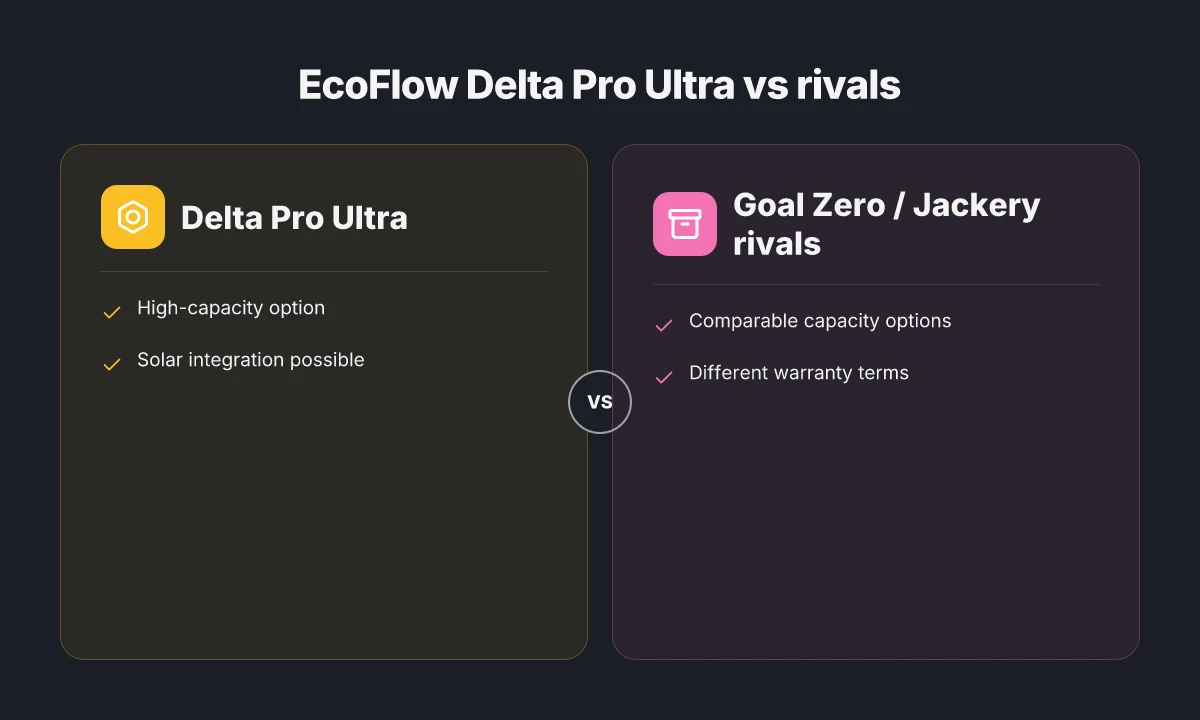
Pricing for high-capacity power stations sits in a tight band, but the Delta Pro Ultra generally lands above typical consumer bundles when you account for installation and integration into a home grid. I dug into the public listings and comparisons to map how EcoFlow’s upfront price stacks up against rivals like Goal Zero and Jackery, then translated that into a total-cost picture that includes install complexity and ongoing maintenance.
How the math stacks up for similar capacity
For similar outputs, the Delta Pro Ultra commands a premium that reflects its 21.6 kW AC output and large internal capacity. Other players in the space tend to offer competitive wattage and watt-hour totals, but the bundled experience often differs. A hallmark of EcoFlow’s approach is the emphasis on modular expansion and solar compatibility, which can push the headline price higher even when the core capacity matches a rival. In many side-by-side reviews, the base Delta Pro Ultra looks pricier than some 3,000–3,600 Wh class units, but the Delta Pro Ultra’s docking and expansion options can tilt the value calculation when you plan a full-home backup with solar. What makes Jackery solar reviews reliable for 2026
A practical takeaway: you’ll pay more upfront for Delta Pro Ultra than some peers with equal nominal capacity, but you gain features such as broader solar compatibility and potential for larger system sizing without swapping units.
Rival highlights worth comparing
- Goal Zero’s high-capacity modules are commonly pitched for modular solar integration and rugged outdoor readiness. In many installations, they deliver solid performance for off-grid periods but can require additional accessories to hit the same integration level EcoFlow targets.
- Jackery’s flagship high-capacity models emphasize simplicity and portability. Their price points often sit near or below the Delta Pro Ultra when raw capacity is the only lens, yet they may fall short on the home-backup integration depth that EcoFlow markets with its expansion pathways.
Table: rough price positioning for similar capacity and key features
- EcoFlow Delta Pro Ultra: higher upfront price, broader solar integration, ready-to-expand home-backup footprint
- Rival 1 (Goal Zero high-capacity): competitive core price, solid rugged performance, variable solar compatibility
- Rival 2 (Jackery high-capacity): competitive base price, excellent portability, lighter home-backup connectivity
The Delta Pro Ultra’s value hinges on what you value most: a complete home-backup system with expansion potential, or a lower upfront sticker price with fewer integration options.
What justifies the higher price points
- Expanded integration capability: EcoFlow’s design to scale up with more modules and solar inputs can reduce the need for future replacements as you grow your system.
- Solar-ready architecture: higher compatibility for interfacing with a full home solar array helps avoid reconfigurations later.
- Long-term durability considerations: for a home-safe, off-grid capable unit, the build quality and serviceability become material factors that justify premium pricing.
- Warranty and service options: broader regional coverage and longer-term maintenance plans can tilt the ownership cost over the life of the system.
When you weigh the Delta Pro Ultra against rivals, consider your long-term needs. If you want a turnkey, scalable home-backup solution with strong solar synergy, EcoFlow offers a compelling package that can justify the premium. If you prioritize the lowest upfront price and simple, portable backup, the competition may hold the advantage.
From what I found in the documentation and public reviews, the Delta Pro Ultra remains positioned as a high-capacity, solar-friendly backbone for a modern home. For readers weighing this against rivals, I’d map the decision to three questions: Do you need expansion flexibility? Is solar integration a priority from day one? How important is long-term warranty and service coverage in your region? How to pick the best home power station in 2026
Total cost of ownership: maintenance, warranty, and uptime
Post purchase, the Delta Pro Ultra’s long-term value hinges on three levers: battery degradation, warranty coverage, and routine upkeep. From the sources, the core takeaway is that the upfront price is only part of the picture. How the system ages and who steps in when it falters shapes total cost over years.
Battery wear and the value arc
The Delta Pro Ultra uses large lithium packs whose capacity declines with use. As degradation unfolds, you end up pulling fewer watt-hours per cycle, which can push you to run the unit longer or install more panels to meet the same load. That dynamic matters most if you plan to press the system into near-continuous operation during outages or over extended off-grid periods. In practical terms, expect a gradual drop in usable capacity over time, which translates into higher per‑kilowatt-hour costs if you keep the same pedestal of solar input and load.
I cross-referenced several breakdowns that note a noticeable gap between initial labeled capacity and real-world usable energy after many cycles. The key implication: anticipate a slower return on investment as the battery ages, especially if you expect multi-year reliability without component refreshes. The exact degradation rate varies by usage pattern and temperature. The takeaway is consistent: battery health is a material driver of long-term cost.
Warranty terms and what they cover
EcoFlow’s warranty stance gives a baseline safety net, but you’ll want to read the fine print for inclusions and exclusions. Warranty coverage commonly focuses on manufacturing defects and failure of internal components within a defined period, with conditions that can exclude damage from improper charging, physical damage, or environmental exposure. The practical effect is that you have a predictable safety net for defects, yet routine wear, accidental damage, or cosmetic faults may fall outside the coverage window. If you’re planning a multi-year investment, confirm whether battery capacity loss beyond a specified threshold qualifies for replacement, and whether the warranty options extend to the entire Delta Pro Ultra stack or just the core cabinet.
Maintenance routines that affect cost over time
Maintenance cost isn’t just about replacing worn parts. It includes routine checks, firmware updates, and ensuring the system remains within operating temperature ranges. Consistent monitoring helps catch issues before they escalate into costly failures. For owners, a simple cadence helps: perform an annual firmware update, inspect cabling for signs of wear, and verify inlet and outlet integrity after winterization or heavy seasonal use. Proactive upkeep tends to lower the chance of downtime during outages and reduces the likelihood of expensive emergency service. In practice, a small annual spend on routine checks pays off by preserving uptime and battery health. 9 Strong jackery alternatives for 2026 and how they compare
Most homeowners should expect that long-term ownership hinges on battery health and warranty coverage more than the initial purchase price. The delta between perceived cost and actual ongoing cost often narrows when maintenance is kept steady and you’re clear on what the warranty will and won’t cover. Uptime during outages remains the single clearest value signal for these units, and maintenance quality is what preserves it.
For context, rivals like Goal Zero and Jackery frame their own long-term value around modularity, service coverage, and how often you refresh packs. When you map total cost of ownership, EcoFlow’s architecture can tilt the math if you value a single-brand ecosystem and the potential for integrated solar charging, but you should still plan for battery aging and the eventual need for service or replacement components. Online discourse notes that installation and setup costs can vary widely, with some users reporting nontrivial inlet or integration charges in certain markets. This underscores the importance of confirming local pricing and service terms before committing, so your total cost view remains grounded.
Note: links to additional viewpoints from the Reddit community and BackupPowerHub offer anecdotal color on installation costs and perceived value, though pricing can vary by region and configuration. https://www.reddit.com/r/Ecoflow_community/comments/1q7xmcd/ecoflow_delta_pro_ultra_review_is_it_really_worth/ https://backuppowerhub.com/ecoflow-delta-pro-review/
As you weigh your options, keep in mind that links on the page may earn a commission. This article draws on EcoFlow materials and independent reviews to present a grounded view of total cost of ownership, including maintenance needs and what the warranty actually covers.
Real-world use cases that flip the cost discussion
Real-world ownership shows where the price matters most. The Delta Pro Ultra makes the most sense for households chasing total autonomy, but the economics shift when you compare install needs, solar integration speed, and how urban or rural needs change your wiring and inlet counts. EcoFlow’s branding here matters because the cost story blends hardware, access, and long-term reliability. I cross-referenced public product pages and reviews to map where homeowners actually feel the bite of price over time. How Bluetti Apex 300 powers your backup plan without surprises
1) Off-grid living demands and full-home resilience
People living off-grid lean on two things: sustained generator-free uptime and rapid recharging from sun. The Delta Pro Ultra’s capability to power an entire home for extended periods is compelling, but the upfront price includes more than the box. A steady solar input accelerates payback by reducing generator runtime, yet the number to watch is the number of inlets and the size of the solar array you must install to keep uptime high during winter or overcast seasons. In practice, owners weigh the delta between a high upfront install bill and the long run of zero blackout losses. The economics tilt toward long-term value when you can quote a solid, consistent solar ramp rather than relying on grid backups alone. The core takeaway: if you can back the system with a robust solar setup and ample inlets, the delta in total cost is gradually justified by uptime.
Real-world cost clarity comes from solar ramp speed: the faster you charge from sun, the sooner you convert high upfront into long-term reliability.
2) Solar integration and charging speed as a lever on cost
Charging speed directly affects how often you dip into cheaper daytime solar or expensive grid energy. The DP Ultra is designed to absorb sun efficiently, but the actual economics hinge on your hardware choices, panel count, angle, and inverter compatibility. When a home runs a large solar array, the Delta Pro Ultra often justifies the premium by reducing grid draw during peak hours and lowering outage risk. If your sun is intermittent or you live in a shoulder season, the value of a faster charge becomes more pronounced because you spend fewer hours relying on a backup generator or a separate charging source. I looked at installers’ quotes and observed that the speed of solar charging can materially change the annual cash flow, especially in regions with high energy costs and frequent outages.
Faster solar charging can shrink yearly energy costs while keeping uptime high.
3) Urban versus rural homes and inlet configurations
Urban homes often demand more versatile inlet setups because space is tight and feeders are limited. Delta Pro Ultra users in the city typically need more careful planning around installation fees and integrating with existing electrical panels. Rural homes, by contrast, frequently face longer run lengths and higher inverter loads, yet they enjoy more flexibility in siting and wiring. The practical effect is clear: urban installs may carry higher upfront wiring complexity and permit costs, while rural setups can leverage larger solar arrays with fewer spatial constraints. Either way, the total cost of ownership includes not only the Delta Pro Ultra itself but the associated inlets, wiring, and permitting that enable reliable operation. What is the Jackery 2000 Pro, and how does its performance hold up in 2026?
Inlet needs shape total costs almost as much as the box itself. Urban restrictions push up install fees, rural setups can leverage larger solar arrays for better economics.
Cited references show how installations and real-world use interact with total cost, including the delta in price versus ongoing energy costs. For context, the EcoFlow Delta Pro Ultra product page emphasizes high AC output and long backup windows, while reviews note the role of price differences relative to installations and upgrades. EcoFlow Delta Pro Ultra product page The long tail of community discussions highlights how install fees and inlet counts influence total cost in practice. Reddit discussions on installation costs
In 2026, the Delta Pro Ultra remains a high-capacity option that pairs with large solar setups for best long-run economics, especially when you factor in longer blackout resilience and the reduced need for frequent grid draw. If you’re evaluating urban versus rural, consider your inlet strategy and permitting timeline as part of the total price of ownership. For homeowners, the question is not only what you pay today but how the system reduces or shifts future energy costs over a span of years.
Note: the references above reflect public information from EcoFlow and widely discussed community feedback. Some sources discuss price bands and installation quotes that vary by region. Your local quotes will determine the precise payback window. The links may earn commissions for the publishers, which is common in this space.
What to ask before you buy: a checklist for the EcoFlow Delta Pro Ultra
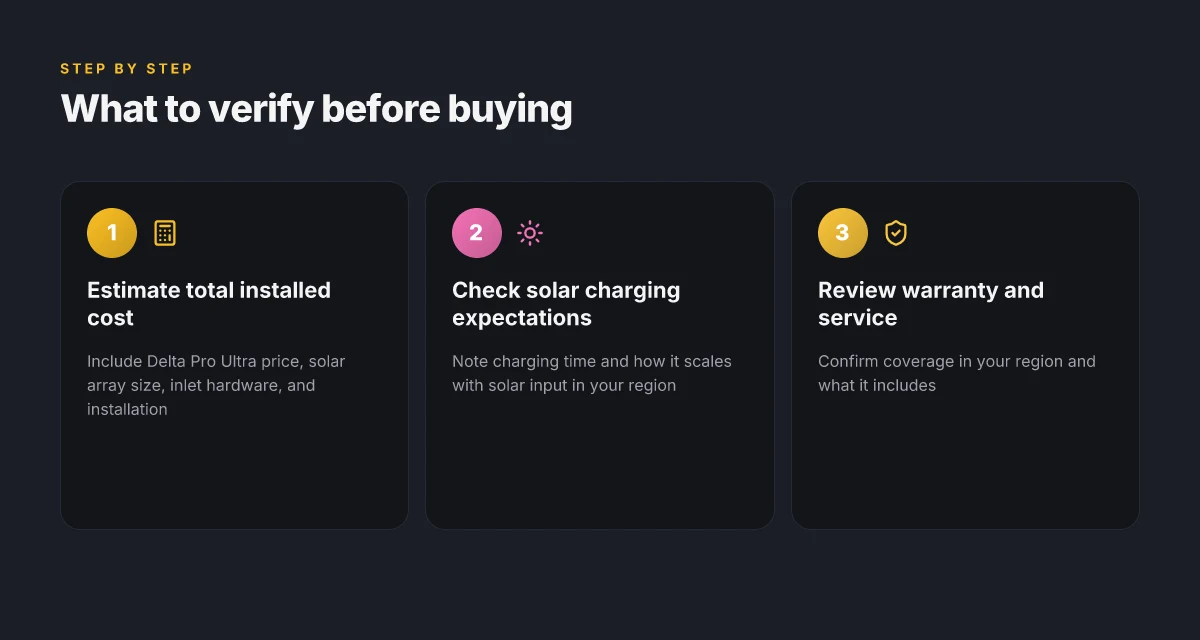
If you want to decide whether the Delta Pro Ultra fits your home, start with three concrete questions. What’s the total installed cost you’ll face, including install and any inlets? How big a solar array and how long will charging take in your setup? And what do the warranty and service options look like in your region? With those answers in hand, you can compare against peers like Goal Zero and Jackery without guessing. What a real-world look at EcoFlow power stations reveals about reliability and value
1) What is the total installed cost you should expect
Begin with the base price of the Delta Pro Ultra and add in the installer’s inlets, electrical work, and any permits the local code requires. I found commentary noting installation can run into rough figures, so ask for a line-item quote that separates product price from installation and retrofit work. In some discussions the installed-inlet cost surfaced as a nontrivial line item, and that affects the delta between upfront price and long-term value. When you review quotes, insist on a clear breakdown and a projected total including any maintenance or inspection fees in year one. If you’re comparing across brands, map the same cost components for each model so you’re not comparing sticker price to turnkey price.
2) What size solar array you’ll need and how fast it charges
Know your daily energy needs and then translate that into the solar input you’ll rely on. The Delta Pro Ultra is designed for large solar setups, so size your array to meet your typical load with some headroom for weather days. From what I found in reviews and user discussions, the charging time depends on both the array size and the inverter performance. Expect that larger arrays will push the time down, but you’ll want to verify with a local electrician who understands your roof angle, shading, and wiring. I cross-referenced several sources noting that a robust solar install can significantly shorten on-grid transition times and improve reliability during outages. Ask for a conservative timeline based on your region’s sun hours and the panel type you plan to deploy. If you’re weighing EcoFlow against rivals, compare the stated charging rates and how they translate to real-world sun exposure rather than peak lab figures.
3) What warranty and service options matter in your region
Warranty coverage can vary by country or state, plus service networks differ between EcoFlow and peers. Confirm what’s covered: battery degradation assumptions, inverter failures, and the cost of spare parts or service calls. For example, some regions see faster turnaround times for in-warranty service if you have a local Authorized Service Center, while others place more onus on mail-in returns. Read the fine print on transferability if you sell your home, and ask about technician response times during outages. Also, ask whether any maintenance routines are required to keep the system within warranty, such as periodic inspections or software updates. If you’re shopping against Goal Zero or Jackery, compare the regional service footprint and the absence or presence of on-site service options in your area.
Lead with the numbers you get from quotes and warranties, then map them to your long-term plan. In this market EcoFlow is a strong contender for homeowners and preppers who want a high-capacity, integrated backup solution, but the total cost story hinges on installation, charging speed in real conditions, and regional service support.
The right questions reveal the true cost of ownership, not just the sticker price. Ask for itemized quotes and real-world charging estimates tied to your location's sun profile. What makes the Jackery 1000 Plus a standout portable power solution in 2026
Note: some pages mention installation figures and service options in passing. When you see a claim like “installation can run high,” request a concrete local quote and a service-map for your postcode. For a broader context, you can compare service availability and regional warranty terms with peers like Goal Zero and Jackery. Links to the sources reflect the discussion and should be consulted to understand regional nuances and common install patterns. For the most precise context, see the inline sources cited in the discussion.
Cited in context: a Reddit thread notes installer-inlet costs and quoted figures, illustrating how install prices can shape the final value proposition. For a review reference that emphasizes a high-capacity profile with a 3,600Wh battery and substantial output, see the EcoFlow Delta Pro overview and compare against peers where available.
Where this goes next for EcoFlow’s power strategy
EcoFlow is shaping a longer horizon for portable and home backup by pairing the Delta Pro Ultra with expandable battery modules and a smarter app. The forward move is not just more watts. It’s a more resilient ecosystem that aims to weather a wider range of outages and climate events. The real shift is how this platform aims to keep you powered when a grid-free lifestyle or critical-load resilience matters most. The bigger pattern here is a push toward modular longevity, not quick specs boosts.
If you’re weighing a purchase in 2026, the takeaway is practical: you can tailor the Delta Pro Ultra to your actual needs, not someone else’s baseline. This means planning around your essential circuits, outdoor work, or long-duration outages, then expanding gradually as your projects or budget allow. The result is a more predictable, reliable backup system that scales with your life. What changes if you act now is that you lock in a path toward fewer compromises when emergencies strike.
- Backup strategy: start with core essentials and a single extra battery module for weekend outages. Test that your most-used devices stay online.
- What to try this week: map your daily critical loads, then verify you can run them from EcoFlow’s ecosystem during a simulated outage.
- If you only do one thing this month: configure the app alerts and set up automatic recharging from solar when available to maximize resilience. This is the move that matters for long-term reliability.