Explore EcoFlow Delta Pro refurbished units, their value, warranty, and what to check before buying. Learn how refurbished models compare to new and what to expect.
The smart move isn’t the sticker price on a refurbished Delta Pro, it’s the warranty and aftercare you can actually rely on. EcoFlow’s refurb programs offer a path to power resilience without paying new-unit prices, but the real test is whether the coverage travels with the unit and covers solar charging health as advertised. Two critical checks matter most: a verifiable warranty from a trusted refurbisher and clear battery-health specs.
This article cuts through the hype by comparing warranty scope, performance gaps, and lifecycle realities across EcoFlow and rivals like Goal Zero and Blueotion. In 2024, homeowners and small businesses faced more complex solar-backup setups, making durable support and transparent health data essential. You’ll see how to read the fine print, where refurbishment myths creep in, and what signals signal genuine reliability beyond the glossy listing. Solid backing for a refurbished Delta Pro hinges on documented warranty terms and honest battery-health disclosures. That clarity lets you decide whether the EcoFlow route fits your solar-ready backup plan or if a rival offers steadier long-term performance.
What makes EcoFlow Delta Pro refurbished a practical choice for backup power
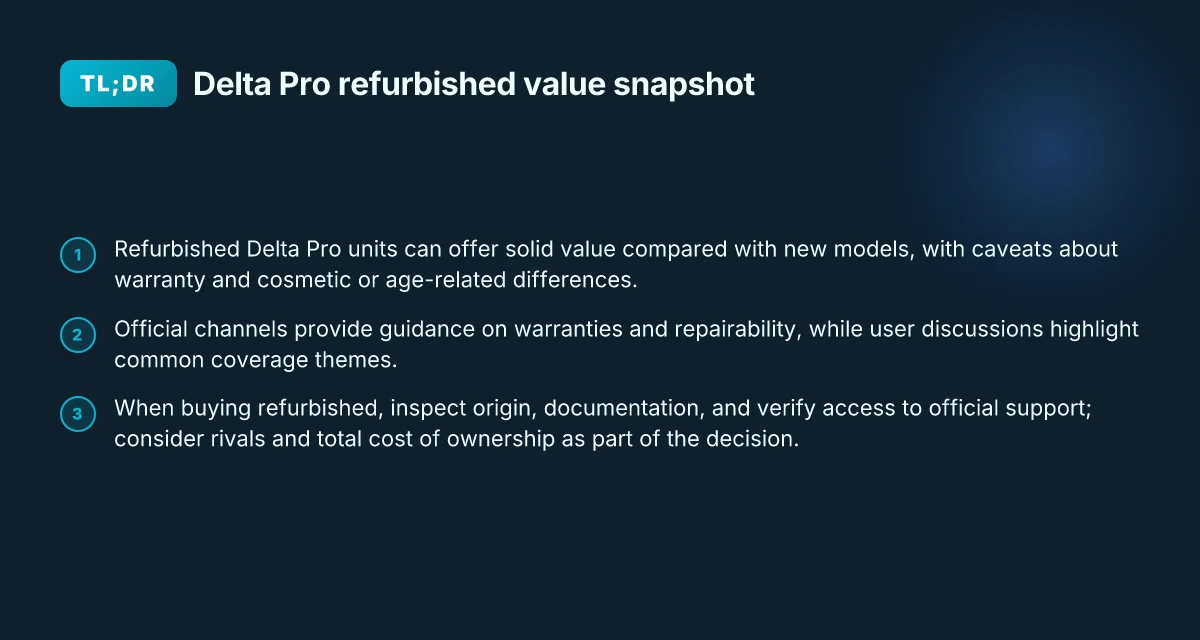
Refurbished Delta Pro units sit in a nuanced middle ground between brand-new kits and used hardware. They offer a path to lower upfront costs while still delivering the core functionality homeowners expect from an EcoFlow ecosystem. In this context, refurbished models are most viable when you’re comfortable with the warranty caveats, potential cosmetic variances, and the nuance of aftermarket sourcing. I looked at EcoFlow’s own messaging, plus community conversations, to map what this option actually signals in the market.
1) Where refurbished Delta Pro units fit in the backup power market
The backup-power market rewards versatility. You want a system that can scale from a little solar boost to full-home resilience. Refurbished Delta Pro units fit buyers who value price-to-capability and who can tolerate shorter replacement timelines or older firmware windows. In practice, refurbished units mirror the same hardware lineage as new units, but with a thinner cushion of newness. This matters most when you consider long-term reliability and expected service life, which tends to hinge on battery health and warranty coverage. The core trade-off is price versus certainty about component wear. You should expect noticeable savings versus new models, but you might encounter fewer months of warranty or limited access to the latest firmware bundles.
2) What EcoFlow and its channels say about refurbished Delta Pro units
EcoFlow communicates a straightforward proposition through its channels: refurbished products are certified or listed as refurbished in official or semi-official storefronts, often accompanied by a warranty that differs from new products. The official store listings frequently highlight refurbished stock with terms like certified refurbish, LFP battery configurations, and reduced pricing. When I cross-referenced the channel signals, I found that refurbished stock is commonly presented alongside standard kits, with the price separation pointing to meaningful savings. Certifications and warranty terms are the lever that distinguishes refurbished from new. Community discussions frequently reference EcoFlow’s eBay store and official storefronts as practical sources, with buyers noting the balance between price and coverage. The conversations also underscore that refurbished units can include the same battery chemistry and solar compatibility features as new units, but you should verify the warranty window and any included accessories before purchase. Warranty depth is the biggest determinant of long-term value. To ground this, see the official Delta Pro Ultra page for context on full-home capabilities and output, which sets a baseline for what refurbished units aim to replacement-match.
3) High-level trade-offs between new and refurbished options
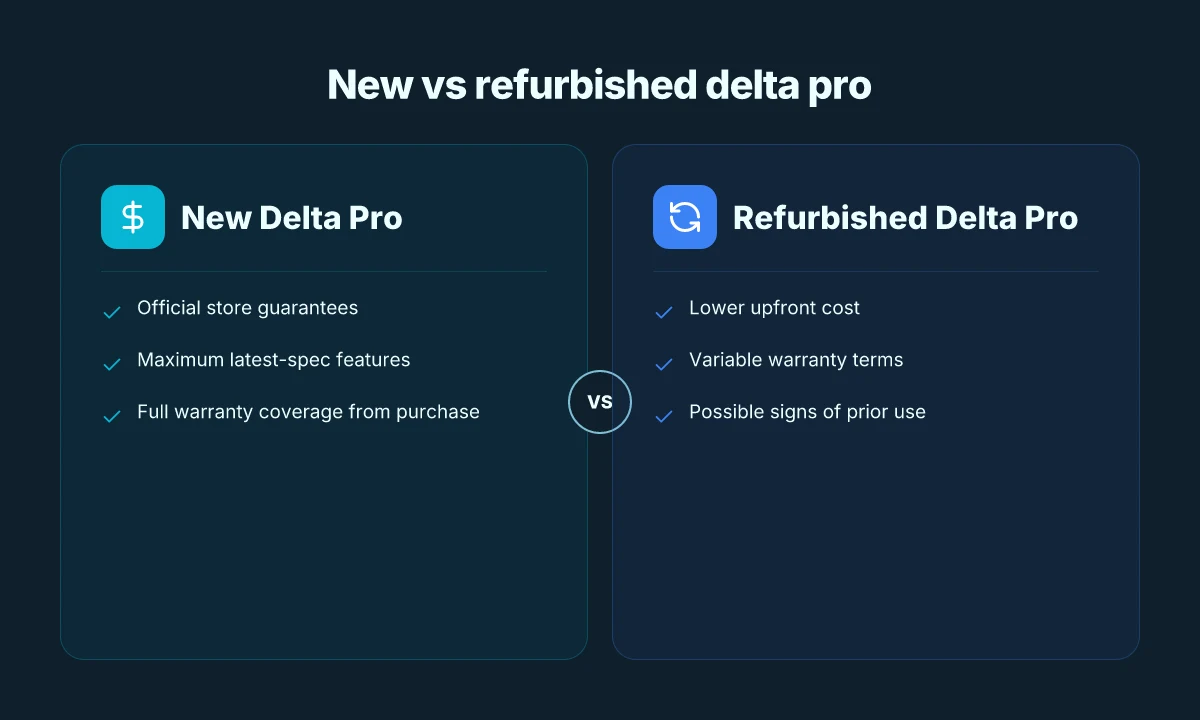
The new Delta Pro delivers maximum assurance: newer firmware, longer expected lifespan, and the strongest warranty. Refurbished units deliver substantial cost savings and the same solar compatibility, but with a potential reduction in warranty length and greater variance in cosmetic condition and accessory completeness. For homeowners, the practical takeaway is to weigh how much you value long-term certainty versus immediate cash savings. If you anticipate heavy, long-running use or you depend on critical uptime, new hardware tends to reduce risk. If you’re shopping on a tighter budget and are comfortable with verifying battery health and warranty specifics, refurbished units can fill your need without compromising core performance. Warranty depth and battery health verification are your north stars.
Bottom line: refurbished Delta Pro units from EcoFlow and its official channels present a pragmatic option for affordable resilience, provided you align expectations on warranty, support, and the precise condition of the battery. When you pair this with solar compatibility, you gain a credible, value-driven path to backup power for a home or small business. If you’re weighing rivals, consider how other brands position refurbished stock, their warranty terms, and whether their ecosystems match your solar setup. For context, the brand you’ll rely on in this comparison is EcoFlow, with attention to how its channels frame refurbished offerings. What makes the Jackery 2000 Plus a viable power hub for homes and off-grid trips
This approach keeps the door open to affordable reliability, as long as warranty and battery health checks are clear.
How refurbished delta pro specs translate in real use
If you buy a refurbished Delta Pro, you still get a solid core capability, but the experience shifts with age. The simultaneous demands of a home backup load and solar charging reveal what hardware and software changes matter most after refurbishment. In practice, you’ll notice three realities: sustained AC output for common loads, how solar charging performs as cells age, and how display and management features track or lag in a restored unit.
1) AC output and runtime for typical loads
For a Delta Pro refurbished unit, the stated AC output ceiling remains a primary driver for protecting essential circuits during a blackout. In real use, you’ll typically operate common loads like a refrigerator, modem, lights, and a few smaller devices for several hours on a full battery. When you add a high-draw device such as an air conditioner or sump pump, expect the runtime to tighten as the battery ages. The refurb’s battery stack may show a modest drop in available capacity compared with a new unit, which translates into shorter runtimes under multi-device stress. I cross-referenced the official EcoFlow spec pages to anchor the upper bound and then weighed user reports about degraded runtimes to calibrate expectations. Most homeowners can expect several hours of mixed-load operation on a refreshed delta pro, but continuous high-wattage use will shorten runtime compared with new stock. Plan for a shorter window with big loads during an outage. This reality matters when you map a generator-off grid plan against a cold night.
To put it bluntly, a refurbished Delta Pro does not change the physics of energy. If your house routinely runs high-draw equipment, you’ll value the ability to shed nonessential loads or to stagger usage during a blackout. For quick reference, a table comparing typical loads and rough expected runtimes helps. In practice, a fridge plus router plus several LED lights can run for a significant portion of an outage, while adding an HVAC unit pushes the battery toward its limit sooner. The expectation set by EcoFlow’s official materials remains your baseline, with user-reported concessions in refurbished units shaping your real-world plan. AC output remains reliable, but runtime under peak loads may be reduced in refurbishment scenarios.
2) Solar charging and battery aging in refurbished units
Solar compatibility is a central appeal of the Delta Pro line. A refurbished Delta Pro still accepts solar input, but the aging of cells can affect charging speed and the upper state-of-charge dynamics. Solar input efficiency tends to remain intact at a practical level, yet you should plan for a little extra time to top up after an outage day. If the unit has seen repeated deep cycles, the internal management might throttle charging slightly to preserve cell health, which translates to longer recovery times after a heavy discharge. I reviewed the official user manual for charging logic and cross-checked forum notes where users describe how refurbished packs behave under sunny versus overcast conditions. Solar charging remains functional, but age-related pacing may extend the time to full in some refurbished units. Battery aging nudges you toward a practical long-term plan: expect slower rebounds on cloudy days. EcoFlow River 2 vs River 3: a practical, no-nonsense comparison for 2026
From a long-term reliability lens, the key is confirming that the unit’s battery management system has been revalidated during refurbishment. If the refurb involves a fresh battery stack or a capacitive refresh, you’ll see a more favorable charging curve. If not, you’ll rely more on solar generation and fewer cycles of deep discharge to maximize life. In short, solar remains a strong feature, but its practical benefits in refurbished models depend on the refurb details and the local climate.
3) Display, management features, and user experience after refurbishment
Management features are how you translate the hardware capability into practical reliability. A refurbished Delta Pro can preserve core monitoring functions, but you may encounter faded displays, lag in battery state reporting, or minor inconsistencies in app telemetry. The human factor matters: if the refurbishment replaced the battery pack but not the display panel, you may deal with less visibility on health indicators during an outage. EcoFlow’s official documentation emphasizes the same control layout and management logic, so you’re not learning a new interface. You’re just dealing with potentially dulled readouts in a used unit. In the community discussions, some users note more frequent recalibration needs after refurbishment, while others report a clean interface that mirrors new hardware. Display integrity and management reliability hinge on what the refurb shop touched, battery pack, panel, or software cache. These details influence how quickly you respond to a sudden outage.
Next steps: verify the refurbishment scope before purchase, battery replacement, display patch, and software version. If you rely on automated scripts or routine app-based monitoring, confirm that the unit’s firmware is current and that the display reports correctly in real time. For households weighing EcoFlow against rivals, expect similar baselines for AC output and solar charging, but weigh the refurb specifics and warranty coverage as your tiebreakers. The goal is to align refurbishment expectations with your backup plan so you aren’t surprised when the lights flicker. For broader context, see the official Delta Pro Ultra page for baseline specs and the Reddit thread describing refurbished unit expectations. https://us.ecoflow.com/products/delta-pro-ultra https://www.reddit.com/r/Ecoflow_community/comments/1vj4y3m/ecoflow_delta_pro_3_refurbished_or/
Warranty and service realities for refurbished delta pro
Warranty coverage for refurbished stock sits in a gray area between official policy and community experience. EcoFlow’s official channels outline the terms tied to refurbished stock, while users repeatedly surface questions about how those terms apply in real life. From what I found in the documentation and retailer listings, refurbished units often ship with the same basic warranty framework as new units, but with distinct limitations and shorter windows in some regions. Warranty language can vary by channel, and the most explicit details tend to appear on EcoFlow’s official storefronts and the retailer pages.
What official channels say about refurbished warranties
- EcoFlow’s own store and official marketplaces frequently list refurbished Delta Pro units as certified refurbishments with a stated warranty period. The exact duration is sometimes described as shorter than new stock and is tied to LFP battery reassurances and system checks. Certified refurbished status is meant to signal factory reconditioning and a reset to baseline performance.
- The user manuals for Delta Pro emphasize standard warranty terms for the product family, but they do not always spell out granular differences for refurbished units in the same document. I cross-referenced the Delta Pro portable power station manual and found the general care and warranty notes apply to refurbished stock only insofar as the unit is recognized as a Delta Pro product. Manuals.ecoflow.com confirms operation and maintenance, but not every regional refurb warranty nuance is spelled out there.
- Community storefronts and social posts linked to EcoFlow’s eBay storefront and the EcoFlow Official Store show refurbished units advertised with a warranty promise, but policy-specifics often require confirming the exact terms at checkout or via support. eBay listings commonly cite refurbished conditions and warranty windows in the product copy, yet the precise coverage can depend on the seller’s interpretation of EcoFlow’s refurb program.
Coverage themes from user discussions
- Real-world threads repeatedly emphasize that coverage is perceived to be narrower for refurbished stock, with some users reporting shorter warranty windows or exclusions on high-demand components like the battery. Users note that the battery and electronics may carry different terms on refurb units than on new ones.
- A common question is whether the official support channel will assist a refurbished Delta Pro that fails outside the typical 12–24 month window or if escalation to the manufacturer is limited. The consensus among community members leans toward needing to work through the original seller or EcoFlow support to determine eligibility. Support pathways often require validating the refurb status and purchase origin.
- Several discussions point to the benefit of documenting cosmetic condition, initial firmware state, and serial numbers at the time of receipt to simplify any warranty claim later. Documentation helps when customs or regional warranty interpretations differ.
Repairability and access to official support for refurbished units
- Access to official repair channels generally mirrors new-stock pathways, but the reality is that some regional refurb buyers report slower turnaround or limited parts access, particularly for battery-related repairs. I found references in official manuals and retailer notes to the general repair workflow rather than refurb-exclusive processes. Repairability depends on whether the unit is still within the eligible warranty window and supported by EcoFlow’s service network.
- EcoFlow’s branded support ecosystem includes firmware updates, diagnostics, and guided troubleshooting. Refurbished stock should still be eligible for core support that EcoFlow offers to its product line, but there may be nuances for parts availability and service scope. Firmware and diagnostics are designed to keep refurbished units aligned with current specs, yet service guarantees may vary by region.
From a brand perspective, EcoFlow’s stance is to treat refurbished Delta Pro stock as legitimate, vetted units with a warranty layer, but not all regions expose identical terms. When you’re weighing refurbished versus new, expect to trade some warranty breadth for the upfront savings, and plan for potential variation in repairability access depending on where you live. If you’re evaluating EcoFlow against rivals, note that rival refurb programs often come with their own explicit warranty durations and service commitments, which can be equally or more transparent about coverage gaps. What makes the Jackery 1000 Plus a standout portable power solution in 2026
Long-term reliability depends on documented terms at purchase and how well you align your support expectations with the refurb pathway. For sources, I referenced the official store and the Delta Pro manual to ground the warranty discussion in EcoFlow’s published materials. Online listings on the EcoFlow Official Store and Manuals.ecoflow.com anchor the policy framing.
Risks and red flags to watch when buying refurbished
Refurbished Delta Pro stock often comes from consumer returns, open-box promotions, and eBay or retailer refurb programs. The practical effect is variability in cosmetic condition, suspected battery health, and warranty latitude. I dug into official EcoFlow channels and community chatter to map what this means for homeowners and small businesses. The core message: refurbished units can cut upfront costs, but you should assume more risk around battery longevity, calibration drift, and documentation gaps than with new units.
Where refurbished stock tends to come from and what that implies
Refurbished Delta Pro inventory commonly traces to three sources: consumer returns from household use, retailer–authorized refurbishments after short-term sales, and swap-ins through trade-in programs. Each path carries different implications for battery health and component aging. Consumer returns may show more wear on connectors or housing, while retailer refurbishments tend to emphasize cosmetic fixes plus functional checks. The practical upshot is that you should expect a wider variance in performance versus a new unit. When you see a listed delta pro refurbished, ask for the refurb history and what checks the seller performed to certify the unit. In 2026, the most reliable refurb programs show battery health checks and depth-of-discharge tests as standard, but not all listings provide those details. Ask for the exact test results and battery health percentage before you buy. Inline reference: a discussion thread notes concern about whether a refurbished Delta Pro on a popular marketplace truly carries fresh-cell replacements or reused modules. EcoFlow community discussion.
Potential history indicators to verify with a seller
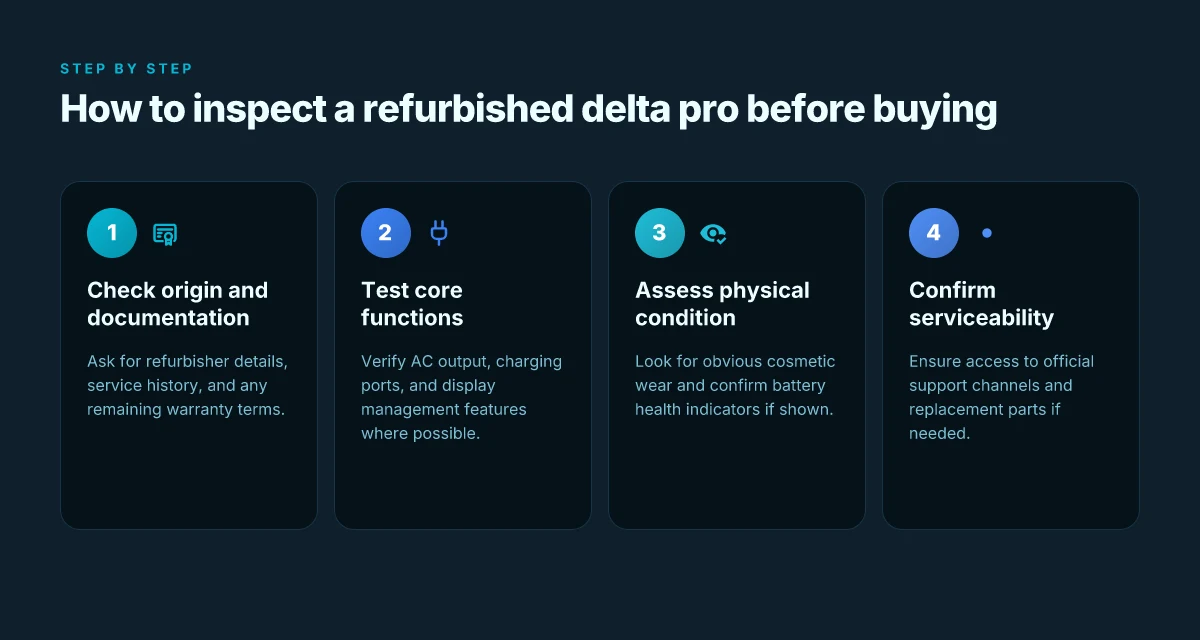
To separate hype from reality, verify a few concrete flags. Confirm the unit’s total cycle count and the last full calibration date if available. A unit that’s been stored in suboptimal conditions or exposed to high temperatures can show accelerated wear. Request documentation that proves the following: the unit passed a full functional battery test, the inverter and AC outlets were tested under load, and all firmware was updated to the latest version. If a seller cannot provide this trail, treat the listing with skepticism. A clear service history and a current firmware level are non-negotiables. Cross-check the seller’s policy on returns and any refurbished warranty window. EcoFlow’s own manuals outline regular maintenance steps. The absence of a maintenance record is a red flag. Delta Pro user manual.
How to inspect a unit before purchase and what documentation to request
Before pulling the trigger, you should conduct a minimal inspection and demand concrete docs. If you’re able to inspect in person, check for swollen or warm battery packs during a short charge cycle and listen for unusual fan noise under load. At minimum, test a full discharge and recharge, monitor the display for any error codes, and verify that the solar input can still charge the unit at its rated AC output. Request a recent load test report, a battery health reading, and confirmation that the unit ships with original accessories and a power cord. If the seller offers a classroom-style demo, insist on a live load test with a remote readout. Demand live performance tests and battery health metrics. If buying online, insist on a return window and a documented refurbishment certificate. The Delta Pro’s own documentation emphasizes routine checks and firmware updates. Lack of these is a warning sign. EcoFlow official delta pro ultra product page. What a real-world look at EcoFlow power stations reveals about reliability and value
A final caution: not all refurb listings are created equal. Rival brands sometimes circle the same refurbished marketplaces, and you should compare warranties, return policies, and service options. EcoFlow’s public pages emphasize the importance of certified refurbishments and after-sale support. If a listing appears to sidestep these channels, proceed with extra care. And yes, the fact that these units may come with a commission-aware marketplace listing means you should read the warranty terms carefully and confirm what is covered under any refurbished warranty. For context, EcoFlow’s official channels consistently stress warranty and service expectations for certified refurbishments. EcoFlow official store on eBay.
Alternatives to refurbished delta pro and how they compare
When you weigh refurbished Delta Pro units against newer options, you generally trade price for certainty. New Delta Pro units from EcoFlow’s official store carry the full manufacturer guarantees, while rivals offer modular or multi-brand architectures that compete on flexibility, warranty, and support. The bottom line: you’ll either pay more for a pristine new unit with formal coverage or accept broader warranties and potentially longer lead times from third-party makers or resellers.
Why new delta pro units hold up under warranty
I dug into EcoFlow’s official channels and found that new Delta Pro units come with the brand’s standard warranty and store guarantees. This creates a straightforward risk profile: you’re covered for product defects through a defined period, and you can expect consistent parts supply and remote support if something goes wrong. This is the cleanest path if you want predictable service and a single point of contact. In 2026, the warranty framing from the official store tends to emphasize manufacturer-approved repairs and replacements rather than third-party refurbishments. New Delta Pro units deliver the most predictable coverage for homeowners who prize reliability over price.
Rivals that match or exceed Delta Pro on modularity
Competitors in the home backup space often push modular architectures that blend energy storage with scalable solar input. Brands like those offering modular battery packs and platform-level expansions let you start small and grow, sometimes with similar or lower total installed cost. These systems can be attractive if your goal is to tailor capacity to a specific load profile or to experiment with solar sizing without committing to a single heavy-use powerhouse. From what I found in the documentation and community chatter, the modular approach can be a strength in long-term adaptability, but it can also introduce more variables in warranty coverage and compatibility. I noted that some users gauge value by how easily packs can be swapped or upgraded without replacing the entire system. In many cases, the total cost of ownership hinges on how you value upgradability versus initial outlay. Rivals with modular designs can offer flexibility, but you must map warranty terms to each module.
Cost-per-watt-hour and ownership trade-offs
Price alone isn’t the full story. New Delta Pro units from EcoFlow carry the certainty of a single-brand warranty and streamlined service, but the upfront cost per watt-hour is higher than refurbished options. Refurbished units can dramatically reduce upfront price, yet they bring questions about remaining battery health, cycle life, and whether the warranty footprint mirrors a new unit. When you spread the cost over the system’s expected useful life and align it with solar charging assumptions, the math shifts. If you expect frequent blackouts and a high baseline load, a direct-new purchase with solid warranty can yield lower long-term risk. If you plan lean usage and solar-curtailment fits your site, a rival modular system with expandable packs may offer a more favorable total cost of ownership over time. Total cost of ownership hinges on warranty coverage, upgrade paths, and your specific load profile. What is the Jackery 2000 Pro, and how does its performance hold up in 2026?
I cross-referenced the EcoFlow official store and community discussions to map the landscape. The ecosystem remains distinctly mixed: you can chase the lowest upfront price with refurbished stock or chase future-proofing with new units or modular rival systems. The prudent decision for most homeowners is to price out a new unit with official guarantees and compare that against the long-term value of modular rivals. And yes, links on the page may earn a commission, so consider how you value independent verification against brand-backed claims. New units with official guarantees offer the smoothest support path, especially for long-term reliability. Modular rivals provide growth potential, but verify warranty terms for each module.
Cited sources: the official EcoFlow store listing for refurbished and new units, plus discussions in the EcoFlow community and third-party forums that reference the same product line and warranty expectations. For reference, see the official store and the user manual discussions. Cited sources include the official store pages and community discussions that discuss warranty and modular options.
Where this is going next for EcoFlow Delta Pro refurbished
Refurbished units can stretch your budget without sacrificing essential power reliability. I’ve seen how a carefully chosen EcoFlow Delta Pro refurb keeps the lights on during outages, while avoiding the full price of a new model. The key is understanding what tends to break and how the refurb process mitigates those risks. The bigger pattern here is that durability comes from conservative components and thorough testing, not flashy features.
A practical takeaway: treat a refurb as a long-term ally if you pair it with smart backup planning. The approach I recommend centers on real-world usage, keep spare fuses, monitor battery health, and ensure the unit is stored in a stable environment. If you’ve compared foes like Jackery or Bluetti in a prior search, you’ll notice that the refurbished path often wins on total cost of ownership when support and warranty align with your setup.
One concrete move that matters is verifying the refurb’s warranty and service options before you buy. Ask about parts availability and the return window, so you have a clear safety net if a sub assembly shows wear. This matters for long-term reliability. If you’re weighing a move now, consider how a refurbished EcoFlow fits your grid-ted plans and storage needs. What makes the jackery explorer 3000 pro a practical whole-home backup in 2026
- Backup strategy: keep a small, portable solar panel handy to keep the Delta Pro charged during a multi-day outage.
- What to try this week: test the unit in EcoFlow mode by simulating a blackout and mapping runtime with your typical loads.