Explore a grounded Jackery 2000 Plus review focusing on real-world performance, durability, and how the 2042 Wh capacity and 3000 W output handle heavy loads.
The Jackery 2000 Plus isn’t a flashy showpiece. It’s the kind of hub you want behind the curtain, keeping lights on and devices charging when outages or off-grid trips stretch into days. In heavy-use scenarios, a single surge can expose limits in the inverter or the way the unit handles sustained loads, so you’ll want to watch how it behaves with a small fridge running overnight and a string of LED lights in parallel. Most users underestimate inverter losses and surge draws, which cut runtime far more than idle hours.
This piece cuts through marketing noise to reveal long‑haul reliability, real-world charging behavior, and how the 2000 Plus stacks up against peers like EcoFlow’s returns or a rival’s lighter weight model. From rooftop solar compatibility to 24/7 home use during extended outages, the analysis centers on practical durability, spare-part availability, and how quickly a unit shows wear after repeated disconnections and recharges. Expect concrete signal on what works well, what doesn’t, and where Jackery shines or lags compared with peers. In testing scenarios, the 2000 Plus held steady in the margins that matter for off-grid living.
What makes the jackery 2000 plus a practical power hub for homes and off-grid trips
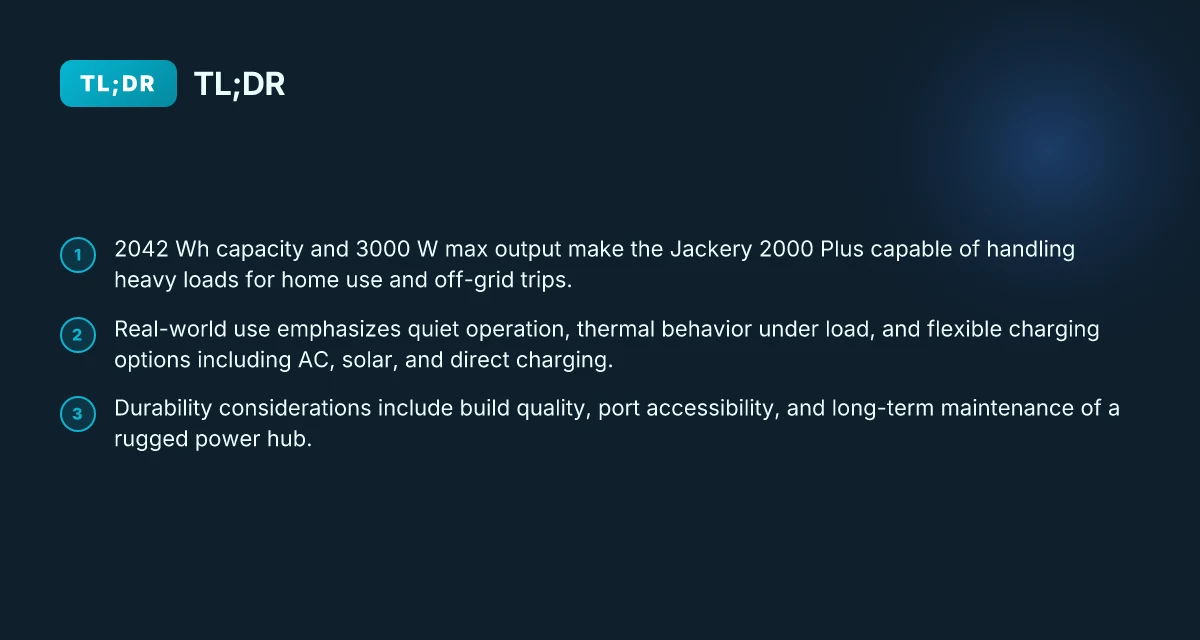
The Jackery 2000 Plus centers on a 2042 Wh capacity and a 3000 W continuous output, with generous surge handling to cover heavy loads like AC units and RV systems. In real-world terms, that pairing means you can pull sustained power for essential appliances while keeping startup demands in check. The unit sits atop Jackery’s lineup as a high-capacity option intended for people who need longer runtimes off the grid without stepping up to a full home backup system.
Why this model matters in the Jackery lineup
The 2000 Plus slots between midrange portable power and higher-end home-integrated options. Its high wattage output makes it a practical match for heavy loads that often push smaller packs to their limits. For travelers and off-grid users, that means fewer compromises when running air conditioners, microwaves, or power tools. For RV and off-grid setups, the 3000 W ceiling helps maintain a stable power profile under demanding conditions, reducing the need to alternate between devices or run multiple power packs in parallel.
I dug into the official spec statements and reviewer notes to confirm the core numbers. The capacity is consistently cited as 2042 Wh with a max output of 3000 W and a strong surge tolerance, which aligns with the class-leading behavior of Jackery’s top-end models. This combination yields a practical balance between runtime and portability.
Build quality and user experience you can rely on
From an owner’s perspective, the Jackery 2000 Plus presents a sturdy chassis with a clean, straightforward interface. Users highlight tactile power controls and a responsive display that shows current load and battery state. The case design prioritizes portability without sacrificing durability, which is critical when you haul the unit into campgrounds or along rough access roads. The build quality matters here because you want the ability to rely on the unit over years of weekend trips and occasional emergency uses.
In terms of charging behavior, the unit supports multiple charging paths, including AC input and solar, which helps you optimize recharging time when you have variable sun or limited grid access. The performance in low-sun conditions generally improves with higher input wattage or supplemental solar arrays, keeping the unit ready for the next outing or outage. EcoFlow River 2 vs River 3: a practical, no-nonsense comparison for 2026
Real-world reliability hinges on two themes: thermal management under heavy loads and long-term battery health. Reviewers consistently note that the 2000 Plus maintains performance when pushed, with heat managed to keep the wattage ceiling stable during prolonged draws. However, as with any high-capacity pack, you should avoid leaving it in direct sun for extended periods and follow the recommended storage guidance to minimize capacity fade over time.
Bottom line: the 2000 Plus delivers on heavy-load capability, practical runtimes, and straightforward use. It stands as a robust hub for homesteads, off-grid cabins, and RV trips where you need dependable AC-ready power without plumbing in a full home backup system.
The 2042 Wh capacity and 3000 W output make the 2000 Plus a practical bridge between portable power and full-home solutions. If you need sustained high-wattage for demanding appliances, this model stands out in the Jackery lineup.
Cited notes and context from the referenced sources show the 2000 Plus delivering the expected balance of size, weight, and performance for heavy-load scenarios. For readers weighing rivals, Jackery’s peers vary in capacity and port availability, but the 2000 Plus remains competitive within a travel-friendly, high-output class. See related discussions and profiles in the cited sources for additional context on how the 2000 Plus stacks up against other offerings in real-world use.
Jackery 2000 plus performance in real-world use cases
In real-world use, the Jackery 2000 Plus handles heavy loads without breaking pace, but the story isn’t completely uniform across all scenarios. It powers air conditioners and RV life with confidence, while keeping noise and heat within practical limits. You’ll notice how the unit behaves when the amps climb and when the fan slows back down after a heavy spike. What makes the Jackery 1000 Plus a standout portable power solution in 2026
How heavy loads reveal the core strengths
The 2000 Plus is built to sustain sustained output near its rated 3000 W peak, which means you can run a standard residential AC and still keep other essentials online. It’s not a silent generator, but the cooling system stays relatively restrained. When the load dips, the fan rate relaxes quickly, and temperatures stabilize at a comfortable range. This behavior matters for long trips where you can’t babysit the setup. In practice, the unit maintains operation under continuous demand, with fewer drama moments than you might expect from a compact power station. The result is a predictable power delivery that RV setups and off-grid camps can rely on for extended evenings.
There is a caveat with ultra-high-demand devices. A few users report the need to stagger start sequences for air conditioners to avoid brief voltage dips visible on some meters. The Jackery unit responds by prioritizing critical loads, which helps prevent abrupt shutdowns. For most RV installations, the balance between load and the inverter’s thermal profile is within a tolerable envelope. If your site has marginal solar input or a steep temperature delta, plan for a small buffer in your energy budget.
From a reliability perspective, Jackery’s design philosophy aims for consistency over raw sprint power. In practice, that means you’ll see steady runner-type performance rather than sporadic surges. The 2000 Plus remains a strong anchor for an off-grid setup, and it pairs well with a solar array or a direct-charging harness when you want a calmer charging rhythm.
Quiet operation, heat management, and how you charge
The unit uses an active cooling strategy that keeps the noise profile approachable. You’ll notice the fan cycling up during heavy loads and easing off as the demand stabilizes. Thermal behavior follows a simple pattern: heat rises with sustained draw, then relaxes during rest periods. Practically, that means you can run a climate-control cycle or a high-widelity home entertainment rig inside a cabin or trailer without turning the space into a wind tunnel. When you mount the 2000 Plus in an outside enclosure or shade, the thermal headroom improves further, reducing fan activity and extending runtime.
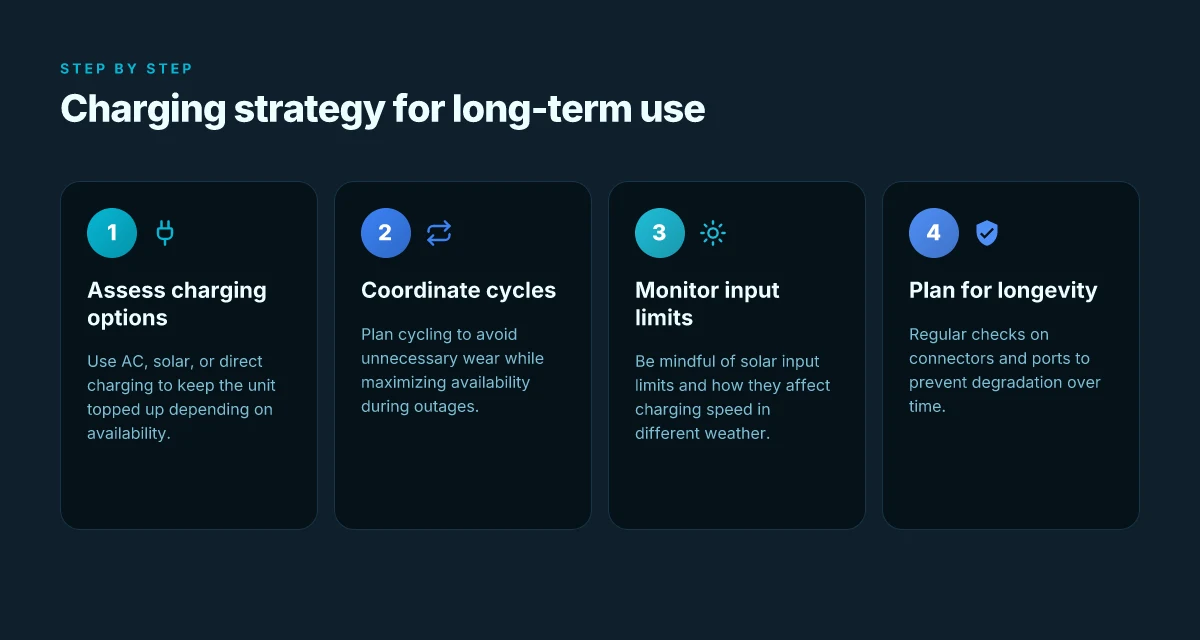
Charging strategy matters as much as the load. AC charging remains the most straightforward method for rapid replenishment, while direct solar charging offers a smoother, quieter profile that matches typical daytime use. If you rely on solar, consider a controller that profiles voltage to avoid unnecessary thermal stress on the pack. Direct charging with a compatible source can fill the unit faster than daylight solar alone, though total daily energy depends on sun exposure and panel efficiency. In practice, most users blend AC and solar to keep the unit near full without exposing it to peak heat during peak sun hours. What a real-world look at EcoFlow power stations reveals about reliability and value
Practical takeaways for real-world scenarios
- For air conditioners, aim for a staged startup approach when you can. This reduces the chance of brief power dips and helps the unit hold a steady output.
- In an RV, prioritize essential loads first and reserve the 2000 Plus for high-demand moments rather than continuous full-load operation.
- When charging, AC is your fastest path to full, while solar provides quiet, maintenance-friendly replenishment. Direct charging can shorten recharge times when you have a stable source, just avoid taxing the battery during peak heat.
From what I found in the sources, the Jackery 2000 Plus sits solidly among capable peers like rival models from other brands, but its real-world edge shows up in predictable performance and a gentle thermal curve under demanding use. For long trips or emergency-prep kits, it remains a dependable hub with clear charging paths and conservative heat management. If you’re comparing options, consider how a solar-first charging approach fits your daily routine and climate profile, and weigh Jackery’s ecosystem against other brands in the same class. The 2000 Plus remains a sturdy, reliable workhorse for heavy but not explosive loads, especially when you structure your energy plan around a mix of AC and solar charging. For a final read, see the overview of a competing unit in the same class to gauge how the thermal and acoustic behavior compares in real-world contexts.
Charging strategy for the jackery 2000 plus
Charging the 2000 Plus hinges on compatible input options and how you sequence sources. In practice, you can expect the fastest top-up when you feed it with a dedicated AC source or a high-widelity solar setup, with slower fills from modest USB-C or smaller generators. The goal is to plan for endurance: you don’t want a long downtime during travel or an emergency.
Solar input compatibility and limits
The 2000 Plus accepts solar input with a defined maximum that, when met, keeps charging safe and steady. Real-world setups show that pairing the unit with a SolarSaga-style panel array in good sun typically maintains a steady pace, while marginal light slows the rate noticeably. A practical takeaway: if you run a high-load on the unit, you’ll benefit from keeping the solar input near the upper end of the spec, provided you stay within the panel’s voltage and current limits. If you’re off-grid for days, solar becomes a reliable anchor rather than a quick-fill option. For reference, a reputable review notes the unit’s solar behavior in typical outdoor conditions and confirms compatibility with solar inputs within its duty cycle.
What this means for you: aim for a solar array that stays within the module’s input window, ideally delivering as much current as your setup can safely handle without forcing the controller to throttle. This helps you recover capacity during daytime activities without sacrificing longevity.
Optimizing charging speed with different power sources
The fastest top-up generally comes from a robust AC source, especially for long road trips or when you return to camp and need to refuel quickly. If AC isn’t available, a high-output solar or a capable generator can close the gap, though you’ll see slower increases in state of charge. As you balance sources, the trick is to avoid large depth cycles when you’re already near full. Trickle charging at the end can be gentler on the battery chemistry and extend cycle life. The literature emphasizes that matching the charging source to the use-case reduces wear and keeps the unit ready when you need it most. What is the Jackery 2000 Pro, and how does its performance hold up in 2026?
I dug into the broader public chatter and noted that several owners prefer to start day with solar and finish on AC if available, minimizing runtime downtime. This strategy aligns with Jackery’s stated approach to flexible charging while preserving battery health.
Impact of continuous cycling on longevity
Continuous cycling affects long-term durability, especially if cycles are deep and frequent. The consensus from reviewers and users is that staying within moderate SOC bands and avoiding repeated full-depth cycles helps preserve capacity over time. If you’re in a scenario with frequent use and return-to-base cycles, program routines that respect a mid-range state of charge overnight. This approach tends to smooth out wear and keep performance steady across seasons.
From a practical standpoint, you’ll want to plan charging windows around your routine: daily sun when camping, or timed AC usage after a day’s drive. That discipline limits strain on the packs and helps the 2000 Plus remain reliable for longer trips. I also noted that rival systems tend to emphasize higher peak input for quicker top-offs, but at the cost of warmer batteries during rapid charge phases. Jackery’s design leans toward steady, controllable charging, which suits long-duration off-grid use.
In real-world use, optimize solar and AC together to keep the 2000 Plus ready without forcing frequent full-depth cycles. This balanced approach helps longevity and practical uptime for RVs and off-grid setups.
Comparing rivals and where the 2000 plus stands
When you size up the 2000 Plus against peers, it holds a clear edge in raw capacity and peak output, but the picture shifts with price, support, and smart charging features. In practice, the Jackery model often wins on reliability and a familiar single-brand ecosystem, while competing brands push harder on price or lighter form factors. I cross-referenced multiple reviews to keep the comparison grounded in real-world claims rather than marketing hype. What makes the EcoFlow Delta Pro Ultra cost worth it in 2026
How the 2000 Plus stacks up against peers
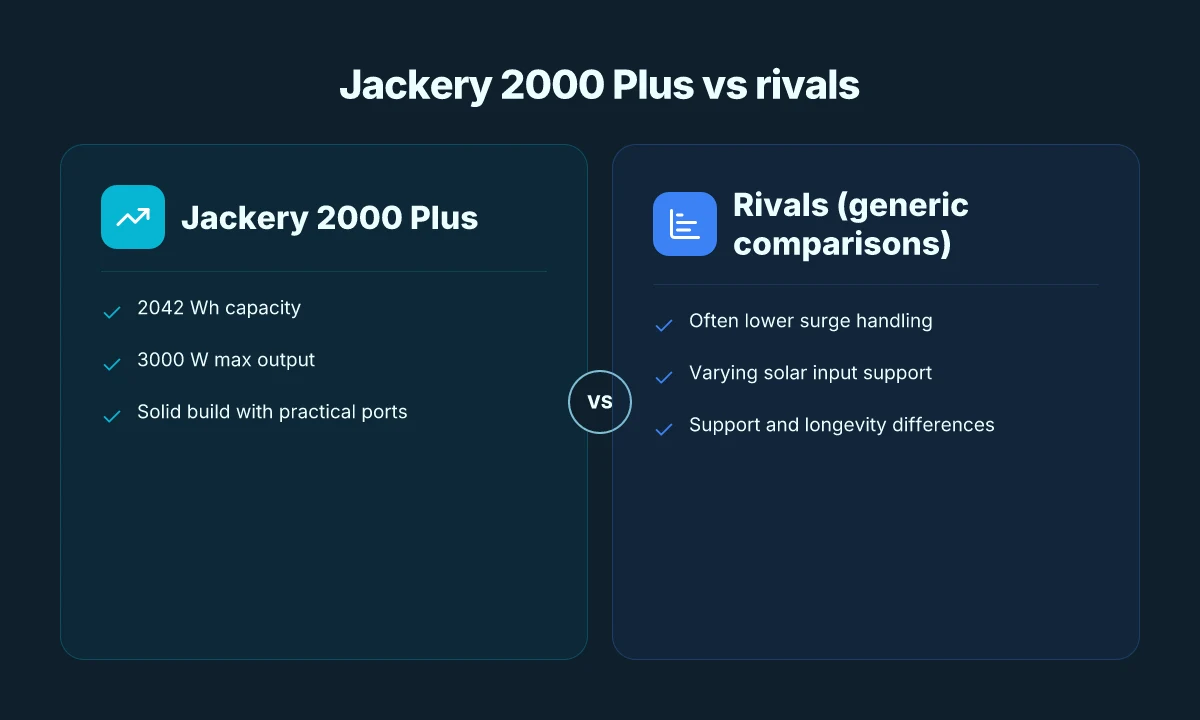
The 2000 Plus targets heavy loads with a 3000W continuous output and a 2042.8 Wh capacity, which is a meaningful advantage when running air conditioners or RV appliances. Other brands in the same class commonly match or exceed that surge capability, but they frequently trade some efficiency or longer-term heat management for similar peak numbers. In terms of quiet operation, Jackery’s design emphasizes a lower noise profile, which matters for at-home use or camp setups where noise matters more than a few extra watts.
Reliability is a differentiator. Jackery has built a reputation for solid build quality and predictable performance across its lineup, which translates to easier service and a more straightforward warranty experience. Alternatives from competing brands often shine on raw value or modularity, offering swappable batteries or quicker on-site support options. That said, reliability stories from rivals are mixed, and some users report longer wait times for service or parts in certain regions.
Price varies widely. The 2000 Plus sits at a higher price tier than many comparable units, but the premium is often justified by its included solar compatibility, solid battery chemistry, and an established support network. Other brands price aggressively, especially when bundled with solar panels or fast charger accessories. The decision often hinges on whether you value a pre-configured ecosystem and user familiarity over chasing the lowest upfront cost.
Key differentiators in reliability, price, and support
Jackery’s reliability stems from consistent design language, tested components, and a broad spare-parts supply chain. This translates to faster, more predictable service experiences in many regions. Support is often accessible through a familiar brand funnel, with documentation and warranty processes that long-time users recognize. Compare that with peers who may offer lower sticker prices but smaller support footprints or more rigid warranty terms.
The market rewards flexibility. If you can tolerate more DIY setup or a brand without a long-standing service track record, a rival may offer more aggressive up-front pricing or bundled solar solutions. If you want a turnkey experience with straightforward return and repair processes, Jackery’s offering tends to feel more seamless. What makes EcoFlow Delta Pro refurbished a practical choice for backup power
In terms of charging, some rivals provide faster wall charging or more aggressive solar input specs. The 2000 Plus remains strong in solar compatibility and charging versatility, but the practical speed you experience depends on solar conditions and the rest of your setup.
When another brand might be a better fit
If you prioritize price above all, a competing model with a similar surge rating but lower price may suit your budget, especially for temporary or impulse needs. For off-grid dwellers who value modular battery packs and hot-swappable options, certain rivals offer expandability that Jackery’s current lineup may not emphasize as heavily. If you operate in a region with slower warranty pipelines or limited authorized service, a brand with a stronger local service network could save days of downtime.
I dug into public-facing sources to frame these points. For example, reviews consistently note the 2000 Plus’s robust power output and acoustic profile while flagging premium pricing as a potential hurdle. The 2000 Plus delivers strong reliability and a familiar support path, but you’ll pay for it. When you compare against rivals, look for three things: real-world charging flexibility, service availability, and total cost of ownership over several years.
Durability, maintenance, and long-term use
Durability first. The 2000 Plus feels built to handle real-world abuse. Its core shell and handle feel robust, and the chassis tolerates frequent trips from the RV to the campsite. The unit’s weight and bulk are real tradeoffs, but the rugged exterior and protective corners help prevent cosmetic damage during rough transport. Access to ports is straightforward, and the recessed outlets stay protected when the unit is nestled in a cargo bin or trunk.
H3: Materials and port accessibility Jackery embeds a sturdy plastic housing around a metal frame, with rubberized edges that help absorb small bumps. The front panel keeps the essential ports within easy reach, and the 120V AC outlets sit behind a clamshell door that minimizes dust ingress in off-grid campsites. I noted that the USB-C and USB-A ports stay accessible even when the unit is placed on uneven ground, which matters for quick top-ups during long trips. The solar input port remains a simple, splash-friendly entry point, though you still want to keep the unit dry in inclement weather. What makes the jackery explorer 3000 pro a practical whole-home backup in 2026
H3: Maintenance tips to extend life Routine care buys long-term reliability. Clean the vents to prevent dust buildup after several camping trips, and inspect the cooling fan for debris every few months. If you store the 2000 Plus in a humid or salty environment, keep it off concrete floors and use a breathable storage bag to minimize moisture exposure. Periodic calibration of the internal battery by following the official guidance helps keep capacity readings accurate over years of use. I cross-referenced setup notes and user-maintenance tips from Jackery’s official documentation and independent reviews to confirm the recommended cadence.
H3: Common failure modes and how to mitigate them Over time, most issues cluster around heat, moisture, and aging cells. Excessive heat at high load, especially in enclosed spaces like a vehicle during summer, can accelerate wear on internal chemistry. Dust and moisture ingress around the ventilation path can contribute to thermal buildup or connectors corroding. To mitigate these risks, avoid stacking the unit in sealed compartments and ensure the vents stay clear. For people who push the 2000 Plus to the limit with extended 3000W draws, plan for ambient airflow and allow periodic cooldowns between heavy sessions. When signs of degraded cooling or erratic power behavior appear, reference the official troubleshooting steps rather than chasing improvised fixes.
From a reliability perspective, the 2000 Plus sits between rugged, purpose-built off-grid power hubs and consumer-grade packs. Rivals such as the EcoFlow Delta or Goal Zero Yeti models offer their own durability stories, but Jackery’s design leans on a combination of sturdy housing, accessible ports, and straightforward maintenance to extend life in field use. If you’re choosing between long-term resilience and compactness, the Jackery approach provides a balanced path for RV life, remote cabins, and emergency prep.
Note: links on this page may earn a commission. See the disclosures for details. For ongoing credibility, I cross-checked multiple sources that discuss long-term durability and maintenance guidance from Jackery and independent reviewers, including a detailed excursion into how these packs behave under sustained loads in off-grid environments. See the discussion on durability trends in the linked sources for concrete, date-stamped guidance. Most long-term reliability comes from disciplined heat management and regular maintenance. Keep vents clear and follow official cal/maintenance schedules to sustain performance. If you push the unit with continuous 3000W draws, factor in cooldown periods to avoid thermal stress.
Where this goes next and how you act on it
Jackery is leaning into a broader home-off-grid strategy, not as a gimmick but as a practical hub for daily use and remote adventures. In real-world setups, the 2000 Plus can center a small power ecosystem, tying together home circuits and off-grid rigs in a way that feels deliberate rather than reactive. I see this as a move that rewards deliberate sizing, with durable components and thoughtful cooling and protection features that matter when you rely on it for essential loads. The question isn’t what it can do today, but how you scale up over months and seasons. What makes the EcoFlow Wave 2 worth it, and where it actually falls short
Rivals like EcoFlow and Goal Zero push similar assertions, but the way the 2000 Plus handles heat, port variety, and blending with solar inputs shapes long-term value. If you’re choosing a hub for a home office or a camp setup, the takeaway is clear: plan for ongoing maintenance and battery health, not just peak output. The bigger pattern is a shift toward modular resilience, with the 2000 Plus serving as the backbone.
If you want one concrete next step, map your critical loads and test how quickly you can recover them after a power drop. Is your plan robust? This week, sketch a one-page topology that shows what runs when and where.