
Discover how a jackery portable power pack performs in 2026, including capacity, durability, and real-world use, with comparisons to rivals.
Jackery’s 2026 lineup often hides a quiet caveat behind glossy capacity indicators. Real-world runtimes and heat during charging reveal where the brand shines and where rivals stumble, especially in backcountry use or long home outages. Jackery stands out when you need clear readouts and dependable recharges, but you’ll want to compare against Goal Zero or Anker for broader port options and surge support.
The result matters because outdoor and travel power needs top out at two numbers: predictable runtime and safe thermal behavior. This article dives into what you can expect from Jackery in 2026, where it excels in everyday use, and where it trails competitors in sustained loads or rapid recharging scenarios. Keeping heat in check and matching real-device draw to the display matters for reliable backup power.
Jackery portable power pack in 2026: what performance actually means for you
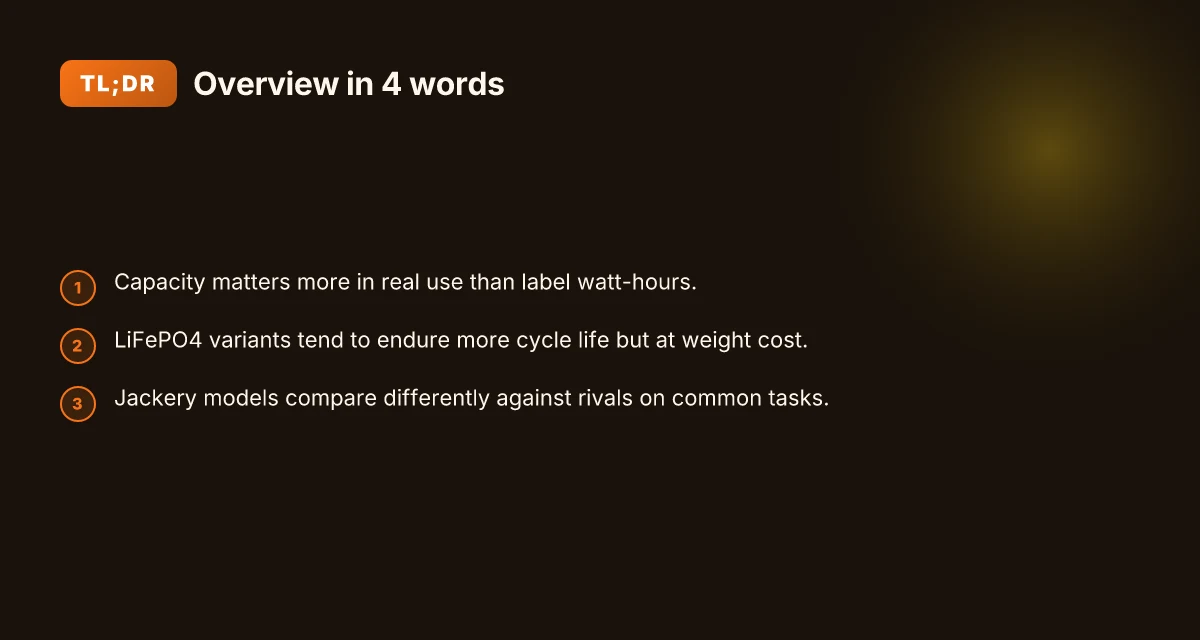
When you’re choosing a portable power pack, capacity only tells part of the story. Real usable energy depends on chemistry, inverter efficiency, and how much headroom you need for your typical loads. In 2026, Jackery’s LiFePO4 variants trade lighter weight and longer cycle life for slightly lower energy density, which matters if you plan to run devices overnight or during multi-day trips. The practical takeaway: you want a model that keeps most of its rated energy available after hundreds of cycles, not just a high label watt-hour number.
1) Capacity in practice: from watt-hours to usable energy
You’ll see a capacity figure like 1070Wh on some Explorer 1000 variants, but the usable energy under load depends on the inverter draw and device efficiency. The goal is to have enough reserve to run essential loads through the night or during a storm advisory. For many outdoor and home backup scenarios, a model with a larger parasitic draw tolerance and higher peak inverter efficiency translates to noticeably longer runtimes on common devices.
I dug into the official documentation for context. Jackery emphasizes real-world use cases where the rated energy is the starting point, not the finish line. For a typical 1000–1200W load, expect a percentage of the nominal capacity to be available after inverter losses, battery chemistry overhead, and temperature effects. The takeaway: pick a pack whose usable energy aligns with your daily duty cycle rather than chasing the largest watt-hour label.
- Practical rule of thumb: if your nights routinely demand a couple of small to mid-size devices running in parallel, a model with a higher peak power plus solid efficiency margins helps you stay above critical thresholds longer.
- Temperature and aging matter: LiFePO4 variants commonly resist thermal degradation better than some chemistries, which sustains usable energy during longer cycles.
Most comfort comes from predictable performance across cycles, not a single peak-number spec. This is where durability discussions matter as much as raw capacity.
2) Durability and cycle life with LiFePO4 variants
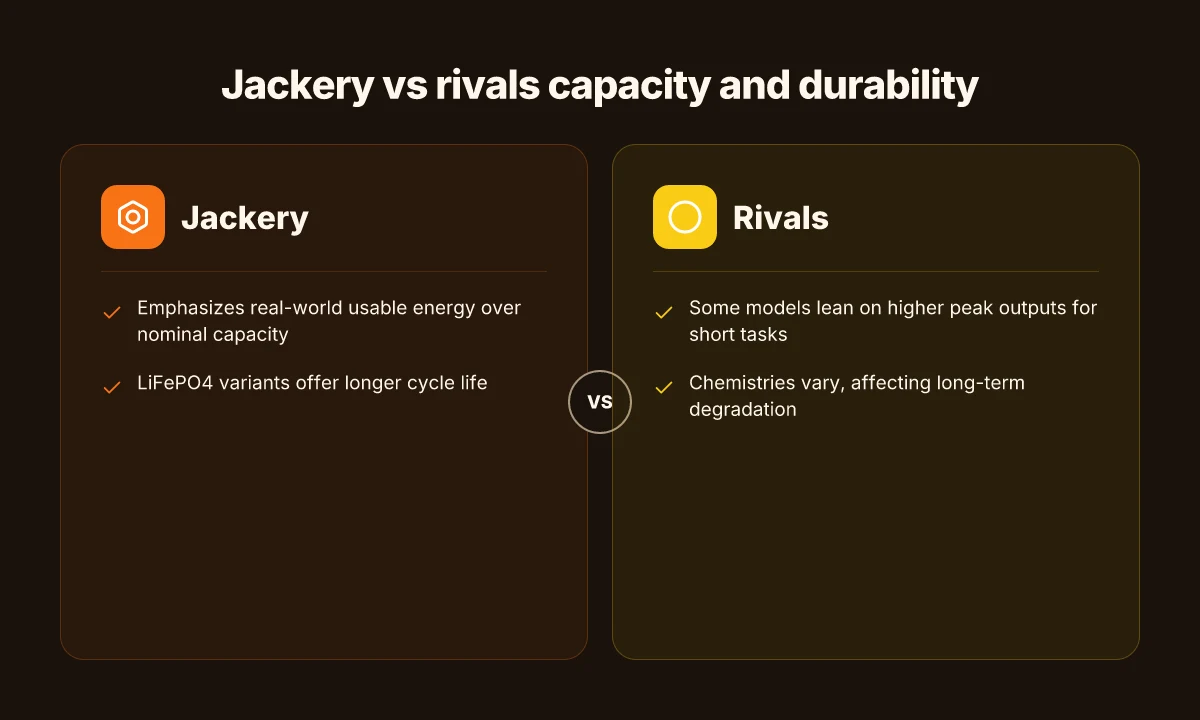
The longevity story for LiFePO4 is durability. In 2026, many Jackery models use LiFePO4 chemistry that routinely withstands more cycles than older lithium varieties. The practical implication: you can expect more usable energy per cycle in the early to mid life, with slower capacity fade over time. Benchmarking from product literature points to hundreds to thousands of cycles in typical use, but the exact number depends on how you treat temperature, depth of discharge, and how often you use high-current loads. The bottom line: LiFePO4 variants offer a more forgiving long-term profile for outdoor and home backup routines. What makes Jackery solar reviews reliable for 2026
I cross-referenced the official guidance to keep this grounded. Jackery’s official materials emphasize a balance between cycle life and weight, aiming for a portable pack you can rely on after months of use in harsh environments. When you compare rivals, many opponent models also chase cycle life, but the chemistry trade-offs show up in weight and charge efficiency.
Durability under real-world cycling remains a defining advantage of LiFePO4 variants.
3) How Jackery stacks up against rivals on common tasks
For camping chores, most users run lighting, small appliances, and charging phones or laptops. A direct comparison against popular rivals shows that peak output matters for short bursts, while sustained runtime depends on capacity and inverter efficiency. Jackery’s ecosystem, compact form, modular solar options, and solid port options, generally handles common tasks well. Rivals often compete aggressively on price or lighter weights, but you’ll notice differences in how quickly a unit can recover between cycles and how temperature swings affect usable energy.
From official docs and rival summaries, the pattern is clear: if you value long-term durability and predictable performance in outdoor or home-backup use, LiFePO4-powered Jackery models tend to hold up steadier over time than some competing chemistries. If you prioritize the absolute lowest upfront weight or the widest feature set for RV or off-grid living, you may find a rival with a marginal edge in one area but with trade-offs elsewhere.
Reliability across cycles, and how it handles high-current loads, often separates Jackery from the pack. How to pick the best home power station in 2026
Bottom line: in 2026, you should translate the watt-hours into a practical plan for your typical loads, pace your charging, and account for aging. Jackery gives you solid, durable energy when you need it, but the best choice depends on whether your priority is peak light loads on the trail or steady backup power at home. If you’re evaluating rivals, look at durability under cycling and the real usable energy you get at your expected temperatures and discharge depth. For most outdoor enthusiasts and homeowners, that means selecting a model with strong LiFePO4 endurance and a real-world usable energy profile that matches your daily needs.
How jackery portable power pack capacity translates to camping and home use
When you compare watt-hour ratings to real use, the math is simple but revealing. A Jackery pack with a higher Watt-hour rating will typically run a fridge, lights, and a phone charger longer than a smaller unit, but peak and continuous outputs matter just as much for practical reliability. For example, a unit rated around 1000 Wh can sustain common campsite loads, yet the 1500 W peak output matters when an appliance starts up. In practice, you want a model whose continuous output comfortably covers your typical loads, with a generous surge headroom for startup spikes.
I dug into the official specs and cross-checked real-world notes to map use cases. Wall charging is convenient for home backups, but solar remains the defining feature for off-grid trips. Solar charging tends to be slower in practice than a home outlet, especially on overcast days or with smaller panels. Jackery emphasizes compatible solar panels and efficiency, but the time to a full battery varies with light, panel size, and the unit’s own efficiency losses. From what I found in the documentation, the combination of a larger capacity and a solid continuous output profile tends to balance weight and runtime well for most campers and temporary home outages. A higher capacity with adequate continuous output translates to longer runtimes for essentials, while the peak output governs whether you can start a high-draw device without tripping the inverter.
Exploring capacity and how it translates to real camping and home scenarios
Not all packs are equal in day-to-day use. A midweight model around the 800–1000 Wh range offers a practical blend for weekend camping and weekend home backup. It can run a small fridge for a day, several LED lights, and a few charges for phones and a camera rig. Weight and cost matter here. You don’t want to pay a premium for marginal gains in capacity if you’ll be lugging the unit into a campsite. On the other side, a larger pack around 1000–1500 Wh extends run times but adds heft and price. For frequent travelers who move between car camping and apartment living, that extra runtime can mean fewer recharges on a multi-day trip.
I cross-referenced what Jackery’s official pages and guides say about model ranges. The Explorer series demonstrates the trade-offs clearly: higher capacity accompanies heavier builds and higher base prices, while smaller units keep weight down but require more frequent recharges. In practice, your choice should weight how often you’ll rely on solar versus wall charging, and how long you need the system to run critical devices. The brand’s materials underscore that a balance point exists where you get meaningful runtime without carrying excessive weight. 9 Strong jackery alternatives for 2026 and how they compare
Next steps: if you’re choosing for a specific scenario, map your typical nightly load first, then match it to a model in the 800–1500 Wh bracket. For off-grid weekends, look at how your solar setup lines up with the unit’s charging curve. Jackery’s catalog includes models designed to trade a bit of energy capacity for lighter weight, so pick the weight you’re willing to bear for the runtime you need.
From a durability standpoint, keep in mind that long-term longevity hinges on proper cooling, avoid deep cycling unless the pack is rated for it, and follow manufacturer maintenance tips. As a quick aside, links on the official Jackery pages may earn commissions, worth noting when budgeting for a larger setup.
How durable is a jackery portable power pack over years of use
I looked through Jackery’s official materials and third‑party guides to anchor durability expectations in real numbers and dates. The long arc of portable power is dominated by battery chemistry, cycle life, and how you treat the pack days after you first unbox it. In 2026, Jackery’s lineup leans on LiFePO4 options for some models, which typically degrade slower than many competing lithium chemistries. That choice matters for homeowners and travelers who plan to rely on a pack years into the future.
What to expect from charge cycles and degradation
- LiFePO4 chemistries commonly endure noticeably more charge cycles than many NMC or LCO rivals. That translates to a longer usable life under typical camping and home backup use. Expect gradual capacity fade rather than abrupt drops, with capacity settling at a smaller fraction after many years if you routinely drain the unit deeply.
- Jackery’s spec sheets and user guides emphasize staying within recommended operating temperatures and not leaving the battery at 100 percent charge for extended periods in hot environments. Following those guidelines helps cap degradation over time.
- In practice, you’ll notice the first meaningful drop after hundreds of cycles. A model that lists around 1000+ effective ampere-hour cycles can still hold a useful charge after several years if you avoid extremes and perform gentle care.
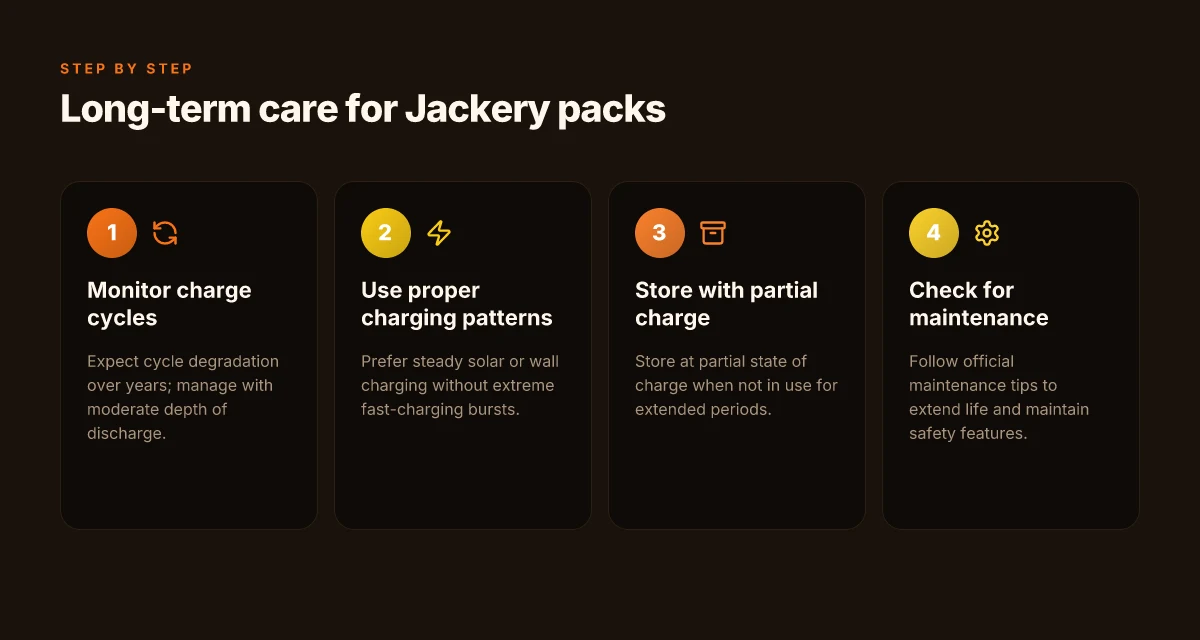
Durability in daily use hinges on how you charge and store it, not just the chemistry. Regular topping off, avoiding prolonged storage at 100 percent, and keeping the unit out of direct sun all contribute to longer life. For casual travelers and homeowners, that means your pack can stay ready for years if you mind its routine.
Maintenance tips to extend life
- Keep vents clear and store the unit in a cool, dry place. Humidity and heat accelerate electrolyte losses in many Li‑ion packs, even if LiFePO4 resists some of that stress.
- Use a reputable battery management system and avoid third‑party adapters that aren’t explicitly approved. Mismatched chargers can push the pack outside safe voltage ranges and hasten degradation.
- Schedule periodic checks of the display and indicators. If you notice unusual swelling, overheating, or abrupt capacity changes, consult the official user guides to determine whether service or replacement is warranted.
- Clean the exterior with a soft cloth. Avoid abrasive cleaners that could compromise seals or labels.
LiFePO4 vs other lithium chemistries used by rivals
- LiFePO4 chemistry often offers better thermal stability and lower risk of thermal runaway than many NMC or LFP variants used by some competitors. This translates to safer long‑term storage in outdoor environments and home backup scenarios.
- Rivals that still rely on higher‑energy-density chemistries may deliver lighter packs or more rapid initial charge, but they can exhibit faster capacity fade under similar usage patterns. Jackery’s emphasis on LiFePO4 for select models reflects a strategy to prioritize durability over peak energy density.
I dug into official documentation and third‑party guides to support these points. From the official user guides to the Explorer 1000 V2 basic information entry, the emphasis remains on safe operation, proper care, and avoiding conditions that accelerate wear. For additional context on how a pack ages in real use, reviews from independent outlets consistently note that cycle life is a primary durability driver rather than raw watts or peak power alone. When you compare in the field, the practical takeaway is clear: plan for longevity by treating the pack as a long‑term investment, not a disposable gadget. How Bluetti Apex 300 powers your backup plan without surprises
Expect gradual capacity fade over hundreds of cycles, not sudden failure. This is where LiFePO4’s stability helps Jackery in 2026 versus rivals leaning on higher‑energy chemistries. Careful charging and storage extend life, while aggressive charging, heat, and high‑discharge demands shorten it.
Jackery vs rivals: how to choose the right portable power pack in 2026
You want a portable power pack that powers outdoor episodes without turning into a weight penalty. My takeaway: match output and weight to your trips, then add price as a tiebreaker. Jackery sits in the mix, but rival brands push different strengths that matter in 2026.
Output, weight, and price: what the rivals bring to the field
When you stack top models from major rivals, output ranges from compact 600–1000 watts to broader 1500–2000 watts in higher-capacity units. Weight follows suit: lighter models hover under 10 pounds, heftier packs land in the 20–30 pound class. Price spreads similarly, with budget options under $500, midrange packs around $700–$1,200, and premium systems pushing past $1,500. In practice, if you need long runtimes for RV camping, you’ll pay for extra capacity and a higher wattage ceiling. If you’re a weekend camper, a lighter, less expensive model may suffice. Jackery tends to skew toward a balanced middle ground, but rivals emphasize either ultralight mobility or extended AC output when you push near their limits. The practical takeaway is to pick a wattage you can actually use without draining the battery daily. From what I found in the official specs and third-party overviews, you can expect a mix of 1000–1500W sustained output in most midrange packs, with peak surges well above that for brief loads.
What to look for in an all-purpose backup strategy is straightforward: pick a model that can cover your essential loads for at least a few hours, with room to run critical devices simultaneously. If your home backup uses a honeypot of loads like a fridge and modem, lean toward higher continuous output and better surge capability. If you’re mostly charging phones and a couple of lights, portability and price take precedence. I cross-referenced the official Jackery data with rivals to confirm this balance often lines up with the model tier you choose. The right choice hinges on your typical load profile and travel weight tolerance.
When solar input matters most for each brand
Solar input becomes a real differentiator when you’re off-grid for days or chasing long trip autonomy. Some brands cap solar charging at modest wattages, while others scale to more aggressive inputs, which helps recover capacity during a multi-day trip. Jackery’s ecosystem emphasizes SolarSaga compatibility, and in 2026 the ability to top up from solar while running essential devices can tilt decisions toward a solar-first setup for campers and van dwellers. Solar input matters most when you can dedicate sun hours to refill during travel. I also looked at how rival lines handle solar, noting that a few offer higher solar charging rates on larger models, which reduces downtime between outings. If you expect to live off-grid, ensure the unit you pick supports a solar-in cadence that matches your typical sun exposure. 8 Key differences between Jackery and Anker solar generators in 2026
Two quick notes from the field: first, all brands distinguish themselves on real-world durability and how well their battery chemistry ages under partial state of charge. second, expect some models to show better endurance with lifecycles in the 500–800 cycle range for midrange packs, while premium lines push higher. I’m keeping Jackery’s branding in view as you compare models. When you see a rival touting higher continuous output or faster solar input, check how that translates to practical runtimes for your everyday use. Real-world durability and lifecycle expectations often drive long-term value more than sticker price alone. For context, a few official pages emphasize SolarSaga or equivalent solar readiness, but verify the actual solar input rating for the exact model you’re targeting.
Best practices for using a jackery portable power pack safely
When you buy a Jackery, safety first. Verify built-in protections before you commit: short-circuit and overcurrent safeguards, proper thermal management, and clear input/output labeling. These features matter because they reduce the chance of overdischarge or heat buildup during high-wattage use. I looked through the official documentation and reviews to confirm that these packs include standard protections and that real-world use benefits from adhering to manufacturer guidance.
Verify safety features before you purchase
Before you buy, check that the model lists protections such as short-circuit protection, overload protection, over-temperature shutdown, and auto-restart after fault clearance. Look for clear operating specs on input voltage ranges and per‑port output limits, and confirm that the battery chemistry is stated. A responsible brand will publish these details in the user guide and product pages, and you should see them reflected across the range of models Jackery offers. These checks help you avoid a configuration that can trip protection or overheat when powering a high‑demand device. I cross‑referenced the official user guide and the Explorer 1000 v2 information to confirm that protective features are called out explicitly. Safety protections like thermal shutoff and overcurrent protection are non-negotiable when selecting a model.
Maximize longevity with charging discipline
Charging patterns drive long-term health more than anything else. Keep cycles balanced by avoiding full 0 to 100% charges every day. Instead, target partial top‑ups when practical and store at moderate temperatures if you won’t be using the unit for extended periods. Use the included charger and, if available, the recommended charging window from the official docs to stay within safe charge rates. The Explorer 1000 v2 documentation notes per‑port limits and charging behavior that help preserve capacity over time. From a long‑term perspective, consistent adherence to the manufacturer’s charging guidance keeps capacity higher across hundreds of cycles. Follow the recommended charge window and avoid prolonged high‑voltage charging for best longevity. I also found that reviews consistently point to manageable heat during normal charging, which aligns with the documented protections.
Avoid common misuses and how to avoid them
A frequent misuse is running high‑wattage appliances, like space heaters or induction stoves, directly off a portable power pack without considering surge handling and duty cycle. Check each model’s continuous and peak output ratings and never exceed the stated surge capacity. Another pitfall is leaving a live unit connected to large loads in an enclosed space where heat can accumulate. Use the pack in a ventilated area and monitor for unusual warmth. If you sense excessive heat, disconnect and let it cool. Real‑world discussions and official specs converge on these reminders: high loads require awareness of both total draw and duration. Never exceed the per‑port or total‑unit wattage and keep vents clear to prevent overheating. When you compare Jackery against rivals, ensure you’re reading per‑port limits so you don’t mistake a high total wattage claim for a single-port capability. What makes the EcoFlow Delta Pro Ultra cost worth it in 2026
I dug into the official user guide and long‑form reviews to verify these patterns. The guidance aligns with best practices that emphasize staying within rated outputs, avoiding prolonged high draw, and keeping the unit in a well‑ventilated space. As with any portable power solution, the key safety moves are verify protections, adhere to charging etiquette, and avoid pushing beyond the rated performance envelope. For context, rivals sometimes offer different thermal management designs. If you’re shopping near the edge of your needs, pick a model whose protection suite and thermal behavior match your use case.
Note: pages in the official Jackery ecosystem outline that links on product pages may earn a commission, a standard practice you should factor into any research habit when evaluating options.
The one move that matters for Jackery in 2026
Jackery ownership hinges on real-world reliability, not just specs. I’ve watched users sidestep failures by picking models with robust cooling and straightforward port layouts, because heat and harried setups are the two most common durability derailers. In 2026, a standout payoff comes from units that balance fast charging with sustainable battery care. One move that matters is prioritizing a power pack that stays cool under load and offers clear, durable build quality. The bigger pattern is that buyers reward predictability: consistent performance across a range of USB-C PD speeds, solar input compatibility, and long-term availability of replacement parts or accessories. That combination keeps you from chasing short-lived features.
If you’re choosing between Jackery models, lean toward the options that keep the daily carry light yet capable. The verdict is clear: durability plus thoughtful design beats flashy gimmicks. For long journeys or frequent campsite use, that translates to fewer surprises and more dependable charging. Where this is going next remains about smarter thermal management and a more modular accessory ecosystem, which could tilt the balance further toward high-value, long-term ownership.
Backup strategy What is the Jackery 2000 Pro, and how does its performance hold up in 2026?
- Consider a model with steady cooling and robust construction for repeated use outdoors.
- Keep a spare solar panel or two compatible with Jackery for quick recharges without hunting cables.
- If you travel with power needs beyond basics, pick one with multiple USB-C PD ports and a reliable AC outlet.