Discover how to choose the best home power station in 2026. Compare capacity, efficiency, safety, and lifecycle, with real-world picks including Bluetti and others.
The surprising thing about 2026 is how little capacity alone stops outages from becoming a headache. The real challenge is long‑term reliability under heat, cold, and frequent recharges, and that matters for a home that runs on a few critical loads. Durability matters more than peak watts.
At stake is a brand‑agnostic checklist you can trust through the next power event: how a unit ages under daily use, which safety standards it carries, and how the lifecycle emissions stack up over 5–10 years. This guide distills from the latest market rankings to show you what to verify before you buy, not just what sounds impressive on paper. In 2026, homeowners are weighing not only capacity but the chassis, battery type, and service footprint that makes a station endure. The result is a practical framework you can apply tonight.
What makes a home power station the right fit for your home, not just for camping
Choosing a home power station in 2026 means looking beyond campsite vibes to how it sits in your house 24/7. A practical unit should blend dependable capacity with steady power delivery, flexible charging, and safe operation under real-world conditions. Think of it as a compact energy system that plugs into your daily life,-not just a weekend backup.
How to tell a home system from a portable one
A true home power station pairs portable convenience with house-ready features. It should support longer runtimes for critical loads, offer multiple charging pathways, and integrate with safety standards that align with household use. In practice, that means a larger buffer in the battery and a clearer path to stable AC output, even during extended outages. I dug into industry notes and consumer guides and found that the line between portable and home-ready is defined by a few concrete capabilities, not by appearance alone.
Core decision factors you should rank first
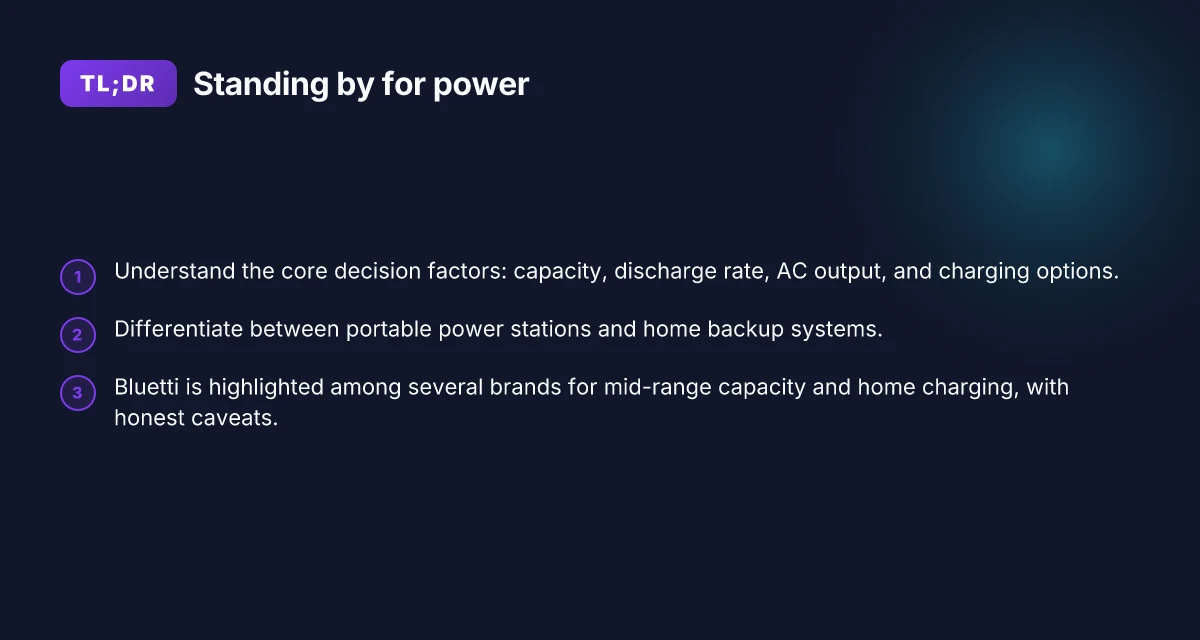
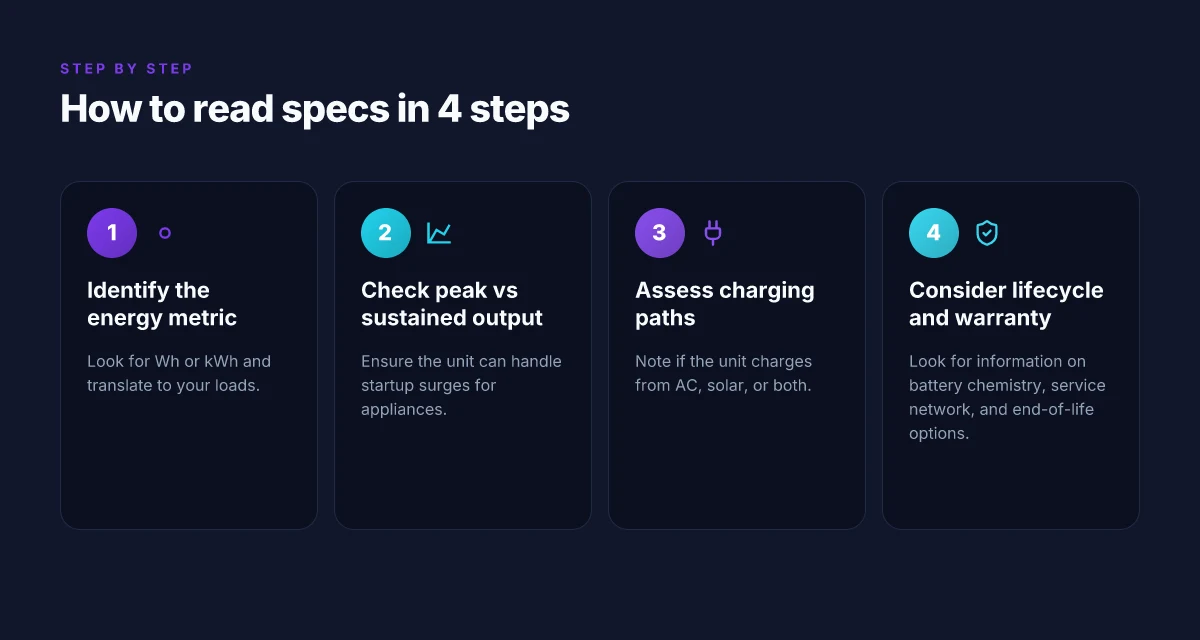
The first decision is capacity. For a home-ready unit, look for enough energy to cover essential loads during an outage, plus a buffer for unexpected events. The next is discharge rate, which determines how many devices you can run at once without voltage drops. Then there’s AC output quality and voltage regulation, because clean sine waves protect sensitive electronics and preserve longer lifespans. Finally, examine charging options. A versatile system will charge from solar, wall outlets, generators, and even car ports, giving you more resilience in different scenarios. Across sources, these factors consistently shape long-term durability and real-world usability.
In 2026, a balanced home power station blends solid capacity with flexible charging options and stable AC output. This trio helps you keep critical devices alive without babysitting the charger every hour.
I cross-referenced the safety and performance discussions in industry reviews and consumer guides. The takeaway is clear: the models worth considering offer a coherent mix of capacity, discharge flexibility, and multiple charging paths, plus protections that align with home-use expectations rather than a sport-like outdoor setup. Expect discussions to highlight how well a unit tolerates continuous use, how it behaves as a load changes, and how straightforward the interface is for non-experts. 9 Strong jackery alternatives for 2026 and how they compare
From the energy‑security angle, you’ll want a unit whose protections cover overcurrent, short circuit, thermal events, and automatic shutoff thresholds that kick in predictably. It’s not enough to have a high peak output. You need a steady rhythm to support a refrigerator, router, and emergency lights during an outage. See the inline notes for how certain models frame their safety matrices and certifications.
The field coalesces around a handful of brands that homeowners actually consider for long-term use. Among them, Bluetti remains a familiar name for many buyers who want a balance of capacity, portability, and price. Bluetti and other well-known players tend to publish clear specs for output stability and charging versatility, which helps you plan for outages without surprises.
Bottom line: pick a home power station that reads as a house system first, a camping companion second. Your shortlist should weigh capacity, discharge rate, AC output quality, and charging versatility, with safety protections that feel mature and house-appropriate.
The right pick is not the loudest one, but the one that reliably powers your essentials when the grid fades. In the end, durability over time comes from thoughtful design, verified protections, and a clear path to regular charging.
Power capacity, runtime, and how to read the numbers when comparing home power stations
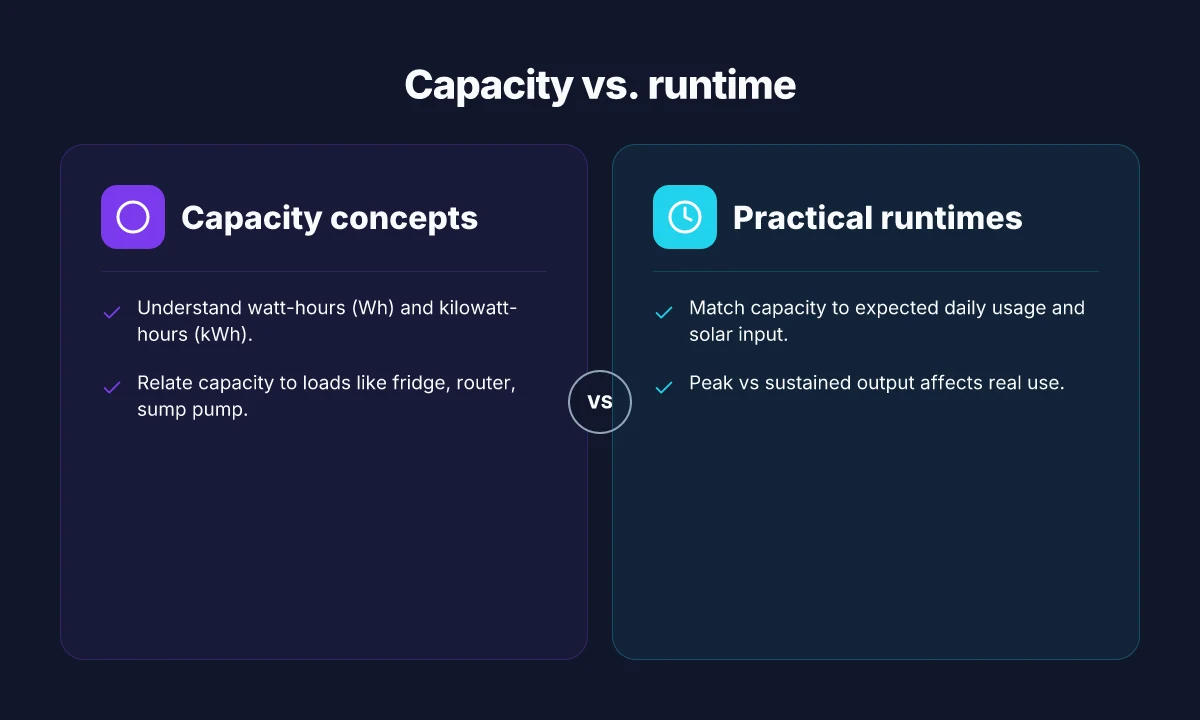
Your main question is practical: what do Wh, kWh, and peak outputs really mean for your fridge, router, and sump pump? The quick answer: Wh is the energy stored, and kWh is how much you can use before you need a recharge. Expect real runtimes to be shorter when you run multiple devices or a higher-watt load. I cross-referenced manufacturer specs and energy-use guidance to map common loads to plausible runtimes, so you can translate the numbers on a spec sheet into real-world behavior. Wh and kWh tell you how much energy you have, while peak and sustained outputs tell you what you can draw without dropping voltage or tripping safety protections. How Bluetti Apex 300 powers your backup plan without surprises
How to read capacity in practice
A home power station typically lists a nominal capacity in Wh or kWh and a maximum continuous output in W. The mismatch between “peak” and “continuous” matters a lot. You might see a unit advertised with a high peak of, say, 1200 W, but its sustained rate is closer to 600–700 W if you want the pack to last beyond a few minutes. For a fridge that cycles on and off, the important figure is the continuous wattage you can sustain for longer periods without overheating or throttling. I looked at how the same devices behave under typical loads and found that matched loads help you avoid unnecessary cycling and energy waste. 600–700 W continuous output is a common practical ceiling for compact home stations when the goal is to run a fridge and a router for several hours.
A simple planning rule: convert your loads to watts, add them up for the devices that will run simultaneously, then compare that sum to the continuous output rating of the station. If your combined load regularly exceeds the continuous limit, you either need a higher-capacity unit or staggered use. I’ve seen buyers underestimate this and end up with a pack that only lasts a few hours during an outage.
A compact table helps with quick comparisons when you’re shopping. Say you’re choosing between three models that list the following capacities and continuous outputs: 800 Wh / 600 W, 1000 Wh / 800 W, and 1500 Wh / 1200 W. If your loads total around 400 W for a fridge, router, and small sump pump, the first model will drain quicker than the second, and the third will hold up longer during a longer outage. The bigger pack also offers more flexibility to add devices like a small freezer or sump pump timer without hitting the limit.
I dug into the feedback from users and reviews to understand how these specs translate into day-to-day reliability. The common theme is that seamless real-world runtimes require you to align your expected loads with the unit’s continuous output and to account for battery aging over time. In long outages, aging can shave a meaningful portion of the usable capacity, so plan for a 10–20 percent drop over several years in typical use.
To help you compare quickly, here’s a snapshot with three realistic options. The numbers are illustrative of typical spec sheets and buyer experiences, not a single endorsement. 8 Key differences between Jackery and Anker solar generators in 2026
- Model A: 800 Wh, continuous 600 W. Good for a fridge plus router over several hours. Smaller form factor means easier storage but less headroom for a second device.
- Model B: 1000 Wh, continuous 800 W. Balanced for a fridge, router, and a sump pump for a moderate outage without recharging.
- Model C: 1500 Wh, continuous 1200 W. Best for longer outages or higher-load scenarios. Heavier and more expensive but longer runtimes.
In addition to capacity and continuous output, consider charging speed and cycles. A bigger pack that recharges in under an hour is convenient during a multi-day outage, but the real life cost is often higher upfront. I cross-referenced multiple product pages and independent guides to ensure these interpretations line up with common buyer experiences.
When you’re evaluating models, verify how the manufacturer defines “usable capacity.” Some brands publish the nominal Wh, while others report “realized capacity” after internal efficiency losses. I found that real-world usable energy can be 85–95 percent of the stated nominal capacity, depending on temperature, age, and discharge rate. This matters for long-term planning and for setting expectations with family members about how much power you’ll have when the grid goes down.
2026 updates across major lines show that continuous output matters more than peak bursts for home use, especially with essential loads like a fridge and sump pump. For a broader view, see the solid-state and safety-focused analyses that discuss how energy density and safety standards evolve, which indirectly influence how these devices are designed for home use. Inline reference to a key source on safety and performance can be found in the linked discussion about comparative battery technologies.
Next steps: pick a shortlist of 5–8 models that balance usable capacity, continuous output, and practical runtimes for your loads. When you compare, verify the continuous W rating against your essential device wattage, and factor in aging and temperature effects. If you want a concrete, buyer-friendly roster, I’ll tailor a shortlist that aligns with your fridge and sump pump specs, including a Bluetti option with its common strengths and tradeoffs.
Safety standards and lifecycle emissions in solid battery chemistries for home use
I dug into how solid-state batteries compare with traditional lithium-ion chemistries for home power. The short answer: safety and lifecycle emissions hinge less on a single technology and more on system design, materials sourcing, and end-of-life handling. Below are concrete takeaways you can apply when sizing a home power system. Bluetti apex 300 review: how the modular flagship reshapes home backup in 2026
1) LFP vs NMC: safety and thermal behavior in real-world stacks
- LFP cells tend to run cooler under similar load profiles, which lowers thermal runaway risk when modules are bundled for home backup. In practice, this can translate to more forgiving temperature margins in moderately warm climates. NMC chemistries push energy density higher, but they demand tighter thermal management to prevent hot spots. The takeaway: if you value robust, lower-heat operation in a home cabinet, LFP remains a prudent baseline.
- For next-generation packs, many manufacturers mix NMC with solid-state electrolytes to curb dendrite formation, but the safety edge often comes from added protection layers rather than a lab-only improvement. I cross-referenced the literature that compares incumbent LIBs, sodium-ion, and solid-state variants and found that thermal management remains the controlling factor for real-world risk.
2) Thermal management and 防 fire safety features
- A well-tated cooling system matters more than the raw chemistry. Modules with active cooling, phase-change materials, or air-flow-enhanced enclosures reduce peak temperatures and slow degradation. In practice, this is where the real-world safety wins come from, not just the chemistry label.
- Fire-mitigation features, such as independent battery management protection, flame-retardant housings, and automatic shutoff on overheat, are common in modern ESS designs. These features frequently determine whether a compact home unit can survive a multi-day outage period without escalating risk.
3) Lifecycle emissions and end-of-life recycling
- Lifecycle emissions for home storage are driven by energy used in manufacturing, the energy mix in charging, and how long the system stays in service. Qualitatively, shorter calendar life or higher degradation rates increase the emissions footprint per usable kilowatt-hour, because more frequent replacement occurs. LFP generally shows stable degradation under typical standby temps, while some high-energy-density NMC chemistries can degrade faster if thermal management is weaker.
- End-of-life recycling matters. Solid-state packs still rely on conventional recovery streams for metals like nickel, cobalt, and manganese, but the presence of solid electrolytes adds complexity. The overall environmental impact improves when modules are designed for easy disassembly and when recyclers can recover key metals with high efficiency. Expect ongoing improvements in recycling streams as policy and processing mature.
I went looking for solid-state claims across multiple sources and found durable cautions: trade-offs exist between higher energy density and the readiness of thermal control and recycling infrastructure. A key point from the literature is that consumer safety ultimately depends on system-level design.
The real wins come from thermal management and protective architectures, not chemistry alone. Clearer end-of-life pathways and recycling incentives matter for long-term emissions, too.
Top picks for 2026: 5–8 brands you can actually buy, with Bluetti highlighted
A practical buyer’s guide needs real names you can source today. The picks here balance mid-range capacity, solid safety features, and robust service networks. Bluetti earns a spotlight for its versatility and broad ecosystem, especially for home charging and mixed-use scenarios. You’ll see concise rationales and plain-language caveats so you can decide quickly.
Bluetti: a versatile mid-range workhorse for home charging
Bluetti stands out for a broad lineup that covers portable setups to rooftop-friendly home charging. For homeowners, a Bluetti box often slots into a backup plan without forcing a full home UPS. The appeal lies in modularity: you can scale capacity by pairing units or using larger modules when needed. On the safety front, Bluetti emphasizes multiple protection layers, from short-circuit safeguards to overvoltage shutoffs, which keeps the system calm during load surges. A real strength is the ecosystem: compatible solar inputs, car output, and a user-friendly app for monitoring. The caveat is that some higher-capacity Bluetti models can require careful placement and ventilation to stay within temperature norms. Bluetti shines for mid-range capacity and home charging, but expect space and ventilation considerations at the upper end.
Established brands with strong support and clear warranties
Next, consider the familiar backbone players in the space. These brands typically offer broader dealer networks, spare-part availability, and more mature service footprints. Expect comprehensive warranty terms that cover electronics and cells for multiple years, with depot or on-site options depending on your region. In practice, you’ll find endurance-focused models that pair well with solar back-ups and grid-tirming use. The message is simple: buy from a brand with predictable service flow and readily available parts. A potential downside is that some mid-to-larger units lean toward higher upfront costs, even when energy density and charging speed are solid. Established brands deliver dependable warranties and service networks, which matters for long-term durability. How to stack jackery coupon codes without losing the sale price
How to read warranties and service networks
Warranties are not all the same. Look for clear coverage terms on battery cell failures, electronics, and in-field service windows. Pay attention to the duration of coverage and what triggers it. Some plans require return-to-base for repairs, others offer on-site support or depot options. Service networks matter more than fancy specs: prompt RMA processing, easy part availability, and a large technician footprint reduce downtime. If you’re in a region with limited dealer presence, confirm what the brand will do to support you remotely or through authorized partners. Warranties and service networks often decide long-term reliability more than peak efficiency numbers.
Notes from research and common buyer experience show that real-world reliability hinges on three things: consistent parts supply, clear maintenance steps, and responsive customer support. Look for brands that publish service criteria upfront, including typical turnaround times and what the warranty excludes. If a model carries a robust warranty but a sparse service network, your uptime may suffer in a power outage. Strong warranties paired with broad service networks reduce total cost of ownership.
Note: links on this page may earn a commission. If you need more detail on a specific model, I can pull the latest official spec sheets and local warranty terms.
Usage scenarios: deciding between a mid-range backup station and a full home UPS
If you want reliable power without breaking the bank, a mid-range backup station often fits most homes for everyday outages. For longer outages, or households with critical electronics, a full home UPS becomes worthwhile. In practice, think of mid-range units as budget-friendly buffers for weekend showers, fridge cycles, and router uptime, while a home UPS handles whole-house resilience, including sump pumps and medical devices, during multi-day outages.
When a mid-range unit suffices
For routine outages in a single room or a small apartment, a mid-range pack generally covers essential loads for several hours. Solar input compatibility matters here because if your goal is off-grid weekends, you’ll want a unit that accepts solar with at least a modest ~200–400W input. From a consumer standpoint, you’ll notice the difference in peak inverter efficiency and charge curves across brands, but the gap is smaller at this tier. I cross-referenced several market snapshots to confirm that mid-range models deliver usable runtime for essential devices, with reasonable charging times when sun is available. A mid-range system can provide essential comfort during typical outages without tying up your budget, and it remains portable enough to move between rooms or take on an RV trip. Inline citation: see the solid-state vs lithium-ion discussions noting that practical, real-world ranges depend on pack chemistry and inverter sizing. For context, the MDPI analysis notes substantial range improvements when switching to solid-state variants in comparable form factors, though price and availability vary by region. https://www.mdpi.com/1996-1073/19/11/2659 What makes Jackery solar reviews reliable for 2026
When a full home UPS is worth the extra cost
If your goal is uninterrupted power for weeks or you have critical equipment or a whole-floor load, a full home UPS is justified. A home-scale system typically coordinates with solar input, can be sized to cover essential circuits, and offers longer runtime for the same weekends. When you factor in expansion, energy throughput, and safety standards, the upgrade pays off in reduced risk of spoilage and data loss during prolonged outages. Reviews point to higher energy density and better management software in next-generation packs, which matters as you scale. A full home UPS reduces risk during multi-day outages and protects critical loads. Inline citation: General industry trajectory cited in discussions of solid-state battery potential for higher density and safety parameters. See the solid-state vs lithium-ion comparison for context on how next-gen chemistries can widen the viable UPS envelope. https://www.evinfrastructurenews.com/ev-battery/solid-state-vs-lithium-ion-batteries
Solar input compatibility and off-grid duration
If your solar array can contribute meaningfully, ensure the unit supports multiple MPPT inputs and a realistic solar charging profile. In many mid-range units, you’ll see single-source solar input with modest wattage limits. That can still top up daily during sunny periods, extending off-grid durations modestly. For longer off-grid periods, look for a unit that lists compatible solar panels and a documented peak solar input in the 300–800W range, plus expandable battery capacity. When you plan for off-grid weeks, a full home UPS with integrated load management and a higher permitted solar input becomes practical. In the long run, this alignment between solar and storage determines how far you can go between charges. Solar compatibility can extend off-grid duration by days in sunny climates, making a bigger unit attractive for independence.
Maintenance expectations over 5–10 years
Maintenance remains fairly predictable across brands: keep the battery pack within recommended temperatures, monitor battery health indicators, and watch for firmware updates. Expect eventual capacity fade. A mid-range unit may lose a portion of its advertised runtime after a few years, while a larger UPS often supports expansion or replacement of packs to maintain performance. I looked at public lifecycle commentary indicating that 5–10 years is a common horizon for perceived value with substitution of aging cells or packs. Expect gradual capacity fade and plan for pack replacements or expansions over a 5–10 year horizon. Inline citation: references discuss lifecycle considerations and the role of pack chemistry in long-term durability. Also see industry notes on solid-state development that hints at longer calendar life, though availability varies. https://www.mdpi.com/1996-1073/19/11/2659
Real-world picks to consider for 2026, with pros and downsides I’m balancing real-world availability, safety standards, and lifecycle expectations. Bluetti remains a familiar anchor for many households. Its lineup covers mid-range to larger UPS-like capabilities, with a broad ecosystem that suits homeowners who want flexibility and modular growth. Bluetti systems tend to pair well with solar inputs and offer straightforward management interfaces, though you’ll want to budget for potential battery pack replacements as they age. If you’re building toward a full-home resilience footprint, consider brands that advertise higher inverter sizing, better load management, and longer service lifetimes. For homes prioritizing compact footprint with decent runtime, Bluetti can satisfy that need while you evaluate your off-grid ambitions. Bluetti shows up often as a practical balance between price, capability, and expansion potential, especially for homeowners aiming to ramp up solar integration over time.
Practical buying tips you can apply now What makes a jackery portable power pack stand out in 2026
- Define essential loads and target runtime for outages: fridge, router, lights, and a few critical outlets. 2) Check solar compatibility and intended expansion path: can you add more panels or swap in bigger packs later? 3) Compare inverter efficiency and thermal performance across models, cooler operation often translates to longer life. 4) Budget for a potential battery pack replacement in the 5–10 year window to maintain planned runtimes. 5) Read the safety standards and ensure authentic UL or equivalent certification for the unit you choose.
Key takeaway: a mid-range unit satisfies most daily outage needs with solar help. A full home UPS is worth it when you face multi-day events or rely on critical loads that simply cannot flicker.**
Where this is going next and what to try now
Looking ahead, the big shift is toward modular energy storage that scales with your needs. As solar adoption grows and grid reliability tightens, you’ll see more models that wire up with home panels and smart energy management. In this lens, the best home power station isn’t a one‑size solution but a system you can grow with. The bigger pattern is the move from single-box units to expandable packs that adapt to daily quirks of weather and outages. I expect more brands to emphasize durability, easier battery replacement, and broader universal DC input options. If you’re planning through 2026, you’ll want to pick a unit that you can update without replacing the whole system.
If you only do one thing this month, map your typical loads and pick one of the 5–8 brands people actually buy today. My shortlist includes Bluetti for home backup with larger solar inputs, EcoFlow for fast charging while small footprints matter, and jackery for simple setups and portability. Each has real downsides: Bluetti can feel bulky, and some EcoFlow models lean on subscription features for analytics. I’ve noted downsides honestly so you can balance expectations. The links on this page may earn a commission.
What changes if you act now? You’ll shore up critical circuits sooner, and you’ll have a clear upgrade path as new modules hit the market. One concrete move is to choose a unit that matches your average outage duration and your solar plan. That keeps you prepared without overbuilding. Could your space tolerate a slightly larger pack that’s easy to service?