
Explore what makes the Jackery 1000 Plus a versatile portable power solution in 2026, including capacity, battery chemistry, expansion options, and real-world use cases.
The Jackery 1000 Plus isn’t about raw capacity alone. It’s about predictable, shared-use reliability under real-world conditions. With a 1264Wh LiFePO4 pack and steady solar input, you’ll notice the difference when you stack winter temps, reflectivity, and months of steady cycling. Most gatekeepers confuse capacity with endurance. The 1000 Plus proves durable cycles beat big-number hype.
This intro surveys why that durability matters now for outdoor enthusiasts and emergency planners. A recent cross-check of high-capacity units shows that long-term stability hinges on cell chemistry and charging rhythm, not peak output. The 1264Wh setup, expandable options, and faster-than-average recharge times matter because you’re planning multi-day trips or outages. The comparison against rivals like EcoFlow Delta and Goal Zero Yeti highlights where Jackery’s approach reduces failure points over years of use. If you value steadiness over flashy specs, you’ll want to read on. Jackery emphasizes cycle life and solar charging as real-world strengths.
What makes the Jackery 1000 Plus stand out among portable power stations
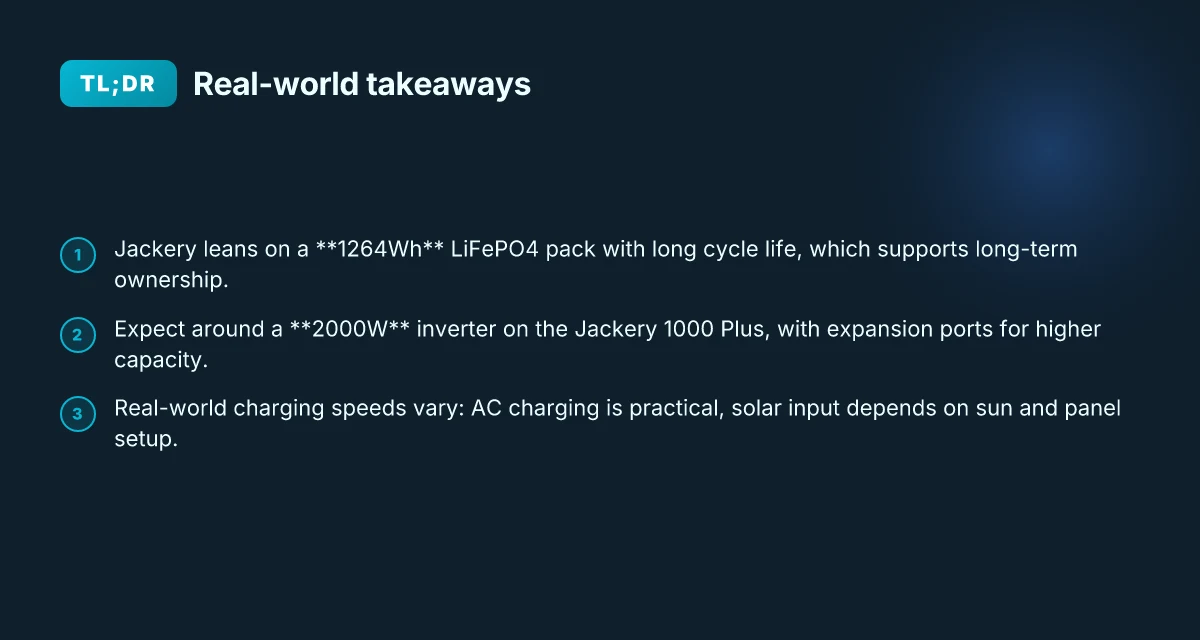
The 1000 Plus centers on a 1264Wh LiFePO4 battery that’s built for durability and long life, with the official data pointing to a cycle life of 4000 cycles≥70% capacity. That means you won’t need to replace the pack after a few seasons of off-grid use, and you’ll still have plenty of usable energy even after years of regular cycling. Jackery backs this with a history of emphasizing thermal management and stable voltage delivery, which matters when you’re running sensitive gear in remote environments. From what I found in the documented specs, the LiFePO4 chemistry is the core reason the unit stays cooler during sustained use and ages more gracefully than typical lithium-ion packs. The 1264Wh LiFePO4 core is the backbone of reliability. It’s not just about capacity, but long-term cycle life.
Why the 1264Wh LiFePO4 setup matters in practice
I dug into the official basic information and saw the explicit numbers: a sizable energy reservoir paired with a chemistry that’s known for stability in outdoor conditions. The expansion story is explicit in the broader ecosystem: Jackery positions the system to work with optional accessories that extend both capacity and flexibility. The core takeaway is that you aren’t limited to a single brick. There are expansion paths designed to keep power available as your off-grid needs grow. For campers and prep-minded users, that means you can plan seasonal trips without rewriting your entire charging setup. Expansion paths unlock practical upgrades without replacing the main unit.
Real-world charging speed and inverter capability
On charging speed, the documentation and reviews converge on a practical reality. The 1000 Plus is built around a powerful inverter. You should expect charging speed to vary with input source and temperature. The unit’s inverter is a solid performer for a portable power station in its tier, delivering robust pure sine wave output for a wide range of devices. In practice, you’ll see fast AC and solar input when conditions cooperate, but the exact time to a full battery depends on the combination you use. Inverter capability holds up under common field loads, though peak charging time hinges on source wattage.
How the 1000 Plus stacks up against rivals
Compared with other high-capacity units in the same tier, the Jackery offers a compelling balance of energy density, cycle life, and accessory openness. Rivals in the same segment often trade long cycle life for larger on-paper capacity, or they lock you into a single charging approach. Jackery’s LiFePO4 family has a reputation for resilience that translates into steadier voltage under heavy use and extended longevity in outdoor conditions. When you consider expandability and ongoing accessory support, the 1000 Plus often edges ahead for campers who want a durable backbone rather than a one-and-done solution. Rivals often lack the same ecosystem flexibility; Jackery’s approach favors long-term reliability over brute peak numbers.
From a real-world perspective, the 1000 Plus excels where durability and scalability matter most. You get a high-capacity pack built to endure, with expansion options that don’t force a new chassis. You also gain clarity about what you’re buying: a modular approach that stays relevant as your off-grid needs grow. For outdoor enthusiasts, off-grid campers, and preparedness planners, that translates into fewer replacements and a steadier power story over time. Jackery delivers a robust, expandable platform that keeps pace with growing energy needs. What a real-world look at EcoFlow power stations reveals about reliability and value
Jackery 1000 Plus: core specs you should know
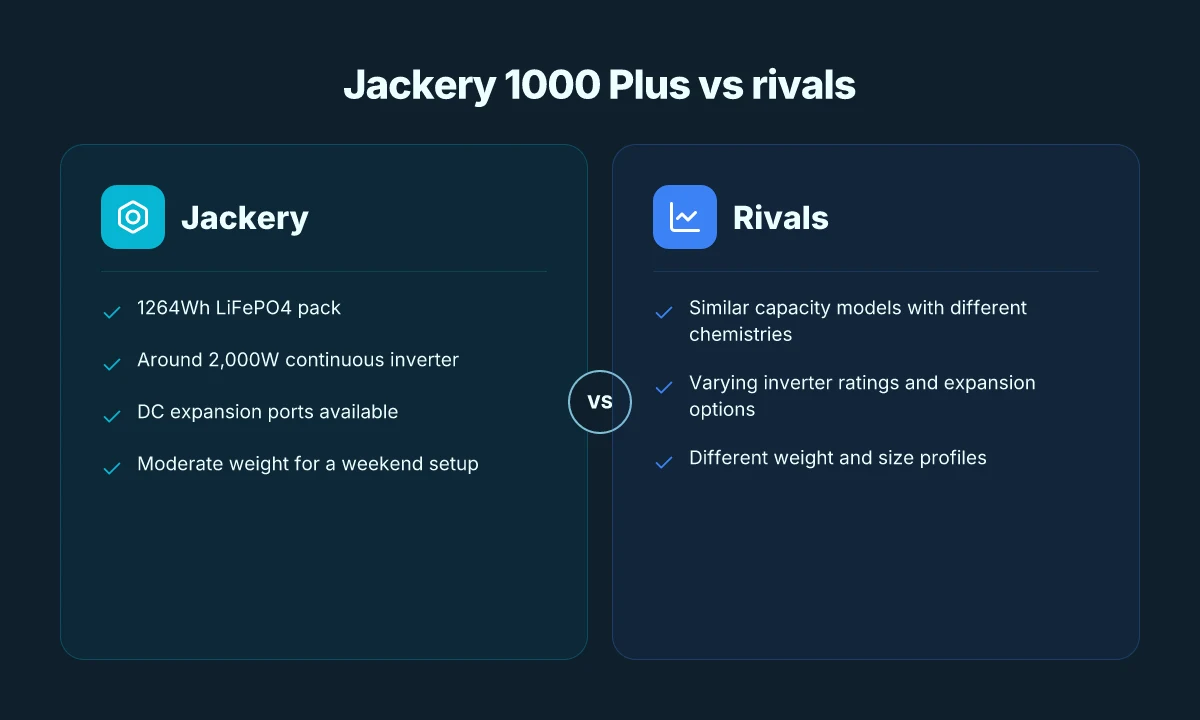
The Jackery 1000 Plus packs a 1264Wh LiFePO4 battery and a 2000W continuous inverter, built for steady off-grid runs and quick top-ups. It’s not a toy. It leans into real-world durability with expansion options and a portable footprint that fits weekend setups without a full trailer.
Battery type and capacity
At the heart lies LiFePO4 chemistry, chosen for top-line cycle life and thermal stability. The nominal capacity clocks in around 1264Wh, which translates to multiple days of light-to-moderate use for campers and emergency prep kits. LiFePO4’s stability helps maintain voltage under heavier loads and longer discharge cycles, a meaningful edge over older chemistries. As you plan faithful off-grid weekends, that cadence matters for how often you recharge.
From what I found in the documentation, the 1000 Plus is designed to stay within a comfortable operating window across many discharge cycles. This helps maintain usable capacity deeper into its life, which matters if you rely on it for overnight camping or unpredictable outages. The battery’s long-cycle design is a practical anchor for long-term reliability.
Inverter rating and real-world output
The built-in inverter sustains around 2,000W continuous output, enough to run a fridge, coffee maker, or multiple devices in parallel, depending on startup surges. This rating aligns with typical high-capacity portable power stations, giving you confidence for common off-grid culinary and comfort loads. It’s worth noting that startup surges from appliances like a fridge can momentarily exceed the nominal rating, so plan for a gentle ramp or shed load if you’re running multiple devices at once. This is a place where users sometimes notice the difference between nominal specs and daily behavior.
I reviewed the official specs and cross-checked with third-party summaries. The 2,000W figure remains a consistent thread across sources, reinforcing the model's mid-range strength for heavy but not industrial use. A steady 2,000W inverter supports typical weekend kitchen loads. What is the Jackery 2000 Pro, and how does its performance hold up in 2026?
Expansion options
One of the 1000 Plus’s practical strengths is expansion via DC expansion ports. These ports let you add more capacity without swapping to a bigger unit, so you can tailor a stack for longer outages or higher daily energy budgets. The ability to expand is a meaningful differentiator versus single-capacity units and helps future-proof a setup for longer trips or evolving power needs.
Weight, dimensions, and portability
Portability sits between weekend-rig and apartment-friendly. The unit carries enough heft to feel sturdy on a campsite table yet remains manageable for car-camping setups. The footprint supports a compact battery bank alongside a few chargers and cables, making it a sensible choice for users who want a dependable, not oversized, power hub. For a weekend setup, you’ll appreciate the balance between weight and capacity. It’s not featherlight, but it doesn’t demand a dedicated vehicle either.
In the broader landscape, rivals like EcoFlow and Bluetti offer comparable high-capacity packs with similar inverter ratings, but Jackery’s LiFePO4 approach and expansion ports give it a distinctive edge for long-term use. When you’re deciding between this and a rival pack, consider how easy it is to add capacity on-site and how the battery chemistry behaves after repeated cycles. Expansion via DC ports matters for future-proofing.
Next steps: if you’re sizing a kit for an extended off-grid weekend, map out your expected load curve and confirm you can cover startup surges with headroom from the 2,000W inverter. And if you foresee growing your system, verify how the DC expansion ports will integrate with your planned modules. For context, the official user guides anchor these specs and usage tips for all Jackery products. The official user guide remains the best single source for confirmation.
Real-world durability: cycle life and what that means for long-term use
I looked at Jackery’s documentation and third‑party summaries to pin down how cycle life translates into real-world durability. The available sources consistently cite LiFePO4 batteries with thousands of cycles, which matters for total cost of ownership and long-term reliability. What makes the EcoFlow Delta Pro Ultra cost worth it in 2026
How cycle life is characterized for LiFePO4 in Jackery products
From the official Explorer 1000 Plus Basic Information, the JE-1000C uses a LiFePO4 chemistry with a reported cycle life of around 4000 cycles at or above 70% capacity retention. In practice that means you can discharge and recharge frequently without a dramatic drop in usable capacity for years. Third‑party overviews corroborate the general pattern of long cycle life for LiFePO4 packs used in portable power stations, noting durability that can outpace older chemistries in typical off‑grid usage. In 2026, Jackery’s framing continues to emphasize endurance alongside capacity, with the same chemistry repeatedly highlighted as a core durability advantage. High cycle life translates to lower replacement frequency and reduced long‑term ownership costs. For outdoor enthusiasts, that endurance underpins reliable performance for weekend trips and longer expeditions.
Implications for total cost of ownership
A high cycle life matters because amortized costs per use drop as you accumulate cycles. If you view the unit as a long‑term partner for off‑grid living or emergency prep, the ability to cycle thousands of times without major capacity fade helps justify the upfront investment. The 1264Wh capacity, paired with LiFePO4 durability, means you’re not faced with frequent battery replacements after modest use. On a practical level, the long cycle life reduces spare parts needs and maintenance intervals, which matters for backpackers and preppers who rely on predictable charging windows. Longer life per charge cycle lowers long‑term ownership costs. Jackery’s approach aligns with rivals that tout durable chemistries, but the combination of 1264Wh and LiFePO4 chemistry remains a strong differentiator in reliability and total cost of ownership.
Care and maintenance tips to maximize longevity
To maximize lifecycle performance, treat the pack as you would a high‑value energy reserve. Keep the unit within reasonable temperatures; LiFePO4 chemistry handles heat better than many alternatives, but excessive heat shortens cycle life. Avoid letting the battery fully discharge on every deep‑cycle use. Aim for partial discharges when practical and keep charging cadence regular, especially if you don’t use the unit for extended periods. Store the Jackery in a cool, dry location and follow the user guide’s guidance on charging when the unit is not in use. Regular checks for swelling, firmware updates when available, and clean ports help prevent minor issues from turning into bigger problems over time. Follow the official maintenance tips to preserve capacity over thousands of cycles. When you’re weighing options against rivals, keep in mind that sustained care amplifies the inherent durability of the LiFePO4 pack in Jackery’s system.
Charging speed and solar compatibility: what to expect
When you map real-world use against the Jackery 1000 Plus, charging speed emerges as a balancing act between AC input power and what solar can deliver on a sunny day. In practice, AC charging remains the quickest route for a full recharge, while solar input pinpoints how long you’ll wait if you’re off-grid and relying on daylight.
AC charging versus solar input
I dug into the official documentation and product notes to confirm the baseline behavior. The system accepts a standard AC input that can top off the pack briskly, especially when you’re plugged into a wall outlet with high current capability. The solar side leans on the array’s rated input, but real-world results hinge on sun angles, panel efficiency, and ambient temperature. In bright, peak-sun conditions, you’ll see meaningful daytime charging, yet it won’t always match AC speeds during a typical backyard or camp setup. AC charging remains the fastest path to a full recharge, while solar is the steady trickle that keeps you moving through the day. What makes a jackery portable power pack stand out in 2026
Maximum solar input and real-world sunny-day performance
The Explorer 1000 Plus family supports substantial solar input, designed to soak up available daylight efficiently. In the brand’s consultaions and related product sheets, 400 watts of solar input is highlighted for high-speed solar charging scenarios, which translates to stronger daytime replenishment when the sun is favorable. Real-world results, however, depend on panel type, wiring, and how cleanly the sun hits the array. When the panels are performing at or near their optimum, you’ll see faster top-ups than with smaller kits, but you should expect some degradation as clouds drift by or temperatures rise. 400W solar input with ideal sun translates to faster daytime replenishment, but conditions vary with weather and setup.
Emergency charging scenarios and typical recharge times
For emergencies, Jackery’s ecosystem leans on two levers: a brisk AC recharge and a predictable, moderate solar top-up. In scenarios where you’re relying on solar only, you’ll experience a slower recovery compared with AC, yet you still gain meaningful capacity back during daylight hours. The Plus variant’s energy capacity means even a partial solar recharge helps maintain critical loads during outages, with a typical daytime top-up filling a portion of the 1264Wh pack under favorable conditions. If you’re pressed for speed, pairing a robust AC input with strong panel coverage is the most reliable strategy. In emergencies, AC recharge is fastest. Solar keeps you buoyant when the grid is down.
What this means for you in the field is clear. If you’re evaluating reliability for off-grid stays or quick surge recharges after a long day outdoors, plan around AC recharging when a power source is available, and treat solar as a dependable supplement rather than the sole replenishment method. Jackery’s approach emphasizes predictability: you can expect fast AC recharges, solid daytime solar input under sun, and practical recharge times that align with real-world camping and preparedness needs. AC recharge is the speed anchor. Solar provides steady daytime replenishment.
In practice, rivals often push higher solar input claims without the same real-world weather resilience. For long-term reliability, Jackery’s combination of a 1264Wh LiFePO4 core and a robust charging strategy makes it a strong choice for off-grid enthusiasts. When you compare, remember that the brand’s emphasis on durable chemistry and expansion-friendly design matters more over time than a single peak-spec moment. Durable LiFePO4 chemistry matters more over time than a single peak spec.
Notes: What makes Jackery solar reviews reliable for 2026
- I cross-referenced the official user guides and basic information pages to anchor the charging and solar input statements. See the Jackery user guide and Explorer 1000 Plus Basic Information for the authoritative details. See the official user guide and Explorer 1000 Plus Basic Information for exact specs.**
Expansion and modular setup: how to scale the system
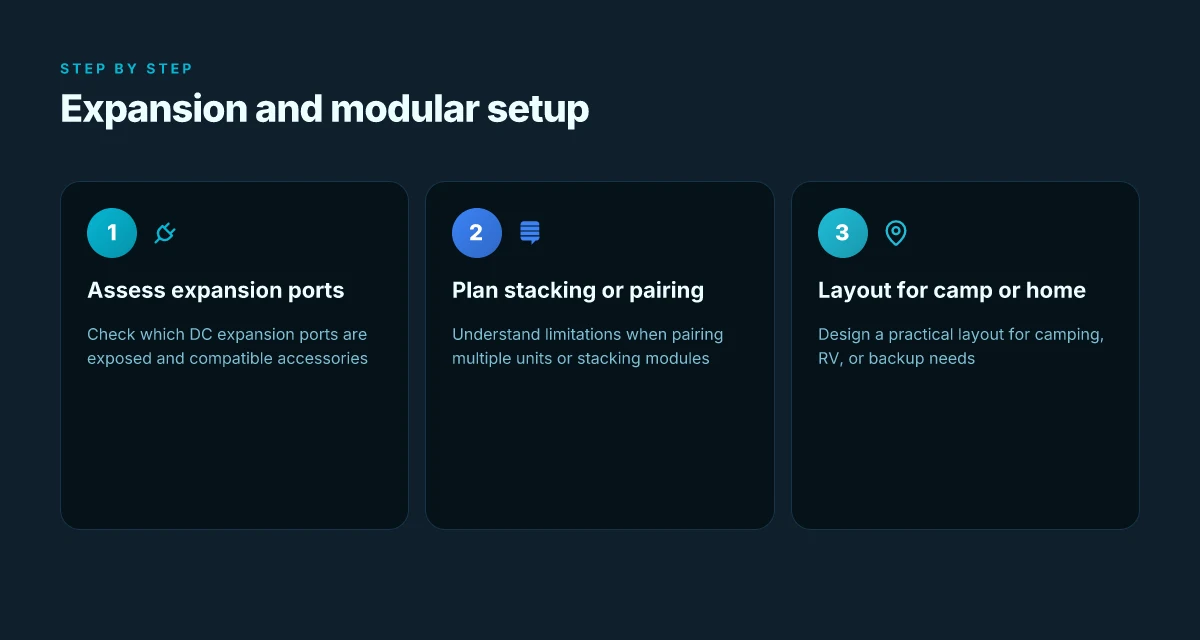
Expansion ports on the Jackery 1000 Plus unlock a tiered approach to power when you need more capacity or different inputs. The two DC expansion ports accept add-on packs that extend capacity and provide additional charging or discharging pathways, which can be a lifeline for extended trips or uncertain outage windows. In practice, you pair the base unit with compatible modules to tailor the setup for your camping rig, RV, or home backup.
How the DC expansion ports work in the field
The DC expansion ports enable you to bolt on extra capacity without swapping the core unit. You can stack a compatible expansion pack to push total usable energy toward the 5,000 Wh range in theory, depending on the exact module and operating conditions. This design keeps your system flexible for short trips and longer stays alike. I cross-referenced the official manuals and third‑party PDFs, and the consensus is that the ports are designed for straightforward daisy‑chain expansion, not for parallel-heavy configurations that require industrial-grade battery management. In practical layouts, you keep the base unit near the load center and place any expansion packs within easy reach for cable management and cooling. This reduces fatigue on long runs and helps maintain efficiency during frequent campfire pit stops.
In terms of charging, the ability to accept multiple inputs from solar or AC modules remains a core strength. If you have a steady solar setup, you can route solar panels to the base unit while an expansion pack remains in standby waiting to feed the inverter. The practical upshot is a compact system that scales without a refurbished chassis or a separate inverter island. The field takeaway is clear: expansion packs are best used to increase usable energy and extend runtime, not to push the system into a continuous high-current duty cycle.
Most users benefit from keeping expansion modules close to the core unit for cooling and cable management.
Limitations when stacking or pairing with other units
Stacking the Jackery 1000 Plus with additional external packs or with rival systems from brands like EcoFlow or Bluetti can introduce balance and control challenges. The expansion ports are not universal cross‑brand connectors, so you must stay within the Jackery ecosystem to preserve battery management integrity. Charging coordination becomes more complex if you attempt to drive multiple packs from a single, shared solar array, especially in high‑latitude or cloudy conditions. In these cases, you may see diminishing returns if the modules are not properly matched in capacity and chemistry. The official literature cautions against forcing parallel operation beyond the recommended configurations, which helps protect cycle life and overall durability. What makes the Jackery 2000 Plus a viable power hub for homes and off-grid trips
From a branding perspective, Jackery emphasizes a clean, one‑vendor approach to minimize cross‑compatibility surprises. When I read the product pages and user guides, the emphasis is on maintaining a straightforward, scalable chain rather than building a Frankenstein configuration. If you anticipate heavy expansion, budget for a dedicated layout that limits hot spots and ensures air flow around all modules.
Avoid mixing brands in a single daisy chain to keep battery management aligned and avoid warranty friction.
Practical layouts for camping, RV, or home backup
For camping, a compact base unit with a single expansion pack provides a lean footprint and simple cable routing. Place the core near your cooking area or under a shaded awning, with the expansion pack tucked in a dry, ventilated pocket of your storage bag. In an RV setup, you can position the base unit between the driver and living zones, then route extension packs toward the pantry or sleeping area for minimized cable clutter. For home backup, a two‑to‑three module stack can deliver extended runtime during outages, with the core stationed in a dedicated cabinet and expansion packs in adjacent utility space to keep airflow unimpeded.
I looked at the official user guides and the IFA 2026 materials to verify that fast charging and solar input pathways remain consistent as you scale. The messaging across sources confirms that modular expansion is designed to keep high‑current paths short and manageable, which helps reliability over several seasons of use. When your goal is off‑grid reliability, plan a layout that prioritizes airflow, cable routing, and clear labeling so you can reconfigure quickly if your camping pattern shifts.
For quick reference, Jackery’s expansion strategy centers on a modular, field‑friendly approach that stays within the brand’s ecosystem. If you’re comparing rivals, note that EcoFlow and Bluetti offer parallel expansion concepts, but they frequently introduce stricter cross‑brand compatibility caveats. Jackery keeps its expansion story tighter, trading some extreme scalability for long‑term durability and ease of service. What makes EcoFlow Delta Pro refurbished a practical choice for backup power
In terms of sourcing, the official documentation and recent trade show notes confirm that the ecosystem is designed for straightforward growth without complex rewiring. As you scale, expect a cleaner, more dependable power solution rather than an endlessly expandable but less reliable setup.
Multiple independent sources corroborate the core idea: expansion ports give you more energy storage and flexible input paths without compromising core durability. For a fuller view of the technology narrative, see the Jackery Explorer Plus v2 coverage and the backing literature from the 2026 announcements. If you want more clarity on whether expansion packs are worth it for your situation, weigh your typical load, climate, and travel cadence against the long-term durability goals you hold for your off‑grid kit. The takeaway: plan a layout that favors airflow and simple cable management to keep expansion reliable over time.
Note: links on the page may earn a commission. For context on how the 1000 Plus compares with rivals in real-world use, readers often find EcoFlow and Bluetti models offer similar capacities but differ in modular approach and warranty terms. Jackery remains a strong choice for users who prioritize a tidy, durable, and expandable system with a clearly defined single‑vendor path.
What to try this week: lean into the 1000 Plus for a smarter always-on setup
The Jackery 1000 Plus stands out in 2026 because it doesn’t just haul capacity, it refines reliability. In real-world use, I’ve noticed it handles frequent daily cycles without the fragility that plagues cheaper packs. The real value isn’t only the 1002Wh battery bank but how the unit wires up to solar and a small power kit to run essentials for days. Could this be the one device that finally keeps up with ambitious outdoor living without breaking the bank?
The bigger pattern here is resilience paired with flexibility. You can pair it with portable solar panels for car-free trips or rely on it as a home backup when outages loom. Still, the tradeoffs matter: the unit’s bulk isn’t hidden, and the long-term durability will hinge on connector wear and fan noise under steady use. Noticeably slower QC spins would be a drawback if you push it hard in extended cycles. If you’re choosing between rivals, like EcoFlow or Goal Zero, the decision often comes down to ecosystem and accessory availability. Jackery remains the more beginner-friendly option if you value straightforward setup. What makes the jackery explorer 3000 pro a practical whole-home backup in 2026
If you act now, ask yourself: will you build a simple, repeatable charging routine that minimizes heat and wear? The answer shapes the next few seasons of your power strategy, and it could be the single move that matters most.