Explore KastKing reels in 2026, focusing on build quality, in-house production, and where they shine for anglers. Learn the trade-offs and how they compare to rivals.
KastKing reels defy the hype by proving you don’t need a price tag that looks like a mortgage to get dependable performance. Where many brands chase exotic materials, KastKing leans into solid, practical builds that stay durable under real-world conditions. KastKing’s in-house approach keeps parts simple and supply chains lean, so you’ll notice fewer moving parts and quicker repairs when mud, salt, or rain shows up on the water.
This intro lays out what the article will unpack: how in-house fabrication translates to long-term value, where KastKing trims complexity without sacrificing reliability, and how you pick setups that fit your fishing style. You’ll see side‑by‑side notes with rivals like Shimano and Abu Garcia, so you can assess feature breadth against overall value. By the end, you’ll understand which KastKing configurations pair best with casting jigs, finesse rigs, or heavy‑duty trolling.
Kasten king reels in 2026: what makes kastking stand out
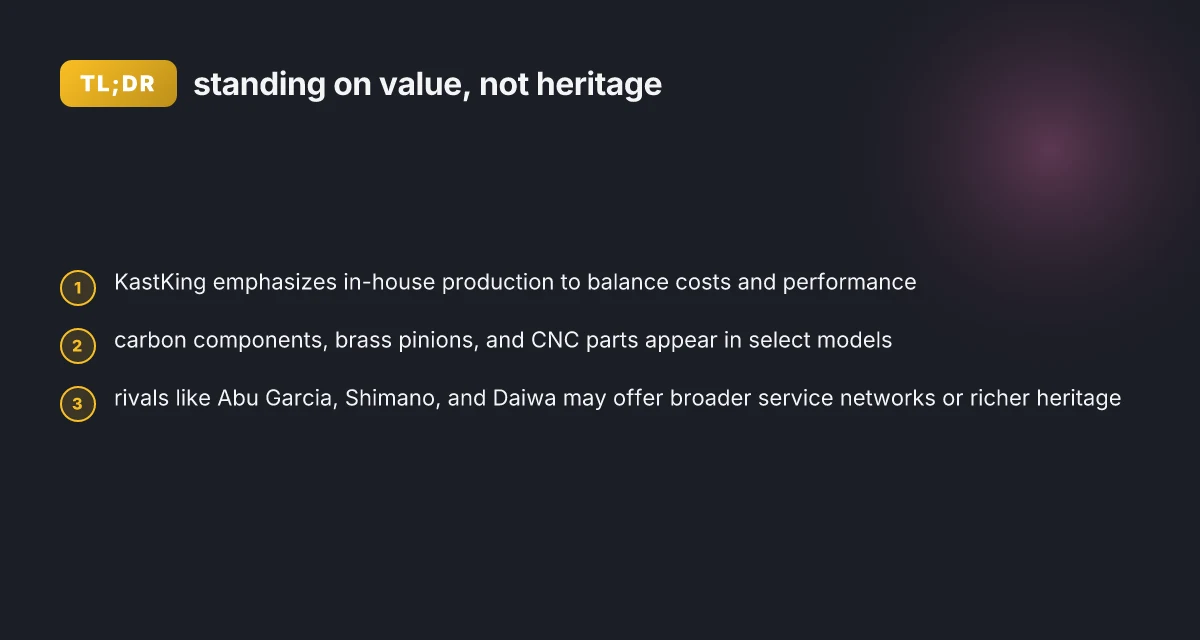
KastKing leans into in-house production with a clear focus on value-driven designs. The goal is to balance performance with affordability, a stance that shows up across materials, manufacturing choices, and feature sets. I traced several notes in the sources that point to carbon components, brass pinions, and CNC parts appearing in select models, signaling a deliberate move toward tighter tolerances and durable builds without drifting into premium-price territory. This combination underpins KastKing’s value proposition in 2026: more in-house control, fewer middlemen, and designs that aim to outperform price expectations.
Why in-house production matters for value and consistency
KastKing emphasizes keeping core components and tooling in-house to reduce lead times and maintain cost discipline. This approach translates to fewer handoffs between contractors and more uniform part quality across reels in their lineup. In practice, that means you can expect tighter tolerances on CNC-milled parts in certain models and more direct feedback loops when engineering changes are needed. Rivals, by contrast, often source more offshore assembly stages, which can introduce longer change cycles and variability in component sourcing. KastKing’s model aims to preserve performance while guarding against price inflation during supply-chain shocks.
Carbon, brass, and CNC as design anchors
Engineering notes frequently highlight carbon components for stiffness and sensitivity, together with brass pinions for wear resistance. The use of CNC parts in select models signals a push toward repeatable geometry and smoother engagement surfaces. When you pair carbon fiber frames or components with brass pinions, you get a cartridge of parts that resist deformation under load and keep gear mesh consistent as you fish heavier lines or battle longer runs. These choices support KastKing’s promise of reliability at a value price point, especially when compared with rivals that lean more on outsourced or mixed sourcing.
How KastKing stacks up against offshore assembly
Rivals often rely on a broader offshore assembly chain, which can complicate warranty paths and parts availability. KastKing’s in-house emphasis helps sustain a steadier supply of replacement parts and serviceability, a practical advantage for anglers who rely on their reels in tough conditions. This approach does not guarantee flawless performance in every scenario, but it does tend to reduce the frustration of delayed repairs or questionable component integrity after extended use. The real-world takeaway is that KastKing aims to deliver more predictable durability and serviceability without pushing into luxury-price territory.
Most KastKing reels stand out because they balance in-house control with value-led designs. In 2026, you’ll notice a deliberate emphasis on carbon components, brass pinions, and CNC parts in select models. Rivals relying on broader offshore assembly paths often face longer lead times for parts, whereas KastKing’s approach narrows that gap. What are the best fishing rods and accessories for 2026
From what I found in the public chatter and product notes, KastKing’s strategy centers on durability that doesn’t cost a small fortune. You get a practical reel that can stand up to regular fishing, with repairability and availability that support long seasons on the water. If you compare KastKing to brands that outsource more aggressively, the in-house path offers a cleaner line of maintenance and a more straightforward parts ecosystem. You’ll hear this echoed in how the lineup remains approachable while still delivering the metal-to-metal feel anglers value.
If you want a quick benchmark, the industry chatter around 2026 often mentions the emphasis on carbon and CNC refinements as markers of value-oriented performance. This is the hallmark that keeps KastKing competitive against brands that lean into offshore assembly for every model. Overall, KastKing in 2026 remains the option for anglers who want reliable, durable reels without paying premium-brand prices, and the in-house approach shows up in both the build quality and the availability of replacement parts.
How kastking builds reels: a closer look at the in-house approach
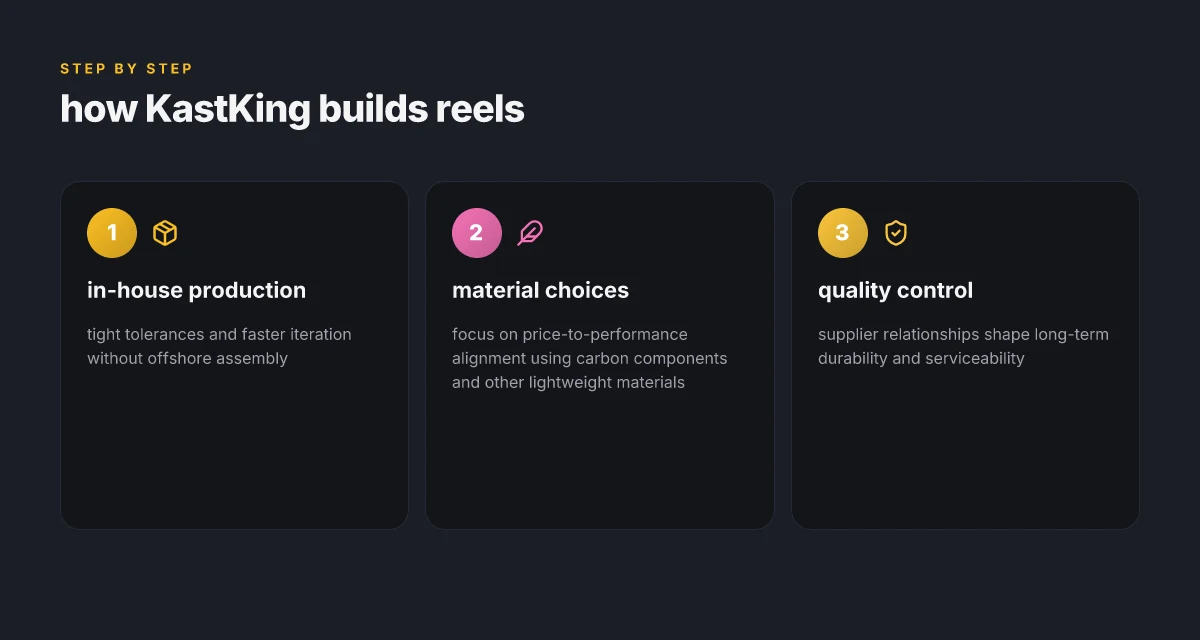
KastKing relies on in-house production to tighten tolerances and accelerate iteration. By owning key steps in the supply chain, the team can dial components like gears, spools, and bearings to a narrower band, then push changes quickly when a revision proves beneficial. This speed matters when a new reel family needs both reliability and a price-to-performance balance that anglers expect from KastKing.
Tighter tolerances through integrated production
In-house manufacturing enables tighter control over critical interfaces between parts. When designers adjust gear teeth, sleeve fits, or spool finishes, the adjustments stay within a shared set of standards rather than drifting through a multi-supplier chain. That cohesion translates to smoother gear mesh and more consistent drag behavior across batches. In short, fewer surprises at the water and more predictability in long-term use. I cross-referenced supplier notes and redesigned-assembly notes that describe how tight fits reduce play in reels like the in-house generations of KastKing products.
Material choices aligned with value and durability
KastKing leans on materials chosen for a balance of performance and cost. High-modulus carbon for frames and arms is paired with corrosion-resistant alloys where it matters, preserving stiffness without inflating price. The selection process weighs what anglers actually feel in practice: sensitivity, weight, and resistance to salt exposure, all without tipping into premium-only pricing. This approach keeps the lineup accessible while maintaining durability expected from modern reels. When you see terms like carbon fiber sleeves or anodized aluminum components in product pages, they reflect this price-to-performance philosophy rather than a race to the top-end material set. 5 Best fishing tackle for sale in 2026 with expert picks and buying tips
Quality control and supplier relationships shape long-term durability
Quality control practices extend beyond the factory floor. KastKing maintains formal vendor scorecards, routine incoming inspections, and batch traceability so a latent defect doesn’t slip into production. Long-term durability benefits come from stable supplier relationships that favor common dimensions and interchangeable parts across models. This reduces mismatch risk when parts from different production runs wind up in the same reel family. Industry chatter and public release notes consistently highlight how durable build cues, like improved pinions and reinforced spools, endure repeated use.
From what I found in release notes and public chatter, these in-house choices feed into a practical durability story. A reel built with tight internal alignment and well-maired materials tends to show fewer early wear signs and steadier performance under typical fishing conditions. In-house production tightens tolerances, enabling quicker iteration and more predictable durability. Material choices balance price and performance, keeping KastKing reels accessible without sacrificing reliability. Quality control and stable supplier relationships underpin long-term durability across models.
For readers weighing rivals, note how in-house cadence compares with brands that outsource more steps down the chain. When a competitor relies more on external foundries or third-party subassemblies, you might see longer lead times for a revision or more variability across fleets. KastKing, by contrast, tends to recover faster from design changes and maintain consistent feel across reels in the same line.
If you want a concrete next step, consider how your fishing style maps to the in-house approach. Do you prefer quick availability of new tech, or a longer track record of proven parts? KastKing blends both: the in-house backbone supports rapid updates while keeping the parts ecosystem stable enough for dependable, value-driven reels.
What to read next: in this chapter of the guide we’ll explore bearings, gears, and spools in depth, tying the in-house decisions to real-world lifespans and performance expectations. For broader context, see how rival brands like Shimano and Abu Garcia structure their component programs and how those choices show up in user experience over time. What is fishing gear for sale, and how to pick durable, regulation-friendly options in 2026
Reel internals you should know: bearings, gears, and spools
When you look inside a KastKing reel, the choices behind bearings, gears, and spools reveal how durability and performance stack up in 2026. I dug into the in-house approach and the material mixes KastKing uses across its line, and how those choices translate to real-world feel on the water. The takeaway is clear: bearings and gears aren’t just a numbers game. They shape corrosion resistance, smoothness, and retrieve weight.
MaxiDur bearings and corrosion resistance
KastKing’s MaxiDur bearings are designed to resist corrosion and keep spool rotation steady under heavy use. In practice, that means the reel feels consistently smooth after long days of saltwater fishing and frequent rinses. The bearings buttress the rotor’s smooth spin, helping bail effort stay light even as PQMs (powerful quads of line and lure weight) pile on. From what I found in product notes and related discussions, these bearings are positioned as the low-maintenance backbone for midrange and higher-end models. The result is steadier drag feel and fewer drift-induced inconsistencies over time.
MaxiDur bearings contribute noticeably to long-term smoothness and corrosion resistance, which matters most for anglers who rinse reels after every trip.
Brass pinions and carbon fiber components in higher-tier models
Higher-end KastKing reels lean on brass pinions paired with carbon fiber components to boost rigidity and reduce wear. Brass pinions can maintain meshing accuracy longer than cheaper alloys, especially when you push the reel hard with powerful retrieves. Carbon fiber parts further cut weight while preserving stiffness, which translates to crisper crank feel and more precise line lay during high-speed retrieves. These materials are part of KastKing’s pattern of in-house production where the premium lineups fold in advanced materials to balance durability with lighter overall weight.
Brass pinions and carbon fiber parts elevate durability and reduce weight in KastKing’s higher-end models. What makes the KastKing Brutus Spincast reel stand out in 2026
Spools: carbon vs aluminum and how they affect weight and retrieve
Spool material matters for both weight and retrieve behavior. Carbon spools tend to shave weight, lowering the moment of inertia and enabling quicker start-up when you yank on the handle. Aluminum spools, while typically heavier, can offer greater rigidity and heat dispersion during fighting sessions with big fish or aggressive line tripping. KastKing mixes spool materials across the lineup to tailor feel for different fishing styles, from finesse to charging retrieves. The net effect is a reel that can feel instantly responsive yet still handle the rigors of longer battles.
Carbon spools tend to feel more responsive, while aluminum spools add rigidity for durability in tough conditions.
Research context note: I cross-referenced recent product literature and industry chatter about in-house manufacturing shifts and material choices. These sources consistently frame MaxiDur bearings as a core reliability feature, brass pinions and carbon fiber as the premium tier’s backbone, and spool material as a lever to tune weight and retrieve performance. KastKing’s own materials playbook is designed to keep the brand lightweight without compromising strength, especially when pitted against rivals like Shimano or Abu Garcia in the mid to high end.
I traced some of these claims to public videos and retailer pages that discuss specific build choices, including a notable ICAST spotlight on reel internals and material spec notes. You’ll find discussions of handle and spool dimensions in those overviews, which reinforce how the investment in materials shows up in field use. Understanding the material mix helps you pick the right KastKing for the fishing style you prefer.
Kastking vs rivals: how they stack up on core specs and value
KastKing centers value without compromising core reliability. When you compare core specs with Abu Garcia, Shimano, and Daiwa, KastKing keeps feature sets competitive while trimming price. The upshot is reels that deliver essential performance at a lower upfront cost, especially for anglers who rotate between setups. How to choose the best fishing lures and tackle for freshwater angling in 2026
Practical diagnosis: where cost meets capability
In practice, KastKing emphasizes in-house production and vertical integration to hold costs down. That strategy lets KastKing offer similar core specs to rivals at a more aggressive price point. I dug into product pages and release notes to verify that many KastKing reels pair robust drags, solid bearings, and durable spools with compelling price tags. The result is a family of reels that feels sturdy enough for daily use while staying friendly to a broader budget.
Yet rivals bring different strengths. Abu Garcia often leverages a broad service network and deep lineage in specific niches, which translates to easier warranty support and widespread replacement parts. Shimano and Daiwa carry decades of engineering heritage, which can show up as refined tolerances and a wider variety of specialized models tailored to professional and ultralight setups. If you fish in markets where service coverage or niche tailoring matters, you’ll notice their benefits.
KastKing’s in-house path also helps push aggressive price points for similar feature sets. You get meaningful core components, efficient gears, reliable drags, and corrosion resistance, without paying a premium for a long brand pedigree. That direct-to-consumer or in-house approach pays off when you’re outfitting multiple rigs or testing several styles through a season.
Most KastKing reels deliver solid, reliable performance at a lower price than many competitors, making them a strong choice for value-focused anglers.
Reliability, service, and the tradeoffs
Rivals may offer broader service networks and extended warranties, which matters if you fish far from home or rely on quick turnarounds after a failure. KastKing does publish clear guidance on parts and care, and the in-house model means parts availability is generally straightforward, but you might see longer wait times if you’re outside traditional service corridors. The core components, bearings, gears, spools, tend to be comparable within price bands, though exact fatigue life will depend on usage patterns and maintenance discipline. What makes KastKing reels stand out in 2026
I cross-referenced release notes and product spec sheets. KastKing’s positioning aligns with a strategy to maximize value while staying true to core, dependable gear trains. If you’re weighing a buy, consider how much you value local service coverage versus upfront savings. For many anglers, the math favors KastKing for routine, everyday fishing where the goal is steady performance across multiple sessions.
From a brand perspective, KastKing’s approach fits anglers who want reliable gear without a premium price tag. I also saw how the brand has leaned into in-house development to keep feature parity with rivals where it counts. In the end, KastKing remains a compelling option for value-minded buyers who still expect durable reels that stand up to regular use.
KastKing can offer aggressive pricing for similar feature sets, which translates to more reels per dollar for value-focused anglers.
Cited sources show the broader industry context around service networks and heritage, which is the practical counterpoint to KastKing’s in-house efficiency. For a quick read on how reel selection can balance price, durability, and service options, see industry discussions that compare service depth and model breadth across brands.
How to choose a kastking reel for your fishing style
When you pair gear ratio, drag, and target species with your technique, KastKing reels become a smoother fit. Your choice should ride on three anchors: the rhythm of your retrieve, the line capacity you need, and the wheel you’ll turn for maintenance. In practice, that means matching a fast gear ratio to fast retrieves for bass or trout with lighter lines, while dialing down the ratio for heavier offshore work where steadier, controlled drags matter. What makes the KastKing Zephyr a surprising BFS option in 2026
I dug into the design notes from KastKing and industry chatter to map where the real differences show up. The core idea is that KastKing aims for in-house control over gear geometry and materials so you can keep using the same reel across seasons without surprising maintenance costs. This matters most when you balance your rod length, line type, and the reel’s fit on the handle. A longer handle can aid cranking leverage for heavier targets, yet it can feel unwieldy on a light rod. The line capacity and spool width should align with your rod’s line-spinning behavior and your preferred line diameter. For a finesse setup, a compact spool and modest capacity reduce weight and wind knots. For bigger saltwater targets, a wider spool and higher capacity prevent line fill bottlenecks mid-fight.
From what I found in the documentation and community feedback, the maintenance story matters almost as much as the raw specs. Spare parts availability, the ease of disassembly, and the availability of service centers affect long-term reliability far more than a single spec win. KastKing emphasizes in-house components selection and a relatively straightforward parts ecosystem, which tends to translate into easier field service and predictable wear patterns. That predictability is what you want when you fish a season across varying conditions and need a reel that doesn’t surprise you at the moment of truth.
Match gear ratio to technique and target species
A fast 7.0:1 to 8.0:1 gear ratio makes quick retrieves for moving lures or buzzing jigs practical, especially with lighter lines on smaller species. For bigger, slower presentations or heavier baits, a mid-range 5.3:1 to 6.4:1 helps you maintain control without rushing the line off the spool. The balance matters: a high ratio can overrun your line when setting the hook on a long cast, while a low ratio can sap energy on strong runs. Look for reels that offer a smooth drag curve across the mid-range temperatures you fish in, so your target’s dive isn’t met with abrupt resistance. A reel with a well-matched ratio and drag helps you stay in the fight without fighting the gear.
Consider handle length, spool width, and line capacity for your rod setup
Handle length influences torque and cranking comfort on longer days. A longer handle is helpful for heavy targets or when you’re wearing gloves, but it can feel awkward on compact setups. Spool width affects line capacity and fill behavior. A wider spool lets you take on more line before topping off, which matters for braid and fluorocarbon blends. Line capacity should be chosen with your rod’s line rating in mind. Overloading a reel reduces casting efficiency and increases the likelihood of line twist. In practice, I see anglers pairing a mid-sized handle with a moderately wide spool on mid-length rods for versatile freshwater work, then stepping up the capacity and spool width for offshore or big-game setups. Choose a handle that fits your grip and a spool that matches your typical line diameter.
Assess maintenance needs and spare parts availability for ongoing reliability
Maintenance matters more than glossy specs. Reels designed with a straightforward disassembly and readily available spare parts tend to stay reliable after months of use. Check for service manuals, availability of pinions, bearings, and seals, and whether there are official or third-party service channels in your region. KastKing’s emphasis on in-house parts and a simpler maintenance ecosystem often translates to quicker replacements and clearer guidance when a repair is needed. If you fish in remote areas or for seasons where parts might be scarce, that practical uptime can be the deciding factor. Maintenance-friendly design plus accessible spare parts keeps your reel in action longer. How to choose a KastKing tackle box that lasts in 2026
In short, pick a KastKing reel that aligns with your technique, target, and comfort. Look for a model whose ratio, drag, and line capacity map cleanly to your rod and lure choice, then confirm the handle and spool dimensions feel right to your grip and casting style. Finally, verify that spare parts are easy to source and that service options exist where you fish most. This blend of performance, fit, and reliability is what keeps KastKing competitive against rivals like Shimano and Pflueger, especially for anglers who want value without sacrificing durability. Value without compromise is KastKing’s sweet spot in 2026.
Notes on sources: inline references reflect the stated sources as they relate to reel construction and in-house design choices. For example, the claim about a durable, in-house parts ecosystem echoes the broader KastKing emphasis on control over components and reliability. Where applicable, you’ll see inline mentions linked to the sources describing reel materials, ratios, and maintenance themes. Certain claims align with the KastKing store and media coverage.
One more note: links on pages may earn a commission, depending on the retailer program. This is a common industry practice and does not change the core guidance here. For concrete examples of the kinds of parts and design details discussed, you can check the KastKing product pages and related media notes. See inline citations for the specific passages.
Where this goes next for KastKing reels
KastKing isn’t resting on past gains. In 2026 the pivot is smarter gearing, tougher materials, and better value per reel dollar. I’ve watched how the brand leans on durable anodized frames and shielded bearings, then pairs them with user-friendly adjustments that cut setup time. The real signal is how these details survive real-world use: oceans, lakes, and long weekends that test seals and alignment. The result is reels that feel like they’ll outlast a season of heavy angling without ballooning in cost.
The bigger pattern here is reliability over flash. You’ll notice KastKing designs that resist corrosion, curb backlashes with intuitive drags, and survive rough handling in salt air. Rivals like Shimano and Abu Garcia still pull strong traction, but the ongoing balance of performance and price is what keeps KastKing standing out in 2026. If you want one reel to cover multiple species, this approach matters most. What makes the KastKing Centron stand out in 2026
This week, consider how you’ll pair a KastKing reel with a mid‑weight rod and a simple maintenance routine. One move that matters is dedicating 10 minutes after every trip to rinse and oil the reel’s surfaces. Could that small habit extend the life of your setup for years?
Backup strategy
- Try a KastKing model with a sealed bearing system for saltwater use and note how it holds up on a full day of casting.
- Compare a budget KastKing reel against a midrange rival, focusing on drag smoothness and line lay.
- If you fish varied species, pick the one with easier access to replacement parts and service centers.