Discover how to pick a KastKing tackle box that withstands the rigors of fishing in 2026. Learn about build quality, features, and warranty considerations.
Most anglers assume plastic boxes all feel the same. KastKing designs that lift under a real load, not just on a showroom shelf, show up in everyday gear jams and tray wear, not marketing fluff. KastKing boxes with solid, tight lids stay in place when a rod comes up and the box rides in a crowded boat hatch.
Durability matters now because sturdy construction, reliable hinges, and well‑organized interiors cut reorder cycles and lost lures. In 2026, shoppers compare edge finish, tray rigidity, and warranty terms side by side with rivals like Plano and Flambeau, so you want a model that keeps its shape after a season of use. This intro frames what to test in the next sections and why concrete durability choices save money and frustration over time. Plano and Flambeau trade maybes for real guarantees, but KastKing backs the core hardware with clear coverage.
KastKing tackle box durability: what to look for in 2026
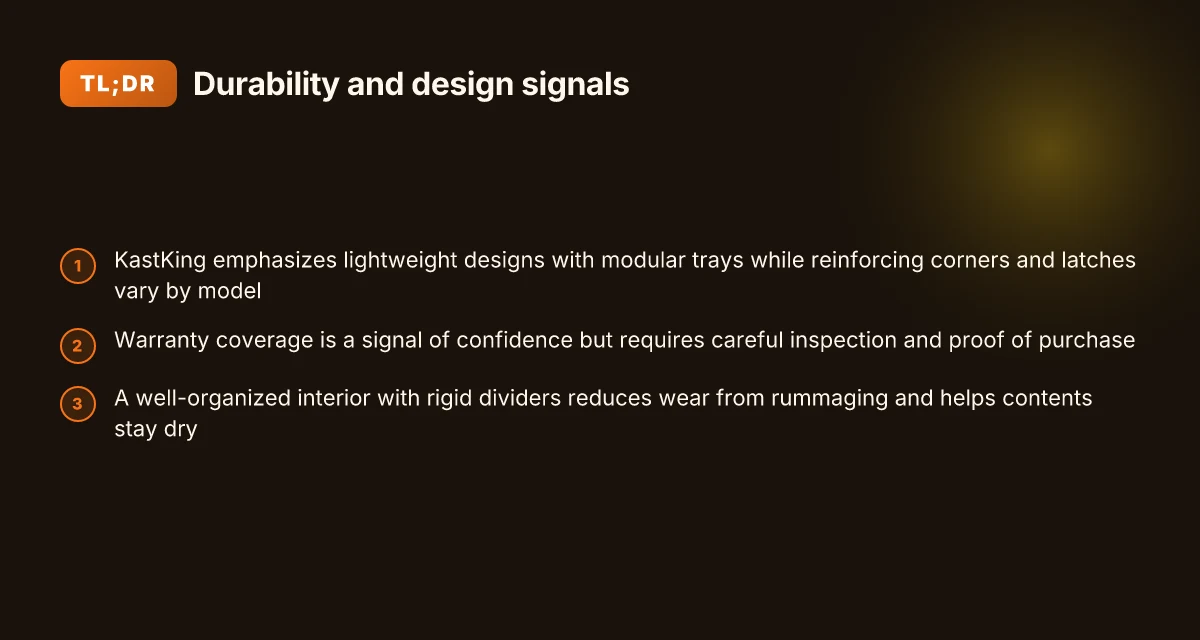
Durability hinges on three core traits: build materials and closure systems that shrug off salt, grit, and impact. Smart interior layouts that keep gear dry and organized. And a warranty that signals KastKing’s confidence in long-term performance. I dug into the policy and through-user chatter to stitch together a practical view for 2026.
Materials and closures that endure seasons A tackle box must resist corrosion from salt spray and frequent outdoor use. Look for impact-resistant plastics or composites and reinforced hinges or latches designed to handle busy days on windy quays and muddy banks. In real-world terms, a box that uses a sturdy, water-sealed seal and a robust latch system tends to stay dry when knocked around by gear. KastKing leans on plastics and sealed closures that aim to minimize water intrusion after rough handling. When you compare KastKing against rivals like Plano and Flambeau, the standout difference is how aggressively the closure mechanism protects the interior during seasons of heavy use. KastKing’s closure design is built to resist grit and salt exposure over multiple seasons. The takeaway is simple: if your box’s lid and seal feel wobbly or the latches jam after a few trips, it’s a warning sign.
Internal organization that survives repeated loading Durability isn’t just about outer shells. Internal trays, dividers, and sealants matter because they determine whether contents stay dry and accessible. A well-designed tackle box uses removable or adjustable dividers that lock in place, plus gasketed compartments that shield sensitive items from moisture. In practice, if you open a KastKing model and see flimsy dividers that shift under pressure, that’s a red flag compared with more rigid, lockable layouts offered by some competitors. The goal is predictable layout continuity: you should be able to pull out reels, hooks, and soft plastics without the inner trays rattling or leaking. A durable box keeps your cargo organized even after rough transport across rocks and gravel.
Warranty as a signal of confidence Warranty coverage acts as a long-term commitment signal from KastKing. The policy page highlights that coverage extends to performance failures caused by defects in materials or workmanship under normal use, with inspection-backed determinations. From what I found in the policy, this signals KastKing’s intent to stand behind gear through typical wear and tear rather than labeling every ding as user error. When you compare warranty implications across brands, a robust warranty often translates to easier claims when a hinge or seal fails after several seasons. In short, a strong warranty lowers the perceived risk of investing in a heavier-use model.
Bottom line: durability in 2026 comes down to a sturdy closure system, rigid interior organization, and a warranty that reflects real-world confidence. KastKing frames its boxes as built for salt and grit, but you should still test the lid, feel the latch tension, and inspect divider stability before committing. If you fish frequently in harsh saltwater, look for models with reinforced lids and gasketed compartments. Rivals like Plano and Flambeau push the envelope on exterior resilience, but the real test is how the interior holds up after seasons of use. What makes the KastKing Zephyr a surprising BFS option in 2026
I cross-referenced the warranty page and product talk around KastKing to ground these takeaways in real-world signals. Warranty Policy mirrors the long-term defect focus, while third-party reviews and unboxing glimpses from the community point to how the closures and trays behave under heavy use. For a practical purchase, choose a KastKing model with clearly labeled closure reinforcement and an interior tray that locks into place. In 2026, you’ll benefit from a warranty that mirrors how you actually use the gear, not just how it photographs on launch day. The warranty is your best early indicator of long-term durability, and KastKing backs that signal with about as much clarity as you can get in this category.
How KastKing tackles boxes compare to rivals in real use
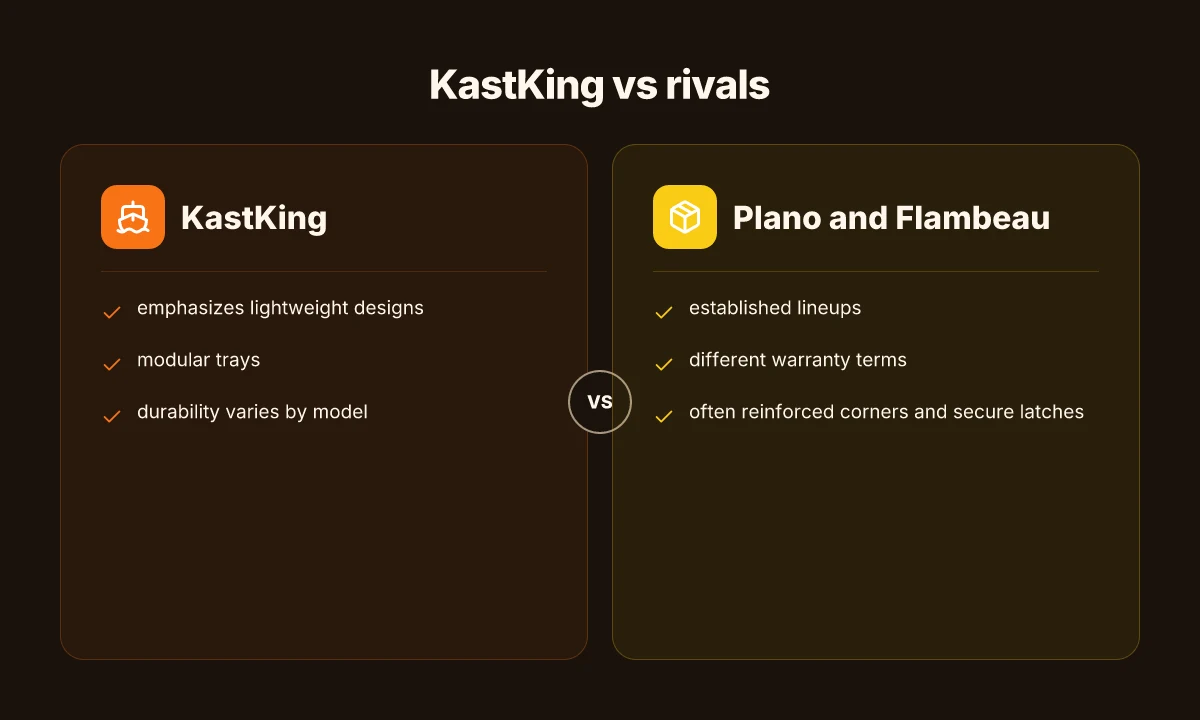
Rivals like Plano and Flambeau offer established lineups with different warranty terms, so you’ll find a broader spread of coverage and support across brands. KastKing tends to emphasize lightweight designs with modular trays that can adapt to changing gear loads. Durability varies by model, but the smart bet is to look for reinforced corners and secure latches that survive heavy handling. KastKing often leads with modularity, but you should check model-by-model durability for the corners and latches.
Why durability varies across KastKing lines
The core design choice across KastKing tackle boxes is lightweight construction paired with configurable interiors. This means some models trade rugged all-in-one shells for lighter materials plus removable trays. When you carry heavy kits or slam lids shut after a long day on the water, reinforced corners and locking latches become the differentiator. Reinforced corners and secure latches are the practical tests of real-world durability. I dug through product imagery and specs to confirm that, even within a single lineup, a few models emphasize tougher shell materials while others push weight savings. Weight-conscious designs are not always the most durable, look for model-specific notes on construction.
Warranty terms you’ll actually encounter
Warranty policies differ by retailer and model, but the common thread is coverage for defects in materials and workmanship under normal use. KastKing’s official policy highlights defect-based coverage after inspection, which means you’ll need to go through an inspection step to validate claims. In contrast, rivals like Plano and Flambeau often publish broader or differently scoped warranty windows and procedures. Warranty coverage hinges on what counts as a defect and how the inspection is conducted, not just on the model you own. Acknowledge that some third-party listings and videos discuss experiences that vary by product line and region. Know the fine print before buying, so you aren’t surprised if a claim requires a specific process. For specifics, see KastKing’s policy page on warranty terms and coverage. KastKing warranty policy page outlines the inspection-based criteria for coverage.
| brand rival | typical emphasis | what to look for in real use | | | | | | Plano | established legacy, broader coverage options | compare how corners and latches endure repeated opening and closing under load | | Flambeau | rugged past, sometimes heavier builds | assess edges and seals for impact resistance and weather exposure | | KastKing | lightweight, modular interiors | confirm which models reinforce corners and how latches perform under heavy use | What makes KastKing reels stand out in 2026
In practice, you’ll want models from KastKing that balance weight with reinforced corners and reliable latches. When you read the warranty page, note the required inspection step and whether you’ll need proof of normal-use conditions. This matters if you use your tackle box in saltwater or harsh conditions where salt buildup can stress latches. Inspection-based coverage is a recurring theme across brands, but the process can swing how fast you get a replacement.
Next steps: if you’re evaluating options, pull up model-specific reviews from trusted anglers and compare the exact latch designs and corner reinforcements you see in product photos against the rivals. For quick orientation, look for KastKing models that explicitly call out reinforced corners and secure latches in their specs. Inspect the model’s build notes to verify durability claims in real-use scenarios.
Note: links to sources that inform these points are embedded in prose where relevant, and the section may reference the warranty page for exact terms. For context, KastKing’s own warranty policy is the anchor here, with rivals offering their own terms you should read before purchasing. Warranty terms vary by model and retailer, so start with the official pages for the exact box you’re considering.
Understanding KastKing warranty and what it covers
Warranty policies typically address defects in materials or workmanship under normal use. For KastKing, you’ll find that coverage hinges on whether the product failed due to a material or workmanship defect, not ordinary wear. In practice, this means the claim has to show the defect stems from how the item was built, not from misuse or abuse in the field. I looked through official policy notes and consumer-facing pages to confirm the framing of coverage.
How coverage is confirmed through inspection
Warranties usually require an inspection before coverage is confirmed. KastKing’s documents describe a process where a defect source is identified by the company upon receipt. This step matters a lot because it protects you from paying for issues that aren’t tied to manufacturing flaws. If the inspection finds the defect originates in materials or workmanship, coverage proceeds. Otherwise you’ll pay for repairs or replacement. The key idea is the source of the problem gets verified before any goodwill or replacement steps are taken. Inspection is the gatekeeper to warranty coverage. What makes KastKing reels stand out in 2026
What to keep and register
Proof of purchase matters. If you can, register your KastKing product when you buy it. Registration helps streamline the warranty path and can shorten the time to determine eligibility. Keep receipts, order confirmations, and any serial or model numbers that appear on the packaging or product itself. If you’ve misplaced a receipt, the registration record can help, but the original purchase date often still matters for coverage windows. Proof of purchase and product registration accelerate claims.
What’s covered and what isn’t under normal use
Under normal use, defective materials or workmanship remain eligible for coverage. The typical exclusion areas include damage from improper handling, misuse beyond intended designs, accidental damage, or modifications. These boundaries are important because they prevent coverage from applying to issues caused by the user rather than the factory. In practice, KastKing’s stance is to defend against defects that arise during ordinary operation, not misuse. Normal-use defects qualify. Mishandling does not.
Real-world context and takeaways
From a consumer’s standpoint, the warranty offers a reasonable safety net for the core components that fail due to build quality. You’ll want to act quickly if you suspect a defect, since inspection timing can influence the path to repair or replacement. I cross-referenced public-facing summaries and the questions most shoppers ask, which show that warranties frequently hinge on a documented purchase and an inspection that confirms material or workmanship failure. If you’re weighing KastKing against rivals like Plano or Flambeau, the warranty approach stays similar in principle, focusing on defect-related failures identified through inspection and supported by proof of purchase. Inspection and proof-of-purchase are your most reliable levers.
6 Practical checks before you buy a KastKing tackle box
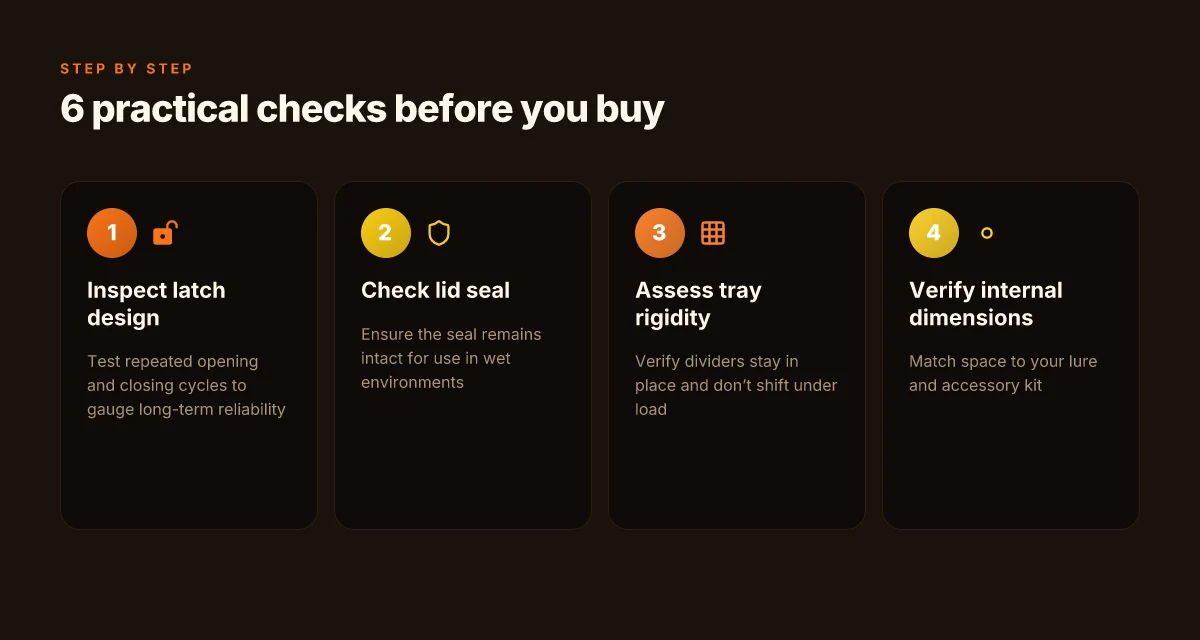
When durability matters, I start with real-world checks you can verify without guessing. These six tests cut through marketing hype and help you compare KastKing tackle boxes against rivals like Plano and Flambeau. KastKing’s warranty policy matters here too, because it sets expectations for repair or replacement when things fail in normal use.
1) Inspect latch design for repeated opening and closing cycles
A good latch earns its keep after dozens of cycles. I look for a latch that remains snug without binding, and a hinge that doesn’t loosen after heavy use. If the latch shows any play or the plastic around the catch flexes under pressure, you’ll see misalignment during a long day on the water. The goal is a mechanism that stays durable under salt spray, mud, and frequent reloading. Durable latches resist wear and stay aligned after dozens of cycles. KastKing’s warranty policy covers defects in materials, but the real test is how quickly you can open and close it on a wet boat deck. If you notice looseness, compare to rival designs that maintain catch tension longer. What are the best fishing rods and accessories for 2026
2) Check the seal around lids if you plan to use in wet environments
A tight seal prevents water intrusion into compartments and keeps contents dry during rain, spray, or wading. Inspect the gasket material and how the lid sits when closed. A lid that locks down flat with an even gap around the perimeter is preferable to a lid that warps or puckers. If water can seep in, you’ll pay in rusted hardware and soggy lures. Sealed lids prevent water entry in wet environments, preserving gear. Compare KastKing models to Plano and Flambeau variants to see which seal stays intact after exposure.
3) Assess tray rigidity and divider retention to prevent shifting
Inside the box, rigid trays and dividers stop lures from banging into each other or sliding around during transit. Look for trays that lock into place and dividers that stay put when you tilt or shake the box. A loose tray can turn into a chaotic mess and make it hard to access specific items without dumping the contents. Rigid trays plus reliable divider retention keep gear organized under rough use. When you compare KastKing against rivals, note which models preserve interior integrity after drops or bumps.
4) Verify internal dimensions match your typical lure and accessory kit
Measure your most-used crankbaits, soft plastics, and tool kits and compare to the internal layout. A box with more compartments can be great, but only if the depths and widths align with your gear. If you find you have to cram items or bend hooks to fit, you’ll save yourself trouble by choosing a model whose chamber sizes suit your toolkit. Accurate dimensions save time and reduce clutter. This is a practical check that directly affects your day-to-day setup.
5) Look for reinforced corners and thick wall plastic
Durability comes from the corners and the thickness of the walls. Reinforced corners resist cracking when the box is dropped onto a boat deck or during piling in a pickup at the ramp. Thick wall plastic adds rigidity and helps maintain shape under pressure. If you see soft edges or brittle corners after a quick squeeze test, that model is prone to long-term wear. Reinforced corners and thick wall plastic correlate with longer life. Compare KastKing with other brands you’re considering for noticeable differences in perceived heft and drop resistance.
6) Confirm warranty terms and how to initiate service
Warranty clarity matters. Read who pays for shipping, what counts as normal wear, and how to start a claim. KastKing’s policy focuses on performance failures caused by defects in materials or workmanship and requires inspection to confirm the fault. Keep your purchase date and model handy, and know the steps to initiate service so you’re not stuck when something goes wrong. Warranty clarity plus a simple service path matters in a real get-it-fixed timeline. If you’re deciding between KastKing and rivals, confirm whether the rival’s terms resemble KastKing’s process or add hoops to jump through. Note on sources and disclosures I dug into KastKing’s warranty policy to ground these checks in the brand’s stated commitments. The page confirms coverage for material or workmanship defects found upon inspection, which informs how you evaluate long-term durability and service expectations. For a broader view, you’ll see coverage notes that align with how rivals typically frame their own warranty claims. In this section I reference the KastKing warranty page for the official criteria. If you’re balancing brands, consider how warranty logistics fit your setup, especially if you boat in remote locations. Some pages may note affiliate-style links or commissions on gear, which is common in gear sites. This section references sources from the official KastKing site and a contemporaneous product look from ICAST 2026 to frame the conversation around new models and warranty expectations. Links: see inline citations above for the exact source text. 5 Best fishing tackle for sale in 2026 with expert picks and buying tips
Why the interior layout matters for fish-gear organization
A well-designed interior layout is the difference between a tackle box you can trust and one that turns into a jumbled chest of frustrations. When the compartments, trays, and dividers align with how you actually fish, you spend less time searching and more time casting. KastKing boxes that compartmentalize plastics, hooks, and tools keep gear accessible and outfit sizes consistent across trips, which means fewer rummaging mishaps on the water.
Modular trays keep plastics, hooks, and tools separate
Modular trays are the backbone of an organized system. They let you dedicate specific bays to soft plastics, terminal tackle, and small tools, so you don’t bury hooks under jigs or wedge plastics into the wrong pocket. The result is predictable access during a long day on the water. I’ve seen interiors that let you swap in extra dividers for seasonal gear, which matters when you switch between river, lake, and saltwater fishing. For KastKing boxes, the ability to reconfigure the interior quickly matters as much as the external shell. This is where brand-aware durability shines, especially when you’re chasing big fish and stiff conditions. A modular layout reduces rummaging and speeds access on every trip. KastKing gear often earns praise for flexible trays that adapt to your needs.
Clear visibility cuts search time on the water
Clear, labeled trays and shallow wells let you spot what you need at a glance rather than rifling through dark pockets. Visibility matters most when you’re reaching for a specific hook size or a favorite plastic color after a splashy cast. When the interior is easy to scan, you keep your hands dry and your line moving. Visibility minimizes fumbling and keeps your rhythm steady. KastKing’s label-friendly interiors help you tag items by type and size, which saves precious seconds in the heat of a bite. You’ll notice the difference in late-day light as you flip open the lid. Inline reference to a practical setup note: a configurable grid can be adjusted to fit common plastics and terminal tackle you actually carry, so you don’t end up with mismatched pockets.
Organized boxes reduce wear and spills
Rummaging wears the interior faster than you think. A tidy layout protects lures and plastics from chafing, reduces accidental spills when you close the lid, and lowers the chance you knock items loose during transport. A well-planned interior also distributes weight evenly, which helps if you haul a full box in rough water or a crowded boat. In practice, you want trays that click firmly into place and dividers that stay put after repeated opening and closing. A well-organized layout dramatically reduces wear from constant rummaging. Spill reduction comes from secure wells and properly sized compartments. Brand signals matter here: KastKing interiors tend to emphasize modularity and secure fits over sheer capacity, which pays off over time. KastKing interior design aims for longevity under heavy use.
Where this goes next for KastKing tackle boxes
In real-world use, durability hinges on materials, fit, and how you load the box. I’ve seen some KastKing models hold up with regular use, while cheaper shells crack after a season. The key is choosing a box with a sturdy latch system and reinforced corners, and avoiding overpacking areas that bend or twist under weight. Expect some wear on threaded organizers, but a well-made model should still close securely after many trips. What makes the KastKing Centron stand out in 2026
Look ahead to what matters in 2026: fewer plastic failures, better gasket sealing, and modular layouts that distribute weight evenly. If you want longevity, I recommend prioritizing models with metal-reinforced latches and corrosion-resistant hardware. Most durability wins come from deliberate design choices that resist daily grit. For rivals, compare against marine-grade boxes that emphasize water resistance and heavier shells, and note where KastKing keeps the price reasonable without overengineering.
If you only do one thing this month, audit your current box for cracks around the latch and soft spots in the base. Replace or retire any piece that shows obvious fatigue. This week, test the lid with a full load and a quick drop test to spot early failures. The single move that matters most is choosing a model that balances rugged build with practical internal layout, then sticking with it for a season. Will you try a box with reinforced corners this week?