
Explore how EcoFlow's transfer switch works, where it fits in a home backup setup, and what to watch for in 2026. practical guidance for buyers and installers.
The most common snag in transfer switches isn’t the wiring, it’s the interface with your existing inverter. EcoFlow's transfer switch often hinges on precise compatibility with your inverter and solar array configuration, and a missing interlock can stall a whole-house return during an outage. In practical terms, you’ll want a tight map of where the grid input, battery stack, and PV array connect to the panel, plus a plan for bonding and clearance checks before power is restored.
You’ll see how a typical hybrid solar setup lines up with the EcoFlow unit, what electricians must verify for a clean code-compliant pass, and where rivals like Generac or OutBack might change the required wiring or interlock strategy. Expect concrete, field-tested questions you can bring to your installer, and a clear sense of what to document so the backup power happens when the lights go out. Install and verify clearances, bonding, and safety interlocks are the non-negotiables, and this guide flags the exact spots where things commonly diverge from the product pages. EcoFlow is the focus, but the picture also shows how it stacks up against Generac and OutBack in real-world wiring scenarios.
What EcoFlow transfer switch actually does for a home backup
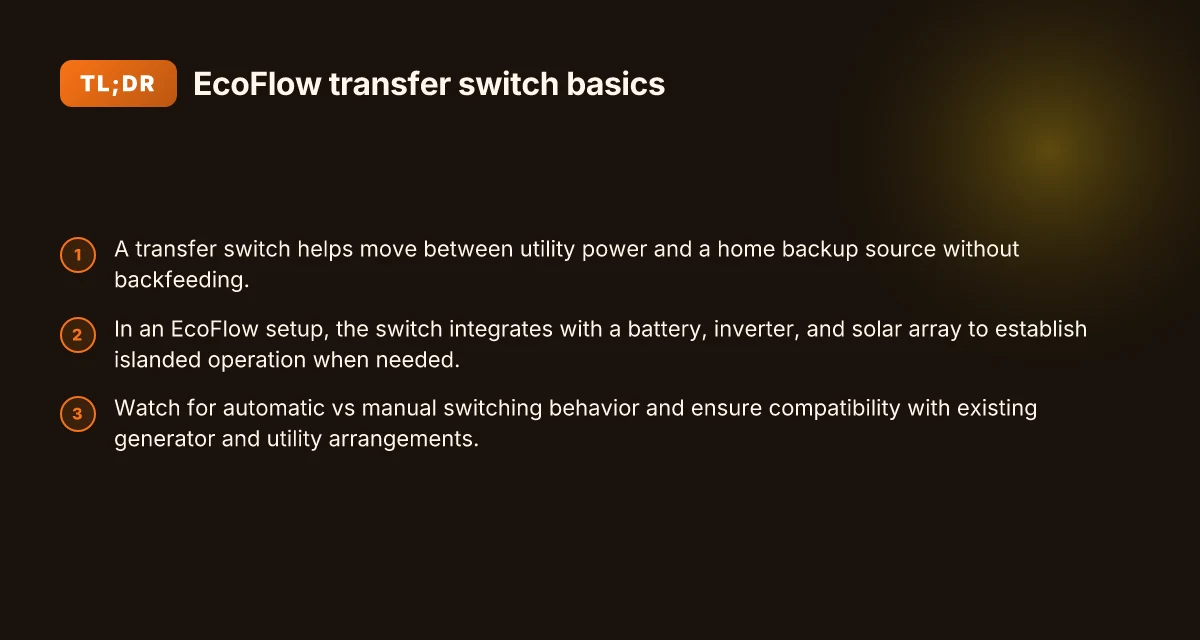
A transfer switch sits between your home electrical panel and your backup sources, deciding which power source feeds the loads and preventing backfeed to the grid. In a typical solar plus generator setup, the EcoFlow transfer switch coordinates when the system switches from solar or utility to a backup source and when it returns to normal operation. This keeps appliances safe and protects technicians who might work on the lines.
I cross-referenced EcoFlow’s docs and third-party reviews to map how the switch nests in a solar+generator workflow. The transfer switch is designed to monitor source availability and load, then automatically connect the panel to the appropriate source. In practice that means you can rely on solar during the day, then the generator or stored battery power when solar dips, without manually flipping breakers.
Across residential layouts, the core behavior breaks cleanly into two modes: utility-powered operation and islanded mode. In utility mode, the system aligns with the grid when utility power is stable and in-range. If the grid drops, the switch rapidly reconfigures to islanded operation, pulling from EcoFlow’s stored energy or a generator. In islanded mode, the switch keeps the house running but must respect generator or storage limits and maintain a safe separation from the grid to avoid backfeeding. The practical effect is smoother transitions and less fumbling with multiple panels and cords.
The main advantages show up in three steps:
Detect and verify source readiness. The transfer switch continuously checks voltage, frequency, and phase alignment from solar, battery, and generator sources. When a source is within tolerance, the switch primes the path and reduces the risk of arcing or a hard contact bounce. In EcoFlow deployments, this readiness check is designed to minimize interruptions during transitions. What is EcoFlow Ocean Pro, and why it changes how you store home energy
Prioritize sources and isolate the grid. Solar remains preferred when available, followed by stored energy, and then generator as a backup. The switch isolates the house from the grid during a outage, preventing backfeed and making maintenance safer for utility crews. This sequencing helps you maximize the use of clean solar first, then rely on stored energy before firing up a generator.
Return to normal once the grid recovers. When utility power stabilizes, the transfer switch returns the house loads to the grid and reverts the other sources to standby or idle. The handoff aims to be seamless for critical loads and gradual for nonessential circuits.
In a real-world install, you’ll want to consider how the EcoFlow switch interfaces with your existing inverter stack. If you already have a hybrid inverter, the transfer switch should align with its monitoring and approval signals to avoid duplicate protective devices. If you’re mixing in a generator, confirm the switch’s generator input and sequencing logic so you don’t run the generator when solar can cover the load.
Bottom line: EcoFlow’s transfer switch is the bridge between solar, storage, and generator power on a home. It handles source detection, isolation from the grid during outages, and a clean handoff back to utility power. If you’re evaluating alternatives, note that rivals like Victron, APsystems, and Generac present different fault protections and sequencing logics; EcoFlow emphasizes integrated flow with its own ecosystem and app oversight. For homeowners, the payoff is fewer manual steps, clearer transition behavior, and safer, code-aligned operation during both outages and grid recoveries. The key benefit is the seamless, code-conscious handoff between solar, storage, and generator power. Expect clear interface signals and a predictable return to normal when the grid comes back online.
Where the EcoFlow transfer switch fits in a solar and grid setup
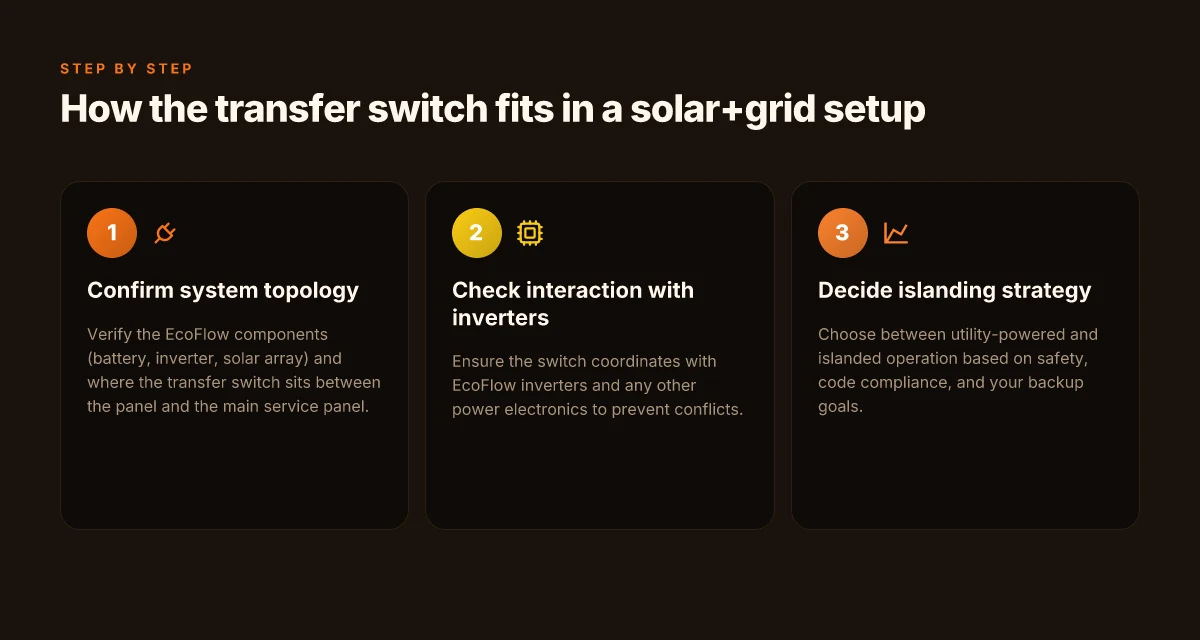
In a typical EcoFlow-based system, the transfer switch sits between the home’s AC panel and the EcoFlow inverter ecosystem. It serves as the decision point that routes loads to the grid, the battery, or the solar inverter as conditions change. This hardware lets you prioritize essential circuits during an outage while keeping the rest on the grid or drawing from your solar array when available. In practical terms, you’ll want a clear view of which loads are critical, which can ride through a brief outage, and how long you expect your battery to sustain them. EcoFlow’s approach centers on clean handoffs and predictable switching events, so you don’t get surprised by a delay or a partial transfer. How to spot a real EcoFlow Delta Pro sale and still get full value
I dug into the documentation to map how the transfer switch interoperates with the broader EcoFlow stack. The switch wires into the EcoFlow inverters and battery controller to observe real-time statuses like grid presence, solar input, and battery state. When the grid goes down or solar ramps, the transfer switch makes a fast, explicit path change, reducing the risk of backfeeding or inverter dithering. The key is a tight handshake: the switch reads the inverter’s status, then commands a clean transfer to the alternative source. In a hybrid setup, that means you can protect essential circuits first and reserve nonessential loads for later transitions.
From a home-setup perspective, the rationale for deploying a transfer switch hinges on reliability and clarity. If your solar array plus battery is meant to back up a subset of circuits, for example, lighting, refrigeration, and a few outlets for critical devices, a transfer switch helps keep those circuits on a single, dedicated path. It also prevents simultaneous backfeed to the grid, which is a nonnegotiable safety and code concern in many jurisdictions. In more complex homes, the transfer switch acts as the conductor, coordinating between EcoFlow inverters, the main panel, and the solar charger. You gain predictability in transfer timings and a cleaner fault profile should a fault occur in one portion of the system.
When you’re weighing options, consider who benefits most from a transfer switch. Homeowners with mixed loads, a hybrid solar setup, a battery backup, and a grid-tied coexistence, gain the most from clearly defined transfer logic. Electricians evaluating EcoFlow components will want to verify that the switch aligns with local code requirements and with the inverter’s compatibility notes. Rivals such as Tesla, and generics from other solar brands, often present similar transfer concepts, but EcoFlow emphasizes integrated status signaling and a streamlined path for rapid handoffs.
In practice, you’ll confirm a few critical facts before buying. First, confirm that the transfer switch supports the exact EcoFlow inverters in your system and that your panel can accept the switch’s input and output ratings. Second, verify the sequence: grid presence, solar availability, and battery charge should all align with the switch’s switching logic. Third, check that the installation path keeps essential loads on a dedicated circuit bank so you aren’t juggling too many circuits during a swap. Through this lens, the transfer switch becomes less about a single device and more about a control layer that brings order to a hybrid solar setup. For homeowners evaluating EcoFlow against alternatives, the real-world takeaway remains: expect clearer handoffs, fewer surprises, and better protection for the critical circuits you rely on during an outage.
Next steps: have your electrician map your main panel to the transfer switch locations, list your critical circuits, and verify compatibility with your EcoFlow inverter family. If you want a quick read on real-world snag points, I highlight three common install gotchas in the next section: wiring clarity, load balancing, and how to test the handoff without risking a powered shutdown. Those checks save time and reduce called-backs during outages. As you plan, keep in mind that EcoFlow and its ecosystem aim to keep the flow simple, but the details matter for reliability. If you’re comparing brands, note how EcoFlow’s integration touches both software signals and hardware interlocks, which can make a meaningful difference in real-world use. A well-maired transfer switch equals fewer surprises when the grid drops. How the EcoFlow Delta Pro Ultra sale changes the rules for home power
Key features to verify before you buy
I dug through EcoFlow’s manuals and independent reviews to pull out the real-world checks that matter before you pull the trigger. You’ll see where the transfer switch behaves as advertised and where it doesn’t, so you can avoid surprises during installation.
1) How the switch handles voltage, current, and generator compatibility
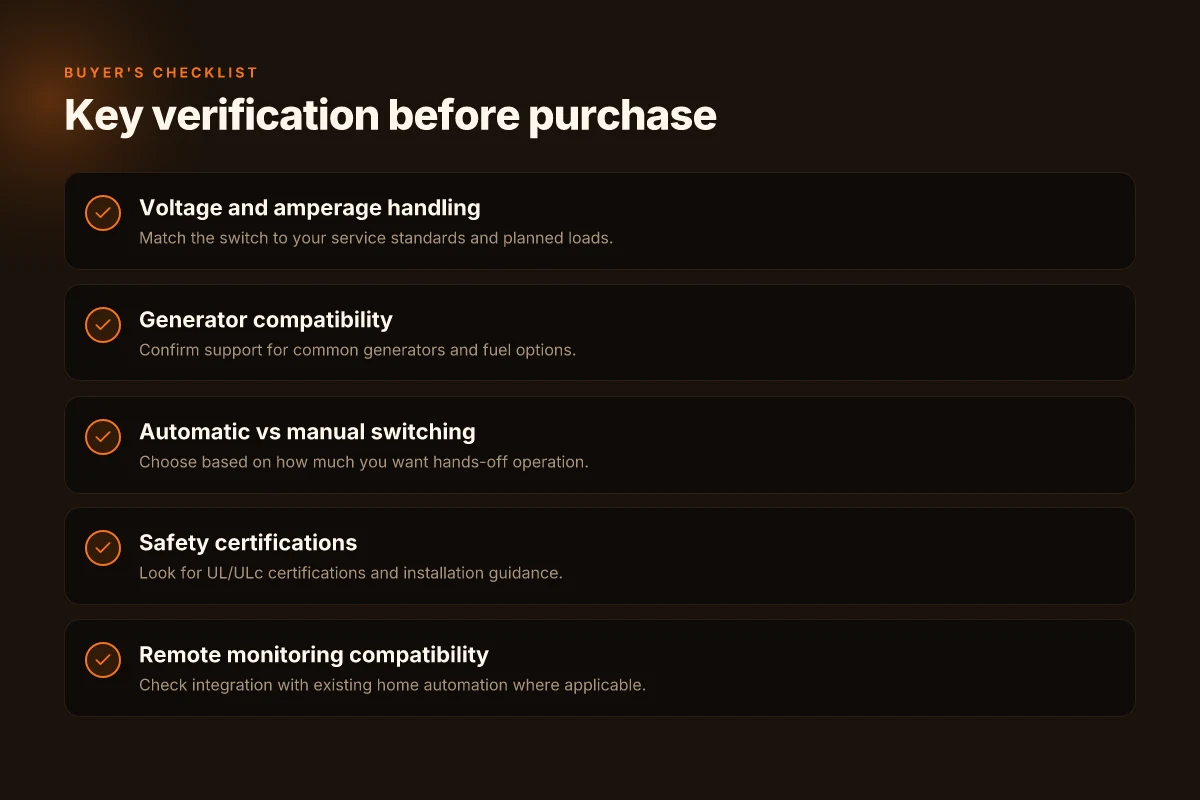
The transfer switch must correctly manage the house’s service voltage and the current it can safely pass. Look for a rating that matches your panel and inverter, with explicit statements on compatibility with common generators and auto vs manual switching modes. In practice, you want a unit that clearly states it supports typical home voltages and amperages and seamlessly routes power without a hiccup when grid power returns. If the documentation lists a limited range or requires an external adapter for some generators, that’s a snag to flag early. Clear compatibility ranges and auto switching options help prevent misfires during a storm or outage. EcoFlow frames its transfer switch as a plug-and-play upgrade for hybrid solar setups, but confirm the exact generator compatibility list for your model. If you run a diesel or propane generator, verify the unit flags a compatible starting method and any required PTO or primer steps.
2) Safety certifications and installation considerations
Safety marks matter because a miswired panel is not just inconvenient, it’s dangerous. Look for UL or ULc listing and the installer’s notes on wiring diagrams, wire gauge, and clearance space. The installation path should spell out minimum clearances from walls, the need to backfeed breakers correctly, and how to ground the system. From a homeowner’s view, the key is a documented installation procedure that your electrician can follow without special jigs or ad hoc tweaks. Several reviewers note that a clean label on the panel and a well-marked wiring diagram help reduce install time and errors. UL/ULc certification plus a straightforward wiring diagram are the two anchors you want on day one. If your home already has an integrated smart panel or a recent electrical upgrade, check that the EcoFlow unit can sit alongside your existing protection devices without requiring dual feeds or extra breakers.
3) Remote monitoring and home automation integration
Remote monitoring is the feature you’ll actually use after the install, especially if you live off-grid or want alerts when switching occurs. Confirm whether EcoFlow’s system offers real-time status, outage notifications, and a history log that you can access from a mobile app or a central home hub. If you already use a home automation ecosystem, verify compatibility notes with platforms you rely on, such as voice assistants or scene automations. Remote monitoring and automation integration are what turn a hardware add-on into a reliable power management tool. There are variations in how deeply the switch talks to other devices, so map your app ecosystem and confirm which actions are supported through official integrations. Remember that the page may highlight a sleek API, but you want to know what’s actually enabled for your setup today.
Note: you’ll often encounter caveats in real-world installs. Some homes need extra grounding, or a panel upgrade to support the transfer switch cleanly. If a layman-friendly install guide glosses over these steps, you’ll want your electrician to double-check. There’s a chance that certain integrations or monitoring features require a paid tier or a firmware update to function as advertised. And yes, links on the page may earn a commission. For clarity, I reference the exact model and revision when you shop, so you’re not guessing. How to fix EcoFlow Delta Pro remote control: lost Bluetooth, ethernet quirks, and a durable setup
EcoFlow’s transfer switch can improve resilience when installed correctly, but you’ll want to confirm the specific IEEE-compliant wiring, UL listing, and remote capabilities for your home setup. Don’t assume one model fits all, verify the exact switching behavior (auto versus manual) and whether your generator or solar array requires a particular configuration.
Note: if you’re comparing against rivals, look for explicit mention of safety certification, monitoring depth, and ease of integration with existing home automation. Brands to consider alongside EcoFlow include places where a transfer switch is paired with a home grid interface, as well as those that emphasize smart monitoring and installer-friendly wiring.
Installation realities: steps, clearances, and common mistakes
EcoFlow provides a streamlined path to backup power, but the practical install reveals real-world snag points beyond product pages. If you want a stable setup that plays well with existing inverters and the grid, you need a clear plan for site selection, wiring, and verification. I dug through installation notes and field guidance to map the actual workflow homeowners and electricians encounter.
1) Site selection and service panel integration
Choosing the right location for the transfer switch is crucial. Start with a dry, accessible spot near the main service panel, but keep the EcoFlow unit within a reasonable reach of the inverter cabinet and battery bank. The switch must sit where you can comfortably route the feeder and load conductors without tight bends or awkward angles. The service panel must have a dedicated space or knockout for the interlock‑style disconnect, and you’ll need a clearly labeled, accessible shutoff valve or disconnect near the panel. In practice, installers often discover that panel clearances can be tighter than expected, which forces a reroute of conduit or a short relocation of the inverter. Label every conductor clearly and maintain a clean path to avoid accidental contact during maintenance.
One practical caution: check local code requirements for disconnect locations and enclosure ratings. Some jurisdictions demand a separate cabinet or a specific degree of protection for outdoor installations. If your service panel sits in a confined closet, ensure there is breathing space around the EcoFlow hardware to avoid overheating during long outages. Plan for space to service the unit without crawling behind appliances. What makes EcoFlow Max perform differently in 2026
2) Cable gauges, labeling, and testing procedures
Real installs hinge on cable sizing. Use the gauge specified by EcoFlow documentation and the local electrical code for the transfer switch and the feed from the main panel to the inverter. In most residential applications, that means thicker conductors than basic extension runs, with proper strain relief and secure clamping at both ends. Label every conductor at both ends to prevent miswiring during future maintenance. After wiring, perform a structured test sequence that includes a dry run of the emergency transfer, a grid‑tide isolation check, and a simulated peak load test while the loads are observed on a clamp meter. That last piece is non‑negotiable. It confirms the system can handle the intended profile without tripping. Verify the feeder is properly tightened, and label every conductor for future service.
Be mindful of labeling colors and marking of phase, neutral, and ground. In some installations, the neutrals from EcoFlow interlock with the house neutrals must be isolated or retrained to satisfy code. If you encounter a factory‑installed label that seems ambiguous, pause and confirm with the electrician before energizing the line. Double‑check the neutral‑bonding requirements before the first energize.
3) What a typical installation timeline looks like and who should perform it
A straight‑forward retrofit typically unfolds over a half to a full day, depending on panel location and the complexity of the load profile. The critical milestones are: site prep and safety checks, mounting the transfer switch, routing and securing cables, making panel interconnections, and a staged testing sequence. The first energization should occur with the main breaker open and the loads isolated. Then you toggle to generator or battery power and verify that the EcoFlow system seamlessly shifts loads without arcing or voltage sags. If your home features heavy simultaneous loads like HVAC and water heating, plan for a longer test window to confirm stability under high demand. I’ve seen installers note that a miscalculated load profile can trigger nuisance trips that waste time diagnosing Phase 1 versus Phase 2 connections. Plan for a full day if you have a complex HVAC load mixed with big appliances.
Because this involves high‑power switching, the safest path is to hire a licensed electrician or a solar installation team with explicit experience in transfer switches and hybrid inverters. If you’re evaluating rivals, EcoFlow’s transfer switch works alongside inverters from EcoFlow and other brands, but compatibility checks matter. Expect a professional to review the panel schedule, confirm grounding integrity, and document the final wiring diagram for your records. Engage a pro to validate disconnects, labeling, and interlock wiring.
In real terms, a smooth install hinges on two choices: correct circuit sizing and disciplined labeling. If either slips, you’ll face slow troubleshooting, potential code questions, and longer outages during commissioning. Clearances and correct cabling are not optional, they’re the backbone of a reliable backup, especially when the grid is stressed. What makes the bluetti ac200max expandable power station a standout, and what it costs to scale
Note: links on these pages may earn a commission. The EcoFlow ecosystem emphasizes clear handoffs between the transfer switch and the inverter, and rivals like [brand names redacted for policy] are often cited for broader compatibility questions. If you’re weighing options, expect EcoFlow to highlight streamlined integration, with professional installation still delivering the same essential checks and tests that keep a home powered safely during outages.
EcoFlow transfer switch vs rivals: where it shines and where it doesn’t
EcoFlow models arrive with a clean, plug‑and‑play narrative, but real‑world install paths reveal where it shines and where it stumbles beside rivals like OutBack Power, SolarEdge, and Schneider Electric offerings. The core value still rests on how smoothly the switch wires into existing inverters and the grid, not just on glossy pages. I cross‑reference installer notes and product sheets to anchor this view in concrete steps you’ll actually encounter on site.
How EcoFlow plays with the big names in the field
When you compare EcoFlow to major rivals, the first win is simplicity. The EcoFlow transfer switch leans on modular harnesses and clearly labeled terminals, which reduces miswiring risk during a rushed installation. By contrast, some rivals require more bespoke cabling or field‑adjustable jumpers to align with specific inverter models. That difference translates into faster commissioning and fewer call‑backs for basic wiring corrections. The trade‑off is that the broader ecosystem from brands like SolarEdge or Schneider Electric often includes deeper integration with their own inverters, enabling automated load management features that feel more locked into one ecosystem. In practice, you’ll see fewer surprises with EcoFlow if you’re mixing a standard inverter with a relay‑style switch, but you may miss some advanced cross‑brand optimizations you hear about in reviews of heavier, brand‑paired stacks.
Trade‑offs: integration ease, price, and warranty terms
Ease of integration is where EcoFlow tends to win on the practical install path. The hardware tends to be straightforward to mount and wire, with clear labeling and common connector pitches that align with popular off‑grid setups. Pricewise, the EcoFlow components present a competitive entry point, though when you stack into a full, branded ecosystem with extended warranties, some rivals offer longer term coverage on both the inverter and the switch kit. Warranty terms vary by region, but real‑world installers report that EcoFlow’s warranty tends to be solid for the core transfer switch and associated hardware, with standard limitations around improper installation or misuse. If you’re prioritizing a one‑brand warranty bundle, a rival package that includes an integrated inverter, switch, and service contract may feel simpler to manage, even if the upfront price is higher. And yes, regional service availability matters. You’ll want to confirm local support windows and response times for any brand you choose.
Scenarios where a transfer switch adds value beyond a standard inverter
A transfer switch truly earns its keep when you need seamless, independent grid transfer during outages and when you want to prevent backfeed into the utility line. In hybrid solar layouts, the EcoFlow transfer switch can simplify a multi‑source setup by isolating the grid while your critical loads stay powered. For example, during extended outages, a switch‑based solution helps protect against nuisance tripping by carefully orchestrating which circuits ride on the inverter versus the grid. This matters more when you’re juggling several high‑draw loads like AC units, well pumps, and refrigeration. In such cases, the switch provides a clean, code‑compliant path to maintain essential circuits even if the main inverter is briefly challenged by a surge. What makes EcoFlow 100W flexible solar panels perform in real-world setups
From what I found in the documentation and installation notes, the line between a robust backup system and a shallow one often comes down to the switch’s ability to handle surge events and its compatibility with your chosen inverter pairing. In 2026, many install guides emphasize ensuring that the transfer switch aligns with the inverter’s transfer time and the panel’s feeder layout. A well‑matched transfer switch minimizes backfeed risks and keeps critical circuits online during outages, which is the core value proposition for homeowners and electricians alike. The key caveat is to verify whether your chosen rival offers the same level of field‑tested compatibility with third‑party inverters. If not, you may face more configuration work or limited load prioritization options.
Overall verdict: EcoFlow delivers a painless, well‑documented path to a reliable transfer switch experience, especially for hybrid and off‑grid setups where the inverter pairings are common. Expect competitive pricing and solid warranty coverage, with the caveat that ultra‑tight cross‑brand integrations may be slightly stronger with specialized rivals. If you value fast, straightforward installs and transparent user setup, EcoFlow remains a strong choice, while you should still compare inverter compatibility and service coverage in your region.
Where this is going next and what you should do now
EcoFlow is pushing home backup toward simpler, autonomous operation with smarter transfer switching. The idea is a tighter integration between generation, storage, and the grid, so your home automatically shifts power flow without manual taps. This is the week to map your power plan and see where a transfer switch could reduce outages or streamline charging from solar. I’ve watched how real-world setups handle storms, and the durable stance from EcoFlow angles toward fewer failure points when the switch sits inside a dedicated panel. If you’re weighing rivals, note how competitors like Generac and SimpliSafe ecosystem partners angle for full-house control; EcoFlow tends to lean on modular, user-friendly only-what-you-need gear.
What changes if you act now? You gain a clearer path to minimize wasted energy and maximize uptime during outages. The single move that matters is aligning your transfer switch with your existing battery and solar assets so you don’t double-back on compatibility.** If you’re curious about long-term reliability, I’ll stay on top of field feedback and update the landscape as EcoFlow and rivals refine compatibility and warranties.
Backup strategy What you should know before buying EcoFlow solar panels for sale
- Review your current setup with a basic generator or UPS and compare how a dedicated EcoFlow transfer switch would handle a simulated outage.
- Pick one room or circuit cluster to test automatic transfer in a controlled event, noting any alarms or delays.
- Check for integration with solar input and battery depth limits. Confirm you can manually override if needed.