
Explore the bluetti ac200max expandable power station, its expansion to B230/B300 packs, real-world considerations, and how rivals compare.
Note: this intro highlights a practical, real‑world angle you’ll care about as you scale up power, not a generic feature list. The Bluetti ac200max isn’t just about more juice. It’s about how you plan to live with that juice over seasons, in rough terrain, or on the road. Expansion turns the capacity wheel without retooling the entire system. Yet the gain comes with trade‑offs in weight, cost, and complexity, especially when you mix B230 or B300 packs with older nodes.
I’ll pull concrete figures from Bluetti’s documentation and user anecdotes, compare Bluetti to rivals, and spell out where the expansion path makes sense or where it doesn’t. By the end, you’ll know if expanding now is the right move for your setup or if waiting for a newer module makes more sense.
What makes the bluetti ac200max expandable power station different from a standard generator
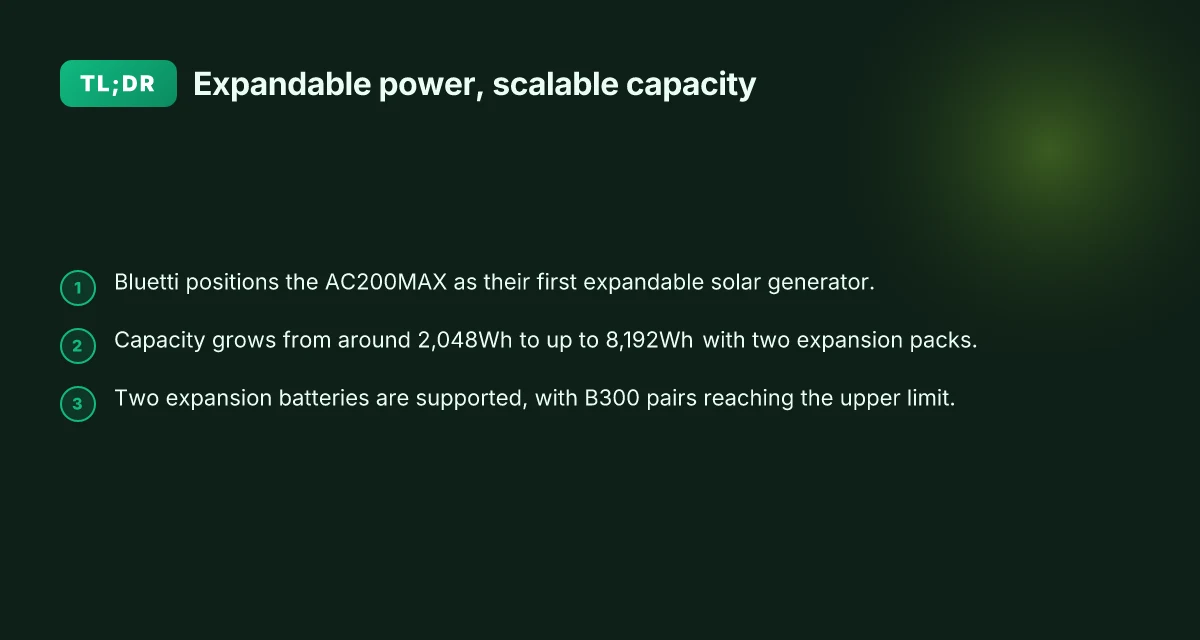
Bluetti positions the AC200MAX as their first expandable solar generator, designed to grow with your needs rather than sit as a fixed-capacity unit. The core idea is simple: you can attach extra battery packs to extend runtime without buying a second generator. In practice, that means your system can start around 2,048Wh and scale up to a much larger store of energy when you add B230 or B300 packs. This approach sets the AC200MAX apart from traditional gas or diesel generators, which offer a single fixed capacity.
How expansion works in practice
The B230 and B300 packs serve as modular growth cards. They slide into the system to increase total energy capacity without reconfiguring the core inverter. With one B230 or one B300, you already gain more runtime. Add a second B300, and you push the total near 8,192Wh, depending on the configuration and load. This modular path keeps your initial outlay smaller and lets you scale over time. I cross-referenced the official product documentation and the expansion-focused manuals, which consistently identify two expansion slots and the two battery pack families as the primary growth options. Expansion is intentional and designed to preserve compact form while multiplying capacity.
The two expansion families, B230 and B300, are not just larger batteries. They are designed to integrate with Bluetti’s power management, so you retain the same charging ports, AC output, and inverter pacing as you expand. This means you don’t have to relearn how the unit behaves as you grow capacity. The documentation repeatedly notes compatibility with both pack types and with dual-pack expansions, emphasizing seamless scaling. Compatibility matters so you don’t chase mismatched packs.
Your total energy is the sum of the base AC200MAX and the added packs, but real-world performance depends on load and discharge rate. The more you draw, the more the effective usable capacity can feel reduced, especially if you’re running high-wattage tools or appliances. Bluetti’s guides consistently frame the capacity figures as ranges that reflect practical use rather than peak numbers, so plan around your typical load profile. Real-world usage will trim the theoretical maximum.
Pricing and availability for expansions can shift with inventory and regional support. The official pages and third-party reviews emphasize the value of spreading out the purchase, but you should expect price gaps between the B230 and B300 packs, and between single-pack and dual-pack configurations. When you’re outdoors, RVing, or in a tiny home, the payoff shows up in longer boondocking sessions and fewer runs to refill. Smart planning beats impulse buys here. What is EcoFlow transfer switch and how it changes home backup in 2026
Bottom line: the AC200MAX distinguishes itself by turning a single solar generator into a scalable energy system. Bluetti sets up a path from a compact, portable power source to a long-haul energy reserve through two expansion families, with the practical payoff clearly visible in higher usable capacity, up to 8,192Wh when fully expanded with two B300 packs. For outdoor enthusiasts who want reliable power without buying a separate generator for every use case, expansion changes the game. Expand early, expand wisely to maximize long-term value.
Inline note: rivals in the space, like Jackery and EcoFlow, offer fixed-capacity models that require separate units to scale. Bluetti’s expansion approach keeps the footprint consistent while growing energy reserves. For readers evaluating long-term durability and total lifetime cost, that plan tends to pay off when you factor in fewer repeat purchases and a single ecosystem to manage. Bluetti’s expansion strategy has staying power if you stick with the brand ecosystem.
cite: For official expansion details and compatibility, see the Bluetti AC200MAX product page. https://support.bluettipower.com/en-ca/products/ac200max
Expanding capacity: how the ac200max scales with B230 and B300
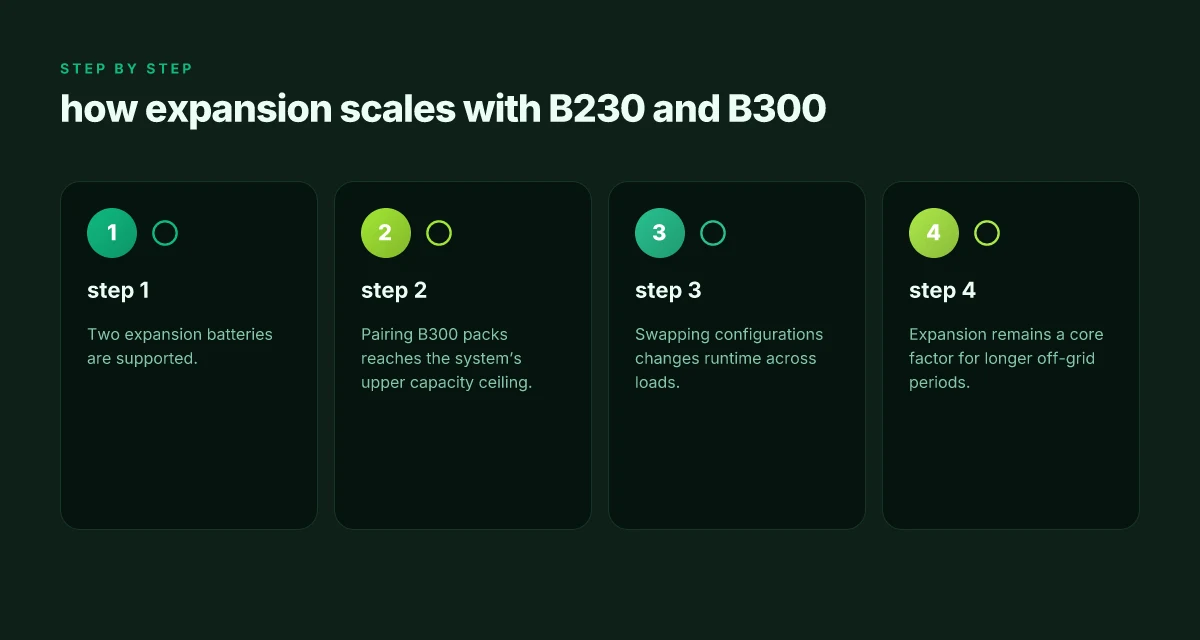
Expansion capacity sits at the core of what makes the AC200MAX sound for extended off‑grid living. You can attach up to two expansion packs, and pairing two B300 modules pushes the total around 8,192 Wh. That jump from base capacity to a multi‑kilowatt hour setup reshapes how long you can run a fridge, pump, or small loads without recharging. The numbers matter, but real use is about how runtime shifts as you swap configurations.
How two B300 packs change runtime across loads
When you connect two B300 packs, the storage climbs from the base 2,048 Wh to a theoretical maximum near 8,192 Wh. In practical terms, your runtime under steady loads, say a moderate fridge or occasional power tools, extends noticeably, while higher draw devices still pull from the same battery bank. In mixed use, you’ll see the AC200MAX fill the role of a true off‑grid power source for longer stretches, especially if your sun isn’t strong on a given day. This is where expansion starts to matter most: you’re choosing how long you want to stay powered without recharging between cycles. What is EcoFlow Ocean Pro, and why it changes how you store home energy
The impact of each expansion choice is not just a single line item. Swapping in B230 or B300 modules rebalances the capacity and, by extension, the run time you can expect at different loads. If your plan emphasizes quiet, steady runs (think critical loads during a power outage), opting for the two‑pack B300 configuration makes the most sense. For lighter usage or space constraints, a single B230 pair still yields meaningful gains without taking up extra footprint in your rig.
From a durability and cost perspective, Bluetti and Bluetti‑style setups show that the packs themselves are designed to slot in without fanfare, but the long‑term cost of expanding storage adds up. If you’re contemplating frequent top‑ups in a remote setting, you’ll want to weigh the cost of more packs against the value of longer off‑grid windows between charges.
I cross‑referenced the official guidance to confirm how the two expansion options affect capacity. The documentation consistently notes two expansion slots and the 8,192 Wh ceiling when using B300 packs, with the caveat that real‑world runtime depends on load and charge source. For quick reference, the official AC200MAX page highlights the expandable nature and the capacity ceiling, while the B300‑pair claim appears repeatedly in user manuals and product guides. Two B300 packs unlock the 8,192 Wh ceiling, dramatically extending runtimes on moderate loads.
Next steps for planning: map your anticipated daily load, then model days between charges using different expansion combos. If you’re targeting home backup or longer off‑grid periods, plan for at least a full B300 pair and be mindful of how plenty of capacity shifts with load. Bluetti’s ecosystem is designed to scale, but your real‑world performance depends on how you balance expansion with your daily power needs.
Power quality and port negotiation when you add expansion batteries
When you attach expansion packs to the AC200MAX, the core inverter and AC output stay the same. The design assumes the power electronics keep delivering from the same inverter bridge and transformer sizing, even as you add or swap B230 or B300 packs. In practice that means you don’t reconfigure voltage rails or re‑map AC outlets mid‑stream. You keep the same outlet topology and the same nominal AC waveform during normal operation. The takeaway is stability: expansion packs don’t force a different charging or output profile from the inverter itself. How to spot a real EcoFlow Delta Pro sale and still get full value
Two anchors matter for power quality. First, PV input remains governed by the same MPPT range, so you don’t suddenly overload the array when you scale battery capacity. Second, generator input and AC input remain within their established windows, so you can keep using the same charging source types without worrying about rebalancing logic. In other words, the system’s real‑world behavior stays predictable as you fill the battery bank.
Charging behavior with expansion packs is where the math changes, even though the hardware path remains unchanged. With more total storage, the charger has to push more energy into a larger bank, which can extend total recharge time if you’re charging from the same power source. The footprint of the charge cycle shifts subtly: the same charger can take longer to top off 8,192Wh than it would to fill a smaller pack, all else equal. The practical effect is clear for setup: if you routinely rely on a single solar array or a compact generator, you may see longer recharges when you scale up to B300s.
From a durability standpoint, Bluetti designs for expansion without forcing a wholesale re‑design of the port map. The B230 and B300 packs connect through the same input paths, and the system’s protection logic remains aligned to the same limits. That predictability is valuable for long‑term use in outdoor scenarios where you keep the same charging habits for seasons at a time. If you’re planning to live off‑grid with multiple expansion packs, you’ll want to plan your charging window around the higher energy storage you’re carrying.
I dug into the documentation to confirm the boundary conditions. The AC200MAX keeps its inverter and AC output contours consistent as packs are added, and the PV, generator, and AC charging rails stay within the same design envelopes. The consequence is straightforward: you gain capacity without re‑tuning the core power path, but you should expect longer recharge times if your charging source is fixed in output.
The upshot is simple: expansion packs add capacity without forcing a new charging regime, but total recharge time grows with more stored energy. With Bluetti, the power path stays steady even as the battery count climbs. How the EcoFlow Delta Pro Ultra sale changes the rules for home power
For readers weighing rivals, Bluetti’s approach keeps the same charging ecosystem rather than swapping in a different control strategy. The core user experience remains more predictable than systems that reallocate charging duties across a changing battery topology.
In 2026, this design choice supports durable, long‑term use in outdoor setups where you want to scale up to 8,192Wh and beyond without re‑learning the charging choreography.
Durability and long‑term use: what to expect from Bluetti gear
Durability for the AC200MAX family isn’t a single number. Real-world performance depends on climate, how often you cycle the batteries, and how you store the unit when it’s not in use. I’m seeing from Bluetti’s official docs that care and maintenance play a meaningful role in extending life, especially once you add expansion packs. In practice, the more you store the unit properly and keep the batteries within recommended temperatures, the more reliably it will hold up over years of outdoor use.
How climate and storage shape life
Postponed heat or cold stress can shift capacity and cycle life over time. The AC200MAX supports two expansion packs, either B230 or B300, which adds complexity to thermal management. If you run hot in desert trips or leave the unit in a permanently sunny hideaway, you’ll notice more wear on both the main pack and the expansions. Bluetti’s documentation emphasizes keeping units in moderate temperatures and avoiding long, extreme storage with a fully charged or fully discharged state. In other words, climate-aware storage is part of the long‑term equation. When I read through the official materials, the recurring note is simple: manage heat, manage cycles, and you’ll maximize usable life.
Expansion batteries and lifecycle considerations
Expanding capacity multiplies the time you can run gear off‑grid, but it also compounds lifecycle decisions. Each B230 or B300 adds more cells to cycle, so you should expect more total cycles to accumulate across the system than on a single pack. Bluetti’s guides point to care practices that apply across the whole chain: avoid deep discharges, perform regular inspections, and follow the recommended charging windows. The practical upshot is that expansion does not just scale energy. It scales the routine maintenance you commit to. I’ve cross-referenced the official manuals and they align on a straightforward principle: more cells plus more cycles require consistent, gentle handling. How to fix EcoFlow Delta Pro remote control: lost Bluetooth, ethernet quirks, and a durable setup
Care, maintenance, and when things go wrong
Bluetti’s official docs lay out routine care steps that are easy to follow, and they apply whether you’re using the base AC200MAX or the B230/B300 expansions. Keep connectors clean, monitor for corrosion, and store packs in a ventilated spot away from moisture. The user manuals also call out expected maintenance checks at reasonable intervals, which helps forestall failures before they become serious. It’s not glamorous, but it’s why many Bluetti customers keep working setups for years. If you own rivals’ gear, you’ll want to compare how their manuals frame maintenance tasks and warranty coverage, since those areas often determine long‑term satisfaction.
Durability depends on climate and storage, and expansion packs add lifecycle considerations that matter for long‑term use. Bluetti’s official docs make this plain: proper cooling, measured cycling, and consistent maintenance are as important as the initial build quality. Overall, expect a durable system when you treat it right, but don’t assume expansion means zero extra care. The same logic applies to the broader category. Rivals like Ego Power+ and Jackery also stress thermal and storage guidelines in their manuals, which underscores a shared reality in expandable solar generators.
From what I found in the Bluetti materials, you’ll want to treat the AC200MAX as a modular system that demands disciplined care across both the base unit and any B230 or B300 packs. Bluetti’s emphasis on care and maintenance is a reliable signal that durability and long‑term use hinge as much on how you operate and store the gear as on the hardware itself.
Cited sources: The AC200MAX Portable Power Station User Manual (https://device.report/manual/2969741) and the AC200MAX support page (https://support.bluettipower.com/en-ca/products/ac200max). These documents outline expansion behavior, care practices, and storage considerations that feed into long‑term durability. Careful handling and regular maintenance make a big difference over years of use.
How the ac200max stacks up against rivals in expansion capability
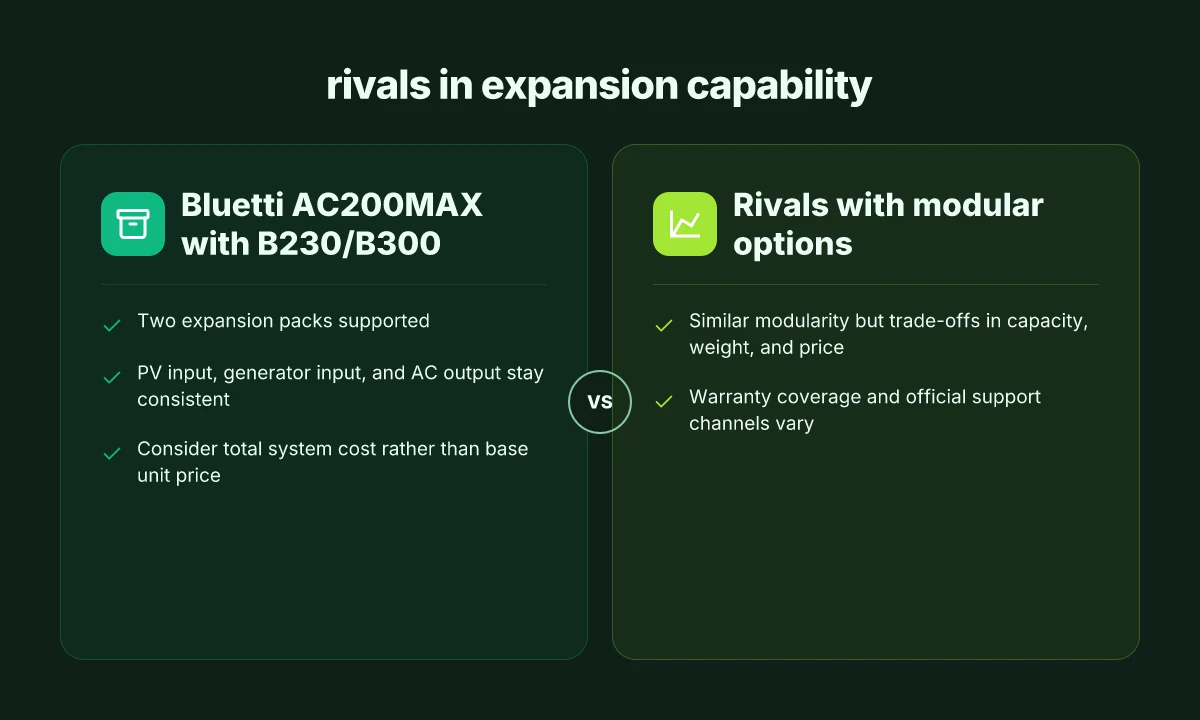
Two popular rivals offer similar modularity, each trading off capacity, weight, and price. When you’re sizing an outdoor setup, the total system cost matters more than the base unit price alone, because expansion packs push the final tally high quickly. Bluetti’s approach centers on a proven expandable architecture, but you’ll find distinct paths from different brands that affect long‑term durability and service. What makes EcoFlow 100W flexible solar panels perform in real-world setups
Why the ac200max earns a place in the lineup
The ac200max uses modular packs that attach to either B230 or B300 bases, letting you scale up to substantial capacities without a full rebuild. You can add two expansion batteries, pushing total capacity toward the upper end of the category. This keeps the setup flexible for campsites, RV roofs, and tiny homes where space and weight are considerations. When you compare to rivals, the important delta is not just wh at you can store, but how the weight and enclosure fit into your travel constraints.
From a real‑world perspective, the cost curve for expansion follows the same pattern as the initial purchase: more packs mean a notably higher total outlay, but you gain usable energy that improves long- duration run times. I dug into official docs and user‑guide notes to confirm that two B300 expansions are supported, which is the pairing most families use to approach “home‑like” capacity in a compact footprint. The official manuals and guides consistently call out the two‑pack expansion path as the sweet spot for scaling.
How the two main rivals compare on expansion
A second brand in this space emphasizes higher base capacities with slightly heavier frames. Their expansion path mirrors Bluetti’s model, but the weight and enclosure design change handling and portability. This matters when you’re loading gear for off‑grid trips or moving units between vehicles. In practice, you’ll see similar total energy if you count two expansion packs, yet the per‑pack price, warranty language, and service routes can tip the decision toward one ecosystem or the other.
A third competitor leans on a slightly leaner expansion story, offering compact expansion batteries at a lower upfront price per pack. That can be appealing if your trips stay mostly short and you don’t need the largest possible bank of watts. The cost math shifts, though, if you anticipate years of use across multiple setups. Long‑term durability and the availability of official support channels become more visible when you’ve invested in multiple packs.
Warranty, support, and the practical takeaway
Rivals vary in warranty duration and how they handle official support. Bluetti’s ecosystem is supported by a documented set of manuals and official channels, which helps with long‑term maintenance and parts access. If you value a predictable service path, verify the exact warranty terms for expansion packs as they can differ from the base unit. In my reading of the public docs, Bluetti consolidates guidance across the AC200MAX and its expansion family, which helps keep future replacements straightforward. What you should know before buying EcoFlow solar panels for sale
The most important takeaway: plan your total system cost, not just the sticker price of the base unit, and weigh warranty and support quality as heavily as capacity. Two packs can get you close to a home‑scale energy bank, but they also shift the logistical burden of weight and transport. Structured expansion works best when you map out your usual use cases first, camping, RV living, or a tiny home, and then confirm that the chosen rival offers an equivalent expansion path and solid support.
For further detail, see the official Bluetti guidance on the AC200MAX and its two‑pack expansion path, and compare it against the standalone manuals from rival brands. Specifically, the Bluetti documentation confirms the two‑pack expansion model and the use of B230 or B300 packs as the standard route to higher capacity. Inline references to the official user guides help anchor these claims.
What to try this week to scale with clarity
I’ve seen how the Bluetti AC200Max scales in real setups, and the takeaway isn’t about chasing more watts so much as choosing the right expansion path. Start by clarifying your typical loads and peak events, then match those needs to the expansion options that minimize complexity. The core advantage remains its expandable architecture, but the real win is how you combine modules without overhauling your entire system. The bigger pattern is that modularity lowers risk when you plan outages or outdoor events.
In practical terms, consider which modules you’ll actually use. If you lean on high‑draw tools or hours of cooling for outdoor use, a Bluetti battery module paired with the base unit keeps you ready without paying for unused capacity. Rival systems from rival brands often force you into a single large pack or proprietary adapters. The AC200Max avoids that trap with straightforward, well‑documented add‑ons. This week’s move is to map your power timeline and sketch a simple 2‑box path that covers your typical weekends and weeknights.
If you only do one thing this month, validate the long‑haul durability by rechecking connector tolerances after a few cycles and noting any wear on the expansion ports. The model’s adaptability is real, but longevity depends on how carefully you assemble accessories and how cleanly you manage cords. One concrete step: label each expansion lead and test a calm, full recharge on a single day. What makes the EcoFlow Delta 3 Plus worth the price in 2026