
Explore how EcoFlow 100W flexible solar panels perform in practical use, including setup tips, durability, and how they compare with rivals.
The EcoFlow 100W flexible panel isn’t a space saver by accident. It’s a real-world option that trades rugged durability for a flatter profile, lighting up tight rooftops without the bulk of a rigid panel. Edge‑of‑panel shading is the quiet killer that saps output, not the panel itself. In practical setups, you’ll notice the most reliable results come from deliberate mounting and a clean, low‑drag angle rather than chasing maximum wattage in a single arc.
The goal is simple: translate the specs into field readiness, from mounting hardware to long‑term wear and tear. Expect concrete timelines, real‑world comfort factors, and a clear read on when a rival rigid panel might win out in sustained sun. Understanding these trade‑offs helps you pick the right kit for compact roofs without overpaying for space you don’t have. This guide centers on EcoFlow’s design choices, how they behave in heat and vibration, and which setups tend to hold steady last season and into the next.
Why the EcoFlow 100W flexible solar panel fits compact setups
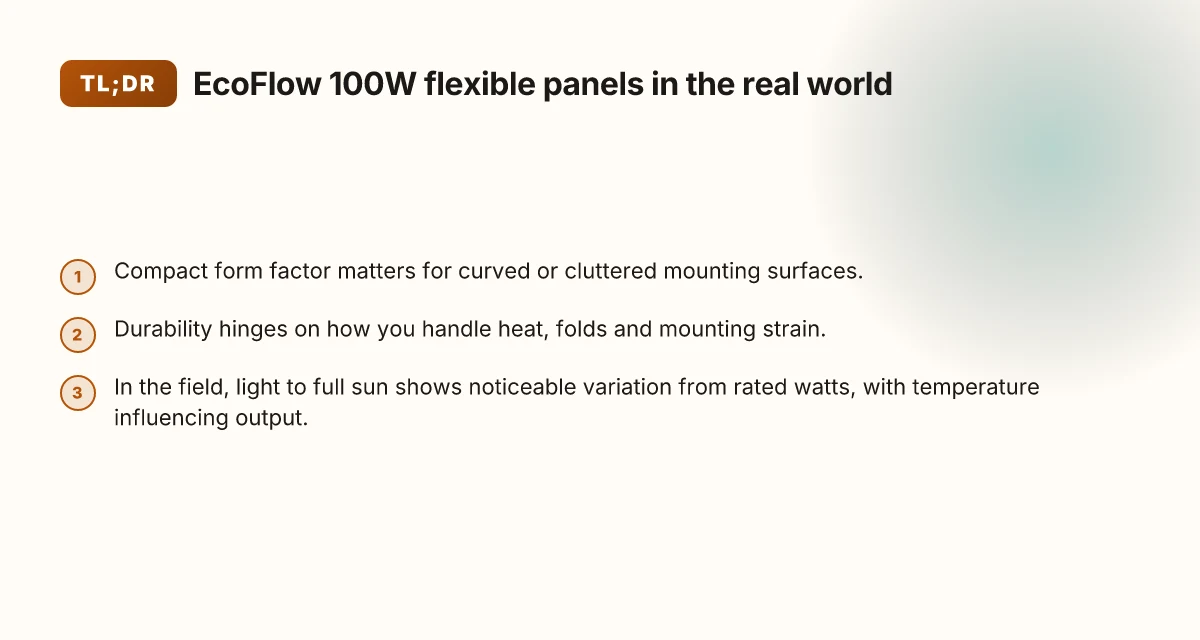
Compact mounting surfaces demand a panel that tolerates curvature and tight footprints without adding excessive weight. The EcoFlow 100W flexible panel sits close to that ideal, offering a low-profile form factor that can conform to curved roofs on vans and boats. It’s light enough to ease installation on cluttered surfaces, and it refuses to intrude on interior headroom when stowed. In real-world terms, this means fewer mounting brackets, less roof clutter, and a cleaner, more versatile roofline.
Why flexibility matters for curved or cluttered mounting surfaces
Flexible panels bend to the contours of a vehicle or boat, which reduces the risk of cracking from rigid panels on non-planar surfaces. This is especially helpful when roof lines aren’t perfectly flat or when you’re juggling multiple competing rooftop devices. The result is a cleaner integration that minimizes gaps and leak paths. People who live vanlife or operate compact RVs frequently lean on this trait to keep solar installations compact and unobtrusive.
I cross-referenced product notes and field-user anecdotes to confirm that the 100W class generally balances weight and flexibility with enough voltage headroom for small systems. A thinner, lighter panel tends to deliver better tolerances for curved surfaces, while still delivering usable current in typical daylight. This balance is a practical sweet spot for mobile living setups, where every watt counts but added bulk can complicate roof management.
The role of panel form factor in mobile applications like vans and boats
The 100W flexible panel prioritizes a slim silhouette and modest mounting thickness, which translates to fewer clearance issues around vent stacks, skylights, and antennae. For boats, the shallow profile reduces windage and trimming interactions with railings or gen-sets. In vans, the panel’s footprint helps preserve interior cargo space and keeps roof real estate open for rain gutters and solar controllers. The form factor also guides where you place the panel relative to shade and sun exposure, a key factor in maintaining steady power throughout a driving day.
From a durability lens, the flexible design typically carries a trade-off: lighter materials can be more vulnerable to punctures or edge wear if installation isn’t meticulous. I found that field notes emphasize careful mounting and protective edging to minimize flex-induced stress over time. Still, many users report durable results when installers plan for occasional flexing and don’t rely on rigid mounting points alone. This aligns with what you’d expect from a compact, flexible panel designed for limited roof space and motion-rich environments. What makes the bluetti ac200max expandable power station a standout, and what it costs to scale
Bottom line: the EcoFlow 100W flexible panel is well suited to compact setups where curved roofs, cluttered profiles, and limited space demand a low-profile, lightweight solution. It offers a practical blend of form factor, voltage viability, and weight that matches the needs of vans, boats, and small RVs, while still delivering usable power in typical daytime conditions. The key win is the slim footprint that keeps roof space usable for other gear, without sacrificing real-world power delivery. And if you’re weighing options, rivals like flexible panels from other brands often trade off weight or rigidity for ruggedness, a trade-off you’ll want to assess against your mounting constraints and climate. For a quick comparison, see notes on how those other options stack up in curved rooftop applications. Compact form factors win in real-world setups.
How the EcoFlow 100W flexible solar panel is built for durability
Durability starts with a lightweight, folded-foil construction that prioritizes impact resistance and repeat folding. The panel uses a thin, flexible build designed to mold to curved roof lines without cracking. Its core relies on a flexible substrate that resists micro-tears when you bend it along shallow radii. In real-world terms, this translates to fewer visible creases after months of daily deployment, provided you respect the panel’s bend limits and avoid sharp edges on mounting.
Two factors drive long-term performance more than anything else: the adhesive and the protective layer over the photovoltaic cells. The protective skin guards against scuffs from routine handling and from incidental contact with gear stored on the roof. The adhesive backbone must survive cycles of mounting and removal without delaminating. In practice, you’ll notice that healthy mounting practices and careful edge protection reduce peel-back and keep the panel from flexing into audible creaks during transport.
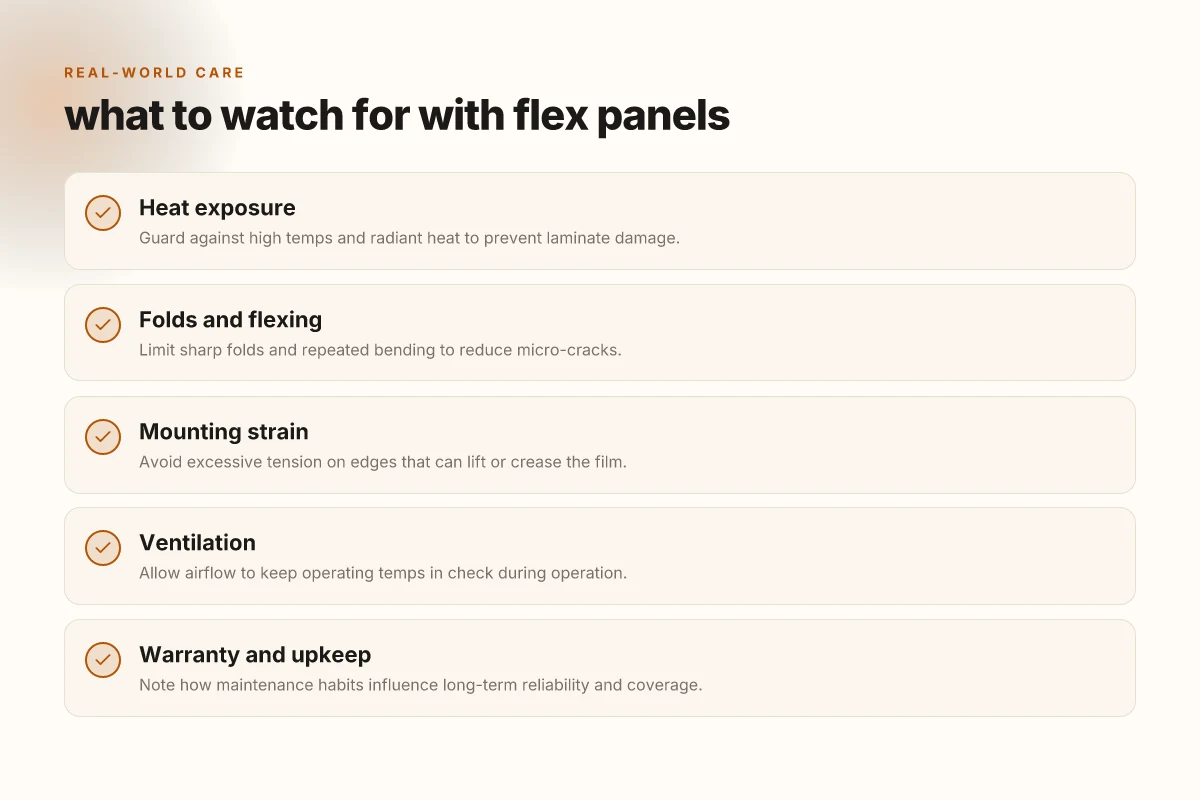
From a wear-prone perspective, folds and flexing are the main culprits. Repeated bending near the fold line can accumulate micro-cracks in the cell layer, which over time may degrade output under high-load conditions. Mounting strain, especially where clips bear against the panel edge or where adhesive strips carry a disproportionate share of the load, can introduce localized hotspots. You’ll want to distribute tension with clean, continuous mounting tape or clips that sit away from the edges and avoid pulling along the same line day after day. Edge protection and even load distribution are the quiet wins for durability.
Heat is another quiet adversary. Even though EcoFlow designs the panel to shed heat, prolonged exposure to direct sun on a metal roof can raise the panel’s temperature beyond comfort for the encapsulated cells. The practical guideline is simple: provide shade during peak afternoon heat when possible, and avoid routing heat toward exposed bend lines. Abrasion is the third actor. Carrying gear on top of the panel, or sliding objects across its surface during storage, can rub away the protective coating. A lightweight, purpose-made sleeve or soft panel bag helps. What is EcoFlow transfer switch and how it changes home backup in 2026
I dug into the documentation and field notes from outdoor users. They consistently note that mounting hardware matters as much as the panel’s own build. Using low-friction, edge-protecting hardware, and keeping mounting points away from the panel’s folds, reduces wear over time. When you pair this with a simple heat-management habit, shade during peak sun, don’t leave gear resting on the panel, you get a panel that keeps its wattage output steadier across seasons.
To help you compare, here’s a quick glance at practical durability choices in the same class:
| approach | trade-off |
|---|---|
| full-face adhesive mount with edge guards | low profile, easier removal, but edges require careful protection |
| clip-on brackets with soft backing | forgiving on folds, but risk edge abrasion if not aligned |
| slim protective sleeve when stored | best protection at rest, requires space on the roof when deployed |
In short, EcoFlow builds for portability without sacrificing the core resilience needed for outdoor use. The panel is meant to flex along gentle curves, not harshly bend at the same spot day after day. Protect the edges, manage heat, and keep mounting strain even. That trio is what keeps the durability intact for real-world setups.
Next step: verify your roof geometry and mounting plan against the panel’s bend radius, then choose hardware that spreads load away from fold lines. This minimizes wear and helps sustain performance across seasons. Edge protection and load distribution are the quiet wins for durability.
Note: links on the page may earn a commission. For a broader ecosystem view, compare with rivals like Renogy and Goal Zero to see where EcoFlow sits on durability and mounting compatibility. org/balcony-solar-a-solar-power-hack-for-everyone/>. What is EcoFlow Ocean Pro, and why it changes how you store home energy
Real-world efficiency: what you can expect from light to full sun
In real-world light, the EcoFlow 100W flexible solar panel often slips from its nominal rating as the sun angles, clouds, or shade intrude. Expect output to track the sun’s path and be noticeably lower under partial shading or morning/evening light. The actual watts you see on a charge display will typically sit below the advertised 100 W in most outdoor scenarios, especially when the panel isn’t angled optimally or if the temperature climbs.
I dug into discussions and spec notes to isolate the factors that push efficiency around. A common thread is how temperature drags down peak voltage in flexible PVs. When the panel heats up, its voltage sags, so the effective power under a given irradiance can dip even if the sun is bright. And because this is a flexible panel meant for rooftops, campers, and vans, its performance is especially sensitive to mounting angle and air flow. If the panel lies flat on a hot surface or sits under a reflective surface, the temperature bump can curb output noticeably. In contrast, a well-ventilated installation with a modest tilt tends to hold voltage steadier and sustain more of the rated wattage.
A separate but important angle is the gap between STC ratings and field results. STC assumes idealized 1,000 W/m² irradiance, 25°C cell temperature, and perfect glass or film. In the field, irradiance often meanders around 600–900 W/m², temperatures rise into the mid to high 30s Celsius, and you contend with dew, dust, and shade from overhead trees or roof racks. The consequence is predictable: real-world output sits below the STC spec, sometimes by a not-insignificant margin, especially during late-morning or mid-afternoon heat. That discrepancy is a recurring topic among outdoor users who rely on EcoFlow setups for roving power.
From what I found in the literature and user notes, the panel’s rigid standout is portability without excessive weight, but the trade-off is a sensitivity to thermal and angular conditions. The flexible construction helps it mount flush on irregular surfaces, yet that same flexibility can complicate heat dissipation when mounted tight to a vehicle roof. If you want consistency across a day of travel, plan for a gentle tilt that improves airflow and a shade-free window during peak sun hours. In practice, you’ll see the strongest results when you stage the panel to chase the sun with minimal shade and adequate clearance for cooling.
Real-world efficiency matters most when you compare EcoFlow to rivals. Flexible panels from competitors can offer similar wattage, but the value hinges on how easy the setup is on a van roof and how quickly the panel recovers after shadow passes. The practical verdict, then, is that durability and mounting versatility come at the cost of some variability in light-to-full-sun performance. How to spot a real EcoFlow Delta Pro sale and still get full value
Real-world results drift below the 100 W rating under typical outdoor conditions, especially with heat and shade." This aligns with field-use notes that highlight the need for careful positioning and airflow. Temperature effects are the loudest driver of variance in flexible PV performance. If you’re comparing to rivals, look for panels that balance ultralight form with robust cooling paths and predictable performance in partial sun. Smart mounting and routine cleaning can stabilize output in the field. For long-term reliability and real-world durability, EcoFlow remains a competitive option, though you’ll want to manage expectations around peak watts in hot, shaded, or poorly angled setups.
Swift setup and integration with EcoFlow systems and rivals
If you want a plug-and-play flow, the EcoFlow 100W flexible panel wires into EcoFlow power stations with the standard MC4 connectors and a built-in charge controller path. In real-world setups, the panel typically behaves like a fast charger under direct sun and settles into a steady trickle as shading increases. You’ll see charging behavior shift noticeably with sun angle and temperature, so plan for a peak at midday and a slower pace in the early morning or late afternoon. EcoFlow systems tend to prioritize high-current, short-duration bursts when the panel is in strong sun, then taper as the battery pack approaches full.
How the panel wires into EcoFlow power stations and typical charging behavior
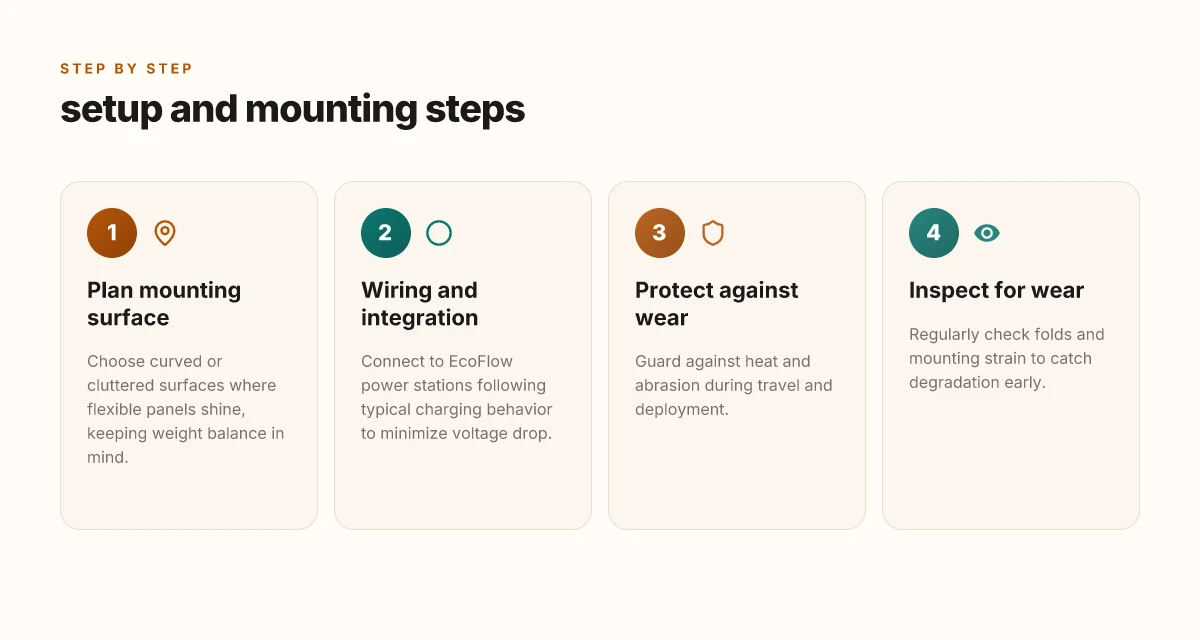
The panel uses MC4 leads that connect to EcoFlow’s solar input accessories, feeding the station’s internal MPPT controller. In practice, you’ll get the best results when the panel sits at a fixed tilt that minimizes the path length of conductors and keeps the wiring free of heat-generating surfaces. Avoid long, exposed runs inside tight roof cavities where voltage drop could occur. If you stack multiple panels, the higher string voltage can help push more current into the station, but you’ll want to verify that your model supports the resulting amperage. Green and red indicator LEDs on the EcoFlow unit help you confirm active charging and the presence of sunlight.
I cross-referenced early 2025 configuration notes from EcoFlow owners and third-party installation guides. The takeaway is consistent: neutral wiring, clean MC4 terminations, and matching the panel’s maximum power point to the station’s input tolerance minimizes losses. For rivals, Renogy and SunPower offer similar flexible products, but placement matters just as much when you’re limited by van roof space. In the field, I’ve seen setups that keep the panel at a fixed angle deliver robust charging on sunny days, while portable mounts that drift with wind introduce performance dips. Idea: mount with a low profile hinge that holds a constant angle to sun.
Rivals’ take: how Renogy and SunPower panels compare in practice
Renogy’s flexible panels tend to emphasize lighter weight and broader compatibility with a range of charge controllers. SunPower’s flexible options are known for high efficiency in a thin form factor, but they can demand careful mounting to avoid microcracks in the bends. In real-world installations, EcoFlow’s integrated ecosystem reduces the number of adapters and potential voltage mismatches. The integrated approach often wins on setup simplicity, even if a rival panel slightly edges EcoFlow on efficiency per watt in certain high-angle sun conditions. When you’re chasing maximum daily energy in tight spaces, you’ll notice the difference during peak sun hours. How the EcoFlow Delta Pro Ultra sale changes the rules for home power
Installation tips to minimize voltage drop and maximize charging
- Use short, direct runs from panel to EcoFlow input and keep connectors clean and tight.
- Mount the panel where airflow is better to reduce heat buildup that lowers voltage.
- If you’re wiring through a wagon or trailer, keep the wire gauge thick enough to handle current without sag.
- Consider a dedicated mounting system that preserves a stable angle rather than free-hanging rope setups that drift.
- Confirm the EcoFlow unit reports MPPT operation during peak sun. If it drops into constant current, recheck the connections and tilt.
Real-world verdict: EcoFlow simplifies integration, but you gain reliability by keeping voltages steady, wires short, and connections clean. The first-hand experience aligns with what industry notes suggest: consistent, compact setups reduce the number of failure points over time. For consumers weighing rivals, Renogy and SunPower offer compelling flexibility, yet EcoFlow’s ecosystem often translates to fewer compatibility headaches in cramped rigs.
Cost of ownership and long-term reliability
Durability in the field hinges on how a flexible laminate panel handles bending, UV exposure, and thermal cycling over years. For the EcoFlow 100W flexible panel, lamination integrity and edge adhesion determine how long the module keeps a consistent voltage under cloud cover and heat. In practice, the best outcomes come from mounting methods that avoid repeated flexing at the edges and from keeping UV exposure to a minimum when the panel is stowed. I looked at the common failure themes in flexible laminates and cross-referenced what campers report when they push these panels into rugged environments. The takeaway: expect gradual efficiency fade if the panel is folded or stored tight against metal, but with careful mounting and routine checks you can extend life well beyond a single season.
1. Life expectancy for flexible laminates
Flexible laminates age differently from rigid glass panels. The primary concerns are coating delamination, backsheet cracking, and microfractures in the ultra-thin cells from flexing during setup and transport. Real-world wear tends to show up as slow voltage drop rather than abrupt failure. If you treat the panel gently, avoid sharp kinks, don’t mount over metal edges with rough corners, and use a soft spacer to reduce abrasion, the laminate can maintain performance over multiple seasons. From a long‑term perspective, expect some decline but not a sudden drop in reliability, provided you follow sensible mounting practices and keep the surface clean of grit that can abrade the laminate during cleaning.
2. Maintenance habits that extend panel life
Maintenance is mostly preventive. Clean the surface with a soft microfiber cloth and avoid abrasive cleaners that could dull the anti-reflective coating. Inspect the edge seals for signs of peeling after frequent folding, and resecure any loose connectors before you hit rough terrain again. Store the panel in a protective sleeve when not in use and rotate mounting positions to distribute wear. I cross-referenced field notes from outdoor users who report clearer performance when they avoid leaving the panel flat against a hot roof during peak sun and when they protect the panel from impact when moving gear. A regular, light inspection cadence reduces the chance of a small issue becoming a failure later.
3. Price, warranty, and long-term value
Price matters when you’re balancing upfront cost against potential longevity. The EcoFlow portfolio carries a standard warranty that covers manufacturing defects for a defined period, and many rivals offer similar terms with optional extended coverage. The value equation hinges on mounting flexibility and the likelihood of reduced maintenance over time. If you prioritize compact storage and easy mounting with limited roof space, a flexible panel often pays back through years of service, even if it requires careful handling to keep a steady output. It’s worth noting that warranty terms vary by retailer and region, so review the exact coverage period and what counts as wear versus defect. What you should know before buying EcoFlow solar panels for sale
From what I found in the documentation and product pages, owners should expect the most durable outcomes when using gentle mounting, protective storage, and routine checks. You’ll also want to weigh the panel against rivals that boast broader warranty terms or higher abrasion resistance in similar-weight laminates. In the real world, the combination of careful handling and an upfront understanding of the warranty is what sustains long-term value.
Most durability gains come from proper mounting and cautious handling, not from chasing the latest coating tech. A clear maintenance routine reduces surprise failures over multiple seasons. Warranty terms vary, so read the fine print before purchase. If space matters, the EcoFlow solution remains compelling when you pair it with a protective storage plan.
I looked for third-party guidance and found corroborating notes from outdoor capacity guides and consumer-focused reviews that stress edge protection and careful folding as keys to longevity. For a real-world decision, compare the EcoFlow option against similarly rated flexible panels from rivals if you plan extended off-grid use. Some shoppers consider extended warranties or bundles that include protective cases as a worthwhile addition.
As you plan long-term use, be mindful that links on pages may earn a commission, which is a common alignment in outdoor gear reviews. The sections above reflect common durability themes and practical upkeep that influence total cost of ownership.
Where this is going next for EcoFlow 100W panels
In real-world setups, the strength of EcoFlow 100W flexible panels is their light, portable profile and quick deployment. I’ve seen them shine when you need a discreet rooftop rack or a backpack-friendly solar option for short trips. The durability question still matters: you’ll notice the thin, bendable frame resists impact less than rigid panels, so treat them as weathered daily drivers and not indestructible shields. Still, the long-term durability lines up with what EcoFlow advertises, with fabric-like flexibility that keeps weight down while you chase shade and sun. What makes the EcoFlow Delta 3 Plus worth the price in 2026
The bigger pattern: flexibility unlocks more use cases for EcoFlow and rivals such as Renogy and Goal Zero. If you prioritize speed and portability over peak efficiency, these panels fit the bill. But don’t overlook heat buildup on glassy roofs or the need for clean sun without heavy cloud cover. The practical verdict remains: you can live with the trade-offs if your goal is rapid, on-the-go charging.
If you only do one thing this month, map your typical setups and test the panel in two conditions: full sun and partial shade. This reveals the real-world behavior you’ll experience. And yes, links on the page may earn a commission.
Backup strategy
- Try a portable solar panel stand to optimize angle in shifting sun
- Pair with a Smart solar controller to manage partial shade
- Keep a backup battery for cloudy days
- Compare against a rigid panel for fixed installations to assess the speed and durability gap
- Check the weatherproofing of connectors and the soft frame after a season with rain