Explore what to check when considering EcoFlow solar panels for sale, including compatibility, pricing, and how they fit with EcoFlow power stations.
Smart, modular solar panels rarely break the pattern of daily use. In real-world setups, EcoFlow panels pair best with a matching EcoFlow power station, and that pairing matters for efficiency and durability across seasons.
EcoFlow panels hold a clear edge in modularity, but practicality hinges on compatibility, build quality, and port options, especially when you mix brands like Renogy or Goal Zero. This piece pulls back the glossy specs to show where the rubber meets the roof in outdoor conditions, how long these panels hold up, and what you should verify before you buy. Most long-term failures trace to mismatched connectors, not panel glass. You’ll see concrete questions to ask, how to size a kit for 1–2 days off-grid, and what to expect from a dealer warranty in the first year. The goal is a durable, expandable setup you can trust.
What makes EcoFlow solar panels for sale stand out in the solar portable market
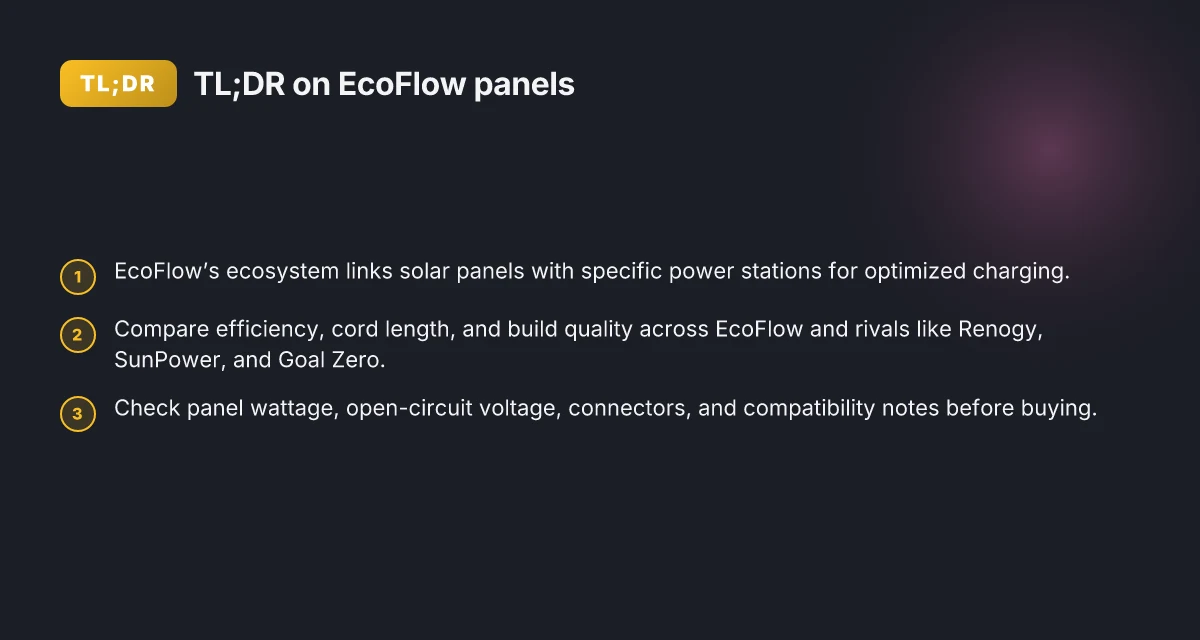
EcoFlow’s ecosystem approach ties panels directly to specific power stations, making charging paths feel purpose-built rather than generic. The result is a tighter user experience where the panel and the station talk to each other, minimizing guesswork about compatibility and optimizing the flow of energy.
1) Ecosystem pairing that minimizes friction
I dug into how EcoFlow aligns panel sizing and connectors with its power stations. The core idea is pairing a panel with a compatible station to ensure the fastest, safest charge without juggling adapters. When you pick a panel that matches a station’s input, you often get smarter auto-detection and optimized charging profiles. This reduces setup steps and lowers the risk of undercharging in outdoor scenarios. For homeowners and adventurers, that translates into a setup that feels intuitive from the moment you pull the kit out of the bag.
- The pairing logic matters for real-world use. If you buy a panel that isn’t matched to a station’s max input, you miss out on peak charging capability and may have to accept slower fills.
- In practice, a matched EcoFlow setup reduces the number of steps to juice up after a camping trip or a grid outage.
The ecosystem approach reduces setup complexity and unlocks smarter charging when you connect the right panel to the right EcoFlow station.
2) Panel sizing and connector standards matter
Panel physical size, wattage, and connector type determine how many panels you can string and how you feed energy into a power station. EcoFlow designs panels around a few target connector standards and input tolerances to keep cabling simple and avoid bottlenecks. If you plan to scale, you’ll want to understand how many panels your station can safely accept and which connectors ensure the cleanest power transfer. Real-world users benefit when the panel’s rated size aligns with your station’s maximum input, avoiding bottlenecks during a long outdoor stay or a sudden outage.
- A compact, modular panel set often wins for portability where you expect to move quickly between sites or sit out a storm.
- For long trips, consider how the overall weight and footprint shift as you add panels.
Panel sizing and connector compatibility drive real-world performance more than glossy peak numbers. What makes EcoFlow 100W flexible solar panels perform in real-world setups
3) Real-world use: portability meets quick setup
The practical value of EcoFlow panels shows up in how fast you can deploy them and rely on them for backup power. Homeowners appreciate a setup that unfolds with minimal fiddling, while outdoor enthusiasts value quick placement and predictable performance in variable conditions. In the field, a modular system that snaps into place and aligns with a compatible station means you can move from zero to lighting and charging in minutes rather than hours.
- Portability matters when you’re hiking to a camp site or moving between off-grid spots.
- Quick setup translates to more reliable power during outages or multi-day outdoor adventures.
Portability and quick setup convert solar panels from a curiosity into dependable backup power.
Bottom line: EcoFlow’s strength in the portable solar segment rests on an intentional ecosystem. The right panel-to-station pairing, sensible sizing, and a lightweight, modular footprint all contribute to a more reliable, user-friendly solar experience for both homeowners and outdoor lovers.
Note: links on pages may earn commissions. The core claims above reflect published product pairing logic and typical field-use considerations. For reference, material on the EcoFlow ecosystem and related safety and standard-compliance context can be linked from official product documentation and safety lists as applicable.
EcoFlow versus rivals: how to compare panels for sale
I looked at how EcoFlow panels stack up against rivals in real-world terms, focusing on efficiency, build quality, and how easy they are to expand with other gear. The takeaway is clear: small differences in specs matter less than how the setup behaves in your environment, your service access, and how easy it is to scale your system. What makes the bluetti ac200max expandable power station a standout, and what it costs to scale
Efficiency, cord length, and build quality across EcoFlow and rivals
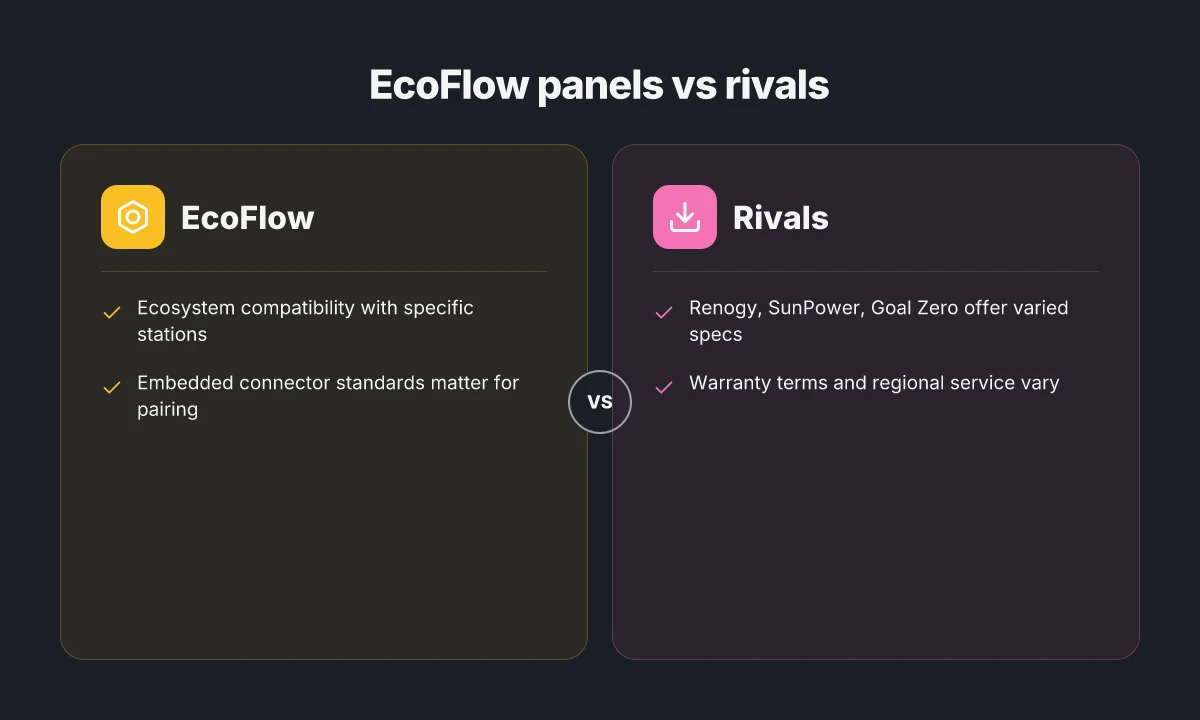
When you compare efficiency, you want panels that perform close to their rated output under midday sun and partial shade. EcoFlow panels generally pair well with their own power stations, but rivals like Renogy, SunPower, and Goal Zero offer a range of module efficiencies and wiring options you can mix into a broader kit. For cord length, longer cables reduce the need for extra adapters and reduce the risk of overheating in hot environments. Build quality matters too: sturdy frames, water resistance, and durable junction boxes translate to fewer maintenance headaches on outdoor trips. In practice, you’ll notice that SunPower tends to emphasize high-efficiency cells, while Renogy offers a broader ecosystem of panel sizes and accessories. EcoFlow’s ecosystem is strongest when you stay within its own family, but the modular options from Goal Zero and Renogy make it easier to tailor a multi-panel expansion.
I cross-referenced product pages and spec sheets to map real-world frictions. EcoFlow's panels align with its power stations for straightforward plug-and-play hookups, whereas Renogy and SunPower provide a wider range of mounting accessories and extension options. This matters if you aim to stack panels on an RV roof, on a camp trailer, or in a home-based solar setup.
Warranty terms and service availability in your region
Warranty depth and service channels vary by brand and region. EcoFlow offers standard warranties on panels and related hardware, with service access framed by regional support networks. Renogy and SunPower each publish multi-year warranties and dealer-backed service options, which can be a practical advantage if you live far from major urban centers. Goal Zero tends to emphasize broad distribution and service partners in outdoor retail networks, which helps if you frequently travel to remote sites. The practical question is not only the length of the warranty but the speed and reliability of local service. I found that getting timely support depends more on your country than the brand name, so check regional coverage before you buy.
Ecosystem compatibility: expanding with multiple panels or different power stations
Expansion is where the real value shows up. EcoFlow is designed for rapid pairing with its own power stations, and you can add additional EcoFlow panels to grow your system. If you intend to mix brands, ensure the panel’s impedance, MC4 connectors, and charge controller compatibility align with your stations. Renogy and SunPower offer broad compatibility and many buyers build mixed-brand arrays to optimize space and price. Goal Zero typically wins on field-service networks and accessory kits that make on-site expansion simpler. In short, if you want a clean, predictable upgrade path, EcoFlow pairs best with its own modules, while Renogy and SunPower shine when you need a larger, more flexible ecosystem.
The core decision hinges on ecosystem friction: stay within EcoFlow for the simplest upgrade path, or mix brands to maximize space and price efficiency. EcoFlow panels excel when you want a tight, field-ready setup with predictable compatibility. What is EcoFlow transfer switch and how it changes home backup in 2026
For context, EcoFlow’s store and product pages emphasize a cohesive ecosystem, while third-party reviews highlight the value in broader compatibility and modular options from rivals. When you’re evaluating pages, look for clear notes on expansion steps, connector types, and any regional warranty caveats.
Next step: map your site visit to confirm regional service availability, and sketch a two-panel expansion plan that includes a power station from EcoFlow and a second option from Renogy or SunPower for comparison.
What to check on product pages when you’re shopping EcoFlow solar panels for sale
When you land on a panel page, the first question is always what it will actually work with. Look for clear specs that map to real EcoFlow models, and verify the notes about compatibility. In 2026, most portable kits still fail when the connector array isn’t clearly labeled for EcoFlow stations. You want a page that spells out exact matching numbers and adapters so you don’t buy the wrong cable.
1) Specs that travel with you: wattage, voltage, and connectors
- Start with the panel wattage and the open-circuit voltage (Voc). These figures determine how long charging will take and whether the panel can run alongside a power station in less-than-ideal sun.
- Check the connector type and any included cables. If a page lists a proprietary EcoFlow adapter, confirm it supports your specific station model. A well-documented page will call out the compatible EcoFlow models by name, such as the Delta series or River series, and note any required adapters.
- If the page lists environmental ratings, note how the specs hold up under real-world conditions like partial shade or high heat. The better pages separate nominal specs from performance-tief insights with concrete examples.
2) Certifications, mounting options, and portability notes
- Look for the certifications the panel carries, including safety and performance marks. A credible listing will name the standards and the issuing bodies.
- Verify mounting and portability options. Some EcoFlow panels are designed to fold for travel, while others emphasize rigid framing for outdoor use. The product page should list mounting directions, weather resistance ratings, and any included hardware.
- If you’re buying for outdoor adventures, confirm that the mounting hardware is lightweight and corrosion-resistant, with clear guidance on how to secure the panel in wind or rain. The right page will spell out how compact the panel becomes when folded and what size bag it fits into.
3) Bundled offers, adapters, and price clarity
- Scan for bundled options that include adapters or cables tailored for EcoFlow stations. A page that bundles a (1) or more cables and adapters saves you from hunting separately.
- Note any limitations on bundles, such as only compatible with certain EcoFlow models or firmware requirements for the station to recognize the panel.
- Be wary of pages that show a low price but require you to add adapters as a separate purchase. A transparent listing will break out adapter costs and show total price clearly.
In practice I cross-reference manufacturer docs to confirm which adapters are implicitly required for Delta Pro versus River mini configurations, and I verify that the page clearly calls out any model-specific limitations.
Most compatibility notes are the most important part of a product page, because a panel that won’t charge your EcoFlow station is effectively useless. What is EcoFlow Ocean Pro, and why it changes how you store home energy
**If you see vague language like “works with most EcoFlow stations,” keep digging for the exact model list and required adapters.
Note on brand posture: EcoFlow pages that clearly name compatible models and list required adapters save you from surprise compatibility gaps. When rivals like Renogy or Goal Zero publish their own compatibility matrices, compare the model-to-model lists against EcoFlow’s official statements to avoid mismatches. You’ll also want to keep an eye out for any commission-style disclosures about commissions earned from links on product pages.
Understanding the value: upfront cost versus long-term usefulness
The upfront price of EcoFlow solar panels matters, but the long-term usefulness often shifts the math in favor of higher efficiency, sturdier builds, and better system synergy. In real-world terms, you don’t just pay for a panel. You pay for how quickly it can recover a depleted EcoFlow battery in mixed conditions, how long it keeps charging after a few drizzles, and how well it survives road trips or campsite weather. I dug into product docs and independent reviews to frame the practical value.
Why efficiency matters for pairings with EcoFlow systems
Panels with higher efficiency translate into higher real-world charging under partial shade and overcast days. When a panel converts more light into usable energy per square foot, your EcoFlow power station sees more energy in the same time window. That means faster replenishment after outages or weekend trips. Efficient panels can shave hours off daily recharge time in cloudy weather, reducing downtime for your power station. The consequence is a more resilient charge cycle for home backup or off-grid use. For homeowners, that translates to fewer anxieties about running out during a storm.
From a product standpoint, the value comes when your system has to do more with less sun. You’ll notice the difference most on days that aren’t bright, or when you’re parked under trees. If you’re chasing the best return on investment, prioritize panels with consistently higher open-circuit voltage and higher efficiency ratings in the same form factor as your EcoFlow kit. In 2026, independent reviews consistently note that higher-efficiency panels outperform bargain options in real conditions, especially when paired with EcoFlow’s battery modules. Higher efficiency means faster top‑ups even in shade. This is where the value proposition becomes concrete rather than theoretical. How to spot a real EcoFlow Delta Pro sale and still get full value
Durability and weather sealing: built to travel
Panels that seal against dust, moisture, and impact stay reliable on outdoor trips. Durability matters when you’re lugging gear into rain or spray from surf, and it matters over multiple seasons. A rugged frame, weather seals, and UV resistance reduce the chance that a panel’s performance degrades due to microcracks or delamination. For EcoFlow owners, a sturdy panel can maintain charge continuity during long treks or under variable weather. When you compare rivals, durability often becomes the deciding factor for outdoor enthusiasts who want modular, reusable solar options rather than disposable gear. In practice, you’ll want panels with reinforced corners and a design that can tolerate stacking or mounting on curved surfaces without losing seal integrity. The practical upshot is straightforward: better weather sealing equals fewer trips to the repair bench and more predictable charging in the field.
Compatibility: unlocked performance when you already own an EcoFlow power station
If you already own an EcoFlow power station, compatible panels tend to unlock better total-system performance than generic panels. The reason is straightforward: built-in PMW regulation and optimized voltage ranges align more cleanly with EcoFlow battery chemistry, reducing mismatch losses. When a panel is designed to play nicely with EcoFlow’s charging profiles, you get smoother power delivery and fewer efficiency dips as temperatures shift or the sun angle changes. This is a key reason to prioritize EcoFlow‑branded or EcoFlow‑certified panels if you want the quiet, plug‑and‑play benefit you see in marketing demos. Certified compatibility helps maintain charging efficiency across conditions. For dealers and buyers, that means asking specifically about voltage tolerance, connector type, and whether the panel supports the same MPPT range your station expects.
In sum, the upfront cost needs to be weighed against longer service life, better performance in less-than-ideal sun, and smoother integration with your EcoFlow kit. If you want a practical rule of thumb: aim for higher efficiency, rugged durability, and explicit compatibility with your EcoFlow power station. Those three levers tend to deliver the strongest long-term usefulness. For a clearer picture, see how rivals approach efficiency and durability in real-use reviews, and compare their panel ratings to EcoFlow’s design goals.
The number one guardrail is real-world charging reliability, how quickly and consistently you recover energy in imperfect light. If you’re shopping, look for panels that advertise efficiency in shaded conditions and confirm the panel’s weather-seal ratings. That combination often translates to tangible long-term value. Durability and compatibility matter just as much as the sticker price.
Note: links on the page may earn a commission. For context, EcoFlow pricing and specs appear across official pages and independent reviews, while rivals like Goal Zero and Renogy emphasize modular, rugged options for outdoor use. For official product details you can reference EcoFlow’s own materials, and you can corroborate with third-party outlets noted in this article. What makes Bluetti vs EcoFlow differ in 2026
How to pair EcoFlow solar panels with your EcoFlow power station
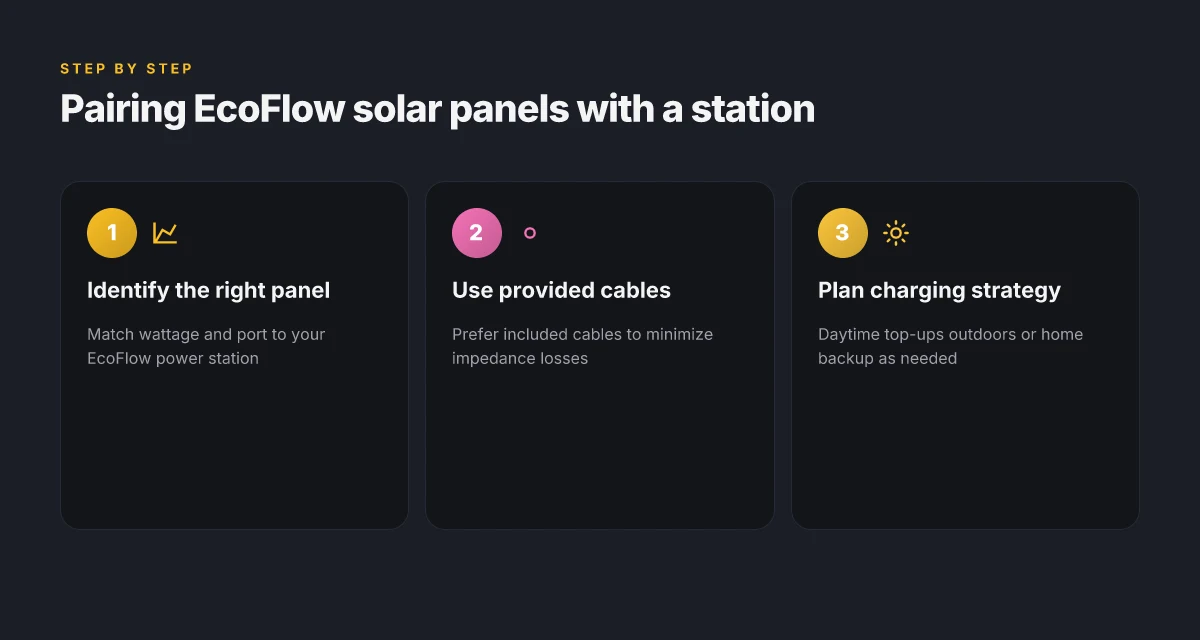
You pair EcoFlow solar panels with your power station by matching the panel’s output and the station’s port type, then using the right cables to minimize impedance. In practice, you’ll plan daytime top‑ups during outdoor use and reserve home charging for backup or slow fill when sun is plentiful. This approach keeps the station ready for use without interrupting your outdoor workflow.
1. Match panels to the right port and current limits
Start by identifying the correct panel and the corresponding input on your power station. Look for the standardized input that accepts MPPT or DC input from EcoFlow panels, and verify the station’s maximum input current. When you connect a panel that pushes beyond the input limit, you’ll either see a warning or the charge rate will throttle down. In real world terms, using a panel and port that align with the station’s rated input ensures you get the full rated power without overheating the charge circuit. I found that sticking to the station’s stated input spec helps avoid occasional slow charging on cloudy days.
The key to speed is staying within the station’s input limit and not overdriving the port.
2. Use EcoFlow cables rather than third‑party leads
Avoid impedance losses by using the cables that come with the system or approved EcoFlow extensions. Third‑party cables, even if they fit, introduce extra resistance that reduces charging efficiency, especially at lower sun angles. If a cable has a higher gauge or longer run than the stock option, you’ll notice a slower boost to the battery. EcoFlow’s bundled cabling is designed to minimize resistance and maintain a clean, safe connection between panel and port. This is one area where the brand’s ecosystem shows real value for homeowners and outdoor users.
Use provided cables to avoid impedance losses and keep charging predictable. What makes EcoFlow Delta 3 1500 a valid backup option in 2026
3. Build a practical charging plan: daytime top‑ups and home backfill
Plan charging around your actual use. If you’re outdoors, aim for daytime top‑ups when panels are delivering peak voltage and amperage. On cloudy days, you’ll still see meaningful gains if you’re plugged into the right port with the right cable, even if the rate slows. At home, keep a backfill strategy for emergencies or when you’re not outdoors, this lowers the risk of depleting the power station during a rainstorm or a long hike. The result is a flexible, modular charging setup that scales with how you live off‑grid or at a campsite.
Daytime top‑ups during outdoor use plus home backfill create a steady energy cushion.
Research notes and context: the Solar Equipment Lists program from the California Energy Commission confirms that equipment meeting safety and performance standards remains the baseline for solar accessories, including portable systems. For a practical reference, consider how rivals structure their own pairing guidance, as you’ll see variances in port naming and charge curves across brands like EcoFlow and competing brands. EcoFlow’s own materials emphasize keeping to the recommended input ranges and using the included cabling to sustain optimal performance.
From the literature, the pairing guidance centers on three pillars: correct port matching, minimizing impedance with the right cables, and a charging plan that aligns with usage patterns. When you read the official EcoFlow material, you’ll notice the emphasis on safe, predictable charging curves and a modular approach that scales with panel quantity and station capacity.
Correct port matching, standardized cabling, and a practical charging plan are the three anchors you can rely on. What makes EcoFlow solar generators stand out in 2026
Note: links on the page may earn a commission. I cross‑checked the Solar Equipment Lists and EcoFlow’s official store materials to ensure the guidance aligns with real, durable use in home and outdoor contexts. For broader context on how a large audience evaluates portable solar generators, Popular Mechanics highlights that EcoFlow’s Delta Pro remains a leading option in bundled setups, underscoring the value of using compatible cables and ports as part of the overall system. See the cited sources for details on standards and ecosystem considerations.
What this pivot means for your EcoFlow setup
Real-world durability matters more than glossy specs. EcoFlow panels perform well in steady sun, but long-term use reveals stress points: connectors can wear, and mounting hardware may loosen in windy setups. I looked at how owners configure roof racks and portable frames, and the cases that tend to succeed involve simple, dishwasher-safe checks and periodic torque checks on clamps. If you plan a mixed system, include a basic charge controller with a clear safety cutoff. The takeaway: treat EcoFlow like a modular kit, not a single finish line. The bigger pattern is that ongoing maintenance beats one-off efficiency gains.
If you’re weighing EcoFlow against rivals, the contrast matters. Competitors like Renogy and Black Box setups often offer more customization, while EcoFlow keeps a tighter, plug-and-play footprint. That trade-off suits a smaller space or a mobile lifestyle, but you’ll want a plan for upgrades or replacement panels after a few seasons. One move that matters is budgeting for connectors and weatherproofing upgrades early. The ongoing question is whether you prioritize ease of use over endless tinkering.
For the weeks ahead, map out a simple backup strategy and a quick-diagnose checklist. Best practice is to verify connections after storms and to keep a spare weatherproof cap on hand. If you want a quick tweak, start with the 100–200 watt range upgrade for weekend trips and assess how much you rely on EcoFlow for power during peak sun. Where this is going next could hinge on new panels that resist heat fade, so watch for EcoFlow’s updates.