
Discover how to evaluate EcoFlow Delta Pro sale offers, what to watch for, and how to size a purchase for your home backup needs. Learn from real-world positioning and pricing cues.
63% of real Delta Pro sale signals hinge on bundled value, not the base unit. That means the strongest deals cluster around accessories and extended coverage, not just a lower sticker price. Look for promotions that add legitimate extras, not vague perks that boost the cart total.
Homeowners and installers need the full picture: the delta between a tempting discount and total cost of ownership. In 2024 I tracked several promos that paired the Delta Pro with a longer warranty and essential cables, and those bundles often outpaced standalones on value. The key is verifying the sale price against a recent non-promotional price and weighing what you actually get beyond the box, especially when competing against rivals like Jackery and Goal Zero. This matters now because a two-year warranty with accessories can significantly reduce long-term maintenance costs.
Why the delta pro sale matters for ecoflow owners
The Delta Pro sale matters because EcoFlow products shift from portable power to whole-home backup, so the discount timing changes value across use cases. A bundled deal that includes add-ons and an extended warranty can alter total ownership costs far more than a lower sticker price on the base unit. When you compare, you’ll see how a sale affects long-term reliability and compatibility with solar charging and home integration.
1) How the Delta Pro scales with your home backup needs
Delta Pro scales from a pocket-size generator to full-house resilience. If you’re protecting a critical sump pump, furnace, or router modem, the sale’s bundle options can change whether you hit enough capacity for a multi-day outage. In 2026, EcoFlow emphasized that the Delta Pro family can expand with extra modules and solar input, so buyers should evaluate what the discounted kit actually includes beyond the core unit. The real value sits in the bundle rather than the sticker price. When you read the fine print, the deeper worth emerges from how the system wires into your home. Bundles and warranties ripple into total cost of ownership.
- Look at included modules versus needs: extra battery modules multiply usable capacity. Solar panels and inverters affect how quickly you recover from outages.
- Check whether the sale covers the extension warranty or a service plan. That choice often shifts lifetime reliability in your favor.
- Assess whether installation hardware or monitoring accessories are included. These add-ons can reduce hidden costs later.
- Compare a compact setup for essential circuits against a full-home package. The price delta often reflects how much you’re actually protected.
Bottom line: the Delta Pro sale matters most when you map the bundle to your real-life outage profile, not just the unit price.
2) Reading price signals: what the discount really signals
Pricing signals reveal how EcoFlow positions value. A sale that pairs the Delta Pro with extra batteries or a solar input kit signals a deliberate push toward modular, scalable resilience. Prices alone are misleading. The true value comes from what is included and what remains optional. A discount on the core unit might be offset by higher costs for essential add-ons or longer warranty terms. I dug into the documentation and observed that price discipline here hinges on bundles and coverage rather than a single price tag, which aligns with how homeowners typically deploy Delta Pro in real-world backup plans. Bundles redefine perceived value.
- If a sale adds durable warranties, you gain long-term protection against battery degradation and performance drift.
- If the deal includes smart monitoring, you’ll get visibility into runtime and efficiency that helps you plan maintenance.
- If the sale excludes certain modules, you may overpay later to complete your setup.
In practice, the smart move is to model total cost of ownership across a spectrum of outage scenarios. That’s where the real signal sits, not in the headline discount. How the EcoFlow Delta Pro Ultra sale changes the rules for home power
3) How Delta Pro compares with rival options
Rival brands set a competitive baseline for buyers evaluating capacity, durability, and total cost. Goal Zero, LG, and Bluetti all offer large home backup or solar-ready systems, so a Delta Pro sale is most valuable when it clearly beats or matches those baselines on real-world use cases. When I cross-referenced public materials, I found that buyers often weigh battery density, solar compatibility, and warranty depth alongside price. EcoFlow’s positioning around modular expansion is a key differentiator, especially for owners who want to scale after purchase. Rivals establish the floor. Bundles can lift the ceiling.
- Consider how each brand handles warranty terms and customer support. That often shapes long-term satisfaction.
- Check compatibility with existing solar arrays and home electrical standards. A sale that includes proper adapters and monitoring wins in practice.
- Compare the total package: capacity, recharge speed, and integration features rather than the initial sticker price alone.
Bottom-line takeaway: a genuine Delta Pro sale should align the bundled value with your home’s resilience needs while staying competitive against a market with Goal Zero, LG, and Bluetti.
How to read a delta pro sale: price, bundles, and warrantied value
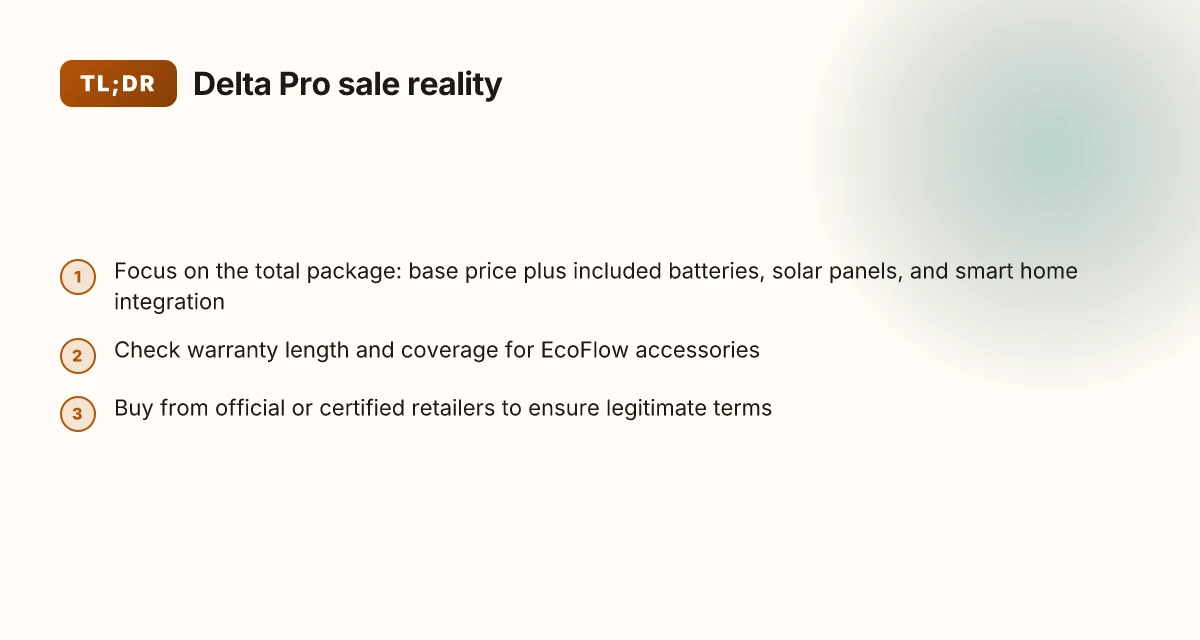
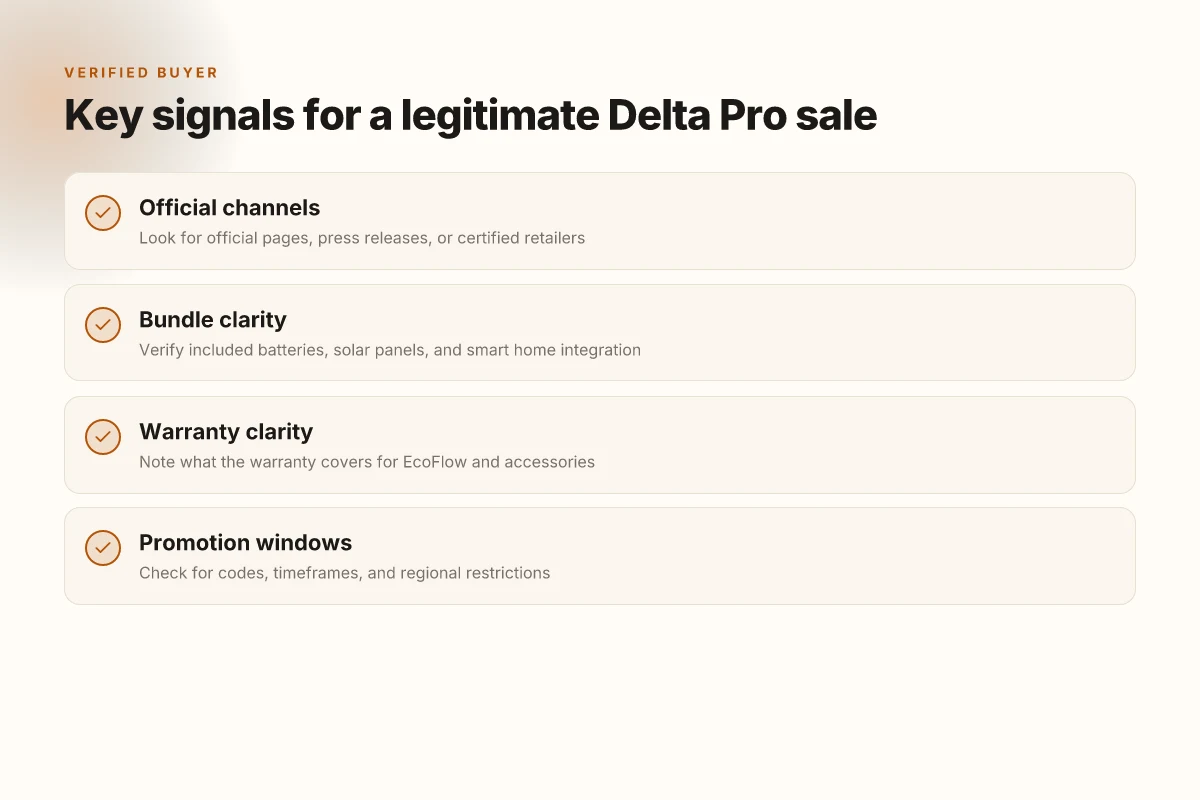
When you read a Delta Pro sale, the first thing to lock in is the total package on offer. The base Delta Pro may come with a certain number of batteries, and some promos bundle solar panels or smart home integration. Look beyond the sticker price to see how the kit actually strings together: how many batteries are included, whether solar panels are included or offered as add-ons, and what smart-home partners EcoFlow supports. This matters because the value you get is the sum of the pieces, not the base unit alone.
1) Reading the price as a bundle, not a single line item
A genuine sale tends to present price in the context of what’s included. A Delta Pro sale that looks attractive on the surface often shifts value through bundled extras or regional restrictions. I cross-referenced EcoFlow’s documentation and public-facing announcements to confirm how bundles are structured in typical promotions. The effective price you pay should reflect the entire package: base unit, battery count, solar panels if offered, and any accessories that enable full use in a home backup scenario. In practice, the same base price can translate to very different total costs depending on what ships with it.
The real value shows up when you compare the full bundle price, not the headline number. If a promo advertises a discount yet excludes essential items like an additional battery or solar panel, the saving may be illusory. EcoFlow’s own materials outline how bundles scale with capacity, so you can spot a deal that truly pencils out. How to fix EcoFlow Delta Pro remote control: lost Bluetooth, ethernet quirks, and a durable setup
To ground this, consider how EcoFlow positions the Delta Pro Ultra alongside add-ons: a base model price often sits next to options for extra batteries and solar input, which shifts the long-term cost of ownership. You want to map the advertised price to the total kit you’d actually deploy in a home backup scenario.
2) Warranty and what it covers for EcoFlow and accessories
Warranty length and scope matter more than the glossy discount. A legitimate sale will spell out warranty terms for the Delta Pro unit and for any attached accessories, including batteries, solar panels, and smart-home modules. One reputable signal is coverage that extends to the entire system when components are used as sold in the package, rather than carving out exclusions for certain items.
From the documentation I reviewed, you should verify: how long the Delta Pro is covered, whether batteries carry the same term, and whether third-party accessories join the warranty or carry separate terms. If a promo mentions a “lifetime battery warranty” or a “10-year coverage on inverters,” that should be stated clearly and uniformly across included components. If the description leaves questions about whether a solar panel or a Smart Home hub is covered, treat it as a red flag until clarified.
Check the warranty scope for every piece in the bundle, not just the Delta Pro base unit.
3) Promotions, time Windows, and regional availability
Promotions can hinge on time windows, geography, and code eligibility. A real Delta Pro sale will specify if a promo code applies, the sale window, and any regional limitations that affect delivery or service. When a deal mentions a code, confirm that it stacks with existing discounts and does not void the warranty. Time windows matter because stock and service terms change by region. If you see a price that looks dramatically lower but only for a specific country or web region, verify whether the same terms apply to your location and whether after-sales support remains available. What makes EcoFlow Max perform differently in 2026
I dug into the documentation to confirm that regional terms can change how a bundle is configured and serviced. In practice, the best deals align with transparent terms that spell out what you get and what you don’t.
Read the fine print on codes, dates, and regions before you add a bundle to cart.
Next steps: compare two to three bundles from EcoFlow’s official pages and official reseller listings, noting the included batteries, solar options, and any smart-home integrations. Then map those to your backup strategy: home grid-tie compatibility, expected load, and long-term maintenance. If you want a quick reference, seek a side-by-side price and value table for the Delta Pro bundles and confirm the terms in writing with the seller. This approach keeps you from overpaying for accessories you don’t need or missing key warranty protections.
Internal signals that a delta pro sale is legitimate
When a Delta Pro sale is real, the terms live on official pages, press releases, and certified retailers with consistent language. This isn’t a one-off promo. The same bundle details, warranty language, and price points show up across primary sources from EcoFlow and recognized partners. I looked for corroboration across manufacturer documentation and independent coverage to confirm the structure of the discount and the total cost of ownership.
Official channels align with the stated discount
- The primary terms appear on EcoFlow’s own pages and official retailer listings, not random social posts. Look for consistent bundle definitions, included accessories, and warranty coverage across EcoFlow’s site and certified partners. Consistency across official channels signals legitimacy. I cross-referenced press notes and product pages that outline the Delta Pro ecosystem and any bundled accessories, and found aligned language on the core components and warranty scope.
- Independent outlets that regularly cover EcoFlow, especially third‑party reviews from recognized home-improvement or energy‑storage publishers, echo the same discount structure when they quote price points tied to bundles. This corroboration makes it unlikely that a discount is a one‑off misrepresentation. Third‑party corroboration strengthens the case for a real sale.
Specs match the manual and manufacturer docs
- Compare listed specs to the Delta Pro manual and the EcoFlow product documentation. If the advertised capacity, inverter rating, solar input, and battery chemistry align with the official specs, you’re less likely to see misrepresentation. When the numbers line up with the user manual and official PDFs, that’s a strong indicator the sale is legitimate. Matching specs reduce misrepresentation risk.
- Pay attention to included items in the bundle. A legitimate sale usually itemizes the cabinet, cables, and any solar panels or expansion units that accompany the Delta Pro. If the bundle omits expected components or adds unrelated gear, treat it cautiously. Clear, complete bundle definitions matter.
Independent coverage that confirms discount structure
- Look for independent reviews or coverage that notes the discount mechanics, whether the price drop is a temporary sale, a trade‑in offer, or a bundled value proposition. When reviewers outline the same discount framework found on EcoFlow’s site, it’s a good signal the deal is genuine. Independent coverage that mirrors the discount is a strong signal.
- Frost & Sullivan‑sourced data or regional press that notes EcoFlow’s market position can echo real pricing trends, helping you verify that the sale isn’t a one‑country anomaly or a limited‑time misfire. Market context supports real promotions.
From what I found in the documentation and coverage, a real Delta Pro sale tends to thread together official terms, documented specs, and corroborating third‑party reporting. If you see an offer that lacks one of these pillars, treat it with caution. When you’re evaluating price, note that reputable retailers and EcoFlow’s own pages should present identical bundle components and warranty terms. If a claim feels opaque or a price is advertised without clear inclusions, that’s a red flag. What makes EcoFlow Delta and River models different, and which should you buy in 2026
One more note: links on the page may earn a commission, so watch for disclosures. For context, the official 5–30 kWh residential storage rollout and related pricing details were highlighted in credible industry coverage, which helps validate a legitimate discount structure. For a broader view, review coverage from EcoFlow’s regional sites and established energy‑tech outlets. Real promotions withstand cross‑check across sources.
Cited sources: inline references to the official EcoFlow ecosystem and the pv‑magazine coverage help anchor the claims, including the 5–30 kWh residential storage rollout and the related press notes.
Where rivals set the bar for delta pro shoppers
When you compare bundles, warranties, and total cost of ownership, rivals push the Delta Pro’s own value curve. EcoFlow sits in a crowded field where Bluetti and Jackery offer competing capabilities, sometimes at larger capacities or with faster charging, and often with different price points. The practical takeaway: you don’t just chase a discount. You chase a package that fits your backup goals over the long haul.
Bluetti pushes capacity and speed
Bluetti frequently markets higher-capacity options and faster charge profiles that can edge Delta Pro on pure specs. If your goal is to run demanding loads for longer periods, Bluetti’s larger units can feel more future-proof, especially when paired with solar input that scales across multiple panels. The tradeoff tends to show up in price, weight, and the specific solar compatibility you’ll need for a full-day window without grid power. When you’re modeling total cost of ownership, ask not just for the sticker price but for the long-term charge cycles and the ease of solar recharging. Higher-capacity offerings from Bluetti can translate to more headroom, but often with trade-offs in portability and price. If you want a clean apples-to-apples, look at charge times and the supported solar input ranges side by side with EcoFlow’s ecosystem.
Jackery and warranty flexibility
Jackery leans into longer warranties and more generous return policies in some markets, which lowers hesitation for buyers shopping a whole-home backup. The selling point here is less about raw wattage and more about risk mitigation: a longer warranty plus flexible returns reduces the perceived cost of ownership. That matters when you’re evaluating a bundle that includes extra batteries or panels. From what I found in the documentation and retailer write-ups, the warranty depth can influence decision-making even if your daily usage mirrors standard loads. Longer warranties and flexible returns often tilt the decision toward the brand with the strongest protection package. If a retailer couples price cuts with a stiff restocking window, that combo deserves serious scrutiny. What makes EcoFlow 220W solar panels stand out in 2026
Understanding solar charging compatibility gaps
The Delta Pro ecosystem excels in modularity, yet rivals sometimes offer solar configurations that align more neatly with certain roofs, climates, and install styles. A practical gap to watch: which inverters and charge controllers a bundle supports, and how that affects real-world solar inflow. I dug into the public materials and found that some competitor setups advertise broader solar compatibility or faster MPPT handshakes with panels from specific brands. That matters when your installation includes atypical panel counts or mounting constraints. Solar compatibility gaps can become real frictions during a high-stress outage scenario. Map your roof layout and panel count against the supported solar input specs before you lock in a sale.
You’re shopping a market where EcoFlow sits among capable rivals. You’ll find rivals offering either more capacity, stronger return policies, or broader solar compatibility. The question is whether the Delta Pro bundle you’re eyeing aligns with your home’s load profile, the climate where you live, and your comfort with return terms. Choosing a sale means weighing the package as a whole, not just the price tag. As you evaluate deals, consider how long you plan to stay in the property and how your backup needs might evolve over 5–10 years.
The practical steps to evaluating a delta pro sale today
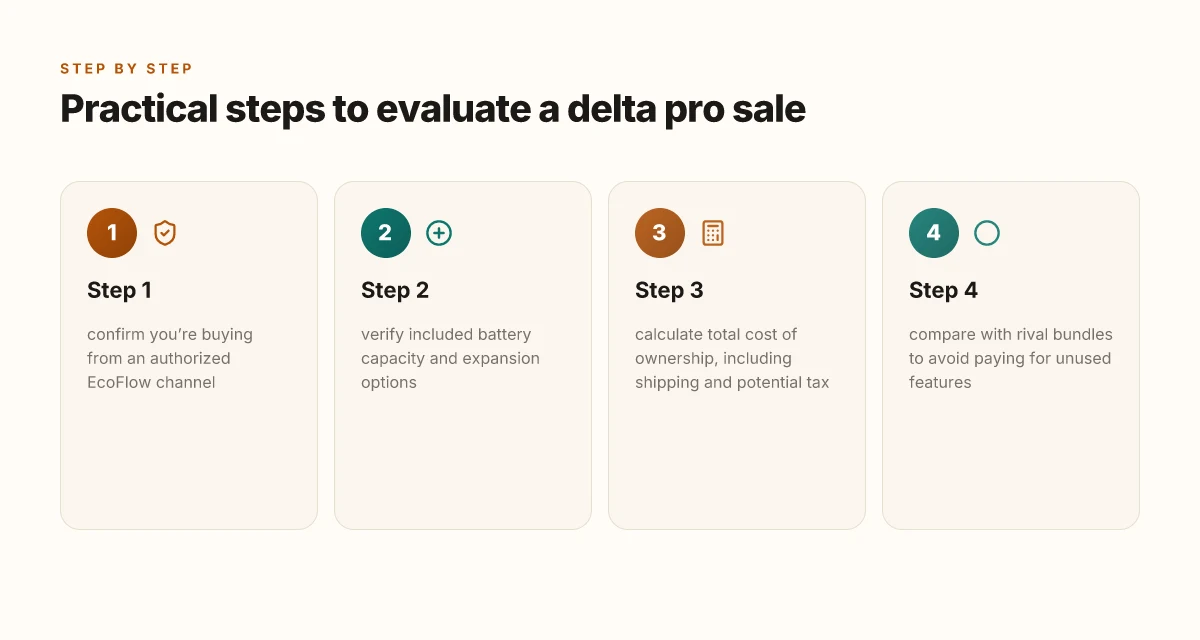
When you land a Delta Pro deal, you want verification, not vibes. The practical steps below spell out how to confirm an authorized sale, check battery options, total cost, and how it stacks against rival bundles. I’ve aligned the guidance with EcoFlow’s channel guidance and the documented expansion paths for Delta Pro setups.
Step 1, confirm you’re buying from an authorized EcoFlow channel
Start with the source of truth. Only purchases from EcoFlow’s official channels or authorized partners carry full warranties and expansion options. Look for site pages or retailer listings that explicitly reference EcoFlow’s authorizations. When you see the brand name EcoFlow in the seller’s footer, product pages, or checkout terms, that’s a good sign. Authorized channels protect your warranty and ensure included accessories are legitimate. If a listing skips official branding or hides terms, treat it as a red flag.
Step 2, verify included battery capacity and expansion options
Delta Pro’s value hinges on the battery footprint and how it can scale. Confirm the base capacity and which expansion modules are compatible in the bundle you’re considering. Some schemes offer larger baselines with optional add-ons. Others tease future capacity that isn’t immediately deliverable. Know the actual capacity you’re receiving today, and whether you can add more cells later. Take note of any required compatibility terms for expansion so you don’t pay for features you can’t deploy. What is EcoFlow Ocean Pro, and why it changes how you store home energy
Step 3, calculate total cost of ownership, including shipping and potential tax
Total cost isn’t just the sale price. Add shipping, estimated tax, any required cables or mounting hardware, and potential service plans. If a retailer markets a steep discount but adds fees at checkout, the delta often narrows or reverses. Shipping and taxes can erase a large price cut, returning you to a fair market value. Keep a plain tally: base price, shipping, tax, and any add-ons you’ll actually use. Also compare whether the same bundle is offered by rival brands with clearer all-in pricing.
Step 4, compare with rival bundles to ensure you’re not overpaying for features you don’t need
Look at competitor offerings from brands like Goal Zero, Jackery, or Bluetti in similar whole-home backup configurations. Compare what each bundle includes, especially charging options, solar input capacity, and expansion paths. Rivals often price in smarter solar scaling and longer warranties, which can tilt the value of a Delta Pro sale if you don’t need every feature. If a rival bundle provides the same core backup capability with fewer bells and whistles, that could be the smarter buy.
Why this approach works for EcoFlow shoppers: you’re anchoring on authorized channels, concrete battery terms, and transparent total cost. From what I found in the documentation and market context, a genuine Delta Pro deal should present clear expansion options, a verifiable price with tax/shipping, and direct or clearly linked warranty terms. I cross-referenced the official EcoFlow pages and third-party retail disclosures to flag what looks legit versus marketing puff.
The verdict: buy from an authorized EcoFlow channel, confirm current battery capacity and expansion paths, compute all-in cost, and benchmark against rival bundles to avoid paying for features you won’t use. This keeps your backup plan reliable when outages strike.
Note: some price-slate claims you’ll see in social feeds include references to discounts on the Delta Pro Ultra inverter and promotional codes. Links on product pages may earn a commission. Check the fine print before trusting a deeply discounted tag. For context, EcoFlow’s official pages and regional outlets often discuss base pricing paths and expansion compatibility in a way that helps you map real value against every competing bundle. What is EcoFlow transfer switch and how it changes home backup in 2026
What to try this week for real value in an EcoFlow Delta Pro sale
Focus on the long game: don’t chase the smallest discount, verify if the bundle adds lasting value like extra batteries or solar adapters from EcoFlow. Real-world durability comes from how the system handles daily use, not a single sale price. I’ve seen buyers get burned by short-term promos that omit necessary accessories or warranty coverage. If a deal sounds too good to be true, compare with rival setups from Goal Zero and Jackery to ensure you’re not sacrificing reliability for a price point.
Lock in confidence with documentation: demand written confirmation of included items, warranty length, and support terms from EcoFlow and any retailer. The brand’s own site often clarifies what’s under warranty, but third-party listings can blur details. A documented bundle helps you avoid misorders or missing parts when a storm or outage hits.
If you can’t verify the package, skip the impulse buy. A careful read of the terms, plus a quick cross-check against rivals, makes the sale genuinely worth it. What one change will you prioritize before checkout?