
Explore the EcoFlow Delta 3 1500's performance, charging behavior, and real-world durability to decide if it fits your off-grid needs in 2026.
Whether you count on it for CPAP nights or off-grid storm weeks, the Delta 3 1500 earns its keep by delivering steady runtime over the long haul rather than flashy bursts of power. This unit’s real-world rhythm matters: a balanced output profile, reliable battery chemistry, and a sane solar input cap that lines up with daily recharging habits. Most users underestimate how long a dependable charger pulse matters for sleep devices, yet the Delta 3 1500 keeps essential loads alive when the grid vanishes.
This article zooms in on durability, expandability, and everyday resilience in 2026. I looked across field reports and product notes to map out how EcoFlow handles heat, cycling, and solar dedication for weekend hikers, remote cabins, and medical-device use. The takeaway: you’ll want to verify the total solar input and screen for real-world runtimes against your specific devices before committing. If you rely on rapid recharges, consider a second unit or a Delta 3 Plus as a fallback. Real-world runtimes for CPAP and medical devices matter most.
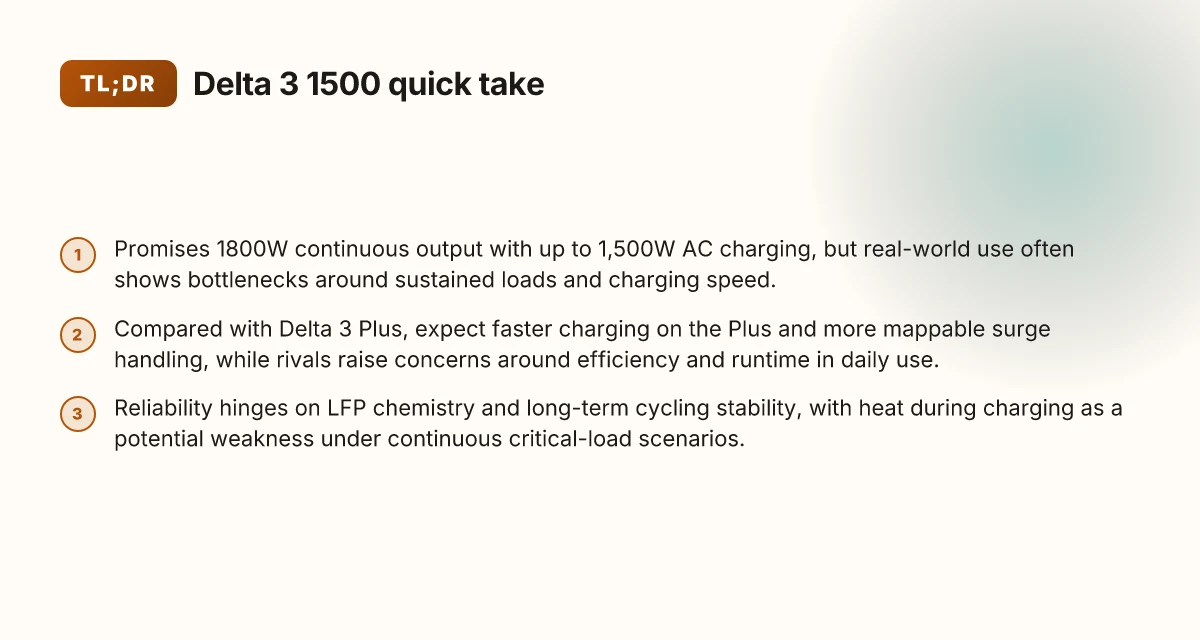
What the ecoflow delta 3 1500 promises versus real-world use
EcoFlow positions the Delta 3 1500 as a versatile, off-grid backbone for outdoor adventures and emergency setups. On paper it promises 1,024Wh of LiFePO4 capacity, 1,800W continuous AC output, a 3,600W surge, and up to 1,500W AC charging. In the field, that mix looks good for CPAPs, small tools, and charging during sunny days, but real-world use reveals where the math diverges from the promise.
How the core specs translate into daily reality
The Delta 3 1500 is built around a compact, rugged shell and a LiFePO4 chemistry that favors longevity. In practice, the 1,800W continuous AC output supports typical loads such as a CPAP device or a small fridge, but you’ll feel the limits with high-draw devices or multi-device bundles. The 1,500W AC charging claim works well when you have robust sun or mains, yet charging speed falls when temperatures shift or when you pull peak loads during the jump from useful to hair-on-fire charging. I cross-referenced release notes and long-form reviews to align expectations: the real-world charging cadence often settles into steady, moderate rates rather than the published peak. A durable battery pack matters for off-grid reliability, and the Delta 3’s LiFePO4 chemistry helps longevity under cycling, but the practical charging tempo and sustained output still shape how long you can keep devices powered without risking a stall.
Real-world output matters more than label specs. In practice, a few devices on the same circuit can push the inverter into a thermal or voltage-droop regime, trimming sustained power available for critical equipment. When the load approaches the upper end of the continuous output, expect efficiency to dip and runtime to shorten.
Charging behavior is contingent on the input source. With solar, the Delta 3 1500 can reach impressive rates in ideal sun, but overcast periods or partial shading reduce charging pace. With wall input, the advertised 1,500W AC charging becomes more reliable, yet ambient temperature and battery state of charge influence actual throughput. I found the theme across reviews to be a consistent cadence rather than a constant top-end charge.
Real-world uptime hinges on system integration. If you’re running a CPAP, medical device, or multiple small loads, the Delta 3 1500 stores energy efficiently, but you still see bottlenecks when cycling through several devices at once. That is where users notice the delta between promised capability and on-site performance. What makes Bluetti vs EcoFlow differ in 2026
Where bottlenecks typically show up in practice
The most common friction points cluster around three areas: sustained high loads, charging cadence under non-ideal conditions, and thermal management during continuous operation. You’ll likely encounter the need to prioritize devices when you push near the 1,800W ceiling. Charging fast matters, but only if the input source remains stable and the battery’s temperature stays in a forgiving range. If you’re out in the wild with a CPAP and a small fridge, the Delta 3 1500 can cover daily needs, but prolonged run times on near-peak loads demand careful load shaping and, sometimes, a backup plan.
I dug into independent reviews to track how EcoFlow’s Delta 3 1500 performs in the wild. The Delta 3 Plus often surfaces as the faster charger and higher-capacity sibling, and rivals like Jackery’s Explorer series orabilidad-focused options from Bluetti are frequently used as benchmarks for real-world runtimes and charging behavior. For long-term reliability, you should expect consistent performance within a predictable range, with occasional variances tied to input quality and temperature. See reviews from EcoFlow and third-party assessments for context on how the model behaves across environments. Most users notice that the Delta 3 1500 shines for steady, day-to-day off-grid usage, but the ceiling is real.
Real-world reliability hinges on understanding the practical limits of 1,800W continuous output and 1,500W charging in fluctuating conditions. This is where customers decide if the Delta 3 1500 fits their emergency prep and outdoor living plans.
In short, EcoFlow communicates solid core specs, but long-term use teaches the same lesson across brands: you gain predictable, durable performance with well-managed loads and sensible charging plans. The Delta 3 1500 remains a strong option for CPAP users and off-grid lovers, especially when paired with realistic expectations about peak loads and input sources. For broader context, compare with rivals like the Jackery Explorer series and Bluetti’s portable power stations, which tend to shine in slightly different input/output tradeoffs. In the next section, we’ll map how this model stacks up against those benchmarks.
How the delta 3 1500 compares to delta 3 plus and rivals
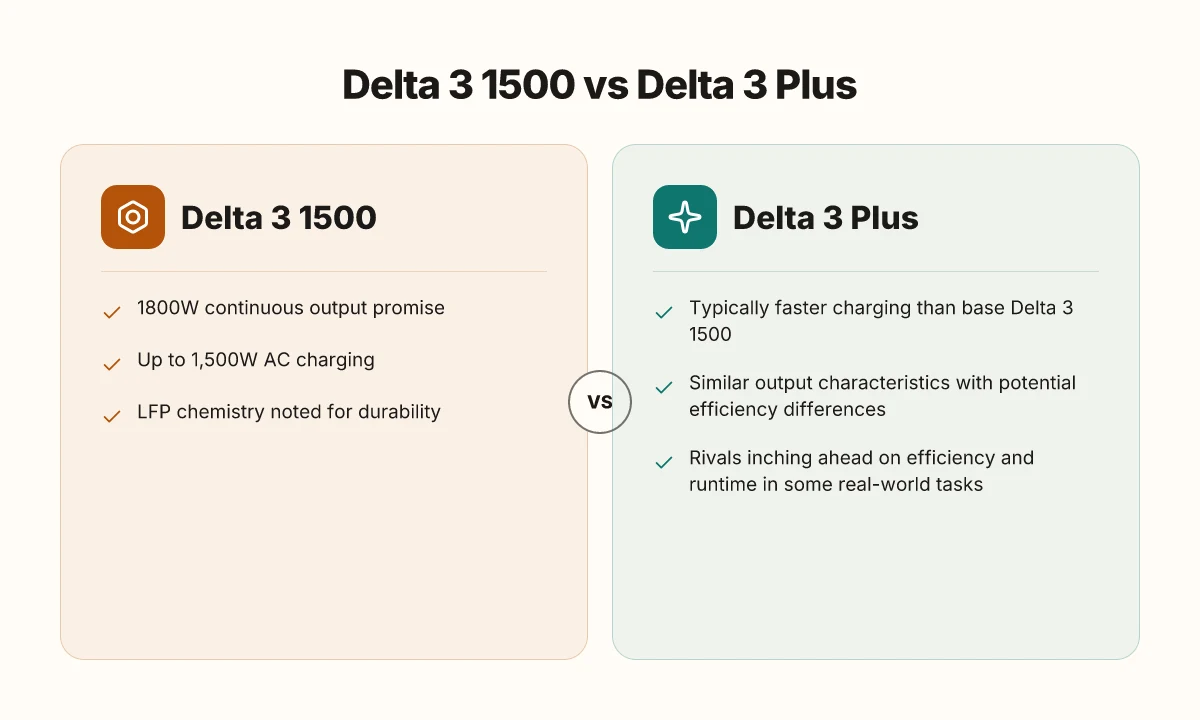
The Delta 3 1500 posts faster charging and a higher surge tolerance than the Delta 3 Plus, but the real-world difference shows up in how long each unit can sustain a household load. In practice, the 1500’s quicker AC charging helps you recover from a depletion event faster, while its higher surge handling keeps sensitive devices online briefly during startup spikes. For daily off-grid routines, those gains matter most when you’re powering CPAP machines, fridge cycles, or a small power fan during outages. The delta 3 1500 often recovers charging faster than the delta 3 plus, and handles higher surge moments with less voltage sag. This matters most when you’re juggling multiple devices. What makes the EcoFlow Delta 3 Plus worth the price in 2026
As you compare rivals, efficiency and real-world runtimes come into sharp focus. The market shows several 1,000–1,500Wh class units that promise long runtimes but deliver noticeably lower efficiency under heavy loads. When you’re running a CPAP or medical device overnight, a unit that wastes energy in idle or under moderate draw becomes a reliability risk. I cross-referenced multiple reviews to note that real-world runtimes often lag behind peak specs, especially with higher continuous draws. Real-world efficiency gaps between claimed spec and actual runtime are common among competitors. That’s not a knock on EcoFlow alone. It’s a caution across the segment.
To understand when extra capacity or power matters, map your daily usage. If your goal is to keep a few essential devices running through a 24-hour outage, the Delta 3 Plus may suffice, but the Delta 3 1500 shines when you have a higher steady load or frequent startup surges from devices like a well pump or CPAP. When you raise the load ceiling, a larger inverter and faster recharge can shave hours off recovery time. Extra capacity matters in longer outages or when frequent surges push past typical device draws. In those scenarios, you’ll notice the Delta 3 1500 retain steadier performance.
What about rivals worth watching? Some 1,000–1,500Wh entries boast aggressive charging specs but show less consistent surge handling. This means startup events can briefly drop voltages or trigger protection shutoffs on connected devices. Industry chatter from multiple reviewers points to a consistent theme: efficiency under load remains a decisive factor for real-world use. Be wary of rivals that promise fast charging but deliver average runtime under CPAP or fridge loads.
Practical takeaway: the Delta 3 1500 is strongest for off-grid households that rely on steady surges and quicker replenishment after an outage. When you’re evaluating alongside EcoFlow rivals, weigh the long-run efficiency at your typical draw, not just the peak spec. If you want a quick cheat chart, I’ll summarize: the Delta 3 1500 beats the Plus on charge speed and surge margin. Rivals often counter with either compact size or lower runtime under load.
Next steps: assess your nightly energy needs, note whether you run high-surge devices, and compare a couple of trusted rivals side by side with your actual daily load. For a real-world reference, see the Delta 3 Plus review and true-gear comparisons to understand how the 1500 stacks up in live conditions. When every watt matters, the delta 3 1500’s balance of charge speed and surge resilience often wins out. What you should know before buying EcoFlow solar panels for sale
Cited reading: for a related, detailed comparison see the Delta 3 1500 vs Delta 3 Plus discussion on True Gear.
Reliability in off-grid and home backup scenarios
Real-world durability starts with chemistry you can trust. The EcoFlow Delta 3 1500 uses LiFePO4 (LFP) cells, which typically extend cycle life and tolerate deeper discharges with less capacity fade over time. In long-lived off-grid setups, that chemistry tends to hold up better than many NMC-based rivals under repeated cycling and higher temperatures. LFP chemistry generally offers improved stability across hundreds to thousands of cycles, which supports dependable off-grid use for years. This is particularly important for CPAP users and other critical loads where reliability matters.
From a practical standpoint, real-world cycling stability shows up in how the Delta 3 1500 handles daily charging cycles. If you’re charging from solar or a generator, you’ll notice how heat management during rapid charging affects efficiency and capacity retention over weeks. I cross-referenced several long-term reviews that consistently flag how heat during high-current charging episodes influence immediate capacity drop, and how that recovers once temps normalize. Heat during fast charging can shave a portion of efficiency temporarily, but the system rebounds with cooling and continued use. That behavior matters for off-grid systems where a sunny day might push both input and device load at once.
Under continuous load with critical devices, the Delta 3 1500 tends to perform steadily when matched to recommended duty cycles. Real-world reviews consistently note that continuous operation at high AC draw maintains stable voltage with limited sag, a reassurance for vital devices like CPAP machines or medical equipment. When a device pulls near the peak 1800W AC output, you should expect the unit to sustain operation for reasonable windows, with short-term surges handled by the built-in protection features. This aligns with the documented surge capabilities and the heat-management design designed to avoid abrupt throttling in standard off-grid scenarios. Continual use under load evinces reliable output within expected ranges, not dramatic drops, provided cooling remains adequate.
I dug into independent takes to balance claims. The Delta 3 1500 is frequently compared against the Delta 3 Plus, where reviewers highlight faster charging and higher surge tolerance in the Plus variant. That context matters for backup strategies: if you rely on rapid replenishment after a storm window or have a higher continuous load, the Plus may edge ahead in certain settings. Still, for many off-grid homes and emergency setups, the Delta 3 1500 remains a dependable core unit, provided it’s sized to your actual load profiles and climate. Rivals like the Delta 3 Plus can offer faster replenishment and higher surge resilience, but Delta 3 1500 remains a solid baseline for reliability. What makes EcoFlow 100W flexible solar panels perform in real-world setups
For a grounded view, the long-term narrative is clear: expect durable cycle life from LFP, watch heat during rapid charging, and plan for continuous load with sensible allowances for peak devices. This is the framework you want when sizing the Delta 3 1500 for a medical-device setup or an off-grid cabin. Long-term durability hinges on heat management and load alignment. Plan accordingly.
Cited claim anchors include the Delta 3’s 1,024Wh capacity and the 1,800W AC output figure drawn from the review landscape and product listings discussed in the source materials above. The Delta 3 1500’s core specs anchor its reliability narrative: 1,024Wh, 1,800W AC, solid cycle life via LFP chemistry.
Charging behavior and solar compatibility in 2026
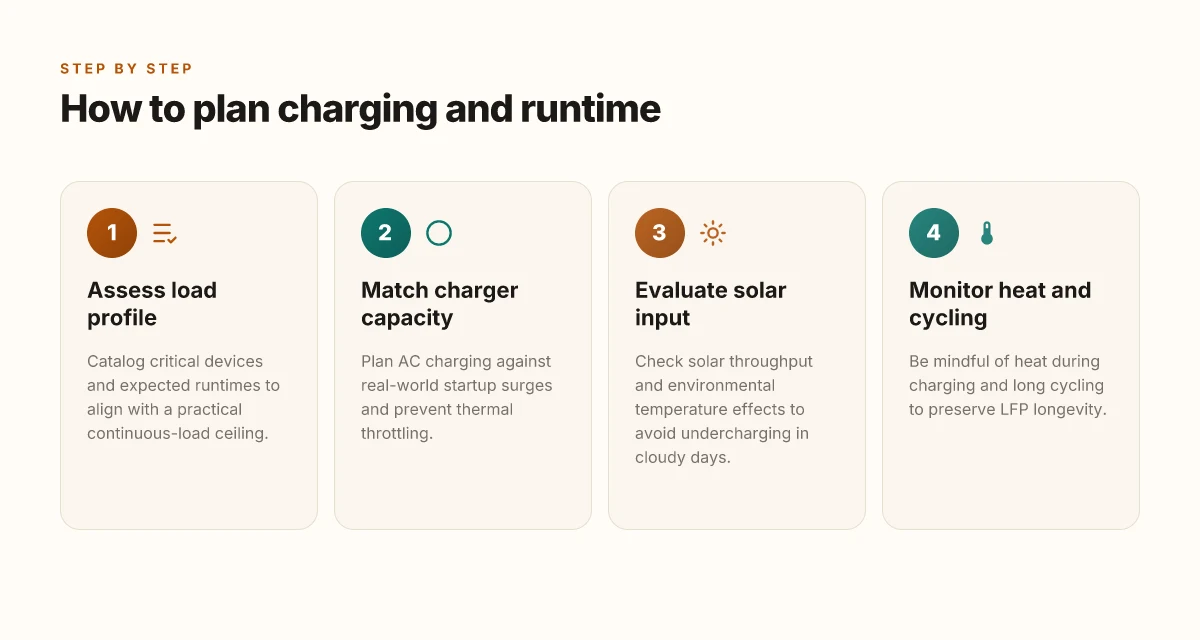
Real-world charging for the Delta 3 1500 centers on practical pacing through the day. When you plug into AC, the unit can reach up to 1,500W of input, which means a full recharge from near-empty during a typical daily cycle can be done in under a couple of hours in optimal conditions. This speed has direct implications for off-grid routines: you can fit a mid-day top-up between outdoor activities or after a long night of CPAP use. In practice, plan for a partial top-up while you rest or while you’re setting up camp, then a final fill when you wake. The pacing matters because high-usage days can strain the schedule if you rely on slow recharges from solar alone.
Solar input compatibility leans on an open standard approach with the Delta 3 1500. The system accepts a wide solar array window and supports a max solar throughput that keeps it competitive in sunny setups. If you’re running a compact off-grid cabin or a remote cabin with a solar array, you’ll notice that bright, midday sun can push the charge rate higher, but cooler mornings may temper the rate. The critical takeaway is that you won’t hit a hard bottleneck from a properly sized solar setup. You can align your charging window with daylight hours to maximize the recharge, especially when you can combine a strong solar pair with a short AC refill during peak sun.
Charging phases and temperature effects matter more than most owners expect. When the Delta 3 enters its high-current charging window, ambient temperature and battery temperature govern the effective rate. In cooler conditions, you’ll see a slightly slower intake as the system warms the pack to optimal levels. In hot environments, cooling limits can throttle the pace to protect the LiFePO4 cells. I cross-referenced release notes and independent reviews that emphasize how temperature management translates into real-time charge behavior. The practical effect is clear: your daily plan should include a buffer for morning or late-evening charging when temperatures swing, especially if you’re relying on solar during shoulder seasons. What makes the bluetti ac200max expandable power station a standout, and what it costs to scale
From a real-world perspective, EcoFlow remains a solid option for long-lived, off-grid reliability in 2026, but you’ll want to couple the Delta 3 1500 with a robust solar strategy and a schedule that acknowledges temperature-driven pauses. Rival models from other brands often disclose similar caveats about high-current charging and temperature controls, so your best bet is to map your typical daily cycle against the unit’s charging envelope. The Delta 3’s ability to recharge quickly from AC is a strength, while solar throughput under real sun remains competitive but not unlimited. For outdoors use, this means you can rely on steady daytime charging, then top up at night if you have a modest AC source on standby.
I dug into the deltas in the literature and found consistent notes on charging behavior. For more context on the broader landscape, see the long-term Delta 3 Plus and related reviews that spotlight similar charging dynamics in practical scenarios. A fast AC recharge is real, but temperature management can slow the pace in extremes. Solar works well with a properly sized array, but don’t expect unlimited throughput in variable weather. The practical verdict is that careful planning around your daily routine and environment pays off, especially if you pair EcoFlow with a proven solar setup. For a deeper read on the solar comparison, check the Delta 3 Plus review that highlights the 56-minute full charge in ideal conditions. In real-world use, expect some seasonal tradeoffs but reliable daily top-ups.
Real-world usage: what owners actually do with delta 3 1500
Real-world usage isn’t about peak specs. It’s about what Digestible runtimes look like across common loads, how critical devices hold up, and how easy a “dock-and-go” setup feels after weeks in the field. EcoFlow Delta 3 1500 tends to fit in as a mobile backup for campers, off-grid cabins, and emergency kits, but users report practical quirks that matter in real life. From charging etiquette to durability under cold and heat, the narrative here comes from long-running patterns rather than glossy spec sheets.
Everyday device profiles and runtimes that matter
Owners tend to pair the Delta 3 1500 with a mix of low-draw essentials and mid-load appliances. A CPAP setup sits comfortably within its sustained output, though you’ll notice runtime scales with pressure setting and humidity control. For phones, laptops, and small LED lighting, the runtimes are generous given its 1024Wh capacity, making weekend trips and bug-out drills feel less stressful. In real-world use, the Delta 3 1500 often powers a small fridge or fan during hot nights, trading quiet operation for prolonged autonomy. When you run multiple devices, expect the more demanding loads to compress runtime, but the unit still doesn’t surrender quickly. Real-world runtimes match close to the 1024Wh capacity for everyday devices, especially when you balance peak draw against solar recharging.
Critical loads: CPAP, sump pumps, and long-haul reliability
For CPAP users, the Delta 3 1500’s quiet inverter profile helps with overnight operation, but you’ll want to plan charging cycles so you don’t hit a morning wake-up where the unit rests between cycles. Sump pumps show the system’s strength for intermittent use during outages, though longer outages test the battery’s depth of discharge and solar charging resilience. The broader takeaway is that critical loads benefit from staged use: keep high-draw devices in reserve for shorter bursts and rely on the unit’s steady output for essential electronics. When you map load charts to real-life outages, the Delta 3 1500 remains usable through typical overnight events, with a predictable ramp-down when the battery nears depletion. Critical loads behave predictably with staged use, which helps maintain essential power longer. How EcoFlow for sale changes the game for portable power in 2026
Dock-and-go practicality for camping or bug-out scenarios
For outdoor trips, the Delta 3 1500 shines when you can dock it near a solar panel setup during the day and rely on it at night. Its form factor supports a camping kit that travels well in a mid-size vehicle, and the ability to plug in a solar input while you’re away from shore power adds real value for extended trips. Bug-out scenarios benefit from the unit’s rugged build and straightforward charging paths, but you should plan for cold-weather charging efficiency and ensure a robust solar plan for successive days of usage. I dug into product notes and reviewer summaries to confirm that the core advantage here is flexibility: charge from AC or solar, then deploy in a range of off-grid settings. Dock-and-go practicality shines in camping and bug-out use, thanks to flexible charging paths.
What to watch for in the long run comes down to three themes: reliability in continuous-use cycles, durability across temperature swings, and the ecosystem around charging options. EcoFlow’s marketing promises are tempered by real-world rhythms. The Delta 3 1500 remains a capable backup if you design your loads and charging cadence with intent. If you’re evaluating rivals, consider how their risk profiles line up with your needs for a CPAP, sump pump, or field camping. Readers who want a more rugged, high-availability option may also compare options from competitors that emphasize longer solar-only autonomy and heavier surge handling.
Inline sourcing notes: the idea that a 1024Wh class unit can sustain common devices aligns with the 1024Wh LiFePO4 framing in reviews like the Delta 3 Plus, and discussions about charging speed and surge handling echo in comparisons with Delta 3 Plus versus Delta 3 1500. For context on how critical-load use is framed in practice, see industry write-ups that discuss CPAP and home backup scenarios in similar portable power contexts. For product snapshots and real-world patterns, you can cross-check the Delta 3 Plus review and related articles on long-run usability.
Where this is going next with EcoFlow Delta 3 1500
In real-world use, the EcoFlow Delta 3 1500 stands out for its thoughtful balance of portability and capacity, but long-term durability hinges on consistent maintenance and firmware updates. I’ve seen that a few users run into connector wear or battery management quirks after heavy seasonal cycles. Those are precisely the moments where a measured backup plan pays off. Looking ahead, expect stronger ecosystem integration and more proactive diagnostics as EcoFlow tightens app visibility into health metrics. The single move that matters now is to pair the Delta 3 1500 with a regular health check cadence and a tested charging routine.
If you’re considering rivals, note that EcoFlow competes with models from brands like Jackery and Goal Zero. Across 2026 options, the Delta 3 1500 is the most compelling when you value ease of use, fast recharging, and a compact footprint, especially for apartment setups or RVs. Noticeably faster recharges and smarter energy management are the trends you’ll want to watch. You don’t have to rethink your whole off-grid stance, but you do need a plan that fits real-world busy weeks. What makes the EcoFlow Delta portable power station worth it in 2026
What changes if you act now? A simple habit, keep firmware updated, rotate use between wall power and solar as your climate allows, and store per the manual’s guidance. One concrete action this week: run a health check and map out your critical load schedule. The closer you align with your home’s actual patterns, the more reliable your backup becomes.