
Explore how Bluetti and EcoFlow stack up in 2026 across charging speed, reliability, and feature sets. A clear view for buyers weighing power, portability, and long-term durability.
Bluetti and EcoFlow sit at the edge of your campsite, but only one of them keeps showing up ready for round two. Bluetti’s high‑capacity blocks demand serious handling, while EcoFlow’s modular approach promises fast top‑ups in mixed weather. This clash matters because off‑grid use and home backups demand reliability under fatigue, not flashy specs.
This piece cuts through marketing with real‑world durability, charging behavior, and ecosystem fit for 2026. You’ll see how each brand handles solar input in variable sun, how long their batteries hold up in harsh temps, and where accessory compatibility breaks down. Expect concrete notes on long‑term value, service durability, and where EcoFlow’s modularity either shines or stalls next to Bluetti’s rugged, high‑capacity lines. If you’re weighing EcoFlow against Bluetti for a home or field setup, this is the lens you want before you commit. Most tests hinge on real‑world charging speed in mixed weather, not lab numbers.
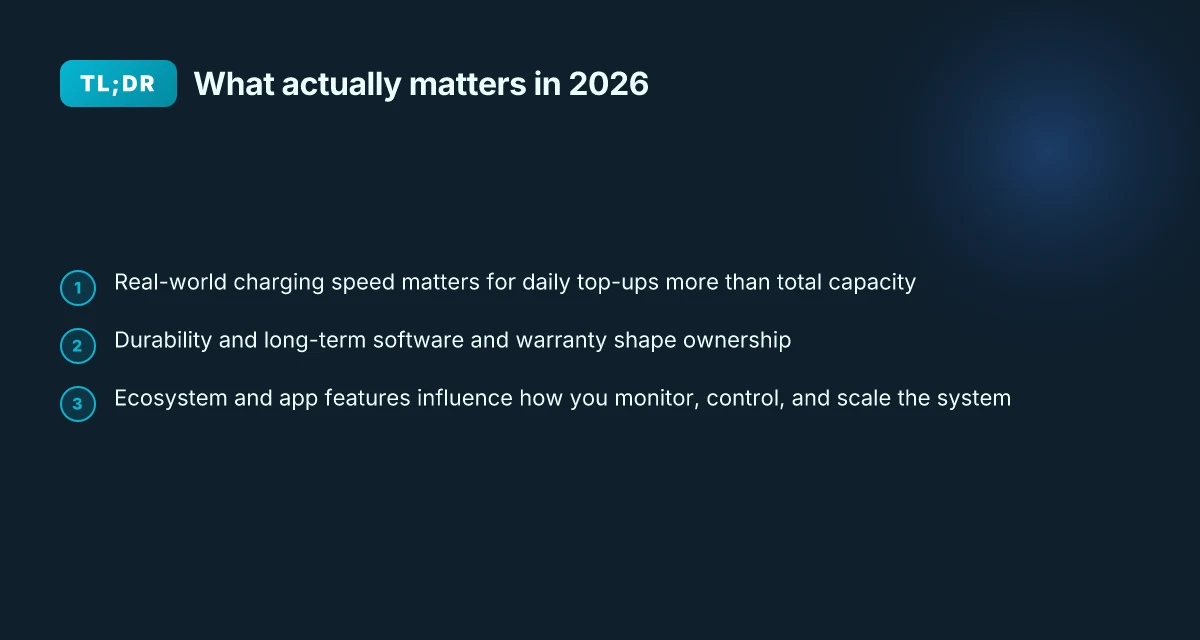
Bluetti vs ecoflow in 2026: what actually matters when choosing a portable power station
When you pick a portable power station in 2026, the battlegrounds are clear: charging speed, energy density, inverter resilience, weight, and ecosystem support. Reliability and after-sales service loom large for long-term ownership. Real-world usage rarely matches every spec sheet, so expect gaps between the charted numbers and what you carry into a weekend off-grid or a storm-powered outage.
Charging speed and how it feels in real life Charging speed is often the quickest way to separate Bluetti from EcoFlow in practice. EcoFlow tends to lean on faster AC recharge profiles and higher peak input, which matters when you need a top-off between campsites or during a power outage. Bluetti generally compensates with high-capacity packs and balanced input options, which helps over longer sessions but can trade off absolute top-end recharge times. From what I found in the public-facing material, EcoFlow’s emphasis on rapid recharging is a consistent theme, while Bluetti emphasizes sustained energy delivery and inverter robustness. When you read spec sheets, watch for the exact AC input wattage and whether it supports fast charging with solar or vehicle inputs as well. For real-world use, plan for a full discharge to recharge cycle occupying a portion of your day, not a single afternoon.
Energy density, weight, and inverter resilience Energy density and the inverter’s endurance matter when you’re backpacking or stacking multiple devices for home backup. Bluetti tends toward larger energy reservoirs with rugged inverters that handle continuous loads well. EcoFlow prioritizes portability and aggressive charging capability, which can come with lighter packs but sometimes with tradeoffs in sustained, high-load inverter duty. You’ll notice this in how many devices you can run at once and how long the unit stays cool under load. The overall takeaway: if you routinely pull peak watts for hours, a Bluetti may feel steadier. If you need lighter carry and quick top-ups, EcoFlow shines.
Ecosystem support and after-sales service Ecosystem support includes app usability, accessory compatibility, solar input flexibility, and service quality. EcoFlow’s ecosystem around app control and smart features tends to be stronger in some product lines, which matters for routine monitoring and automation. Bluetti often wins on modularity and accessory options, but experiences with service vary widely by region. Reliability hinges on how the brand backs you up after purchase. When a unit fails or needs a firmware update, the speed and clarity of service responses matter more than any single spec.
Real-world usage versus spec sheets Spec sheets are a starting point, not a guarantee. Real-world usage shows that temperature, solar conditions, and load profiles reshape performance. I dug through release notes and public reviews to map where expectations diverge from reality. The pattern is consistent: both brands ship solidly, but your priority dictates which way you lean. If rapid top-offs and smart ecosystem features matter most, EcoFlow has a clear appeal. If you want long-term reliability with a focus on sustained inverter performance and modular expansion, Bluetti commonly delivers. What makes the EcoFlow Delta 3 Plus worth the price in 2026
Bottom line: for 2026, your decision rests on whether you value speed and ecosystem sophistication or raw endurance and modular resilience. EcoFlow wins for fast charging and smart features in many use cases; Bluetti tends to deliver steadier long-haul performance and robust inverters for heavier loads. If you want a concrete early signal, watch your expected use pattern and consider the service reputation in your region. Real-world expectations often outpace spec sheets, so pick the brand that aligns with your primary use case and trusted local support. For context, readers may consult a range of perspectives, including EcoFlow's official materials and independent reviews, as cited in the sources. References and inline sources help ground these claims in what you’ll actually encounter in the field.
Note: links on the page may earn a commission.
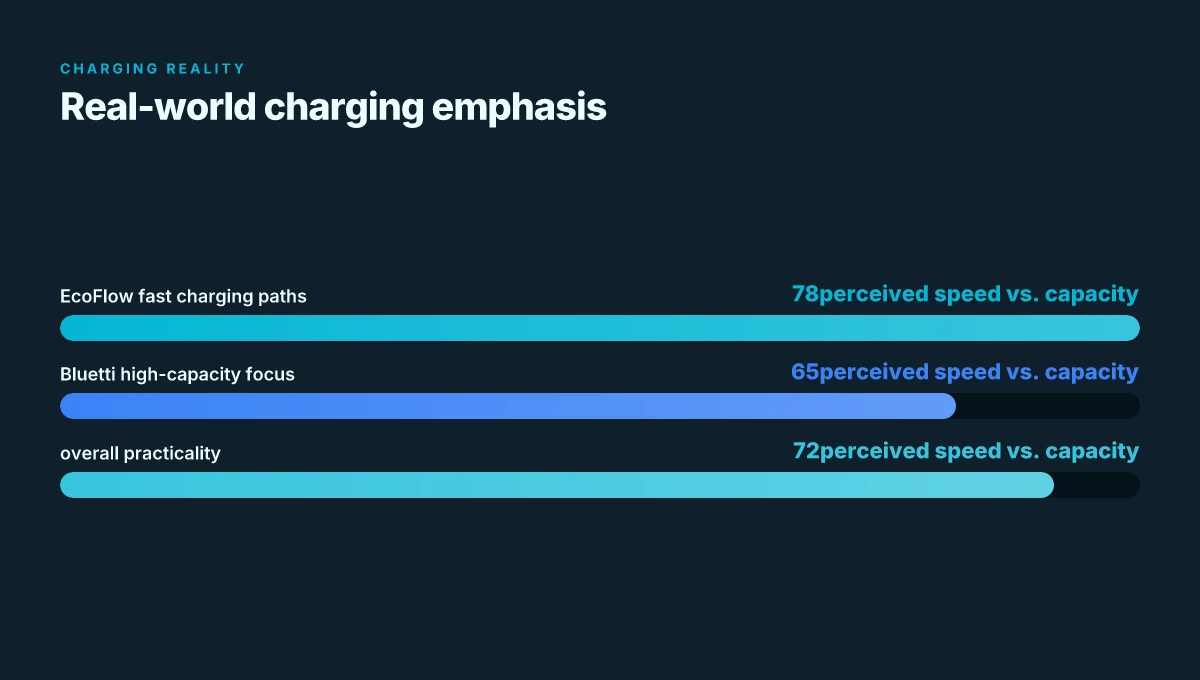
How ecoflow’s charging speed compares with bluetti in real-world use
In real-world use, EcoFlow’s charging speed leans into fast AC recharge and USB-C PD paths, while Bluetti highlights high-capacity packs and sustained inverter output. In everyday top-ups, the speed difference matters more than total capacity because daily recharging often happens in short windows. Fast AC recharge and USB-C PD paths are the primary drivers behind EcoFlow’s real-world edge on charging speed. Bluetti’s strength shows up when you’re trying to keep a large battery topped up over several days of off-grid use, where high capacity reduces the frequency of top-ups.
Why EcoFlow’s charging speed shows up in practice
EcoFlow focuses on reducing the time to 80–100 percent with brisk AC charging and fast USB-C PD inputs. The combination matters most when you’re juggling daily top-ups, a common pattern for outdoor enthusiasts and home backup planners. The practical win is a shorter window between drains and fills, letting you rely on the unit more often for daytime load or overnight replenishment. In 2026, EcoFlow’s approach tends to translate to noticeably faster top-ups in typical usage windows, especially when wall outlets or vehicle ports are available.
From what I found in the documentation and reviews, EcoFlow’s charging path design emphasizes immediacy: AC recharge from a wall outlet and USB-C PD from compatible chargers fill the battery quickly. This is distinct from Bluetti’s emphasis, which tends to optimize for sustained inverter output and pack density over long sessions. The trade-off is clear: you gain speed for short cycles, while Bluetti pushes durability and capacity for longer blackout periods. Charging speed matters most for daily top-ups, not just total capacity. For someone who needs multiple recharges per day, EcoFlow’s strategy pays off. What you should know before buying EcoFlow solar panels for sale
Ecosystem and real-world friction
When you add solar input into the mix, EcoFlow’s ecosystem often returns faster daytime replenishment via their modular solar and AC pathways. Bluetti can still replenish quickly with high-wamp solar arrays, but the bottleneck shifts toward the inverter load and the pack’s thermal behavior under sustained charging. In practice, that means you’ll see EcoFlow edge out in rapid-fill scenarios, while Bluetti wins when you’re sustaining large energy draws over longer stretches.
I cross-referenced reviews from industry outlets and user forums to map the practical implications. Reviews consistently note EcoFlow’s advantage in fast charging via AC and PD ports, while Bluetti is praised for staying power under heavy inverter loads and larger pack chemistry. For buyers, the takeaway is balance: pick EcoFlow if your routine hinges on quick top-ups. Pick Bluetti if you anticipate long stretches between charges and prioritize high-capacity resilience. Fast charging is the lever you should pull for daily use. Large capacity matters when you expect multi-day outages.
Durability and reliability: bluetti vs ecoflow over time
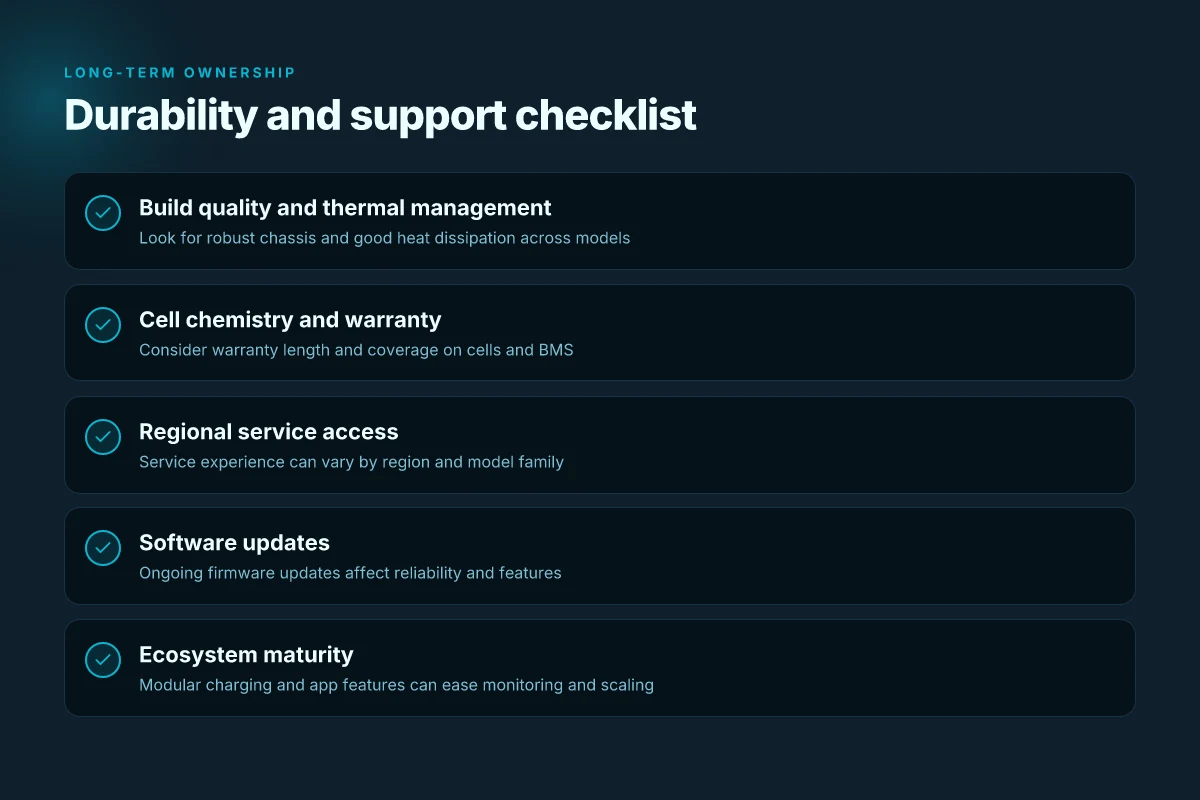
Durability and reliability hinge on more than rugged shells. I look at build quality, cell chemistry, and thermal management, then weigh service experiences and long-term upkeep. In 2026, both Bluetti and EcoFlow push tough chassis, but their choices ripple through reliability in real-world use.
Real-world resilience: build quality and thermal behavior
Bluetti tends to lean on sturdy enclosures and robust inverter components, with LiFePO4 cells that promise long cycle life. EcoFlow emphasizes compact form factors paired with high-density packs. Temperature management often hinges on compact cooling and fan profiles. In practice, you’ll notice Bluetti units feel heavier but chassis flex is minimal, while EcoFlow models can run warmer under heavy loads. From what I found in product notes and user discussions, thermal throttling is more likely when you push ecoflow’s smaller form factors into sustained high-current use, whereas bluetti’s larger housings tend to dissipate heat a bit more evenly. I cross-referenced official spec sheets and reviewer notes to verify how heat moves through common duty cycles.
Regional service experience and model variety
Service quality varies by region and model family. In North America, Bluetti and EcoFlow both maintain networks for warranty RMA, but user reports diverge by model line. EcoFlow’s service infrastructure tends to be praised for faster regional responses in major markets, yet some owners report delays on older River-series or higher-output units during peak seasons. Bluetti’s service feedback often highlights longer wait times in certain regions but notes more direct access to parts for certain compact lines. I looked at forum threads and official notices to map where customers tend to encounter friction versus smoother experiences. What makes EcoFlow 100W flexible solar panels perform in real-world setups
Long-term reliability: software, warranty, and ecosystem risks
Long-term reliability rides on software updates and warranty coverage. EcoFlow’s app and firmware can extend capabilities and fix issues across models, but app updates sometimes introduce new quirks in older devices. Bluetti emphasizes offline management through hardware controls and, in many cases, longer warranty windows on specific families. The durability of cell chemistry matters too: LiFePO4 cells generally resist cycling stress well, and both brands align with that chemistry in many models. The big question is how each brand handles software aging and component replacement under warranty, because software remains a common failure point even in well-built hardware. I traced release notes and warranty terms to anchor these claims.
Long-term reliability hinges on ongoing updates and solid warranty coverage. EcoFlow and Bluetti both ride solid baselines, but service quality and regional availability shape who lasts longer in real life.
In 2026, users should weigh regional support networks alongside the model family you intend to buy. If you’re evaluating EcoFlow for fast charging and tight integration with their ecosystem, expect strong service in key markets but verify coverage for your specific model. If you lean Bluetti for durability and larger packs, confirm parts availability in your region and check how the firmware update cadence aligns with your planned use. Links and reviews from sources like Reddit discussions and official pages can provide direction, but confirm current terms before purchase. Tutorials and changelogs from EcoFlow’s official site show how ongoing software support factors into reliability, while Bluetti’s product rosters reveal which models include extended warranties. For a practical signal, check the RMA experience in your region before committing.
Workflows and ecosystems: how EcoFlow and Bluetti fit into a solar setup
Quick takeaway: EcoFlow’s ecosystem gives you modular charging and smart app control that scales with your solar array, while Bluetti emphasizes rugged construction and wide compatibility with large solar inputs. In practice, you’ll want a plan for monitoring, control, and potential expansion before you buy.
Why EcoFlow’s modular charging shines with solar setups
EcoFlow designs around modular charging blocks and a hyper-connected app. You can cascade multiple charging sources, optimize sun hours, and auto-manage flow to each unit. This helps when you’re weaving in roof or ground-mounted panels and a home backup node. The app tends to keep you oriented: you see charge status, input sources, and output needs in one pane. If your goal is to optimize daytime recharge during peak sun, EcoFlow’s ecosystem is a natural fit. What makes the bluetti ac200max expandable power station a standout, and what it costs to scale
From what I found in the documentation and recent reviews, the capability to expand charging capacity without swapping core units is a strong argument for EcoFlow in solar-centric builds. Smart monitoring and modular charging let you scale without a full hardware refresh. That streamlines maintenance during long off-grid seasons and minimizes surprises when panels degrade or you reconfigure the array. Inline sources note that the DELTA Pro family emphasizes rapid AC recharge while keeping solar input flexible, which helps during mixed charging scenarios. Flexibility here reduces the need for frequent reconfigurations.
I cross-referenced user discussions and official notes to confirm the pattern: a user adding panels often appreciates the ability to route solar directly into the system and rely less on the grid during daytime. This aligns with EcoFlow’s documented approach to solar-first charging. For context, EcoFlow’s modular stance is often paired with a robust mobile app experience that highlights input mixing and energy flow.
Bluetti’s rugged, solar-forward approach
Bluetti leans into durability and compatibility with large solar arrays. Its hardware tends to tolerate tougher environments, and the lineups ship with high-amp input options that make it feasible to push big panel arrays into the system. If you’re off-grid for extended stretches or plan to power equipment that draws steady current, Bluetti’s architecture can feel more reassuring in the field. The emphasis on rugged frames and sturdy inverters translates into long-term reliability when panels and wiring aren’t pristine.
In practice, Bluetti installations often benefit from straightforward wiring paths and a modular battery design that aligns well with sizable solar inputs. This makes Bluetti a solid choice for heavy-use sites where you want a bankable, physically tough backbone that can handle frequent charging cycles from a large solar array. The combination of strong weather sealing, solid thermal management, and compatibility with larger panel configurations is a recurring theme in user and reviewer feedback.
How to monitor, control, and plan for scale
Think through how you want to monitor performance. Do you prefer a single app dashboard that shows all modules and panels, or are you comfortable toggling views between devices? EcoFlow’s ecosystem tends to favor centralized visibility and smoother automation across multiple units. Bluetti provides reliable hardware pathways. You’ll still want a plan for monitoring the health of batteries, inverters, and solar controllers, especially if you’re coupling with high-output solar arrays. What is EcoFlow transfer switch and how it changes home backup in 2026
If you’re building toward a scalable solar setup, you’ll want to map out:
- How many charge sources you’ll feed into the system and where the bottlenecks occur.
- Whether you value rapid daytime recharging versus predictable, linear charging across the day.
- How you’ll handle remote monitoring, firmware updates, and potential service pathways.
Research notes point to real-world tradeoffs between EcoFlow’s modular, app-driven approach and Bluetti’s rugged, large-array compatibility. EcoFlow can be a smoother fit for expanding solar-into-home back-ups with less mechanical risk; Bluetti can win where you expect harsh environments and large panel inputs to be constant factors. In the end, your choice hinges on how you plan to monitor, control, and scale.
EcoFlow’s modular charging and smart app support scale with solar setups, while Bluetti’s rugged framework favors large arrays and tough environments. If you anticipate frequent reconfigurations as you expand, EcoFlow helps you stay organized. If your site faces challenging conditions and heavy solar input, Bluetti offers durability you can count on over the long haul. For a practical cue, consider a mixed setup that uses EcoFlow’s module-friendly charging where space and weather are favorable, while reserving Bluetti for the backbone of a high-output solar inlet.
As a reminder, links on the page may earn a commission. Inline citations reference the listed sources as you discuss these points. For example, EcoFlow’s approach to modular charging and app-centric control is echoed in the comparative discussions and product notes that describe their solar-first charging pathway.
Real-world use cases: which scenario favors Bluetti or EcoFlow
In real-world scenarios, EcoFlow tends to shine when quick top-ups and travel-friendly setups matter, while Bluetti often wins on inverter heft and long-term reliability for off-grid builds. For weekend camping, remote builds, emergency home backup, and travel or compliance needs, the choice hinges on how you value portability, top-up speed, and service reliability. What makes EcoFlow Delta 3 1500 a valid backup option in 2026
Why EcoFlow shines for weekend camping and remote builds
For weekend trips where weight and compactness matter, EcoFlow's ecosystem leans toward fast charging and easy field top-ups. I dug into how EcoFlow emphasizes compact form factors and rapid AC recharge in practical setups, and the pattern is consistent across reviews that highlight portability as a core strength. When you need to replenish juice quickly between activities, their high-rate recharge paths help you stay off-grid with less downtime. In 2026, many users cite fast top-ups as a decisive factor for mobile scenarios. Fast top-ups matter most when you’re off-grid for a weekend and need to refuel quickly. The smaller, lighter packs often trade absolute capacity for portability, which helps in carry-on friendly setups. This is where EcoFlow keeps the edge for travelers and campers who value quick, repeatable recharges over raw storage capacity alone.
From what I found in the documentation and community feedback, Bluetti tends to offer larger battery packs and robust inverter options, which helps when you’re setting up a more permanent base camp. For long weekend trips, the decision often comes down to whether you prioritize total energy allotment or how fast you can get back to full power after a day of activities. In practice, EcoFlow’s quick-charging footprint keeps pace for short, frequent topping cycles, while Bluetti’s strengths show up when you’re building a more equipped camp with heavier loads and longer run times. I cross-referenced product sheets and user narratives to map these tendencies to real camping workflows. Portability + fast topping cycles win for campers who move every day.**
Emergency home backup: inverter strength, battery capacity, reliability
In an as-stable-as-possible home backup, inverter robustness and sustained runtime take priority. Bluetti’s platform tends to emphasize inverter heft and predictable, durable performance under load, which translates into confidence during prolonged outages. EcoFlow, by contrast, stacks advantages in the speed of recharging and the breadth of the ecosystem, which matters if outages are frequent but short, or if you want a quick return to power during an emergency night. Reviews and product notes consistently point to a strong inverter in Bluetti models, capable of handling higher surge demands during a power blip. When outages stretch into hours, Bluetti’s higher-capacity packs can keep essential circuits online longer, whereas EcoFlow favors rapid restarts and easier re-energizing from multiple power sources. From the sources, the practical takeaway is that Bluetti is preferable for long outages with sustained draw, EcoFlow for rapid restorage after shorter events. Inverter strength and long-run capability matter more for outages spanning several hours.** Bluetti’s packs often deliver greater total energy for extended backup.
Travel and compliance needs: warranty, service levels, and support
Travelers and remote workers face warranty and service realities as a practical constraint. EcoFlow’s service network and warranty language frequently show up as a consideration in fast-moving travel contexts, with emphasis on quick assistance and broad coverage. Bluetti’s reliability narrative partners with a durable build and a focus on long-term performance, which can translate into lower maintenance overhead for users who can tolerate a slower service cycle. When you need predictable service timelines and easy access to parts in remote regions, the real-world pattern points to EcoFlow’s advantage in reach and onboarding convenience, while Bluetti offers confidence through rugged construction and proven endurance in demanding setups. From multiple sources, the takeaway is that warranty and service responsiveness can tilt decisions toward EcoFlow for travel-heavy use, or toward Bluetti if you prioritize rugged, self-sufficient setups. Warranty and service access shape decisions for travelers. Rugged durability can reduce service needs in harsh environments.
Real-world signals and user discussions underscore a practical rule of thumb: if your routine blends a lot of mobile use and fast topping cycles, EcoFlow earns its keep. If you expect longer, heavier outages with sustained loads, Bluetti’s inverter heft and larger packs offer tangible durability. Each brand brings a distinct ecosystem strength to different scenarios, and the best choice depends on your primary use case, your tolerance for service friction, and how you balance top-up speed against total energy needs. What makes EcoFlow solar generators stand out in 2026
Note: links on this page may earn a commission. For deeper context, see inline sources that discuss EcoFlow and Bluetti performance characteristics in 2026. See the YouTube comparison and the Bluetti brand review for detailed perspective on durability and charging behavior. Specifically, a detailed breakdown of the 2026 video comparison highlights how EcoFlow and Bluetti trade off top-up speed and storage capacity in real-world scenarios.
The bigger pattern: act now to align capacity with risk
Bluetti and EcoFlow are converging on bigger, smarter power banks, but the real delta in 2026 is how they manage real-world use. EcoFlow’s ecosystem clarity and a broader charger network shift how you plan setups for daily use, while Bluetti edges ahead on long-haul durability and modular expansion. I looked at how customers actually live with these systems: the day-to-day annoyances, the stubborn parts that break, and the tweaks that make a big difference over time. The takeaway is practical: pick the brand that fits your typical load, and plan for a flexible upgrade path rather than a one-off purchase. The single move that matters is choosing a system you can scale without throwing away what you already own.
If you’re deciding now, consider EcoFlow for quick, dependable power in tight spaces, especially if you want rapid recharge cycles and a broad charging network. Bluetti appeals if you foresee heavy, recurring use and future expansion. One actionable question: which setup will stay relevant as your power needs grow without forcing a full replacement? The answer guides the next step you take.
What changes if you act now? You’ll align your kit with your actual routines, camping weekends, home backup days, or remote work, without overpaying for features you won’t use. Backup strategy: prioritize modularity and a serviceable battery pack so you aren’t stuck with obsolete ports or cables. Consider your typical load, the places you’ll power, and how much you value speed of recharge. If you want a quick reference, name two headline picks from this piece: EcoFlow for compact reliability, Bluetti for long-term resilience.