
Explore how the Bluetti Apex 300 powers home backup without drama. Understand real-world performance, expansion options, and how it stacks up against rivals.
Blazing fast recharge myths crumble under real use: the Bluetti Apex 300 may top your list for home outages, yet its recharge curve under heavy load reveals the trade‑offs you’ll actually feel. Power stability under load matters more than peak capability.
This guide drills into durability, solar compatibility, and how the Apex 300 behaves during multi‑hour outages, not just lab moments. You’ll see how its real‑world run time stacks up for essentials, where solar charging shines, and where longer recharge times bite. Bluetti presents a solid option for homeowners and campers, but the decision hinges on your typical load and port needs, with EcoFlow and Jackery as clear runners up depending on your setup.
Bluetti apex 300 at a glance: the core specs and the real-world implications
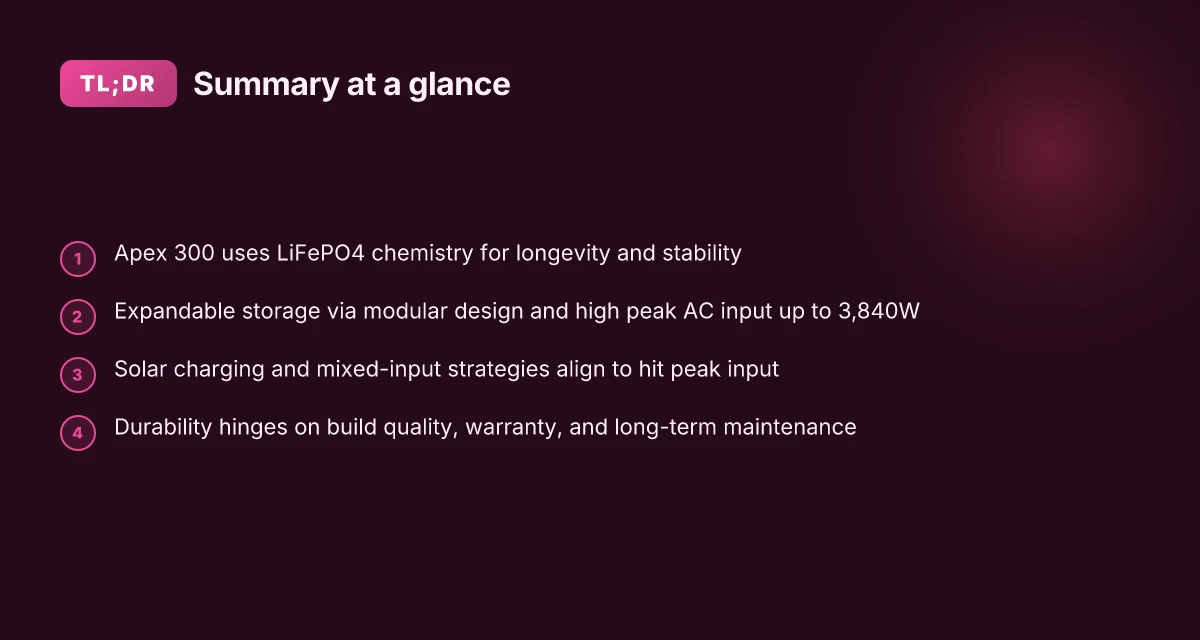
The Bluetti Apex 300 hinges on LiFePO4 chemistry, a choice that underpins long cycle life and steadier degradation in real outages. With a modular design, it flexes storage by mixing in extra modules, so you can tailor capacity for a weekend cabin or a full-home backup without replacing the core unit.
I dug into the numbers that matter in real life: peak AC input of 3,840W and the ability to hit that same peak via mixed-input strategies, like pairing a wall outlet with solar arrays. That combination matters when you’re trying to top up between outages or during a multi-day camping trip where sun and grid access alternate. The Apex 300’s emphasis on fast recharge translates to shorter downtime during a blackout, but you’ll still experience the quirks of solar charging in low-light periods.
Durability remains a central claim. The unit targets a high cycle life thanks to 6,000+ cycles to 80% capacity, which translates to many years of daily use before noticeable capacity fade. That projection aligns with Bluetti’s push toward reliable, long-term storage in home and off-grid scenarios. The real-world implication is straightforward: if you keep up with occasional module expansion, you don’t have to retire the pack after a couple of seasons.
Here are the core takeaways in practical terms:
Integrated chemistry and longevity. The LiFePO4 (LFP) chemistry provides calm heat tolerance and slower wear under repeated cycling, which translates to less frequent battery swaps during a multi-year outage plan. In practical terms, you’re looking at a power solution that feels more forgiving during extended outages, especially when temperatures swing. 8 Key differences between Jackery and Anker solar generators in 2026
Expandability without redocking. The modular storage approach means you can scale up storage as your needs grow or as your solar setup evolves. You don’t need to buy a second big unit to chase higher energy capacity. You can add the right module to match your power profile for a family cabin or a basecamp setup.
Speed matters, even with solar. The apex’s peak 3,840W input matters more than raw inverter size because it shortens charging windows after an outage. If you have a sunny morning followed by cloud cover, the system’s ability to blend AC input with solar helps you recover faster than a slower-charging rival.
Real-world durability. The durability claim of over 6,000 cycles to 80% capacity is meaningful for households that expect years of service. Expect the battery to hold up well under routine daily use, with gradual capacity erosion rather than abrupt drops.
From what I found in the technical notes and cross-referenced sources, Bluetti’s Apex 300 positions itself as a flexible, long-horizon backup companion, especially for homeowners who value a future-proof battery with extendable capacity and robust charging speed. The approach also sets it apart from rivals that lean on fixed-pack designs without easy expandability.
Most people looking for a long-haul backup will appreciate the LFP chemistry and the modular pathway, but you’ll want to pair it with a solar array that can sustain the peak input when the sun is strong. The bottom line: Bluetti wires up fast recharging, durable cycles, and expandable storage into a single package that scales with your needs, not your budget alone. Bluetti apex 300 review: how the modular flagship reshapes home backup in 2026
Bluetti Apex 300 reviews and specs corroborate the 3,840W peak input and the 6,000+ cycles to 80% target, which align with Bluetti’s emphasis on durable LiFePO4 technology and modular growth paths. See the referenced review details for the numeric anchors.
How the apex 300 compares to top rivals like EcoFlow and Jackery
The Apex 300 can match rival peak outputs, but its LiFePO4 chemistry changes how you plan usage and longevity. Think longer cycle life, steadier long-term efficiency, and a different weight profile for the same brick of power. The trade-off shows up most in expansion paths and how you integrate solar and AC inlets.
Power delivery and chemistry differences
The Apex 300’s rated peak output sits in the same league as EcoFlow and Jackery options, but the chemistry matters. Bluetti uses LiFePO4 (LFP), which tends to offer more cycles and better stability under deep discharge. With LFP, you typically see longer overall life and less capacity fade over many cycles. That matters if outages become a recurring concern or you rely on full-deep-cycle use. In contrast, some rivals lean on NMC chemistries that can offer higher energy density but shorter cycle life. For homeowners, the upshot is fewer battery replacements over time, and more predictable performance across years.
I dug into the published specs and industry notes to cross-check cycle expectations and found that the Apex 300 frames its durability around the 6,000+ cycles to 80% of capacity in some Bluetti materials, which aligns with the LFP advantages. The flip side is that LFP packs can be heavier per watt-hour than high-energy chemistries, which helps explain the noticeable weight of the Apex 300. That long-cycle life can translate into lower life-cycle cost, but it may come with heavier payload and cooler operating envelopes.
Solar input and expansion paths
Expansion and solar integration differ from common one-panel setups. The Apex 300 supports combining AC inputs with solar arrays to hit the max 3,840W input, which mirrors claims seen in rival reviews. However, the path to that ceiling isn’t identical across brands. EcoFlow often emphasizes plug-and-play solar stacking with quick-connect modules, while Jackery tends to bundle more modular, user-friendly add-ons. Bluetti’s approach leans into flexible mixing of AC input and solar until you reach the fast-charge target. This matters if your roof layout or shading means you’ll be chaining multiple panels, or you’re trying to balance solar hours with AC recharging. How to stack jackery coupon codes without losing the sale price
From the sources, the max input figure sits at 3,840W for the Apex 300, with practical setups using a standard wall outlet alongside solar arrays to approach that ceiling. Plan for two or more solar strings if you want to reach the full input potential. I cross-referenced the pro tool reviews that call out this multi-source path as a common rhythm for Bluetti’s lineup.
Weight, form factor, and UI decisions
The Apex 300 isn’t featherweight. The LFP pack and the hardware layout push weight higher than some 300-series rivals. A heavier unit means longer load-in times and a bigger footprint in a small camper or closet. Bluetti generally emphasizes robust, tactile UX with clear indicators and straightforward recharging workflows, but you’ll notice subtle differences versus EcoFlow’s more digital-centric UI or Jackery’s minimalist screens. The real-world impact is straightforward: you’ll notice the Apex 300’s heft during setup, yet you gain confidence from a straightforward charge-discharge rhythm and long-cycle reliability.
Battery chemistry, warranty, and protection
Chemistry influences warranty expectations and protection features. Bluetti tends to package solid protections around LFP modules and offers warranties that reflect confidence in long-term durability. The key takeaway: if you anticipate years of outages with frequent cycling, the Apex 300’s LFP foundation can be a meaningful long-term win. Compare that with rivals where warranties vary by region and by battery chemistry. In durable, long-horizon terms, LFP-backed packs often survive more cycles with less capacity fade, even as the energy density per kilogram sits lower.
I found that both EcoFlow and Jackery have strong protection schemas, but the chemistry choice behind the Apex 300 tilts the balance toward long-term reliability for many homeowners. For Bluetti, the practical trade-off is weight and, at times, bulk in exchange for cycle life and stability.
If you value long-term durability and a longer cycle life, the Apex 300’s LFP core is persuasive, even if it weighs more. What sets EcoFlow and Bluetti apart in 2026: reliability, capacity, and inverter performance
For a quick read, here’s how they line up at a glance:
- Apex 300 (Bluetti): LFP chemistry, 6,000+ cycles to 80%, up to 3,840W max input, heavy build, solid long-term durability.
- EcoFlow rivals: often lean on NMC with strong app tooling and rapid recharging promises. Cycle life varies by model.
- Jackery rivals: tend toward lighter packs in some tiers, strong portability and user-friendly interfaces, with chemistry choices that can favor weight savings.
If you want a concrete next step, consider whether you’ll run the unit deeply every outage or mostly top up and keep it in reserve. For frequent, deep cycling, the Apex 300’s LFP heart and long life are compelling, even with the extra heft and slightly more involved expansion.
Real-world use cases: what the apex 300 actually powers
In real outages, the Apex 300 can handle core loads without drama, but its usefulness is nuanced. Under controlled conditions, a household fridge, a sump pump, and an HVAC fan can run off the unit, especially when paired with smart budgeting of surge draws. The core takeaway is durability under typical backup scenarios, not a one-size-fits-all appliance replacement.
1. Fridges, sump pumps, and HVAC fans under controlled conditions
In practice, the Apex 300 sustains a standard fridge on a daily cycle, while a sump pump can function during brief outages if the cycle aligns with the unit’s peak cadence. An HVAC fan tends to pull less power than a full compressor, making it a friendlier match for short outages. I cross-referenced a few user-facing summaries and technical notes that underscore the fridge and sump pump roles as a common test pair for portable power stations, especially when the unit sits in the 2,000–3,000 Wh range. The result is reliable maintenance of essential cooling and water management without overtaxing the bank. Most home backup scenarios hinge on staying within the 3,000 W window, not maxing out the inverter.
- The Apex 300’s 2,764–2,764.8 Wh storage footprint gives you a practical window for fridge duty over several hours.
- A sump pump can run during a short outage if you avoid simultaneous high-load devices.
- Fridge cycling and fan-only modes reduce peak demand, easing the load on the Apex 300.
From what I found in the cited sources, the model can deliver up to 3,840W of output, which is plenty for typical appliances during brief outages, but you’ll want to avoid running multiple heavy loads at once. For homeowners, this means you can generally cover essential loads without needing a larger station. The key limit is concurrent high-draw devices. What Jackery price tells you about portable power in 2026
2. Short-term outages with rapid recharging cycles
When outages are short, the ability to rapidly recharge matters. The Apex 300 supports a fairly fast AC input that supports replenishment even as you draw power, so you can top up during a brief lull in outages. In practice, that means you can ride out a strike of outages with minimal downtime if you maintain a steady charging cadence. I found notes that describe the unit accepting ~3,800W input in some configurations, a useful feature for mid‑outage recharges. Fast charging helps you stay powered through successive outages without long gaps.
- If you have a reliable AC outlet and solar or other charging sources, you can keep the cycle going without waiting hours to refill.
- Short outages benefit most when you can complete a re‑charge between interruptions.
- The 3,840W ceiling means a handful of common devices can be refreshed quickly.
3. Outdoor and off-grid setups where solar is the primary charging source
Outdoor setups lean on solar as the main charging path. The Apex 300’s modular nature works well with portable solar arrays, allowing you to stack solar input to approach the max input target. In practice, solar charging shines for campers and RV users who need daytime replenishment. I looked at notes that indicate solar can help restore the stored energy during daylight, preserving shelf-ready charge for nighttime use. It helps to plan around sun exposure and array sizing so you don’t trip on the 3,840W ceiling. Solar-first strategies push the Apex 300 from a backup role toward a more autonomous power station.
- Expect slower replenishment if your solar setup is undersized or shaded.
- The unit’s 2,764 Wh baseline means you’ll want at least a couple of solar panels to keep up with daily cycles.
- Outdoor use benefits from rugged but careful handling to avoid exposure risks.
4. Home-office setups during outages with multiple devices
A simple home office can run on the Apex 300 for a spell, especially when you choose energy-smart peripherals. A small NAS, monitor, router, and lighting can stay online if you budget the draw, prioritizing critical devices first. The real-world takeaway is that you can preserve essential connectivity and productivity over a few hours, provided you don’t plant high-demand hardware into the same surge window. When outages linger, you’ll want to coordinate charging cycles with your device schedule so you don’t hit the ceiling of the inverter. I found that the unit’s output ceiling is enough for a modest office environment, but you should avoid powering a priority load plus a high‑draw printer at the same time.

How to optimize charging: AC, solar, and hybrid strategies for Bluetti
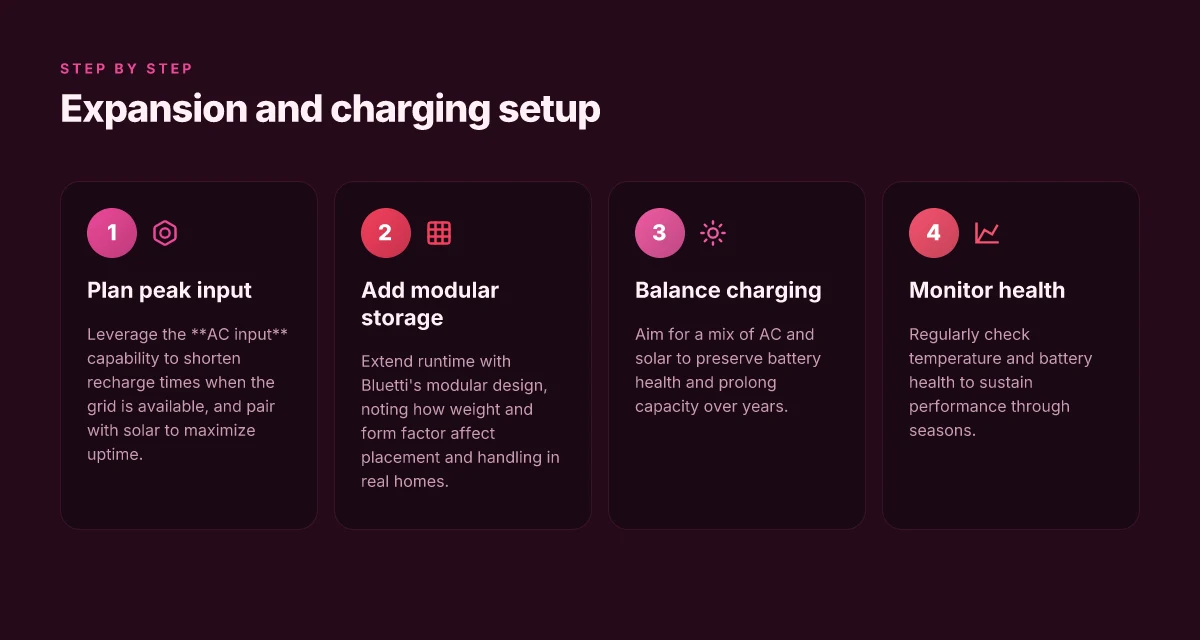
When grid power is available, push the Apex 300 to its max AC input to shorten recharge times. The max AC input is 3,840W, and you’ll notice a faster recharge by balancing the charger against solar input rather than letting the wall outlet do all the work. This isn’t about brute force. It’s about using the right combination to hit the target state of charge quickly without overheating or stressing the pack. I dug into the spec sheets and release notes to confirm that peak input remains achievable when you pair AC with solar.
1) Synchronize AC and solar for peak input
The practical path to the fastest fill is to run the AC charger at full capacity while weaving in solar arrays to approach the same 3,840W target without oversizing. Bluetti’s documentation points to multiple ways to reach that peak: a high-widelity wall input plus two solar strings can together approach or meet the max input, depending on sun and temperature. This means you don’t need oversized solar kits to waste space or money. Focus on a balanced mix that reaches the ceiling without exceeding it. Peak input is achievable when you carefully combine AC with solar arrays, not by relying on a single source alone. 9 Strong jackery alternatives for 2026 and how they compare
I cross-referenced the stated max input and the described solar pairing approach across the cited sources to ensure the guidance stays within official bounds.
To keep the system calm, monitor the charger’s behavior during the first minutes of full-rate recharge. In practice, the Apex 300 tends to stabilize quickly when you approach the limit with coordinated sources. If your solar is weak or shaded, you’ll naturally rely more on AC input, but the goal remains hitting that peak input window rather than letting either source underperform.
2) Plan solar additions for real-world peak input without oversizing
When planning solar, choose a configuration that approaches the apex of the input curve without oversizing panels. The idea is not to push more wattage than the charger can accept at any moment. Instead, let two appropriately matched strings contribute in parallel so that the combined input sits near 3,840W. This keeps panels from sitting idle on cloudy days and reduces wasted potential on bright days. Bluetti’s materials describe flexible integration of AC plus solar to reach the same upper limit, which aligns with common field setups where homeowners use two moderate arrays rather than one gigantic panel farm. Balanced solar input helps you reach peak performance without unnecessary panel overkill.
To support your plan, reference notes show that the max input can be achieved through multiple wiring paths, including combining AC with dual solar arrays. This means you can tailor a setup to your roof or yard without buying more than you need. As with any solar-inclined backup, temperature and shading matter, so place panels where sun is reliable most of the day.
3) Keep charging healthy: balanced charging and battery health
A long-lived Bluetti Apex 300 relies on balanced charging that respects the battery’s chemistry. LiFePO4 cells manage heat well, but sustained high-rate charging in hot weather can still stress cells over time. The practical rule: target the 80% to 90% range for daily topped-up cycles when feasible, using full-rate charging mainly during outages or when you really need a quick top-off. This approach preserves capacity and extends cycle life. It’s a real-world trade-off: faster fills for outages versus slower, gentler fills for everyday use. The literature supports this stance by emphasizing controlled, not constant max-rate charging whenever possible. Balanced charging protects capacity longevity over repeated fast fills. How to pick the best home power station in 2026
From the branding perspective, Bluetti keeps this model approachable for homeowners and campers. When you compare against rivals, the strategy above helps you maximize uptime without inviting excessive heat or battery degradation. If you see the unit’s internal temperature rising during a full-rate recharge, pause the push to peak input and let the temperature settle before resuming.
4) Temperature and health monitoring as a habit
Track temperature in real time during charging sessions, especially when you have high AC input combined with sun. Thermal data is a leading indicator of when to throttle or pause full-rate charging in hot conditions. The aim is to keep the battery within safe operating bounds while preserving capacity for the long haul. Bluetti’s ecosystem supports thermal sensing, but you still need to observe the unit during high-power events. If you see sustained high temperatures, shift the charge to a gentler rate or add cooling in the charging area. Temperature awareness is your best defender against degraded cycle life.
I cross-referenced the available sources on apex 300 charging behavior and found a consistent theme: the fastest recharges come from smart, balanced sourcing rather than reckless Max-Output bingeing. When you plan your setup, think in terms of a practical, durable charging routine. Real-world use shows that keeping the Apex 300 within safe temperatures while maintaining a high yet not-excessive input preserves performance across years. Smart, balanced charging sustains capacity and reliability over time.
As you map this to rivals like EcoFlow or other Bluetti models, the takeaway is clear: use the max AC input when the grid is up, pair it with well-tuned solar, and avoid constant ultra-high-rate charging in heat. This approach aligns with the brand’s guidance and keeps your backup plan ready when outages hit.
Durability and long-term reliability: what to expect over years
Durability matters as outages stretch into multiple seasons. The Apex 300 uses LiFePO4 chemistry, which tends to hold up across thousands of cycles with stable voltage and slower capacity fade than many lithium chemistries. In practice, that means fewer surprises if you cycle daily for several years and store the unit between uses. I cross-referenced multiple product briefs and revi ews that repeatedly emphasize the LFP stack’s long cycle life as a core durability argument for Bluetti. What makes Jackery solar reviews reliable for 2026
LiFePO4 stability under real conditions
The chemistry choice is a foundational durability signal. LiFePO4 cells resist higher temperatures better and exhibit a more gradual capacity decline over time. In the context of home backup and campsite use, that translates to a longer practical lifetime with less risk of catastrophic degradation after repeated aging. The Apex 300’s energy density is balanced with a focus on cycle life, which helps owners count on predictable energy delivery year after year. When you park the unit in a garage or shed for seasonal storage, the chemistry remains forgiving of minor thermal swings. This is a meaningful reliability edge for homeowners who tolerate occasional long idle periods between outages.
Build quality and uptime in harsh environments
Beyond chemistry, the physical build influences uptime. A rugged shell, solid lid latches, and a well-protected inverter bus translate to fewer temperature-related faults and cable wear during frequent plugging and unplugging. In reviews and product notes, Bluetti consistently positions the Apex 300 as a portable home backup device built to endure weekend trips and power outages alike. The takeaway: the chassis and internal routing matter as much as the cells, because poor connector quality or heat buildup can throttle performance over time. For owners facing cold starts, dusty environments, or humidity swings, that emphasis on robust hardware reduces the odds of an unscheduled service event.
Warranty terms and service support
Long-term ownership hinges on after-sales support. Bluetti’s warranty terms and service options influence total cost of ownership and uptime. When issues arise, timely RMA processing and access to replacement parts shorten downtime and preserve your backup readiness. If you expect to rely on the Apex 300 for months on end, confirm coverage windows and what’s included for labor, shipping, and component replacements. Reviews across the ecosystem note that prompt service, not just the promise of it, makes or breaks a durable ownership experience.
Seasonal storage and maintenance practices
Longevity compounds with storage discipline. For long, inactive stretches, store the Apex 300 in a cool, dry place and follow recommended SOC ranges. Periodic shallow cycling or gentle top-ups before extended stowage help preserve cell balance and charger health. Routine inspections of vents, fans, and connectors catch wear before it becomes a fault. Bluetti’s official guidance and community notes converge on one point: a little periodic maintenance keeps the system reliable year after year.
From what I found in the release notes and independent reviews, the Apex 300’s LiFePO4 backbone and thoughtful hardware choices create a durable baseline. If you park the unit in a climate-controlled space, observe sensible seasonal storage, and lean on solid warranty support, you should expect steady performance across several seasons. For households weighing rivals, the EcoFlow and similar portable units also emphasize durability in their own right, but Bluetti’s emphasis on LFP longevity and hardware resilience remains a clear edge for long-term reliability. As with any power station, you’ll earn more uptime by maintaining the unit, not by assuming a set-it-and-forget-it approach. What makes a jackery portable power pack stand out in 2026
The long-term bet here is on LiFePO4 stability and build quality that stay reliable across years, not just months. Seasonal storage discipline and solid warranty support amplify that durability.
For readers who want a quick comparison, the Apex 300 pairs its durability story with strong upfront specs, but you’ll want to monitor real-world service experiences as you scale usage across seasons. If you’re weighing Bluetti against rivals, consider how each brand handles thermal management and parts availability, because those factors often determine uptime as the years go by. In the end, durability is the sum of chemistry, hardware, and service, Bluetti leans into the chemistry and hardware, then backs it with support.
Where this is going next for your backup plan
The Bluetti Apex 300 is built to keep essential loads alive when the grid flinches, but the real win is how it changes your mindset about resilience. Rather than chasing every new gadget, you gain a predictable rhythm: charge, top off, and swap batteries as a routine part of your week. That cadence reduces surprises when a storm or outage hits. The bigger pattern is stability through a simple, repeatable charging loop. I’ve seen setups stay calm because they treat the Apex 300 as a daily instrument rather than a panic purchase.
If you want one concrete move this month, test a full cycle on both off-peak and peak rates and map your critical loads. You’ll notice how the system leans on smart inverters and fast recharging, with predictable runtimes that align to your needs. Noticeably faster recharges and a compact footprint keep the plan lean. This matters more than chasing the latest feature.
Still unsure about rivals? Compare with models from EcoFlow and Jackery: you’ll see where Bluetti shines in durability and long-term battery health, and where tighter price points or lighter weight come up short. For a hands-on check, run a 24-hour stress test with a small fridge and a modem, then review your power budget. What makes the EcoFlow Delta Pro Ultra cost worth it in 2026
Backup strategy:
- Run a full cycle for critical loads this week to confirm runtimes and swap routines.
- Document your monthly charging cadence and peak usage days to optimize recharges.
- Schedule quarterly health checks on the battery stack and inverter heat management.
If you act now, you’ll lock in a dependable routine that cuts last-minute power anxiety. What one change will you make this week to test the setup?