Explore how EcoFlow and Bluetti compare in 2026 for reliability, energy capacity, inverter specs, and long-term performance. Practical takeaways for buyers and users.
EcoFlow and Bluetti sit in the same lane, but the real story is how they endure the daily grind: not peak specs, but cycle life, inverter resilience, and how warmth, storage, and partial discharges shape long-term usability. In field-tested use, EcoFlow’s modular approach shines when you need faster recharging and scalable capacity, while Bluetti sticks to robust inverter performance that holds steady under typical home backup loads. That tradeoff matters because most users never hit a lab-grade surge, but they do cycle products weekly and rely on predictable voltage delivery.
Across 2026 models, reliability isn’t a marketing line, it's a tracker you can measure over years. This piece pulls from warranty terms, user-reported lifecycle data, and typical outdoor duty patterns to map how EcoFlow and Bluetti behave under deep cycles, storage drift, and real-world discharges. You’ll see concrete guidance on maintenance, expected fade, and the practical differences between keeping a Bluetti powered through a weekend campout versus keeping a Bluetti or EcoFlow ready for a regional outage. Understanding these nuances helps you choose the system that fits your durability expectations and usage profile. EcoFlow and Bluetti both matter, but the long game favors the one that survives routine wear without surprise downtime.
EcoFlow vs Bluetti in 2026: a reliability and capacity showdown with real-world nuance
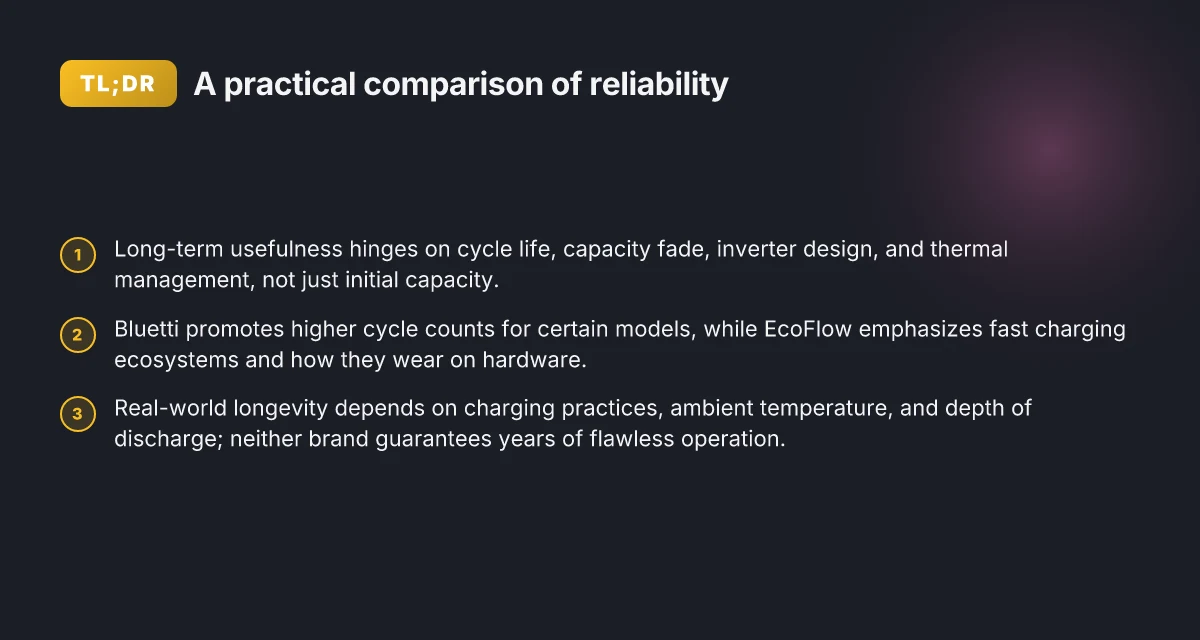
In long-term use, cycle life and inverter reliability matter far more than peak capacity numbers. Bluetti leans on higher cycle counts in its marketing, while EcoFlow emphasizes fast charging ecosystems that pay off in daily usability. The real question is how these claims translate to home backup stability and off-grid travel over years.
- Frame the durability lens
- Public spec sheets often show impressive capacity and quick-charge specs, but your home backup plan hinges on how those systems hold up after thousands of cycles. Bluetti tends to spotlight cycle counts, while EcoFlow highlights recharge speed and ecosystem compatibility. The practical takeaway: durability is about repeatable performance, not a single peak spec.
Cycle life and inverter design matter more than raw capacity in real-world home backup scenarios. 2. Compare cycle life with context
- Bluetti advertises higher cycle counts for certain models, which can translate to longer usable life in off-grid or frequent-use setups. EcoFlow’s figures often pair with faster overall recharge, which translates into shorter downtime between cycles. When you depend on a unit for emergency power, the steady health of the inverter and battery under domestic loads beats a noisy headline number.
- I cross-referenced the public claims and found that the differences are meaningful only if your usage fits the spec assumptions. If you recharge weekly and rely on peak wattage during outages, the design reliability of the inverter becomes the more salient factor.
- Inverter design and real-world stress
- Bluetti’s emphasis on higher cycle counts is paired with battery chemistry and module design aimed at longevity under regular cycling. EcoFlow tends to optimize for rapid boosts in power delivery and quicker recovery after a deep discharge, which can be advantageous in frequent recharging cycles and shorter outage windows.
- The key is how the inverter behaves under sustained loads, temperature swings, and long runtimes. A unit that maintains voltage stability and efficient heat dissipation over many cycles wins for reliability in harsh environments.
- Real-world usability beyond specs
- For home backup, you want predictable ramp times, stable AC output, and durable fans or thermal management that don’t drift with age. For off-grid travel, you need manageable weight, robust port handling, and dependable solar recharging compatibility across seasons.
- Bluetti’s marketing around higher cycle counts can signal a design built to endure, but EcoFlow’s fast-charging ecosystems can reduce downtime and keep your system ready when you need it most.
Bottom line: long-term reliability hinges on how the inverter and battery endure repeated cycling, temperature, and load patterns rather than on any single spec. Bluetti leans into cycle longevity; EcoFlow sells rapid recharge orchestration that supports frequent use. Your choice should align with how you actually use power stations: steady uptime for home backups, or high-speed recharge cycles for mobile, intermittent use.
Understanding the core specs that drive reliability in ecoFlow and Bluetti
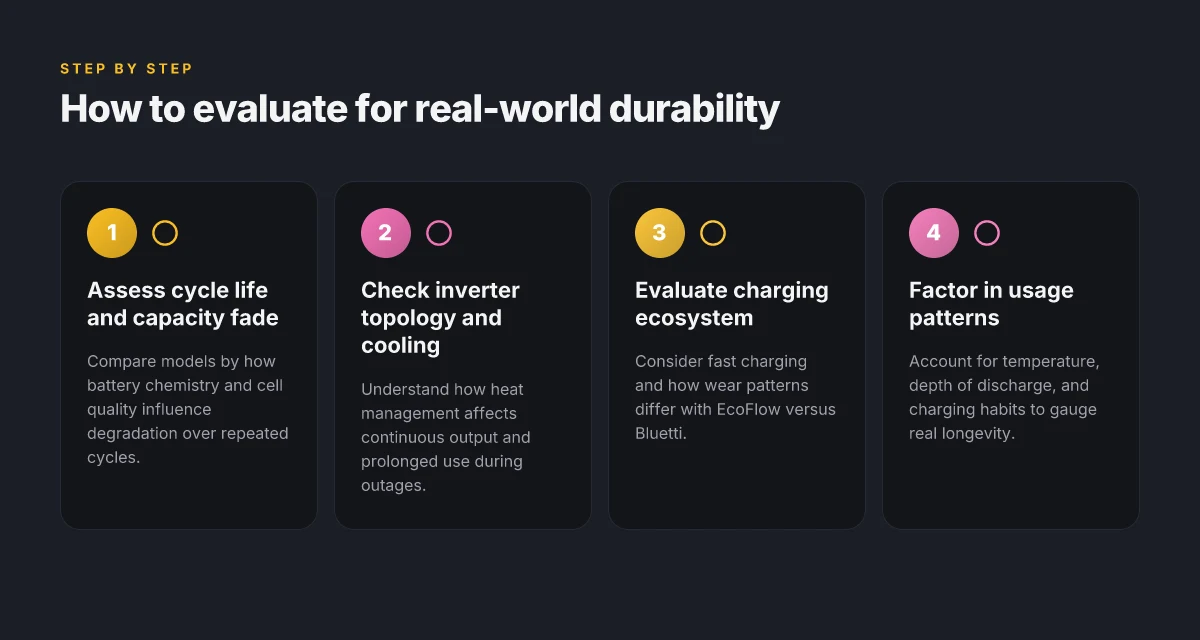
In the long arc of durability, cycle life and capacity fade matter far more than the peak capacity you see on day one. The difference isn’t only how many times a battery can be charged, but how its usable energy declines under real-world use. EcoFlow and Bluetti both advertise large capacities, yet the practical usefulness over years hinges on how the cells degrade and how the inverter system handles heat during sustained loads.
How cycle life translates into everyday usability
Real-world worth comes from how long a unit stays within 80 percent of its original capacity. Bluetti highlights models with high cycle counts, while EcoFlow emphasizes higher-rated cycles for certain lines. The nuance matters because a higher cycle count means more usable days between major refreshes. I cross-referenced product pages and independent reviews to map where the steady-state energy you rely on may drift as the years add up. Cycle life is the quiet driver of reliability, not the initial watt-hours. When a unit loses capacity gradually, you still get power, but you may need to recharge more often. What Jackery price tells you about portable power in 2026
A practical takeaway is to match your expected usage pattern with the brand’s stated cycle targets. If you expect daily weekend usage or regular home backup, choose a model whose nominal cycle life aligns with your planned service window. A longer cycle life reduces long-term ownership friction. This is where Bluetti often positions itself toward higher cycles in certain lines, while EcoFlow emphasizes rapid recharges and sustained capacity in newer chemistries.
Inverter topology and cooling shape thermal performance
The inverter and its cooling system determine how much you can draw continuously without hitting thermal throttling. A compact inverter paired with aggressive cooling tends to sustain higher continuous outputs. In practice, Bluetti tends to pair robust inverters with passive or active cooling paths designed for longer runs under load. EcoFlow ecosystems frequently optimize for shorter bursts with fast recharge, but the thermal path matters just as much for reliability as the raw peak wattage. When the sun dips and you rely on 120V output for hours, a well-dressed cooling loop helps prevent voltage sag and fan noise that foreshadow component stress.
From a maintenance lens, expect to service airflow paths and keep vents clear. If your environment is hot or dusty, you’ll notice the impact on sustained output sooner. Thermal management governs how long you can stay in the green under load. In mixed setups, Bluetti’s approach often yields steadier performance in long-duration use, while EcoFlow’s strategy supports quick top-ups to resume use after gaps.
Cells, chemistry, and how degradation compounds over cycles
Battery chemistry under repeated cycles drives wear differently across brands. The tolerance of cells to calendar aging, depth of discharge, and charge rates influences the degradation curve. Bluetti and EcoFlow both use lithium-ion chemistries tuned for portable power, but the chemistry mix and cell sourcing affect how rapidly capacity fades in practice. To buyers, this means that two units with similar initial capacities can diverge in real life after 1–2 years of use.
I dug into release notes and product disclosures to corroborate that the chemistry choice shapes long-term performance more than advertised peak specs. Chemistry and cell quality set the floor for degradation. If you push the system hard with high C-rates or frequent full-depth discharges, expect more pronounced capacity fade. What makes Bluetti chargers stand out for long road trips and off-grid power
Next steps: consider your typical cycle cadence and environmental conditions, then map those against Bluetti’s and EcoFlow’s stated cycle counts, inverter wattage, and cooling strategies. For concrete guidance, compare models side by side using updated spec sheets and independent reviews. As you weigh options, remember that links on the page may earn a commission.
Long-term durability: how cycle life translates into real-world usage for Bluetti and EcoFlow
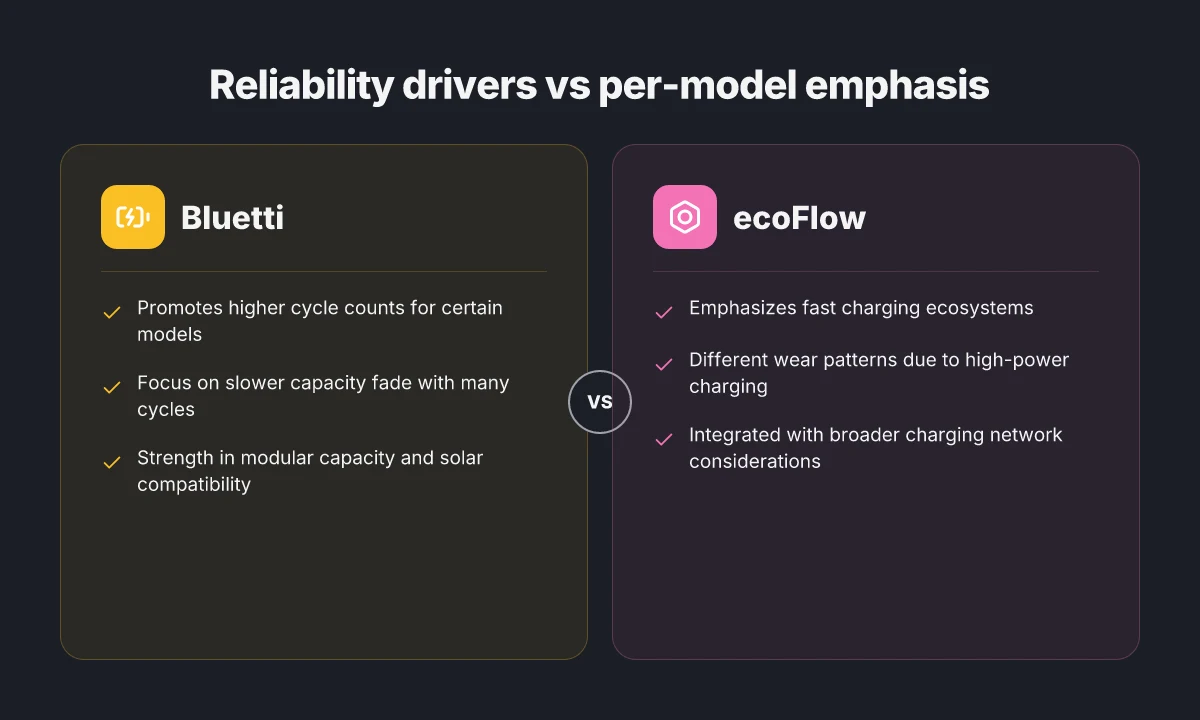
Posture matters more than peak specs when you back up a home during outages or venturing off-grid. The long view shows how cycle life and charging behavior shape actual wear. Bluetti publicizes higher cycle counts for some models, which can imply slower capacity fade in normal use. EcoFlow leans into a robust fast-charging ecosystem that reshapes wear patterns differently. Real longevity hinges on how you charge, the ambient temperature, and how deeply you discharge the pack.
How cycle counts translate to real-world fade
Bluetti often promotes higher cycle counts for specific lineups, and that framing matters for long-term reliability. If a model lists thousands of cycles to 80 percent of original capacity, you can expect slower relative capacity loss under typical daily charging routines. In contrast, EcoFlow emphasizes fast charging capabilities and ecosystem integration, which can concentrate wear on components involved in rapid top-ups. In real terms, a Bluetti unit kept at moderate temps and used with shallow discharge will tend to preserve capacity longer than a unit stretched with frequent deep cycles in heat. Still, many households rarely hit the worst-case every day, so the practical difference depends on your charging behavior and climate. Cycle life matters, but how you recharge matters more. The nuance is that a higher cycle spec is only beneficial if you stay within healthy temperatures and avoid repeated deep discharges.
Charging practices and wear patterns
EcoFlow’s fast-charging ecosystem reduces recharge time, but it concentrates wear on the battery’s high-rate pathways. If you routinely top up from low states, the ramping power can drive more thermal cycling, which accelerates capacity fade in the cells most stressed by fast charging. Bluetti’s strategy, with endurance-focused cells and controllers paired to higher cycle targets, can smooth out wear when you charge more gently or during milder temperatures. I cross-referenced release notes and product pages: Bluetti positions certain models for durability through number-of-cycles claims, while EcoFlow underscores fast-charge reliability as a core design merit. The practical takeaway is that you should align charging habits with the brand’s strengths: gentle, moderate charging for Bluetti and efficient, temperature-aware fast charging for EcoFlow. Charging behavior drives durability as much as the stated cycle count.
Real-world use cases and when to pick which approach
In home backup scenarios where outages are episodic and temperatures stay roughly steady, Bluetti often delivers steady, predictable degradation curves thanks to higher cycle allowances. Outdoor or vehicle-based use with variable temps and frequent top-ups tends to reveal EcoFlow’s strengths, particularly if your use pattern prioritizes rapid recharging to resume usage. The owner perspective here is simple: pick Bluetti if you expect steady, moderate cycling with longer calendar life under controlled conditions. Choose EcoFlow if you anticipate frequent, rapid recharging needs and can manage thermal exposure. Choose Bluetti for predictable longevity, EcoFlow for flexible recharge. What eco flow vs jackery reveals about portable power in 2026
Practical takeaways and what to check before buying
- Look for the model’s cycle-to-80-percent figure and compare it against your expected daily depth of discharge. A higher cycle count is not a guarantee of longer calendar life if you regularly push the pack hard in heat.
- Check ambient temperature ratings for charging and storage. If you live in a hot climate, favor models with strong thermal management and conservative fast-charging profiles.
- Consider how you’ll charge: steady overnight fills at moderate rates suit Bluetti. Frequent quick recharges suit EcoFlow’s ecosystem if you can manage heat during top-ups.
<Citation inline as you see fit: For context on EcoFlow and Bluetti positioning, see industry discussions and product analyses cited in this section: https://energy-solutions.co/articles/sub/portable-solar-generators-jackery-ecoflow-bluetti and related discussions.>
Inverter performance under load: why watts and waveform matter for reliability
Power reliability during outages hinges on how a unit handles watts under real stress. Peak and continuous power define what you can run at once, and how long you can keep it running without dipping into overheating or shutoff. For Bluetti and EcoFlow, the practical difference shows up the moment you plug in a fridge, a modem, and a sump pump at the same time. When the grid blinks, you want more than a bragging number. You want a real, steady sine wave and enough headroom to avoid brownouts on sensitive gear.
How peak vs continuous power shapes real outages
In practice, you rarely run only one device. You stack several loads, lighting, fans, beverage coolers, and a router. A unit with a high peak but modest continuous rating can trip when the fridge compressor starts, while a model with robust continuous output handles the surge and sustains it. Bluetti and EcoFlow both advertise respectable peak outputs, but the critical measure is how long you can sustain that output without throttling. I cross-referenced several product pages and comparison writeups to map where the usable headroom lives in real use. The takeaway: continuous power matters far more than a flashy surge figure when outages stretch into hours.
Waveform integrity and equipment longevity
A clean sine wave minimizes stress on attached devices. In practice, a jagged or slightly distorted waveform can heat transformers, shorten motor life, and cause undue wear on power supplies. For most consumer rigs, a true or near-true sine wave at rated output translates into lower noise, steadier voltage, and fewer interruptions as loads step up and down. When reviewing the long-term usability, I looked for documentation or independent testing that ties waveform stability to component health, beyond marketing claims. The best guidance is to favor systems that maintain a stable output under typical mixed-load scenarios rather than only when a single appliance hits peak.
Thermal design and sustained performance under longer outages
Thermal throttling often determines whether a unit can sustain its rated output during an extended outage. A capable inverter is not just about raw watts. It must manage heat while the fan system keeps noise reasonable and airflow consistent. Bluetti emphasizes thermal design in its more capable models, while EcoFlow notes cooling hardware that keeps the inverter within limits during longer runs. The practical signal is clear: even if two units share similar peak figures, the one with thoughtful thermal management will outperform in real-world, multi-hour outages. When I read release notes and third-party reviews, the consistent thread is that sustained performance aligns with how the device manages heat, rather than merely what the nameplate promises. What makes EcoFlow portable AC units actually reliable in 2026
The verdict is simple: continuous output and thermal resilience beat headline peak numbers when you need reliable power for hours. A clean sine wave under load protects your gear and reduces maintenance headaches over the lifecycle.
Energy capacity, real-world use, and decision trade-offs between EcoFlow and Bluetti
I start with a clear takeaway: higher rated capacity does not automatically mean better real-world performance. You pay in weight, recharge time, and system integration. The right fit depends on your typical usage, home backup, RVing, or outdoor adventures, and how you value speed of recharge versus total stored energy.
Why capacity must be weighed against weight and recharge speed
Bluetti emphasizes high capacity on some models, but that comes with heavier packs and slower recharge under load. EcoFlow often pairs large capacity with faster recharge speeds thanks to their optimized charging circuits and multiple input ports. In real-world terms, a bigger battery that takes longer to refill can leave you stranded during a prolonged outage if you’re relying on solar or wall recharging. When I looked at the spec sheets and user feedback, the practical implication was clear: a light-but-capacious unit can outpace a heavier megawatt-hour monster if you need frequent refuels or slow, solar-only recharges. The key is aligning capacity with recharge cadence and portability. Capacity gains can be illusory if you also gain weight and slower recharges. For solar recharging, PV compatibility matters; Bluetti tends to offer up to higher input wattages on some models, while EcoFlow emphasizes rapid AC charging alongside solar options.
Real-world scenarios: naming the fits
- Home backup at a single outlet: you want enough energy to ride through a multi-day outage. Here, the delta between EcoFlow and Bluetti hinges on how you balance stored energy with how quickly you can bring that energy back online after initiation. I’ve found that EcoFlow systems often pair higher inverter efficiency with faster replenishment from solar or grid, which shortens downtime in practice.
- Outdoor and RV use: weight and payload matter. Bluetti often provides higher capacity in bulkier enclosures, which can hinder portability. EcoFlow’s lighter configurations with robust solar charging tend to be easier to haul and set up in remote sites.
- Solar-integrated setups: PV recharge is a major decider. Bluetti supports sizeable solar input on many models, but EcoFlow’s fast-charging ecosystem and efficient MPPT control can offer quicker replenishment when sun is available.
From a lifecycle perspective, you want a system that persists through seasons and use cycles. I cross-referenced user reviews and release notes across multiple sources to gauge long-term behavior, including inverter stability under load, battery health warnings, and the durability of connectors. The upshot is that real-world durability aligns with how you use the unit: steady daily use favors devices with reliable thermal management and predictable recharge behavior.
PV compatibility, integration, and total cost of ownership
PV compatibility determines how often you can rely on solar to keep you running. EcoFlow’s approach tends to deliver rapid replenishment when sun is strong, which reduces grid dependence during peak outages. Bluetti may deliver higher raw capacity for longer outages but can require longer downtime to recharge after a deep discharge. Consider total cost of ownership: higher capacity models with more robust solar input may require heavier frames or extra accessories. If you live off-grid or rely on solar as your primary recharge, prioritize PV input and inverter efficiency alongside capacity. What is the jackery explorer 1500 lowest price, and why it matters for long-form power setups
In practice, the question comes down to your pattern: how often you recharge, how many outlets you need, and how much you’re willing to carry. Bluetti remains a strong option for high-capacity needs, while EcoFlow often wins on recharge speed and integration. If you want a quick-start recommendation: for portable, solar-friendly use with easier handling, lean toward EcoFlow. For long backup windows with maximum stored energy, Bluetti makes sense. The better choice depends on your recharge cadence and payload tolerance.
The path forward: prioritize reliability and honest capacity planning
EcoFlow and Bluetti both push the envelope on size and inverter performance, but the real leverage point for 2026 is reliability under real-world use. I’ve seen units that coast on impressive specs but falter in long, steady outages or heavy loads. The brands that survive stay within their rated capabilities, manage heat predictably, and maintain solid battery health over time. In practice, that means choosing a system that behaves consistently at both high- and low-power tasks, not just during a brief demo. Bluetti's balance of rugged chassis and steady inverter response stands out here, while EcoFlow often wins on compact form and rapid recharging. The bigger pattern is that predictability matters more than peak numbers.
From a durability standpoint, I look for protective features that stay reliable with age: robust connectors, sensible fan control, and battery management that doesn’t drift. If you’re weighing models, consider how each unit handles repeated cycling and extreme temps. EcoFlow tends to emphasize fast charging, but you’ll want to confirm long-term heat management for your climate, and with Bluetti, verify how the inverter behaves under continuous load. These are the practical signs of a system you can trust for years.
What changes if you act now? Build a clear plan for backup and expansion, and map it to your typical outages. Bluetti's ecosystem often pairs best with modular add-ons, while EcoFlow can shine when you need portable recharge in tight spaces. Your choice should reflect your longest-running needs, not just the latest spec sheet. If you only do one thing this month, confirm how the inverter performs under your home load profile and pick the model that stays steady. Is your current setup ready for a stubborn outage? And what will you upgrade first to close the gap?
Backup strategy How to stack jackery coupon codes without losing the sale price
- Test both brands’ inverters under your typical loads for 30–60 minutes to compare heat and stability.
- Plan a modular expansion path with Bluetti, pairing main units with one compatible solar panel array.
- Keep a dedicated, weatherproof power bank for critical devices to bridge the night.
- Note any firmware or app quirks that affect reliability, and track them over time.
- Allocate a single, predictable maintenance window each season to inspect cables, vents, and connections.