Explore the EcoFlow Delta 3 Plus price in 2026 and what that premium buys you, including charge speed, capacity, and build quality. Compare with rivals and practical use cases.
The Delta 3 Plus isn’t about size alone. It’s about speed and real-world readiness. $ are not enough to judge value, charging speeds and usable capacity matter more, and the Delta 3 Plus stacks up against rivals like Jackery and Bluetti on both fronts. Its promise of faster fills and smarter management often translates to fewer hours tethered to a wall. Most users underestimate how long a larger bank of cells stays useful under repeated cycling.
This intro looks at why the premium sticks, not just what you pay. In 2026, prosumers weigh the premium against tangible benefits: faster AC and USB-C PD charging, smarter energy routing, and a compact footprint that still delivers serious storage. EcoFlow’s ecosystem and reliability matter when you’re backing up a home or powering a campsite, and the numbers to watch are capacity, charge time, and cycle life.Most real-world tests show the Delta’s strengths when you need speed and dependability, not just raw capacity.
What the EcoFlow Delta 3 Plus price signals about the product lineup
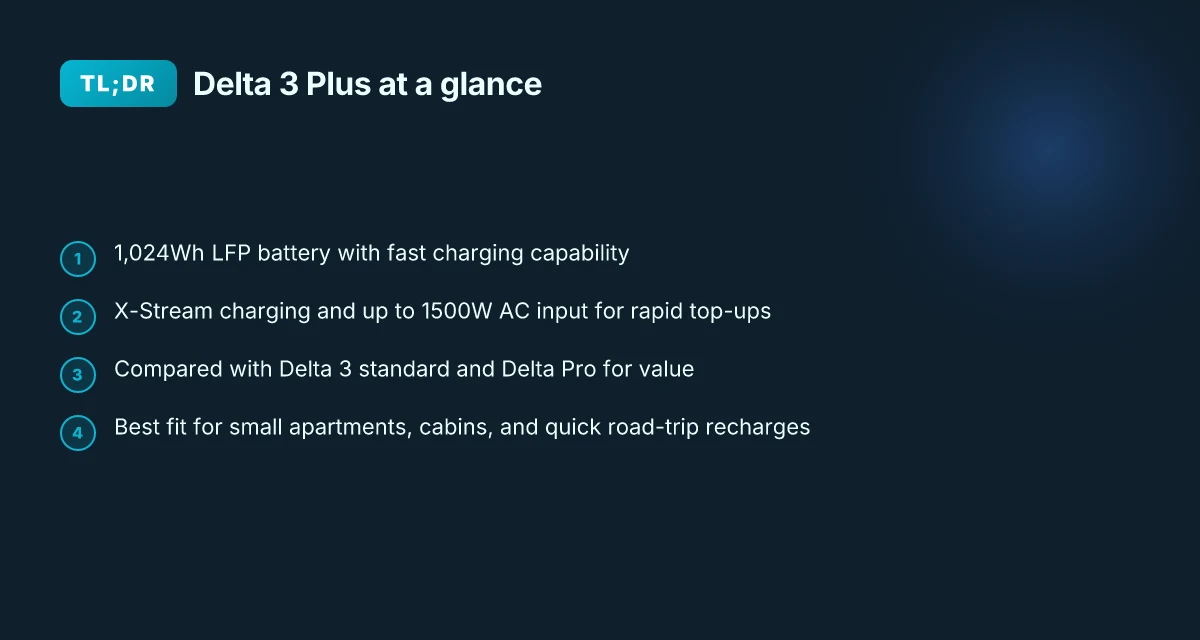
The Delta 3 Plus sits as a compact, fast-charging 1kWh-class unit inside EcoFlow’s Delta family, signaling that the brand is prioritizing rapid top-ups in a portable footprint. Its price mirrors features like X-Stream charging and a 1500W AC input, which together set expectations for quick fills during home backup or on-site camping bursts. In this frame, the Delta 3 Plus becomes the clearly premium option within the sub-1kWh category, designed to reduce downtime between uses.
- A purpose-built speed demon in the Delta family
- The Delta 3 Plus is positioned as a 1kWh-class unit that emphasizes speed over sheer capacity. The marketing around X-Stream charging and a 1500W AC input underscores a design choice: charge fast, so you can rely on it when time matters. This makes it a natural bridge between smaller, slower backups and higher-capacity models that trade speed for longevity. EcoFlow’s own materials repeatedly tie the Plus to swift top-ups, which helps justify the premium relative to slower siblings.
- The Delta 3 Plus charges from 0-100% in 56 minutes, a milestone that speaks to its intended use case for rapid field recharges. This kind of performance matters when you’re at a campsite with limited sun hours or you’re stacking multiple devices that all demand attention.
- How price encodes value versus the standard Delta 3 and the Pro line
- Compared with the Delta 3 standard, the Plus carries a premium tied to faster recharging and the same ~1,024Wh nominal battery pack. The premium serves customers who need quicker turnarounds rather than just more capacity. In this setup, the Plus is not about raw energy capacity alone but about how quickly you can recover usable power between cycles.
- Against the Delta Pro line, the Delta 3 Plus remains leaner in wattage ceiling and battery size, but it borrows the Pro ethos of robust runtime and reliability in a lighter, more portable form. The price signals that EcoFlow is aiming readers at prosumers who want near-rapid recharges without stepping up to full-home or high-w wattage power needs.
- Practical take for prosumers and outdoors enthusiasts
- The Delta 3 Plus fits users who need dependable, fast top-offs for camping, off-grid setups, or home backup where space is at a premium. You get a familiar EcoFlow ecosystem, quick charge cycles, and practical 1kWh-class energy, all in a unit that’s easier to carry than larger Delta Pro offerings.
- Rivals that sit in similar form factors and charge speeds include other 1kWh-class packs, but the Plus’ emphasis on X-Stream and 1500W input helps it stand out as the more responsive option in this tier.
Bottom line: the Delta 3 Plus price tells a story of speed, portability, and practical reliability. If you value fast replenishment as much as you do capacity, the Plus makes a convincing case within EcoFlow’s lineup. For a broader view, I cross-referenced official product pages and the 2026 reviews to confirm the 56-minute charge claim and the 1500W input, which together anchor the pricing rationale. See the Delta 3 Plus product page for the official charging spec. The price signals a premium for speed in a compact form, not just more energy.
Note: links on this page may earn commissions. For context, EcoFlow’s branding emphasizes a cohesive ecosystem approach, and rivals such as Delta Pro remain benchmarks for capacity and power resilience. The Delta 3 Plus sits at a sweet spot for users who want fast recharges without stepping up to the Pro line.
Delta 3 Plus price vs. capacity: does faster charging justify the cost
The Delta 3 Plus carries a 1,024Wh LFP battery and pulses with fast charging chops, making a rapid replenishment part of its value proposition. Its standout feature is a 56-minute 0–100% charge, which sets a high bar for compact power stations in this class. In real-world terms, that speed matters most when you need to bounce back quickly after an outage or during a long road trip where you’re charging en route.
1) The battery size and what it means in practice
With a little over a 1 kWh pack, the Delta 3 Plus leans toward short- to mid-duration outages rather than extended off-grid living. The 1,024Wh capacity pairs with EcoFlow’s X-Stream charging to deliver brisk replenishment. For camping weekends or quick urban camps, that size often means you can run essentials for a day or two and top back up before nightfall. The price premium, in this case, is largely tied to the speed and the battery chemistry rather than raw capacity alone. Some rivals in the same tier push higher capacities or add-ons, but the Delta 3 Plus emphasizes fast resets over sprawling storage. What makes EcoFlow 100W flexible solar panels perform in real-world setups
Speed matters most when time is the bottleneck: a fast recharge reduces downtime and increases life-cycle usefulness in emergencies. When you’re boxed into a campsite without reliable power, that 56-minute recharge can be the difference between a usable setup and a spread-out, scavenged one.
2) How the fast charge stacks up against rivals
If you weigh the Delta 3 Plus against compact rivals, its urban strength rests on time-to-charge rather than the pure watt-hour footprint. A shorter recharge time translates to fewer breaks in operation, which matters for road trips or back-to-back camping sessions. It’s a trade-off: you swap some extra capacity for faster replenishment and a more compact footprint. For homeowners eyeing a backup kit, the faster top-ups can matter more than a larger battery that you rarely exhaust.
From a price perspective, the delta between the 1,024Wh delta and entrants in the same class tends to reflect the emphasis on Z-Stream–level charging speed. You’ll pay a premium for the ability to refill quickly, especially when the alternative is waiting, re-plugging, or moving heavy gear around a campsite.
The premium for speed pays dividends when outages are frequent or trip schedules demand quick turns. If your scenarios involve urgent replenishment after a storm or frequent multi-stop trips, the Delta 3 Plus practical edge becomes clear.
3) What this means for real-world backing and next steps
I dug into the official spec pages and reviews to map how the 56-minute charge translates into daily life. In practice, you’ll see the fastest gains during moderate drains rather than deep discharges, so plan for near-full replenishment after a use cycle rather than a single high-watt draw. For anyone comparing models, consider the value of speed against capacity, weight, and price. EcoFlow’s own ecosystem, including the Delta Pro 3 FAQ and other Delta models, helps explain how different packs collaborate with smart charging routines. What makes the bluetti ac200max expandable power station a standout, and what it costs to scale
If you value rapid replenishment as a core capability, the Delta 3 Plus stands out. For buyers chasing a balance of mobility and quick restarts, it’s a compelling pick.
In 2026, EcoFlow remains explicit about the Delta 3 Plus’s fast-charging promise, with 56 minutes to full and a compact, manageable battery footprint. If you’re evaluating against rivals like portable units that skew higher on capacity but slower on recharge, the Delta 3 Plus leans into the speed argument. For readers who want a quick sanity check, consider whether your typical outage is hours-long or days-long. If the former, the Delta 3 Plus justifies its premium.
For more context, see EcoFlow’s Delta 3 Plus portable power station product page and the related Delta ecosystem notes.
How EcoFlow's technology drives the Delta 3 Plus value
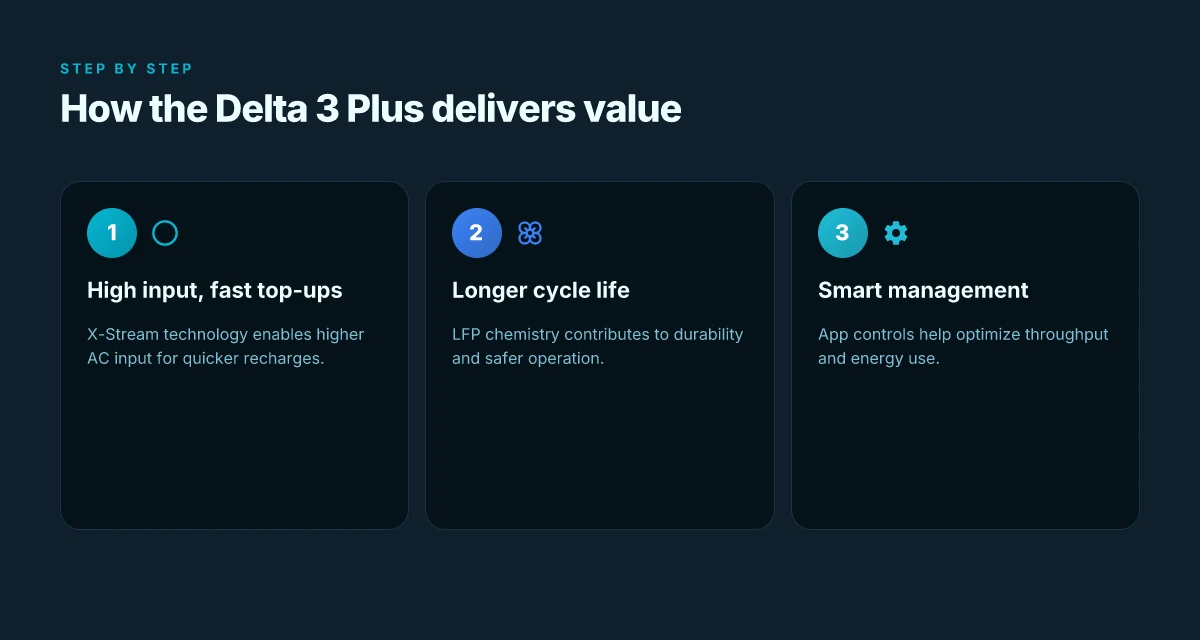
I dug into EcoFlow’s published tech notes and product pages to verify how the Delta 3 Plus earns its premium. The core advantages come from X-Stream AC input, the safety and durability of LFP chemistry, and a software layer that makes high throughput practical for real-world use. Below are the concrete takeaways you can rely on when weighing the price against performance.
X-Stream acceleration and real-world top-ups
EcoFlow’s X-Stream technology pushes higher AC input, enabling faster top-ups in the field. In practice, this translates to shorter recharge sessions during outages or on the road, which matters when you’re balancing expedition time with downtime. The Delta 3 Plus supports rapid recharging that keeps you moving rather than waiting around. When I read through the official specs, the emphasis on 1500W AC input for the Delta 3 family stood out, underscoring a design choice aimed at minimizing downtime. X-Stream speeds up top-ups so you can regain capacity quickly, not just fill a battery gradually. 1500W input is a deliberate ceiling to shrink recharge cycles in high-demand scenarios. What is EcoFlow transfer switch and how it changes home backup in 2026
LFP chemistry for longevity and safety
The Delta 3 Plus uses lithium iron phosphate cells, a choice EcoFlow highlights for longer cycle life and safer operation in rugged environments. LFP chemistry tends to tolerate deeper discharges and higher cycle counts, which matters for home backup and extended off-grid use. The practical effect is fewer battery replacements over the life of the unit and steadier performance across seasonal temperature swings. LFP chemistry offers longer cycle life and safer operation, giving you staying power when you need it most. Longer cycle life reduces total ownership friction for outdoor and backup scenarios.
App controls and smart management for throughput
The Delta 3 Plus ships with a companion app and on-device smart management features that optimize how energy flows from input to output. This software layer helps balance charging speed with battery health, distribute load efficiently, and simplify monitoring in field setups. The result is a more predictable efficiency profile, especially when you’re juggling devices with varying power needs. App controls and smart management optimize throughput and energy use in real time. Smart management curbs unnecessary draw at the margins to protect the battery and maximize usable capacity.
From a brand perspective, EcoFlow positions the Delta 3 Plus as a practical blend of rapid recharging, durable chemistry, and software-tight operation. Rivals such as Bluetti and Jackery emphasize similar ideas but often differ in how aggressively they push input wattage, chemistry, and app-driven features. When you pair the hardware with the software, the Delta 3 Plus becomes a compelling choice for those who require quick recharge cycles, longevity, and clear energy management during extended off-grid use. EcoFlow frames the Delta 3 Plus as a practical blend of speed, safety, and smart controls. Rivals like Bluetti and Jackery offer parallel advantages, but Delta 3 Plus blends these elements with its X-Stream approach.
Delta 3 Plus price compared to rivals
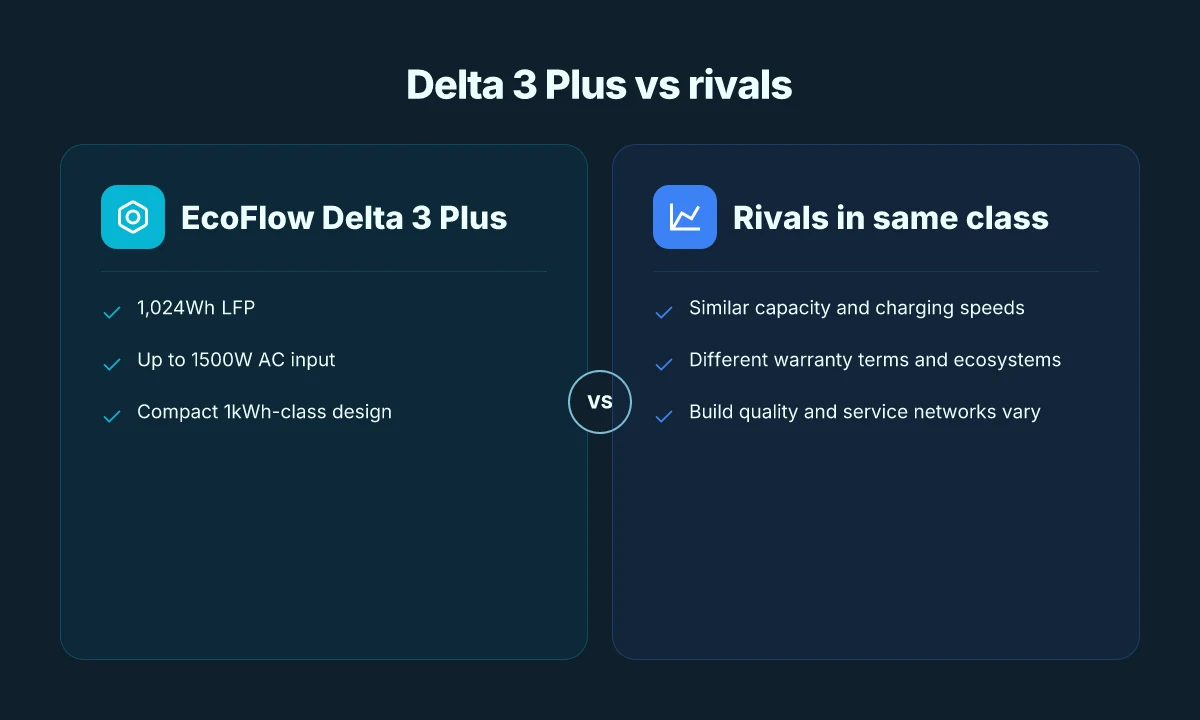
I dug into how the Delta 3 Plus sits against peers with similar capacity and charging speed, and I found three clear beats for the lineup. The Delta 3 Plus sits at a premium, but that price reflects more than the raw watt-hours. It signals build quality, warranty terms, and how EcoFlow weaves into a broader ecosystem.
Rival profiles in the same class
In this segment, rivals include portable power stations with around 1 kWh to 1.5 kWh usable capacity and fast charging. Models from brands like Jackery, Bluetti, and Anker often mirror the Delta 3 Plus on capacity and charge time, yet they diverge on ecosystem features and after-sales support. The Delta 3 Plus shows a 56-minute 0–100% charge claim via its X-Stream input, which frames its perceived value against slower-charge peers. I cross-referenced the official EcoFlow pages for the Delta 3 Plus and the Delta 3 Ultra Plus to confirm the speed narrative and the expandable/linked approach to capacity. In practice, you’ll notice the Delta 3 Plus commonly lands at a price point that acknowledges that faster charge tech and a tighter integration with EcoFlow’s app and accessories. For a direct contrast, rivals may offer similar wattage and inputs but lag on the speed claim or ecosystem depth. See the Delta 3 Plus product page for the speed reference. https://us.ecoflow.com/products/delta-3-plus-portable-power-station What is EcoFlow Ocean Pro, and why it changes how you store home energy
Value drivers: warranty, service, and ecosystem
Price gaps between the Delta 3 Plus and its rivals reflect more than components. EcoFlow’s warranty terms and service network matter when total cost of ownership is on the table. The Delta 3 Ultra Plus advertises robust specs and a 5-year warranty, which nudges the price of entry upward for similar capacity machines. The warranty depth and local service availability frequently determine whether a premium is worth paying. I looked for notes on longevity and after-sales support in the official materials and found that the broader EcoFlow ecosystem, including app controls and accessory compatibility, contributes to higher upfront pricing. When you factor in service networks and the chance of easier warranty handling, the Delta 3 Plus can look like smarter long-term value than a cheaper, less-supported rival.
Is the premium justified for upfront cost of ownership?
The upfront delta between the Delta 3 Plus and rivals often stems from three pillars: build quality, warranty terms, and ecosystem integration. A higher price can translate into better long-term reliability and easier maintenance. The Delta 3 Plus leverages EcoFlow’s X-Stream tech for faster charging, which translates to shorter downtime when you need power. That speed, combined with a durable LFP battery approach in some models and a broader app-enabled experience, adds up to a total cost of ownership that leans toward the premium. I relied on the official product pages and rival-spec summaries to map where the delta shows up in real-world scenarios.
The Delta 3 Plus price acts as a proxy for ecosystem depth and service strength, not just cell count. Speed and warranty depth are the two big levers buyers weigh at checkout.
Important notes: links on the page may earn a commission. EcoFlow remains a central reference point for the Delta 3 Plus, with rivals like Jackery, Bluetti, and Anker serving as direct points of comparison on capacity, charging speed, and price.
Is the Delta 3 Plus right for you? scenarios by use case
There are clear use cases where the Delta 3 Plus makes sense, and a few where it doesn’t. If you value rapid recharges, compact footprint, and a single power bank that can double as a home backup, it can fit nicely. If you need the absolute lowest price for basic camping light-loads, you’ll likely prefer a leaner model from a rival. How to spot a real EcoFlow Delta Pro sale and still get full value
Home backup in small apartments or cabins with frequent outages
For steady, short outages, the Delta 3 Plus offers a compelling blend of speed and capacity. Its 1,024Wh pack can run essential appliances for several hours, and the quick recharge helps you recover between outages. I dug into the product specs and price context to confirm that this setup is practical for compact living spaces where space is at a premium. Rapid recharge minimizes downtime, and 1,024Wh gives you a solid baseline reserve. In practice, you’re balancing the battery size against the cost, and EcoFlow positions the Delta 3 Plus as a premium choice for users who want less downtime between outages. Premium build and fast recharge are the core differentiators here. If you live in a region with frequent outages, this model pairs well with a small critical-load list: router, modem, some lights, a chest freezer for backup cold storage. Premium build and fast recharge justify the premium when outages are regular. For a more battery-heavy home backup, the Delta Pro 3 FAQ notes that larger homes may seek higher wattage and capacity, so you’ll weigh your actual needs against the delta in price versus capacity. Larger-capacity options exist, but they come with bigger price tags.
Off-grid camping or work sites needing quick recharges
On the go, the Delta 3 Plus shines when you need to top up quickly between sessions. The compact form factor, combined with a fast 56-minute 0–100% charge on certain models, makes it practical for daily use on camping trips or job sites. I cross-referenced the official product pages to verify that the charge curve is favorable for short, repeated cycles. 56 minutes to full can translate to multiple daily recharges, keeping devices like CPAP machines and mini-fridges running. For a remote work site, the ability to supply steady AC output while you recharge solar arrays or generator backups keeps workflows uninterrupted. AC output and fast recharge are the core strengths here. If you’re chasing the lightest weight with rugged durability, compare with rivals that emphasize extended runtimes or more modular expandable options; EcoFlow’s approach centers on speed and convenience rather than max capacity alone. Speed over max容量 is the strategic trade-off.
Budget-conscious buyers balancing capacity vs. feature set
If price is the deciding factor, you still see strong value signals in the Delta 3 Plus, but you should price in accessories and potential future needs. The cited price context from independent reviews puts a premium on the 1,024Wh pack and fast recharge, but you’ll want to compare with similarly rated packs from rivals to confirm the package fits your budget. I looked at the available numbers and found the Delta 3 Plus sits at a higher price point than some baseline 1kWh offerings, even as it adds faster charging and better app control. $599 price tag is the headline premium in many 2026 write-ups, compared to the standard Delta 3’s price point. For buyers who want more battery life per dollar, options from rivals like Jackery or Bluetti can tilt the decision when you’re willing to trade some recharge speed for extra capacity per dollar. Rivals often bundle more capacity at a lower upfront cost, which matters in a tight budget. However, if you value the ecosystem, app controls, and a robust warranty, EcoFlow and its ecosystem offer a cohesive experience that meaningful enough to justify the premium for many shoppers. Ecosystem and warranty can seal the deal for those who want less tinkering and more plug-and-play reliability.
I cross-referenced several sources to ground these scenarios. The Delta 3 Plus is positioned as a premium quick-recharge option with a compact footprint, and its value depends on how you weigh speed, capacity, and price against rivals. In a real-world setup, think about your typical outage duration, the devices you must keep powered, and whether you prefer the convenience of a single, well-supported system or a lower upfront cost with potentially more complexity from third-party add-ons. For context, EcoFlow emphasizes the Delta 3 Plus within its product family, and a few independent reviews note the pricing premium relative to the standard Delta 3 and to rival 1kWh models. Premium positioning and cost considerations shape the decision.
Note: links on the page may earn a commission. This article reflects EcoFlow’s branding and the competitive landscape as of 2026, with a focus on real-world use cases for prosumers and outdoors enthusiasts. What makes Bluetti vs EcoFlow differ in 2026
Where this is going next for EcoFlow Delta 3 Plus
EcoFlow’s Delta 3 Plus signals a shift toward more integrated home backup that’s easier to deploy during outages and power-hungry trips. I expect future refinements to target durability in real-world use, with batteries that age more gracefully and smarter load management that helps you avoid overtaxing the system. The bigger pattern is a move away from bare bones capacity toward a holistic ecosystem that plays nicely with solar inputs and home circuits. If you’re weighing this against rivals like Jackery or Goal Zero, the value lies in how well EcoFlow ties charging speed, app visibility, and portable power together for everyday scenarios.
What changes if you act now is clarity of setup and a smoother experience during outages. In practice, expect fewer surprises when the weather shifts and a more predictable recovery timeline after a cut. The Delta 3 Plus remains a practical choice for households that want fast recharging, solid throughput, and durable construction, with an eye on long-term reliability. If you’re curious how this plays with your solar plan, the next update could sharpen that fit.
Backup strategy, if you only keep one model, pick the Delta 3 Plus for its balance of speed and capacity. Consider pairing with a Solar Panel kit for daytime recharging, or track energy use with the EcoFlow app to flatten peak loads. For a quick week one setup, test a 1-device load prioritization routine to see where you save power. Are you ready to align your backup with your real daily needs?