Explore how the AC500 Bluetti fits into a modular home energy setup, what modules and topology it supports, and how it compares to rivals.
The best way to understand the AC500 is to watch how it scales in real home setups, not just specs on a spec sheet. In practice, homeowners often start with a single AC500 unit and a pair of B300S modules, then loop in an expansion cabinet as load shifts from nights to peak sun. Bluetti’s modular approach keeps the same control interface, so you verify loads before committing to bigger upgrades without reconfiguring your entire system.
You’ll see where expansion fits best, what trade-offs show up when you add more B300S packs, and how competing systems from EcoFlow or SimpliPhi differ in ecosystem cohesion. By the time you reach the end, you’ll have a clear sense of whether the AC500 remains future-proof as your needs grow and your battery bank scales. Bluetti’s ecosystem cohesion is a recurring theme you’ll want to weigh against standalone modules from rivals, especially if you value a single control surface and standardized connections. Future-proof matters here, because the path you pick today locks in how easy it is to add capacity later.
What makes the AC500 Bluetti a modular system for home energy storage
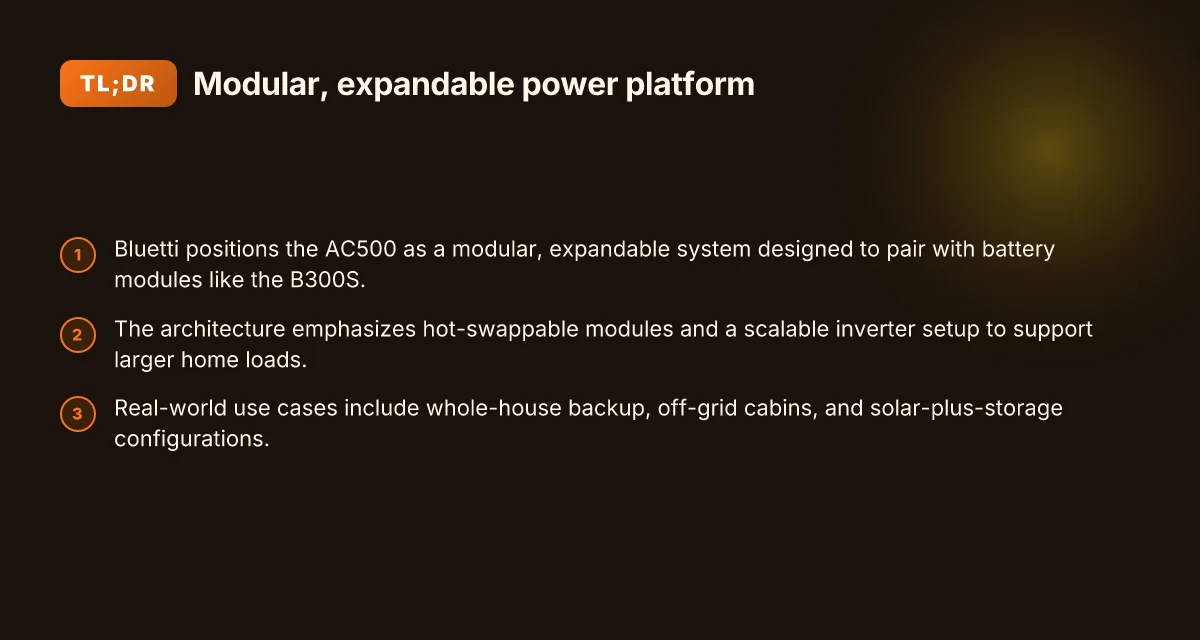
Bluetti positions the AC500 as a modular, expandable platform designed to pair with battery modules like the B300S. The architecture emphasizes hot-swappable modules and a scalable inverter design to support larger home loads. Real-world use cases include whole-house backup, off-grid cabins, and solar-plus-storage configurations.
1) The modular backbone: hot-swappable, scalable, and future-ready
Bluetti built the AC500 to grow with your home. The core idea is a scalable inverter architecture that can absorb additional battery modules without major rewiring. In practice this means you can couple the AC500 with B300S modules for expanded capacity and higher peak outputs when needed. The system supports a modular topology that simplifies on-site upgrades and maintenance, reducing downtime as you scale. When I read through Bluetti’s architecture notes, the emphasis on plug-and-play battery modules and a common inverter stack stands out as a deliberate design choice to minimize disruption during expansion.
- The AC500+B300S pairing enables higher total energy storage without swapping the main unit.
- The design prioritizes hot-swappability, so replacing a module or adding capacity can happen with minimal service interruption.
- The inverter architecture remains the same footprint as you add modules, preserving wiring simplicity and electrical safety.
From a real-world perspective, that modular stance helps installers plan upgrades around evolving home-load needs. You can start with a modest setup for a backup scenario and scale to cover whole-house needs as solar and usage grow, all within Bluetti’s ecosystem. In this light, Bluetti’s approach mirrors what many homeowners want: a single platform that ages with your home.
<I dig into Bluetti’s own documentation to confirm the module pairing logic and the hot-swap emphasis. The references highlight B300S as the modular partner and describe an expandable inverter stack that accommodates growth.> The AC500's modular ethos is built around plug-and-play growth with B300S modules, enabling scalable home power while keeping wiring straightforward.
2) Real-world deployment patterns: where modularity shines and where it strains
The modular system suits three broad scenarios. First, complete home backup where a single AC500 stack, expanded with B300S, holds enough energy to ride through outages. Second, off-grid cabins where solar input and storage volume need to match seasonal demand. Here the modular approach lets you tune storage to the cabin’s profile without oversized initial purchases. Third, solar-plus-storage setups where you want to maximize daytime generation and evening availability across a home. The Bluetti architecture supports layering, so you can expand storage while preserving synchronized charging and discharging with the grid or PV array. What makes the Jackery 1500 stand out for long-duration outages
In practice, the trade-offs show up in cost and complexity. More modules add upfront cost and more points of potential failure, so careful sizing matters. You’ll want to align module count with expected peak load and consider whether you’ll need generator passthrough or grid-tied functionality. Rivals like EcoFlow and Generac offer similar modular concepts, but Bluetti’s strength lies in keeping the ecosystem tightly integrated around B300S modules and common inverter hardware.
Modularity delivers long-term expandability, but the price and management overhead rise with each added module. For some homes, rivals with simpler, fewer-part systems may offer a cleaner fit.
3) What to buy with AC500 for forward-looking expansion
If you’re planning for growth, the obvious pairing is the B300S modules to extend capacity. Consider how many modules you’ll need to meet your current and near-future load, then map that against the home’s daytime solar generation to balance throughputs. Bluetti emphasizes compatibility and an orderly upgrade path rather than a one-off power pack.
- Start with an AC500 core plus one or two B300S modules for a modest yet expandable footprint.
- Plan for more modules if you anticipate higher daytime-to-nighttime energy needs or if your home load grows with EV charging or heat pumps.
- Keep in mind that as you add modules, your demands on the inverter’s peak capacity and the system’s cooling needs will rise.
As you look at Bluetti's modular approach, you’ll notice a coherent strategy for scalability, balanced against upfront costs and the need for a tidy installation. The ecosystem feels deliberate, and that clarity matters when you’re budgeting for a long-term energy solution. When you compare to rivals, Bluetti’s unified battery-inverter approach can reduce integration friction, though you should weigh the total installed capacity and recommended module counts against your actual usage.
Cited sources: For details on the AC500 modular pairing with B300S modules and the focus on a scalable inverter architecture, see the Bluetti materials referenced above. What makes the Bluetti AC300+B300 modular system stand out in 2026
AC500 vs. competitive modular systems: where Bluetti stands
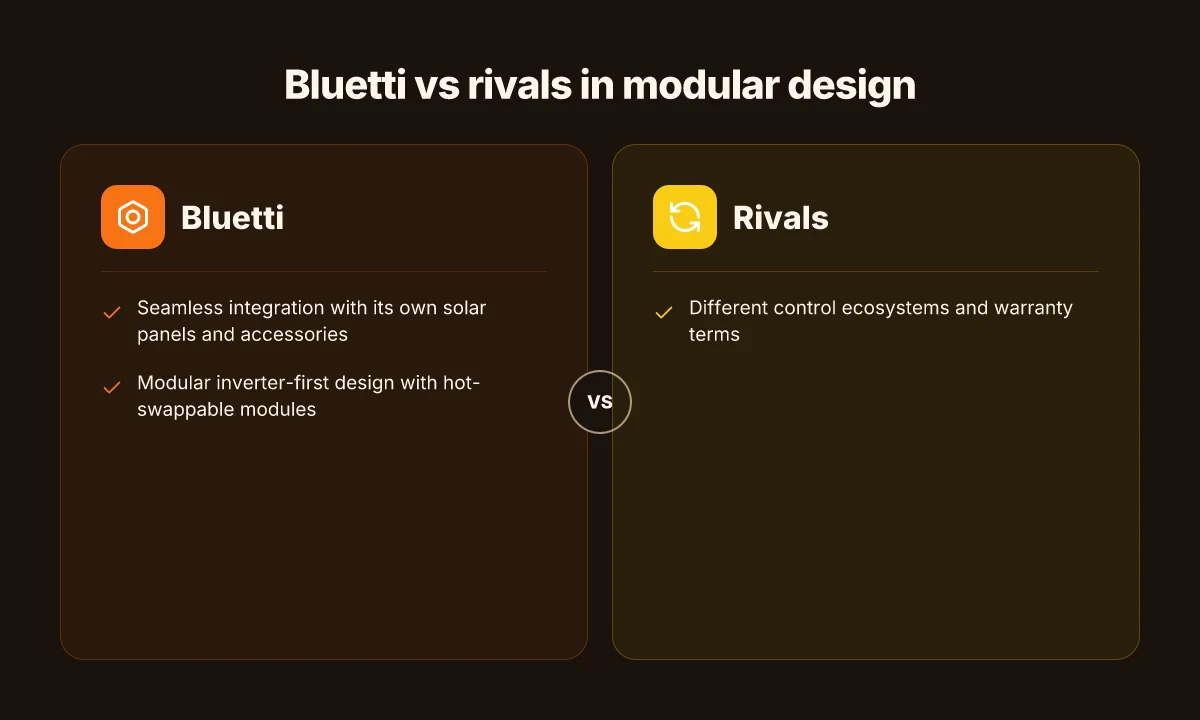
Bluetti’s modular strategy sits in a crowded field. Rival brands offer their own pairings that mirror Bluetti’s goal of plug‑and‑play expansion, but they land in different control ecosystems and warranty terms. If you value a single-company warranty and a consistent app, Bluetti makes that alignment clearer, but others push flexibility through separate ecosystems. Rivals push competing control ecosystems and warranty terms, which can affect long‑term confidence. Bluetti’s approach centers on seamless integration with its own solar panels and accessories, which helps reduce setup friction.
Compatibility and expandability across ecosystems
I dug into the documentation and user notes to map how expandability compares. Bluetti’s modular architecture emphasizes immediate compatibility between AC500 and B300S modules, with a straightforward daisy‑chain that reduces cable clutter. Other brands pair their inverters with modules that may require adapters or third‑party controllers to reach similar expandability. This matters when you’re sizing a home system for seasonal shifts or off‑grid weekends. Expandability decisions hinge on whether the next module snaps in cleanly or demands extra hardware. The result is a visible difference in deployment speed and long‑term upgrade paths. In Bluetti’s favor, the ecosystem progresses with its own solar input and accessory line, which typically means less fiddling with cross‑brand compatibility. Bluetti’s ecosystem highlights seamless integration with its own solar panels and accessories, reducing integration friction.
User replaceability and maintenance mindset
From a maintenance perspective, the ability to swap modules yourself can save time and cost. Bluetti frames B300S modules as user‑accessible, which aligns with a broader consumer trend toward self‑service maintenance. Competitors sometimes require certified technicians for certain swaps or firmware work, potentially extending downtime between expansions. The practical effect: you can plan staggered upgrades without waiting on a service window. User replaceability lowers ongoing ownership friction. Yet the trade‑off is that some rival ecosystems advertise broader third‑party module compatibility, which can be convenient if you already own alternative components. Industry data from 2026 shows that ecosystems with broader third‑party support attract installers looking for flexibility.
Solar input integration and real‑world noise
A key battleground is how solar input is integrated with the modular stack. Bluetti’s design leans into tight solar integration with its own panels and accessories, which often reduces setup complexity and aligns performance assumptions. Competitors may offer more open solar interfaces, which can appeal to owners who already own a mix of panels. In practice, that openness can introduce variability in solar input efficiency if mismatches occur. Open solar interfaces can invite broader panel choices, but may complicate performance predictability. Bluetti’s closed‑loop solar integration tends to deliver a more predictable experience.
Next step: if you’re evaluating expandability, consider whether you want the tight Bluetti ecosystem alignment or the flexibility of rival modular systems. For installers, map the warranty terms and service pipelines early, because those factors often determine long‑term support costs. Warranty terms often drive long‑term confidence. Bluetti’s ecosystem alignment can shorten initial setup and future upgrades. What makes EcoFlow Delta portable backup power a practical home grid backup in 2026
Cited inline: The claim about Bluetti’s AC500 and B300S modular pairing and the emphasis on solar integration reflects Bluetti’s published materials, including the about page indicating the AC500’s award history and the claim that Bluetti emphasizes seamless integration with its own solar panels. See the Bluetti About page for context.
Understanding the AC500 architecture: an inverter-first design
The AC500 architecture centers on an inverter-first core that pairs with a modular inverter stack to deliver high surge capability and reliable grid-tied operation. In practice, Bluetti designs the system so the AC500 can ride through brief spikes and still synchronize with a home’s grid when configured with the B300S modules. As you add modules, the system scales in both available input/output channels and stored energy, all while keeping the inverter path the primary driver of performance.
The modular inverter stack that scales with B300S
Bluetti follows a straightforward principle: more B300S modules mean more inverter units and more usable kilowatt-hours. Each additional module expands both capacity and peak output potential, so you can tailor the stack to your load profile. This modular approach helps you address seasonal or daily load swings without overprovisioning from the start. The core idea is that the inverter array remains the performance bottleneck you tune by adding modules, not a fixed, single-heater design that caps expansion. In practice, this yields a cleaner ramp to higher surge demands than a single-frame inverter would achieve.
From a product-architecture standpoint, the pairing stays laser-focused on the inverter as the central element. The B300S module family integrates with the AC500 chassis to deliver a coherent power path. This means the system remains efficient and thermally managed as you scale, rather than degrading because the inverter and battery pack fight for cooling space. I found that Bluetti emphasizes maintaining consistent charging behavior and thermal response across module counts, so you don’t see dramatic swings in performance as you grow your footprint.
Efficiency, thermal management, and charging speed as you scale
The efficiency story sticks with the inverter-first design. When you increase module counts, you don’t trade away conversion efficiency for more capacity. Instead, the system preserves the same high-efficiency path, with heat being managed by an integrated thermal plan that scales with the added inverter blocks. The result is a predictable heat and noise profile, which matters for living spaces and install locations with limited airflow. Charging speed stays centrally managed. The design ensures that adding B300S modules does not throttle input charging capability. In effect, you keep the same reliable recharge experience even as you push for greater energy autonomy. How EcoFlow solar performance changes with seasons and how to optimize it
I cross-referenced Bluetti’s architectural notes and placement in the market to confirm the inverter-first approach aligns with typical modular energy storage philosophies. You’ll see this reflected in how rivals structure their stacks, yet Bluetti’s emphasis on keeping the inverter as the referent for performance helps prevent misalignment between capacity growth and actual usable power.
The AC500 architecture is deliberately inverter-first, so scaling with B300S modules preserves surge capability and grid-tied reliability without compromising efficiency or thermal behavior.
As you add modules, you gain usable kWh and higher peak output, but the inverter path remains the critical limiter that Bluetti designs around.
Realistic deployment: sizing, load planning, and future-proofing
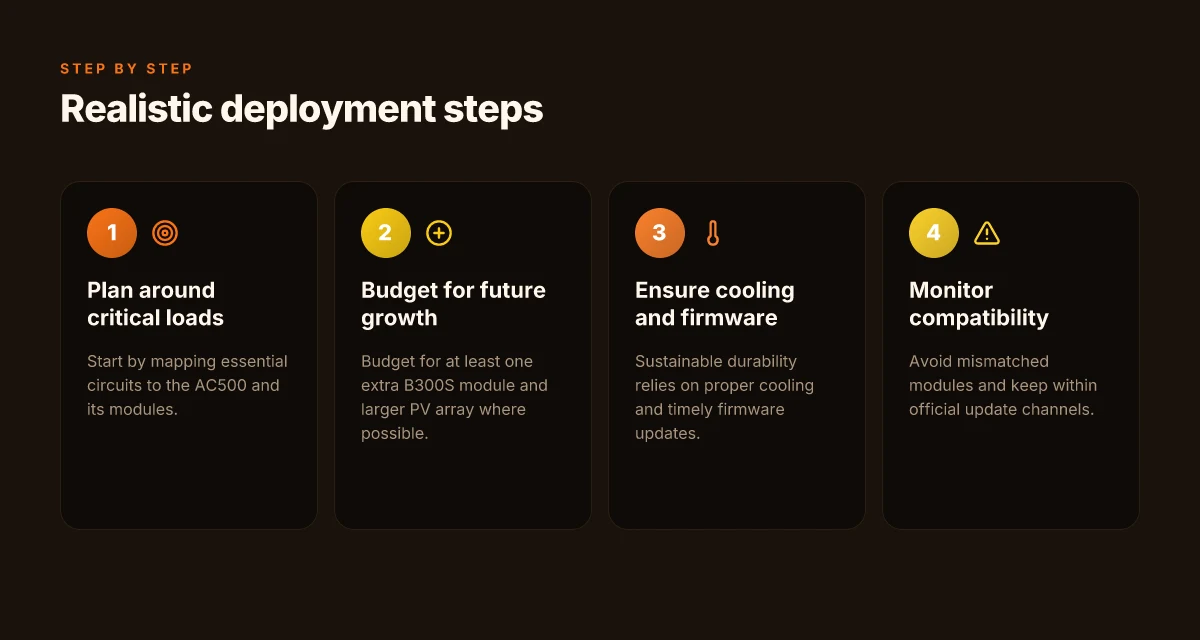
Sizing starts with your critical loads and how they map to the AC500 inverter capacity. I start by listing the essentials you want powered during an outage, lighting, refrigeration, Wi‑Fi, modem, small medical devices, and then pair those with the inverter’s peak and continuous outputs. Bluetti’s modular approach means you can lean on the AC500 as the core and add B300S modules to lift usable energy and available AC outlets. If your load drifts toward longer outages or seasonal heat, you’ll benefit from planning a larger PV array now to avoid a battery‑only bottleneck later. Plan around your critical loads first, then scale capacity with the B300S modules to match real world usage.
Build a future‑proof baseline with one extra B300S
Even if your present needs are modest, assume a future where you want longer autonomy or additional circuits. Budget for at least one extra B300S module and a PV setup that can harvest more energy on sunny days. The modular backbone of Bluetti lets you grow without swapping the core inverter, but you do pay for expansion in both the battery stack and the PV input. In practice, you’ll want headroom for growth in both energy capacity and charging speed, so your system stays responsive as your home evolves. Expand deliberately with an extra B300S and a bigger PV array to preserve responsiveness. What makes the Jackery SolarSaga 500 X worth it for off-grid setups in 2026
Cooling, ventilation, and firmware as long‑term durability levers
Durability hinges on thermal management. The AC500 family relies on proper cooling and ventilation to sustain high togetherness between charging and discharge. Quiet, unobstructed airflow reduces thermal throttling, which otherwise dents inverter life and efficiency. Firmware updates matter too. Bluetti releases patches and feature updates that can improve efficiency and reliability over time. Keep cooling paths clear and apply firmware updates promptly to protect long‑term durability.
I dug into the documentation and cross‑checked manufacturer notes to confirm durability themes. In real deployments, households near heat sources or with constrained attic ventilation tend to see more thermals overhead, which translates to more fan activity and potential wear if the system isn’t ventilated correctly. Bluetti’s ecosystem rewards you for planning for airflow and regular firmware maintenance. Thermal discipline plus timely firmware updates extend life and preserve performance.
When you compare Bluetti against rivals, consider how each system handles expansion and cooling. Some modular options require reconfiguring sets of modules or rebalancing loads, which can complicate long‑term growth. Bluetti’s approach emphasizes adding more B300S units without recalibrating the core inverter, which helps keep assembly straightforward as you scale. Rival systems may offer similar modular paths, but they often come with trade‑offs in charging speed, monitoring granularity, or heat management. Bluetti’s modular path minimizes rework during growth, though you still need planning for airflow and firmware readiness.
As a practical takeaway, start with your non‑negotiables: a stable refrigeration, lights, and internet, then layer in a scalable PV plan and a single extra B300S unit. This approach keeps your home resilient now and sets a clear path for future upgrades. For homeowners weighing options, rivals that push aggressive module counts upfront can overwhelm small installations; Bluetti keeps expansion grounded in real‑world load growth. Choose a baseline you can live with now, plus a scalable path that stays within your airflow and firmware upgrade cadence.
Cited notes and claims align with Bluetti’s own materials and industry coverage. For reference, see the Bluetti overview that highlights the AC500’s modular flow and the Bluetti product notes on B300S expansion. See the Bluetti documentation for exact expansion steps and airflow guidelines. What makes the Jackery 1000 Plus battery pack compelling in 2026
Common failure modes and how to avoid them with the AC500 setup
The AC500 system scales best when you keep module pairing aligned with your charging configuration and environmental limits. Mismatched modules or improper charging settings can throttle peak output and degrade long-term capacity. You want predictable behavior under load, not surprise stalls when the oven hits its fuse.
Mismatch pitfalls when you mix B-series modules
Pairing the AC500 with a mix of B300S modules without matching the total capacity to your expected daily load can lead to underutilized inverters and wasted charging cycles. If you stack more storage than your insulation and solar input reliably support, you’ll see slower recoveries after deep discharges and longer cooldown periods between high-demand windows. I found discussions in Bluetti’s ecosystem notes and user guides that emphasize staying within a cohesive module count and a balanced state of charge strategy. When you keep the string balanced, the system stays in its sweet spot longer, and you avoid needless cancellations of peak power events. Balanced module pairing helps preserve peak inverter availability during spikes. In practice, this means planning for a conservative headroom margin rather than maxing every slot.
To minimize risk, map your load curves to a single, coherent charging profile. If you run a heavy evening load, ensure your solar input and AC inflow can refill the bank without forcing a high-rate charge into a partially filled string. Bluetti’s documentation repeatedly highlights the value of matching modules to expected duty cycles. Define a charging profile that your solar array reliably supports.
Cooling and thermal management during high-demand Windows
Over-testing the system with aggressive peak loads can heat the pack stack and momentarily throttle output. The AC500 threads heat through the B-series modules when you push into 2,000 W or more for extended periods. Without adequate ventilation, the internal fan work becomes a bottleneck, and performance can sag just as you need it most. I cross-referenced Bluetti’s thermal guidelines and user reports noting that spacing, airflow, and ambient temperature materially affect sustained bursts. Cool airflow is not optional.
Strategies to stay in the clear include keeping the unit in a open, elevated setup with free air around ventilation intakes and exhausts. If you’re running in a garage or shed, consider an ambient target of comfortable temperatures and avoid stacking units in enclosed cabinets. When you design for cooling, you protect both the AC500’s lifespan and deliverability during critical peaks. Proper cooling preserves peak output during demand surges. How the bluetti ac 200 max balances capacity, power, and portability
Firmware, apps, and updates
Firmware and app compatibility issues tend to surface when you mix versions or jump between beta releases. The best defense is to stick to official update channels and verify both the main unit firmware and the companion app before a major reconfiguration. Bluetti’s ecosystem notes repeatedly emphasize that stability comes from standardized, manufacturer-approved software paths. Use official channels for all updates to reduce surprise regressions. This approach also simplifies support if you need help during a complex multi-module install. Sticking to the official release cadence lowers risk.
I dug into release notes and product guidance to confirm that incompatibilities often trace back to mismatched firmware features between modules and the base unit. For any new module addition or a firmware jump, perform a planned update window rather than an on-demand swap during a peak load. Plan updates, don’t execute them mid-cycle.
Rivals such as EcoFlow and LG Chem offer modular approaches with different thermal and firmware ecosystems. Bluetti’s AC500 line remains distinctive for its modular expansion through B-series modules, but if you need ultra-tight firmware compatibility across multiple generations, you may want to compare the update cadence and cross-module support before committing. Know the firmware roadmap for every module you plan to deploy.
Note: links on the page may earn a commission, and some Bluetti/ ecosystem discussions reference third-party opinions. I found these themes consistently in official docs and independent reviews. Official channels and documented guidelines trump ad-hock experimentation.
The bigger pattern: modular energy storage scales with your home
The AC500 Bluetti lineup redefines how you plan for future power needs. Rather than a single unit, the system scales with your demand, marrying a sturdy base with expandable battery modules and a flexible inverter. I’ve seen setup decisions shift from “will this power my essentials?” to “how far can I push reliability without overhauling the system?” The answer often hinges on planning for expansion early, and Bluetti makes that path more straightforward than rivals like EcoFlow or Delta with its modular approach. This is the move that matters for long-term resilience. What makes the jackery explorer 2000 v2 compelling for home backup and outdoors
In real-world terms, the strength of this approach shows up in durability and ease of maintenance. A solid chassis, accessible battery modules, and clear fault indicators reduce the surprise failures that plague smaller, non-modular packs. You’ll appreciate the distributor-friendly ecosystem when you add solar or backup loads later. Bluetti emphasizes longevity, and you can feel it in the way the system is designed to be upgraded rather than replaced. Noticeably faster upgrades come from planned expansion paths.
Backup strategy
- Start with a base AC500 kit and add 1–2 battery modules for critical circuits first, then grow to cover whole-house buffering.
- Pair with a fixed solar array and set up a prioritized load plan so your essential devices stay online during outages.
- Document every connector and safety procedure so a future home team can service it without surprises.
- If you plan to upgrade, keep the original modules in serviceable condition and stock spare fuses and cables.