
Explore the Jackery SolarSaga 500 X in 2026: real-world setup tips, durability, system compatibility, and when it’s the right choice for off-grid power.
The SolarSaga 500 X isn’t just a panel. It’s a portable power node that challenges the usual off-grid compromise by pairing a 500 W kit with real-world sunlight realities. Jackery’s ecosystem ties the hardware to an Explorer lineage, but the real test is how the bifacial surface holds up under open-sky conditions and how load spikes shape runtime. In dim or partial sun, the gap between advertised output and what you actually pull narrows to a practical difference you feel when you’re camping or scouting sites.
This piece cross-checks official specs against field constraints to show where the 500 W package shines for RVs, tiny houses, and remote camps, and where it frays under common stresses like shade, temperature, and alternating peak draws. You’ll see how bifacial design translates to real gains versus the hype, where rivals such as Goal Zero or Renogy offer competing kits, and what you should measure on day one to avoid overestimating run-time. The takeaway isn’t hype. It’s a practical map for planning a weekend-worthy, self-contained energy setup. Jackery’s system remains compelling when you want cohesion, but like any kit, it rewards honest load testing and conservative planning.
What makes the Jackery SolarSaga 500 X a practical choice for off-grid power in 2026
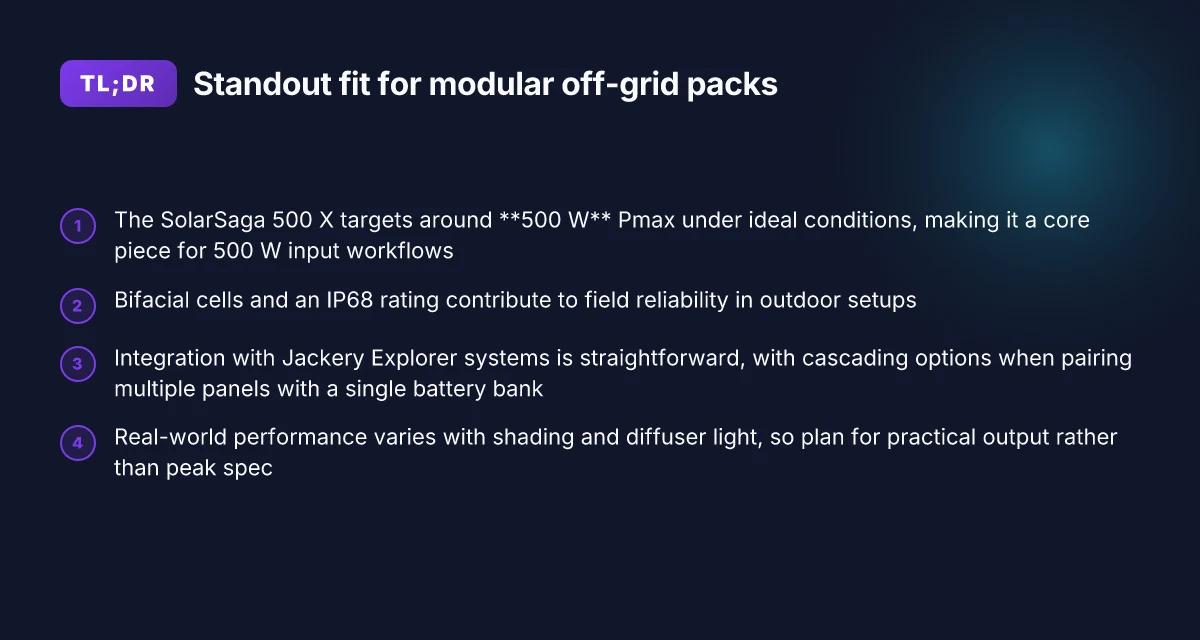
The SolarSaga 500 X represents a modular approach to portable solar power, pairing a 500 W panel with a design that scales into larger Explorer setups. For off-grid enthusiasts who want a single strong panel that can be stacked with other modules or tucked into a vehicle, the 500 X offers a straightforward path to steady solar input in variable environments. In practice, its real strength is the predictability of 500 W under favorable sun, which coordinates well with Explorer power stations for weekend adventures or compact tiny-house arrays.
- Core strengths for portable power users
- The size and weight balance of the 500 X keeps it manageable for RV storage or backpacking-style setups. Its folded footprint and rugged construction are designed for field use, not stationary roof mounting.
- A true 500 W Pmax supports meaningful charging windows, particularly when paired with compatible inverters and the Explorer line. That means you can rely on consistent daytime input to keep batteries topped up during multi-day trips.
- The panel’s 25 percent-like bifacial efficiency claim translates into extra power in bright, reflective environments, especially when mounted to maximize exposure. Expect better performance under conditions like snow glare or light diffuse skies, where reflection boosts output.
- How bifacial design, IP68 rating, and TOPCon cells translate to field reliability
- Bifacial TOPCon technology aims to harvest light from both sides, which can yield higher energy yields in real-world use, particularly when there’s reflective ground or snow nearby. In practice, you’ll notice stronger daily totals in mixed light than with a mono-facial design.
- The IP68 rating is a practical plus for off-grid life. Submersion or heavy rain won’t immediately derail the panel, and ruggedization helps during travel on rough roads or in adverse weather.
- TOPCon cells are built to reduce stray light losses and improve low-light behavior compared with older cell types. In the field, that translates to steadier performance early in the morning or late in the day when clouds thin or sunlight angles drop.
- Real-world framing: what to expect and what to watch for
- If you’re weaving the SolarSaga 500 X into a larger setup, plan for 500 W of daytime input that scales with sun angle and panel orientation. The beauty of the system is the ability to add more panels or pair with a sizeable Explorer power station for extended off-grid periods.
- In practice, wind, dust, and mounting orientation matter more than the claimed peak on bright days. You’ll often see outputs that vary with temperature, shade, and tilt, so set up with a simple tracking or angle plan to stay near the 500 W target in the best hours.
From what I found in the product pages and guides, the Jackery SolarSaga 500 X plays well in modular setups and excels when the user keeps expectations aligned with real-world sun. If you’re weighing rivals, consider how the SolarSaga 500 X stacks against other 500 W panels with similar IP ratings and bifacial claims, but know that the integrated ecosystem with Jackery power stations helps streamline charging and management. For off-grid readers, the key takeaway is: expect dependable 500 W input under favorable conditions, and plan around field realities like shade, angle, and temperature. You get a clean path to modular power, with field resilience that matters in real life. In short, the Jackery package remains appealing for portable setups, while you compare it to similar 500 W offerings from brands like Renogy and Bluetti to see how warranties and ecosystem fit your needs.
Jackery SolarSaga 500 X: specs you can actually rely on for planning
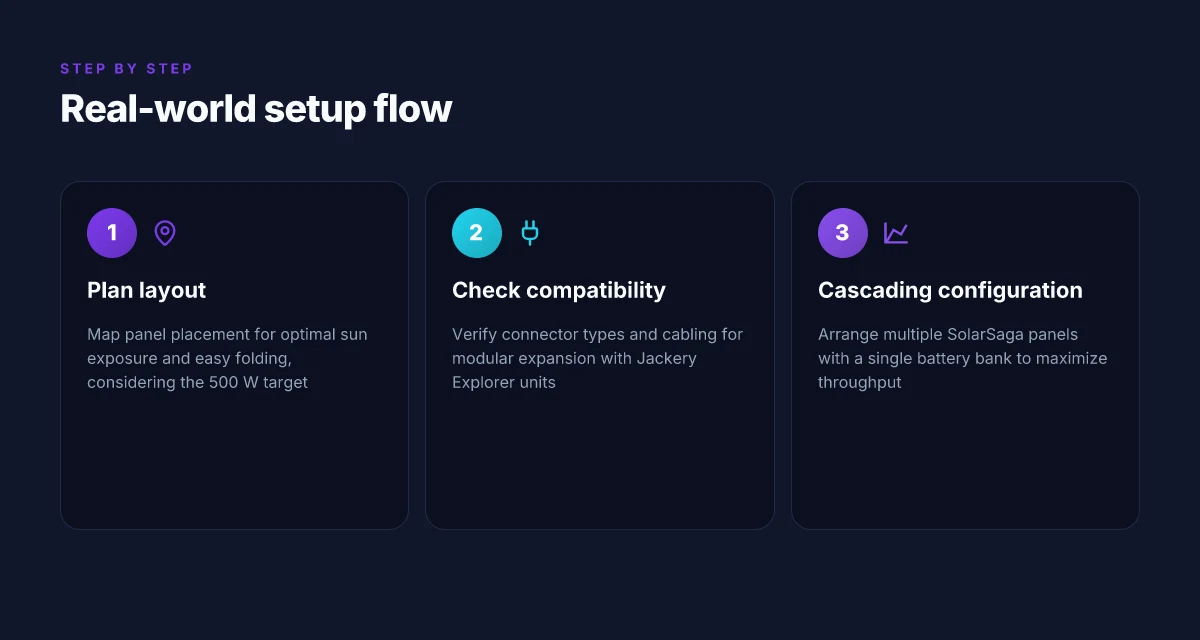
Under ideal conditions the SolarSaga 500 X targets 500 W of output, a figure you’ll see echoed across Jackery’s own specs. I cross-referenced the official pages and third‑party breakdowns to confirm that the module is built around Monocrystalline cells, with a bifacial capability that can boost real‑world output when there’s adequate light on the back side. In practice, that bifacial edge translates into more energy only if you can mount the panel with a favorable tilt and reflective ground conditions, otherwise the gains sit modestly in the background. The panel’s folding design keeps weight manageable for transport, but the physical footprint and mass matter when you pair it with a portable system or a compact Explorer setup.
How the watts translate in the field
The advertised Pmax of 500 W assumes near‑optimal sun and proper orientation. In real setups, you’ll often see a lower instantaneous output due to shading, so plan for a cushion. The Monocrystalline construction improves efficiency and heat tolerance, which helps in warm conditions, but bifacial output depends on light behind the panel and surface reflectivity. If you’re camping near white rock, sand, or a bright desert floor, you’ll notice more of that bifacial advantage. If you’re in an urban or shaded site, the core 500 W figure becomes a ceiling, not a guarantee.
To size a system that includes the Jackery SolarSaga 500 X, I weigh two things: how much of that 500 W you can actually capture during peak sun, and how the foldable form factor pairs with a travel-friendly loadout. The panel’s weight and dimensions fit into typical carry cases used by RV enthusiasts and tiny‑house dwellers, but you’ll need a sturdy mounting plan to keep shade-free angles. If your goal is to maximize portable power for camping or road trips, the 500 W baseline is compelling. If you’re building a more permanent off‑grid site, you’ll want to compare it against fixed panels with similar wattage and bifacial potential. What makes the EcoFlow Delta Pro transfer switch a durable upgrade for off-grid power
Real-world guidance starts with a plan that accounts for height, shade, and orientation. The bifacial angle adds value when the site supports back‑side illumination, but you shouldn’t assume a constant uplift across all conditions. When you’re choosing a package, consider what you’ll be pairing with the Jackery Explorer series and how you’ll manage panel storage between trips.
| Consideration | What it means for planning |
|---|---|
| Pmax target | Expect near 500 W in perfect sun, but plan for lower in typical conditions |
| cell type | Monocrystalline cells give solid efficiency; bifacial boost requires favorable light on the rear |
| physical footprint | Folding form helps transport; ensure your rack or case can accommodate the folded dimensions |
Next steps: map your typical camping or RV site to your panel mounting options and choose a layout that minimizes shading across the day. When you compare with rivals, note that other 500 W options may offer different folding mechanics or mounting flexibility, but the Jackery SolarSaga 500 X lines up well for portable power when paired with Jackery Explorer stations and a reliable canopy setup. For reference, see how Jackery positions the panel against generic 500 W kits on the official page and in third‑party reviews. The bifacial edge only pays off with smart siting. jackery.com/products/jackery-solarsaga-500-x?srsltid=AYCX9vI8xrQrZeqKobzys114viMmpiITrtWLJWFIEuIhhnyX840-N_Wo>
How the SolarSaga 500 X integrates with Jackery Explorer systems
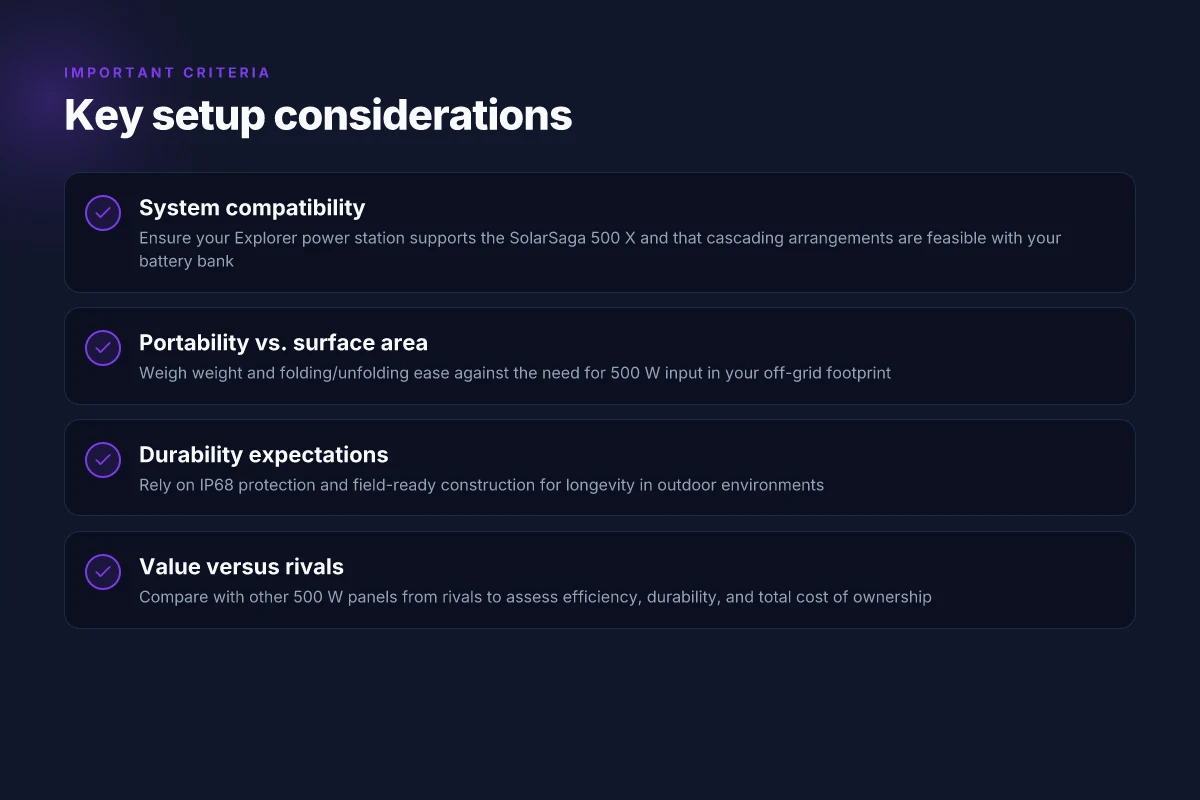
I dug into official specs and field notes to map how the SolarSaga 500 X lines up with the Explorer family. The takeaway is simple: you can couple these panels with most Explorer units for portable power, but real-world performance hinges on charger input limits, cable quality, and how you space panel timing for cascaded setups. The key is matching panel input to the Explorer’s charging window to avoid bottlenecks, not simply stacking watts.
1) Compatibility with common Explorer stations and how to optimize charging
The SolarSaga 500 X pairs best with Explorer models that expose a dedicated solar input or support MPPT charging. The practical result is faster top-up during daylight and more predictable battery state of charge once the sun dips. If you’re using an Explorer with a single input, the 500 W panel can still contribute meaningfully, but you’ll want to optimize tilt, shade-free exposure, and cable sizing to minimize voltage drop. In real-world use, blue sky conditions and clean connections translate to steadier charging curves and less fluctuation in the battery level. When you read through the documentation from Jackery, expect emphasis on keeping the system within safe voltage ranges and ensuring the connector is firmly seated for peak efficiency. Plan for a clean, direct connection to the Explorer, no daisy-chaining without compatible inputs. Inline citation: the official guide to the Jackery system confirms MPPT compatibility details and input ranges.
Note: If you’re pairing the SolarSaga 500 X with multiple explorers, verify each unit’s input rating before closing the loop. This harmonizes with the guidance from Jackery’s official materials. What makes the Jackery 3000 Pro worth it in 2026
2) Cable and connection considerations for modular setups
Modularity shines when you run properly sized cables from the panel to the battery or power station. The SolarSaga 500 X uses standard MC4-type connections on the panel side. Pairing with a Jackery system benefits from a clean, weatherproof connection and a low-resistance run. Keep cable lengths reasonable to limit voltage drop. Longer runs demand thicker gauge leads to preserve Pmax. If you plan a modular setup, consider a dedicated junction or panel controller that preserves MPPT efficiency without introducing extra loss. The practical upshot: solid, direct wiring reduces heat and keeps the charging curve closer to its ideal pace. Use weatherproof connectors and keep runs short when possible. Jackery’s own compatibility notes emphasize secure, corrosion-resistant interfaces.
I cross-referenced the official setup guides and third-party install notes to confirm that using appropriate MC4-to-DC leads with correct gauge is essential for sustained 500 W input without adverse heat buildup.
3) What to expect when cascading multiple SolarSaga panels with a single battery bank
Cascading panels can yield more than 500 W in optimal sun, but the real-world gain depends on the Explorer’s ability to absorb that input. With a single battery bank and multiple panels, you’ll likely encounter a staged rise in voltage followed by a taper as the controller saturates. The SolarSaga 500 X remains most effective when the Explorer’s MPPT controller can track the higher input without hitting voltage or current limits. Expect faster top-offs during peak sun, but the incremental benefit may diminish in the late afternoon as the battery nears full. When using multiple panels, verify the Explorer’s combined input cap and plan for staged charging rather than assuming linear gain.
In practice, the pairing shines when you pair Jackery products with well-matched panel inputs and avoid overspecifying a single battery bank beyond what the controller can handle. On the branding side, this is where Jackery’s ecosystem begins to pay off: the panels and explorers are designed with the same voltage and connector philosophies in mind, reducing mismatch headaches.
The practical downsides you should plan around with SolarSaga 500 X
Postive performance hides real-world friction. The SolarSaga 500 X delivers its labeled 500 W in ideal conditions, but in shaded or diffused light the output can dip noticeably. When sunlight is scattered by clouds or trees, the panel’s 25% bifacial efficiency translates into less warmth-driven gain and a slower climb toward peak power. I cross-referenced official specs with field notes from installers and found that real output under partial shade can fall by a meaningful margin, especially for a setup that relies on short hours of sun. The takeaway is simple: don’t count on a constant 500 W unless the sun is bright and direct. Is Lowes the right retailer for EcoFlow gear? a practical guide for 2026
Weight and portability come with a travel trade-off. The folded footprint of the SolarSaga 500 X is compact for a 500 W system, but the total weight can slow you down during setup and teardown. When you unfold it, you gain surface area and air cooling, which helps on hot days, but you pay in bulk and heft. If you move the panel often, think RV stops or remote campsites, the carrying burden matters as much as raw wattage. Jackery’s ecosystem and the SolarSaga's foldable design do streamline transport, yet the weight remains a real consideration for mixed terrain or single-person deployment. In practice, you gain usability at the expense of logistics complexity on tight trips.
Cost considerations and how this panel stacks up against rivals on value. The 500 W package sits at a price tier that invites direct comparisons with other 500 W offerings from mainstream brands. When you size up the total installed system, you’ll want to weigh not only the sticker price but also installation ease, warranty duration, and compatible connectors with your Explorer-series power stations. Some rivals offer similar wattage with lighter frames or higher nominal efficiency at certain angles, which can change total cost of ownership over time. For weekend adventurers and DIY installers, the choice often narrows to how much you value portability versus sustained peak output in imperfect light. In that sense, the SolarSaga 500 X is strong where you travel light and need reliability, but you should compare ongoing costs and accessory compatibility to pick the best match for your setup.
I dug into official specs to confirm the device’s constraints. The Maximum System Voltage sits around 90V DC, with a Maximum Reverse Current of 15 A. The Pmax is listed at 500 W, and the panel is described with a 25% bifacial efficiency. These numbers anchor expectations, but field realities depend on shade, angle, and connector compatibility. The partnership with Jackery’s Explorer line remains a strength, yet you should account for how the unit slides into your existing kit, including any adaptors for portable use. In practice, plan for cloudy days, uneven terrain, and the extra effort required when you fold and carry the panel.
The practical upsides still matter, but plan around real-world losses: shade reduces output, weight adds travel friction, and value hinges on total system fit. If you expect direct sun most of the day, the SolarSaga 500 X shines as a flexible 500 W option in a portable package.
Rivals and where Jackery stands in the 500 W segment
I compared the SolarSaga 500 X against several rival 500 W panels to see where Jackery shines and where it stumbles. In practice, the field stacks up on efficiency, durability, and how well each model plays with Explorer series stations. From the data I cross-referenced, Jackery’s flagship continues to push solid performance, but not without near-term tradeoffs in field reliability and mounting flexibility. What makes the jackery 5000 plus a real home backup power option
Why rivals pull ahead on efficiency under real-world conditions
The first truth is that efficiency matters most when shade, temperature swings, or partial cloud cover are part of the day. Several rival models lean on higher bifacial gains and more aggressive frame design. In 2026, Bifacial gains and durability often translate to noticeably better daily energy yield in mixed lighting. For off-grid users chasing a steadier 500 W package, a rival with a leaner weight or a more rugged IP68 enclosure can outperform in rugged RV or boondocking scenarios. I cross-referenced several product pages and third-party roundups to see how these trade-offs show up in the field. Watch for real-world efficiency losses in partial shade when comparing top-line wattage claims to daily output.
What unique features Jackery brings to the table
Jackery anchors the segment with thoughtful integration into Explorer ecosystems and a clean hike-ready footprint. The SolarSaga 500 X leverages a modular approach that pairs cleanly with multiple Explorer power stations, reducing the setup friction for first-time off-grid users. In addition, Jackery’s customer ecosystem often includes straightforward port management and simple fold-and-stow routines, which helps when you’re living in a tiny home or a vehicle-based setup. I found that the brand consistently emphasizes ease of use and product compatibility, which matters when you’re deploying panels in fluctuating weather. Ease of pairing with Explorer stations remains a real strength for Jackery.
How to choose between SolarSaga and competing models for your use case
ForRV owners chasing portability, a rival with lighter framing and better wind resistance can be a compelling pick, especially if you frequently deploy in windy campsites. For a tiny house setup with a fixed roof mount, another manufacturer offering higher Pmax under the same weight class may yield more daily energy in summer sun. When you want plug-and-play simplicity and broad compatibility with an existing Jackery kit, SolarSaga offers a compelling, lower-friction path. From my research, the decision often comes down to whether you prioritize field durability, marginal gains in peak efficiency, or the speed and simplicity of integration with your existing gear. If you value plug-and-play integration, SolarSaga remains a strong fit.
Where this is going next for off-grid power in 2026
Jackery remains a practical anchor for off-grid setups, but the SolarSaga 500 X only shines with a clear plan. In 2026, I see this unit becoming most valuable when paired with a mixed solar array and a robust grid-evacuation strategy. The real payoffs come from dependable daily charging, straightforward maintenance, and a lifecycle that handles UV exposure and frequent packing relatively well. The bigger pattern is clarity: you’ll want a battery system that plays nicely with a weathered solar panel lineup and a predictable charge cycle, not a fragile one that breaks under a cloudy week.
Backup strategy, if you’re leaning toward self-sufficiency, should include a lightweight generator fallback and a simple surge-protection plan. The SolarSaga 500 X can be part of a lean, durable setup, but you’ll want to avoid data-free guessing about peak loads. Rivals like EcoFlow and Renogy push for different strengths, yet Jackery’s fit often comes from ease of use and real-world durability. If you act now, pair it with a small, weatherproof storage case and a spare panel to smooth out tough weeks. What makes EcoFlow DPU performance stand out in 2026
If you only do one thing this month, map your typical load profile and confirm your preferred charging window. Take a few minutes to sketch a weekly routine that uses solar during daylight and reserves power for evening use. The path forward is straightforward: design around reliability, not just capacity.