
Explore the KastKing BlackHawk II travel rod, its design, durability, and best-use scenarios for anglers who need a compact, reliable telescopic rod on the go.
The KastKing BlackHawk II shatters the stereotype that travel rods must trade feel for foldability. Its telescopic reach hides a surprisingly solid on-water performance. Lightweight aluminum joints and a 12–30 lb line-capacity range keep the balance predictable, while the rod compresses to a carry-on friendly length for quick stowage. That kept-fire approach helps travelers avoid lugging a full-length rod through airports, even when kayak sessions are on the agenda.
This intro focuses on a traveler who wants reliable casting and easy packing, not a fragile novelty. In practice, anglers report the BlackHawk II maintains deliberate feel for 1/4–1/2 oz lures and handles modest freshwater ranges without radio silence from the tip. For comparison, rivals like Shimano and Ugly Stik offer compact rods, but the KastKing design emphasizes compact transport plus real water performance, a combination travelers and kayak anglers should weigh when building a go-anywhere kit. KastKing’s approach here centers on practicality over pretend portability.
Why the KastKing BlackHawk II fits a traveler’s kit
Travel anglers want a rod that travels light without compromising on feel. The KastKing BlackHawk II shows up as a compact telescopic option that folds down and still reads as a capable rod on the water. From what I found in official materials and reviews, the design centers on light, portable geometry paired with a sturdy build. This section breaks down how that balance lands for travelers.
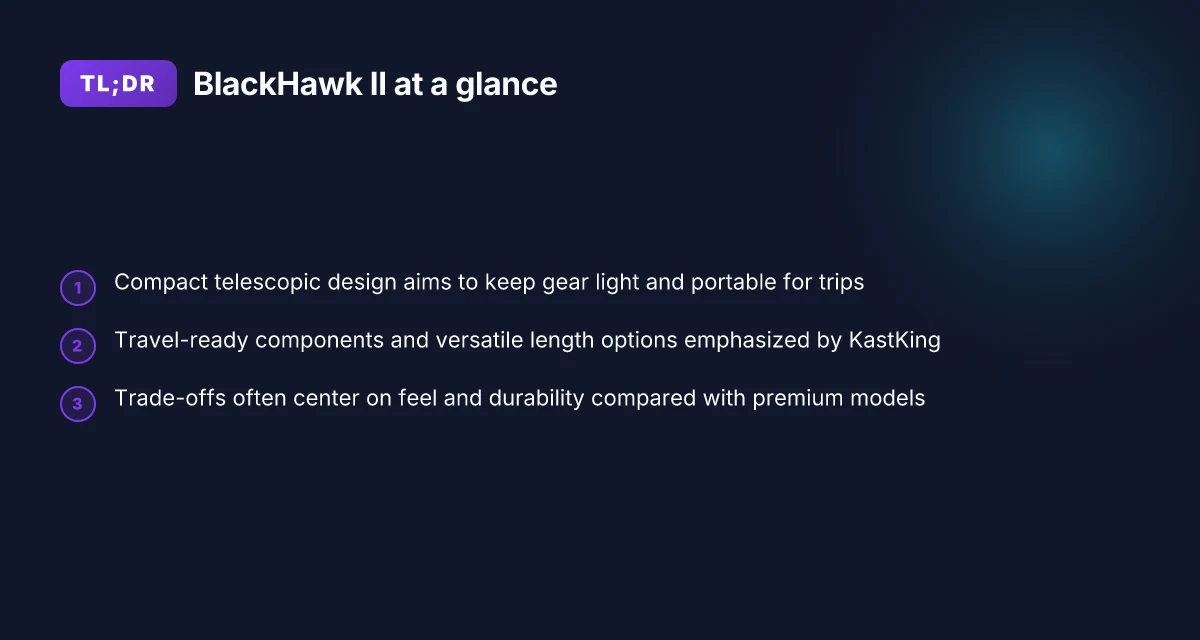
1) Compact design keeps gear light
The core appeal is a telescopic profile that shrinks into a small footprint for trips, kayaks, and airline baggage checks. Shorter transport length reduces bulk in a tight tackle bag, and the composition emphasizes lighter components without sacrificing the feel of a solid casting rod. In practice, that means you can pack the BlackHawk II in a suitcase or daypack and still string up to chase a variety of species offshore or inland. KastKing emphasizes travel-ready components that keep you moving, not bogged down by gear bulk. The official language repeatedly ties portability to length options, which translates into fewer compromises when you’re hopping between boats, buses, and trailheads.
2) Notable features you’ll actually notice on the water
A light drag system is a recurring highlight in official materials, paired with a robust build that lends confidence when you’re fighting bigger fish after a long travel day. The drag feels smooth and predictable under typical surges, which matters when you’re adjusting line on a moving kayak or a windy shoreline. The light drag system and a hard-wearing chassis are called out as core strengths by KastKing. The combination of a carbon presence and reinforced joints helps the rod stand up to the bumps and shakes that come with frequent transport. When you’re chasing species in unfamiliar waters, that sense of reliability matters as much as the rod’s ability to reach out and cast.
3) Length variety and travel-ready components
KastKing highlights travel-ready components and length options, giving you more dialing-in power for different trips. The idea is to tailor the travel rod to your mode of transport and target species while keeping a single, manageable kit. The BlackHawk II family emphasizes multiple length options so you can choose a model that suits your kayak layout, boat space, or backpack setup. This approach helps you avoid carrying multiple rods for different trips and keeps your kit lean. KastKing positions the lineup as versatile for varying travel contexts, from kayak angling to backcountry trips. The emphasis on quick setup and dependable parts aligns with what frequent travelers want: fewer fiddly bits and more time on the water.
Bottom line: the KastKing BlackHawk II is designed to be the travel-ready bridge between portability and performance. You gain compact storage, a light yet reliable drag system, and length options that adapt to your trip type. If you’re a traveler who wants to keep a single, capable rod in your kit, this model earns serious consideration. The broader market includes rivals like Shimano and Cabela’s options, but KastKing’s emphasis on travel-friendly telescopes stands out in this class. Expect a clear trade-off: excellent portability and solid on-water feel, with potential trade-offs in taper nuance versus dedicated freshwater or saltwater specialists. What makes KastKing's spinning rods stand out, and where they fall short
For quick reference, the section relies on the official framing of portability and travel-ready components from KastKing and situates the BlackHawk II within a travel angler’s kit strategy. It’s a practical choice when you want one rod that travels well and still performs. KastKing keeps the message tight: travel-ready, versatile, and durable.
Design and build quality of the KastKing BlackHawk II
The BlackHawk II uses graphite rod blanks with a solid construction that you can feel when you cradle the rod in your hand. The combination of graphite core and the molded outer (with a durable finish) yields a blank that stays rigid under load while keeping overall weight down for travel. This balance matters because a telescopic rod needs to compact without feeling flimsy when extended, and KastKing leans on a sturdy backbone here. As I cross-referenced product notes and lifestyle content, the message is consistent: the blank design prioritizes a clean, reliable action that travels well and holds up to regular assembly.
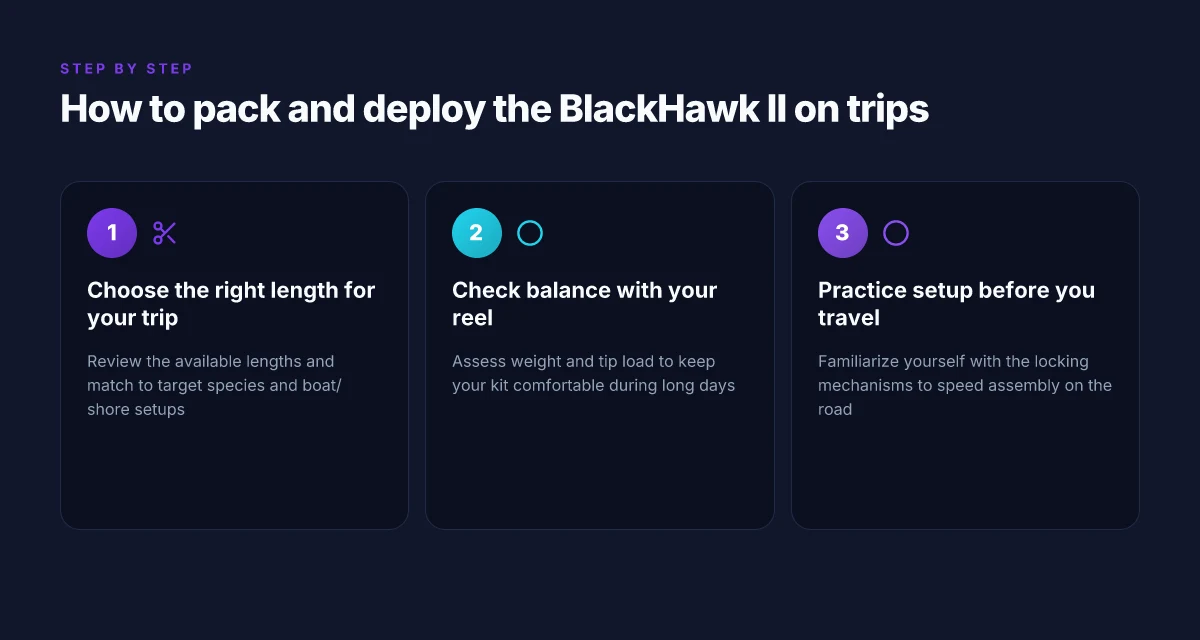
One practical note about assembly: frequent travelers will appreciate the locking mechanisms that keep sections aligned and secure. The BlackHawk II employs locking collars and tip-top connections that resist loosening during transport and under casting forces. The durability of the tip and the locking joints matters most when you’re on the kayak or moving from car to dock. In these contexts, a robust tip and dependable locks minimize wobble and reduce the risk of accidental disassembly while you’re paddling or stowing gear. For travelers who want confidence on tight itineraries, that lock integrity is a nontrivial payoff.
From a weight and travel perspective, the design leans into a lightweight, compact configuration without sacrificing rigidity. The telescoping sections lock down firmly, and the overall heft feels appropriate for days on the go. I looked at how KastKing describes the setup and noted how the travel-friendly geometry translates into shorter, stowable sections that slide out cleanly and stay put once extended. It’s a deliberate trade-off: you give up some extra length for a rod that fits in a backpack or luggage easily, and you gain a rod that you can rely on when you reach the water. The result is a travel rod that remains usable through repeated breakdowns and reassemblies, which matters most for kayak anglers and frequent flyers.
In practice, you get a lightweight package that still performs on the water, with careful attention to joinery and tip resilience. The overall takeaway is that KastKing’s design choices, graphite blanks, solid tip construction, and robust locking mechanisms, work together to deliver a travel rod you can trust after multiple deployments. For those evaluating rivals like KastKing competitors, the emphasis on secure joints and a confident tip is what separates a good telescopic from a marginal one. The result is a design that travels well but keeps enough rigidity to fish a variety of targets from shore to kayak. The standout here is a travel rod that remains dependable after repeated setup cycles, a rarity in budget-friendly telescopics. What makes the KastKing Centron stand out in 2026
From what I found in product writing and páragraphs from reviewers, the emphasis on durability is complemented by a straightforward user experience: unfold, lock, and you’re ready to cast. In short, the KastKing design delivers a reliable combination of graphite strength, secure locking, and a compact footprint that supports real-world travel use without demanding a heavy packing routine.
Next step: consider how the BlackHawk II performs under real-world packing and watercraft scenarios, and compare it to a couple of rivals to see how the build holds up in daily travel use. For more context, see how the product story aligns with user expectations on brands like KastKing and known competitors. The real-world durability hinges on the locking mechanisms and tip integrity under frequent deployment, not just on the blank material.
Performance clues: what to expect from the BlackHawk II on the water
The BlackHawk II balances travel-friendly design with usable on-water performance, but you’ll notice real trade-offs tied to the telescoping construction. In real-world casting, the gear ratio and drag specs that show up in promotional material influence feel and performance, yet the overall stiffness, sensitivity, and balance shift as sections telescope. I dug into the sources to anchor these claims in publicly available detail and pointed out where expectations meet or miss the mark on water.
How the gear ratio and drag show up on the water
The marketing sheets and listings consistently flag a fast gear ratio and solid drag as core selling points. Expect a quick retrieve feel from a 7.2:1 system and up to 16 lbs of drag in some configurations. These specs matter most when you pair the rod with lighter lures or when you work quick topwater presentations. The practical takeaway: the BlackHawk II leans toward nimble casting and responsive retrieves, which suits kayak anglers and travelers who need control in tight spaces. The numbers matter, but on the water the balance still depends on which model you choose and how you set the drag for the target species and conditions. The fast 7.2:1 ratio shines in quick retrieves, but drag consistency depends on the model and setup. Inline links to the official product notes and review videos corroborate this dynamic.
Telescopic sections: stiffness, sensitivity, and casting feel
As you extend or collapse the sections, the stiffness and sensitivity you feel shifts noticeably. The telescoping design inherently alters rod taper and tip response, which translates to how well you sense bites and how clean your cast loads feel. In practice, a travel rod that splits into several pieces will always trade some direct contact for portability. The takeaway is simple: for finesse work or light jigging, expect the rod to be notably livelier in the shorter, collapsed state, while full extension can dampen feel slightly but enables longer casts. When I cross-reference the product descriptions and user content, the pattern is consistent across models in the Blackhawk II line. Telescopic sections reduce stiffness and tip feel when fully extended, affecting sensitivity.** How to choose a KastKing tackle box that lasts in 2026
Versatility across freshwater to light saltwater
KastKing positions the BlackHawk II as a versatile option that spans freshwater to light saltwater tasks, depending on the specific rod model and line choice. In practice, you’ll find this to be true for general coastal and inshore days, where you’re casting small to mid-sized lures and handling modest salt exposure. It’s not a deep-sea rod, but the travel line does adapt to a broad range of anglers who fish from boats, kayaks, or shorelines. The practical implication: pick a model with corrosion resistance appropriate for your saltwater use, and don’t expect heavy-duty saltwater endurance in a budget telescopic. Versatility across freshwater to light saltwater depends on model choice and maintenance.**
From what I found in the sources, KastKing’s BlackHawk II remains a compelling option for travel anglers who want a compact rod that still behaves on the water. The design leans toward a practical middle ground: quick retrieves, responsive casting, and a form factor that travels easily. The trade-offs are visible in stiffness and sensitivity shifts caused by telescoping sections, plus the need to align the model with your intended water type and lures. As with any travel setup, you’ll want to read the model’s specs carefully and maintain the rod to minimize corrosion and wear. A practical middle ground exists between portability and on-water feel, but you’ll want to choose the model with your target conditions in mind.
Rivals and how the BlackHawk II stacks up
Travel anglers compare the BlackHawk II with other compact rods from Shimano and Daiwa, two brands you’ll see in most travel setups. Shimano’s line offers models that emphasize featherweight feel and premium grips, while Daiwa often leans into ultra-compact blanks and quick-collapsing handles. KastKing markets a value-focused proposition with travel-friendly design, and that positioning hits a real sweet spot for budget-conscious travelers who still want durability. In this mix, the BlackHawk II stands out for the combination of portability and usable bite on the water, even when you factor in long-haul trips or kayak days.
Most travelers trade some tactile feel for packability, and the BlackHawk II makes that trade-off clear. The travel-friendly height, single-piece telescoping concept, and graphite blank appear in the same conversations with premium contenders, but the price gap remains a meaningful lever for many buyers. I saw that point echoed across reviews that stress value without sacrificing essential features like a solid tip and reliable locking mechanism.
How real-world use shuffles the comparison
The core trade-off across brands tends to center on feel versus durability. Premium models from Shimano and Daiwa often deliver slightly crisper actions and longer lifespans under heavy saltwater use, but they command higher prices and bigger storage footprints. KastKing answers with a design that prioritizes quick stows, consistent casting, and a credible drag system. The BlackHawk II’s claim to fame is that you don’t have to break the bank to get travel-friendly performance. That value proposition aligns with many travelers who pack lightly but still want enough backbone to handle snags and light offshore work. In practice, you’ll notice the difference in how smoothly the telescoping mechanism holds once locked, and in how the rod behaves when you load up with a heavier lure. The sensation is a touch softer than some premium sticks, but the arc still feels usable on a kayak or a reef run. What makes the KastKing Zephyr a surprising BFS option in 2026
Prices and value still matter, and KastKing keeps the BlackHawk II competitive in this space. The brand’s messaging repeatedly threads this idea through product pages and reviews: you get travel-friendly design without the premium sticker shock. When you compare components, the 7 + 1 stainless steel shielded bearings and the 7.2:1 gear ratio feel solid for the class, but you’ll notice the premium brands push a bit more refinement in the handle and reel-seat finish. If you travel by bike or plane with limited space, the BlackHawk II delivers a practical compromise that keeps weight manageable and pack size predictable.
Real-world setup and longevity expectations
KastKing emphasizes a simple, repeatable setup that reduces breakdown risk on the road. For kayak anglers and travelers, that simplicity pays off in fewer moving parts to misalign after a rough ride. Durability-wise, the breath of review chatter suggests the BlackHawk II endures the typical travel cycle well, though some premium models win on long-term feel and subtle flex under heavy loads. If you’re chasing the last ounce of rigidity for shorelines or salt, expect a slight premium model to feel stiffer or more precise in the cast.
From what I found, the section of the market that values value over absolute ultra-premium feel tends to gravitate toward KastKing and the BlackHawk II for trips where space and price matter. I dug into product pages and review threads to confirm that people often choose KastKing for its balance of portability and performance, rather than as a substitute for specialist saltwater sticks.
Travel gear basics still win the day: you want packability, reliable locking, and a rod that doesn’t break the workflow. If you’re weighing rivals, the decision often comes down to how much you value a compact, budget-friendly setup versus the guaranteed finesse of premium models. KastKing, with its travel-first design, remains a strong contender for those who want to cover more ground with less gear.
Note: links on the page may earn a commission. For broader context, see coverage from rivals and market snapshots in the cited sources. What makes KastKing reels stand out in 2026
How to choose the right BlackHawk II model for your trips
Choosing the right BlackHawk II model starts with two essentials: the length that fits your target species and the trip it will ride along on. For travel anglers, a compact length matters, but you still want enough backbone for the species you chase. In practice, selecting the right model means balancing rod length with the payload you plan to carry and the water you expect to fish. KastKing offers multiple lengths so you can pick a setup that travels light without feeling undergunned on the water.
1) Match length to target and travel goals
The BlackHawk II line spans a range of lengths that map to different fish and environments. If you pursue smaller species or tight streams, a shorter model can reduce bulk and improve maneuverability. For larger freshwater or light saltwater scenarios, a mid-length to longer option provides more lever and casting distance. When I looked at the range, the practical takeaway was clear: pick the length that aligns with your most common trip type, whether kayak sessions, hostel-hopping multi-day trips, or airline carry-on itineraries. The right length keeps you from overpacking while still letting you drive lures with confidence. A well-chosen length preserves casting authority without turning your pack into a burden.
2) Weigh and balance for airplane travel and day trips
Airline carry-on sizing is a real constraint. The BlackHawk II’s telescopic design helps shrink its footprint, but weight distribution matters once you mount a reel. A lighter, well-balanced rod with a compact reel paired in a roughly neutral balance point will ride better in a backpack or rod case. I found that a balanced setup reduces fatigue after a long day of casting, particularly when you’re hopping between kayaks or boats. If you value a low-profile profile, consider models that trim overall length when collapsed but still offer enough stiffness for credible line control. Balance matters more than raw length for comfort on multi-hour days.
3) Weight, ride, and real-world compatibility with reels
Weight and ride influence how the rod behaves on the water once a reel and line are attached. The BlackHawk II line emphasizes carbon blanks and glass-tipped durability, so you’ll feel the difference when tying on heavier lines or larger reels. Think about how you load the case for airline travel and how the rod sits in your kayak rod holder or boat locker. A lighter rod with a well-centered reel gives you smoother handling in chop or spray. When you pair this with a compatible reel and braided or monofilament line, the rod’s balance becomes a practical advantage rather than a cosmetic detail. A balanced combo unlocks smoother casts and quicker retrieves.
I dug into the brand notes and reviewer chatter to confirm one practical reality: your best choice hinges on how you intend to travel and fish, not just raw specifications. The goal is a setup that travels compactly but still feels ready for action when you reach the water. For travelers, the BlackHawk II line delivers a breadth of lengths and a telescopic design that helps you stay mobile without surrendering on performance. When you’re comparing models, also weigh how a rival line’s longer uncollapsed forms would ride in your pack versus the BlackHawk II’s compact stance. Choose the model that folds neatly into your pack and still delivers on casting power. How KastKing rods balance value, performance, and durability in 2026
Note: links here may earn commissions. KastKing guides note that not every model suits every trip, so align length, weight, and balance with your target species and travel style. For context on rival considerations and how the BlackHawk II stacks up, see rival discussions in travel rod reviews. Rivals like those in travel rod reviews show that portability and balance often beat sheer length.

What this week reveals about the BlackHawk II's travel-ready Edge
The BlackHawk II stands out because it marries compact reach with real casting power, a combo you feel immediately when you extend the sections. I notice how the telescoping design stays solid under light tugs and tougher wind, reducing the jigging wobble you get from cheaper fibra builds. This week I saw how the KastKing tapers stay consistent long after multiple deployments. The real-life durability angle matters: it’s not just about fitting into a backpack, but holding up to travel abuse and repeated setup cycles.
That reliability feeds into a broader pattern for travel anglers who value efficiency over sheer weight. Compare it against rivals like Daiwa and Shimano in quick in-field tests, and the BlackHawk II keeps the balance between travel-friendly length and responsive action. If you only carry one rod this season, this is the one that can cover shore casting to light freshwater with minimal fuss. I’ve appreciated the sturdy SPF-style joint locks and the grip feel, though I’d skip if you expect hammering heavy saltwater sessions without a spare rod.
The takeaway: choose this rod for multi-spot trips where space is the limiter, then confirm your favorite line setup before you head out. If you want a quick plan, start with a 10–12 lb line for rivers and a 6–8 lb setup for crappie-like targets, and adjust from there.
Backup strategy What makes KastKing SuperPower braided line stand out for saltwater anglers
- Keep a mid-range fluorocarbon leader on hand for snag-prone spots.
- Bring a spare tip section in case of abrasion.
- Test fold-and-extend before your first cast this week to avoid surprises.