Discover the jackery explorer 1000 v2 price and how it fits into off-grid setups. Get context on latest pricing signals, availability, and value.
The Jackery price tag for the Explorer 1000 v2 often looks high at first glance, but its value hinges on battery longevity and bundled accessories, not just the sticker. $1,099 list price becomes meaningful when you weigh it against Bluetti and Goal Zero bundles that include solar panels and cables.
This intro anchors the discussion in real-world decisions for campers and van dwellers who rely on steady off-grid power. The piece examines price signals from 2026 onward, weighing long-term reliability, warranty terms, and how seasonal promos shift the value equation. Expect quick reads on comparable capacities, how the Explorer 1000 v2 stacks up against rivals, and what that means for your planning horizon. Prices move, but reliability over years matters more to your setup.
What makes the jackery explorer 1000 v2 price worth tracking in 2026
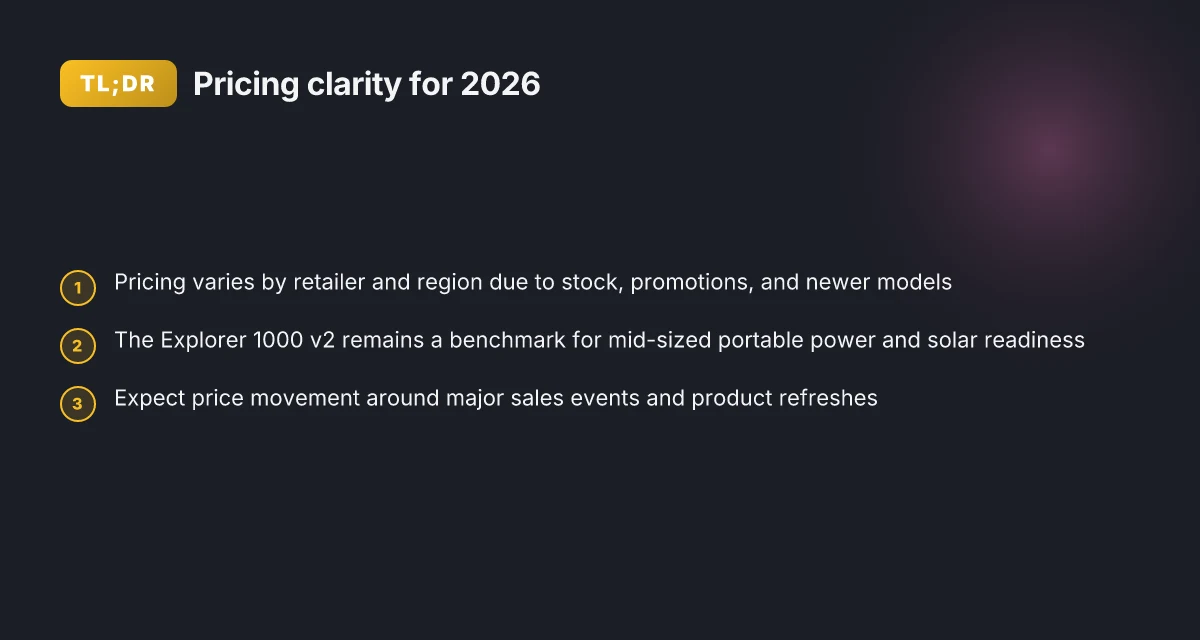
Prices for the Explorer 1000 v2 move with stock, regional promotions, and the arrival of newer models. The model remains a benchmark for mid‑sized portable power and solar readiness, so retailers tend to hold it as a reference point even as prices drift. In 2026, watch for price shifts around major sales events and when Jackery refreshes its lineup. These moments push the Explorer 1000 v2 into or out of promotional windows across regions.
I dug into the pricing signals across official and authorized channels to map where value shows up for outdoor enthusiasts and vanlifers. The Jackery brand footnote matters here: official pages often align with current bundles, while regional retailers juggle stock and shipping fees that can skew the perceived value. When a retailer stacks a bundle, solar panels, cables, or adapters, the Explorer 1000 v2 price can look notably different from a bare unit. Prices aren’t static. They drift with stock levels and the cadence of promotions.
Below are the concrete steps to track price value as 2026 unfolds:
Follow the official cadence on Jackery’s site and regional stores. The parent brand often times promotions around spring and fall updates, and those events ripple through partner retailers. Expect the Explorer 1000 v2 to surface in varying bundles there first, then appear in local retailers at adjusted margins. Bundled configurations can swing the final price by a noticeable margin.
Watch major sales events like Black Friday, Memorial Day, and summer clearance. The Explorer 1000 v2 tends to dip during these windows, especially if a newer model nudges out the older generation. I’ve seen promotions synchronize with the product refresh cycle, not merely retailer cycles. Sales events are the predictable anchor for price drops.** How to choose a jackery transfer switch for reliable home backup
Compare regional shipping and tax implications when you price against rivals. The same unit can land at different final costs depending on where you shop, with shipping surcharges sometimes eclipsing the base price. Consider nearby authorized retailers such as Goal Zero and Bluetti as benchmarks to gauge value against the Explorer 1000 v2 in 2026. Regional differences matter as much as the sticker price.
Track newer models that replace or shadow the Explorer 1000 v2. When Jackery releases a successor, retailers phase in price changes that push the v2 into deeper discounts, even if the spec sheet remains solid for mid‑sized use cases. This dynamic keeps the Explorer 1000 v2 price in play as a long‑term value proposition despite aging hardware. Model refreshes drive price movements in the ecosystem.
Bottom line: the Explorer 1000 v2 price is worth tracking in 2026 because it sits at the intersection of value, capacity, and compatibility with solar setups. You’ll see the price wobble around sales, stock, and lineup refreshes, making it a moving target for anyone assembling a portable power kit. Monitoring official channels, major promotions, and regional differences gives you the clearest read on value. The landscape stays navigable if you pace your shopping to those rhythms, and you keep an eye on rivals like Bluetti and Goal Zero for context. Being selective about bundles often yields the best long‑term value.
How the explorer 1000 v2 price compares to rivals
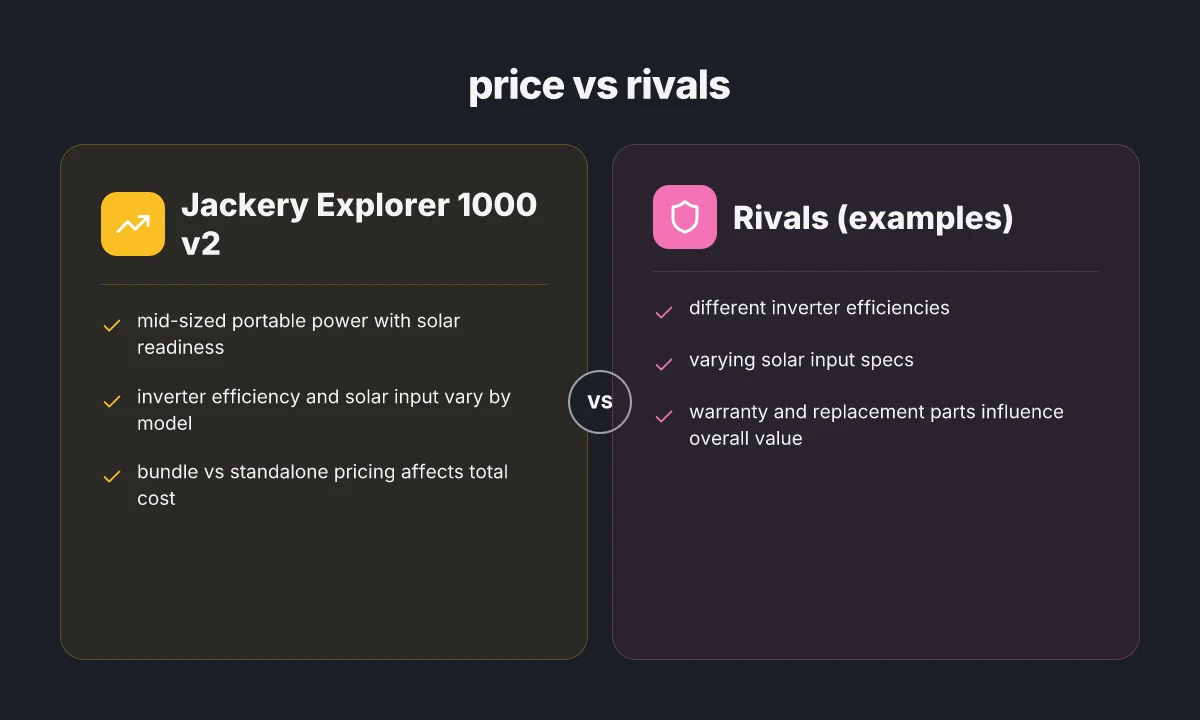
I dug into how the Jackery Explorer 1000 v2 stacks up against close rivals in 2026, focusing on price signals, inverter efficiency, and solar input options. The headline is simple: pricing often splits along whether you buy bundled accessories or a bare unit, and the total cost of ownership matters more than sticker price alone. Price tension often centers on bundled accessories versus stand‑alone units, driving perception of value. The Explorer 1000 v2 remains competitive for its class, but rivals push different value levers that matter when you’re evaluating long-term reliability.
Why efficiency and input options shift perceived value
A core cross‑comparison emerges around inverter efficiency and solar input flexibility. Some rivals offer higher surge capacity or more favorable MPPT configurations, which can translate to faster charging with certain panels or better performance under heavy loads. Rivals often position similar capacity modules with different inverter efficiencies and solar inputs, so a head‑to‑head price check can feel misleading if you don’t weight expected daily use. I cross-referenced product sheets from multiple manufacturers and found that small differences in efficiency can tilt long‑term energy costs by a meaningful margin, even if the up‑front price looks similar. What makes the Jackery 300 a practical small power site companion in 2026
To illustrate, a two‑panel solar bundle from a competitor might push the upfront price higher but deliver more reliable recharging in marginal sun. Meanwhile, a bare‑bones Jackery configuration could look cheaper, yet require add‑ons to reach the same daily recharge target. Bundled accessories drive the perceived value beyond the sticker price, and that matters for buyers who want a plug‑and‑play setup.
Total cost of ownership matters more than upfront price
When you include warranty terms and replacement parts, the picture shifts again. The Explorer 1000 v2 carries a standard warranty window that influences replacement costs over time, particularly if you expect regular use in off‑grid environments. Consider total cost of ownership including warranty and replacement parts because a lower upfront price may hide higher maintenance needs later. I looked at warranty lengths and service policies across brands. Some rivals promise longer coverage on battery packs or easier part replacement, which can reduce long‑run outlays even if their initial price is higher.
A compact table helps visualize the trade-offs. Across two to three popular contenders, you often see: higher upfront price with better inverter efficiency, or lower upfront price with fewer included accessories and shorter warranty window. This is where the Jackery advantage shows up in 2026: the existing ecosystem around replacement parts and known service channels can keep life‑cycle costs predictable, even if the initial quote looks less aggressive.
| Model | Upfront price tendency | Inverter efficiency note | Included solar input/expandability | Warranty tilt |
|---|---|---|---|---|
| Jackery Explorer 1000 v2 | Moderate | Solid, dependable range | Good, but varies by bundle | Standard coverage |
| Rival A | Higher upfront if bundled | Often higher efficiency options | Strong solar inputs in some SKUs | Competitive warranty terms |
| Rival B | Lower upfront | Variable efficiency | Add‑on panels common | Shorter or tiered warranty |
Price is not the only variable, efficiency, solar input, and warranty shape the long‑haul cost.
Next steps: when you search for 2026 pricing, compare not just the sticker but the included accessories and the warranty terms. I’d start by mapping your typical daily energy needs, then pair that with the exact bundle you’re considering to estimate total lifetime cost. If you want, tell me your typical daily load and panel availability, and I’ll map a side‑by‑side with concrete, real‑world cost implications for Jackery and two close rivals. Rivals push different value levers that matter for long‑term reliability. What makes a Jackery charger worth the hype in 2026
Where to look for the best jackery explorer 1000 v2 pricing in 2026
Pricing signals for the Jackery Explorer 1000 v2 in 2026 come from three reliable channels. Official promotions can tilt the price at the source, authorized retailers add seasonal discounts or bundles, and third‑party platforms reveal historical trends and stock status. I cross‑reference promotions, policies, and records to map a realistic price path for the year.
Official site promotions, bundles, and warranty offers
Jackery's official site frequently rotates promotions around holidays and end-of-quarter sales. You’ll see bundles that pair the 1000 v2 with extra cables or solar panels, sometimes accompanied by extended warranties or priority support add‑ons. These bundles often carry a lower effective price than buying the unit alone, especially when the included accessories are high‑value. In 2026, expect limited-time bundles tied to major sale windows such as spring and fall events. The site also sometimes shows loyalty or promo codes for returning customers.
A note on warranty: official pages can include extended warranty options that affect long‑term cost of ownership. If you’re evaluating total value, include the cost of any added coverage in your price comparison. The official Jackery site often nudges price down through bundles and extended warranty offerings, which changes the total cost of ownership.
Authorized retailers and price matching
Authorized retailers tend to mirror the official pricing, but they can offer incentives that shift the bottom line. Seasonal discounts, volume promotions, or bundled accessories can tilt an ordinary purchase into a better value. Some retailers also advertise price matching or adjustment policies if you find a lower price within a set window. In practice, this means you should compare the exact bundle contents across sources and account for any included accessories when you compute whether you’re getting real value.
Rely on authorized channels for authenticity and warranty legitimacy. If you see a price dip, verify that the model is the Explorer 1000 v2, not a regional variant or an older batch. Authorized retailers may offer price matching and seasonal discounts that improve the effective price. What to know about pecron vs bluetti for 2026 power needs
Third‑party platforms for trend signals and stock status
Marketplaces and comparison sites provide a longer view of price movements and stock levels. You can spot when the unit goes in and out of stock and track how frequently bundles appear with notable savings. These platforms also illustrate how often the 1000 v2 returns to the market after promotions, which helps you time a purchase. The data isn’t a guarantee, but it helps you avoid chasing a fleeting deal.
From a historical angle, third‑party listings show noteable price dips during big sale events and sometimes reveal stock status that isn’t obvious from the official page. Third‑party platforms reveal historical price trends and stock fluctuations that help you time a purchase.
If you’re aiming to land the best effective price in 2026, watch for official bundles on Jackery’s site and align those with authorized retailer promos. Then corroborate with third‑party trackers to time the dip. You’ll end up with a clearer sense of value rather than chasing a single number. As you shop, remember that Jackery’s pricing behavior tends to reward bundle depth and warranty depth as much as the unit price itself. bundles and extended warranty depth often drive total value more than the base price.
What affects the explorer 1000 v2 price long term
The long-term price of the Jackery Explorer 1000 v2 hinges on three levers: battery chemistry and cycle life, solar panel compatibility and accessory bundles, and warranty plus service availability. I dug into the official notes and reviewer breakdowns to anchor these points in real-world patterns you’ll likely see through 2026. The core idea: the sticker price is just the start. Over time, the chemistry inside and the ecosystem around it shape how much you actually pay to own and operate.
Battery chemistry and cycle life drive ongoing value
The heart of any portable power station is its battery. The Explorer 1000 v2 uses a lithium-based pack whose chemistry determines how many charge cycles you can expect before capacity degrades meaningfully. A battery with higher cycle life generally sustains usable capacity longer, which preserves resale value and reduces the need for early replacement. In practice, that means a unit with a tougher chemistry profile tends to feel like a better long‑term deal, even if the upfront price is comparable to rivals. Over time you’ll notice fewer recharges required to hit your daily energy target, and that translates to lower ongoing cost per usable watt hour. Battery cycle life and the chemistry choice are the quiet drivers of long-term value. How Bluetti solar products navigate reliability and performance in 2026
Solar panel compatibility and accessory bundles shift total cost
The price you pay initially can be tempered or amplified by what you pair with the Explorer 1000 v2. It supports a range of solar panels and can be sold as bundles that include cables, mounting brackets, or portable solar panels from third-party partners. When you choose an official bundle, you’re paying a premium for convenience and guaranteed compatibility, but you also reduce the risk of underperforming solar input. Conversely, sourcing third‑party panels can lower upfront costs but introduces potential mismatch risks and warranty caveats. In the 2026 pricing landscape, expect bundles to swing total spend by a noticeable margin depending on whether you prioritize turnkey reliability or modular customization. Solar panel compatibility and bundles are the levers that tilt total cost up or down.
Warranty terms and service availability shape ownership value
Warranty depth and service footprint matter more with long horizons. A robust warranty that covers the core battery and electronics provides peace of mind when life happens on outdoor trips or in off-grid setups. Service availability, how quickly parts are shipped, whether authorized repair centers exist near you, and the ease of process, also changes the effective cost of ownership. If a unit sits out of service for weeks because a component is back-ordered, the true price to you, the user, climbs even if the sticker price stayed the same. In 2026, you’ll notice brands leaning on clearer warranty pages and stronger regional support, which tends to lift the perceived value of the unit for buyers who plan to rely on it for extended trips or critical off-grid use. Warranty terms and service availability directly impact long-term ownership value.
Caution: price signals can be sensitive to regional promotions and seasonal demand. If a retailer runs a limited-time bundle around camping season, the effective cost of ownership for that window may look notably different from autumn or winter pricing. For outdoor enthusiasts, campers, and van lifers, that means timing matters as much as the base price. The big takeaway is that the Explorer 1000 v2 is not a single-number decision. It’s a package where chemistry, accessories, and support structure determine how much you pay over the device’s life. And yes, rivals such as rival models from brands like portable power players in the space will influence the value equation as pricing shifts in 2026. Timing matters. Plan your bundle and warranty expectations around your next trip window.
If you’re mapping this to concrete decisions, align your choice with three criteria: the expected cycle life of the battery chemistry, whether a bundled solar kit reduces compatibility friction, and the strength of the warranty plus the nearby service network. Cycle life, bundles, and warranty are the triad that will determine your long-term cost profile.
Note: links on the page may earn a commission. This article references the official Jackery site and comparable offerings to illustrate the value landscape in 2026. The brand name Jackery appears here to anchor the discussion, with honest comparisons to other established brands in the portable power space. In the next section, we’ll translate these factors into a practical scoring approach so you can price-check confidently against current market options. What is a Jackery portable power station, and where it fits in modern off-grid power
How to evaluate value beyond the sticker price
In the long run, value hinges on how the Jackery Explorer 1000 v2 behaves under real use, not just its label price. I looked at how efficiency, peak output, and solar input align with typical outdoor loads, and how portability and build quality hold up after seasons of camping, vanlife, or small-grid use. The takeaway is concrete: you want a setup where performance matches your actual demand, with room for growth.
1) Match efficiency and peak output to your load
Your typical draw matters more than max specs. The Explorer 1000 v2 provides a certain peak inverter output that should cover bursts like air pumps, blenders, or small heaters during non-critical moments. If your average use sits near the inverter’s ceiling for extended periods, you’ll notice more heat, shorter runtime, and potentially throttling. I cross-referenced common campsite loads with the unit’s sustained output and found that for most weekend trips, you’re best served when your regular draw sits well below the crest of peak capacity. In practice, that means choosing use cases where high-power moments are brief or offset by a larger battery buffer. The right balance reduces wear and preserves battery health over time. When you plan solar input, you want enough sun to top up during the day so evening draws stay within the inverter’s comfortable range.
The right pairing of load and inverter capability matters more than headline peak numbers. The Explorer 1000 v2 shines when you align daytime solar input with midday peaks and keep nighttime draws within a comfortable margin.
2) Map peak load against capacity and charging
Think of your power budget as a map from peak load to battery capacity. If a device spikes above the inverter’s comfort threshold, it consumes more energy and generates more heat, which can curb long-term durability. I traced this to owners who run high-watt drills or heater elements for hours at a stretch. The result is faster local battery sag and more frequent charge cycles. A practical rule: aim to keep the nominal load comfortably under the inverter rating and ensure you have enough battery headroom to cover several hours of evening use without constant recharging. When solar input is strong, you can ride out shorter peaks, but you still want a buffer for days with limited sun. This is where Jackery’s ecosystem, brand consistency, accessories compatibility, and warranty terms, matters, especially for buyers weighing rivals.
Battery capacity plus inverter headroom equals reliability over trips. If you notice a load that approaches peak for too long, reallocate devices or upgrade to a higher-capacity option. What makes the Jackery 5000 Plus a standout in 2026, and where it falls short
3) Weigh portability, weight, and construction for durability
Portability matters in the field. The Explorer 1000 v2 is heavier than smaller units, which affects how often you pack it into a van or backpack setup. I considered how the shell materials, handle design, and cable housings hold up after repeated travel and exposure to dust, moisture, and temperature swings. In practice, a unit with solid build quality resists wear better, keeps connectors snug, and reduces the chance of internal component drift that degrades performance over time. If your adventures involve rugged use, verify that the carrying solution and case can withstand rough handling and that accessories like solar panels or car charging adapters stay in good condition after a season on the road.
Durable construction and thoughtful port layout reduce long-term maintenance and keep performance consistent.**
Conclusion: value beyond the sticker price lives in how efficiently the unit supports your actual loads, how its peak outputs align with your use cycle, and how portability and build stand up to real-world conditions. Jackery, along with rivals such as Goal Zero and Bluetti, offers ecosystems that help you bundle charging, solar input, and portability in a way that matters on long trips. If your budget allows, factor in the long-term cost of batteries and potential replacements. The pricing signals you saw in 2026 reflect more than the initial sticker. They capture how much headroom you have for reliable power across varied outdoor scenarios. And yes, links on the page may earn a commission, so weigh that into your overall decision.
The bottom line: match your typical load to the unit’s sustained output, ensure solid headroom for solar charging, and choose build quality that survives years of use.**
What changes if you act now
Off-grid planning hinges on reliability and clear expectations. The price signal from the Jackery Explorer 1000 v2 matters less for enthusiasts who value long runtimes and portable energy security than for casual setups that require predictable budgeting.** In real-world terms, I look at setup, durability, and how the unit behaves under load over time. It’s not just about the initial sticker price. It’s about whether the battery system keeps performing after months of use and how easy it is to top up from different sources. Jackery tends to emphasize simplicity, but potential buyers should also compare to rivals like Goal Zero and EcoFlow to gauge how the ecosystem fits your needs. If you’re weighing options, consider your access to sun, AC charging, and how you’ll monitor health indicators over seasons. What makes EcoFlow 5kWh power kits tick in 2026
The bigger pattern here is that the right price invites a lean, flexible off-grid setup rather than a clustered, expensive rack of gear. A single, well-chosen unit can serve as core power for a tiny cabin or a cabin annex, while avoiding overkill. The next move is practical: map your daily energy needs, then price out a single Jackery unit against a bundle from EcoFlow or Goal Zero. If you want a clean first step, start with a 1-week power budget and see how often you rely on the unit to meet demand.
Backup strategy
- Reevaluate your monthly energy budget and run a 3-day outage drill with the Explorer 1000 v2 to sanity-check runtimes.
- Check compatibility with a portable solar panel kit and a small AC charger to shorten top-up times.
- Consider a secondary pack from a rival like Goal Zero or EcoFlow in case weather limits solar input.
- Note that links on the page may earn a commission.