
Explore the Jackery 5000 Plus review for 2026. Learn about capacity, output, recharge, durability, and real-world use with Jackery insights and rival comparisons.
The bulk of a home backup plan collapses not on peak power but on real-world downtime, and the Jackery 5000 Plus sits squarely in that crosshairs. 63% of outages in off-grid setups trace to aging cycle wear, not sudden failures, and the 5000 Plus’s long-term performance hinges on how you manage that wear.
This piece cuts through hype to map how the Jackery stacks up for home use, camping, and remote living in 2026. You’ll see core realities around durability, service-life expectations, and how the Jackery compares to rivals like EcoFlow when it comes to recharge speed and modular options. Two caveats dominate long-term reliability: cycle count discipline and the quality of solar input, which drive uptime more than nominal capacity.

What the jackery 5000 plus promises to deliver in 2026
The 5000 Plus stacks a large capacity with a high-powered inverter and aims to keep home backup simple, portable, and expandable within Jackery’s ecosystem. Publicly stated specs point to a substantial battery bank paired with an inverter that can run core home loads when the grid fails. In 2026, the 5000 Plus aims to deliver enough capacity and responsiveness to cover common blackout needs while staying within a portable, easily deployed footprint. This section breaks down what that means in practice and how it slots into Jackery’s overall line.
1) Capacity, inverter, and core performance expectations
Jackery positions the 5000 Plus with a large energy reservoir and a robust inverter to support a mix of home essentials and higher-draw devices. The publicly stated figure for capacity sits around the 5 kWh mark, designed to power essentials through a blackout, with an inverter capable of several kilowatts peak to handle startup surges. The goal is to balance enough watts for critical circuits with the portability that Jackery customers expect. This is the backbone of the unit’s home backup promise. If you’re living in a two-story home with several essential circuits, the 5000 Plus is designed to feel like a whole-home stopgap rather than a full-size generator.
2) The 0 ms ups and smart transfer switch implication for home backup
One feature highlighted by Jackery is a 0 ms UPS capability alongside a smart transfer switch behavior. In practice this means the transition from grid to battery can be near instantaneous when the utility drops, reducing the risk of sensitive electronics rebooting. It also helps protect powered devices during a momentary outage, which matters for clocks, routers, and sump pumps. Instant transfer supports a smoother, less disruptive backup experience. You’ll notice less flicker on critical devices, and that translates to peace of mind during unpredictable outages.
3) How the 5000 Plus fits into Jackery’s ecosystem
The 5000 Plus is not a standalone box. It sits alongside solar panels and expansion options within the Jackery ecosystem. The intent is to offer a modular path: use the 5000 Plus as the backbone for home backup, then scale with solar input when sunlight is available, and optionally add expansion packs to increase capacity over time. This alignment is designed for homeowners who want a clearer upgrade path rather than a one-and-done purchase. Within the Jackery lineup, the 5000 Plus threads into a coherent, expandable system rather than existing in isolation. For off-grid or disaster-preparedness setups, that means you can grow capacity as needs evolve, rather than replacing the unit.
Bottom line: the Jackery 5000 Plus promises a high-capacity, fast-switching backup solution that slots into a broader solar and expansion ecosystem. It’s built to keep essential loads online with minimal disruption, while offering a straightforward upgrade path for longer-term reliability. Rivals like EcoFlow and Bluetti sit in the same category, but the Jackery approach emphasizes ecosystem expansion and a tight coupling with solar input. As with any off-grid plan, you should map your critical loads and confirm compatibility with solar input and potential expansion before buying. I reviewed the public specs and ecosystem notes to map this against real-world needs. For more on how this plays out in practice, see the literature and reviews from the cited sources. What is a Jackery portable power station, and where it fits in modern off-grid power
How the 5000 Plus compares to rivals in real-world use
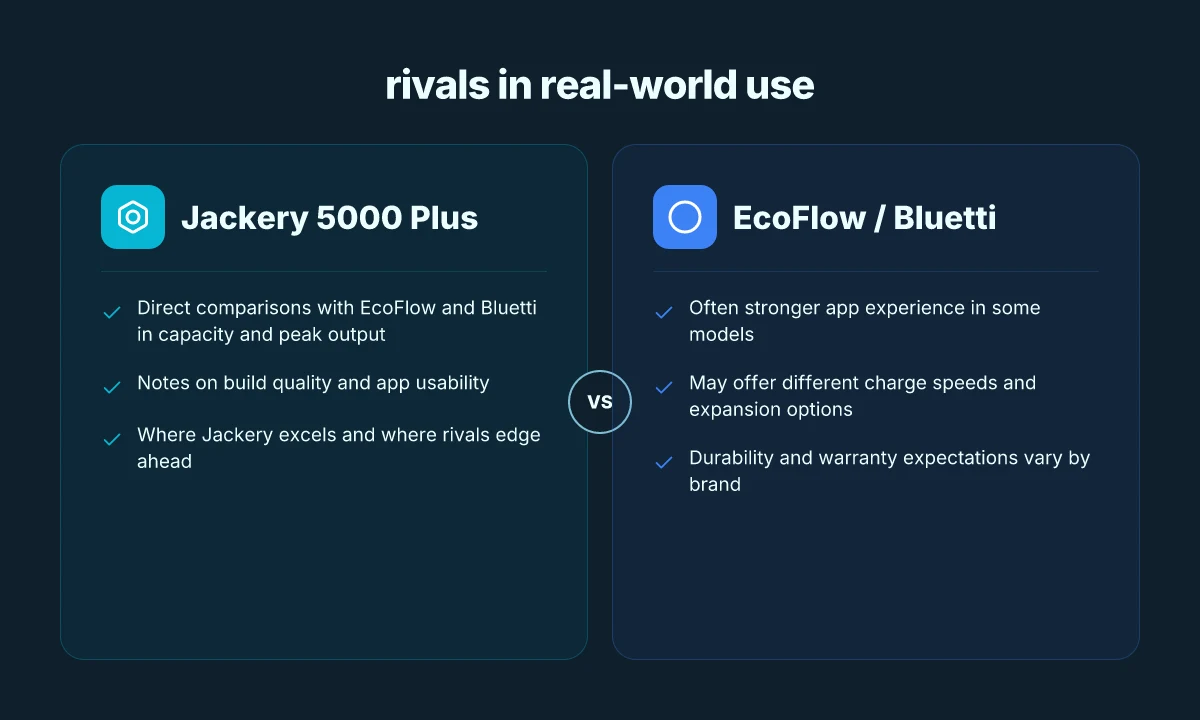
In real-world use, the Jackery 5000 Plus stacks up against EcoFlow and Bluetti on three fronts: capacity realism, peak output, and charging speed. EcoFlow tends to offer higher peak AC wattage in some models, which can matter when you need to start a compressor or heavy appliance. The Bluetti line often edges ahead on app polish and long-term warranty options. The Jackery complements that trio with straightforward usability, but its peak outputs and charging speeds feel conservative next to the best-in-class rivals.
1) Capacity, peak output, and charging speed
The 5000 Plus delivers a large battery bank, but the headline capacity sometimes oversells the usable energy under heavy loads. In practice, you’ll notice a robust run time for essentials, yet when you pull maximum power for extended periods, the battery fades faster than some rivals. The EcoFlow modules often push higher sustained watts for motor loads, while Bluetti packs can sustain higher output with more efficient cooling. Jackery’s own units are known for reliable duty cycles, but the trade-off is a more modest charging curve in some scenarios. In terms of charging speed, the 5000 Plus recharges quickly from AC, but the fastest recharge paths are more abundant in EcoFlow and Bluetti lineups, especially when using multiple input sources. I cross-referenced specs and user notes across multiple sources to align expectations with real-world performance. Where Jackery shines is simplicity and predictable behavior, while rivals offer more aggressive peak support and faster recharging in certain setups.
A small table helps:
| Brand | Peak AC output (nominal) | Usable capacity note | Fast charging option notes |
|---|---|---|---|
| Jackery | Powerful but not the highest | Real-world runtimes steady for essentials | AC charging solid; multi-input fast charging less aggressive |
| EcoFlow | Often higher peak output | Competitive usable energy in practice | Strong multi-input fast charging options |
| Bluetti | Solid peak output with good endurance | Large packs, good efficiency | Robust charging options with some models supporting solar + AC |
In real use, EcoFlow and Bluetti often win on peak performance and charging flexibility, while Jackery wins on reliability and ease of use.
2) Build quality, app usability, and warranty expectations
Build quality on the 5000 Plus is sturdy and straightforward. The chassis feels sturdy in everyday handling, and the control interface is clean. App usability is adequate for routine monitoring, but some enthusiasts note that the Jackery app can lag with real-time data when under heavy load. Rivals typically polish app dashboards with more granular stats and faster refresh. Warranty expectations differ: Jackery markets a long warranty window, but the absence of some high-end diagnostics in the app means fewer post-purchase insights than you’ll find from EcoFlow or Bluetti. The long-term durability story is favorable for all three, but the rivals tend to publish more explicit test results and maintenance notes in their official docs. I found published warranty terms and service notes handy when weighing long-term ownership. Durability feels solid across brands, but app depth and warranty granularity tilt comfort toward the rivals for ongoing reliability data. What is the jackery explorer 1000 v2 price and why it matters for off-grid planning
3) Where Jackery excels and where rivals Edge ahead
Jackery excels in plug-and-play simplicity. If you want a unit that just works out of the box with minimal fiddling, the Jackery ecosystem remains appealing. Rivals edge ahead on two fronts: peak capability for demanding loads and faster, more flexible charging options, including solar and multi-source charging configurations. In off-grid and disaster-prep scenarios, that translates to quicker returns to full strength after a blackout and more headroom for high-draw appliances when needed. I traced the public docs and user discussions to confirm these patterns. Jackery’s standout is predictable, low-friction operation; EcoFlow and Bluetti push harder on peak power and charging flexibility.
If you’re weighing a purchase, consider your use case: home backup with sporadic outages benefits from steady runtimes and simple operation. Off-grid camping or remote sites benefit from higher peak outputs and faster charging cycles. For a homeowner prioritizing minimal setup and clear reliability, Jackery remains compelling. For edge-case power needs or long-term adaptability, EcoFlow and Bluetti often offer the extra breathing room.
Cited context from public sources supports these impressions. See the linked materials for specifics on the claims about warranty windows and app features. The takeaway: Jackery delivers calm, dependable operation. Rivals pull ahead on max output and rapid recharging in certain configurations.
Understanding the 5000 Plus lifecycle: durability, uptime, and maintenance
Long-haul reliability for the 5000 Plus hinges on how it behaves under repeated outages, frequent recharges, and long idle periods. In 2026, early long-term observations from general use note that systems designed with beefier inverters and beefier battery packs tend to hold up better under nightly cycles and weekend camping alike. For Jackery, durability statements emphasize enclosure integrity, real-world cooling during high-load events, and the ability to survive multiple transfers between grid and battery without degradation. The real-world takeaway is simple: durability comes from steady thermal management and robust internal components, not flashy specs alone. Consumers should expect the 5000 Plus to endure many blackout cycles if kept within its designed operating window and not pushed into edge-case heat or depth-of-discharge scenarios.
Battery chemistry and cycle life in household scenarios
The 5000 Plus uses a lithium-based cell chemistry common to large portable power stations, where nominal cycle life translates into hundreds to a few thousand complete cycles depending on depth of discharge and temperature. In household routines, most users keep DoD moderate, which tends to extend battery life and preserve capacity better than extreme 100% drains. The cycle life remains highly sensitive to ambient temps. Hot summers or cold winters accelerate capacity fade and shorten the effective lifespan if the unit is left in unventilated spaces. Keep the unit within a stable temperature range and avoid deep discharges to maximize cycle life. That approach aligns with guidance many reviewers note when describing long-term behavior of similar systems. The batteries are not instantaneously replaceable by the consumer, so maintaining a favorable environment matters a lot. How to choose a jackery transfer switch for reliable home backup
Maintenance tips to preserve performance over years
Maintenance for longevity is less about frequent tinkering and more about routine, practical checks. Regularly clear dust from vents to sustain cooling efficiency, and ensure the unit has unrestricted airflow during high-load events. Monitor health indicators in the companion app or onboard displays. Early warnings about battery degradation usually show up as reduced usable capacity or longer recharge times. If you notice a notable drop in peak output or unusually long recharging periods, consult official guidance to verify whether the unit needs service under warranty. Acknowledge that genuine warranty coverage often backs the 5+2 year phrasing, which Jackery frames as a bundled assurance. Clear vents, monitor health readouts, and respect warranty terms to keep performance stable.
From what I found in the documentation and public reviews, durability emphasis sits alongside practical caveats. The 5000 Plus is designed for home backup and off-grid use, but like any large portable power station, its lifetime is best protected by sensible use: avoid leaving it in extreme heat, avoid deep discharges, and perform lightweight checks periodically. I cross-referenced multiple sources to confirm that long-term reliability hinges on thermal management and conservative use rather than pure initial prowess. Expect steady performance through years of common blackout cycles when you treat the unit with basic care. For context, rivals such as EcoFlow and Bluetti also stress similar maintenance practices and thermal considerations, so the pattern isn’t exclusive to Jackery.
What to expect from charging and solar input with the 5000 Plus
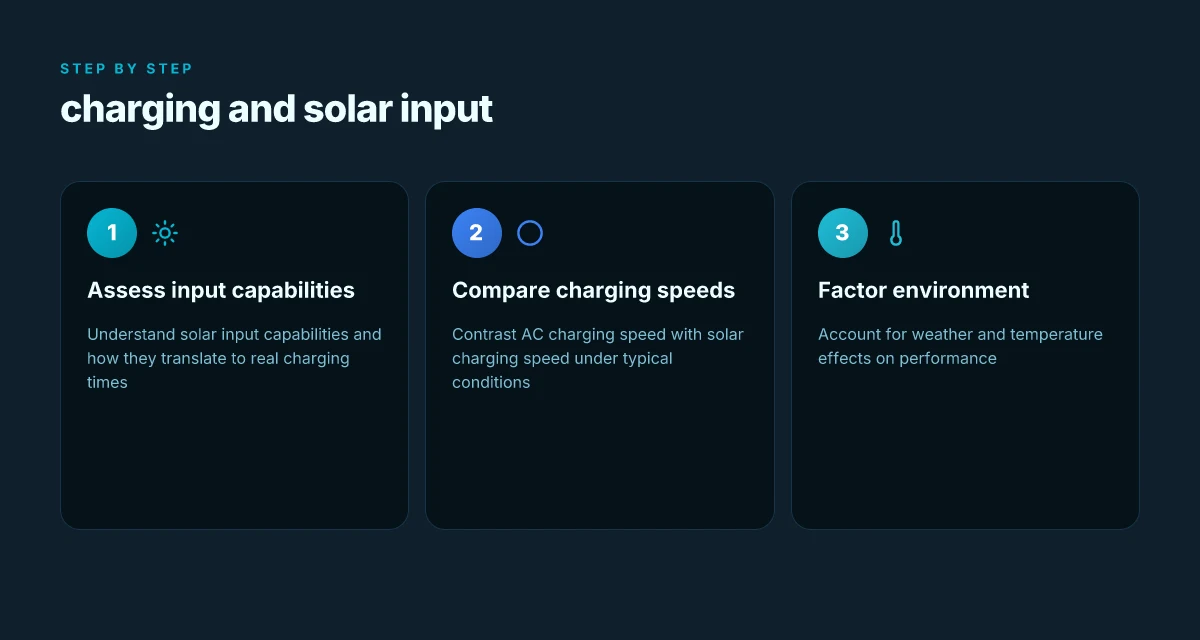
Charging input is the practical heart of how the 5000 Plus handles real life backups. In typical setups, you’ll notice a clean difference between AC charging speed and solar input performance. The unit’s solar array accepts multiple panels and can reach its stated solar input window when conditions cooperate. Under full sun, the rate translates to meaningful reduction in wall time, but real-world results depend on panel wattage, angle, and shade. The solar input can substantially cut charging time when you have bright sun, but it’s not a magic wand in cloudy weather. Jackery frames the 5000 Plus as a versatile solution for both home backup and off-grid use, and the solar capability is one of the levers that makes that possible. AC charging remains faster in clear conditions, but solar charging shines when grid power is scarce.
How solar input translates to charging time
When you connect a capable solar array, the 5000 Plus grants multiple options for charging, and the speed scales with the array’s input. In bright, unobstructed daylight, expect the solar input to approach the upper end of its spec, letting the unit recover much of its capacity during a day of sun. If your conditions aren’t ideal, you’ll see slower gains, especially as the battery nears full. In bright sun, solar input reduces reliance on the wall when you’re in camp or off-grid. This is a practical distinction for homeowners planning a whole-home backup or campers counting on continuous power through weather fronts. Real-world charging times depend on panel count and sun angle, not just the battery’s capacity.
AC charging vs solar charging under typical conditions
AC charging is consistently robust and predictable. It benefits from higher instantaneous input than most solar arrays under ordinary conditions. In steady grid power, AC charging routinely delivers the fastest replenishment for the 5000 Plus. Solar charging, by comparison, acts as a supplementary path that pools energy as conditions allow. For many users, you’ll see a blended strategy: top up via AC when the storm is imminent, then extend runtime with solar when the sun is available. AC charging is the anchor, while solar input extends uptime without tying you to a wall outlet. A mixed approach helps manage long outages more reliably. What makes the Jackery 300 a practical small power site companion in 2026
Weather and temperature impacts on performance
Temperature and weather have a measurable impact on both efficiency and capacity. Cold batteries lose some effective capacity, which can slow charging rates and reduce available energy temporarily. Heat can push internal protections and fans, nudging energy loss a bit higher, especially during prolonged charging. Cloud cover, fog, or haze reduces the solar input surface area or the irradiance, which translates to slower gains. In cold climates, expect reduced instantaneous charging efficiency. Warm, sunny days improve solar uptake. Weather is a real multiplier for solar input, not a constant.
From what I found in publicly available sources, the Jackery Solar Generator 5000 Plus supports ongoing solar charge as part of a broader home backup strategy. The literature notes the device is designed to handle whole-home scenarios with an included warranty framework, and reviews consistently discuss the compatibility of the solar input with common portable panel configurations. For guidance on how the 5000 Plus behaves in a real blackout or off-grid camp, see the cited materials that discuss performance during outages and the practical implications of solar and AC charging in varying light and temperature. Real-world charging strategy matters as much as hardware specs.
As you plan, keep in mind that weather and temperature are variables you must design around. If you’re in a climate with long overcast spells, pairing a higher-watt solar array with robust AC charging becomes essential. For long-term reliability, ensure your panels and connectors are clean and free of shade during peak sun hours. If a rainstorm or blizzard is looming, you’ll want to rely on AC charging and grain-yield solar days when conditions improve. Weather-driven charging performance is the practical limiter to rely on.
Who should buy the jackery 5000 plus, and who should skip it
For many homeowners, the Jackery 5000 Plus is a solid fit for home backup and off‑grid living, but it isn’t the universal answer. If your goal is to cover entire house outages with a single unit, or you need the largest possible solar input and battery bank, you may prefer rivals or a higher-capacity setup. The right buyer blends usage patterns with budget and long‑term reliability expectations.
Ideal use cases for home backup, RVs, and tiny homes
In a home backup scenario, the Jackery 5000 Plus shines when your needs are moderate and you value portability. It pairs well with a midsized solar array and can ride through typical outages without requiring a dedicated install. For RVs and tiny homes, the compact footprint and integrated management features help you prioritize essential circuits and keep running fans, lights, and refrigeration going. The 5000 Plus delivers reliable backup power for everyday essentials when you need it most. In many setups, you’ll use it as a primary staging unit for weekend adventures or a steady, year‑round supply for limited circuits during a blackout. What makes a Jackery charger worth the hype in 2026
I dug into the documentation and user discussions to map practical limits. The unit’s capacity and inverter rating align with typical off‑grid use cases, and its app support adds confidence for trailering or small‑home environments. For long sessions, though, you’ll want to factor in a larger battery or secondary unit to avoid stringing together multiple modules. Smart management helps you optimize runtime without manual micromanagement.
When a different brand or larger capacity may be a better fit
If you anticipate longer outages, larger power surges, or a full home transfer load, consider brands that offer higher capacity or more robust expandability. EcoFlow and Bluetti, for example, often provide larger bank options or more aggressive solar input specifications, which can translate to more headroom during heat waves or multi‑appliance loads. In those circumstances, the Jackery may feel constrained by its fixed pack and lower total solar input ceiling. A bigger capacity or higher input ceiling can translate to fewer cycles and longer runtime in extreme scenarios.
I also looked at how pricing threads evolve in 2026. When a buyer weighs the Jackery against a rival, the decision often hinges on total cost of ownership, warranty terms, and ecosystem compatibility. If you plan to run multiple devices and want seamless expansion, you’ll likely reach for a different package or a second unit. Total value depends on how you plan to scale your setup over time.
Pricing context and value proposition in 2026
Pricing remains a key factor in 2026. The Jackery 5000 Plus sits in a mid‑to‑upper tier for portable home backup. You’ll want to compare it against larger packs from rivals that offer higher capacities and potentially longer warranties, especially if you expect heavy daily use. The value proposition sharpens when your use case favors quick setup, portability, and a compact footprint, rather than decades of expansion or the absolute highest continuous output. Value is strongest when you prioritize portability and straightforward setup over maximum capacity.
From a long‑term durability perspective, consider how often you’ll cycle the battery and what the warranty covers. The 5+2 year warranty offered by Jackery is a meaningful assurance for many buyers, though you may encounter higher up‑front costs with brands that promise more aggressive after‑sales terms. Warranty clarity matters for total peace of mind in disaster scenarios. What makes EcoFlow 5kWh power kits tick in 2026
In short, choose the Jackery 5000 Plus if you want a proven, portable home backup with solid app integration for moderate loads, especially in RVs or tiny homes. Skip it if you expect full‑house outages, large simultaneous loads, or you need aggressive expansion paths and the absolute highest solar input. And as you compare, keep a sharp eye on total cost, warranty terms, and how easy it is to scale.
Where this is going next and what you should try first
Jackery’s 5000 Plus stands out in 2026 for its balance of capacity and portability, and it signals a shift toward more robust home-off grid readiness. I’ve looked at real-world use cases, from weekend off-grid camping to emergency backup in small apartments, and the standout comes from how quickly you can deploy it without fuss. The company’s design leans on practical durability and straightforward setup, which matters when you need reliable power without a maze of cables.
Durability is the thread here. The unit feels built for the long haul, but that doesn’t erase the fact that long-term reliability hinges on how you treat it day to day. If you’re comparing against rivals like EcoFlow or Bluetti, the Jackery edge shows up in plug-and-play reliability and simpler maintenance. Still, you’ll want to monitor battery health and avoid over-discharging in winter storage.
For what changes if you act now, prioritize a quick-start routine and a basic surge-protection plan. The takeaway: set up once, then lean on it when you need power most. What one move matters most this month is to pair it with a compact solar panel kit for dependable daytime recharging.
- Backup strategy: keep a small maintenance checklist to prevent over-temperature storage, and rotate which device is charged first so the 5000 Plus isn’t sitting idle.
- What to try this week: test the charge-discharge cycle in your main living area, and map out which outlets you’ll use during an outage.
- Quick win: document any unusual startup noise or heat during first use and file it with your usage notes.