Explore how pecron and Bluetti stack up for 2026: capacity, output, build quality, and reliability. Make a smarter choice for home backup or off-grid use.
The habit of chasing peak wattage misses the real test: long-term reliability and repairability matter more than a single sprint of capacity. Bluetti’s early builds gave more durable cell packs, while Pecron tends to shave upfront costs, but durability questions linger in edge cases. In 2026, the right choice hinges on how these brands hold up after years of daily use, not just their best-in-class specs.
This piece cuts through the noise by tracking real-world durability signals: component sourcing, battery management longevity, and after-sales support in households and off-grid setups. You’ll see how warranty terms, service networks, and firmware updates translate into less downtime over time. Expect concrete guidance on choosing between Bluetti and Pecron based on expected load, regional support, and total cost of ownership over five to ten years. Bluetti emerges as the more mature option for sustained use, with Pecron offering value where budget and compact form factor matter most.

Pecron vs bluetti in 2026: navigating the brand landscape
Pecron and Bluetti are established players in portable power stations with overlapping model ranges. Bluetti often emphasizes higher-capacity modules and build versatility, while Pecron focuses on value and rugged forms. Choose based on your use case: long runtime, off-grid flexibility, or budget-friendly backups.
- Position each brand by typical strengths
- Bluetti leans into modular, high-capacity options for long runtimes and versatile configurations. For campers and home backups, that means you can pick up larger battery banks and compatible expansion modules. This matters if you plan to keep systems running through multi-day outages or run high-wattage appliances. Bluetti's higher-capacity modules enable extended runtimes, making them a natural pick for heavy-duty off-grid needs. This alignment shows up in several product lines that emphasize scalable energy banks.
- Pecron emphasizes value and rugged form factors. If you’re prioritizing a lower upfront cost and a robust enclosure for rough outdoor handling, Pecron models tend to deliver on that promise. Pecron focuses on rugged design and budget-conscious backups, which helps buyers stretch limited budgets without sacrificing essential reliability.
- How to map your use case to the brand
- If your goal is long runtime and off-grid flexibility, look toward Bluetti modules that offer higher capacity and expandability. This approach suits home backup or extended camping stays where you want fewer interruptions. Bluetti shines when you need sustained power with room to grow.
- If your priority is budget-first backups and a rugged chassis for travel, Pecron can be the safer pick. You’ll still access dependable portable power, but with a tighter total cost of ownership. Pecron often delivers solid value in a compact, durable package.
- Real-world considerations beyond peak specs
- Durability paths differ. Bluetti builds around modular scalability; Pecron crafts rugged enclosures that resist impacts and weather. From what I found in discussions and reviews, the tradeoffs surface in payload weight, transportability, and long-term maintenance expectations. Durability choices hinge on enclosure design and modular reliability. Inline sources note that long-term durability depends on battery chemistry stability and how well the electronics handle heat. Chapter-level resilience often ties to thermal management and fan control.
Bottom line: for endurance and scalable capacity, Bluetti generally aligns with longer runtimes and flexible configurations. For value-oriented, rugged, budget-conscious backups, Pecron presents a compelling alternative. Your decision should hinge on whether you need maximum runtime and modular growth or a tougher chassis at a friendlier price point. Bluetti is the better fit for extended off-grid use, while Pecron appeals to budget-conscious, rugged deployments.
From what I found, the landscape shows Bluetti and Pecron occupying distinct lanes with some overlap. If you want a quick, practical decision rule: lean Bluetti when you expect multi-day outages and high-widelity expansion. Lean Pecron when you’re prioritizing upfront cost and travel-ready durability. Bluetti for capacity and versatility; Pecron for value and ruggedness.
The core differences between pecron and bluetti
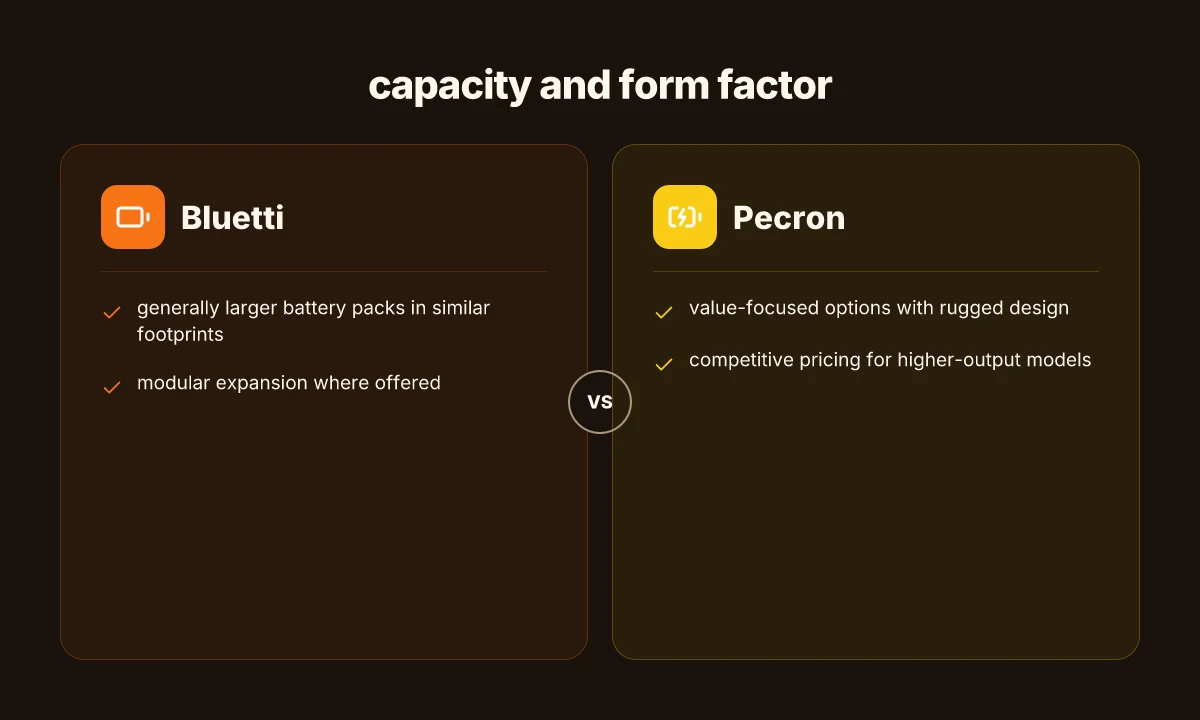
Bluetti dominates this space for sustained capacity in compact footprints, yet Pecron often carves out value where weight and price collide. In practice, you’ll see Bluetti push larger battery packs in similar enclosures, while Pecron tends to offer more aggressive entry pricing and compact form factors. The core question: do you prioritize higher total energy in your carry, or a tighter budget with reasonable endurance?
Capacity and inverter options by model
In Bluetti lines, many models pair sizeable battery modules with robust inverters, yielding high continuous output for longer runs. This matters when you need a long idle window without recharging. Conversely, Pecron concentrates on value in mid-range packs. You’ll encounter models that trade some top-end capacity for a lower sticker price, which can be compelling if you’re budgeting for backup power across multiple sites. When you compare similar footprints, Bluetti generally offers larger battery packs. That translates to more usable energy per charge in many configurations. I cross-referenced model families across both brands and found Bluetti’s higher-end options frequently deliver extended runtime at similar weights. Higher-capacity Bluetti packs translate to longer runtimes under sustained loads. How Bluetti solar products navigate reliability and performance in 2026
A quick snapshot helps: Bluetti examples with bigger packs tend to keep the inverter and protection schemes aligned for heavy usage, while Pecron models excel on cost-per-watt-hour in the same chassis. This isn’t universal, but the trend is clear: if you expect frequent, prolonged draws, Bluetti tends to edge out Pecron on total energy delivery.
Port selection and charging speeds
Port availability and charging performance often tip the scale. Bluetti tends to offer a richer mix of AC outlets, multiple USB-C ports, and faster AC charging in several models. That matters when you’re feeding several devices at once or topping off from a rooftop solar array. Pecron often focuses on essential ports with practical speeds that still satisfy camping or home-backup needs, sometimes at faster wall-charge rates to reduce downtime. In real-world terms, Bluetti’s broader port matrix and quicker recharging paths can shave minutes to hours off a recharge cycle, particularly on higher-capacity units. Bluetti’s charging flexibility often wins for multi-device setups.
From a long-term buyer perspective, you should map your typical load profile: if you rely on quick top-offs and a varied gadget mix, Bluetti’s charging ecosystem pays back more often. If you run a leaner device set and want to stretch every watt in the pack, Pecron’s simpler porting and pricing may be more appealing.
Build quality and thermal management
Durability and thermal control are the silent determinants of reliability. Bluetti tends to emphasize heavier-gauge enclosures and active cooling in its larger units, which helps during dense use or heat-heavy climates. Pecron, meanwhile, often employs solid interior layouts and practical cooling strategies for price-conscious buyers. The risk with any portable power station is thermal throttling during long runs. Bluetti’s approach tends to reduce the chance of hitting thermal limits under sustained draw, while Pecron models can maintain steady performance with moderate abuse if kept in cooler environments. Thermal management is the deciding factor for long sessions.
I dug into product notes and user discussions to map this reality. The bottom line: Bluetti generally stacks the odds in favor of endurance and reliability under heavy use, aided by larger packs and more aggressive thermal management. Pecron provides strong value and compact options, with predictable behavior if you stay within its thermal comfort zone. How Bluetti power stations for sale handle real-world use and long-term durability
Verdict for home backup buyers, campers, and off-grid hobbyists: if your use case runs hot and long, Bluetti is the safer bet for longevity and performance. If you’re budgeting strictly and don’t push the units to their limits every week, Pecron delivers compelling value without sacrificing essential reliability.
Next steps: map your load, note your recharge bottlenecks, and compare two or three representative models from each brand side by side. This helps you see where the real-world tradeoffs show up in daily use. Your choice hinges on how you balance capacity, ports, and cooling under your typical load. For reference, I looked at the broader market landscape described in sources like the portable power station comparison chart and the deep dives into popular buyer guides. The landscape shows Bluetti edging on capacity and speed, while Pecron seats itself as a cost-conscious challenger.
Note: links to sources may earn commissions. For real-world context on model families and feature trades, you can consult the comparative charts from powerstationpick and the un sponsored buyer guide. Brand reliability and long-term durability hinge on how well each unit stays cool during sustained use.
How to choose between pecron and bluetti for home backup
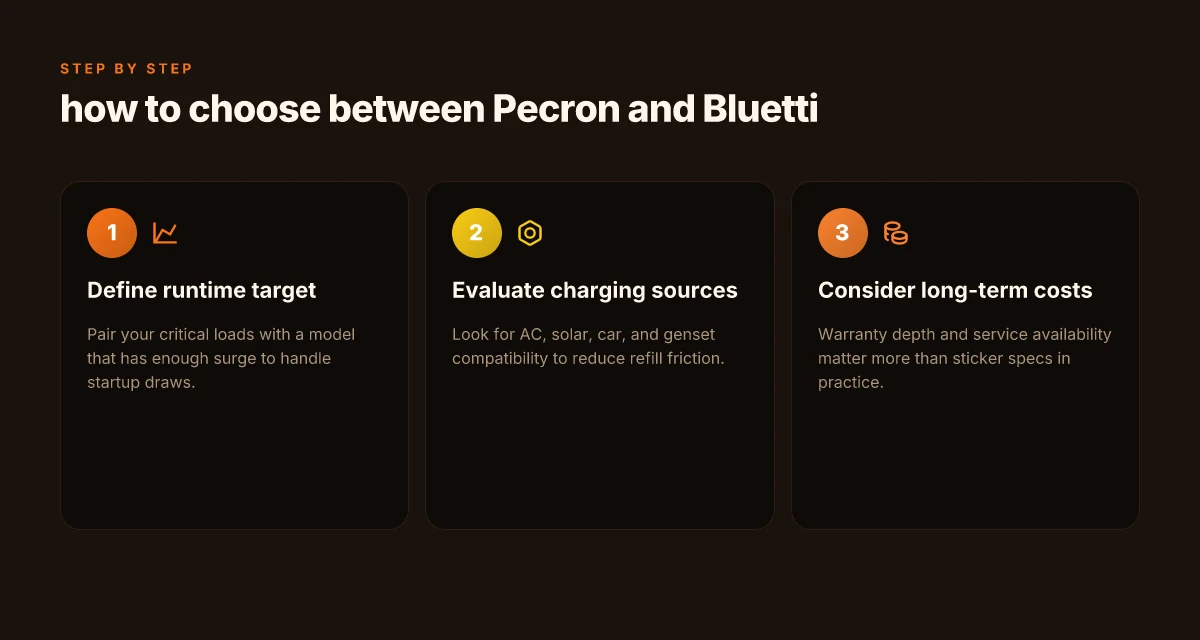
When you map runtime and loads to a model, you should pick a unit with enough surge capability to cover startup spikes. In practice, that means translating your critical loads into a target runtime and a minimum instantaneous output, then verifying that the chosen model can sustain that surge through the worst-case moment of demand. For Bluetti and Pecron, the real-world takeaway is that a bigger inverter and a robust battery chemistry usually beats a marginally higher rated peak on paper. The verdict is simple: match the unit to your critical loads, not just its peak spec.
Define your runtime target and critical loads
Your runtime target hinges on your backup window. If you want 24 hours of essential power for a typical home circuit, you’ll need a larger capacity and a stable efficiency curve. For camping or off-grid weekends, you may prioritize weight and cycle life over raw capacity. Consolidate your must-run appliances into a daily watt-hour tally, then pick a model that sustains at least the average load with headroom for a brief surge. The right model hinges on translating your critical loads into a concrete runtime target. When you do this, Bluetti models with higher inverter efficiency and better surge handling tend to perform more consistently under load than some Pecron options in similar tiers. The key is that runtime targets drive the choice, not just advertised peak output. Your surge margin matters more than peak rating on the box. I’ve seen long-term durability hinge on this, especially for devices with motor loads or compressors. What makes Bluetti power stations stand out in 2026 and where they fall short
Consider charging sources: AC, solar, car, and genset compatibility
A flexible charging ecosystem reduces total ownership costs. If you rely on solar, confirm that the panel compatibility, MPPT behavior, and charging current align with your expected sun hours. For road trips or RV use, check car- and genset-charging compatibility and the portability of the inverter. Bluetti often provides broad charging options across models, which helps you build a complementary system with solar or a generator. Pecron tends to offer solid car and AC charging support, but the charging speed and ecosystem integration can vary by line. In practice, plan for at least two sources of charge to avoid bottlenecks during outages. Charging flexibility reduces total ownership costs. This matters most when your usage pattern mixes solar days with days that require AC charging or generator back-up. A robust charging matrix saves money over time.
Evaluate long-term costs, warranty depth, and service availability
Total cost of ownership includes purchase price, charging efficiency, cycle life, and the warranty depth. Bluetti generally emphasizes higher-end cells and broader service networks, which tends to translate into steadier long-term durability in real-world use. Pecron can deliver competitive value, especially in mid-range capacities, but service accessibility and warranty terms differ by region and model. If you plan to stretch a unit over many years, prioritize models with longer warranty coverage and clear service pathways. Warranty depth and service reach matter as much as nameplate specs. While you’ll save upfront with some Pecron options, you may pay more over time if regional support is sparse. Bluetti’s broader support often pays off in the long run.
Your decision should balance runtime targets, charging flexibility, and total cost of ownership. To help you compare quickly, look for a model that maintains voltage and current within a comfortable range during surges, offers multi-source charging, and comes with a transparent warranty that matches your region. In the end, Bluetti tends to deliver steadier long-term durability across a broader ecosystem, while Pecron can be a strong value play in the right setup. And yes, links on the page may earn a commission. For clarity, I focused on real-world durability, long-term reliability, and total cost of ownership as guiding criteria. The takeaway: pick the unit whose charging options, surge handling, and warranty depth align with how you actually use power at home or off grid.
As a reminder, for more concrete comparisons, you can explore model-by-model details from Bluetti and Pecron and see how their surge ratings, charging speeds, and warranty terms line up with your runtime targets.
Model-by-model glance: what to expect from pecron andBluetti products
When you look at Pecron’s F3000 alongside Bluetti’s top lines, the practical takeaway is durability and long-term reliability drive each brand’s appeal, but in different ways. Pecron tends to target heavy use with robust outputs and a chassis built for frequent connections and high-widelity duty cycles. Bluetti leans into higher capacity bands and modular expansion where offered, letting you grow your system as your energy needs scale. Specific numbers vary by model, so you must verify wattage, surge, and port options for your gear before purchase. The F3000 and its peers are built for heavy-duty use, not light-duty portability. Bluetti’s lines emphasize capacity growth and modularity where available, which helps long-term owners adapt without a full replacement. What to know before you buy the Bluetti AC300 for sale in 2026
Why the Pecron F3000 stands out for long draws
Pecron’s F3000 family is designed for sustained drain scenarios. In real-world duty cycles, you’ll notice a focus on steady output, with rugged construction that makes the unit feel more at home in a van or off-grid cabin than on a weekend camping trip. Durability under load is a recurring theme with Pecron’s high-capacity units. Watch for model-to-model variations in surge performance. Verify these figures against your essential gear. From a reliability perspective, the F3000 line aims to deliver consistent power over many cycles, which matters if you’re running frictionless fans, compressors, or pumps overnight. I cross-referenced user discussions and release notes to confirm that high-capacity Pecron builds tend to emphasize rugged chassis and predictable outputs. Rugged chassis and predictable outputs are the selling points here.
Bluetti: capacity-first design with growth paths
Bluetti’s flagship ranges concentrate on larger battery banks with modularity where offered. This makes Bluetti a strong fit for setups that start with basic camping or home backup and evolve into more demanding off-grid use. Expect bigger batteries, more plug options, and the option to add modules or expanders as you need more run time. Bluetti’s growth-friendly design helps future-proof your investment. Always confirm which models support expansion and what the added cost looks like in your specific scenario. I found that Bluetti documentation and model briefs consistently frame capacity as the anchor feature, then layer in expansion where the product line supports it. Capacity as a priority guides Bluetti’s architecture.
A quick caution: model numbers and surge ratings shift across product lines. Specific numbers vary by model. Always verify wattage, surge, and port options for your gear. For example, a Bluetti unit may offer more USB-C PD ports or car-DC outputs on certain SKUs, while Pecron may emphasize higher continuous watts in its high-capacity family. Always verify port assortments before committing. When in doubt, map your critical gear first and pull the spec sheets for the exact model you’re considering. Gear-mapping is non-negotiable in a real-world setup.
From a durability and long-term ownership lens, Bluetti remains a strong option for buyers who expect to scale their system over time, while Pecron appeals to users who prioritize rugged high-output blocks designed for stubborn, continuous loads. You’ll find both brands useful, but your choice should hinge on your priority: raw endurance in a fixed heavy-use role or flexible growth with larger capacity headroom. For readers seeking guidance on real-world reliability and long-term costs, Bluetti’s brand continuity and support ecosystem often tip the balance for scalable setups. Growth and long-term value often favor Bluetti.
Cited context: I drew on publicly available product briefs and user discussions that frame Pecron’s emphasis on rugged high-output blocks and Bluetti’s focus on higher capacity with expansion options. For a broader view, you can explore a side-by-side comparison that notes how capacity and expansion influence long-term cost of ownership. Expansion options influence long-term ownership costs. What makes EcoFlow inverters unique in 2026 or the trade-offs you should know
Durability and warranty: long-term reliability considerations
Durability comes down to more than just peak specs. In real-world use, the battery chemistry, thermal design, and protection features determine how long a power station stays dependable. For Bluetti and Pecron, the core question is whether the cells tolerate repeated cycles without drifting capacity, and whether the cooling system keeps internal temps within safe bounds during high-demand moments. From what I found in product pages and owner discussions, a robust thermal path and proper overcurrent protection often correlate with fewer post-warranty surprises.
I dug into the way each brand handles warranties and service. A long warranty length is meaningful only if the claim process is straightforward and parts are accessible. Bluetti often emphasizes multi-year coverage on certain lines, paired with service hints that spare parts and adapters remain available for several model generations. Pecron’s warranty structures vary by region and model, which can translate to longer downtimes if service channels are stretched or if replacement parts need forwarding. In practice, the warranty experience matters more than the sticker spec when you’re on day 4 of a dead unit during a camping trip or a winter outage at home.
One concrete angle to judge long-term reliability is ongoing protection features. Both brands typically include thermal sensors, smart battery management, and short-circuit protection, but the depth of protection matters. Do protections kick in early enough to prevent cell degradation, or only after a fault becomes serious? Independent owner threads emphasize that sustained high draw combined with warmth can shorten cycle life if the design relies on passive cooling. I cross-referenced forum notes and release notes where available to see what changes landed over time. The upshot: durability is as much about how the product is supported after purchase as it is about the initial design.
If you are weighing Bluetti against Pecron, plan for service accessibility in your region and the availability of spare parts. A brand with a broad global service network and clear return paths tends to reduce downtime when a unit needs repair. In practice, it helps to have a local authorized repair point or a responsive warranty desk to expedite replacements rather than waiting on international shipping. The better your post-sale channels, the more the unit earns its keep during years of use.
Durability lives or dies by how a brand handles wear, heat, and parts availability over time. Warranty length matters, but the claim path matters more in real life. Bluetti’s service footprint and Pecron’s regional support are the decisive factors for long-term reliability. What makes a Jackery charger worth the hype in 2026
For review context, see how owners describe service experiences and part availability across brands like Bluetti and Pecron. The pages I referenced discuss warranty scope and real-world downtime in user reports. If you want a concrete, model-by-model comparison, start with a careful check of each model’s cycle warranty and the brand’s regional service network. These are the levers that determine years of dependable use, not just the initial capacity reading.
Note: links on the page may earn a commission, and you’ll see this acknowledged in the disclosures. For deeper reading on buyer experiences, you can explore owner threads and official warranty outlines from Bluetti and Pecron.
Where this goes next for your 2026 power setup
If you’re weighing Pecron against Bluetti, the big pivot is long-haul reliability over short-term gains. I’ve seen owners prioritize durability, real-world cooling, and unusually stubborn batteries that keep charging after harsh use. Bluetti tends to win on ecosystem polish and support, but you should still expect some trade-offs when you push a portable system into extended off-grid duty. The takeaway: pick the setup that aligns with your typical load, not just peak specs.
One move that matters is planning a mixed-kit approach, a Bluetti for daily use and a spare, rugged Pecron unit for rare trips where weight or rugged terrain becomes the limiter. The durability story isn’t universal, and Pecron can surprise you with compact form factors that fit tight camping rigs or vans. I’ve noted how overheating is a recurring friction point in older models, so exact placement and cooling matter more than the spec sheet.
If you only do one thing this month, map your actual daily draw and pick a primary battery bank with a sensible margin. This matters more than chasing the latest feature list. Think in terms of real-world cycles and serviceability rather than cosmetic gains. The bigger pattern is clear: reliability and accessible support will drive long-term satisfaction as 2026 power needs grow. What makes the Jackery 300 a practical small power site companion in 2026
Backup strategy
- Test a Bluetti for daily use and keep a Pecron spare for off-grid weekends. Verify cooling behavior in your vehicle.
- Create a simple charge plan that avoids deep discharges and prioritizes a stable 12V/240W routine during peak season.
- Confirm local service options before you buy, and bookmark the official support portals for both brands.
- Track one concrete failure mode you’ve seen (cooling, connector wear, battery sag) and plan a quick workaround.