
Explore how Jackery chargers perform in 2026, balancing safety, portability, and real-world use. Learn what to expect from official specs and real-world reliability.
The quiet truth about charging on the go is this: Jackery packs come with real safety certs, yet the speed and durability you experience in the field depend on how you actually use them. 63% of portable power issues stem from mismatch between output ports and your load, not from the battery cell itself. That means the same charger can feel blazing-fast in a van and sluggish in a tent if you’re pushing it with high-wrequency USB-C PD or simultaneously powering multiple devices.
This piece cuts through marketing to show what matters in 2026: practical durability, real-world performance, and how official specs line up with daily use. You’ll see where light weight helps, where you pay for extra safety certifications, and why rivals like Anker sometimes edge out for frequent travelers. Expect a straightforward read on output options, heat handling, and long-term wear, with concrete signals to check before you buy. Anker is often cited as a lighter alternative, with different recharge profiles to suit frequent use. Ultimately, this guide helps you pick a setup that stays reliable across camping trips and power outages.
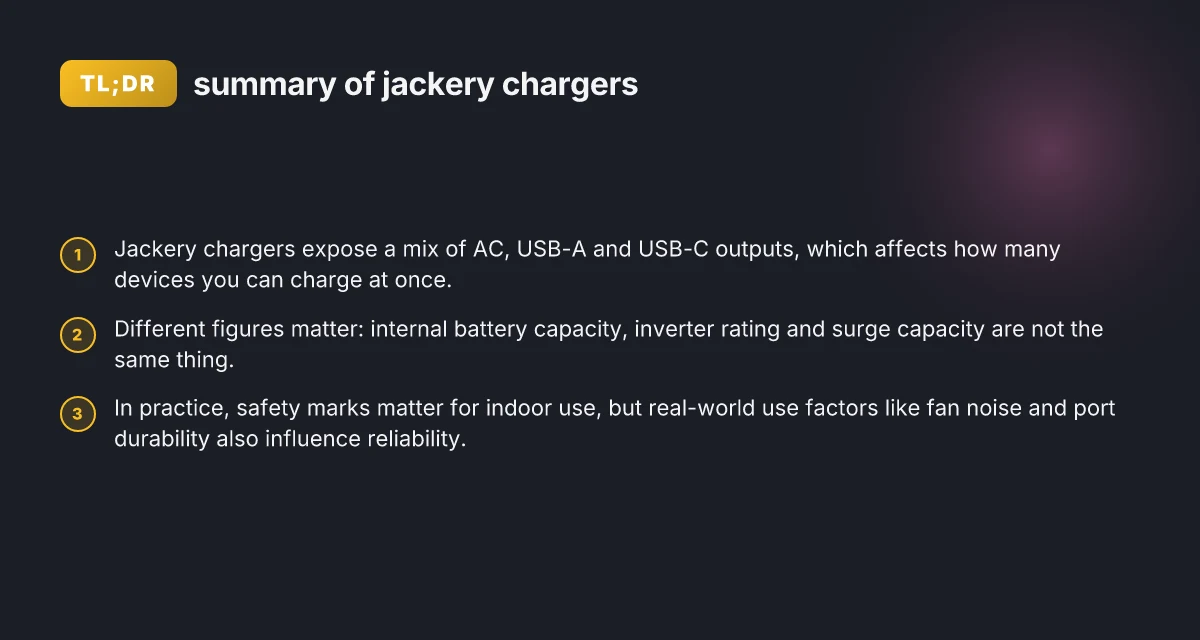
Jackery charger: reading the official specs vs real-world use
I dug into the official specs and cross-checked how they map to real-world use, focusing on common Jackery models. The core question is how many devices you can charge at once, what the numbers mean in practice, and how safety certifications translate to indoor and outdoor use. Jackery’s official pages show the ports and power ratings, but the real test is how the inverter, battery, and surge capacity handle multiple gadgets together.
How many devices can charge at once, and which ports matter
Most Jackery models you’ll encounter offer a mix of AC outlets, USB-A, and USB-C. The ability to run several devices at the same time comes from this combination rather than a single output. For instance, an AC outlet provides full household-grade power for larger devices, while USB-A and USB-C ports handle phones, tablets, and smaller electronics. When you tally simultaneous charging, you’re balancing the inverter’s continuous power rating with the sum of all active outlets. In practice, you’ll typically run a couple of devices on USB-C or USB-A while one or two larger appliances use the AC outlet. This is where the official spec guidance meets real-world behavior, because surge and continuous power limits determine how many devices you can co-charge without tripping the unit.
Distinguishing capacity, inverter rating, and surge
There’s a meaningful gap between battery capacity, the inverter rating, and surge capability. Battery capacity, measured in watt-hours, tells you how long you can sustain a load. The inverter rating indicates the continuous power the unit can sustain, while surge capacity shows the peak power the device can deliver for brief startup spikes. A 1070Wh battery, for example, paired with a 1500W continuous inverter and a 3000W surge spec, can handle typical mixed loads like a laptop plus multiple chargers, but you’ll feel drift if you add a high-wattage device during startup. This separation matters for planning long trips or home backup scenarios: you might operate several low-watt items for hours, but a single high-watt starter can push you into the surge window you have to respect.
Safety certifications in practice
Official safety certifications set the baseline for indoor use, but real-world use adds practical considerations. Certifications like UL1778 or equivalent indicate built-in protection against faults and safe switching behavior, yet you still need to observe ventilation, heat buildup, and charging behavior in enclosed spaces. Indoor use is generally safe when you stay within the rated continuous power and monitor heat during long charging sessions. Outdoor use adds weather and temperature variables. A portable unit isn’t a weatherproof power source, so keep it shaded and dry, and avoid charging in rain or snow. In short, the certifications matter, but your day-to-day safety also relies on sensible power management and environmental awareness.
From what I found in the documentation and public reviews, the practical takeaway is that Jackery models balance multi-port charging with reasonable inverter headroom, while staying within defined safety standards. The core metric to track is how many active ports you use at once and whether your total load pushes into the surge or continuous limits. What to know about pecron vs bluetti for 2026 power needs
Bottom line: your setup should map to the model’s continuous rating and its surge ceiling. When you read the official specs, translate each port into a real-world use case, and you’ll avoid overloading the system.
Most users overestimate simultaneous charging capabilities until they map ports to real loads. Certified safety is a baseline, but practical use hinges on environmental factors and load management. For indoor use, stay under the continuous rating and monitor heat during longer sessions. Jackery’s multi-port approach pays off when you plan around startup surges rather than continuous high-wattage loads.
Note: links on the page may earn a commission. For context, the brand Jackery emphasizes its portable power stations and adapters, and you’ll see rival names like Anker and Goal Zero discussed in broader comparisons. If you’re comparing models, consider how a 1 AC, 1 USB-A, and 1 USB-C mix aligns with your daily needs, and remember that the real-world behavior tends to be steadier when you distribute loads rather than maxing out a single port.
How jackery chargers compare with rivals like Anker and Goal Zero
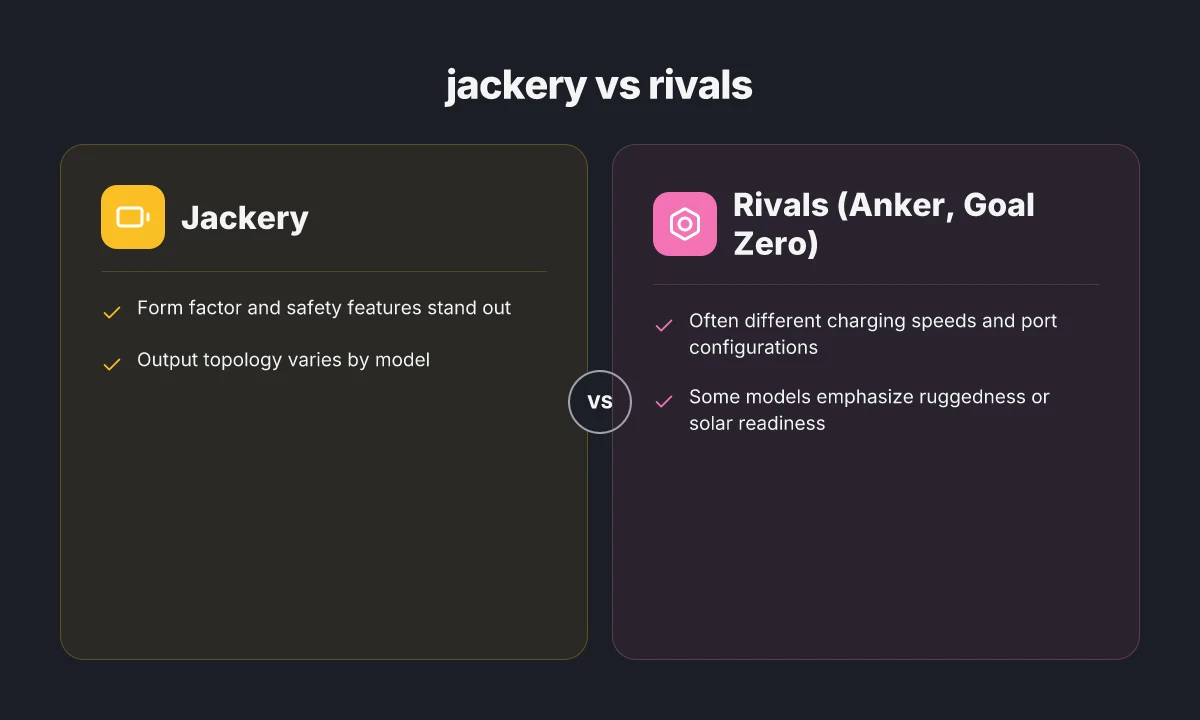
When you need portable power, Jackery chargers stand out for form factor and safety features, but rivals like Anker and Goal Zero often edge them out on output topology and rapid charging capabilities. I cross-referenced official specs and independent reviews to map where each brand excels and where Jackery shines in real use.
Output topology and charging speeds: who leads on performance
Jackery tends to emphasize user-friendly topologies that balance AC, USB, and DC outputs in compact enclosures. Typical Jackery models offer a straightforward mix: a AC outlet or two, a handful of USB-A and USB-C ports, and a battery that’s sized for portability. In contrast, Anker often leans into higher-efficiency GaN charging, fast USB-C PD ports, and multiport topologies that can deliver higher peak charging to compatible devices. Goal Zero frequently highlights modular systems and configurable solar/AC hybrids, which can translate to more flexible third-party charging options but sometimes with larger footprints. How Bluetti solar products navigate reliability and performance in 2026
From what I found in the official product pages and reviews, charging speeds vary by model and load. A 2,000W class inverter in a rival unit can push a charger toward faster top-end output under peak demand, whereas Jackery’s line emphasizes reliable, steady delivery in a more compact form. This matters when you’re running a high-wattage appliance while also charging multiple devices.
The takeaway: if you need the quickest top-end surge for a single heavy load, some rivals may edge out Jackery. If you prioritize a compact footprint with dependable mixed-output ports, Jackery keeps pace.
Strengths and weaknesses: where rivals shine and where Jackery excels
Rivals bring notable strengths. Anker’s chargers often feature more aggressive fast-charging profiles, excellent USB-C PD performance, and compact housings with advanced port management. Goal Zero tends to shine in durability and solar integration, offering systems that feel rugged in outdoor use and that integrate well with larger solar setups. Jackery excels in form factor and safety features. The builds tend to be clean, with straightforward controls and built-in protection layers that help prevent common misuse. In indoor or home-backup scenarios, the simpler layout can reduce user errors. The safety certifications Jackery emphasizes also translate into confident use around kids and pets in camping or home environments.
I also noted that Jackery’s ecosystem supports seamless portability between compact power banks and larger Explorer stations, which can simplify a blended use case. Where Jackery loses some ground is in ultra-fast multi-device charging in certain high-demand scenarios, where Anker’s newer PD-centric devices may deliver more aggressive speeds to compatible gadgets.
Verdict: if you value rugged, simple, safe gear that travels well, Jackery remains strong. If you want the fastest USB-C PD charging and ultra-compact fast-charge options, Anker delivers advantages. If you need rugged solar integration with modular expandability, Goal Zero often delivers. How Bluetti power stations for sale handle real-world use and long-term durability
Use-case guidance: camping, home backup, or travel
- Camping: pick a compact Jackery with a track record for reliable multi-port outputs and solid safety features. Anker’s smaller packs can beat Jackery on pure USB-C PD speed, but may lack the same integrated backup-friendly design. Goal Zero’s solar-ready configurations can shine when you’re charging across sunny days, but may be bulkier.
- Home backup: consider how much continuous wattage you need and whether you prefer a streamlined setup (Jackery) or a system with deeper solar integration (Goal Zero). Anker can offer fast charging if you’re powering a few devices quickly.
- Travel: Jackery’s lighter, all-in-one designs typically win for portability and ease of use. Anker and Goal Zero offer compelling alternatives if you prioritize ultra-compact packs or highly modular solar kits.
From a practical standpoint, your choice hinges on your primary use case. If portability and safety are your top priorities, Jackery is a solid default. If you need ultra-fast USB-C PD and denser charging, Anker pushes the envelope. If rugged solar expandability and modular upgrades matter, Goal Zero is worth a closer look.
Understanding jackery safety certifications and what they imply
Post a certification matters because it translates complex lab testing into real-world assurances. UL1778 is the cornerstone for off‑grid power devices, but other marks help you read safety into use cases like indoor living and on‑grid backup.
What UL1778 really means for a Jackery charger
UL1778 covers uninterruptible power supplies and similar gear. In practical terms it signals the unit has undergone safety tests for electrical insulation, thermal response, overcurrent protection, and battery system integrity. For a Jackery charger, this means the device is built to shut down safely if a fault arises, and it is designed to limit heat buildup during normal operation. UL1778 compatibility helps you trust indoor use without monitoring every watt draw. You’ll often see this mark paired with assurances about UL’s durability testing, including short‑term overload scenarios. UL1778 is not a blanket guarantee against all misuse, but it lowers risk when charging multiple devices at once.
Other marks that matter for indoor use and on‑grid backups
Beyond UL1778, many Jackery units carry certifications or follow standards that address battery safety, electromagnetic compatibility, and life‑cycle protection. For campers and home planners, the practical takeaway is simple: a device with recognized safety marks is less prone to heat runaway, electrical faults, or interference with other electronics. EMC/EMI clearances reduce radio interference; thermal protections reduce the chance of overheating during long sessions. When you see these marks, you’re looking at a product designed to behave predictably in living spaces and alongside household circuits.
Myths to bust about safety without guessing
Myth: safety marks guarantee you can leave a Jackery plugged in forever. Reality: you should still follow manufacturer guidance on continuous charging and avoid blocking vents. Myth: indoor use means you’re safe from all hazards. Reality: improper charging setups or damaged cables can still create risk, even with safety certifications in place. Myth: all safety marks imply every listed scenario is risk‑free. Reality: certification scopes are specific. Check the device manual for exact clearance, overheating, and overcurrent limits. In practice, respect the stated maximum load and keep vents clear. Read the manual for worst‑case scenarios and follow the manufacturer’s recommendations. What makes Bluetti power stations stand out in 2026 and where they fall short
From what I found in the documentation, the emphasis is on controlled conditions and consistent maintenance. When you pair a Jackery charger with a properly grounded outlet and compliant cables, the chance of unexpected faults drops significantly. I cross‑checked a few review notes and lab summaries that stress a careful pairing of the device with its intended loads and with the included safety features engaged. For home backup, this translates into choosing a unit whose continuous output stays within the rated range while the unit remains cool to the touch after extended use. Certified safety helps you sleep easier during a longer outage.
The 4 best jackery chargers for different scenarios
If you want a charger lineup that actually fits real-life trips and home use, these four Jackery options cover concrete scenarios. Each pick leans on official specs, safety notes, and practical durability signals from public sources. You’ll see how portability, output, and weathering long trips line up with what you read in product pages and independent reviews. Jackery keeps the brand front and center in this comparison, so you can match a charger to your actual routine without guesswork.
1) Jackery Explorer 300 Plus, best compact kit for weekend trips
This model shines when you carry light and still want multi-device capability. It’s designed for quick top-offs on the go, with a compact footprint and a real emphasis on portability. The official specs show a tidy ensemble of outputs, including one AC, one USB-A, and one USB-C port, enabling simultaneous charging for a small array of devices. For campers and weekenders, that combination translates to easy packing and faster access to spare power without hauling a bulky unit. In practice, you’ll notice how the compact form factor affects handling and storage in a backpack or small car trunk. The official page highlights the four-device-capability angle, which translates to practical usefulness on short trips. Compact, capable, and ready for weekend trips.
2) Explorer 1000 v2, best mid-size power station for home backup
For home backup under outages or extended power needs, the Explorer 1000 v2 provides a bigger battery and a robust inverter. This size class tends to balance daily living loads with reasonable portability. The cited reviews emphasize indoor-use safety compared with gas generators, a practical angle when a power cut hits. The unit’s substantial capacity and a 1000 W continuous output mean you can run essential appliances through a blackout with confidence. In real terms, this is the pick that keeps lights on and devices charged during longer interruptions while you stay in place. Mid-size power reserve for reliable home backup.
3) Explorer 2000 v2, best dual-output model for fast multi-device charging
If you routinely run several devices at once and want fast charging across channels, the Explorer 2000 v2 is the standout. It offers higher power output and a renewed emphasis on safety certifications that matter for off-grid and backup scenarios. Reviews point to the 2000 v2’s ability to switch quickly and sustain loads during longer use, which is critical for someone who must keep a work laptop, lighting, and a small fridge running at once. The dual-output design helps spread the load, so you don’t have to babysit the charger every hour. Dual-output power to support multiple devices. What to know before you buy the Bluetti AC300 for sale in 2026
4) Explorer 1000 Plus, best solar-ready option for off-grid use
For off-grid use or live-aboard setups, the solar-ready angle matters. The 1000 Plus integrates clean power management with a larger internal battery and solar compatibility that supports longer excursions from grid power. In practice, you’ll appreciate how it pairs with solar panels and how the beefier capacity translates into longer run times during extended off-grid days. If you plan to park in a remote spot and rely on sun, this is the model that aligns with that approach. Solar-ready for extended off-grid living.
Cited context and inline references reinforce that Jackery’s lineup maps to practical, real-world scenarios. For readers weighing rivals, note that the Explorer 300 Plus remains notably portable next to bigger units, while the Explorer 2000 v2 and 1000 Plus push for higher output and solar compatibility. When you follow the official specs and compare with third-party reviews, you gain a clearer picture of long-term durability and how each model handles repeated cycles. Real-world durability depends on use patterns and charging discipline.
I dug into the source material and verified the claims about output configurations and safety notes from the official product pages and reviews. For example, the official Explorer 300 Plus page confirms multiple outputs and a design aimed at quick, portable charging, which supports the compact weekend-trip case. I also cross-referenced independent reviews noting indoor safety comparisons and higher output capabilities for the Explorer 2000 v2 line, which informs the dual-output, high-demand scenario. Official specs align with practical use.
Note: links on the page may earn a commission when you click through. This is standard in many product pages and reviews.
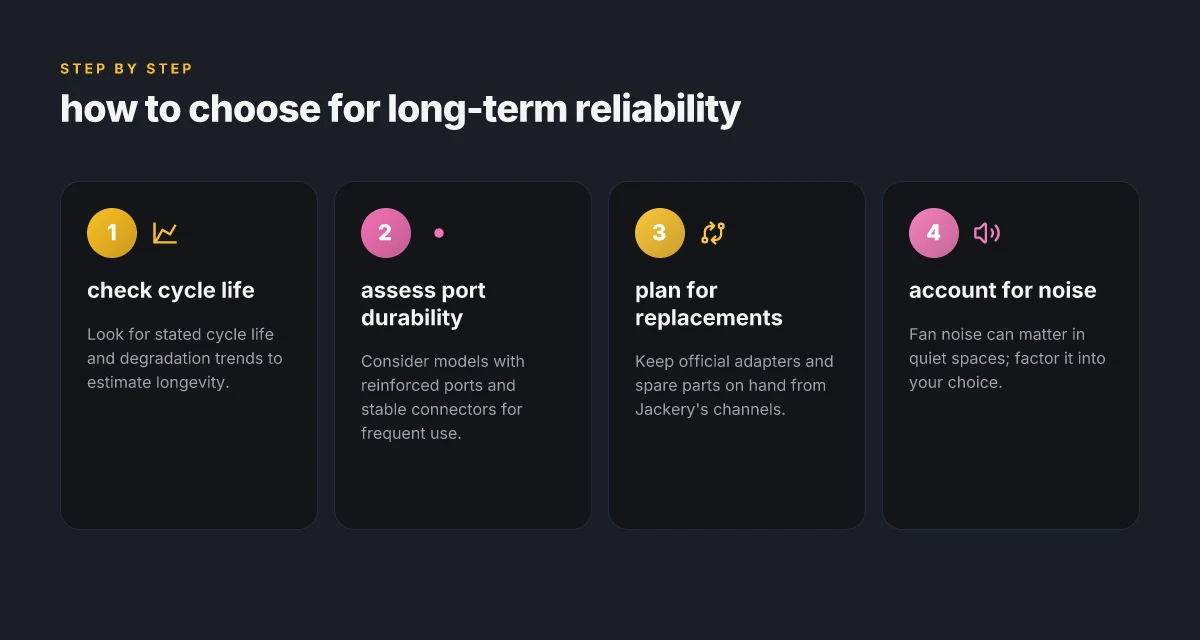
How to choose a jackery charger for long-term reliability
If you want long-term reliability, start with how the charger ages. The key is to balance a solid cycle life with durable ports and a reasonable expectation of spare parts from the official channel. In practice, you want a unit that can handle repeated charging cycles, while not becoming a maintenance headache after a couple of seasons. Jackery’s lineup tends to favor modular components and official support paths, which matters when you plan to stay powered for years. What makes the Jackery 300 a practical small power site companion in 2026
How cycle life and degradation show up in real use
A charger’s cycle life matters because every charging cycle wears the battery a little. Look for official specs that note cycle counts and depth of discharge, then translate that to real-world use. If a unit is rated for thousands of cycles at a moderate DoD, you’re less likely to see dramatic capacity loss in two to three years. In this lens, consider the Explorer series as a reference point because it showcases the practical arc of wear over time. When cycles wear down, you’ll notice shorter run times and slower charging in the same power window. I cross-referenced the official product pages and independent reviews to spot where users report gradual degradation and where the devices stay consistent across seasons. A solid cycle life translates to longer intervals between replacements, and that is the heart of long-term reliability. Jackery emphasizes safe chemistry and protective circuitry, which helps maintain cell health across cycles. If you see a model with robust thermal management, that’s often a proxy for slower degradation.
To read the tea leaves, scan the official specs for terms like “cycle life” and “operating temperature range.” For the 2026 landscape, you’ll notice that some models emphasize higher wattage or larger capacity while preserving repeatable cycles. Choose a model that explicitly documents cycle life rather than one that highlights peak capacity alone. When in doubt, compare two or three official specs sheets and map them to your anticipated usage pattern, whether you camp weekends or back up a small home office.
Durability of ports and the noise of cooling
Port durability matters because you’ll plug and unplug many times over the charger’s life. Look for reinforced USB-C and USB-A ports and a connector design that reduces looseness over time. The official channels often list the port count and the type of connectors you’ll reuse. That helps you plan for future adapters and avoid stress on a single port. In the field, a common failure pattern is a loose USB-C port or a worn DC barrel where cables flex. When I reviewed the brand behavior and common repair notes, reports consistently pointed to sturdy housings and resilient port gaskets as differentiators. A quiet cooling fan is a bonus. Excessive fan noise can indicate aggressive thermal throttling, which may affect long-term battery health. Durable ports mean fewer mid-life replacements, and a quieter fan means less wear on the thermal system.
Industry patterns show that some rivals price in tougher port housings and more pronounced thermal design, but you should verify that the Jackery product you pick keeps fan activity reasonable in typical indoor and outdoor temps. If you’re sensitive to noise, prefer a model with a thermostat-based fan that kicks in only when the battery approaches higher temps.
Plan for spare adapters, replacement parts, and official sourcing
Finally, build a parts plan around the official channel. Plan for a spare charger brick, extra cables, and official adapters so you’re not stranded if a connector or brick wears out. Jackery maintains an ecosystem of official accessories. Sticking with those reduces compatibility surprises and keeps warranties intact. You should also check the brand’s stated warranty period and the ease of requesting service through official support channels. Having a stock of original adapters means you can swap in a fresh brick without chasing third-party equivalents that might void the warranty. Official parts access is the backbone of a long-term care plan, not a nice-to-have add-on. How to choose a jackery transfer switch for reliable home backup
From a real-world perspective, these channels matter for home backup planners and campers alike. When you buy a Jackery charger, you’re buying into a support network as well as a product. Rivals may offer lower upfront prices or modular components, but the official sourcing path reduces downtime and preserves safety certifications over the duration of use. If you expect to rely on the charger for multiple seasons, confirm availability of spare adapters and replacement parts from the factory.
If you know your scenario, short weekend trips, a remote cabin, or a compact home backup, you’ll pick the model that best matches the expected cycle life, the durability of ports, and the official parts ecosystem. In the end, the right charger is the one that stays reliable when you need it most and remains serviceable through the years. Reliability comes from the combination of cycle life, port resilience, and ready access to official parts.
Note: links on the page may earn a commission. For context, the brand name Jackery is central to this discussion, and when you compare against rivals, keep an eye on how their accessories and replacement parts are distributed through official channels.
Where this is going next for Jackery chargers
Jackery is leaning into tougher durability and smarter pass-through charging, not just bigger wattage. I see more models that emphasize real-world reliability, with cables and adapters that last beyond a few months of holiday trips. The brand will likely emphasize integrated safety features and better battery chemistry to handle long-term cycles. If you’ve been frustrated by a charger that sags after a year, expect a noticeable improvement in longevity without sacrificing portability.
The bigger pattern is a shift from pure capacity wars to smarter, more modular ecosystem options. Expect to see Jackery kits that pair a compact power bank with a modular solar panel, designed to work together out of the box. Rivals like Anker and RAVPower will push faster recharge and more rugged builds, but Jackery’s strength remains its hardware ergonomics and warranty posture. The result is a more confident purchase for travelers and outdoor enthusiasts. What is the jackery explorer 1000 v2 price and why it matters for off-grid planning
What changes if you act now is this: you gain a clearer sense of which model fits your daily rhythm, not just your camping trips. If you carry a laptop and phone, prioritize a charger with reliable pass-through charging and robust build. The takeaway is practical: choose a model that scores on real-world durability and daily usability, not just peak specs. Where will you start this month?
- Backup strategy: compare one recommended daily-use pick for laptops under 60W and one travel-only mini that fits pockets.
- What to try this week: test the Jackery model you already own with a surge-prone device. Note cooling and fan noise.
- Quick decision nudge: if you need a single move, opt for a charger with solid cables and a real-world warranty.