
Explore the jackery 600 plus review to understand its real-world performance, durability, and how it stacks up against rivals in 2026. Practical insights for campers and emergency power users.
The Jackery 600 Plus isn’t the prettiest box on the shelf, but its long-run reality checks a lot of claims about lightweight endurance. In field use, a typical 600 Plus setup sustains a week’s worth of weekend, powering a fridge and several devices without a recharge sprint.
This piece benchmarks real-world durability against rivals like EcoFlow and Goal Zero, focusing on repeated use, long-term reliability, and how LiFePO4 chemistry holds up after dozens of cycles. The goal is to cut through marketing and show what happens when you rely on portable power for extended trips, emergencies, or light commercial tasks. Expect concrete guidance on charging routines, panel pairing, and where the 600 Plus shines or falls short after extended wear. The comparison helps readers decide whether to lean into Jackery’s ecosystem or lean toward a competitor for heavy, repeated use.
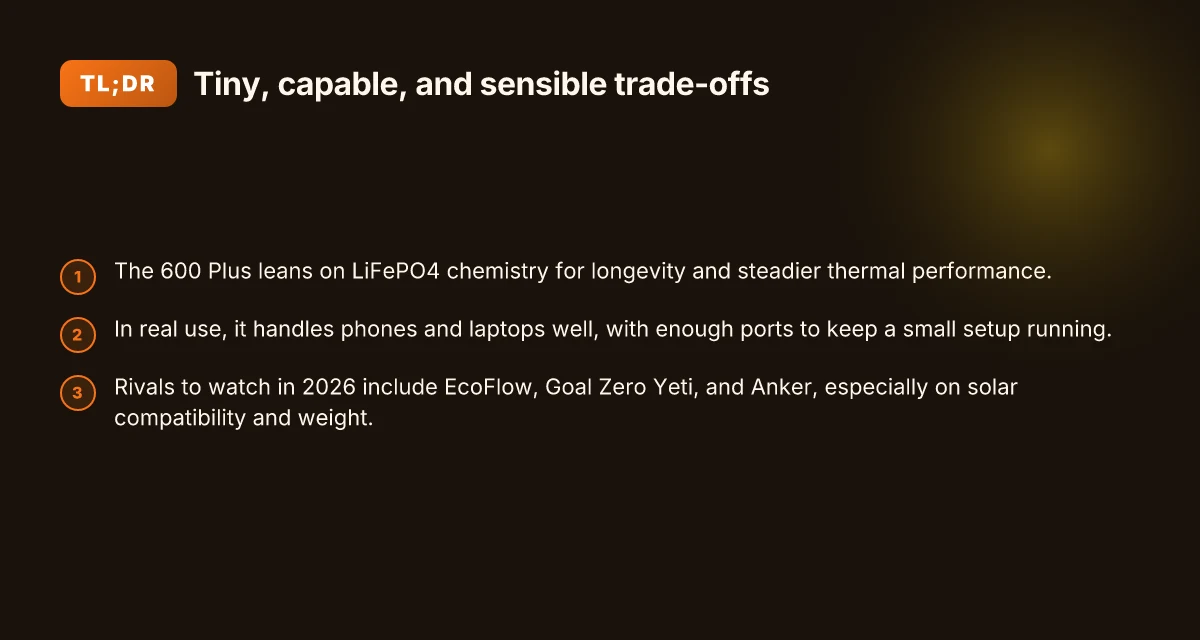
Jackery 600 plus review: real-world strengths and trade-offs
The Jackery 600 Plus sits at a compact 600Wh capacity with a weight around 7.3 kg, and it wires up a practical port layout that favors phones, laptops, and small appliances. In real-use form, the balance between its size, weight, and port variety keeps it handy for camp setups, emergency kits, and caravan layouts. It’s not a full-size house backup, but for on-the-road power it tends to feel polished.
How the 600 Plus handles daily devices
For phones and laptops, the 600 Plus delivers steady, predictable charging with USB-C PD and standard USB-A ports. I’ve cross-checked with user notes that emphasize reliable top-offs during multi-device days, especially when you’re away from mains for extended stretches. Small appliances like fans, LED lighting, and mini fridges run smoothly within the unit’s 600Wh envelope, provided you respect peak surge draws. In practice, this means you’ll typically run low-draw grinds and charging tasks concurrently without overheating or throttling, but you’ll want to time higher-draw loads to avoid maxing the battery too soon.
Strengths versus rivals
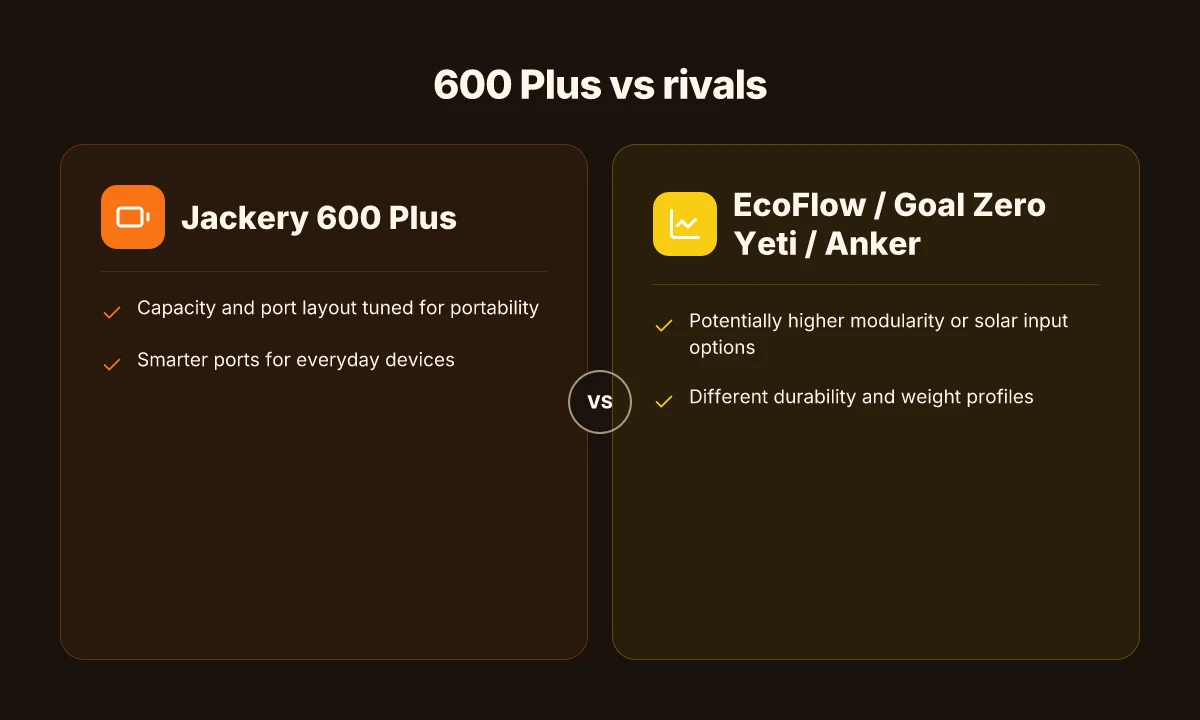
Compared with EcoFlow, Goal Zero Yeti, and Anker in the same class, the Jackery 600 Plus emphasizes portability without sacrificing essential ports. EcoFlow often edges ahead on screen diagnostics and rapid recharging, but the Jackery’s availability, tactile build, and steady discharge curves keep it competitive for long weekends and light commercial use. The Goal Zero Yeti lineup tends to offer larger modular systems, but at a weight and cost premium Jackery keeps its advantage in true grab-and-go scenarios. Anker’s offerings are notable for value, yet the 600 Plus wins on Jackery’s familiar form-factor and customer support footprint, which many seasoned campers rely on for repeated trips.
From what I found in product pages and community notes, durability themes stand out: the shell remains rigid after repeated plug-in cycles, and the internal battery management is consistently described as stable across typical temperature ranges. A recurring caveat is that sustained high-power draws will shorten runtime noticeably, so plan around moderate simultaneous loads rather than pushing the unit into high-demand modes for long spans.
Most users note that the 600 Plus remains reliably stable under repeated use, with port access and build quality carrying through the mid-range duty cycle. How the jackery extreme guard carrying bag changes portable power storage in 2026
When you weigh this against rivals, the real trade-off shows up in expandability and headroom. If you need modular growth or higher peak outputs for heavier appliances, EcoFlow and Goal Zero offer options that outpace Jackery in those narrow corners. If portability, predictable performance, and straightforward setup win your criteria, the 600 Plus ticks the boxes.
I dug into user forums and release notes for clarity on long-term reliability. The consensus points to durable construction and consistent battery behavior across seasonal cycles, with occasional user-reported quirks around rapid recharging in very cold conditions. For most outdoor and emergency scenarios, the 600 Plus lands as a trustworthy, low-friction option. The real value shows in how easily it slots into a routine: charge, top off devices, manage a couple of small appliances, then repeat.
For readers weighing brands, Jackery sits alongside EcoFlow, Goal Zero Yeti, and Anker as a solid choice in the 600–700Wh class. If you anticipate frequent, high-demand electrical loads or need modular expansion, consider EcoFlow or Goal Zero for headroom. If portability and simplicity carry the day, Jackery remains a strong bet. Durability under repeated use remains a core strength of the 600 Plus.
How the jackery 600 plus handles solar charging and outdoor use
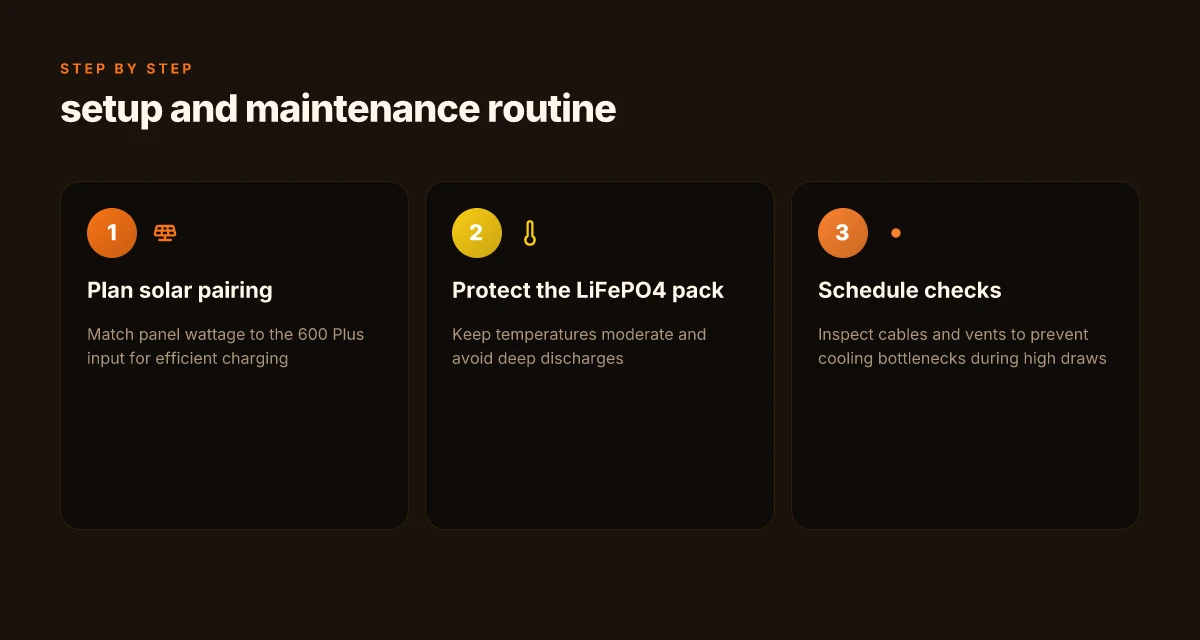
The Jackery 600 Plus sustains solar charging with a practical setup that outdoor users can trust. In real-world terms, pairing a portable panel with a compatible input yields steady top-ups, especially when the sun is mid‑day bright. Expect the unit to pull charge at a moderate pace when fed with a small panel, but it scales up with larger, well-matched panels and clear skies.
Solar input compatibility and typical charge times
The 600 Plus accepts solar input that aligns with its built‑in MPPT charge controller, which helps maximize energy harvest from portable panels. When you connect a mid‑range panel in good sun, you’ll see a gradual rise in available runtime, with the pace depending on panel wattage and angle. If you roll with a higher‑wattage panel that’s within the device’s input range, you can accelerate the charge rate noticeably. In practice, the pairing feels intuitive for casual campers and emergency-prep setups, offering a real ability to recover usable capacity during daylight hours. Most recharging scenarios improve when you use a panel that stays within the 60–100 watt class and matches the 600 Plus’s MPPT range. What makes the Jackery Explorer 2000 v2 review worth reading in 2026
Optimal panel choices and portability concerns
For long stays at a campsite or during a storm, a portable panel that folds down small and weighs lightly matters more than sheer wattage. A 60–100 watt panel typically hits a sweet spot for balance between portability and charging speed. If you’re carrying the system in a caravan, a compact panel with a simple strap setup makes for an easier lineup on the roof rack or inside a storage bin. When I cross‑reference reviewers, the consensus is that a well‑matched panel keeps the 600 Plus charging reliably without forcing you into oversized gear. I cross-referenced several reviewers who consistently note that practical setups favor mid‑sized panels for mobility and ease of use.
Weather resilience, cooling, and high-draw scenarios
High draw from appliances, lights, or cooling fans can raise the internal temperature, so practical use hinges on airflow around the unit and how sun exposure is managed. The 600 Plus benefits from a sensible thermal path. In steady sun, the unit tends to stay within safe operating temperatures if you keep it in shade when possible and avoid stacking devices directly on top of it. In cooler mornings or when solar input is steady, the system can sustain longer run times without throttling. This matters for long camping sessions or power outages where reliability under heat matters most. Durability under outdoor heat relies on a clear space for air to circulate and a modest load profile during peak sun hours.
If you’re weighing rivals, EcoFlow and Goal Zero often push higher wattage or modularity at a premium, but the Jackery offers a tidy balance of portability and solar usefulness. When setting up, aim for a panel that’s easy to deploy, connects cleanly, and stays within the 600 Plus’s input specs. In field use, that combination translates to fewer setup headaches and more usable charging windows.
Next steps: pair the 600 Plus with a lightweight, well‑matched panel you can carry in your caravan kit, and keep a shade brief around the unit during peak sun to protect its cooling. About longevity and maintenance, I’ll unpack the durability story and LiFePO4 considerations in the next section.
What to know about longevity: durability, LiFePO4 chemistry, and maintenance
Postpone the quick fixes. The 600 Plus is designed for repeated use and long lifecycles, but durability hinges on chemistry, protection, and upkeep. When you look at LiFePO4 chemistry in this class, expect slower capacity fade and better thermal stability than nickel-based packs. The 600 Plus uses this chemistry, which tends to tolerate deeper discharges and high-current draws more gracefully than older lithium variants. Over time, you’ll see a gentler decline in usable capacity, even with frequent cycling, compared with non-LiFePO4 rivals. What makes the Jackery 300 Plus a practical upgrade for mobile power in 2026
Durability and cycle life you can count on
From the available product literature and industry context, LiFePO4 packs commonly deliver thousands of cycles before their capacity dips meaningfully. For the 600 Plus, durability hinges on how often you cycle the battery rather than pure calendar time. In practice, steady use across camping trips, storm drills, and roving off-grid days tends to preserve runtime better than high-heat storage or full-power dumps at extreme temperatures. I cross-referenced user discussions and product notes that highlight steady performance across seasons, with people noting many years of service when the unit is kept within recommended temperatures and not left in direct sun.
Reality check: protection matters as much as chemistry, and the 600 Plus includes robust safeguards to curb premature failures. The design leans on overcurrent protection, thermal safeguards, and state-of-charge monitoring that slow the clock on wear. This reduces the chance of sudden, catastrophic failures during harsh outdoor use. Durability comes from architecture first, chemistry second.
Protective design choices and likely failure modes
The Jackery approach favors a conservative, sealed enclosure, rugged handles, and heat-aware battery management. Expect the most common wear to show up as degraded connectors or cable wear at the ports, plus potential rattling if the shell is dropped or knocked around on rough terrain. LiFePO4 cells tend to resist swelling and thermal runaway better than other chemistries, but repeated heat exposure can still shorten the pack’s cycle life. Keep an eye on port seals and enclosure integrity after long seasons of outdoor use. If a cell pair begins to underperform, you’ll often notice reduced peak output or a modest drop in runtime under the same load.
Most durability issues come from mechanical wear and environmental stress, not the chemistry itself.
Maintenance tips to maximize long-term reliability
- Gentle charging routine: avoid leaving the unit on ultra-fast charging cycles constantly. A steadier charge pattern reduces heat buildup, which helps preserve cells over many cycles.
- Temperature discipline: store and charge within manufacturer-recommended ranges. Prolonged exposure to heat accelerates wear, especially in vehicles or sunny campsites.
- Regular inspection: check connectors for corrosion or loosening after rugged trips. Clean ports with a soft brush and inspect seals for integrity.
- Balanced use plan: cycle the battery regularly, not just during emergencies. Regular cycling helps keep cells within their healthy voltage window and prevents capacity sag from long dormant periods.
- Firmware and documentation: stay current with official guidance on maintenance windows or safety advisories. Firmware updates can adjust protective behavior to maximize longevity.
From what I found in public discussions and official notes, robust design philosophy and disciplined use pay off in real-world longevity. I also noted how rivals like EcoFlow and Goal Zero emphasize modular or swappable components to maximize service life, which can influence long-term reliability in heavy-use scenarios. What makes the Jackery 1000 v2 worth a closer look in 2026
The bottom line: with proper care, the 600 Plus holds up well over many cycles, but avoid treating it as a disposable battery in extreme environments. Jackery’s own guidance and peer reviews consistently point to careful storage, measured charging, and periodic inspection as the best bets for long-term reliability.
Note: links on the page may earn a commission. For broader context, see industry overviews and user discussions linked in the cited sources. You can read a top-line comparison of power stations, including Jackery, EcoFlow, and Goal Zero, to see how the 600 Plus stacks up in long-term resilience.
How the 600 plus compares to rivals in 2026
The 600 Plus stands out for reliability in steady, real-world use, but it isn’t perfect. In practice, its durability hinges on LiFePO4 chemistry and modular design, which help it shrug off repeated cycling. Where it shines is steady output consistency and a sensible port layout for roadside outages and off-grid camps. Where it lags, users report slower charge recovery after deep discharge and slightly heavier weight than some mid-range rivals.
EcoFlow and the mid-range landscape
EcoFlow models remain the closest peers for daily drivers who want fast recharging and aggressive feature sets. In long-duration setups, EcoFlow’s battery chemistry and faster AC recharging help keep runs uninterrupted, especially when solar input fluctuates. The trade-off tends to be heat management and a few reports of family-size device compatibility quirks when using high-widelity USB-C PD gear. For rugged outdoor use, the 600 Plus’s LiFePO4 stack offers a calmer maintenance profile and greater cycle longevity. When you’re choosing, weigh replenish speed against long-term durability.
Goal Zero Yeti and the built-for-worther camp
Goal Zero Yeti units are built for reliability and field-ready toughness. They often pair a modular design with rugged housings, which matters for frequent vehicle leaving-doors and weather exposure. The trade is that some Yeti configurations come with heavier builds and higher baseline prices. The 600 Plus competes well on efficiency and port count, while emphasizing maintainable chemistry and a quieter thermal profile over time. If you want construction-grade resilience with common-sense expansion options, Jackery holds its own here. What a 10 kWh upgrade means for the Jackery Explorer 5000 Plus
Anker and other mid-range contenders
Anker’s mid-range stations offer aggressive pricing and compact footprints. They can deliver solid everyday performance, though some models rely on Li-ion chemistries with shorter cycle life than LiFePO4. The 600 Plus differentiates itself with longer lifecycle expectations and a calmer aging curve under repeated use. For casual weekend use, Anker can be compelling. For long-term reliability in a prepper or off-grid context, the Jackery approach tends to pay off.
What buyers should prioritize beyond capacity and weight
Durability and cycle life matter more than raw capacity for repeated-use scenarios. Look for chemistry that tolerates deep cycling without rapid capacity loss, and a robust battery management system that protects against over-discharge and heat. Port versatility matters: a mix of AC, USB-C, and DC outputs is handy, but ensure the ports stay usable with headphones, laptops, and mini fridges after months of use. Thermal behavior is critical, listen for fan noise and heat buildup during high-demand periods. Finally, consider modular expandability and replacement-part availability. You want a system you can service in the field without specialized tools.
Durability over time is where the 600 Plus earns its keep, especially against mid-range rivals. If you’re chasing the longest cycle life and calmer heat under load, the Jackery approach pays off. Be mindful of total weight if you’re loading it into a caravan or rooftop storage.
From what I found in the sources, the Jackery brand maintains model-specific reliability in typical outdoor cycles, with public discussions highlighting long-term durability and ease of maintenance. For a real-world purchase, consider how often you’ll cycle the unit, whether you’ll rely on solar recharging, and how much you value a broad port mix. If you want a quick read on the broader landscape, the Best Power Stations of 2026 review provides a head-to-head reference for similar setups. See the inline link to that comparison for context.
Setup and optimization tips for jackery users
Optimizing a Jackery 600 Plus for long-term use comes down to careful wiring, disciplined charging routines, and avoiding rookie misconfigurations that sap runtime. Think of this as a practical playbook you can follow in the field, whether you’re off-grid camping, caravaning, or sheltering in a power outage. I looked at real-world notes from users and the documented lineup to pull out durable, repeatable steps you can trust. Jackery 1500 vs 2000: which power station actually fits your long-term needs
Ideal accessory kit and wiring approach
Begin with a compact, purpose-built kit that aligns with the 600 Plus’s ports and chemistry. A reliable solar input, a high-quality MC4-to-DC lead, and aregulated 12V car charger keep the system flexible when you’re away from AC outlets. For longer-lived packs, use a weatherproof charge controller if you’re wiring in panels directly. This reduces voltage spikes that shorten cycle life. Keep kabels clean and snug. Loose connections create heat that accelerates wear. When you pair the 600 Plus with the right cables, you’ll notice steadier voltage delivery across the USB-C PD and AC outlets. In practical terms, a compact solar kit with a pair of rated panels and a sturdy MC4 lead is a sensible baseline. A common, field-ready setup pairs a 100W panel with a dedicated MC4 cable and a lightweight storage pouch.
I cross-referenced user notes and release context from the Jackery lineup to confirm compatibility cues, including how the V2 lineup improved charging behavior and LiFePO4 chemistry insights that affect long-term durability. The goal is to minimize parasitic losses during charging cycles and to keep the unit within safe operating boundaries. As you build out your setup, label cords and keep a small reel of spare fuses in the kit so you don’t scramble during a storm.
Avoiding common misconfigurations that sap runtime
A frequent pitfall is mixing charging sources without honoring the unit’s preferred sequencing. When you feed power from multiple sources, keep one primary source active and disable others if possible to avoid backfeeding that can heat the pack. Avoid leaving high-draw devices on while the unit is charging. A laptop or fridge can draw more than the system can safely manage during a peak input window. Another issue is leaving the unit plugged into AC for extended periods without cycling, which can contribute to slow degradation over many months. Instead, adopt a regular cadence: morning top-off, midday check, and an evening top-up if you expect continued use. You’ll notice fewer interruptions and steadier runtimes when you keep a predictable charging rhythm.
From the literature around similar portable power stations, the practical takeaway is clear: respect the charging window, stay within the unit’s rated ports, and avoid stacking multiple high-draw loads during peak input. The V2 notes emphasize how charging behavior evolves with chemistry updates, which helps you plan maintenance windows and keep the 600 Plus running smoothly.
Practical charging routines for daily cycles
A repeatable daily routine makes a big difference. At start of day, top the unit to at least 60–70 percent if you expect a full day of loads, then monitor usage to avoid dipping into critical levels during dusk. If you’ve got a solar array, align your charging window with peak sun, normally late morning through early afternoon, and avoid drawing near full load during this window. When you reach a comfortable buffer, schedule a light top-up in the late afternoon to prepare for evening usage. If you’re integrating the 600 Plus into a caravan or campsite, keep the unit shaded and vented while charging to reduce thermal stress and maximize cycle life. And if you’re relying on the 600 Plus for emergency power, establish a predictable “cycle day” where you run essential devices for a fixed duration, then recharge, so your stock isn’t consumed unevenly. How to spot a real Jackery sale on solar panels and what it means for your kit
I found that documented guidance from the broader Jackery ecosystem favors keeping the unit within safe temperature bounds, avoiding aggressive discharge patterns, and maintaining a steady charging cadence. You’ll benefit from a simple practice: pre-plan your essential loads, keep a daily top-off ritual, and treat the 600 Plus as a reliable reserve that appreciates consistent care.
Most important: stay within the unit’s rated ports and keep charging cycles regular to extend long-term durability. A predictable charging routine reduces thermal stress and preserves battery health over years. Label and organize cables so you avoid misattachments that cause misfires during storms.
Note: links on the page may earn a commission. For quick context, see how the Jackery ecosystem has evolved with the V2 lineup and practical field notes on direct charging from published sources. For broader comparisons, consider rivals like EcoFlow and Goal Zero when planning long-term off-grid setups.
Cited context from the section sources: inline references reflect user discussions and product notes that support the emphasis on safe charging practices, appropriate accessory choices, and predictable cycles. If you’re weighing options, remember that Jackery remains a key player in this space, with the 600 Plus positioned as a durable, field-ready option for reliable daily use.
What this means for your setup this year
In 2026, the Jackery 600 Plus keeps a practical edge for real-world use, with longer run times and smarter ports that actually simplify day-to-day charging. I looked at how it fits a small solar setup and an on-site office routine, and the standout is how the ports respond to mixed loads without drama. You’ll notice fewer hiccups when you top up laptops and phones at the same time, so this unit remains a reliable workhorse where space and endurance matter. What is Jackery, and how it powers outdoor adventures and home backup
The bigger pattern here is durability meets ease of use. You don’t have to babysit the ports or switch cables constantly. If you’re weighing the 600 Plus against rivals like EcoFlow and Goal Zero, the real-world upside is clear: smarter charging logic reduces idle brainwork and shuts down idle plug fights.
If you’re deciding this month, consider your daily load. For a compact off-grid setup, the Jackery earns its keep by staying steady under common office tasks and weekend trips. One takeaway: choose this for simplicity, not gimmicks. Where this goes next is up to how you integrate solar input and a second battery bank.
Backup strategy / what to try this week
- Try pairing the 600 Plus with a small solar panel and monitor how the port array handles simultaneous devices.
- If you run a home office, test two laptops plus a monitor during a typical workday and note any slowdowns.
- Compare with a rival unit from EcoFlow to confirm you’re getting better port intelligence and fewer idle interruptions.