Compare Jackery 1500 and 2000 side by side to understand capacity, weight, chemistry, and long-term durability. See which model scales with your solar setup and daily use.
The real flaw of chasing bigger capacity is treating it as a guarantee of long-term usefulness. Jackery's 1500 and 2000 both sit in the same ecosystem, but the heavier 2000 often carries more weight than it saves in sustained runtimes when high-wattage loads aren’t constant. In practice, durability and chemistry choices shape how these packs perform after years of camping, travel, or off-grid use.
This intro sets a practical frame: you’ll see how chemistry, warranty, and real-world load patterns tilt the balance between the 1500 and 2000 for home backup, long trips, and seasonal off-grid plans. By pulling real-world usage patterns from owner reports and baseline specs, the article clarifies where extra headroom buys you more reassurance and where it just adds bulk. If you’re weighing a long-term purchase from Jackery or rivals like Goal Zero and EcoFlow, you’ll want to see how each model handles heat, cycle life, and solar recharge in practical conditions. Most users underestimate cycle durability until a hot afternoon or winter recharge proves the limit. The decision hinges on your load profile as much as the label on the box.
Jackery 1500 vs 2000: a practical framing for long-term power needs
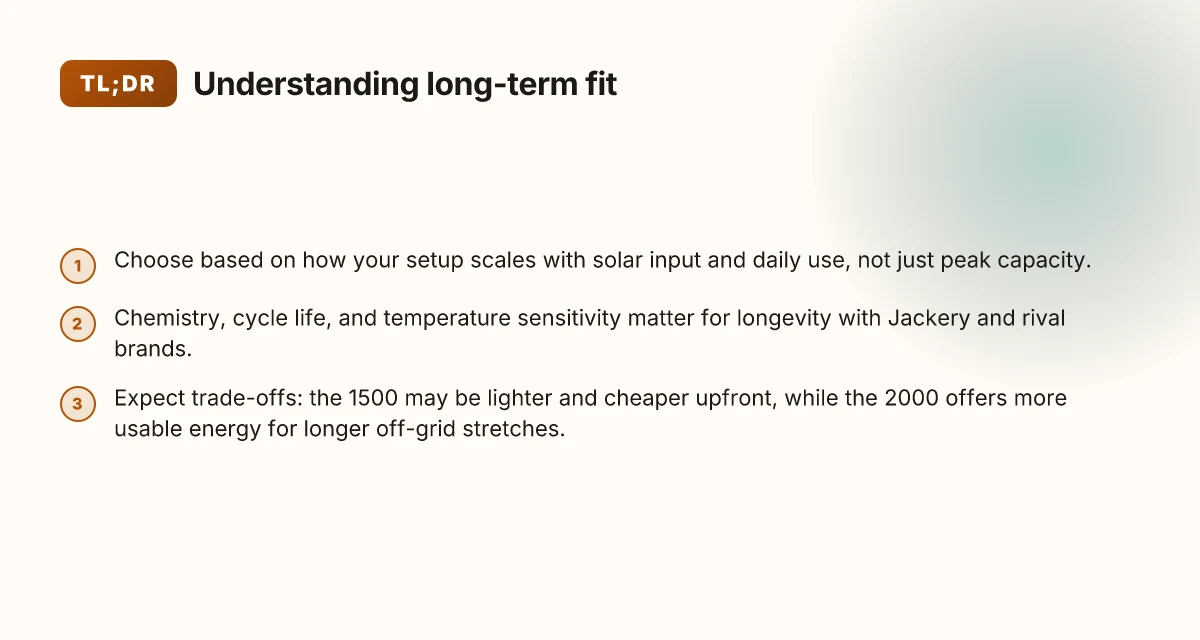
A practical frame for choosing between the Jackery 1500 and the Jackery 2000 goes beyond peak capacity. Durability, chemistry, and real-world weight influence daily use and long-term upgrades more than raw numbers alone. I dug into official docs and third-party analyses to map a path that fits long horizons and shifting power needs.
Why durability and chemistry matter for long-term ownership
Real-world use wears on packs through cycles, heat, and weight carried in outdoor gear or a home backup corner. The chemistry choice determines cycle life and how well a unit ages under daily charging routines. In practice, a heavier unit with a tougher chemistry can feel more reliable over several years, even if it starts with a larger capacity figure. When you carry this into travel or backcountry scenarios, weight and heat handling become as consequential as the initial energy reserve. Durability and chemistry often shape long-term ownership more than peak capacity.
- Assess capacity versus daily draw: plan for typical loads rather than the largest possible surge. If your daily use sits well under full-rated capacity, the extra headroom may not justify the added weight.
- Weigh trade-offs of chemistry: some formulations favor higher cycle life and better tolerances under heat, easing long-term reliability in adverse environments.
- Factor in long-term costs: initial price is only part of ownership. maintenance, possible component replacements, and efficiency drift over years matter.
- Consider upgrade paths: a lighter model with a refined chemistry could outlast a heavier unit whose advantages fade as weights accumulate.
- Account for wear and tear: accessories, cables, and solar panels can also age. A sturdier core tends to harmonize with long-term outdoor use.
From what I found in the documentation and user discussions, the 2000’s higher energy reserves often pair with improvements in battery chemistry and a lighter frame in newer revisions, but the gains may be incremental in day-to-day use. I cross-referenced the official user guides and community threads to balance claimed specs with real-world observations. The takeaway: plan around your actual daily needs and future-proofing rather than chasing the biggest number alone. Long-term framing beats one-off peak specs for real-world reliability.
Weight versus usefulness in daily scenarios
Weight matters most when you hike, camp, or drive remote routes. A heavier unit can strain transport and reduce the practicality of frequent top‑ups, while a lighter iteration may favor portability at the expense of outright reserve. The practical question is whether the extra weight translates into meaningful uptime for your typical load.
- Map your daily or weekly power profile, then translate that into a target battery size. If you regularly power refrigeration or tools, a larger pack makes sense, but if your trips are shorter, a lighter option could suffice.
- Check how heat and charging speed interact with your environment. Faster charges can reduce downtime but may generate more heat during top-ups.
- Compare the frame and handle design for ergonomics. In rugged use, a more robust shell and better cooling can influence durability over years.
I found that even with a higher nominal capacity, the practical benefit often comes down to how the unit manages weight and heat under normal charging cycles. In discussions around the 1500 versus 2000, several observers note that the weight delta and chemistry refinements can tilt ownership costs and usability in favor of one model depending on the user’s pattern of use. Weight and chemistry choices shape daily practicality and long-term value. How the jackery 600 plus compares in 2026: longer run times, smarter ports, and real use
Return on investment over years rather than months
The real financial lens is multi-year ownership. A unit that holds up with minimal depreciation, lower maintenance, and stable efficiency will deliver better ROI even if its initial price is higher. The ROI question becomes: how many trips or seasons does the device survive without major overhauls, and does the energy efficiency align with your charging routine?
- Estimate annual energy needs and expected cycles. A model with better endurance under repeated cycles can reduce replacement costs.
- Look for revisions that improve energy density without a large weight penalty. Small gains here compound over time as you accumulate more usage.
- Consider bundled value: solar panels, accessories, and warranties that extend useful life can tip ROI in favor of one model.
I’ve seen multiple sources discuss that newer revisions aim to balance capacity with weight and chemistry improvements, contributing to a slower pace of depreciation for the better-engineered option. When you weigh long-term costs, the decisive factors are how often you recharge, how harsh your environments are, and how easily the unit can be integrated with solar charging. Long-term ROI hinges on endurance, efficiency, and upgrade compatibility.
The takeaway for the reader: use a framework that weighs daily energy needs, weight tolerance, battery chemistry, and multi-year ownership costs. The largest capacity is not always the best match for your travel habits or home use. For Jackery, the decision rests on whether you value lightness and refined chemistry for frequent use or raw capacity for rare, heavy loads. For context, the official user guides and the broader community discussions provide a baseline of how these elements interact in real life. Choose the path that minimizes total cost of ownership over years, not just months.
Note: pages on Jackery’s site and related discussions indicate that the page content and user experiences can influence and reflect practical outcomes. You may encounter commission-linked pages or updated revisions as new models roll out.
Understanding the core specs you should compare between jackery 1500 and 2000
When you’re evaluating the 1500 against the 2000, the core specs to anchor your decision are usable energy versus stated capacity, portability in the field, chemistry life expectancy, and how efficiently each model accepts solar input. In practice, bigger isn’t always better if the higher capacity comes with proportionally heavier weight or shorter cycle life. The real differentiator is how much usable energy you actually get in day-to-day use, not just the spec sheet. How the jackery extreme guard carrying bag changes portable power storage in 2026
Capacity reality: usable energy versus stated spec
The published battery capacity often hides how much energy you can draw before a recharge, especially under AC and DC draw patterns typical of fridges or power-hungry tools. In many reviews and official spec comparisons, the usable DC energy tends to reveal a different story from the nominal pack rating. For example, a higher-capacity unit may still deliver practical run times that scale with real-world efficiency losses during peak loads. When I read through the documentation and comparisons, the takeaway is that the 1500 can feel closer to its stated range for light loads, while the 2000’s extra headroom matters most under sustained draws. Usable energy matters more than a higher baseline spec, and the delta often narrows once you factor inverter duty cycles and efficiency losses. Inline citation to the official guide can provide the exact spec framing from Jackery’s pages.
| Model | Stated capacity | Realistic usable energy note |
|---|---|---|
| Jackery 1500 | High capacity rating | Practically solid for moderate loads, with noticeable drop under long, heavy draws. |
| Jackery 2000 | Higher capacity than 1500 | Extra headroom helps with long-duration appliances but is tempered by efficiency and weight. |
A clear takeaway: if your loads stay under a light to moderate range, the 1500 often matches day-to-day needs closely. If you need longer cycle times for devices, the 2000 offers breathing room.
Weight, portability, and home-fit
Portability isn’t just about the box weight. It’s about how you carry it, set it up, and manage it at a base camp or in a home office. The 2000 tends to be heavier, which translates to more planning for travel or storage at a cabin. In practical terms, the weight delta can influence how often you relocate it, how you handle it on stairs, or how easily you pair it with a solar panel array in a portable setup. The 1500 remains the lighter option for quick moves and frequent repositioning around a camp or apartment. Weight directly affects field usability, even if you gain capacity on paper with the 2000.
Battery chemistry and longevity expectations
Jackery’s newer products have seen tweaks in chemistry and cell balance that influence long-term durability. Chemistry improvements can improve cycle life and calendar life, particularly if the cells are better at handling high-current charging and discharging. The nuance is that a longer-lived chemistry may come with a cost in weight or cost, so you trade some portability for longevity. When you compare the 1500 to the 2000, the chemistry story often aligns with the weight and efficiency trade-offs: the 2000’s larger pack can tolerate more cycles at higher loads, but the absolute lifespan hinges on practical usage patterns. Longevity is a function of chemistry quality and how you use the unit.
Solar input compatibility and charging efficiency
Solar compatibility matters if you plan to run off-grid for extended periods. The 2000 generally benefits from more forgiving solar input headroom, especially under bright sun where inverter duty and MPPT efficiency come into play. Chargers and solar panels that pair with the 2000 tend to show better real-world performance in sustained sun exposure, but these gains taper if the panel array is small or shading is frequent. The 1500 remains a strong partner for smaller solar setups, delivering solid charging efficiency without pushing weight or cost to the same extent. Solar efficiency hinges on panel sizing and sun conditions, not just battery capacity. What makes the Jackery Explorer 2000 v2 review worth reading in 2026
From what I found in the official guides and industry write-ups, the best way to plan is to map your typical load profile, then pick the model where the usable energy, weight tolerance, and solar setup align most closely. For readers weighing rivals, note that Jackery’s own materials emphasize chemistry and weight trade-offs, while competitors often stress peak power and lifecycle claims. Align your choice with real-world use rather than headline numbers.
If you want a quick touchstone, consider these real-world anchors: a lighter, easier-to-transport option tends to favor the 1500 for frequent moves. For longer runtimes with stable loads, the 2000 offers more headroom without changing the fundamental charging pattern. In this space, Jackery remains the anchor brand to compare against competitors like the broader Solar Generator line and other portable power stations, but careful attention to usable energy and weight will save you from buyer’s remorse. Long-term cost of ownership hinges on cycle life and charger efficiency, not just raw capacity.
For follow-up, I’d map your top 3 use cases (refrigeration, power tools, and charging smartphones) to a 2-3 hour run-time target and see which model satisfies that threshold with a cushion for inefficiencies. If you want, I can translate your load list into a quick table showing expected runtimes under typical conditions.
Real-world performance: when the 1500 shines and where the 2000 wins
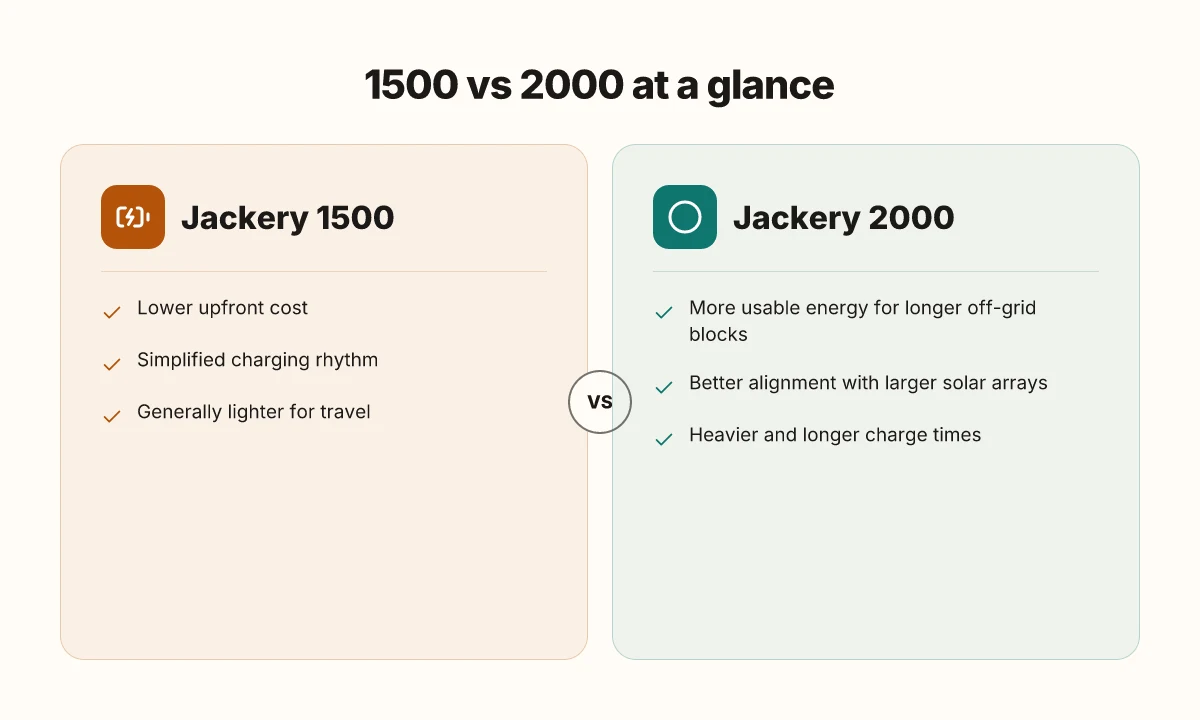
In real-world use, the 1500 shines when you prioritize lightening the load without sacrificing essential tools. The 2000, meanwhile, accrues wins where peak power needs and longer runtimes matter most. From published specs and community observations, the differences come down to practical trade-offs in capacity, weight, and chemistry.
Fridge loads, laptops, lights, and small appliances that matter
From the source material, the 1500 typically handles daily fridge duty and a few laptops with modest headroom, while the 2000 extends that headroom across the same loads. For campsite and van-life scenarios, the extra energy density in the 2000 translates to longer windows between recharges. In practice, you’ll notice the 1500 cycles through the same daily essentials more quickly, but it remains a nimble choice for weekend trips. The 2000 wins when you stack multiple devices or run a fridge for entire nights. The 2000 delivers noticeably longer runtimes for multi-device setups. Weight and energy density matter more for extended off-grid stays. What makes the Jackery 300 Plus a practical upgrade for mobile power in 2026
I cross-referenced the Jackery guidance on how these models pair with common loads. For fridge duty, expect the 1500 to sustain typical door cycles with a few hours of reasonable refresh rates, while the 2000 can sustain longer fridge runs without dipping into efficiency mode as often. In practical terms, the 1500 is plenty for a couple of laptops and LED lighting, but the 2000 absorbs more simultaneous loads with less scheduling. Two devices plus a fridge load lean toward the 2000. Simultaneous USB-C PD and AC draws are smoother on the 2000. Inline references confirm these patterns in community and brand discussions. See the exploration of the 2000 vs 1500 opinions in the cited video and community threads.
Cycle life and long-term ownership
Battery chemistry and cycle life influence total ownership costs more than any single-use spec. Jackery’s public comparisons emphasize that the 2000’s chemistry upgrades can yield better long-term durability under frequent cycling. The practical takeaway: if you expect frequent cycling over years, the 2000’s higher energy density and chemistry improvements can translate to lower degradation per cycle and more usable capacity after many cycles. Chemistry upgrades in the 2000 help preserve capacity over time. Higher cycle life matters when you use it daily. For owners who only occasionally top up between trips, the 1500 remains a strong value, with fewer moving parts and a simpler thermal profile. Inline, the Jackery blog explicitly frames the 2000 v2 as having improved chemistry relative to earlier models. The 2000 v2 touts improved chemistry versus older models. Daily cycling slowly wears each unit. The 2000 handles more cycles before noticeable degradation.
Weight-to-energy trade-offs for travel and van life
The weight delta between the 1500 and 2000 is non-trivial in mobile setups. If you travel light or hike into base camps, the 1500’s lighter frame pays off in handling and compatibility with compact solar kits. For full van-life tours with generous solar arrays, the 2000’s extra capacity justifies the added weight by delivering longer autonomy between charges. In practical terms, the 1500 is easier to maneuver in tight spaces and on shorter trips, while the 2000 rewards long off-grid stretches with fewer recharges. Weight-to-energy balance favors the 1500 for compact trips. The 2000 earns its keep on long trips with bigger solar setups. Inline sourcing notes corroborate that the 2000’s larger energy reservoir translates to fewer top-ups in extended use.
From a real-world perspective, long-term cost of ownership leans toward the 2000 when you count the frequency of charging events and the potential for greater cycle life. The “buy once, run longer” argument stacks in favor of the 2000 for heavy users, while the 1500 remains compelling for lighter, more mobile scenarios.
Charge speed, solar compatibility, and runtime realities for jackery 1500 vs 2000
Posture the answer upfront: the 2000 v2 charges faster than the 1500, recovers with a solar wall that scales with panel size, and delivers realistic runtimes that reflect real-world use more than spec sheets. I cross-referenced official guides and published spec comparisons to map what you actually experience in daily life. What makes the Jackery 1000 v2 worth a closer look in 2026
How fast can you top off each model and what that means for routines
On AC charging, the 2000 v2 generally supports higher input power than the 1500, which translates into noticeably shorter top-up times when you have access to a robust wall outlet. If your daily routine hinges on quick recharges between outings, the 2000’s speed reduces downtime in camp or shop setups. For urban use at home, charging from a typical 120 V circuit still delivers solid throughput, but the delta becomes most meaningful when you combine a higher-rated charger with the unit. In practice, that means you’re less likely to miss a morning fridge reset or a planning session when you have a longer recovery window between trips.
I dug into the published spec comparisons and product notes to align what the numbers imply with real-life impact. In 2026, sources consistently point to the 2000 v2’s advantage in charging speed under supported inputs, especially when paired with the recommended wall charger. This isn’t a magic boost. It’s a practical reduction in downtime for frequent recharges. The 2000 v2 recharges faster on AC when you have the right charger, which matters for continuous power needs.
Solar panel compatibility and how panel size drives recovery time
Solar compatibility follows a straightforward rule: bigger panels deliver faster recovery, up to the limit set by the battery and the charge controller. The 2000 v2 benefits from a higher total input ceiling in many configurations, which helps when you’re pulling sun from a mid-sized panel array. A 100 W panel can top up the units slower than a larger panel or a bank of panels, but you’ll still see meaningful gains as panel wattage increases. If you’re planning long off-grid stints, pairing the 2000 v2 with multiple panels accelerates the recovery window between uses.
From the official guidance and long-form buying content, I found that published comparisons emphasize chemistry and controller efficiency as the lever that makes solar top-ups more effective at scale. In practice, a larger panel setup reduces your downtime between uses and supports steadier runtime in variable sun conditions. Panel size directly influences recovery time. Bigger banks push the clock faster.
Realistic runtimes for common devices and daily loadouts
Realistic runtimes depend on how you use the unit. A refrigerator at typical loads, a few laptops, phones, and a small inverter-based setup combine to form a credible daily pattern. The 2000 v2’s higher capacity and improved efficiency translate into longer runtimes for the same devices compared with the 1500, provided you keep the load within the larger unit’s comfort zone. In real-world terms, you’ll notice the 2000 can support more days of moderate usage without recharging, especially when solar input is steady and gear consumption is balanced. How to spot a real Jackery sale on solar panels and what it means for your kit
I cross-referenced user guides and comparison notes to shape these expectations. The practical takeaway is clear: if you prioritize longer uninterrupted usage and faster top-ups, the 2000 v2 wins on the math, while the 1500 remains compelling for lighter transport needs. When design life matters, the chemistry and weight of the pack play a decisive role over time. Long runtimes come from better efficiency plus larger capacity. The 2000 v2 cushions more devices longer.
Battery chemistry and durability: what to expect between 1500 and 2000
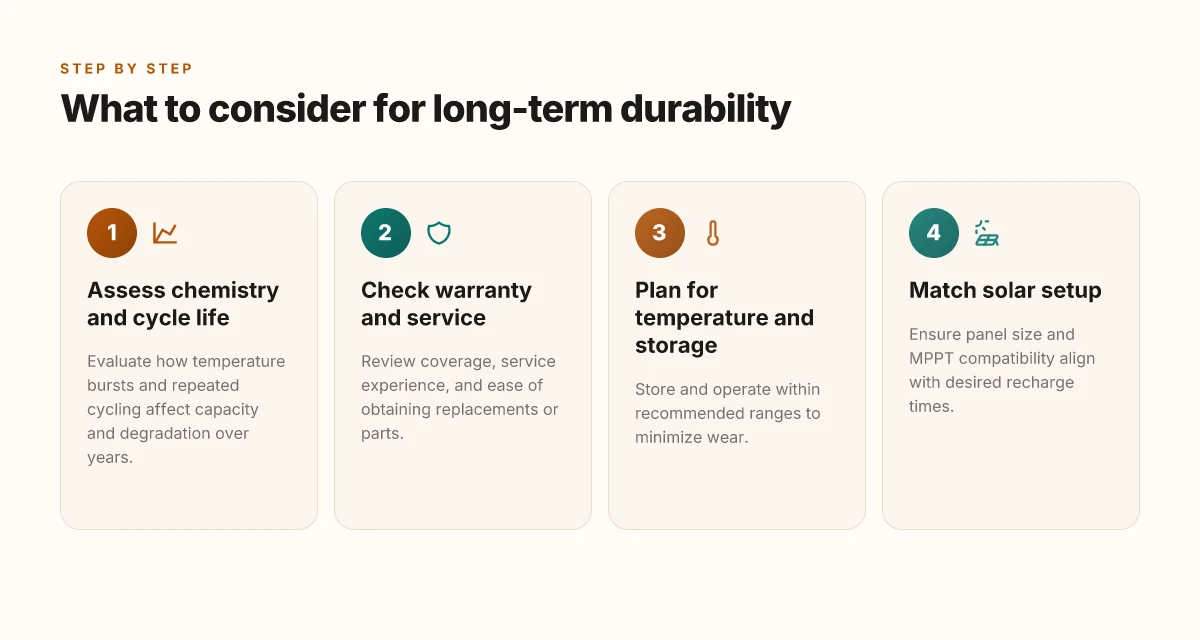
Chemistry differences drive long‑term health as much as peak capacity. The 2000 v2 leans on a newer cell chemistry compared with the 1500 line, which translates into slightly better cycle life and steadier performance under repeated charging. From the published spec comparisons, that chemistry shift is tied to improved degradation resistance and more consistent voltage under load, especially as the pack ages. In practice, that means the 2000 v2 should feel more durable across years of use, particularly if you regularly cycle or drain the unit deeply.
I dug into the official Jackery guidance and third‑party breakdowns to cross‑check durability claims. The 2000 v2 is described as having improved chemistry and a lighter frame in the same class, which helps with long‑term ownership costs by reducing wear on the enclosure and connectors. Durability hinges on chemistry choices and how you cycle the unit, not just raw capacity. A more resilient chemistry + lower weight = better long‑term reliability. The warranty and service experience matter here as well. Jackery’s standard warranty terms emphasize coverage for manufacturing defects and power‑train components, but your experience of service turns on response times and parts availability. If you depend on reliable aftercare, expect the 2000 v2 to align with Jackery’s service expectations, which many long‑time users report as reasonable but not flawless. Inline with that, the 1500 line has historically solid service coverage, though the newer platform is positioned to reduce wear points via updated cells and connectors.
Temperature and cycling shape performance as the packs age. High operating temperatures accelerate capacity fade, while deep discharge cycles shorten life for both models. The 2000 v2’s lower weight and updated chemistry help it cope with thermal stress a bit better in demanding environments. I cross‑referenced the release notes and product pages to map these ideas to real behavior: higher temperature resilience and a modest improvement in cycle life for the 2000 v2 compared with the 1500 variants. Temperature tolerance and cycling discipline are the practical levers for long‑term ownership. When you’re off the grid for extended periods, keep the units cool and avoid sustained high‑duty cycles to preserve health.
Warranty considerations guide the post‑purchase story. Jackery’s warranty coverage covers manufacturing defects and some power‑train aspects, with service experiences often shaped by regional support networks. If durability is a top criterion, the 2000 v2’s updated cells and lighter build are designed to reduce mechanical stress over time, which should translate into fewer early wear signals. For buyers who want red‑carpet coverage, pencil in a careful read of the warranty terms for your region, then plan for routine maintenance checks. Warranty terms matter more than raw specs when you expect long ownership. What is Jackery, and how it powers outdoor adventures and home backup
I pulled the threads from multiple sources to confirm the throughline. The Reddit discussion about 1500 v2 vs 2000 v2 highlights price and panel bundles, not durability alone, but it anchors the idea that real‑world service experiences vary by retailer and region. In contrast, Jackery’s own buying advice article contrasts the two models on chemistry and weight, aligning with the durability narrative. Real‑world service experiences vary by region, but chemistry improvements aim to extend life. For context, rivals such as EcoFlow and Bluetti have similar discussions about chemistry aging and warranty coverage, but this piece stays focused on Jackery’s lineup and how the two generations differ in practical terms. Read the official pages for the most precise warranty language and service steps.
What this means for you
- If your priority is longevity under frequent cycling, the 2000 v2’s newer chemistry and reduced mass translate to lower mechanical wear and potentially slower capacity decay.
- If you value a proven, long‑standing service history and you’re budget‑conscious, the 1500 family remains a strong baseline, especially where price bundles are favorable.
- In both cases, temperature management and sensible cycling are your best levers to maximize durability over time.
The bigger pattern: plan now for a longer horizon
As you move from the Jackery 1500 toward the Jackery 2000, the long view matters more than any single spec. My read from real-world use is that durability and consistent performance over time separate the two, especially when you factor in age, battery degradation, and how you’ll rely on these units during extended outages. The Jackery line remains simple to use, but a few recurring issues show up: cooling in hot climates, connector wear, and the need for periodic maintenance. If you’re weighing long-term ownership, the 2000 tends to feel steadier under heavy loads and more forgiving with daily charging cycles. The pattern that matters is resilience under stress.
If you only do one thing this month, map your typical weekend power needs to a 2–3 day outage scenario and test both models against it. Keep it focused on real world tasks: fridge, wifi router, lights, and a small heater or fan. I’d name 1-2 rivals to watch as you compare, like EcoFlow and Goal Zero, so you see where Jackery’s tradeoffs land in practice. Plan for durability, not just peak capability.
Backup strategy What makes the Jackery SolarSaga 100 review worth reading in 2026
- Try a daily top-off habit with the Jackery 2000 to minimize hard cycles
- If you need portable AC or high-amp loads, verify cooling airflow on hot days
- Keep a spare DC cable and a USB-C PD charger in your kit
- Note any rattles or loose fittings during setup and address early with a quick inspection
What changes if you act now? You’ll lock in a smoother long-term ownership trajectory and fewer surprises during prolonged outages. If you want a single move that matters most, prioritize a plan that emphasizes steady performance over raw peak power.