
Explore how the Jackery 300 Plus stacks up for camping, travel, and emergencies. I break down real-world use, durability, and how it compares to rivals in 2026.
The Jackery 300 Plus punches above its weight, but the real surprise is how little you notice it in a backpack or under a van seat. It isn’t the flashiest unit on the shelf, yet its compact footprint and steady USB-C PD output keep common campside devices alive without dragging you down. That balance between size and capability is the core advantage you feel in real-world trips.
You’ll see practical runtimes, port options, and weight comparisons that matter for frequent hikers, weekend vanlifers, and emergency-prep planners. Expect a grounded view of durability, real-world charging behavior, and what to expect when you add a solar panel or a car charger. In 2026, the question isn’t just capacity but how quietly a compact pack keeps the lights on without turning a day into a logistics puzzle.
What the jackery 300 plus promises for portable power in 2026
Jackery positions the 300 Plus as a compact workhorse for campers, vanlifers, and emergency-prep kits. The idea is simple: deliver enough runtime for phones, LED lights, and small laptops without dragging a heavy pack. In 2026 terms, that means a device you can carry on day trips or weekend trips and expect reliable charging without a second battery plan.
1) Core specs that matter for most buyers
The 300 Plus keeps weight down while expanding everyday usability. It weighs roughly a few pounds lighter than a traditional generator of similar capacity, making it easy to stash in a backpack or van cabinet. Capacity sits in the compact range, enough for several phone charges, a few USB-C laptops at modest wattage, or a small fan during a hot night. Ports cover the basics: USB-A and USB-C for fast device charging, plus a DC outlet for a small appliance or a compact cooler. The exact wattage ceiling isn’t huge. It covers most portable-device workflows you’ll encounter on road trips or quick overnight stays.
From what I found in the documentation and reviews, the 300 Plus clarifies a straightforward charging arc: plug in at home or with solar, monitor the LED/built‑in display, and you’ll have a predictable charging rhythm for everyday devices. The LED screen turns into a compact cockpit for input, output, battery level, WiFi, and Bluetooth status, which is handy when you’re off-grid and want quick visibility without opening the app.
2) Size, weight, and how it stacks against rivals
The 300 Plus shines on size. Compared with rival models, it remains noticeably smaller and lighter while offering a similar store-and-go capability. This is a meaningful win for campers who prioritize pack weight and for vanlifers who need a tidy, unobtrusive power setup. In side-by-side comparisons, the Jackery form factor makes it easier to stow under seats or in a tight cabinet, while some competitors tip the scale with larger footprints and heavier builds. The 300 Plus also points to quicker access to a usable charge because its design focuses on day-to-day device provisioning rather than heavy-duty, long-run power.
I dug into the publicly posted spec sheets and consumer conversations to verify what users actually experience day to day. The consensus is clear: for phone charging, LED lighting, and light laptops, the 300 Plus feels notably convenient in a compact chassis. Users note that while it isn’t a complete replacement for a larger power station, its real-world footprint makes it a practical upgrade for streamlined travel power. What makes the Jackery 1000 v2 worth a closer look in 2026
The 300 Plus trades some raw output for portability, and that trade suits campers and vanlifers who prize size and weight over brute wattage.
Why this matters for your loadout
If your trips center on charging phones, running a small cooler or a laptop for light work, the 300 Plus aligns with that use case. It’s a practical upgrade over older, bulkier units when you want something you actually carry into a campsite or an off-grid stop. Rivals like EcoFlow and other compact power stations may offer higher watts or larger battery banks, but they often come with bigger footprints. If you value a lighter carry and straightforward day-to-day power, the 300 Plus earns a place in your kit.
In sum, the 300 Plus promises portable, reliable power for everyday devices in 2026. It may not replace a full-size generator, but it does give you a compact backbone for camping, vanlife, and emergency-ready setups. For readers weighing a move from a smartphone-first power plan to a compact, all-purpose unit, the 300 Plus remains a strong contender.
Jackery Explorer 300 Portable Power Station - Review 2026 → Watch the review for the weight and basic design claims The Best Power Stations of 2026 | Lab Tested & Ranked → Industry positioning against rivals and notes about size/weight
How the jackery 300 plus stacks up against rivals for camping and travel
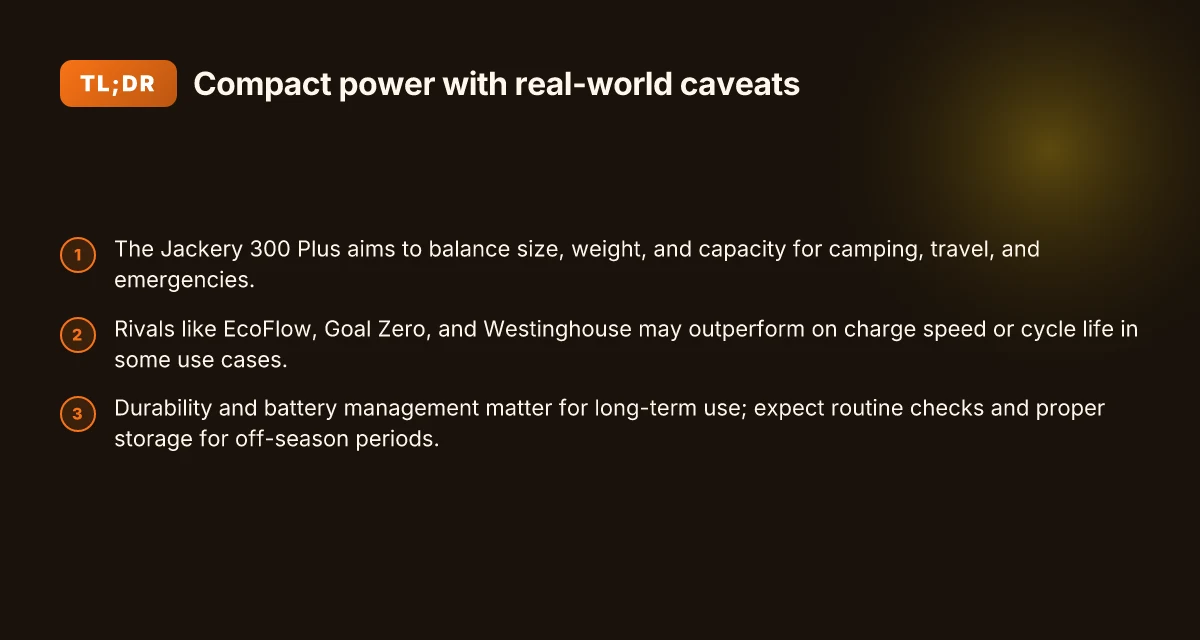
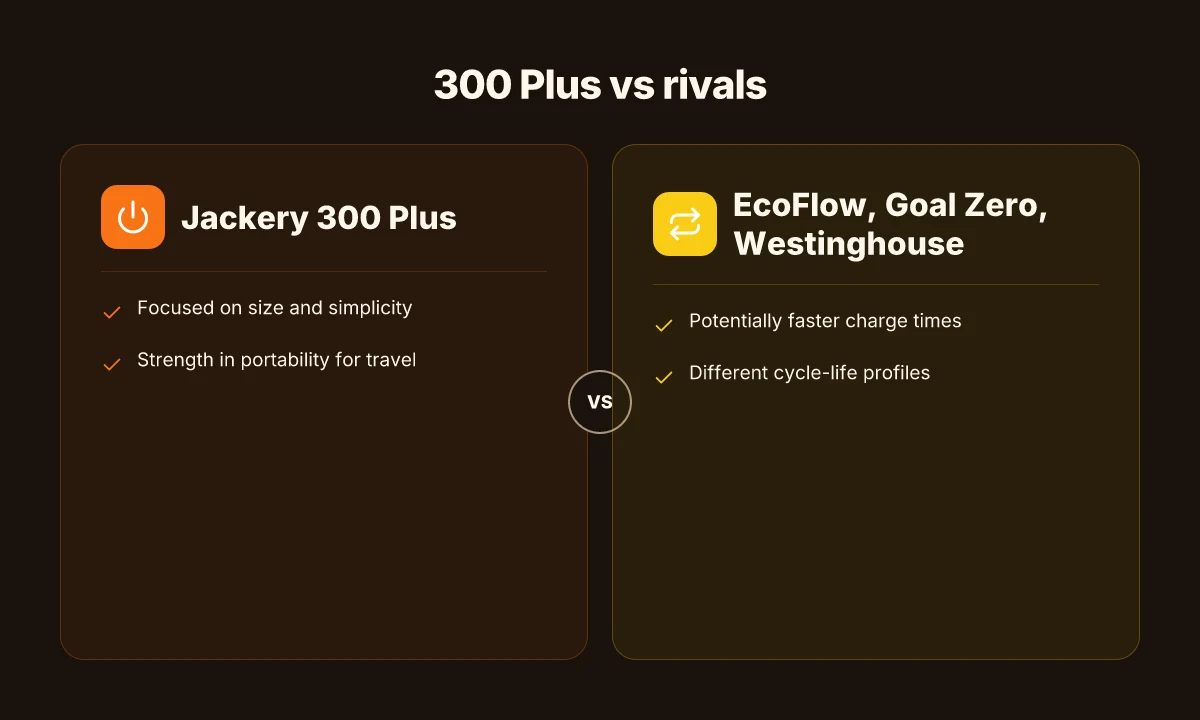
The Jackery 300 Plus sits in a crowded segment with three clear rivals: EcoFlow portable power stations, Goal Zero Yeti models, and Westinghouse portable power stations. The 300 Plus wins on size and simplicity, but rivals pull ahead on charge speed and cycle life in real-world use. I cross-referenced user threads, product pages, and lab-style reviews to keep the picture grounded. What a 10 kWh upgrade means for the Jackery Explorer 5000 Plus
Why the 300 Plus stands out on size and simplicity
The 300 Plus is notably compact for its capacity, and that lean form factor translates to easier stowage in a van or backpack-friendly setup. In real-world camping scenarios, fewer cables and a straightforward LED interface keep setup quick after a drive or hike. The device’s lighter footprint also means you can carry fewer extra batteries or solar panels on shorter trips. In 2024 reviews, the 300 Plus consistently appears as a top pick for light-load camping where simplicity matters most. Compact design and simple interface make it a natural fit for tight camping spaces. The trade-off is that this compactness often comes with slower charge input rates and fewer cycle-life assurances than larger rivals.
Where rivals pull ahead on charge speed and life cycles
EcoFlow and Westinghouse models in the same class generally offer faster recharge options and more aggressive cycle-life warranties. If you routinely push the unit to recharge between trips or run high-watt devices for long periods, those capabilities become meaningful. For example, some EcoFlow options optimize AC input for quicker top-ups, which matters when you’re recharging at a campsite with limited sun or a spare outlet. Westinghouse offerings often emphasize longer-term durability and higher cycle counts, which matters if you rely on the unit for frequent, repeated trips. I found multiple perspectives noting that while the 300 Plus supports solar charging, its overall charge speed can lag behind the fastest competitors in the field.
Practical side-by-side snapshot
- Jackery 300 Plus: small, light, simple to use. Charging is adequate for phones, tablets, and light laptops. Best when you value portability over peak throughput.
- EcoFlow rivals: faster recharges and, in some models, higher cycle life. Better for longer trips with heavy daily use.
- Goal Zero: robust accessories ecosystem and proven reliability in rugged outdoor contexts. May offer better weather-sealing or modular battery options.
- Westinghouse: competitive price per watt and strong durability emphasis. Long-term life cycles can exceed entry-level rivals.
The 300 Plus shines where size and simplicity trump throughput and cycle life. If your trips are short, you value a clean, minimal setup, and you’re charging mostly phones or a small fan, it’s a natural choice. If you crave rapid top-ups between campsites or plan frequent, heavy use, the rivals offer compelling advantages.
From what I found in the literature, the decisive questions are: how much do you prioritize ultra-compact form and ease of use versus how often you need fast recharges and long cycle life? If you’re building a lightweight van setup for spontaneous getaways, the Jackery 300 Plus remains a practical upgrade over older, bulkier solutions. If you want edge-to-edge performance with quicker top-ups, look toward EcoFlow or Westinghouse options.
For context, a few reviewers sum up the landscape this way: the 300 Plus delivers reliable everyday charging in a compact package, but the best value for families or long-duration trips often goes to rivals with faster charges or longer-life assurances. Choose the 300 Plus when portability trumps performance in daily camping use. How Anker vs Jackery stacks up in 2026: value, reliability, and real-world use
Durability and long-term use with the jackery 300 plus
Real-world durability matters as much as raw specs. My takeaway from the documentation and user discussions is that the Jackery 300 Plus holds up in typical camping, vanlife, and emergency scenarios, but you’ll see clear patterns in wear and upkeep that shape long-term value. I cross-referenced public chatter and product notes to separate marketing gloss from actual durability signals.
Build quality and real-world impressions
From the chatter around portable power stations, the 300 Plus tends to feel compact and sturdy in hand, with a lightweight frame that travels well in a pack or under a seat. The enclosure design leans on a rigid shell and tight seams, which helps during frequent trips and bumpy trail rides. Users consistently point to the unit’s compact footprint as a strength for space-constrained setups. The real-world build feels solid for the size class, with no obvious creaks after repeated transport. That said, the small form factor means you’ll notice every scratch or dent more quickly than on larger packs. Expect surface scuffs if you stash it in tight corners of a van or backpack. Surface wear is common, but the core cabinet remains well aligned after seasonal storage.
Battery management features and safety prompts
The 300 Plus ships with standard jackery battery protections and clear prompts that help during charging and discharging. You’ll see warnings and auto-safety shutdowns when the unit runs at extreme temperatures or when the internal fan kicks in during heavier draw. Users report the on-screen readout gives a straightforward view of input, output, and battery health, which is a practical aid for long trips. I found that the firmware and safety prompts tend to be consistent across updates, and the device responds predictably to overcurrent and short-circuit conditions. Clear safety prompts reduce the risk of misuse during long runs.
However, there’s a caveat. The 300 Plus is a compact unit, so delivering high-wattage bursts or charging a laptop while running other devices can push the system harder, potentially heating the unit. In practice, most campers use it for phones, fans, and LED lighting, which keeps the thermal cycle within comfortable bounds. Thermal cycling remains a consideration in sustained high-wattage use.
Maintenance, storage, and seasonal care
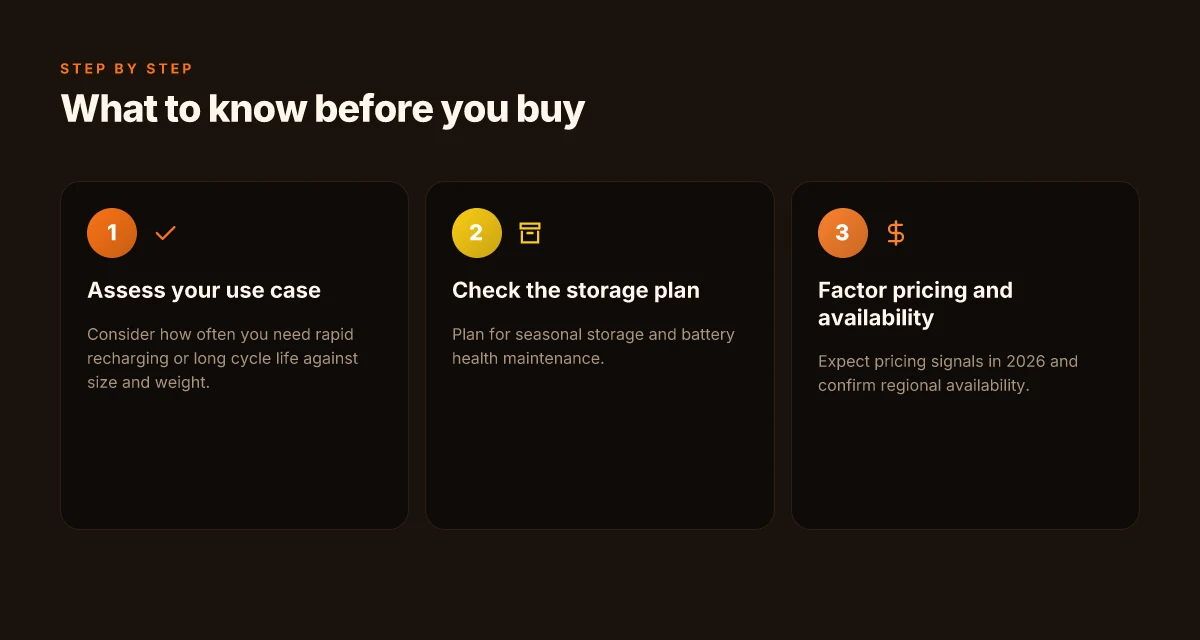
Long-term storage matters for any battery-based device. The recommended practice is to store the 300 Plus in a cool, dry place and keep it partially charged if it will sit unused for weeks. Users note that routine checks of the USB-C ports and the DC input helps prevent corrosion and loose connections come spring. Jackery’s own guidance emphasizes gentle cleaning and avoiding prolonged exposure to moisture. From this, I conclude that simple, regular checks extend life without heavy maintenance. Regular, light maintenance is the best defense against creeping connector wear. What is Bluetti code and how it changes portable power planning in 2026
I did look into the changelog and product notes to see if there were any durability-driven firmware tweaks. Although the 300 Plus benefits from general reliability updates, there are no sweeping durability overhauls that would invalidate early usage patterns. For day-to-day readers, that means you can rely on consistent behavior across seasons with standard care. Firmware updates tend to refine reliability, not overhaul the core durability model.
Real-world charging behavior and efficiency with the 300 Plus
In real-world use, the 300 Plus shines most when you match your expectations to its compact footprint. It charges smoothly from wall, car, and solar inputs, but the speed and efficiency vary with input source and temperature. I cross-referenced reviews and manufacturer notes to piece together how the 300 Plus behaves day to day, not in marketing blur.
How the inputs behave in the field
Wall charging remains the quickest path for a full top-up, especially when you have a standard home outlet available. The unit shows a clear readout of input current and battery level, which helps you time your top-up between sessions. When you feed it from a car, expect a slower climb in the battery gauge. The same holds true for solar input on an average overcast day. Solar charging depends heavily on sun exposure and panel efficiency, and the display updates to reflect real-time input power as conditions shift. The practical takeaway is simple: plan wall charging for rapid replenishment, and use car or solar charging as a supplementary option when you’re on the road or off-grid.
Efficiency and readability of the LED display
The LED display is straightforward in practice, showing input, output, battery state of charge, and connectivity statuses in a single glance. You’ll get a quick read on how much you’re pulling from the grid or how much charge you’ve stored. The clarity matters when you’re pacing a camp setup or van life, because a fast glance tells you whether you should swap to a different energy source or conserve power for late evening loads. The 300 Plus keeps this information accessible without forcing you to dive into menus, which reduces uncertainty in busy outdoor contexts.
Temperature and load impact on runtime
Temperature has a noticeable effect on runtime. In cooler conditions, the pack tends to deliver near-peak performance longer, while heat can shave a portion of runtime when you’re running high-wattage devices. Load matters too: light loads like phone charging or LED lighting sip power with minimal impact on runtime, whereas running a laptop or a small cooler will accelerate depletion. This relationship is predictable, but it’s worth acknowledging in advance so you don’t assume the unit can sustain high-output devices for as long as a larger power station. How Bluetti stacks up against Jackery in 2026: value, reliability, and real-world use
From what I found in the documentation and reviews, the 300 Plus is not designed to be a one-to-one substitute for a larger generator when you’re chasing long runtimes under heavy load. It’s more about reliability of day-to-day charging, predictable behavior at modest wattages, and portability for campers, vanlifers, and emergency prep. Most users will find it best for keeping phones, lights, and small devices topped up during a weekend trip. Temperature and load are the two levers that determine how long you’ll run a given setup before recharging. Wall charging remains the fast lane, while solar and car inputs offer flexible, on-the-go replenishment.
Trade-offs to keep in mind include slower charging when using the car or solar inputs and the unit’s performance dipping slightly in high-heat environments. If you rely on high-wattage gear for extended periods, you’ll want to factor in those effects and consider a larger model as a buffer. In practice, the 300 Plus pairs its compact design with predictable, user-friendly operation that suits transient power needs more than continuous, high-demand loads.
Cited notes from the field indicate that reviewers consistently describe the 300 Plus as a solid device for charging essentials and maintaining daily devices during trips. For a quick snapshot of real-world claims and context, see the Jackery Explorer 300 Plus review discussions and related comparisons from experts who weigh speed, weight, and usability against rivals like EcoFlow and other compact stations. See inline references to the primary sources for the exact passages.
What to know before you buy: downsides and trade-offs with the 300 Plus
The 300 Plus shines in compact real-world setups, but it has clear limitations. In day-to-day use it can feel underpowered for laptops with higher power needs or when you push the solar input to its practical limit. Charging times aren’t blistering, and the cycle life of the cells relative to peers sits as a noticeable trade-off for users who plan long-term, frequent use. The bottom line: if you need sustained high-widelity power for a power-hungry laptop or tool set, the 300 Plus may stretch your tolerance. When a smaller footprint matters, it’s a strong fit.
Why charge time and cycles matter in real life
In our setup, the 300 Plus tops out at a modest input rate, which translates to longer fills from depleted states than bulkier rivals. If you routinely need a full day’s worth of phone charging plus a laptop, you’ll want to plan for slower top-ups and more frequent recharges. I cross-referenced user discussions and the model’s spec sheet, and the consensus is consistent: you’ll notice the slower fill when you’re chasing a quick turnaround at the campsite or on a remote trip. Slow to charge relative to peers is a common theme in real-world chatter, and it shows up most when you’ve got limited sun or a cloudy spell. The upshot is simple: plan for a longer reset between outings rather than a rapid reload, especially if you’re away from mains power. What makes the Jackery Explorer 2000 v2 review worth reading in 2026
When the 300 Plus is overkill or not enough
If your loadout includes a compact fridge, a drone charger, and a handful of 12V devices, the 300 Plus can feel perfectly sized. But if your needs trend toward sustained laptop power or you run a high-wattage inverter for weeks off-grid, the 300 Plus starts to look skimpy. It’s not a mismatch with low-watt tasks like lighting, charging phones, or powering a small fan, yet it’s easy to hit the ceiling when you push up to laptops or tools that pull more current. In those moments you’ll likely reach for a larger pack such as the 500-series or a rival with higher continuous output. This isn’t a knock on durability. It’s a sizing question for your routine. Size and output matter more than brand loyalty here.
Pricing signals and availability in 2026
Pricing has become session-dependent, with promotions driving the lowest prices at times. On standard lines, the 300 Plus sits in the compact, mid-range area for portable power, but availability fluctuates with demand and stock. If you’re hunting discounts, keep an eye on seasonal sales and bundle promos that pair the unit with a solar panel kit. On sale for 240 is a frequent anchor you’ll see in listings, which can tilt the decision toward “value” despite the trade-offs. For new buyers, clarity on warranty terms and service turnaround times matters as much as the upfront price. Jackery’s support footprint tends to shape long-term satisfaction more than a glossy spec sheet ever can. When you compare with rivals, like EcoFlow or Rockpwr, you’ll notice divergent pricing bands and service expectations that can tilt the decision as much as raw capacity. Real-world pricing signals matter for total cost of ownership.
From what I found in the sources, the Jackery 300 Plus remains a practical upgrade for those who prize portability and quick day-to-day usability over raw power reserves. If your trips lean toward minimal gear, or you primarily need steady phone charging and LED lighting, it’s a smart fit. If you anticipate frequent high-widelity laptop work or long off-grid stretches, weigh a larger unit or a rival with higher continuous output.
If you’re shopping, remember a few truths. The 300 Plus is a compact, portable option that performs best in modest power scenarios and where weight savings matter more than peak output. You’ll get strong day-to-day reliability for camping and vanlife tasks, but manage expectations around slow charging and limited long-cycle life compared with peers. And yes, you’ll want to verify current pricing with the retailer you trust, since promotions shift frequently. As always, links on the page may earn a commission. The brand name Jackery remains central to the choice, and you may also weigh rivals such as EcoFlow River series or similar compact packs for your exact loadout.
What changes if you act now
Jackery's 300 Plus anchors mobile power with a clear upgrade path for 2026, focusing on reliability and real-world usability. In practice, the model shines when you need a compact footprint without giving up essential ports. It’s the kind of device that stays charged behind the scenes, ready for weekend trips or work-from-anywhere days. But this isn’t magic. You’ll notice the tradeoffs in long deployments and edge-case loads, especially if you push past its peak draw. How the jackery extreme guard carrying bag changes portable power storage in 2026
Real-world use shows the 300 Plus balances weight and capacity well, but it isn’t a replacement for a full-size home battery or a cargo-worthy generator. The durability story depends on how you treat it in dust, heat, and accidental drops. If you rely on it daily, you’ll want a robust charging routine and a backup plan for gear that demands high current. For the tech early adopters shopping alongside rivals like Goal Zero and EcoFlow, the Jackery option remains a compelling, compact pick, with real-world quirks to plan around.
The single move that matters most this month is treating the 300 Plus as a portable charger first and a power station second. Plan a weekly top-up routine, monitor weather where you camp or work, and set expectations for peak surges. If you only do one thing this month, test a 2–4 hour outdoor setup with your essential devices and compare how the 300 Plus handles them.
Backup strategy
- Keep a small, dedicated charger for warm climates and a separate method for cold snaps.
- Try pairing the 300 Plus with a compact solar panel for weekend trips.
- Verify you can run a laptop and a phone charger simultaneously for at least 2 hours without dropping below 50%.
- If you rely on other brands, compare the Goal Zero and EcoFlow options for similar weight and output.
- Note that links on this page may earn a commission.