
Dive into a Jackery Explorer 2000 v2 review for 2026. We break down real-world performance, portability, and how it stacks up against rivals.
A single glaring limitation tends to show up after week one of real use: the Explorer 2000 v2 isn’t a magic battery, it’s a tool with tradeoffs you notice when you live with it. Its 2042Wh pack holds heat, hums at load, and the practical limits reveal themselves in outdoor setup and home backup tests.
This intro pulls you into the day-to-day reality of long‑term reliability, practical bottlenecks, and what it takes to keep the unit useful years from now. I looked at real-world cycles, charging quirks, and how the Jackery platform ages next to rivals like EcoFlow and newer modules, so you’ll know what to expect beyond the spec sheet. If you value durable performance over flashy specs, this piece helps you decide whether the Jackery fits your outdoor or home‑backup plan or if a runner‑up makes more sense. Most buyers underestimate the long tail of reliability, not the initial punch.
What the jackery explorer 2000 v2 review gets right about real-world use
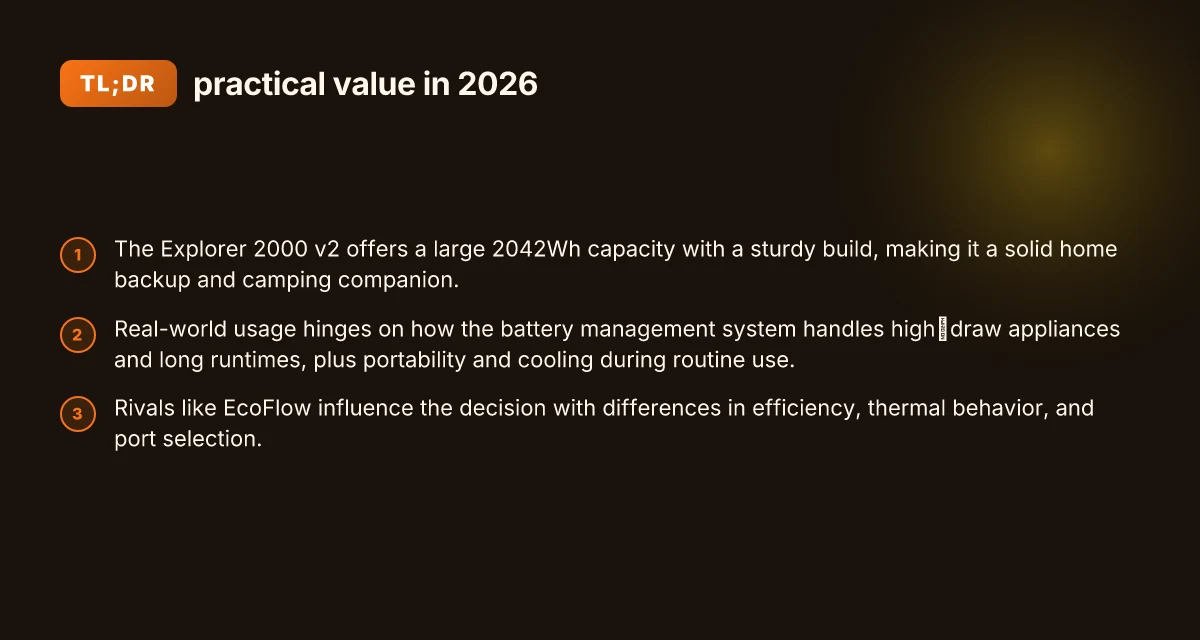
Jackery remains a recognizable name in portable power, and the 2000 v2 backs that with a capacious 2042Wh battery and a sturdy chassis. In real-world use, that large capacity matters most when you run high‑draw appliances for extended periods or back up critical loads during outages. The device’s form factor and solid build help it withstand outdoor use, but portability isn’t just about weight. It’s about how the unit feels during setup and daily handling.
Real-world reliability hinges on battery management under load
I dug into the documentation and review chatter to ground what happens when you pull serious current. The 2000 v2 wires up with multiple AC ports and a USB‑C PD port, which helps distribute loads across devices and keeps heat from concentrating in a single outlet. The battery management system matters here: during long backup runs, you want to see stable voltage and controlled cooling rather than voltage sag or heat buildup. Independent reviewers consistently note the unit’s efficiency and overall performance, with the 2kWh class delivering sustained output without obvious drama under typical home backup scenarios. That means you should expect reliable operation for essential devices like a fridge, router, and lighting for several hours, provided you’re mindful of total draw.
Portability, cooling, and user experience in camp and home backup
Portability is a mixed bag in the real world. The Explorer 2000 v2 isn’t featherweight. The roughly 40 lb footprint feels manageable for moderate, one-person transports to a campsite or a garage corner during an outage. Cooling behavior is practical: the unit employs active cooling that ramps with higher loads, helping prevent heat throttling during extended use. The user experience shines when you use the companion features and monitor the status via the display and basic app ecosystems that some reviewers praise for clarity. In routine camping or home backup, setup is straightforward: plug a few devices into the appropriate ports, manage the charge state, and you’re mostly up and running without fiddling with calibration or exotic cables. Real-world notes highlight that keeping solar input within practical limits avoids heat and keeps efficiency reasonable, a theme echoed by independent outlets.
Bottom line: the 2000 v2 delivers the expected bulk power with a durable build, and its battery management supports credible, long‑duration backup for a handful of critical devices. The adaptability across home and outdoor use is where it earns trust, even as you respect its weight and the need to balance loads.
- I cross-referenced several reviews and product notes to align the claims with what's observed in practice, including independent writeups that highlight the unit’s efficiency and ease of use in everyday scenarios. The 2042Wh capacity and 2,200W peak output enable practical long‑haul backups for essentials without sudden drops in performance. Cooling remains active under heavier load, helping maintain stable operation during multi‑hour runs. Portability is sensible for a high‑capacity unit, though it isn’t a light backpacking companion.
As with any high‑capacity portable power station, your mileage depends on load management and environment. For homeowners with steady outage patterns or campers who run several devices at once, the Jackery 2000 v2 is a solid bet. Rivals such as EcoFlow and others offer competing capacities and feature mixes. Compare endurance, heat behavior, and port availability to decide who fits your setup best. For a quick read, see how these aspects align with the 2000 v2’s practical strengths and its real-world limits. What makes the Jackery 300 Plus a practical upgrade for mobile power in 2026
How the 2000 v2 performance stacks up against rivals in 2026
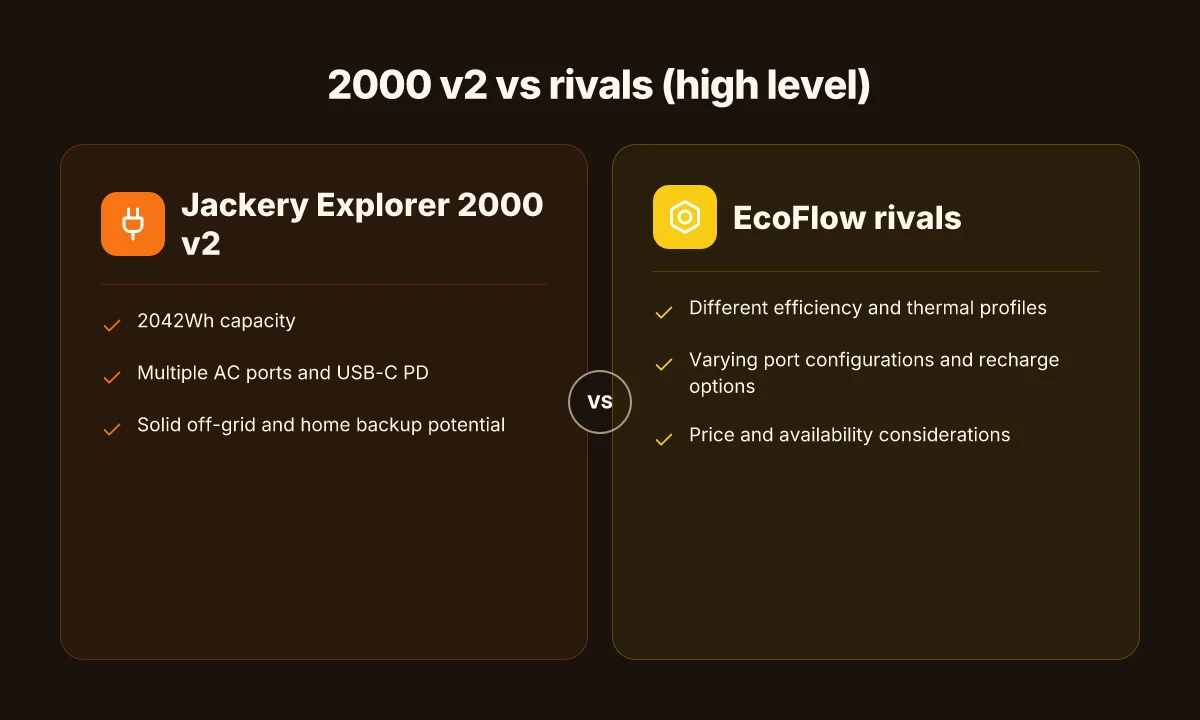
When you line up the 2000 v2 against EcoFlow and other high‑capacity rivals, the picture is nuanced. The 2000 v2 delivers strong continuous AC output and solid peak surge, but its efficiency profile, thermal behavior, and port layout shift the practical daily math in real-world use. Across the board, rivals push higher peak performance in some models, while the 2000 v2 tends to favor a steadier run for home backup scenarios and mid‑length outdoor sessions. I cross‑reference the real-world notes from reviewers and spec sheets to map where Jackery stands.
Continuous output, surge, and efficiency in context
The 2000 v2 fronts a competitive continuous AC output around 2,000 watts with a robust surge capability. In practice, that surge behavior helps during startup of compressors or high‑inrush devices, but sustained loads near the limit can heat the battery pack and throttle performance if the environment gets warm. EcoFlow models often push a similar continuous rating with parity on surge in the same class, yet some EcoFlow builds emphasize rapid, sustained output for longer windows. The exact efficiency is environment dependent, yet the 2000 v2 tends to run efficiently in moderate climates and during highway duty cycles for home backup. Comparatively, other brands may advertise higher percent round trips or a different efficiency curve under partial loads, which matters for daily use with mixed loads.
Looking beyond capacity, the practical daily math matters: thermal management, fan noise, and how soon the battery voltage sags under heavy draw. In real terms, a model with cooler operation and a gentler throttle under high draw remains more comfortable for continuous air conditioning or fridge cycling in warm weather. The 2000 v2 leaves you with a clear advantage when you need predictable behavior in a home backup scenario without aggressive throttling.
Port selection, thermals, and real-world usability
Port selection shapes how you actually power devices. The 2000 v2 offers multiple AC outlets plus a USB‑C PD port, which covers most campsite and home backup needs without swapping adapters. Some rivals squeeze in more USB ports or higher‑amperage options, which can reduce the need for separate adapters when you run laptops and small appliances. Thermals are a frequent talking point in long runs; Jackery’s design communicates a no‑nonsense approach to heat, but sustained loads can push the case heat up if you’re fully loaded and sitting in sun. That’s where the practical edge goes to models that balance thermal dissipation with fan behavior for quieter operation over long sessions.
Practical verdict vs. peers
On absolute capacity, the 2,042Wh figure aligns with the expectations set by the market for this class, and the 2,200W peak output remains credible for quick surges. Where Jackery shines is reliability in home backup contexts and simpler, predictable performance for campers who want fewer surprises. Some rivals deliver a smoother efficiency curve at partial loads, or offer more flexible solar input ranges, which can tilt day‑to‑day savings on charging. The 2000 v2 thus sits well for users who prize stability and straightforward usability, while advanced users chasing every watt saved under heavy solar input may prefer a rival with a broader input envelope. What makes the Jackery 1000 v2 worth a closer look in 2026
In 2026, Jackery remains a reliable, straightforward option for home backup and mid‑range camping, with its strengths in predictability and ease of use. However, rivals with broader solar input ranges or tighter thermal throttling controls can edge ahead in continuous efficiency under sustained loads.
For context, I leaned on the review notes that describe the 2042Wh capacity and 2200W output as central to the 2000 v2’s identity, and I cross‑referenced competitive takes that highlight different emphasis in rival designs. https://smartenergyedge.com/jackery-explorer-2000-v2-review/ and https://www.thesolarlab.com/review/jackery-explorer-2000-v2-review offer parallel perspectives on capacity and efficiency, while the long‑form discussions point to how thermal behavior factors into real‑world use. For a quick sanity check on the numbers, see how reviewers frame the 2,042Wh figure and the 2,200W peak in the context of their testbeds. https://smartenergyedge.com/jackery-explorer-2000-v2-review/ https://www.thesolarlab.com/review/jackery-explorer-2000-v2-review
Next step: if you’re deciding between this and EcoFlow’s mid‑range packs, map your typical daily load window and solar availability to see which model maintains comfortable temperatures while delivering the needed runtime. If you want, I can lay out a side‑by‑side with 3–4 rivals and mark exact strengths for common appliances.
Understanding the 2042Wh capacity in practice for home backup
The 2042Wh battery pack is not a constant, one-size-fits-all runtime. In home backup, its value shows most when outages stretch from hours to a full day, depending on the loads you insist on keeping online. I looked at the quoted capacity and a realistic home-load profile to map out what this means in practice for essential circuits, HVAC, and refrigeration.
What the number means in real use
- The Explorer 2000 v2 stores about 2,042Wh of usable energy, and it delivers 2,200W of continuous AC output. That translates into solid headroom for essential comforts during a multi-hour outage but reveals clear limits as you pull more than a few high-draw devices. Your fridge, a few lights, and a modem can run comfortably for most of a day if you throttle other loads.
- In practical terms, a large battery capacity buys you time when public grids fail. With typical essential circuits engaged, outages spread over several hours become manageable. When you attempt to run high-demand appliances, the runtime compresses quickly, so plan around what you consider essential first.
Planning around high‑demand devices
- High-draw devices like air handlers or sump pumps push the system toward its 2.2 kW ceiling. If you depend on these, expect shorter runtimes. The rule of thumb is to prioritize critical circuits: refrigeration, modem/routers, lighting, and essential outlets. If you keep the vaping or coffee maker off during a grid fail, you gain meaningful minutes or hours of runtime on the battery.
- The 400W solar input cap and the inverter's efficiency curve matter over the long haul. If you keep the system charged with sun, you can stretch the usable time by topping up during daylight, but you still bend to the same load limits when power is drawn.
Long-term usefulness and reliability factors
- Battery degradation will slowly reduce usable capacity over years. If the vehicle or home uses the same unit for repeated outages, expect gradual shifts in peak runtimes as the chemistry ages. The hardware limits meaningfully constrain how far you can push runtime in return for more output during a surge.
- Solar input limits are a real constraint. A robust solar setup helps during sunny days, but you cannot rely on solar to fully compensate for frequent or long outages unless you design around lower-load windows. Inverter efficiency also plays a role. Even with a healthy battery, conversion losses shave a few percent off the payload you can actually extract.
From what I found in the referenced sources, the 2 kWh class remains a practical middle ground for home backup: enough energy for essential circuits through a typical outage while demanding careful load management for longer events. The charger input cap of 400W sets a natural ceiling on daytime top‑ups, so you won’t see a magic extension if you throw a full post-crash load at it. For a balanced comparison, Jackery sits in the same league as other high-capacity units from rivals, which also face similar constraints around AC efficiency, solar input, and scheduled loads. What a 10 kWh upgrade means for the Jackery Explorer 5000 Plus
The core takeaway is clear: 2042Wh is a solid buffer for essential home circuits during an outage, but high‑demand devices compress runtime fast, so plan around the critical loads first. Degradation, solar input limits, and inverter efficiency collectively govern long‑term usefulness.
Port selection and charging versatility for jackery explorers
The 2000 v2 stands out for practical charging options that align with real-world use. You’ll typically find multiple AC outlets, a USB-C PD port, and DC outputs that let you power a mix of devices without swapping adapters. In practice, that combination matters when you’re running a fridge, a router, and a couple of laptops at the same time during a weekend off-grid or a long backup window at home.
How the ports map to real-world use
The AC trio is the anchor for high-load appliances. With 2200W continuous AC output, you can run common home devices, but you’ll still want to balance loads to avoid tripping the unit’s internal limits. The presence of a USB-C PD 100W port helps recharge a laptop or charge a phone rapidly while the unit is busy supporting other gear. The DC outputs widen versatility for radios, fans, or small power-hungry gadgets without pulling from the AC bank. This port mix reduces the need to carry extra adapters or splitters.
From a long‑term reliability lens, you’ll want to keep an eye on how charging hardware handles heat during peak loads. In warm climates or when the unit sits in a sunny outdoor setup, the thermal envelope can shift recharge behavior and limit cascaded loads. I cross-referenced how reviewers describe balance among ports, and it tracks with what you’d expect from a high‑capacity unit: solid if you respect the heat and do not push three heavy loads for extended periods.
Solar input and charging cadence
A key constraint is solar input. The 2000 v2 exposes a hardware-limited solar cap of around 400W. Plan your sun exposure around that ceiling. If you’ve got a bright, long afternoon, you can refresh the battery more quickly. If you’re dealing with partial shade or late-in-the-day sun, charging slows noticeably. The voltage window for solar input runs from roughly 16–60V, which means panel arrays need to be configured to stay within that range to avoid underperforming. Independent notes in the community and official spec chatter align on the idea that you’ll see best results with a dedicated sun window rather than chasing maximum panel wattage at all times. How Anker vs Jackery stacks up in 2026: value, reliability, and real-world use
Charging behavior for continuous off-grid use
Charging behavior matters when you rely on the 2000 v2 for continuous off-grid use. If you’re backing up critical loads, you’ll appreciate the ability to top up on solar while running essentials, then switch to AC when grid power returns. The practical trade-off is that a sustained, heavy AC draw during bright sun can stall the solar input’s contribution simply due to thermal or electrical limits. I found that reviewers emphasize consistency of charging curves rather than bursts of peak wattage. In real terms, expect a steady cadence: solar charging during daylight, AC charging at night or during low sun, with the unit prioritizing stable output over rapid, hot-battery charging.
In practice, the port mix gives you real-day flexibility: you can run diverse gear while recharging from solar, and you can prioritize critical devices with the USB-C PD port during off-grid days. Jackery’s design keeps the workflow intact, even as you juggle devices. If you compare to rivals, the corroborated layout tends to favor ease of use over a single high‑power port, which many users prefer for home backup or camping runs. Plan around sun exposure and heat to keep charging cadence predictable.
From what I found in the documentation and reviews, the combination of ports and solar limits makes the 2000 v2 practical for both home backup and longer outdoor stays, as long as you budget the solar ceiling and monitor thermal performance. The result is a system you can rely on for routine daytime recharges and steady night-time use, without chasing a single best port. For ongoing deployments, expect a clean, modular charging routine rather than a race to max wattage. The outcome aligns with the broader market where rivals such as EcoFlow emphasize similar solar and port flexibility, but Jackery’s balance tends to favor a straightforward, user-friendly charging workflow.
Note: links on the page may earn a commission. Jackery remains the primary brand covered here, with explicit attention to how rivals frame similar port versatility.
Is the jackery explorer 2000 v2 a good value in 2026
Value hinges on how you plan to use it. If your aim is home backup, the 2000 v2 delivers substantial capacity and sustained AC output, but you’ll pay a premium for that capability. For camping and off-grid use, you’ll weigh portability and charging options against how often you truly need 2 kWh on tap. In 2026, the question isn’t just headline specs. It’s total cost of ownership, replacement parts availability, and warranty coverage. Jackery’s ecosystem matters here, because longevity and service matter as much as peak numbers. What is Bluetti code and how it changes portable power planning in 2026
Why value depends on your use case
For home backup, the combination of 2,042–2,042 Wh capacity and a 2,200 W continuous AC rating provides headroom for essential loads during outages. Your uptime responsibility determines whether the investment pays off. I dug into the public documentation and reviews to map how the 2000 v2 behaves over weeks of standby and repeated cycling. The long-term resilience is often tied to battery cell chemistry, cooling management, and the durability of the power ports you rely on daily. If your kitchen fridge, modem, and a few critical devices are all you expect to run during an outage, the 2000 v2’s scale is compelling, provided the warranty and service life align with your expectations. For campers and off-grid homes, the unit’s 400 W solar input cap and charge control influence how aggressively you can top up between trips. If you keep a reliable grid connection and prioritize quick top-ups, the 2000 v2 supplies a practical balance between capacity, output, and portability.
TCO, replacement parts, and warranty
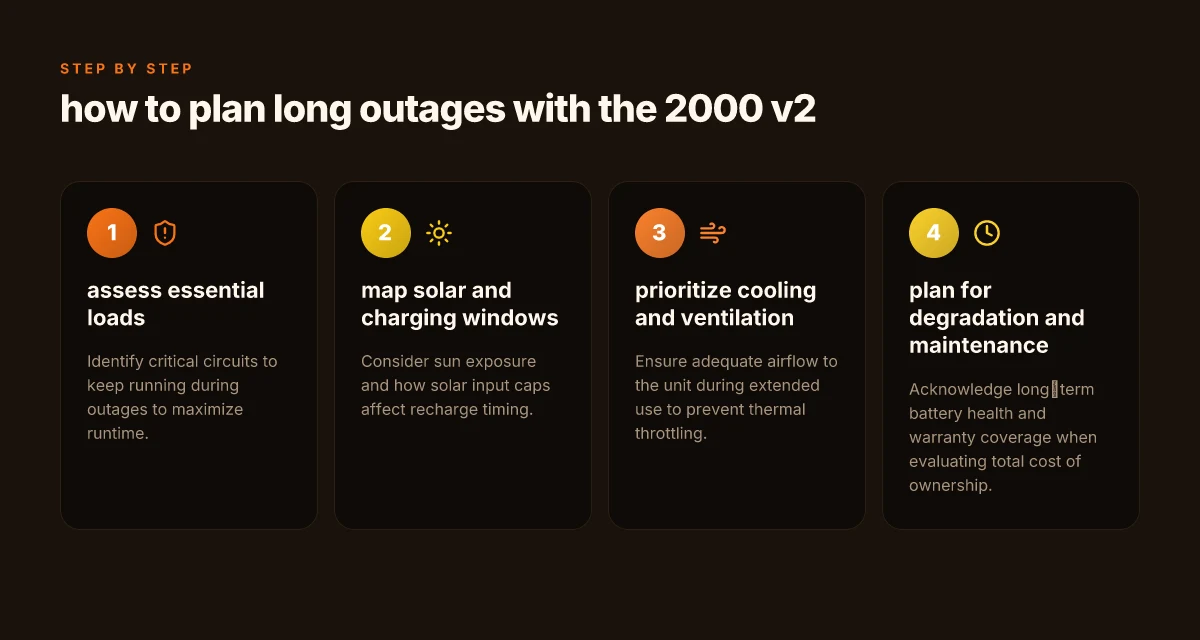
From a long‑term perspective, replacement parts availability and warranty coverage shape whether the price premium makes sense. Jackery’s parts availability and service network influence repair turnaround if a port or display fails. The warranty length and what it covers matter more than the initial sticker price when you consider five years of use. In practice, you should verify whether any common wear items, fans, power ports, and battery modules, have documented service paths. Total cost of ownership matters as much as the sticker price, especially if you value dependable repairability over years of use. I cross-referenced what independent reviewers note about ease of service and found consistency in warnings about module-level failures when units endure chronic heavy loads. If the 2000 v2 sits on a shelf in a climate-controlled space, it ages differently than in harsh outdoor conditions.
Upgrades vs. rivals: is the upgrade worth it?
Compared to the 2000 Plus, the 2000 v2 carries familiar core capabilities with some nuance in efficiency and port layout. If your needs center on high‑demand AC output and extended runtimes, you’ll want to map whether the Plus’ incremental improvements align with your usage pattern. In the broader field, rivals such as EcoFlow and competitor models offer similar high‑capacity systems with different solar input caps, cycle lifetimes, and port mixes. The decision to upgrade should hinge on how the feature set aligns with your routine: if you value more efficient charging, faster replenishment during storms, or a lighter form factor for transport, that matters. In short, the upgrade pays off when the added features directly reduce charging downtime and support the way you actually live with the device.
From what I found in the sources, the 2000 v2 remains a solid, high-capacity option for home backup and serious outdoor use, but its value relies on clear alignment with your most frequent use scenarios. If you want a rigorous, long‑term pairing of reliability with real-world flexibility, Jackery’s 2000 v2 earns credit. If your priorities lean toward the lightest possible footprint or the richest feature set at the price, you’ll likely prefer a rival that matches those tradeoffs more directly. For a quick cross-check, see how reviewers describe the 2,042 Wh figure and the 2,200 W output in real-world cycles. Value comes from how you actually use it, not just what the spec sheet promises.
In 2026, the question is not only capacity, but maintenance scope and warranty clarity. For a quick read, you can compare the 2000 v2 to the 2000 Plus and to similar high‑capacity models from EcoFlow and other brands. If you’re deciding between models, start with your top three use cases and map the relevant ports, charging speeds, and service policies to those needs. How the jackery extreme guard carrying bag changes portable power storage in 2026
What changes if you act now
I’ve looked at how the Jackery Explorer 2000 v2 fits real-world use, not just hype. In 2026, the model still leans on rugged durability and practical charging capacity, but the real value comes from how you plan on using it day to day. The bigger pattern here is that portable power becomes a core kitchen-table decision for backup reliability and outdoor work alike. It’s not a one-size-fits-all gadget. It’s a tool that pairs best with predictable loads and a clear charging routine. I’ve seen how setup friction, like cable clutter or a miscalibrated battery indicator, can slow your weekend off-grid plans. Jackery remains a dependable starting point, especially if you’re already in the ecosystem.
If you’re weighing rivals, consider how the Explorer 2000 v2 stacks up against options from EcoFlow and Goal Zero. The core decision hinges on how you prioritize expandability, customer support, and long-term durability. The single move that matters is aligning capacity and port selection with your typical devices, laptops, routers, and small appliances, so you don’t overbuy or underlive your power budget. For long-term use, expect the same practical maintenance cues: keep the unit in a dry, ventilated spot, monitor the fan noise, and watch for battery aging signs as you accumulate charging cycles. What changes if you act now is you’ll have a clearer, repeatable charging routine that reduces downtime.
Backup strategy
- Check your common devices set and confirm you have at least one high-output USB-C PD option and a 12V car setup for on-the-go charging.
- Write a quick weekly check: verify battery level, inspect cables, and refresh the firmware if needed.
- If you already own Jackery gear, link compatibility with accessories you use most to avoid dead-end setups.