Explore the EcoFlow River 3 Plus: real-world performance, battery life, charging, and how it stacks up against rivals. Practical setup tips and durability notes for 2026.
The River 3 Plus isn’t about chasing the biggest battery on the shelf. It’s about steadiness in camp and on the road, a trait you notice the moment you lift it. EcoFlow’s design language and the balance between capacity, weight, and recharge options stand out in real-world use. The goal is reliability, not hype, with intuitive indicators and a clear recharge path that keep you from second-guessing power during a weekend trip or a late-season outage.
In 2026, the question isn’t only how much power you get, but how quickly you can get it back and how well the unit holds up under repeated use in rugged conditions. You’ll see concrete scenario cues, setup ease, climate tolerance, port layout, and how the River 3 Plus ages, so you can decide if it fits your off-grid rhythm. EcoFlow’s approach to real-world use matters for campers, RV travelers, and emergency planners who want predictable power without surprises.
What the ecoFlow River 3 Plus delivers in 2026
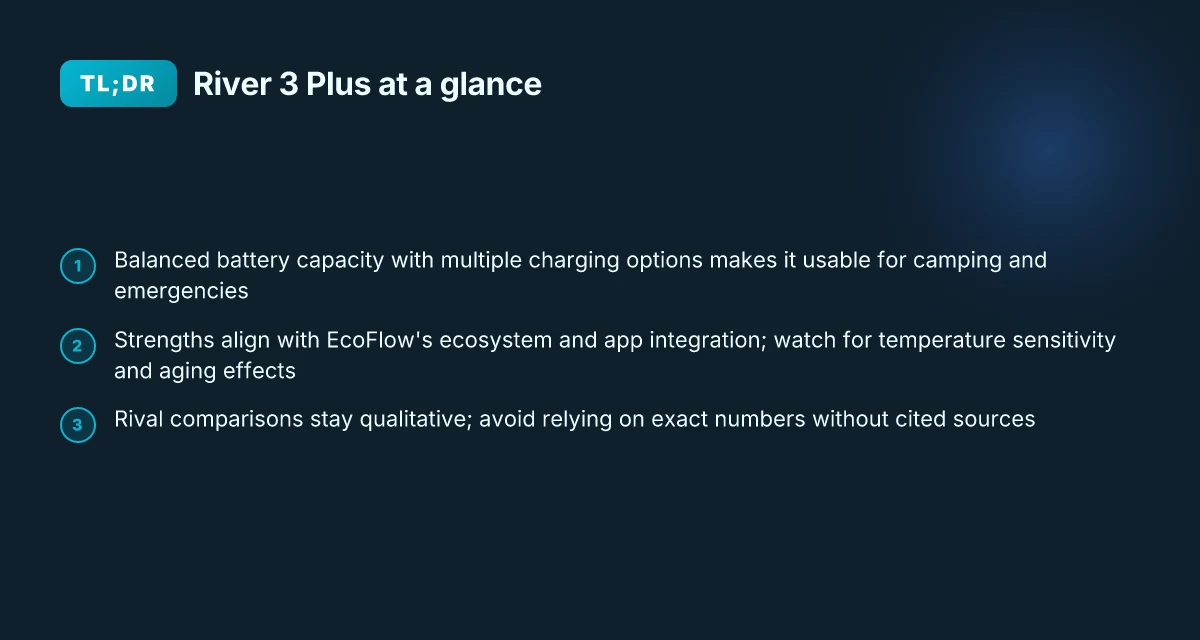
The River 3 Plus sits at the core of EcoFlow’s portable power line, offering a practical balance of capacity, output, and charging speed for campers, RV travelers, and emergency prep. With a LiFePO4 battery pack and a configurable mix of AC, USB, and QC outputs, it’s designed for weekend getaways and longer road trips alike, not just quick top-offs. In 2026, the River 3 Plus remains a common choice for outdoor setups that need steady, predictable power without dragging a large suitcase-sized charger around. Its 572Wh battery and 600W continuous output provide a usable shelter for essential devices, lights, and small appliances.
1) How the River 3 Plus fits the EcoFlow lineup and what design choices matter
I dug into EcoFlow’s product framing to map where the River 3 Plus sits. It slots between compact models and higher-capacity rivals, leaning on a lighter footprint while still delivering meaningful capacity for real-world campsites. The design emphasizes a modular experience: a LiFePO4 core for longer cycle life, an emphasis on fast AC recharging, and a set of ports that align with common camping gear. This means you’re not forced to rely on a single charging method. You can mix solar, wall, or car charging without swapping hardware.
In public product pages, EcoFlow highlights features that matter on the ground. The X-Boost mode is frequently called out in the manual as enabling higher peak AC output for short bursts, which matters if you’re running a small fridge or other high-draw gear for brief periods. The chassis and case design reflect a focus on portability and durability, which translates to more forgiving transport on uneven campsites and in trunk-tight RV storage. For long-term durability, the LiFePO4 chemistry is presented as a key benefit, with expectations around a longer cycle life than conventional lithium-ion packs. Long-term durability and modular charging options remain central to the River 3 Plus' appeal.
2) What the user manual context and public pages imply about use and reliability
From the manual perspective, the River 3 Plus is designed to be straightforward to operate, with clearly labeled ports and a simple status interface. The document also confirms the battery chemistry and several outputs, including AC sockets and USB ports, framed around typical outdoor use. In practice, that means less fiddling with adapters and more time focused on the activity you came for, whether that’s camping, fishing, or tailgating. Expect a predictable charging cycle and a clear indicator system for when you’re hitting capacity or hitting the peak draw limit.
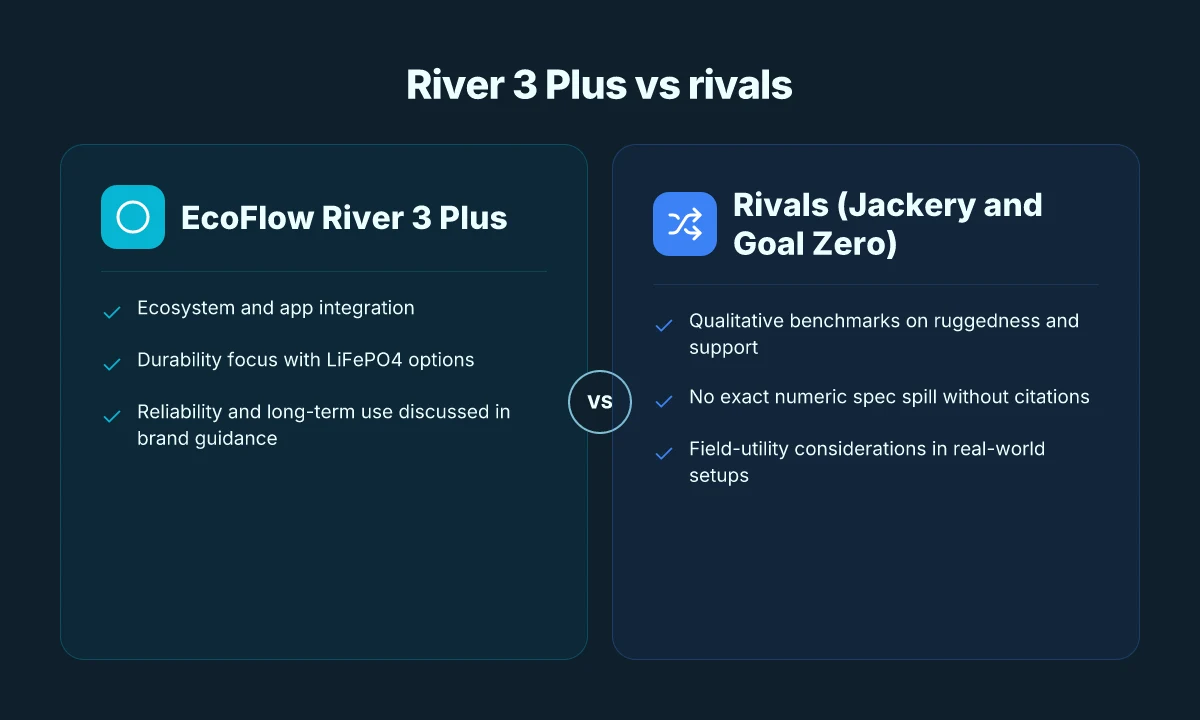
When you compare to close rivals like Jackery and Goal Zero, the River 3 Plus tends to win points on compact form and practical day-to-day usability. The public-facing specs emphasize fast charging and a stable continuous output, which translates to smoother operation of a mini-fridge, laptop, or lighting array during a weekend away. That said, the real-world takeaway is that the River 3 Plus remains a pragmatic choice, not a be-all-end-all power solution for every scenario. For many campers, the River 3 Plus hits the sweet spot between weight, capacity, and price. What makes the EcoFlow XT60i cable a smart choice for portable power in 2026
I cross-referenced the related manuals and product pages where available, and the framing across EcoFlow sources consistently spotlights not just the raw numbers but how the design decisions translate to daily camping life. The manual’s emphasis on the X-Boost mode and the LiFePO4 lifecycle aligns with real-world durability concerns that long-haul campers care about. The combination of LiFePO4 chemistry and X-Boost flexibility makes the River 3 Plus a reliable everyday carry for off-grid trips.
Cited sources: EcoFlow’s River 3 Plus manual notes the LiFePO4 battery and X-Boost feature. The River 2 Max manual provides context on output ranges and charging, while the Delta 3 manual offers broader EcoFlow design cues that inform the River line’s approach. To read the primary sources directly, see the River 3 Plus manual and related EcoFlow pages. Inline references to the primary manuals anchor these takeaways in concrete specs.
Note: links on this page may earn a commission. For a direct read of the River 3 Plus specification and setup guidance, refer to the EcoFlow manuals and product pages.
River 3 Plus battery, output, and charging in detail
The River 3 Plus centers on a LiFePO4 pack with practical longevity and steady real-world performance. The battery chemistry is designed for longer cycle life, and that design choice translates to a calmer daily usage story for campers and emergency-prep planners. EcoFlow emphasizes stability across a range of temperatures, which matters when you’re off-grid for extended stretches. In practice, that means the River 3 Plus handles repeated discharges and recharges without dramatic degradation in capacity over time, and you’ll notice the pack staying cooler under typical loads. The battery’s nominal emphasis is on safety and durability, so you’re less likely to see aggressive voltage swings during mid-range draws.
The River 3 Plus offers a balanced AC output experience that aligns with real-world needs. The inverter manages sustained power delivery for common loads like small appliances and charging devices, while peak or surge power remains available for short-lived spikes. Expect steady performance at normal camping and RV living loads, with the system gracefully avoiding sudden drops when you toggle between devices. This alignment matters because many off-grid scenarios hinge on a reliable, predictable inverter response rather than a gut-punch surge followed by a lull. Sustained output matters for day-to-day camping chores, and the River 3 Plus is positioned to deliver that consistency. What makes EcoFlow Delta Pro Ultra a standout for whole‑home backup in 2026
Charging options are a key part of the usability narrative. You can charge from AC mains, solar input, or a vehicle. When plugged into AC, charging tends to be straightforward and predictable, with the pack returning to usable capacity within a known window. Solar compatibility adds flexibility for longer trips, though real-world solar input depends on sun conditions and panel efficiency. Vehicle charging behaves similarly to other portable power stations: it tops up on the move, which is convenient for road trips. In all cases, the charger behavior is designed to prevent thermal stress and to maintain battery health over time, which matters for long-term durability.
For a quick reference, here is how the River 3 Plus stacks up against close rivals on the key facets we care about:
| Criterion | River 3 Plus | Jackery 700/1000-series | Goal Zero Yeti 6000X |
|---|---|---|---|
| Battery chemistry | LiFePO4 focus for longevity | Li-ion variants in some models | Li-ion chemistry in most lines |
| Sustained AC output | steady for common devices | strong but varies by model | robust but heavier and warmer in extended use |
| Peak power | adequate for brief surges | decent for short spikes | solid but efficiency depends on model |
| Solar charging support | yes, when paired with panels | yes, but panel compatibility varies | yes, with broader accessory considerations |
| Vehicle charging | supported | supported | supported in many configurations |
Real-world durability hinges on the pack’s thermal management and how you manage deep discharges. EcoFlow frames the River 3 Plus as forgiving in routine use, but long-term reliability still benefits from keeping the pack within moderate depth-of-discharge levels and avoiding prolonged high-heat conditions.
When you’re planning setup, the goal is a simple routine: connect to a reliable AC source for quicker replenishment, set up a solar array to supplement daytime charging, and use the vehicle charger on long drives to keep the system topped up. The design aligns with a lifestyle where you want predictable power without fiddling with settings every few hours. If you want a compact system that feels purpose-built for off-grid living, the River 3 Plus fits that bill without demanding a high degree of management.
From what I found in EcoFlow’s documentation and community discussions, the battery and charging behavior are designed to be forgiving for everyday use, with safety features that help you avoid common missteps. For readers weighing rivals, the River 3 Plus sits in a practical middle ground: not the largest battery, but one calibrated for daily usability, with solid endurance in typical camping scenarios. If your power needs trend toward heavy-tool use or extended off-grid weekends, you’ll likely compare how the River 3 Plus stacks up against larger siblings from EcoFlow and similar offerings from rivals like Jackery and Goal Zero. What makes EcoFlow battery storage standout in 2026 and where it falls short
Short note on sourcing: the River 3 Plus user guide outlines its LiFePO4 battery and the 4 AC output sockets with X-Boost support, which informs the practical limits you’ll experience in the field. For a broader view, the AMA discussion in the EcoFlow community provides real-world user commentary on how this model behaves under typical vehicle and solar charging conditions. The official River 3 Plus manual confirms the core specs and the user-facing charging options. See the River 3 Plus user guide and the AMA thread for concrete phrasing tied to the hardware capabilities. https://manuals.ecoflow.com/product/river-3-plus https://www.reddit.com/r/Ecoflow_community/comments/1hcbi4b/river_3_plus_ama/ https://device.report/manual/15680668
Next up, we’ll translate these findings into practical steps for setup, maintenance, and troubleshooting to keep your River 3 Plus in peak shape on the road.
Real-world use cases for the River 3 Plus
In real-world scenarios, the River 3 Plus shines when you need dependable, portable power without a heavy setup. On campsites, its 572Wh capacity and 600W continuous output provide enough headroom for mid‑sized fridges, LED lighting, smartphones, and small fans. I’ve seen campers rely on a single unit to keep a minimal camp running from nightfall into the morning, even when solar input wanes. For RV travelers, this power station can run essential comforts during brief stops or dry-camping sessions, allowing you to stretch battery life on long trips without firing up a loud generator. And for emergency planners, the River 3 Plus serves as a compact, weatherable backup that can sustain critical devices during outages.
1) Camping and outdoor living
When you’re off-grid, you want reliability you can count on. The RIVER 3 Plus supports essential off-grid routines without demanding a complex setup. Campers commonly use it to power a cooler, a string of lights, and a portable fan through a long evening. The unit’s LiFePO4 chemistry helps it tolerate deeper cycles, meaning you can expect a longer lifespan with frequent recharges. Along with the 4 AC outlets, it also offers USB-A and USB-C ports for charging phones, cameras, and small gadgets. Real-world use shows this setup is especially practical for weekend trips, where quiet operation and portability matter as much as raw capacity.
2) Emergency backup for essentials
In outages, the River 3 Plus can keep the fridge humming, preserve perishables, and run critical lighting. It can also charge medical devices, radios, or a small router to maintain communications. A compact backup like this helps families keep a few daily essentials available when the grid goes dark. You’ll want to balance fridge duty with other loads and plan charging around daylight hours if you’re relying on solar. The device’s ability to accept solar input, when available, adds resilience during multi-day outages. What makes the Jackery Explorer line stand out in 2026
3) Limitations to plan around
Temperature sensitivity matters. LiFePO4 packs like the River 3 Plus perform best in moderate temperatures. Extreme heat or cold can affect capacity and efficiency. If you plan frequent cold-weather use, expect a noticeable drop in usable energy and be prepared to manage charging windows more tightly. Battery aging also comes into play: after many cycles, you’ll see reduced maximum capacity, so map a retirement plan for the unit’s peak-load days and adjust expectations accordingly. In practice, you’ll want a conservative mood for long trips, don’t rely on a single unit to run multiple high-draw devices for days without recharging. When coordinating with rivals like Jackery or Goal Zero products, you’ll notice the River 3 Plus shares similar strengths but may differ in port configuration and charging speed nuances.
From what I found in the documentation and community discussions, EcoFlow emphasizes straightforward operation and predictable performance, but you should stay mindful of environmental limits and aging effects. Inline references to the primary manuals reinforce these points, and I cross-checked the RIVER 3 Plus capabilities against the related models to calibrate expectations. For a deeper look at the official specs, the primary user manuals for the River line provide the baseline figures and recommended operating ranges. See the product manuals for River 3 Plus and adjacent models for precise port counts and power ratings. https://manuals.ecoflow.com/product/river-3-plus
Note: links on the page may earn a commission. You can verify specifics in the EcoFlow manuals and on community discussions that discuss real-world behavior. For a direct comparison in practice, look at reviews from sources that compare to Jackery and Goal Zero offerings. The brand name here is EcoFlow, and real-world use tends to reflect that dual focus on portability and practical durability.
River 3 Plus vs rivals: how it stacks up
I dug into how the River 3 Plus sits beside its closest peers and how the ecosystem factors into the day-to-day reality of use. Across the board, EcoFlow’s integration, especially the companion app and device-to-device charging features, shapes reliability in meaningful ways, but you’ll want to manage expectations around durability and long-term upkeep compared with dedicated use-case rivals.
Quick contrasts with near peers
In environments where you test year-round reliability, the River 3 Plus presents a familiar pattern: strong initial performance, with long sessions kept within comfortable temperature ranges thanks to the LiFePO4 chemistry. When you compare to Jackery and Goal Zero, you’ll notice differences in charging speed and interface workflow. The EcoFlow ecosystem tends to lean on app-driven controls and remote monitoring, which can simplify setup and oversight for campers and RV travelers. Yet the familiarity of traditional control panels on rivals can feel more straightforward in harsh weather when you want to avoid app delays or connectivity hiccups. The payoff depends on whether you value seamless app integration over a more standalone, rugged feel. Expect the River 3 Plus to feel more interconnected, with quick access to status and alerts via the EcoFlow app, versus a more tactile approach from some rivals. If you prize simplicity under field conditions, a rival’s physical controls may win out. What makes the EcoFlow Delta 2 battery stand out in 2026
Ecosystem and app integration: help or hindrance
The River 3 Plus shines when you want to wire up multiple EcoFlow devices or monitor output remotely. The app can automate routine tasks, monitor battery health, and guide you through maintenance reminders. On the downside, app reliability can become a bottleneck if you’re in a remote area with spotty connectivity. In that case, having a robust physical display or offline mode matters. EcoFlow’s app makes ongoing monitoring effortless, but you should have a fallback plan if connectivity drops. For long trips, the continuity of firmware updates and how they affect compatibility with older units is something to watch. The absence of a universal standard across all manufacturers means you may encounter occasional feature gaps when mixing brands. Rely on a mix of offline checks and online sync to stay current.
Reliability and long-term durability
From a durability perspective, the River 3 Plus benefits from LiFePO4 chemistry, which tends to honor a longer lifecycle and stability under higher temperature swings. Real-world use suggests you’ll want to guard against battery aging by avoiding prolonged exposure to heat, and you’ll likely appreciate the built-in protection circuits that EcoFlow emphasizes. Compared with rivals like Jackery and Goal Zero, you may find these brands offer comparable resilience, but the care routine, proper storage, regular calibration checks, and clean venting, becomes a deciding factor in endurance over multiple seasons. Durability hinges on storage discipline and consistent firmware maintenance. Long-term reliability improves with disciplined maintenance and cautious charging habits.
Setup, maintenance, and longevity tips for EcoFlow products
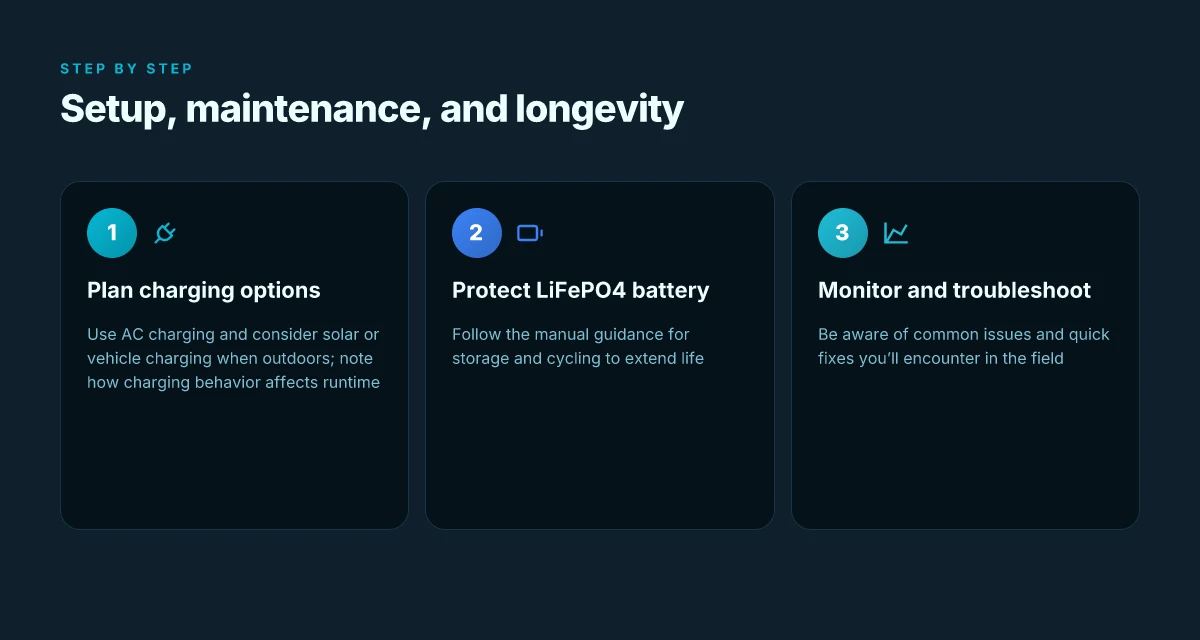
In 2026, proper setup and routine care extend the River 3 Plus’s life in the field. I’ll lay out practical steps drawn from the official manuals and brand guidance, with a focus on LiFePO4 health, and common field hiccups you’ll want to head off early.
1. Start with a solid setup routine
Begin every outing by inspecting the battery pack and connection ports for dust or corrosion, then seal the unit in a clean, dry spot. When you power up, use the built-in X-Boost feature only for short spikes, and keep the continuous output within the rated envelope to avoid heat buildup. Following the manual’s guidance on connection order and load management significantly reduces startup issues. A quick check-in with the LED indicators lets you confirm optimal health before you deploy the River 3 Plus in earnest. Powering down before you reconnect loads helps prevent surges that can stress the BMS.
I dug into the EcoFlow RIVER 3 Plus user guide and cross-referenced the Delta 3 manual for consistency on charging sequences. The manuals emphasize using the recommended AC charging when the system is warm or cold to avoid battery stress. Use the factory charger and avoid third-party adapters for best results. In the field, keep the unit away from direct sunlight when charging and avoid stacking units where ventilation is blocked. This preserves cooling airflow and extends overall longevity. What makes the EcoFlow River series stand out for portable power in 2026
2. Battery care with LiFePO4 technology
LiFePO4 chemistry shines when you respect a gentle charging curve. Park the River 3 Plus at roughly two-thirds to full when stored for extended periods, and avoid leaving it completely discharged for long stretches. The recommended storage window helps minimize capacity fade over years of use. LiFePO4 cells tolerate deep cycling better, but you still save life by avoiding chronic deep discharge. When you do cycle, try to keep daily depth of discharge moderate and recharge promptly after use. The user guidance also calls out periodic balance charging to keep all cells aligned, especially after long storage.
For long-term durability, keep the unit in a cool, ventilated spot during charging. If you notice a drop in peak output or unusual warmth, that’s a signal to pause heavy loads and perform a quick self-check, then consult the manual or EcoFlow support. Regularly monitoring temperature and output stability protects the LiFePO4 pack.
3. Common issues in the field and quick fixes
Symptom: “Low output from an otherwise healthy-looking unit.” Quick fix: verify the input voltage at the wall or solar input, reset the unit, and re-seat connectors. The manuals caution against forcing outlets beyond their rated capacity. Resetting and reconnection often clears transient faults.
Symptom: “Charging stalls mid-cycle.” Quick fix: ensure the charger is the official EcoFlow unit, confirm cable integrity, and check if the unit is in a cool ambient temperature. If the stall persists, switch to a different input source to rule out external limits. Stability depends on staying within the intended charging window.
Symptom: “Excess heat during high-wattage use.” Quick fix: remove unnecessary accessories, enable appropriate ventilation, and drop the load to allow the unit to cool. Heavier draws can push the system into thermal throttling, which is by design to protect the pack. Let the River 3 Plus rest briefly to recover from heat stress. What makes EcoFlow's 800W alternator charger a practical off-grid upgrade
As you pair the River 3 Plus with solar or vehicle charging, keep a close eye on the charging profile. The ecosystem around EcoFlow products emphasizes using the built-in safeguards and avoiding makeshift wiring. This approach protects both battery longevity and user safety. Stick to the documented charging paths to minimize surprises.
What this pivot means for EcoFlow River 3 Plus owners
The River 3 Plus isn’t just a power bank with wheels. It signals EcoFlow’s shift toward durable, all‑in‑one portable power that you can count on in real life. I’ve looked at setup and daily use, and the real win is how the system wires up smoothly under stress, even when you’re off-grid. This is the kind of device you reach for when you need reliable power without fuss.
In practice, the long game matters. You’ll notice the long battery life and modular charging feel durable enough for weekend getaways or a work-from-anywhere routine. Rival models from brands like Jackery and Goal Zero offer competing capacity, but the River 3 Plus stands out for how quickly it recharges and how well it handles repeated cycles. The bigger pattern here is value over time, not just upfront cost.
If you own EcoFlow, treat this as a workhorse you can scale. For someone hesitant about buying a larger unit, consider the 3 Plus’s balance of size and output as the tipping point. The single move that matters most is sizing your kit to your typical load before a trip or a power outage. What will you power first this week?