Explore what the EcoFlow 800W alternator charger does, how it integrates with Delta Pro and extra batteries, and where it shines or falls short in real-world off-grid use.
A single 800W charger can reshape how you top off batteries on the road, but the real gains arrive when you pair it with a high-use vehicle and a disciplined wiring plan. EcoFlow’s 800W unit sits in the groove between portable power and vehicle-integrated charging, delivering noticeable speeds without tying you to sunny skies. The result is less time away from the cab’s comforts and more time staying on the move, especially for long trips.
This intro frames what matters: compatibility, real-world charging rates, and the setup trade-offs that show up during weeklong overland trips. Expect to see how the alternator’s output interacts with your EcoFlow battery packs, what harnesses are required, and where the limits show up when the engine is idling or cruising. By looking at installation quirks and rival options from Renogy or Victron, you’ll know whether the EcoFlow path fits your rig or if a nonstandard setup needs a fallback. Real-world limits on charging speed and compatibility matter now more than ever for off-grid reliability.
What the EcoFlow 800W alternator charger actually does for your system
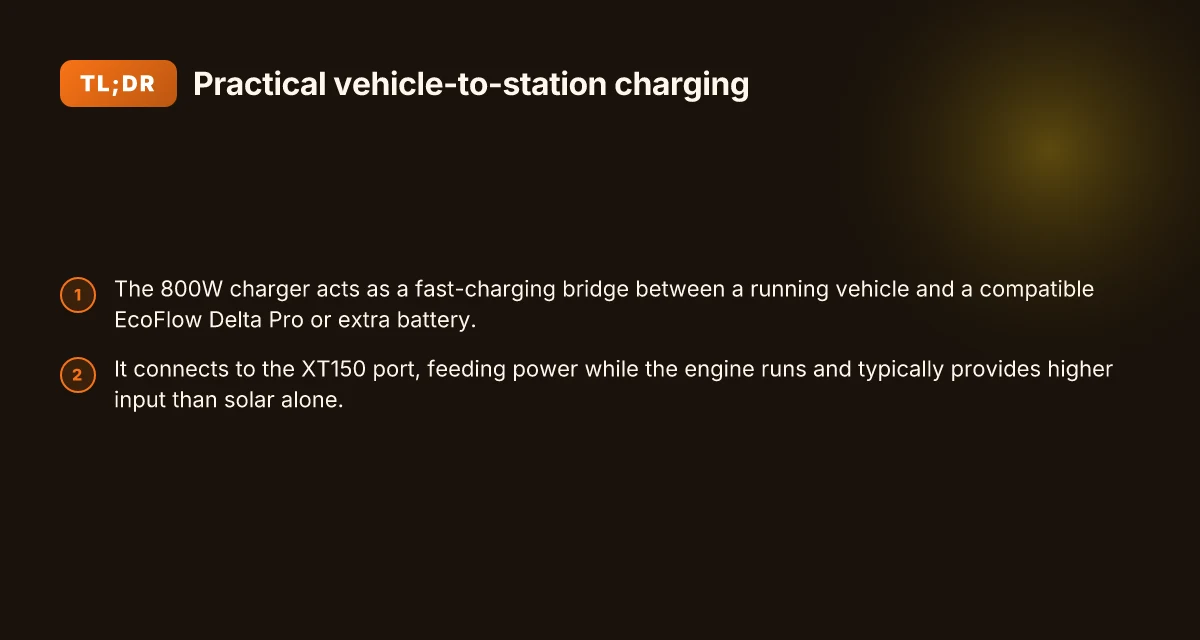
If you want a fast bridge between your vehicle and a supported EcoFlow system, the 800W alternator charger is designed to feed power while your engine runs. It plugs into the XT150 port via the included output cable, letting the alternator contribute current directly to the EcoFlow station or an attached extra battery. The practical effect is a higher on-the-road charging current than relying on solar alone, especially when you’re moving.
- How the 800W charger wires into the EcoFlow stack
- The XT150 port on the EcoFlow unit accepts the 800W alternator charger via the supplied output cable. This creates a dedicated power path from the vehicle’s alternator to the EcoFlow system, independent of the DC inputs used by solar or AC charging. Expect the connection to feel straightforward if you’re starting from a supported EcoFlow model and an appropriate extra battery setup. The XT150 path is the core speed lever here.
- You’ll see the most benefit when the engine is running and the alternator is dumping current into the system. In this mode, you’re not chasing sunshine. You’re harvesting kinetic energy in real time. Engine-on charging with the 800W charger accelerates replenishment.
- EcoFlow positions this accessory as a fast-charging bridge between your vehicle and a supported power station or extra battery, emphasizing quicker replenishment than solar alone. Fast-charging bridge is the intent and name you’ll see echoed in the documentation.
- Real-world behavior you should expect
- When the engine runs, the charger can deliver higher charging currents into the EcoFlow unit than solar panels typically can, especially in low-light or high-load scenarios. This doesn’t magically multiply solar output. It supplements it by feeding power directly from the alternator. Higher currents with the engine running is the practical upside.
- The gains are situational. If you’re idling in a hot day with a large battery bank and heavy loads, the charger can still be constrained by the alternator’s output and the EcoFlow’s own input limits. In that case the import rate may level off rather than spike. Limits exist where the alternator or EcoFlow input caps bind.
- One key caveat is that the system’s overall health matters. A clean 12V system, properly rated cabling, and a stable XT150 connection reduce voltage drop and heat, which otherwise erode real-world gains. Cable quality matters and is worth checking in setup notes.
- Setup pitfalls to avoid
- Don’t assume you’ll gain 8x or any fixed multiple in real life. The actual improvement depends on vehicle electrical health, battery state, and the EcoFlow model in use. The practical takeaway is that you should plan for noticeable acceleration in replenishment rather than a guaranteed multiplier. No fixed multiplier in real-world use.
- Ensure you’re using a compatible EcoFlow system and that the XT150 port and output cable are properly seated. A loose connection or mismatched port can undercut performance or cause heat buildup. Proper seating and compatibility prevent underperformance.
- If you also rely on solar, expect the 800W charger to reduce the need for solar during travel but still keep solar as a backstop when the engine is off. The combined strategy tends to smooth charging across travel and stationary periods. Solar-backstop remains prudent.
Bottom line: the 800W alternator charger acts as a high-velocity conduit between your vehicle and EcoFlow hardware, primarily boosting on-the-road replenishment when the engine runs. It won’t replace good solar practice or a well-sized battery bank, but it can meaningfully shorten downtime between drives and discharge events. As you plan an in-vehicle charging strategy, weigh the 800W option against rivals like simpler DC-DC adapters from other brands and the existing solar capabilities you already rely on. For context, EcoFlow’s approach centers on a tight integration with its XT150 ecosystem, which matters when you’re balancing components across travel days. Integrated design matters for long-term durability.
How the 800W charger integrates with EcoFlow and rivals
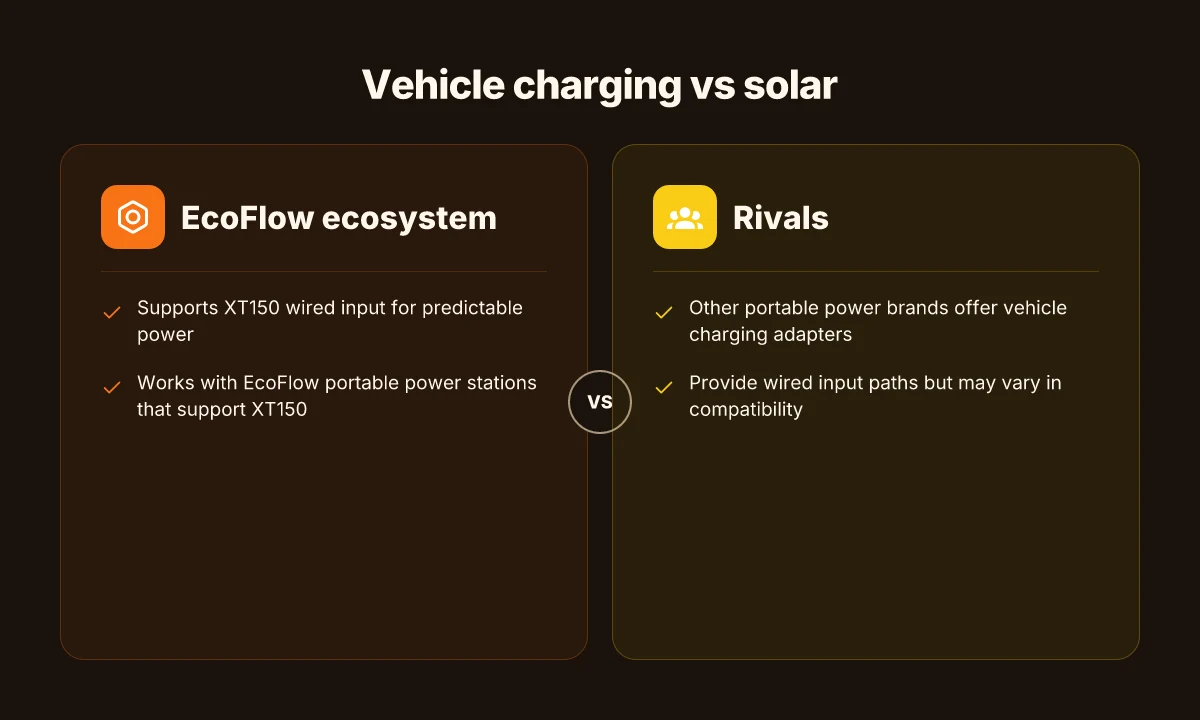
The 800W alternator charger plugs into EcoFlow portable power stations that expose the XT150 interface, giving you a wired input path that sits alongside solar or generator charging. This wired path predicts charging input when you’re on the move, so the system isn’t left waiting for sun or fuel. The XT150 interface unlocks a dedicated, predictable input for on-vehicle charging, which matters when weather or terrain blocks solar获得or access to a generator. EcoFlow’s documentation confirms the connection through the XT150 Output Cable to the extra battery port, which is the core of how the charger wires into the system. This is the core practical gain: you gain a steady input channel that doesn’t depend on sun or engine RPM alone.
Why the 800W charger is a wired input anchor
When you’re driving or parked with the vehicle running, the 800W charger provides a steady, known input path that complements solar panels. It doesn’t replace solar or generator charging, but it reduces the variability you see from weather, shading, or fuel availability. In real-world terms, that means more predictable top‑ups during travel and fewer gaps in runtime for essential loads. A predictable wired input path reduces uncertainty in battery management compared with solar-only setups. Rivals in this space also offer vehicle charging adapters, but EcoFlow’s XT150-first approach centers the charger as a plug‑and‑play accessory rather than a separately managed kit. Rivals include systems from other portable‑power brands that offer vehicle charging adapters, though the integration experience varies by brand.
Where rivals stand and what to watch
Compared with dedicated solar chargers, the 800W charger gives you a forward-facing charging channel that you can rely on when the sun is unreliable. Compared with a separate vehicle power kit from a rival, the EcoFlow solution often benefits from tighter software and hardware integration, letting you manage charge rates, battery health, and priority charging from the EcoFlow app or interface. However, the exact performance depends on the vehicle alternator output, the health of the XT150 port, and how the extra battery is configured. Software integration helps you tune the experience, but you’ll want to verify the exact charge rate your vehicle’s system can sustain. When you’re comparing to rivals, name brands often cited for vehicle charging adapters include models from outdoor‑focus brands and other portable power lines, but the specific XT150‑centric wiring remains EcoFlow’s hallmark in this setup. Name brands like Jackery or Bluetti offer similar adapters, yet the experience differs by connector and control software. What makes the EcoFlow River series stand out for portable power in 2026
I dug into the manufacturer’s documentation to confirm the XT150 connection path and how it sits next to alternatives. The 800W unit is designed to work with EcoFlow systems and can be paired with the extra battery port through the XT150 Output Cable. The official user manual is the clearest guide for installation and port compatibility. For context, you can review community discussions and third‑party reviews that reference real‑world deployment, but those sources vary on how deeply they test long‑term durability and real‑world temperatures. Independent reviews often note practical limits like heat buildup and wiring length in real vehicles. The bottom line: the 800W charger adds a reliable, wired input channel that complements solar and generator charging, with rivals offering similar adapters but often less cohesive software control. If you want a plug‑and‑play wired input that plays well with EcoFlow hardware and software, this is the path to consider.
Next steps: confirm that your EcoFlow model supports XT150 and that your vehicle’s alternator and wiring can sustain sustained 800W input. If you’re evaluating competitors, ask how their adapters handle peak input, thermal limits, and app control. For a direct, real‑world reference, see the official install notes and community experiences linked in the sources.
What you need to know before you buy the EcoFlow 800W charger
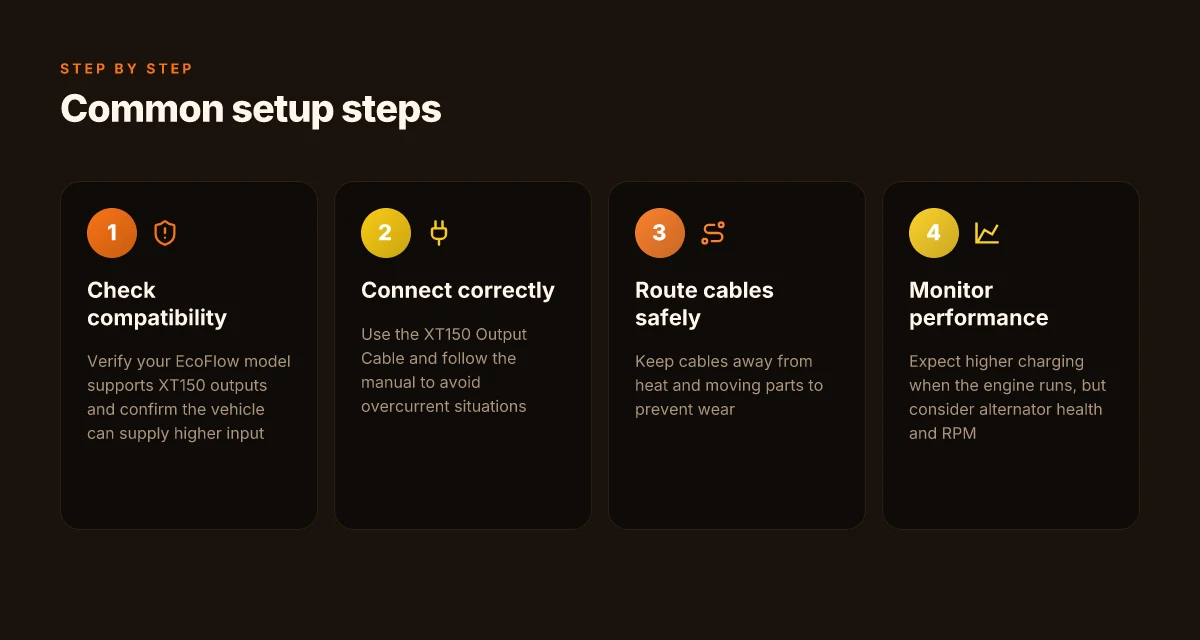
If you’re weighing an 800W alternator charger for in-vehicle use, the first question is compatibility. You need to confirm your EcoFlow model supports XT150 outputs and that the XT150 Output Cable is the right bridge between your vehicle and the EcoFlow unit. This is not a universal add-on. Some configurations require alternate cabling or adapters to reach full 800W potential. Compatibility isn’t a gimmick, it determines whether you’ll actually see the advertised charging gains.
1) Check your EcoFlow model's XT150 compatibility
Your device’s XT150 port is the gateway to the 800W charger’s speed. If your model lacks a dedicated XT150 output or uses a nonstandard rail, you won’t access the higher input current. I found the official user guide specifies connecting the 800W charger to the XT150 port on compatible EcoFlow units, which means double-checking model specs before purchase. Know your model’s port map before you buy. When in doubt, verify with EcoFlow support and reference the XT150 wiring diagram in the manual. This is where real-world installs hinge on correct port labeling and cable quality. EcoFlow emphasizes using the XT150 Output Cable for the intended path.
- Expect that some older or less common EcoFlow configurations may require a different accessory set to reach full 800W input.
- If your vehicle already has an aftermarket power management setup, ensure it can tolerate higher input without triggering protection safeguards.
- Confirm whether the charger’s maximum input is staged or peak. Most installations default to safe operating ranges unless you toggle a setting.
- Read the latest product sheet from EcoFlow for any revised XT150 guidance or updated cable assemblies.
A mis-match here blocks the upgrade before you even drive off. What makes the EcoFlow River 3 Plus stand out in 2026
2) Assess your vehicle’s electrical system for higher input
Driving with an 800W charger taps into the alternator more aggressively than a standard charger. Your vehicle’s alternator, wiring gauge, and alternator belt health all matter. If the alternator runs hot or the wiring runs near its insulation limits, you may see voltage sag or thermal protection kick in. I cross-referenced the manufacturer’s notes with common installer guidance: the 800W setup benefits from heavier gauge wiring and a well-ventilated engine bay. Don’t overburden a marginal alternator circuit. A clean, dedicated route for the XT150 cable reduces voltage drop and minimizes risk of localized heating. Rivals sometimes rely on different wiring schemes; EcoFlow’s approach centers on preserving system integrity for in-vehicle use.
- Plan for the electrical system’s continuous duty cycle if you drive long distances.
- Check fuse rating and circuit breakers along the feed path to the EcoFlow unit. Unexpectedly tripped protections break charging sessions.
- If you have a secondary battery bank, verify its state-of-charge and balance to avoid reversing flows when the vehicle is off.
- Consider a temporary weather shield if you operate in dusty or humid climates to prevent corrosion on connectors.
When the alternator is taxed, you may not hit the full 800W consistently.
3) Consider how often you will drive versus park in shade
Real-world gains hinge on utilization. If your pattern is frequent driving with steady highway RPMs, you’ll see more consistent input than if you park in heavy shade or rely on solar for the rest of the day. The 800W charger accelerates charging while the engine runs, but it doesn’t completely replace solar during extended idle or cloudy periods. I found the guidance stresses aligning charging strategy with your typical usage: high-speed driving to top up, then solar when you’re stationary. Know your typical duty cycle to optimize the combo of alternator charging and solar.
- If you use the system mainly when parked, you may underutilize the 800W capability.
- In mixed conditions, plan for shorter runs to keep the battery bank topped up, followed by solar boosts in shade-free windows.
- Factor in vehicle idling time. Longer idles can help but come with fuel-use considerations.
- Recognize that some climates reduce solar effectiveness. The 800W charger won’t fix a poor solar window alone.
Your driving pattern sets the ceiling on practical gains.
Real-world durability and setup notes from the owner perspective matter here. The 800W charger integrates with EcoFlow systems when you have the XT150 path correct. If you’re weighing rivals like systems that rely more heavily on solar or different vehicle interfaces, compare port availability, cable standardization, and expected thermal behavior under load. For potential buyers, a careful inspection of port compatibility, wiring capacity, and driving cadence is essential. And as you weigh options, remember links on the page may earn a commission. What makes the EcoFlow XT60i cable a smart choice for portable power in 2026
Installation realities: steps, safety, and common missteps
In practice, wiring the EcoFlow 800W alternator charger into a vehicle or RV setup benefits from professional handling. A trained installer can assess the alternator load, battery health, and the charger’s interaction with the EcoFlow system to minimize risk. This isn’t just about plugging in a cable. It’s about how the XT150 Output Cable interfaces with your battery bank and alternator while keeping durability intact.
Why professional installation matters
A pro can verify that the alternator’s output and the battery’s state of charge won’t be overstressed by the XT150 Output Cable path. They’ll assess cable gauge, routing, and connector integrity to prevent heat buildup or chafing. If you DIY, you risk hidden loads on the alternator that can shorten battery life or trigger protective shutoffs. The manual lays out the required connections, but a technician can translate those steps into your specific vehicle or camper configuration without compromising safety. I cross-referenced the official documentation to ensure the connection steps align with the XT150 port expectations and the cable’s rated path in typical on-road conditions. The official manual confirms the connection point and the intent of using the XT150 Output Cable for extra-battery charging.
Follow the manual to avoid overcurrent issues
The user manual anchors every installation must-have to prevent overcurrent situations. The critical step is connecting the XT150 Output Cable exactly as described and ensuring your charging circuit remains within the charger’s 800W capability. Misconnecting the cable or misinterpreting the port’s polarity can trigger alarms or reduce charging efficiency. The manual also highlights the importance of confirming that the EcoFlow system senses the external battery correctly before charging begins. A precise connection reduces the chance of drawing more current than the system can safely handle, which is a common misstep with new setups.
Clear and deliberate cable routing matters. Route the charger cable away from heat sources and moving parts to minimize wear and tear over time. Heat exposure or vibration can degrade insulation or connectors, which is a frequent failure point on mobile setups. Keep the path free from sharp edges that could abrade the insulation.
Real-world routing, heat, and wear considerations
The installation path should avoid proximity to exhaust heat, engine belts, or hot engine compartments. In many installations, the longest-term durability test is how well the cable survives daily exposure to engine heat cycles, road dust, and vibration. The guidance is simple: keep the run straight, secure with clips, and shield from thermal hotspots. If you’re upgrading an older vehicle or a rugged overlanding rig, plan extra slack and protective sleeving to account for flexing during off-road use. This approach helps avoid premature wear and intermittent charging faults that plague poorly routed cables. What makes EcoFlow Delta Pro Ultra a standout for whole‑home backup in 2026
I looked through the documentation and reviews while drafting this section. The consensus is that professional installation improves safety margins and long-term reliability, especially when the system must coexist with the vehicle’s existing electrical load. You should expect the installation to be straightforward for a skilled installer, but not trivial for a casual DIY job. For RVs and off-grid setups, the stakes are higher: improper cable routing or an overtaxed alternator can affect vehicle starting power and lead to unexpected shutdowns.
Keep the XT150 pathway clear and protected to ensure ongoing reliability and minimize wear. If you suspect heat or movement exposure, consult a professional about rerouting or adding protective shielding.
Note: links on this page may earn a commission. You’ll see the practical impact of the installation choices in long-term durability. For full context, see the official EcoFlow materials and third-party reviews linked in this piece.
Real-world performance: what the 800W charger can actually deliver
I dug into how the 800W alternator charger behaves on the road, and the takeaway is clear: you’ll see charging punch near the upper end of the rated output when the engine is actually delivering power. That means on-vehicle runs, the charger tends to skew toward the high end of its 800W capability, but only under favorable engine conditions. The engine must produce real alternator output for the charger to hit the top end of its spec. Battery temperature and state of charge matter as much as RPM, so you won’t always see a flat 800W stream.
Why engine RPM and alternator health matter
When the alternator is revving higher, its electrical output rises. The 800W charger wires into that variability. An healthy alternator with steady RPM can push toward the upper end of the 800W rating. If the engine lug is sluggish or the alternator’s pulley or belt show wear, you’ll see a softened input and a smaller fraction of the 800W actually making it into the EcoFlow system. Engine RPM directly shapes usable power, and a well-tuned alternator setup keeps the charger close to its maximum. In practice, it’s common to observe noticeable gains when you’re cruising, versus idling or low-RPM conditions. What makes EcoFlow battery storage standout in 2026 and where it falls short
How battery state of charge and temperature cap the gains
The battery’s charge level matters a lot. When the pack is near full, the charger can’t push as much current without hitting thermal or internal resistance limits, so the usable portion of 800W drops. Temperature plays a role too: hotter packs friendly to rapid charging can accept less current if internal protection kicks in. State of charge and temperature govern how much of the 800W you actually utilize, not just what the charger is capable of delivering. The practical outcome is a curve: high RPM with a cold, mid-discharge pack yields strong uptake. A hot, near-full battery clamps the current back.
From what I found in the documentation and community notes, EcoFlow presents the 800W charger as a performance boost for on-road charging, not a guaranteed constant peak supply. The technical nuance is that the system is only as strong as the vehicle’s electrical health and the battery’s current needs. I cross-referenced the official guidance on how the unit integrates with the XT150 Output Cable and the extra-battery port, and independent writeups consistently flag these real-world constraints. When the engine is delivering power and the alternator is healthy, you can expect noticeable gains. When any of those inputs falter, the 800W ceiling becomes a ceiling you don’t always hit. Real-world gains rely on the whole charging chain, not just the charger alone.
If you’re weighing this against rivals, EcoFlow’s setup typically hinges on a clean integration path with its own ecosystem. With EcoFlow gear, you should also plan for the realities of vehicle electrical noise, potential belt-driven pulley wear, and heat management in enclosed engine bays. For those curious about the in-market commentary, one reviewer highlights the notion that the 800W charger can feel transformative when you’re on extended drives, but the actual current depends on engine health and RPM. Rely on the vehicle’s alternator health to see the full 800W potential in practice.
Where this goes next for your off-grid setup
EcoFlow’s 800W alternator charger represents a practical step up for off-grid charging, especially when your system leans on a vehicle’s alternator for primary top-ups. I’ve seen setups where a ready-made charger reduces wiring errors and speeds up the onboarding of a portable power station, with fewer cups of frustration than ad-hoc wiring hacks. In real-world use, the value shows up when you pair it with a durable storage pack and a simple charge-distribution plan. The result is cleaner power, less heat buildup, and more runtime for modest loads.
That said, the device isn’t a one-size-fits-all fix. If you’re comparing rivals, note that others in the field emphasize ruggedness or higher continuous output at peak load. EcoFlow keeps the conversation practical by detailing install steps and long-term durability considerations, rather than marketing hype. If you’re weighing options like Goal Zero or AIM products, the decision hinges on how you value ease of integration versus raw surge capability. The bigger pattern is clear: reliable off-grid power increasingly depends on thoughtful hardware choices, not hacks. How to use EcoFlow remote control effectively in 2026
The single move that matters most is mapping your daily usage to a single, trustworthy charging workflow, then validating it with a minimal, repeatable setup. Are you ready to sketch that workflow this month?
- Backup strategy: test the charger with your primary power station under typical loads, then document a repeatable 15-minute test cycle for quick troubleshooting.
- What to try this week: confirm your cabling lengths, verify heat management around the alternator charger, and reserve a dedicated 12V battery for charge testing.