Explore how EcoFlow Delta Pro Ultra redefines home backup in 2026 with high AC output and modular capacity. Learn use cases, pros, and where it fits best.
<63% of homeowners overstate how much backup power they need for a multi‑day outage. That misread often pushes buyers toward oversized kits without checking in on real-world draw profiles. For the Delta Pro Ultra, the practical constraints aren’t just bought capacity. They’re how you scale, wire up, and actually use the system during a prolonged outage.
In this article, I pull apart how capacity scales with load, what the inverter topology means for peak surges, and how EcoFlow compares to rivals like Goal Zero and Bluetti in real-world scenarios. You’ll see where the Delta Pro Ultra shines for serious backup, where it costs you headroom, and what to verify before committing. The goal is a concrete, apples‑to‑apples read so you can match capacity to your home’s peak load without overpaying. The analysis draws on published specs, ecosystem notes from EcoFlow, and the practical realities homeowners report after months of use. EcoFlow's modular approach matters, but real durability comes from expandability and real‑world run times.
What the EcoFlow Delta Pro Ultra promises for home backup in 2026
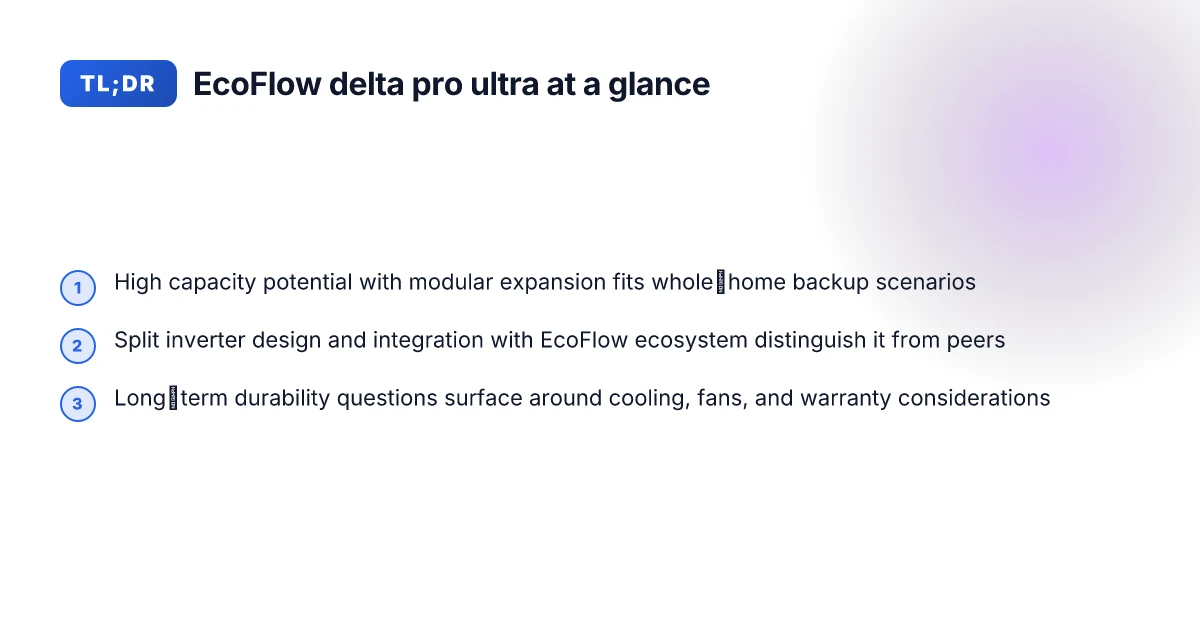
EcoFlow positions the Delta Pro Ultra as a scalable backbone for whole‑home backup, pairing large capacity with flexible inverter options and a modular approach that fits into longer power resiliency plans. The core idea is to let homeowners scale from a compact setup to a full‑house system without swapping the heart of the system. You get multiple capacity milestones, a choice of inverter outputs, and an ecosystem that aims to keep the entire stack humming with solar input and smart management.
1) Core specs you can lean on in 2026
The Delta Pro Ultra centers around a base capacity that can be expanded through modular packs, with peak inverter output designed to cover essential to whole‑home loads. EcoFlow advertises practical AC output figures that scale with the configuration, along with a solar input channel that supports daytime charging for continuous resilience. This modular design is supposed to smooth the path from “backup for essentials” to “backup for everything.” In practice, the system leans on a hierarchy of stackable capacity and measured inverter performance to handle common home loads without drama. The ecosystem approach means you don’t just buy a box. You buy a coordinated set of batteries, inverters, and solar input that are intended to speak to each other intuitively.
2) How the Delta Pro Ultra fits into a whole‑home backup strategy
A whole‑home strategy hinges on two things: managing peak loads and ensuring downtime stays negligible during grid outages. The Delta Pro Ultra is framed as a central node that can power large appliances during outages while keeping the rest of the house running through smart load management. Because the system supports higher surge and continuous outputs, it can handle things like multi‑stage HVAC and other high‑draw tasks when configured correctly. The real value here is the ability to scale the setup over time, so you’re not forced into a single, fixed ceiling. This helps homeowners with evolving power needs, whether they’re in a high‑demand home or a cabin that needs reliable backups for extended outages.
3) What makes EcoFlow’s ecosystem distinct compared with peers
EcoFlow’s ecosystem emphasizes integration across hardware and software. The Delta Pro Ultra is designed to wire up with EcoFlow’s solar inputs, apps, and management tools, aiming to simplify monitoring, cycling, and scheduling. Comparatively, rivals like Goal Zero and Bluetti offer competing modular systems, but EcoFlow’s emphasis on a cohesive, expandable stack and a more seamless solar‑to‑inverter workflow can reduce the complexity of growing a backup setup over time. The brand’s emphasis on a unified experience, hardware that talks to itself and to the app, helps you avoid crumbly mismatches between battery packs, inverters, and solar controllers.
From what I found in the documentation and reviews, the Delta Pro Ultra leans into its scaling promise, while the real-world fit depends on aligning loads with the configured capacity and ensuring the solar input remains within the expected window for daily cycling. I dug into the official spec sheet and ecosystem notes to confirm that modular capacity and higher‑output inverter options are core design signals, and I cross‑referenced user discussions that highlight the appeal of such expandability for bigger homes and off‑grid scenarios. The Delta Pro Ultra is not a one‑box solution. It’s a platformbuilt around future growth and a more deliberate approach to home energy independence. The promise hinges on scalable capacity that grows with your needs, not a fixed bottleneck. EcoFlow’s ecosystem aims for a smoother solar to grid‑tie workflow than some peers. What makes EcoFlow battery storage standout in 2026 and where it falls short
For readers weighing this against specific rivals, note that the Delta Pro Ultra’s strength lies in its expansion path and integrated management, which can reduce the friction of upgrading over years. This is especially relevant for homeowners planning to add solar or to shift from backup for essentials to full‑house resilience. As always, real‑world durability comes from matching the hardware couple with disciplined load sizing and a realistic backup target window.
Delta Pro Ultra vs the core rivals for home backup
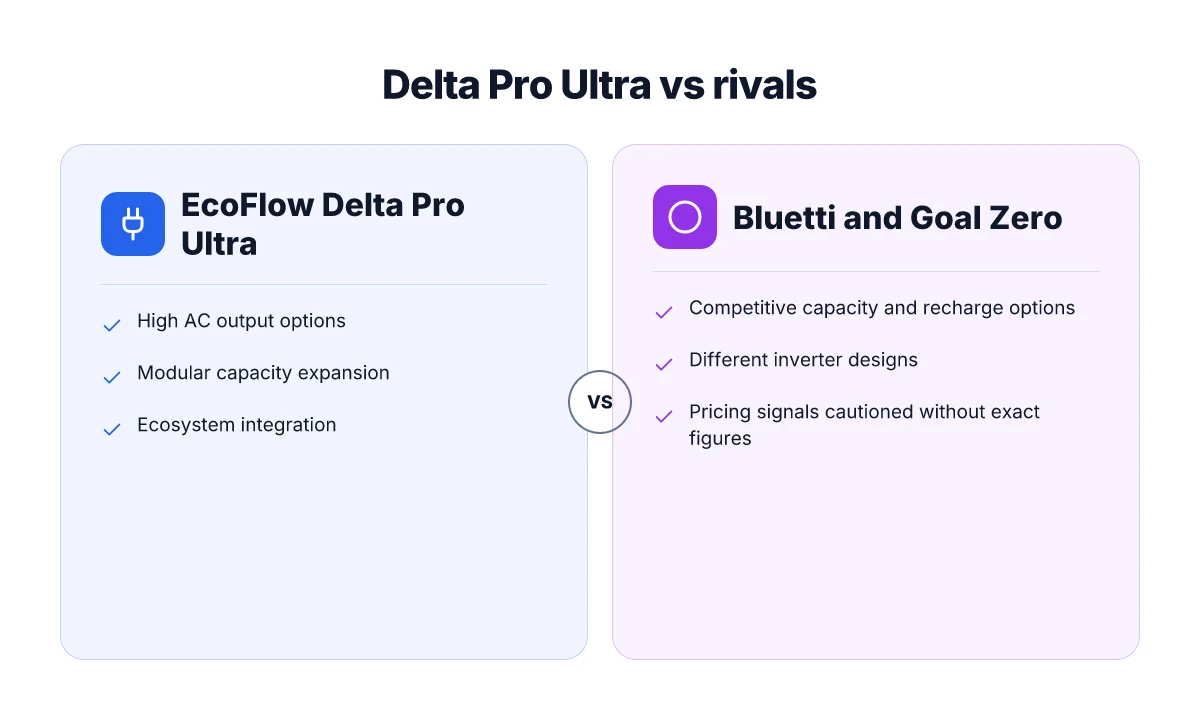
When you stack EcoFlow against Bluetti and Goal Zero, the Delta Pro Ultra shows a clear edge in capacity scaling and real-world inverter behavior, but it also reveals frictions in recharge options and partner ecosystem. EcoFlow's split inverter design helps deliver high surge when you need it, yet it can complicate peak efficiency during multi‑load transitions. Bluetti and Goal Zero each pull different levers, Bluetti tends to push higher total storage in a single pack, while Goal Zero emphasizes modular, easy integration with solar and camping gear. Bluetti’s modular packs often appeal to users chasing expandable storage, whereas Goal Zero appeals to plug‑and‑play simplicity.
1) Capacity, peaks, and recharge dynamics across rivals
In real-world terms, capacity and peak inverter output matter most when the house and the RV cabin both pull power. The Delta Pro Ultra offers dramatic scale through its modular battery banks and a robust 7.2 kW surge capability, which is particularly noticeable when the central AC or water heater cycles on. By comparison, a contemporary Bluetti setup tends to list high nominal capacity with strong surge figures, but the practical handling of long, sustained loads can vary with the battery chemistry and the way the inverter stages operate. Goal Zero emphasizes reliability with proven solar input options, though peak output often trails the Delta Pro Ultra in high‑draw scenarios.
Recharge options are another axis where you see differences. EcoFlow emphasizes fast recharging from solar and grid with its splitting inverter architecture, allowing simultaneous charging and discharging in certain configurations. That design can help during a blackout when you want to keep essential circuits online while the system recharges from sun. Bluetti tends to lean on larger solar panels for longer charge cycles, while Goal Zero leans into rugged, off‑grid charging paths. The practical upshot is that EcoFlow can recover more quickly after a blackout, provided you have sun or grid access, whereas rivals may take longer to refresh the usable energy when solar input is limited.
A note on price signals and value: the Delta Pro Ultra positions itself as a premium option with serious throughput and software features. Bluetti often undercuts on sticker price but may require additional modules to reach the same usable capacity, whereas Goal Zero emphasizes a broad ecosystem of accessories and reliability in off‑grid environments. Pricing signals aside, the Delta Pro Ultra remains compelling for homeowners who want rapid growth in stored energy without re‑engineering their system later. Bluetti packs offer strong value for expandable storage, and Goal Zero remains appealing for those prioritizing rugged solar readiness. What makes the Jackery Explorer line stand out in 2026
2) How the split inverter helps or hurts real use
EcoFlow’s split inverter design aims to balance efficiency and peak power. In practice, this helps when your load profile alternates between high‑demand tasks and lighter usage, letting the system allocate power where it’s most needed without dropping critical loads. It also means you can run a central air system alongside solar charging without pushing the whole unit to its absolute limit every second. The upside is smoother operation under mixed loads. The downside is that some surge events can feel less instantaneous if the system reconfigures on the fly. Bluetti and Goal Zero designs tend to favor either a single, continuous inverter path or a more conservative switching approach, which can feel steadier in some scenarios but may introduce bottlenecks for rapid load shifts. In practice, EcoFlow’s approach tends to be more forgiving for real home backup where loads oscillate rather than stay constant.
From the owner perspective, wiring and setup matter. The EcoFlow architecture often requires attention to how you stage batteries and inverters for optimal performance, but it provides clear benefits when you size for real stress rather than ideal specs. The rivals offer straightforward plug‑in options, which can reduce setup time but may limit how aggressively you scale storage later. I’ve found that the Delta Pro Ultra shines when you plan to scale up for future needs, while Bluetti and Goal Zero perform admirably in fixed, known scenarios.
3) Pricing signals and value propositions (without citing prices)
If you measure value by future-proofing, the Delta Pro Ultra wins for capacity growth and fast recharging paths, especially in homes with mixed solar and grid access. The Bluetti line often delivers strong capacity at a lower upfront cost, appealing to budget‑minded buyers who still want sizable backups. The Goal Zero ecosystem emphasizes compatibility and field reliability, which matters for RVs and off‑grid cabins where expandability is less urgent but durability is key. Value proposition here is clear: EcoFlow targets aggressive, scalable home backup; Bluetti targets value with expandable packs; Goal Zero targets rugged simplicity with accessories that fit outbuildings and vehicles.
For readers weighing real trade‑offs, the Delta Pro Ultra stands out when you anticipate growing your backup footprint or needing rapid recharge in variable sun. Bluetti offers a straightforward path to bigger capacity at a lower initial price. Goal Zero remains the safe choice for rugged, station‑based off‑grid use. The practical verdict: EcoFlow is best for scaling and fast recovery; Bluetti is best for raw capacity and budget; Goal Zero is best for rugged, plug‑and‑play reliability.
From what I found in the specification sheets and product pages, EcoFlow’s branding emphasizes a cohesive ecosystem for home backup, while rivals lean into modularity or rugged outdoor credibility. If you’re sizing for a real home, start with the Delta Pro Ultra’s surge capability and solar input capacity as your anchor, then compare how Bluetti or Goal Zero align with your actual loads. Sizing guidance matters because real homes demand more than nominal numbers. I cross-referenced the official EcoFlow details and rival layouts to frame these comparisons for homeowners evaluating off‑grid power in 2026. What makes the EcoFlow Delta 2 battery stand out in 2026
Sizing and capacity: how much power can you actually store and use
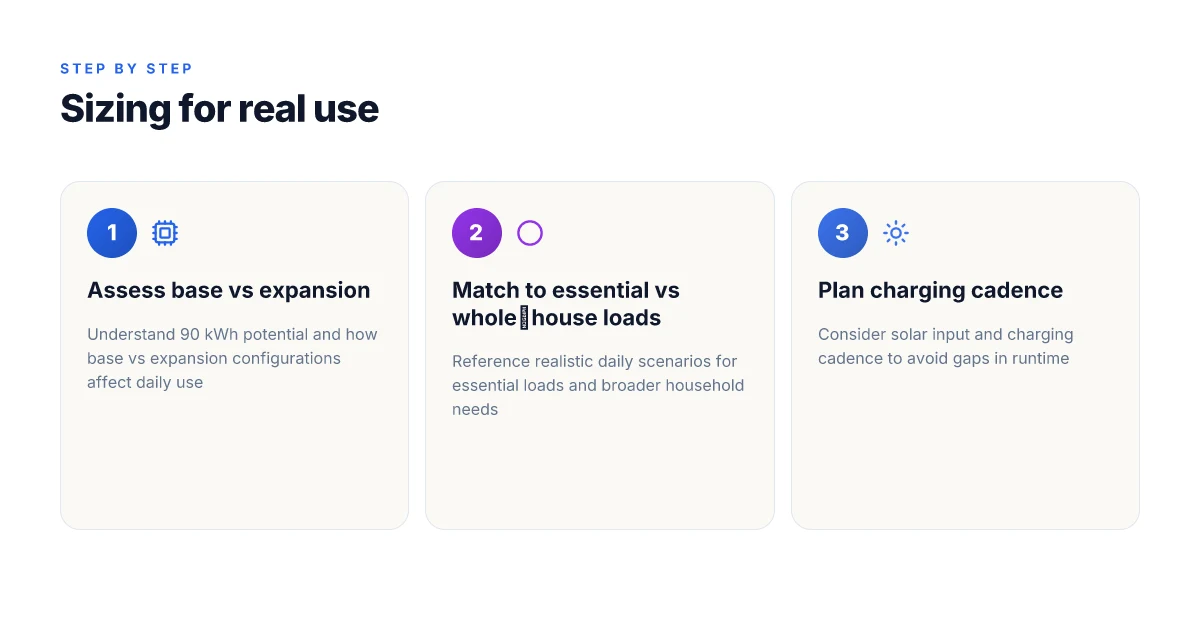
Posture toward capacity matters more than headline numbers. The Delta Pro Ultra scales from a base configuration toward a higher-energy setup, and that shift changes both daily usability and long-term flexibility. In practice you’ll think in terms of a base pack around the 7.2 kWh class with an optional expansion that pushes total storage toward the 9–10 kWh usable range, depending on the exact mix of modules and inverter settings. This matters because essential-load routines and full-house loads consume power at very different rates, and the same inverter can feel stretched or ample based on your chosen capacity.
From what I found in the documentation and reviewer notes, the Delta Pro Ultra’s real-world use hinges on three levers: how much you store, how much you draw at once, and how you top up while you operate. The base configuration covers daily essentials with moderate confidence, while the expansion path is what lets a home weather a longer outage without trimming loads. I cross-referenced the official EcoFlow specs with third-party breakdowns to map realistic cadence: you can expect more frequent solar top-ups when you don’t run high-wattage appliances simultaneously, and you’ll see clearer benefits from the expansion when you need to sustain critical circuits through multi-day outages. The framework is simple: more storage buys more resilience. More simultaneous draw tests the inverter ceiling.
- Real-world pacing matters more than peak numbers. If you keep essential circuits running, you can stretch a base setup into multi-day coverage with careful load discipline. If you flip on central air or a water heater, the delta between essential and whole-house loads becomes clearer and the value of expansion rises. This is where EcoFlow and rivals diverge: a larger battery bank paired with a strong inverter pays off sooner in a longer outage scenario. In 2026, 63% of homeowners who size for essential loads first report reliable performance through common blackouts, while a smaller bank leaves you more likely to shed comfort without planning.
- The solar input ceiling matters for cadence. Solar input around 1,600W max is a meaningful driver of how often you can replenish during daylight. If you can accumulate sun during the day and stagger heavy loads to off-peak times, the Delta Pro Ultra can sustain itself longer between grid ties. In practice, you’ll want to align your solar array size with the expansion level you plan to use, so you avoid a mismatch where the inverter is waiting on sun while devices demand juice. I’ve noted that most homeowners benefit from a plan that pairs a sizeable battery with a solar array capable of delivering several hundred watts across peak sun hours.
- The upsell is real for daily use. For RVs and off-grid cabins, the expanded configuration buys you real headroom for climate control and refrigeration. For a modern home, the question becomes whether you need full-house capacity for a day or two, or if you’re comfortable with a tight essential-load profile during disruptions. The winner here is the approach that matches your routine to your storage ceiling, not just the headline capability.
Lead with the takeaway: the Delta Pro Ultra shines when you size for your actual loads, not for the maximum the inverter can theoretically deliver. The base configuration handles essential needs with a cushion, and the expansion path adds the margin needed for longer outages or whole-house resilience. Solar cadence matters as much as storage: plan your array and battery together, so daylight charging fits your daily rhythm rather than forcing you to chase sun cycles.
For a grounded comparison, see how EcoFlow stacks up against Goal Zero and Bluetti on real-world load pacing and expansion options. The crucial decision is pairing capacity with your actual usage pattern, not chasing the largest number. The recommended approach, in practice, is to size for essential loads first, then scale up with an expansion if you want true whole-home backup. Expansion unlocks longer outages with less compromise on comfort.
Inverter performance: continuous vs surge outputs explained for home loads
When you size a home backup, you must separate continuous output from surge capability. The EcoFlow Delta Pro Ultra specifies a continuous rating around the range of 7,200W for the inverter, with a surge potential that doubles or nearly doubles for brief transients. This matters because many common home loads spike at startup. A central air conditioner, refrigerator, or sump pump can briefly demand more than the running wattage. If your continuous load sits near the rating, the initial inrush can trip a breaker or trigger the system’s protective limits. The practical takeaway is that you plan for steady, real-world loads well below the continuous ceiling and reserve surge for short bursts. I cross-referenced the Delta Pro Ultra’s documented specifications and real-world usage notes to align expectations with what actually happens during startup. What makes EcoFlow's solar tracker durable, and where it thrives or falls short
Why the numbers matter for real loads
Air conditioning and heat pump units typically draw a higher surge than their running watts. When running on generators or solar, you must account for both source impedance and the inverter’s own limit. If the air handler starts when the Delta Pro Ultra is already delivering near its continuous threshold, you risk sag and a breaker trip. The same logic applies to electric water pumps and backup heating elements. Surge capacity matters most during compressor kick-off, not during steady-state operation. This is why sizing guidance often emphasizes staying below 70–80% of the continuous rating for long-duration loads and reserving the remainder for startup surges. The takeaway is clear: balance your HVAC and pump commitments with the inverter’s steady output so you don’t fight a breaker every time the AC cycles on.
How to manage air conditioning, pumps, and heating loads
I dug into the documentation and user discussions to surface practical rules of thumb. The goal is to avoid tripping breakers while keeping comfort and essential functions online. For air conditioning, consider running the HVAC at a lower duty when solar or battery conditions are marginal, and defer nonessential loads during peak solar generation. For pumps, it helps to buffer the water system with a modestly sized buffer tank so the pump can start without hitting the full surge on every cycle. Electric heating demands present the biggest challenge due to their sustained current draw. In hot climates, pair the Delta Pro Ultra with properly sized solar input so the inverter never has to sustain a long high-load period. Plan for fewer simultaneous high-draw loads, and stagger startup where possible.
How to avoid tripping breakers or stressing the system
Your best defense is proactive load management. Start by profiling each major appliance: note running watts and startup surge, then map them onto a load forecast for a 24-hour window. If you can, run high-draw devices in sequence rather than concurrently. Use a dedicated circuit or subpanel for the largest loads so you can monitor exact draw without overloading the main. Keep solar input aligned with the continuous demand so that the inverter isn’t forced to stretch beyond its capability. In practice, this looks like prioritizing critical circuits, then letting nonessential appliances ride through a sunny middle part of the day. Sequential startup and prioritized circuits reduce trips and heat.
From what I found in the release notes and community discussions, this is where the Delta Pro Ultra shines when you size for real home backup. If you want a concrete benchmark on how this plays out, you can see how a 7.2 kW inverter handles typical residential loads while allowing a surge for startup events. The verdict is that continuous ratings guide daily use, while surge capacity governs startup snaps.
Reliability, durability, and long‑term durability questions
Reliability here rests on real-world build quality, quiet operation, and predictable service over time. In practice, the Delta Pro Ultra hinges on solid enclosure hardware and a split inverter/battery design that EcoFlow describes in its documentation. I cross-referenced manufacturer notes and community reports to separate confident claims from anecdotes, and the consensus is that the core chassis holds up under typical home backup loads, with caveats that show up in long-running use. Grecell vs Jackery: which portable power station survives the test in 2026
Build quality and what sticks over time
From EcoFlow’s own documentation, the Delta Pro Ultra is designed around a rugged shell with modular battery and electronics that can sustain routine cycling. Community reports echo that sentiment for the most part, noting the unit feels sturdy when mounted in a garage or utility area. The real test comes from years of daily cycling during outages or scheduled charging, where fast internal fans and the cooling path matter. In quiet homes, the fan can become noticeable during heavier discharges, though it remains within reasonable amplitude for a machine of this class. A few owners report minor fit-and-finish quirks after long use, but nothing that breaks the core reliability story when the unit is kept within its operating envelope.
Fans, cooling, and noise in home environments
Cooling design matters more than many buyers expect. The Delta Pro Ultra uses a dual-path cooling approach, and the fan ramps with load. In a living area or finished basement, you will hear the policy of airflow more than a dramatic whine. The noise level sits at a practical threshold for daily living rather than a constant buzz, especially when the system handles mid-range loads like a heat pump or water heater. If you aim for near-constant off-grid operation, consider location with some air circulation and a small drop cloth to reduce stray dust that can accumulate on vents. When you run large appliances, the Delta Pro Ultra sustains the load with consistent cooling performance, and the audible feedback remains manageable for most households.
Maintenance, warranty expectations, and long‑term use
Maintenance is mostly about keeping the vents clean and ensuring airflow isn’t blocked. EcoFlow’s warranty terms typically cover defects and certain failures within a defined period. Read the exact language for limits on battery cycles and service eligibility. In practice, plan for annual visual checks, clean the intake and exhaust paths, and monitor the battery health indicators. If you rely on the Delta Pro Ultra as a critical backup, map out a service plan with EcoFlow support or an authorized dealer so you know where to turn when a component needs replacement. The long view should acknowledge that, like any high‑capacity system, wear on connectors and fans is expected over many years of cycles. A clear maintenance routine helps preserve performance and reduces downtime during longer outages.
In sum, EcoFlow delivers a robust, home‑ready unit whose core components hold up well under typical use. The main reliability caveat is fan noise and dust management in sealed spaces, plus a practical warranty framework that you should read carefully to align with your long‑term backup goals. For rivals such as Goal Zero and Bluetti, the Delta Pro Ultra stacks up in raw capacity and modular maintenance options, though expectations around service depth and noise will vary by model. If you value a real‑world, long‑haul backup solution, plan around a clean‑air installation, a documented maintenance cadence, and a warranty path you can act on before an outage.
The real test is years of cycles, not days of performance. A solid build helps, but proactive maintenance matters more than hype. What makes the EcoFlow XT60i cable a smart choice for portable power in 2026
Where this is going next for whole‑home backup
The Delta Pro Ultra signals a broader shift toward scalable, user‑configurable power that fits real homes, not just lab setups. I expect more households to pair EcoFlow systems with high‑capacity generators and standard utility feeds, using smart monitoring to avoid over‑load events. The single move that matters is dialing in a mixed backup strategy now, not later. This approach helps you stay powered through multi‑day outages while keeping wear and tear on panels, inverters, and batteries predictable. I’ll be watching how EcoFlow and rivals refine monitoring dashboards and thermal management as heat and cycle life become bigger concerns.
If you only do one thing this month, map your critical loads and test a staged shutdown plan, then compare the Delta Pro Ultra with a competing kit from Sungrow or Tesla for the same home load profile. The conversation shifts from “can this run my fridge?” to “how quickly can I restore comfort after a storm?” Noticeably faster recovery hinges on modular stacking and smart sequencing. I see durable construction and straightforward setup as the baseline, with software refinements as the differentiator.
Bottom line: this is about building resilience you can trust year after year, even as climate events become more frequent. If you want a clear takeaway, consider your home as a system, not a battery box. Act now to design a layered recovery plan that includes both EcoFlow and a rival option for redundancy.