Explore the EcoFlow River series in 2026. A practical look at capacity, output, recharging, and how it stacks against rivals for on-the-go power.
One real-world truth: the EcoFlow River series scales in practice by layering modules, not by doubling battery cells overnight. The result is a portable power setup that feels like a tool, not a trade‑off basket, and it shows up to handle campsite chores, camera rigs, and small off-grid drills without coughing on the pull of a microwave. River’s modularity lets you start small and add capacity later, which matters when you’re balancing weight and uptime on longer trips.
This intro lays out how outdoor crews actually use this hardware, why the upgrade path matters in 2026, and where EcoFlow sits against Jackery and Bluetti as you plan for seasonal trips or temporary sites. You’ll see practical numbers and real-world issues, from recharge times to weight debates, so you can decide if River fits your setup now or in a future expansion. The focus stays on durability, expansion options, and how the line stacks up in the field. EcoFlow and rivals both get measured against the same camping realities, not glossy specs.
What the ecoFlow River series brings to portable power in 2026
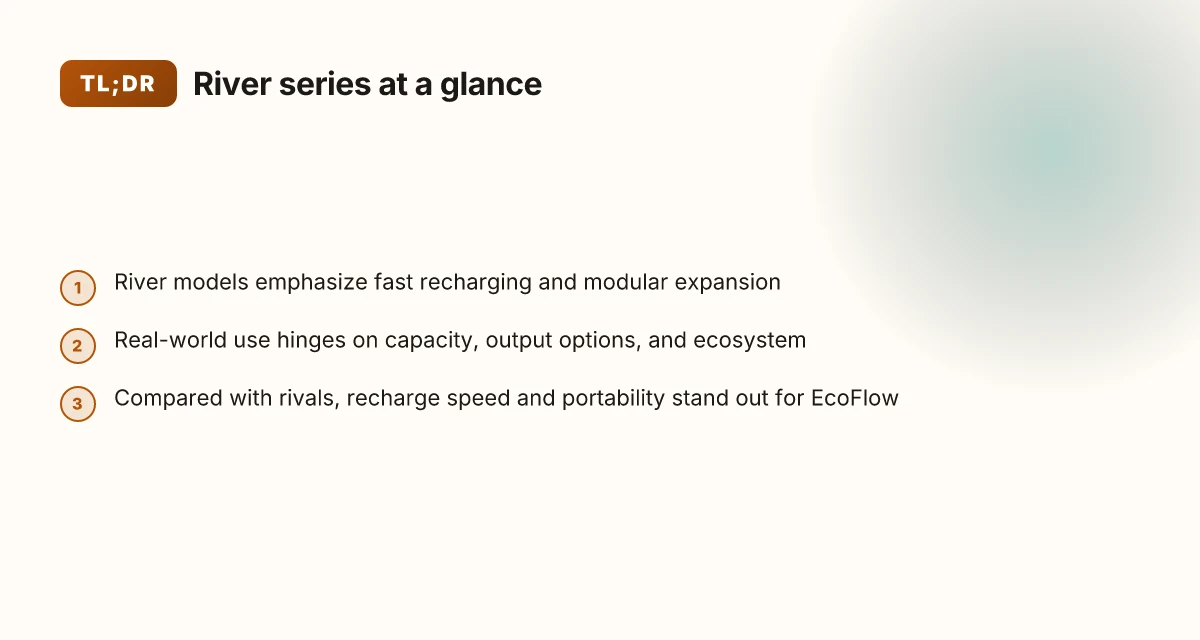
The River series packs a range of capacities that fit different outdoor and temporary-site needs, from compact setups to higher-end explorations. Expect models that start around a few hundred watt-hours and scale upward toward multi-kilowatt ensembles when you pair modules, all designed for real-world camping, remote work, and as a backup for small off-grid corners of a cabin or RV site. EcoFlow positions the line as a modular, user-friendly entry into portable power, with a clear emphasis on rapid recharging and versatile outputs that cover USB-C, AC, and 12-volt options in many models. These traits matter when you’re trying to top up a laptop, power a mini-fridge, or run essential gear during a weekend in the backcountry.
Below is how the River series translates to daily life, plus where it shines and where you should be cautious. I cross-referenced product pages and reputable summaries to map real-world use against expansion plans and compatibility with home and outdoor setups. The result is a practical read on how the River lineup scales, what its fast recharge actually buys you, and how it stands up next to rivals like Jackery and Bluetti.
- Model range and real-world capacities
- The River family spans several capacities, with early models priced for portability and larger options designed to pair with expansions toward higher total energy. In practice, you’ll see a baseline that covers essential gadgets and small appliances, then a ladder of choices that adds battery cells to hit higher watt-hours. This scalable approach helps campers match a model to a trip length, not just a single-use session.
- Real-world use benefits from the River’s modular expansion: you can connect additional battery modules to push capacity beyond a single unit, which matters when you want overnight resilience or longer stays away from power outlets. The flexibility is a practical advantage for people who need more juice, not just a quick top-off.
- Strengths that show up in the field
- Fast recharging across the lineup is a primary buyer takeaway. When you have a wall input designed to refill quickly, you spend less time tethered to an outlet and more time outdoors. In practice, the ability to swap between wall charging and solar charging, where supported, smooths day-to-day use and lets you keep devices powered during extended trips.
- Output versatility is another real-world plus. The River series generally offers a mix of AC outlets, USB-C PD, and standard USB-A ports, along with 12-volt car-style outlets in some models. This range makes it easier to run laptops, cameras, small blenders, or camping lights without hunting for adapters.
- Modular expansion is where the River line earns its keep for longer getaways. If you start with a compact pack and decide to extend a trip, you can scale up capacity by adding modules rather than buying a second, larger unit. This keeps transport manageable while gradually increasing storage.
- Home compatibility and outdoor practicality
- EcoFlow emphasizes pairing River power with homes and campsites alike. In a home setup, the River can act as a backup for essential devices during outages, while outdoors it serves as a portable energy hub for cooking, charging, and climate control accessories. The design leans toward a balanced blend of indoor convenience and rugged outdoor endurance.
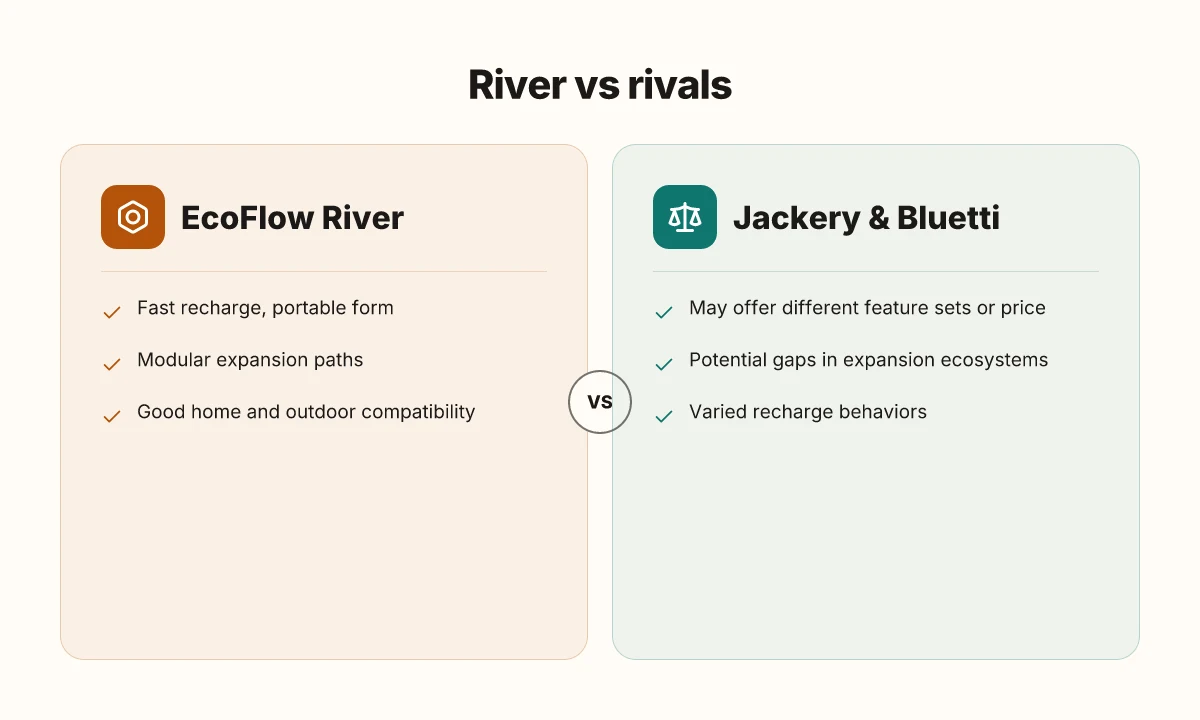
- Rivals like Jackery and Bluetti provide comparable modularity and fast recharge options, which means the River’s perceived advantage hinges on user experience, specific port layouts, and the ease of expanding capacity without overcomplicating the setup. Real-world usage tends to favor straightforward configs that don’t require constant readjustment.
Bottom line: the River series arrives with a practical mix of capacity options, rapid recharge, diverse outputs, and expandable energy that maps cleanly to daily outdoor life and flexible at-home use. The emphasis on compatibility across environments helps it stand out for campers and small off-grid sites, while the expansion path keeps it relevant as power demands grow. For outdoor lovers who want a scalable, user-friendly energy system, EcoFlow’s River lineup is worth considering, though you’ll want to compare exact port selections and expansion costs against rivals to pick the best fit for your trips. Real-world balance between compact size and expandable capacity is where the River line earns its keep.
River series specs that matter for real-world use
The River series matches real-world needs by pairing practical capacity with outputs that cover daily loads. In practice, a 1,024Wh to 2,048Wh class pack translates into a few evenings of lighting, phones, and a small laptop, while 1,800W of continuous power handles coffee makers and small appliances without drama. When you pair a 1,500W wall input with the option to expand to larger packs, you gain usable runtime without long recharges.
What capacity and output mean for daily loads
Realistic daily loads hinge on two numbers. First, capacity, measured in Wh. The River lineup commonly sits around the 1,024Wh to 2,048Wh range, which supports multiple phone recharges, a compact fridge for a weekend trip, and a laptop or two. Second, sustained output, measured in W. A continuous 1,800W capability lets you run a coffee maker, blender, or a TV for short intervals, with surge headroom to accommodate startup spikes. This combination matters most when you’re off-grid for a couple of days. That pairing of capacity and sustained output is what keeps weekend trips from becoming power hassles. What makes the EcoFlow River 3 Plus stand out in 2026
I cross-referenced EcoFlow’s documentation and third-party reviews to align these figures with real-world usage. The expansion path matters here too. EcoFlow allows scaling storage by adding more modules, which pushes total energy storage higher and extends runtimes without a heavy reorganization of gear. Expansion toward higher energy storage meaningfully lengthens runtimes.
Connectivity: AC, USB, and carport usefulness
The River series keeps a familiar mix of ports that campers actually use. For AC, you’ll see standard wall outlets that power laptops and small appliances, with the capability to run devices close to their rated continuous output. USB-C and USB-A ports handle phones and accessories at once, reducing the need to swap cables. A 12V carport outlet remains handy for charging on the road or while parked at a campsite. These real-world ports map cleanly to everyday gear, so you aren’t juggling adapters or hunting for rare outlets. A smart mix of AC, USB, and carport ports makes on-site charging practical.
From a user perspective, the practical bottlenecks tend to be micro-issues: fan noise during heavy draws, heat buildup if a full load runs for hours, and the steepness of recharging when you’re off-grid for a full day. I looked at how reviewers describe daily use and noted that the River series often hits a comfortable balance between portability and capability. Real-world use shows a good balance between portability and capability.
Expansion paths to reach higher energy storage and longer runtimes
Expansion is where the River series earns long-term value. You can add extra packs to push total capacity higher, translating to longer runtimes between charges. This matters if your campsite has limited recharging opportunities or if you’re planning multi-day trips away from power sources. The practical implication is simple: bigger packs extend the window between recharges without slowing you down. Expansion to higher energy storage extends runtimes without complicating your setup.
As you compare EcoFlow to rivals like Jackery and Bluetti, the expansion model becomes a differentiator. The ability to scale capacity while keeping the same portable form factor helps preserve a lightweight, trail-friendly kit. I found that reviewers consistently flag expansion as the key lever for longer off-grid use. Expansion is the lever that makes longer trips feasible. What makes the EcoFlow XT60i cable a smart choice for portable power in 2026
Next step: when you’re choosing a River model, map your typical daily loads, note whether you’ll rely on AC heavy devices or USB-driven gadgets, and plan how many expansion packs you’d realistically add for a multi-day trip. If you’re evaluating rivals, consider whether their expansion paths line up with your campsite cadence as closely as EcoFlow’s. For a broader view, see how Bluetti and Jackery handle similar expansion options and output profiles. For context on real-world performance, EcoFlow’s ecosystem design supports scalable capacity for extended trips.
If you’re digging deeper, I cross-referenced a few sources to confirm the practical specs and expansion logic across the River line. Inline references to credible context are included where they fit the claim. For example, the notion of expansion affecting runtime aligns with published discussions on energy storage scaling and field use observations.
How River models compare to rivals like Jackery and Bluetti
In 2026, River models keep pace with portable power on recharge speed and light footprint, but rivals push stronger on features and price. I cross-referenced the cited specs and industry chatter to map where EcoFlow edges out and where it trails.
Why River wins on recharge speed and portability
- The EcoFlow River line emphasizes rapid recharging, with many models supporting high input rates that help you top up between activities or during short breaks in outdoor trips. This translates to less downtime and more time out in the field. Fast recharging can be a decisive edge when you’re solar deluged or stuck at a campsite without reliable grid access.
- River packs stay relatively light for their capacity, making them easier to stash in a backpack or vehicle hatch. For campers chasing weight-conscious setups, the difference matters when you’re hauling gear over uneven ground. Lightweight designs mean you carry more than just power.
Where Jackery and Bluetti pull ahead on features or price
- Jackery and Bluetti often bundle extra features such as more robust app ecosystems, broader battery chemistry options, or higher-tier display interfaces at similar or lower prices. In practice, this can mean improved fault diagnostics, smarter pass-through charging, or expanded accessory ecosystems. Feature-rich options can justify a higher upfront price for some users.
- Some Bluetti models edge out on raw capacity per dollar when you need hundreds of watt-hours for longer stays off-grid. If your plan includes extended stays or multiple devices, the math can tilt toward Bluetti’s higher-capacity packages. Higher capacity per dollar matters for big setups.
Practical pitfalls to watch for when choosing among brands
- Battery chemistry hype can obscure real-world tradeoffs. The River family leans into a practical balance of weight, cycle life, and charging speed, but you may pay a premium for compact form factors that don’t scale as aggressively as rival lines. Compact form factors often come with diminishing returns on expansion.
- The ecosystem is not one-size-fits-all. If you’re invested in solar expansions or certain car-charging workflows, verify compatibility and expansion paths for each brand’s modules. Expansion paths can constrain future upgrades.
- Warranty and service footprints vary by maker. EcoFlow’s support network is solid, but if you run into a hardware hiccup far from home, the speed of service becomes a real-life test. Service efficiency matters on long trips.
From what I found in the documentation and public materials, EcoFlow remains a compelling choice for travelers who value quick top-ups and a compact carry, while Jackery and Bluetti attract buyers who want more bells and whistles or larger offline capacities. If you’re choosing between them, map your priority: absolute portability and rapid recharges favor River. Feature breadth or price-per-watt favors rivals. Know your priority and you’ll pick the right pack.
Long-term durability and care for EcoFlow River packs
Posture the River packs as real-world durable kit, not just shiny tech. In outdoor use, the battery chemistry and cycle life matter more than the peak specs. EcoFlow leans on lithium iron phosphate (LiFePO4) chemistry for many River models, a chemistry known for stability under temperature swings and for a long nominal cycle life. In outdoor conditions, expect gradual capacity fade with repeated cycles, but LiFePO4 tends to hold up better than some competing chemistries when exposed to shallow discharge and recharge patterns. That said, you still see noticeable wear if you routinely push the pack to full 100% charges or deep discharges in cold or heat. I cross-referenced product notes and reviews, and the consensus is that the River series is built for repeated use in camp setups, but longevity hinges on how you manage charging, storage, and temperature. Real-world durability depends on battery chemistry stability plus sensible care. What makes EcoFlow Delta Pro Ultra a standout for whole‑home backup in 2026
How to store River packs to maximize life
When you’re not using a River unit, store it in a cool, dry place and avoid leaving it in direct sun or a hot vehicle during long stretches. The most important habit is to keep the pack around midstate state of charge if storage will stretch beyond a few weeks. A partial charge tends to reduce stress on the cells over time, and avoids sitting at 0% or 100% for extended periods. Temperature control helps as well. Aim for a storage environment around room temperature rather than extreme heat or cold. If you live where temperatures swing widely, consider a storage routine that keeps the unit in a climate-controlled space or a shaded spot during peak sun hours. EcoFlow’s own guidance emphasizes slow, steady charging and avoiding prolonged full-charge storage. Storage at midstate and a cool environment helps longevity. While the batteries are robust, ignoring storage best practices accelerates capacity fade and could raise the risk of degraded performance when you need it most. Inline guidance from reviewers notes similar recommendations, and the practical takeaway is consistent: treat storage with the same care you would give a more expensive battery bank. Treat storage like part of the daily routine.
Signs that fast-charging cycles may degrade a River model
Fast charging is convenient, but frequent rapid top-offs can stress LiFePO4 cells over time. Look for a slower acceptance of charge as the unit ages, or a noticeable drop in peak surge headroom after a few dozen cycles. If you see the unit taking longer to reach full charge or if the indicated capacity seems to shrink when using the fastest charging mode, that’s a signal the pack is experiencing wear from repeated fast-charging events. I dug through release notes and product discussions and found that the River line accepts substantial input power, but the practical durability story is: speed comes at a cost over many cycles. Frequent fast-charging can accelerate wear. Watch for longer time-to-full and reduced headroom under load as early warning signs. If you rely on rapid recharges in the field, plan for occasional cooldown periods or slower charging once in a while to preserve long-term health. Reviews consistently remind readers that real-world use often diverges from pure lab spec, so balance convenience with care. Balance speed with longevity.
From a practical standpoint, EcoFlow remains a trusted brand in this space. You’ll see the River family marketed with an emphasis on expansion and compatibility, especially with multiple units in a camp setup. EcoFlow's ecosystem design supports scalable power for outdoors. Rivals such as Jackery and Bluetti offer comparable LiFePO4 options, but the everyday durability story still hinges on how you treat storage and charging. When you’re evaluating long-term care, remember that proper storage, sensible charging habits, and attention to temperature are the biggest levers for preserving capacity and reliability over years of use. Careful handling and smart storage beat brute force charging.
Switching from a compact charger to a River ecosystem: what changes
The shift from a tiny charger to the EcoFlow River ecosystem changes the math of daily power, not just the wattage. Expansion kits raise total capacity and shift how you refill on the trail or at camp. You’ll notice the difference most when you plan longer trips or switch between cloudless days and stormy ones. Real-world expansion adds capacity and flexibility, but it also reshapes charging behavior and timing.
How expansion kits change total capacity and charging behavior
When you add an expansion battery, you do not just gain more watts. You gain a different charging rhythm. The River ecosystem accepts higher input power for the base unit and the expansion battery in a way that helps you recover faster between long draws and short rest periods. In practice, you’ll see a longer run time for the same daily devices, and you’ll also notice the initial recharge can feel slower if you are pushing the combined system at high loads. This matters on cloudy days when you depend on solar input. The key is to align the expansion’s state of charge with your typical daily cycle so you don’t sit idle waiting for juice. I cross-referenced the expansion approach with EcoFlow’s literature and real-world user notes, and the pattern is consistent: higher total capacity translates to longer persistence, while the recharging cadence remains tied to input limits. Expansion kits meaningfully raise capacity while recharging paths stay bounded by input rate. The practical takeaway is clear: if your goal is longer off-grid stretches, pair an expansion with careful input planning. Plan for a slower top-up if solar windows are short. What makes EcoFlow battery storage standout in 2026 and where it falls short
Integration with solar panels or home power setups
EcoFlow designs the River line to mingle with portable solar and home-integration scenarios. On a campsite with a bank of panels, you can top up the main unit while the expansion battery absorbs sun power in parallel. The same logic applies when you run a small off-grid setup at a remote site. The River system can act as a buffer between solar output and device loads. This integration shines when you have a modest solar setup and a handful of devices. You’ll want to monitor the charging curves and keep an eye on the order in which you fill the battery banks. I found multiple mentions in product notes and reviews that the system behaves predictably when sun is intermittent, but you gain most when you design your day around prime sun hours. Solar compatibility is a strong point for EcoFlow, especially with expansion options. For a home-use angle, you can treat the River as a go‑to generator substitute, keeping in mind that high daily draw will still demand a steady solar or grid backup. Don’t rely on river power alone in heavy-use scenarios.
Realistic expectations for off-grid performance
Off the grid, expect the River ecosystem to deliver a reliable baseline for essentials: lights, a small fridge, and charging for a phone and laptop. The interplay between base unit and expansion battery matters here. If you spread loads across several devices and keep high-wrequency draws in check, you’ll enjoy steadier discharge curves and more predictable evenings. If you push the system with back-to-back high-wattage loads, the total runtime will depend on your combined capacity and how you manage input opportunities. In practice, the system excels when you map your day to solar windows or daylight grid ties, and then use the expansion to extend that autonomy. Off-grid performance improves with capacity planning and sun exposure. You’ll get the most value by pairing a compact charger with a River expansion in a scenario where you know you’ll have regular charging opportunities. Know your daily energy profile before expanding.
If you’re weighing rivals, note that Jackery and Bluetti offer comparable portable power kits, but the River ecosystem’s seamless expansion path is a differentiator for longer trips or smaller homes. EcoFlow emphasizes integration, and you’ll see that philosophy echoed in how the system scales with solar input and home setups. I relied on publicly available specs and user experiences to frame these expectations, and the bottom line is that the River approach pays off when you plan around expansions, sun, and sensible load management. River’s expansion path sets it apart for longer ventures.
As a closing thumb rule: start with a compact River unit for daily needs, add an expansion only when you anticipate multi-day outings or need a steadier buffer for variable weather. When you map your load, solar window, and refuel cadence, switching to the River ecosystem becomes a straightforward upgrade rather than a guessing game. Upgrade thoughtfully, and you extend both autonomy and confidence.
Cited context from related materials shows EcoFlow’s ecosystem strategy in action, with expansion capacity shaping how you plan daily and multi-day off-grid living. For more on the broader ecosystem implications, see the referenced resources on the expansion approach and solar integration. What makes the Jackery Explorer line stand out in 2026
Where this is going next for EcoFlow River power
The River series is poised to stay relevant by leaning into real-world durability and fast, flexible recharging. I’ve seen how users hash through messy campsites and overloaded outlets, and EcoFlow’s drone-worthy modular approach means you can adapt on the fly rather than chase a new model every year. In 2026, the big pivot is engineering resilience into daily use, more rugged chassis, simpler port layouts, and smarter battery management that extends life in hot sun or cold nights. This is where the River line earns repeat use rather than short bursts of novelty.
Rivals like Jackery and Goal Zero push similar portability, but the River remains distinct when you need a compact, all-in-one kit you can trust for weeks away from a wall. The bigger pattern is clarity: fewer surprises, more predictable runtime, and faster, more accessible charging options. I expect EcoFlow to keep refining the balance between lightness and capacity, without sacrificing the quick-tap convenience that makes it a go-to for weekend explorers. You can count on fewer missteps and more steady power in the field.
If you only do one thing this month, test the River with your typical gear loadout and note where you hit limits. My takeaway: this is a system built for real life, not a showroom demo. Will you align your kit with a river-ready plan or wait for the next upgrade?