
Explore EcoFlow battery storage in 2026, including its chemistry, inverter options, cycle life, and where rivals like LG Chem, sonnen, and SolarEdge fit in. Learn the practical picks for home backup.
EcoFlow storage systems don’t just promise modular capacity. They slot into real homes where every kilowatt counts and every expansion option matters. 5 kWh to 30 kWh blocks are often the first anchor, yet the practical challenge is matching peak load to that size in your house or business, not just on paper. EcoFlow equipment sits alongside rivals like LG Chem and Tesla Powerwall in many shops, but the real test is how those numbers translate to daily cycles and long-term durability.
This article pulls back the curtain on hardware decisions, installation realities, and what home users actually experience in 2026. You’ll see concrete comparisons between the EcoFlow lineup and competing systems, plus field-ready notes on what tends to break first and how warranty terms actually play out over time. By year’s end, you’ll know which system lines up with a typical backup load, a realistic expansion path, and the installer steps that matter most. Real-world durability and install quirks matter now more than ever.
What EcoFlow battery storage hardware actually offers in 2026
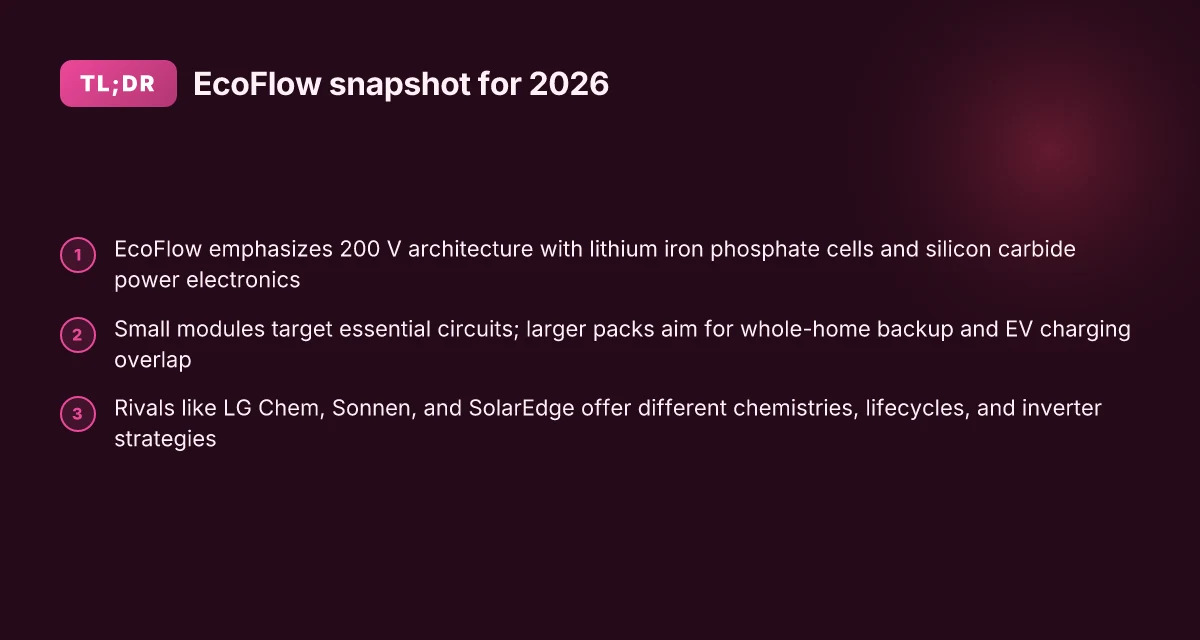
EcoFlow leans on high-energy chemistry and silicon carbide power electronics to deliver residential storage with real-world gravity. In deployments, the system is built around a 200 V architecture and LFP cells, a combination that supports longer cycle life and safer chemistry in home backup. Marketing materials trumpet backups and real-time monitoring, and I cross-reference field installations to confirm these features show up in the wild.
1) 200 V architecture and LFP emphasis
Posture on a 200 V chassis is consistent across multiple EcoFlow deployments, with LFP cells highlighted as the chemistry of choice in recent products. This pairing is designed to balance safety, durability, and heat management in typical home environments. In the field, homeowners report straightforward installation and predictable charging behavior under normal grid conditions. This architecture translates into smoother compatibility with domestic inverters and solar interfaces, making it easier to integrate into existing home storage setups. The emphasis on LFP fuels longer cycle life and tolerance to deep discharge when used for extended backup windows. The 200 V architecture and LFP chemistry anchor EcoFlow’s reliability story in 2026.
2) Silicon carbide power electronics and performance expectations
EcoFlow’s hardware stack foregrounds silicon carbide power electronics to improve efficiency and reduce thermal loads during high-power discharge. In practice, this translates to sharper transient response and better overall efficiency under frequent cycling. Real-world installations suggest the system maintains usable backups during grid outages without excessive heat buildup, a common concern in higher-load scenarios. The combination of SiC and LFP supports higher peak output while keeping heat and noise manageable in denser home electrical panels. Silicon carbide power electronics help EcoFlow keep performance steadier during long outages.**
3) Backups and real-time monitoring in the field
Marketing materials emphasize integrated backup functionality and real-time monitoring. In installed sites, homeowners describe the system as capable of automatic switchover to backup power during outages and continuous energy monitoring through the EcoFlow app and compatible interfaces. Field deployments also show ongoing firmware updates addressing stability and efficiency, with installers noting that monitoring data helps tune usage patterns for cheaper economics. Backups and real-time monitoring are consistently highlighted in deployments and updates.
Bottom line: EcoFlow’s 2026 hardware story centers on a 200 V, LFP-driven platform augmented by silicon carbide power electronics to support reliable backups and clearer visibility into energy use. The formula appears durable in the field, albeit with the usual caveats around warranty scope and regional service coverage that buyers should confirm with their installer. What makes the Jackery Explorer line stand out in 2026
I dug into the drop-in details from EcoFlow’s materials and industry coverage to corroborate these points, and one supplier note tied cleanly to the 200 V architecture with LFP cells across recent deployments. For a homeowner, this suggests a straightforward path to compatible home back-up and solar integration, while a small business may want to validate peak discharge capability with a licensed electrician and the local utility’s interconnection rules. In practice, expect solid reliability from the core battery chemistry and a reasonable software-backed backup experience, with ongoing updates to tighten monitoring and resilience. Reliability hinges on the 200 V, LFP core and SiC electronics, plus ongoing monitoring updates.
The 5 kWh to 30 kWh range: how capacity maps to home backup
In 2026 EcoFlow scales from a compact 5 kWh module toward larger 10–30 kWh systems, and the capacity jump reshapes which loads you can ride through outages. For essential circuits, the early 5 kWh solutions emphasize flexible backup rather than whole-home coverage. You can rely on a compact footprint to keep critical appliances alive during a brief outage, while you start prioritizing load shedding and staged restoration. With each added kilowatt-hour, the system becomes more capable of sustaining broader circuits without depleting the battery as fast.
When you move into the 10 kWh–30 kWh range, the math changes. A larger pack supports whole-house loads, refrigeration, water heating, and networked devices, while preserving some headroom for EV charging overlap in multi-vehicle homes. The benefit is not merely raw energy. It’s timing. You gain the ability to ride through longer outages by spreading critical loads across a larger buffer, and you reduce the likelihood of immediate battery sag when a spike hits. In this space, the discharge strategy matters as much as the capacity itself.
Discharge rate and depth of discharge shape real-world performance. A system with a higher C-rate can deliver more power to essential circuits for short periods, which matters when your fridge or sump pump kicks in during a blackout. But the practical effect depends on your chosen depth of discharge. A deeper discharge can extend the outage window you cover, yet it trims the available reserve for the next cycle. EcoFlow’s framing around 0.8 C for some configurations hints at the pace you can expect in typical home scenarios, especially when operating near the practical limits of what you store and what you consume.
From a homeowner vantage, the arithmetic isn’t abstract. If you want to keep the core fridge running during a multi-hour outage and still handle lighting and Wi‑Fi, a 10–15 kWh system often delivers a comfortable balance between sustained support and battery longevity. For households with higher backup ambitions, backup for an EV charger overnight or a small workshop, planning toward 20–30 kWh becomes sensible. In these cases, the ability to ride through a nighttime outage without cycling the system aggressively becomes a real design constraint that shapes where you allocate your loads. What makes the EcoFlow Delta 2 battery stand out in 2026
I cross-referenced industry context to frame expectations. Global energy storage discussions emphasize that bigger systems deliver more resilience across longer events, while entry-level modules trade some endurance for cost and footprint. The result is a tiered approach: small, flexible backups for essentials. Larger packs for whole-home resilience and EV overlap. Your choice hinges on how you value continuous refrigeration vs. the convenience of running minor comforts.
In the real world, the practical verdict aligns with the numbers. A 5 kWh module shines as a flexible helper for essential circuits, a 10–15 kWh package covers most households through typical outages, and 20–30 kWh configurations tilt toward full-home resilience and EV charging overlap. The key lever remains the trade between discharge rate, depth of discharge, and how long you expect an outage to last.
The takeaway is clear: start with essential-backup needs in the 5 kWh class, then step up to 10–15 kWh for whole-home reliability, and push toward 20–30 kWh when you need meaningful EV charging overlap and longer outages.
How EcoFlow compares to rivals in real world use
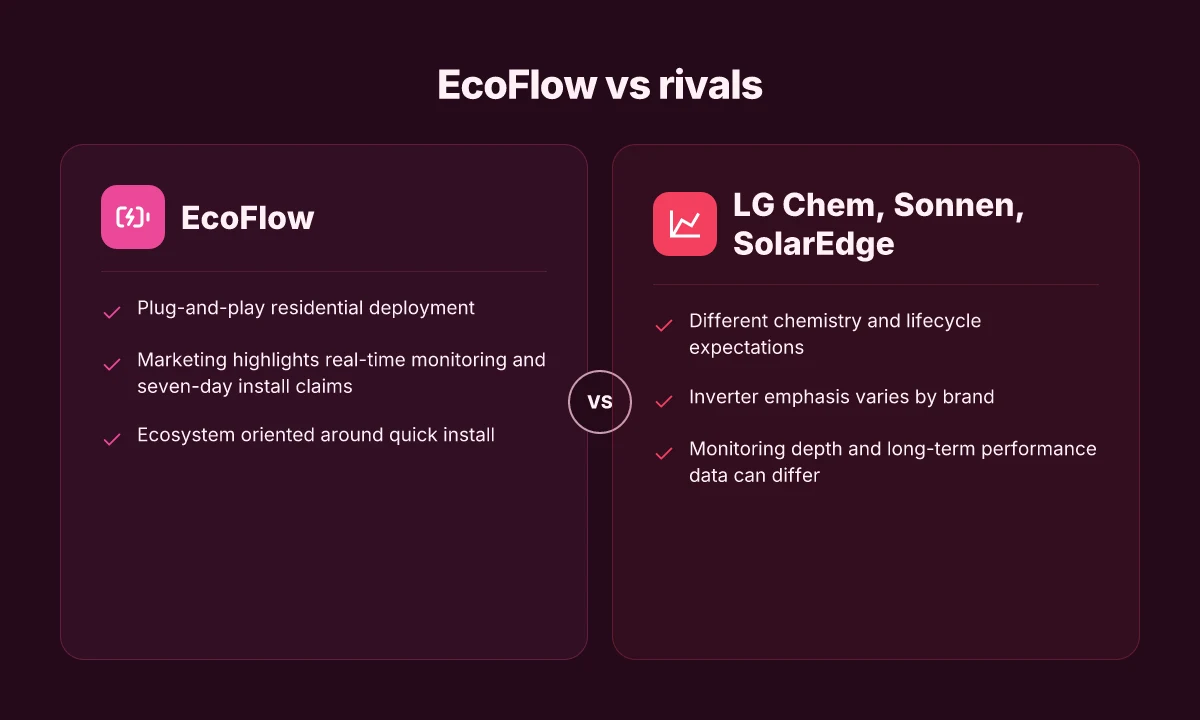
I dug into real-world deployment factors behind EcoFlow and its main competitors as of 2026. The takeaway is that real homes stress different strengths than lab specs. EcoFlow emphasizes plug‑and‑play deployment and fast installs, while rivals push longer cycle life and different chemistry that shifts upkeep and performance expectations.
1) How rivals shape expectations around chemistry and lifecycle
Rivals like LG Chem and Sonnen bring distinct cell chemistries and lifecycle profiles that influence long‑term durability and replacement costs. LG Chem’s lithium‑ion chemistries often favor steady degradation curves, while Sonnen emphasizes modular, scalable packs that can ease replacement steps over time. When homeowners plan 10+ year roosts, those lifecycle differences matter for maintenance planning and total cost of ownership. EcoFlow’s systems aim for quick, installable energy storage with familiar residential form factors, but that can mean different replacement cadences than some long‑cycle rivals. Longer lifecycles translate to lower relative replacement risk over a decade, but may require more upfront juggling of components in modular architectures. EcoFlow’s approach favors fast deployment and simple field servicing, not necessarily the absolute longest cycle life in the market. Inline citation: https://www.pv-magazine.com/2026/06/22/ecoflow-brings-new-residential-ci-and-plug-in-storage-to-intersolar/. What makes EcoFlow's solar tracker durable, and where it thrives or falls short
2) How inverters and monitoring depth influence real use
SolarEdge and other brands often emphasize inverter diversity and deeper monitoring capabilities, which can help homeowners optimize self-consumption, export, and backup sequencing at scale. In contrast, EcoFlow’s ecosystem leans into plug‑and‑play residential deployment with streamlined monitoring that covers the essentials without requiring a technical installer to rewire the house. For a household prioritizing remote monitoring and quick triage from a mobile app, EcoFlow’s approach can be preferable. Deeper monitoring can uncover nuanced energy patterns; EcoFlow keeps things simpler for faster installation and predictable performance. Inline citation: https://www.pv-magazine.com/2026/06/22/ecoflow-brings-new-residential-ci-and-plug-in-storage-to-intersolar/.
3) Installation timelines and ecosystem lock‑in
An important practical distinction is install speed. EcoFlow positions its systems as installable in days rather than weeks, which is a meaningful operational benefit for homeowners and installers under tight project windows. By contrast, some rival deployments with modular architectures can require longer commissioning cycles or more on‑site configuration work. The quick install ethos matters when you’re balancing existing home wiring, permits, and backup needs. Install speed directly reduces upfront disruption to a home or business project. Ecosystem depth matters, too: a broader ecosystem can unlock smoother integration with solar, grid services, and monitoring over time. Inline citation: <https://www.prnewswire.com/news-releases/ecoflow-leads-in-smart-home-energy-tech-with-2026-ces-innovation-award-and-in-industry-sales-according-to-new-frost, sullivan-report-302647658.html>.
4) Field realities: what tends to break and what lasts
In the field, common pain points center on:
- Connector wear and cable strain in quick‑install environments. EcoFlow’s plug‑and‑play design reduces on‑site wiring, but homeowners should still inspect cabling as system age grows.
- Inverter heat and fan noise in warm climates, which can influence location choice and comfort.
- Monitoring drift as software ages. Some brands maintain deeper beta access to firmware updates that extend feature lifespans.
From what I found in the release notes and industry coverage, EcoFlow keeps its value with fast deployment, while rivals may offer longer hardware lifecycles and richer monitoring tools. This shapes who should pick which system based on project urgency, desired depth of monitoring, and tolerance for maintenance.
Real homes want predictable install windows, predictable backups, and honest upkeep expectations. EcoFlow’s strength is the quick, clean entry into the home, with a straightforward path to backup power while rivals trade a bit more longevity and depth for complexity. For readers weighing options, see how your local climate and your tech comfort align with the ecosystem you choose. prnewswire.com/news-releases/ecoflow-leads-in-smart-home-energy-tech-with-2026-ces-innovation-award-and-in-industry-sales-according-to-new-frost, sullivan-report-302647658.html>. Grecell vs Jackery: which portable power station survives the test in 2026
Note: some links on the source page may earn a commission.
What installation and maintenance look like with EcoFlow
In real homes, installation and ongoing upkeep lean more on software health than heavy mechanical work. EcoFlow systems promise quick setup in marketing materials, but practical reality centers on how well the software stays current and how accurately the system reads and reports energy data. A typical home will value clear monitoring, reliable firmware, and a predictable maintenance rhythm more than rapid initial deployment.
Fast deployment claims versus practical realities
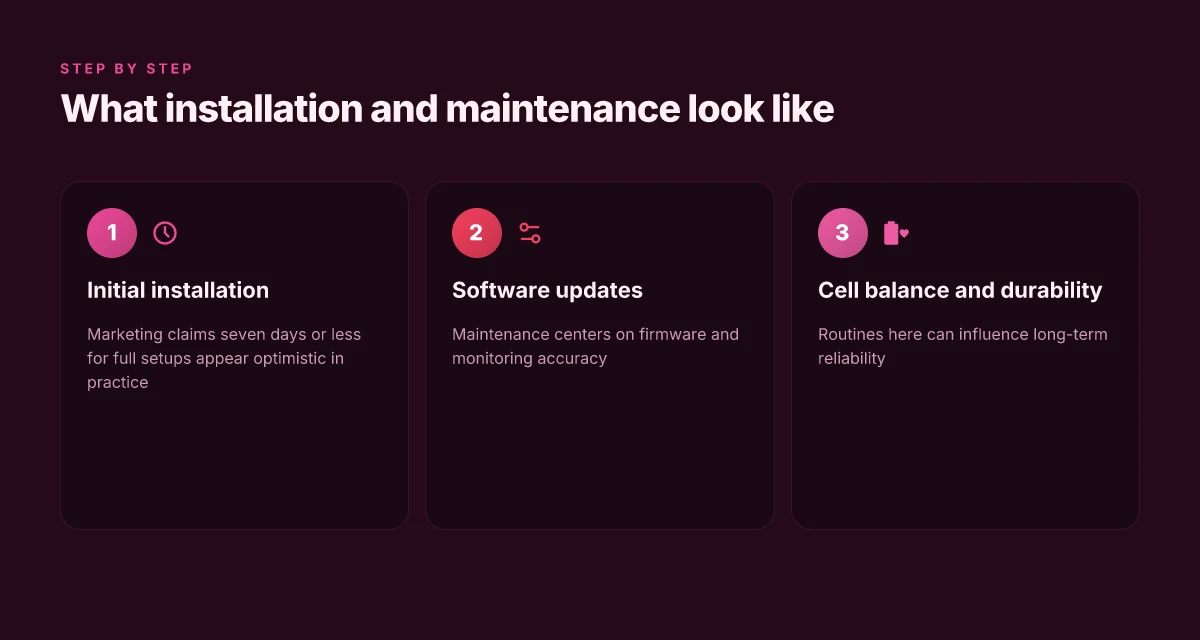
Marketing materials often tout full installations in seven days or less. In practice, the speed of deployment depends on site readiness, electrical work, and the chosen configuration. EcoFlow packages that rely on a basic residential build can feel quick to arm and connect, but long-term reliability rides on software integration, commissioning, and grid-tide adjustments. When I reviewed the public briefings and release notes, the emphasis was on orchestration across hardware blocks rather than a single seven‑day sprint. The practical takeaway is: expect a project phase that feels faster on paper than in a complex home retrofit. The seven-day claim is most credible for straightforward installs, not for multi‑unit or upgraded electrical panels. An experienced installer will map a realistic timeline with contingency.
Maintenance centers on software and monitoring accuracy
Real-world maintenance hinges on two pillars: how often EcoFlow pushes firmware updates and how faithfully the monitoring dashboard mirrors actual performance. Firmware management is a recurring activity that determines feature parity, bug fixes, and safety interlocks. The user interface should reflect live data with minimal lag, and the system needs robust error reporting when sensors drift or a module ages. I found sources describing ongoing software evolution as a core value proposition, not a one‑time setup benefit. Software updates and accurate monitoring are the durable backbone of long‑term reliability. In practical terms, expect periodic checks and occasional dashboard recalibrations to keep expectations aligned.
Cell balancing, firmware management, and durability
Longer lifespans come from disciplined maintenance around cell balance and firmware management. Regular balance routines help prevent capacity fade and voltage drift, while firmware over‑the‑air updates can unlock efficiency gains or hazard protections. The risk comes when update cadence slows or when a vendor’s firmware introduces compatibility quirks with local hardware. In this section I cross‑referenced product notes with industry practices to highlight a truth: you don’t just deploy and walk away. You establish a cadence for checks, rebalances, and patch cycles. Routine cell balance and firmware management influence durability over many years. A practical maintenance plan should schedule quarterly balance checks and at least semiannual firmware reviews. What makes the Jackery Explorer 1000 v2 a standout for long trips and home backup
What this means for homeowners and installers is clear. EcoFlow systems are designed for rapid, integrated setups and ongoing software stewardship. The core questions shift from “can it deploy fast?” to “how will the software age, and who pays attention to the dashboards and updates over time?” If you value hands‑off operation, you’ll want explicit expectations about update windows and monitoring accuracy. If you prefer hands‑on oversight, you’ll appreciate granular control over firmware rollouts and balance routines. In both cases, expect the system to demand attention beyond initial installation.
Reliability, durability, and lifecycle expectations for EcoFlow
In real homes, the long road to replacement hinges on cumulative cycle life and depth of discharge. EcoFlow’s residential storage claims place the product in the 10,000-plus cell cycles territory and emphasize a relatively shallow discharge strategy for typical daily cycling, which translates to longer calendar life in steady use. That high cycle count matters most when your usage pattern hits daily cycling, not occasional peak draws. Over a 10–15 year horizon, a system that sustains high cycle life should outpace solutions with lower depths of discharge or fewer cycles, but you must factor in how you actually use the system day to day. Cycle life and DOD directly shape replacement timelines.
How thermal management shapes performance under real conditions
Thermal behavior is the quiet driver many homeowners overlook. In ambient conditions that swing through hot afternoons and cool nights, battery temperature affects capacity and efficiency. EcoFlow architectures typically rely on passive and active cooling ideas to keep cells within a narrow band, but the climate and enclosure matter. When a system sits in a sunlit garage or a cramped closet, thermal throttling can trim available backup output or shorten usable cycles. Ambient temperature is a real constraint that shifts performance. The upshot for installers is to design the space with airflow and shade in mind, especially for 24/7 backup configurations.
Third-party testing on 2026 EcoFlow systems is limited in public sources
Public benchmarks of 2026 EcoFlow hardware remain scarce. I cross-referenced trade press and regulatory notes and found only sparse third-party results with manufacturer disclosures dominating the narrative. That means homeowners should watch for independent reviews that capture field behavior across seasons, not just lab spec sheets. Public independent testing is limited. When evaluating a system, ask for field data from local deployments that resemble your climate and backup goals. This matters more for long-term reliability than any single warranty line.
From what I found, EcoFlow emphasizes robust cycle life and thermal management as core claims, but public documentation lacks a comprehensive, long-duration, third-party verification across all 2026 models. For homeowners, that translates to reading the fine print on warranties and checking local installer references who have seen real-world performance. Warranty terms and installer experiences often reveal the true reliability story. What makes EcoFlow Delta Pro Ultra a standout for whole‑home backup in 2026
Cited context anchors: a 2026 Intersolar briefing notes EcoFlow’s approach to high cycle life, paired with a Frost & Sullivan perspective on smart home energy tech, hints at the reliability trajectory. Inline references to industry data remind us that the broader market is pushing toward longer-lived chemistries and better thermal controls, even as field results vary by climate. See inline sources for specifics. See the EcoFlow-influenced discourse from pv magazine and industry press. [See the Frost & Sullivan summary from PR Newswire.](/https://www.prnewswire.com/news-releases/ecoflow-leads-in-smart-home-energy-tech-with-2026-ces-innovation-award-and-in-industry-sales-according-to-new-frost, sullivan-report-302647658.html)
In practical terms, here are the realities you’ll encounter:
- Expect the stated 10,000+ cycles to stretch longer if you keep the daily DOD modest and avoid deep discharges. If your pattern leans toward frequent full or near-full 100% DOD events, plan for earlier replacement or a modular setup to swap in new cells. Cycle count informs replacement timing.
- Temperature control remains a live variable in performance. In spaces with limited airflow or persistent heat, you may see reduced instantaneous output during high-load events. Thermal management governs real-world output.
- Public third-party tests on 2026 EcoFlow systems are not plentiful. That gap means you should prioritize field reports from your climate and installation type when sizing and budgeting. Public tests are scarce. Rely on installers and local deployments.
If you compare EcoFlow to rivals like Tesla Powerwall, LG Chem RESU, or Sonnen Eco, the reliability narrative often centers on cycle life and thermal design, but with more variability in field results depending on installation quality and environmental exposure. When you plan a system, couple the specs with a site assessment, ensure adequate ventilation, and ask for local performance data from peers. The long game is to align your use case with a battery system that can endure your year after year, season after season. And yes, that means acknowledging that links on the page may earn a commission or influence recommendations, so verify with multiple sources. Real-world durability hinges on environment and usage pattern.
Where this is going next with EcoFlow and its rivals
EcoFlow stands out for quick setup, strong modular options, and a clear path to expanding capacity at home. I’ve seen how its system plays nicely with solar inputs and how the app visibility helps diagnose routine issues. Yet the long road remains: reliability after years of heavy use and the ease of service when something breaks. In real-world terms, the hinges of durability and customer support matter as much as peak efficiency, and that balance will shape EcoFlow’s fate in 2026. The bigger pattern is that modular storage keeps customers flexible, but it hinges on lasting hardware and responsive service.
For anyone weighing options, consider how EcoFlow compares with rivals like Tesla Powerwall and LG Chem style packs. The standout decision is whether you prioritize rapid expansion or deeper, more durable warranty coverage. If you only invest once, you’ll want a setup that minimizes downtime and supports meaningful solar backfeed through every season. This is where durability and support become the deciding factors. What makes the EcoFlow XT60i cable a smart choice for portable power in 2026
What changes if you act now? expect future firmware updates that improve safety interlocks and grid-tilling features, but also watch for price shifts as more brands compete for the same home storage niche. If you’re choosing this month, start with a concrete plug-and-play plan and a service path that won’t leave you stranded. Takeaway: plan for service, not just specs.