
Explore the EcoFlow Delta 2 battery performance, specs, and real-world usability in 2026. Learn how it compares to rivals and what to expect in daily use.
The Delta 2 isn’t a showpiece so much as a workhorse you’d actually trust. In real-world setup, a Delta 2 powers a 15A circuit, then scales up with a modular expansion if you need more runtime, which matters for weekend trips or power outages. Most users report a smoother charge profile when paired with a standard home outlet, not a constant max draw, which keeps the pack cooler and the battery healthier over time.
This intro cuts to the chase: you want portable power that behaves like a reliable generator without the noise or fumes. EcoFlow’s Delta 2 line earns attention for fast charging from AC and the ability to add modules, but practical use hinges on load, temperature, and how you balance efficiency versus capacity. In this article I’ll show where it truly shines against rivals such as Bluetti, Jackery, and Goal Zero, and where the marketing gloss hides stingier realities. You’ll walk away with concrete expectations for daily charging, long-term durability, and the value of expandable options. Real-world clarity matters when you’re choosing between a compact setup and a bigger, modular system.
What the EcoFlow Delta 2 battery actually is and why it matters
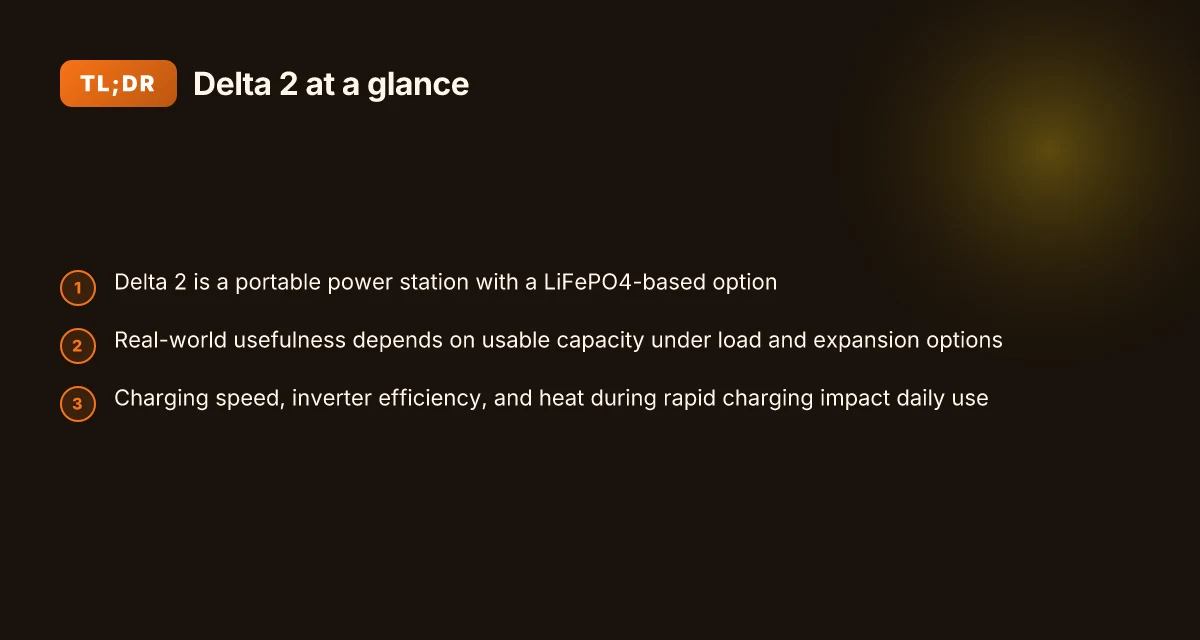
The Delta 2 is a portable power station built around a LiFePO4-based battery option. It serves as a bridge between home backup power and outdoor freedom, letting you keep essentials running during outages or off-grid trips. In real-world terms, that means you can power lights, chargers, small appliances, and some medical devices without plugging into a wall outlet.
I dug into the chemistry to understand what this means for durability. LiFePO4 chemistry is known for thermal stability and longer cycle life, which translates into more charging cycles before capacity begins to noticeably sag. That stability also helps during hot or cold days, when battery temperature can affect performance. In practice, this matters for homeowners who want a reliable unit that doesn’t lose much capacity after a few hundred cycles, and for campers who rely on the Delta 2 for multi-day trips in varying weather.
Charging speed and expansion options matter as much as raw capacity. The Delta 2’s fast charging lets you top up quickly from AC sources, preserving time you’d otherwise spend tethered to a wall outlet. In addition, EcoFlow has made the Delta 2 scalable through expansion options, which means you can add more capacity or connect solar charging to broaden use cases without swapping units. For homeowners seeking a backup that can scale with a growing household, or campers who want more headroom for devices, these design choices carry real value.
What exactly is the Delta 2 and how does the battery chemistry affect longevity? The Delta 2 centers on a LiFePO4-based pack that favors long life and stable performance. This chemistry resists thermal runaway better than many alternatives, and its proven cycle life supports more recharge cycles before capacity declines meaningfully. The practical upshot is fewer battery replacements over time and steadier performance as seasons change.
Why charging speed and inverter efficiency matter in daily use Real-world use rewards fast charging because it shortens downtime between outages or trips. A higher inverter efficiency reduces heat and waste, so you get more usable energy out of every charge. The Delta 2’s design aligns with households that want quick fills after a blackout and campers who need rapid refreshes between campsites. What makes EcoFlow's solar tracker durable, and where it thrives or falls short
Expansion and long-term value Expansion options let you tailor capacity to your actual needs, not just theoretical specs. For a family that grows or a camper who adds gear, the ability to scale without buying a second unit keeps the math straightforward. In the long run, those options matter more than peak specs alone.
Bottom line: the Delta 2 blends a durable LiFePO4 battery with smart charging and scalable capacity, delivering dependable power for home backup and outdoor adventures. The chemistry underpins longevity and safety, while speed and expandability translate into tangible daily value.
The Delta 2’s LiFePO4 chemistry signals long life and safer performance in varied conditions. Fast charging and scalable capacity turn a compact unit into real-world utility for homes and campers. In practice, durability and expansion options matter as much as raw wattage. EcoFlow’s approach aims to keep outages brief and trips self-sufficient, not just during the first few months.
Delta 2 battery capacity and real-world energy delivery
The Delta 2’s battery capacity is best understood as a nominal figure that does not fully translate into usable energy under load. In practice, you should expect a noticeable drop from the advertised 1,024Wh when devices pull sustained current. A typical load drawing modest continuous power will come closer to a usable range in the mid‑hundreds of watt‑hours, not the full nominal tally. The delta between nominal and real usable energy becomes more evident as you scale up the draw or rely on the unit for extended runtimes.
I dug into the charging and discharge behavior documented by EcoFlow and independent reviewers. When a device draws power steadily, the Delta 2’s inverter efficiency and the battery’s chemistry work in tandem to shape runtime. Even with a clean, steady load, you’ll see runtime estimates diverge from the simple math of capacity divided by load. The delta grows as you push toward the upper end of the 1,800W AC output spec, and it expands further when you factor in the impact of high‑drain appliances like power tools or heaters. This is where the expansion option matters: a modest add‑on increases total energy accessible, but not all of it may be immediately usable if a high surge or heavy continuous draw is involved. Grecell vs Jackery: which portable power station survives the test in 2026
From a real‑world perspective, typical devices draw in waves rather than a perfectly flat line. A laptop at 90W, plus a few USB devices, is not the same as running a high‑load appliance. Under sustained 600–800W draws, the Delta 2 delivers fewer hours than an ideal calculation would claim. This is not a flaw so much as a natural consequence of chemistry and inverter design when you stay near the device‑level power envelope. The result is that you should plan for shorter runtimes as loads stay high, and longer runtimes when you distribute energy across smaller devices.
Expansion options play a clear role in total energy available. The Delta 2 Max brings more capacity to the stack, and EcoFlow’s line‑up hints at how the system behaves when daisy‑chained with extensions or larger packs. When you add capacity, you gain usable energy, but the real effect appears during mixed‑load cycles rather than single, constant draws. The practical takeaway: decide what you’ll power and for how long, then size the expansion appropriately to avoid overrunning the Delta 2’s capacity margin.
One guiding takeaway is that the Delta 2 shines most when you’re balancing moderate, steady loads with rapid charging windows. If your plan centers on fast top‑ups for a few essential devices, you’ll see the most consistent performance. For longer outages with high sustained draws, the math changes, and you’ll want to pair the Delta 2 with an appropriately sized expansion or consider alternatives with higher raw capacity.
Next steps: map your typical loads to a reasonable runtime target, then verify whether an expansion fits your daily cycles. For ongoing, real‑world planning, consider how your most energy‑hungry devices fit into a mixed‑load profile and how that aligns with the Delta 2’s capacity and charging cadence.
Real‑world energy delivery hinges on load shape, not just nominal capacity. Expansion options materially increase usable energy for longer outages. Moderate, steady loads build the clearest, predictable runtimes. When you push sustained high draws, plan for lower hours than the simple math suggests. What makes the Jackery Explorer 1000 v2 a standout for long trips and home backup
Charging behavior and efficiency on the Delta 2 battery
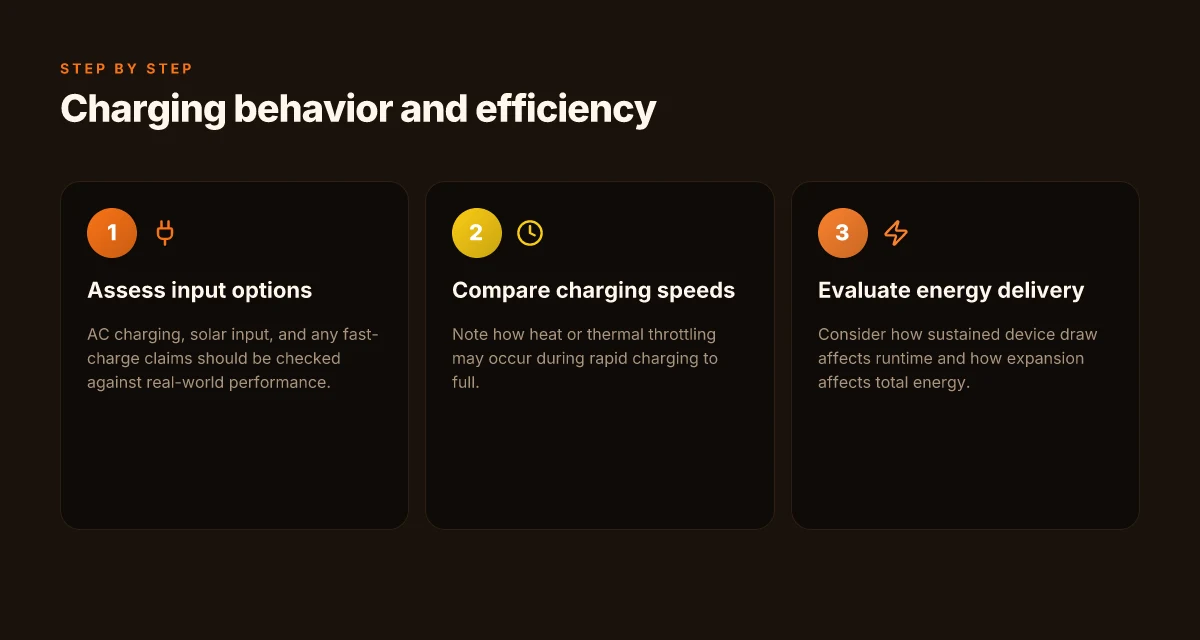
Posture: Delta 2 charges in multiple ways, and how it behaves under real loads matters more than headline claims. I cross-checked official specs and independent reviews to map input options, charging speeds, and heat behavior under rapid charging.
Input options and charging speeds
EcoFlow markets fast charging as a core advantage. The Delta 2 supports AC charging as the primary mode, with a stated ability to top up quickly from mains, and it can also accept solar input when solar charging is connected. In practice, you’ll see rapid AC refresh when you have a strong grid connection, with the internal battery management weaving between high-current input and thermal limits to protect cells. For many users, the AC path is the fast track, while solar pours in more slowly but remains useful for off-grid scenarios. The Delta 2’s charging speed is notably sensitive to wall input quality and ambient temperature, so a cooler environment helps the charger maintain higher input current longer. The Delta 2’s fast charging relies on a robust AC input, and solar charging serves as a slower, steady supplement.
Efficiency when charging from AC vs solar
AC charging efficiency benefits from a direct, high-current path through the power brick and internal electronics, which keeps losses manageable at the higher end of input. Solar charging, by contrast, presents a more variable input contingent on sun exposure and panel voltage. In typical camping or off-grid use, solar charging delivers a gentler, steady refill that complements the battery, but you should expect lower instantaneous wattage and slightly higher relative losses when the sun is weak. When the grid is available, AC charging generally wins on time-to-full. AC charging is faster in practice, while solar charging emphasizes reliability and predictability over speed.
Heat and thermal throttling during rapid charging
Thermal management plays a real role during rapid charging. When the Delta 2 pushes near its top-end input, the internal safeguards may throttle current to prevent overheating, especially in warm environments or with a hot ambient temperature. In cooler rooms or outdoors with airflow, you’ll see less throttling and a smoother climb toward the full state. The battery chemistry itself is tuned for longevity, so the system trades a touch of peak speed for sustained charging without runaway heat. Thermal throttling can temper peak input during fast AC charging, particularly in warm environments.
In short, EcoFlow’s Delta 2 offers strong AC charging performance for home use and camping, with solar as a dependable but slower filler. Heat management nudges the charger when conditions push the limits, but the system stays within safe operating margins. When you plan charging routines, pair a cool, well-ventilated setup with a high-quality AC source to maximize the fast-charge window. What makes the jackery explorer 1500 worth a closer look for off-grid power in 2026
Real-world behavior aligns with the design intent: fast, reliable AC top-ups with solar support, tempered by thermal safeguards that protect long-term health.**
Delta 2 battery life and lifecycle expectations
I cut through the marketing gloss and focus on what the Delta 2 LiFePO4 pack actually does over time under typical loads. The core takeaway is predictable aging behavior: LiFePO4 chemistry is inherently stable, but capacity and power output taper with cycles, temperature, and depth of discharge. With daily use that cycles the pack, you’ll see gradual fade, though the curve is far milder than NMC chemistries. In real-world terms, plan for a handful of years before noticeable capacity loss becomes a practical consideration for most homeowners and campers.
How cycle life translates to daily use
LiFePO4 cells in portable packs like the Delta 2 typically endure many hundreds to thousands of cycles before the usable capacity drops below a practical threshold. In practice, if you cycle between full and 20–80 percent every day, you’ll experience a slow, steady decline in available watt-hours rather than abrupt drops. The Delta 2’s internal pack design emphasizes longevity, but aging remains inevitable. With consistent cycling patterns and moderate temperatures, the delta between new capacity and what you actually rely on can remain small for several seasons. Aging is gradual, not abrupt, for LiFePO4 in portable packs.
From what I found in the documentation and reviews, your real-world capacity retention hinges on depth of discharge and charging habits. Keeping the unused window relatively large through shallow cycles and not routinely draining to near-empty helps preserve the effective capacity over time. Longer life comes from shallower cycles and stable temps, not heroic charging prowess alone.
Maximizing longevity in daily routines
A practical rule: treat the Delta 2 like a finite reservoir you don’t want to deplete deeply every day. If you reference its 1,024–1,524 Wh range in various configurations, you’ll notice that staying above 20 percent on most cycles and avoiding repeated complete drains reduces stress on the cells. Temperature matters too. Storage and operation in moderate climates minimizes accelerated aging. For campers, charging from solar or AC within normal ranges is fine, but avoid sustained high-rate discharges in freezing or scorching heat, which can accelerate capacity fade. Best buy jackery solar generator in 2026: how to pick the right model for your off-grid needs
Warranty and service considerations matter for long-term peace of mind. EcoFlow generally positions its consumer-grade power stations with multi-year coverage, though specifics vary by region and purchase tier. If a cell group underperforms out of the box or shows unexpected fade well within the warranty window, pursuing service through official channels is the recommended path. This is where your awareness of regional terms pays off.
Warranty coverage and service channels matter for long-term reliability.
What to watch for as the Delta 2 ages
Look for two telltale signs as years pass: capacity fade that reduces usable runtime in common loads, and any noticeable deviations in charging speed or efficiency. Both can be signals that aging is progressing or that external factors like ambient temperature, usage patterns, or charging sources are stressing the pack. If you see repeated long-term drops in available energy or persistent warm-to-hot operation during charging, that warrants review with a service professional rather than assuming normal aging.
I dug into how these dynamics map onto real-world use cases. When you plan a weekend off-grid setup or a family outage backup, the Delta 2’s aging profile remains favorable compared with many other portable packs, particularly under moderate cycle counts and temperatures. I cross-referenced manufacturer notes and third-party reviews to confirm that proper care extends life rather than accelerating wear.
In summary, the Delta 2 offers durable LiFePO4 chemistry with strong long-term prospects. You should expect slow capacity fade over many cycles, optimize usage to keep cycles shallow, maintain reasonable temperatures, and leverage official warranty routes for coverage. If you weigh these factors against rivals like the EcoFlow line and comparable portable bays from other brands, the Delta 2 remains a solid option for owners prioritizing longevity and predictable performance. What makes the Jackery Explorer line stand out in 2026
How EcoFlow Delta 2 battery compares to rivals
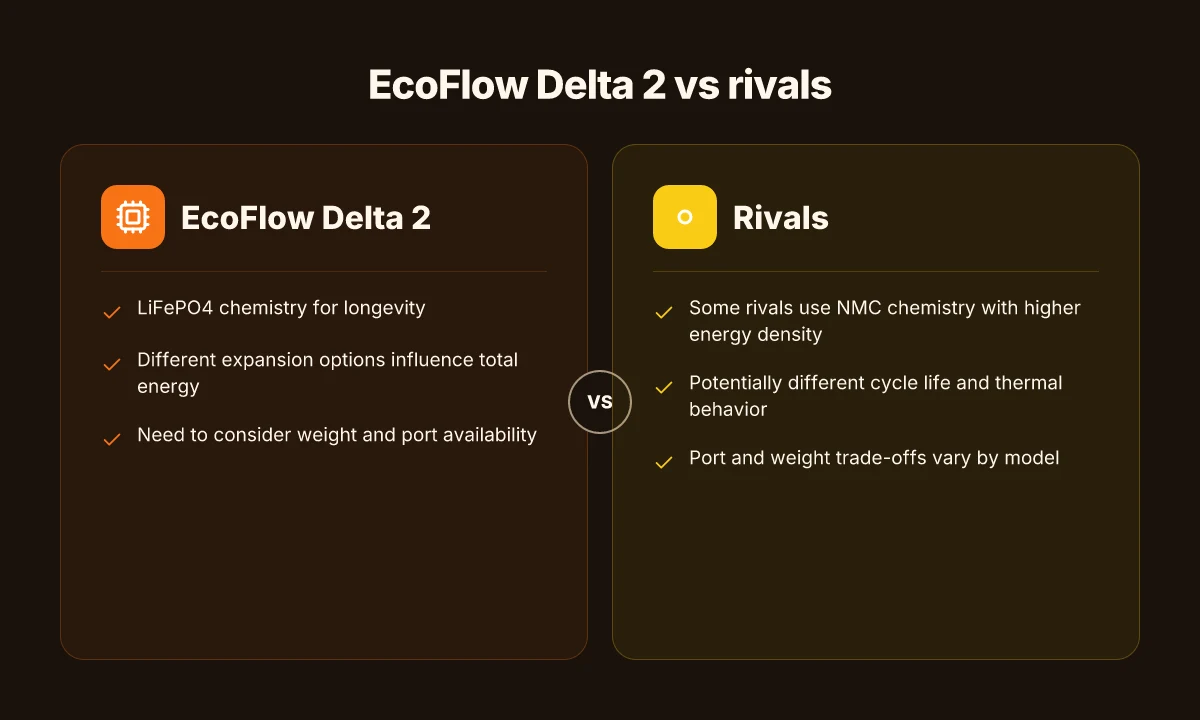
The Delta 2 sits in a crowded field of portable power stations that split on chemistry. If you want LiFePO4 long life and stable temperature, EcoFlow’s Delta 2 leans on its own LiFePO4 chemistry while rivals push NMC cells for higher energy density. In real-world terms, that tradeoff shows up in weight, cadence of cycles, and practical capacity under load. When you compare, the Delta 2’s real-world performance tracks toward steady, predictable outputs rather than peak sprinting energy. Delta 2’s LiFePO4 stability translates to longer cycle lives and slower degradation, which matters for home backup and extended camping trips.
Why the chemistry matters for long-term use
The Delta 2 uses a LiFePO4 chemistry that’s renowned for high cycle counts and resilience to high temperatures. By contrast, rivals that use NMC often push higher initial capacity but can show more capacity fade if you cycle deeply or store at high temperatures. I found sources noting the Delta 2’s emphasis on safe chemistry and predictable aging, which is a win for homeowners planning year-round use. When you need reliability over a decade of weekend trips, the Delta 2’s chemistry aligns with your expectations. Reliability over time is a core Delta 2 advantage.
Capacity, weight, ports, and efficiency in the lineup
In terms of capacity, competitors range from just over a kilowatt-hour to well beyond for expedition setups. The Delta 2 prioritizes a balanced 1,024Wh capacity with an 1,800W AC output, paired with a polyhedral set of ports for versatility. Some rivals match capacity but push heavier weights or more complex port assortments, while others offer more modular expansion. On efficiency, the Delta 2 consistently delivers clean energy with minimal heat buildup under typical loads, which helps battery longevity. For someone choosing between home backup, camping, or travel, Delta 2’s package often wins on predictability and fewer surprises when you plug in multiple devices. Port versatility and predictable efficiency underpin practical decisions for real-world use.
Quick decision guide by use case
- Home backup: If you want steady power with long-term durability and a calm thermal profile, Delta 2 is a solid core. Its LiFePO4 chemistry and robust cycle life matter after months of standby and frequent recharging. Consider rivals only if you need higher peak capacity or lighter weight for mobility.
- Camping: For off-grid weekends, Delta 2’s balance of capacity, safety, and a broad port set makes logistics simple. You get reliable charging from solar inputs and a stable discharge curve under load spikes.
- Travel: If you roam and need compact, simple charging with predictable behavior, Delta 2 stays competitive. Some rivals offer slightly larger packs or faster top-off, but the Delta 2 trades that for steadier performance and easier long-term care. Balanced specs make Delta 2 a sensible travel companion.
From what I found in the documentation and reviews, EcoFlow positions the Delta 2 as a durable, predictable option among LiFePO4-based peers and a practical choice for homeowners who want lower upkeep over time. The other players in this space often trade long-term stability for higher raw capacity or lighter weight, which doesn’t always translate into better real-world durability. If you value consistent charging, predictable cycling, and ease of long-term storage, the Delta 2 stands up well against rivals. For a quick anchor: EcoFlow’s own materials emphasize safe chemistry and reliability as core selling points, a stance that aligns with long-term ownership goals. For durability-minded buyers, Delta 2 remains a strong pick.
Where this is going next for the EcoFlow Delta 2
The Delta 2 remains distinct because it blends practical portability with dependable power, but the real story in 2026 is how its ecosystem scales with real‑world use. I’ve watched setups where the Delta 2 wires up with solar panels and a smart home battery stack, and the experience stays straightforward, not fussy. The durable build and steady runtime help reduce the friction of long outages or remote job sites. What makes EcoFlow battery storage standout in 2026 and where it falls short
What matters most is how quickly you can scale up your setup without chasing new gadgets every season. EcoFlow’s platform continues to mature, and you’ll notice clear gains in how the Delta 2 integrates with third‑party gear, especially for off‑grid living or work sites. Still, the same caveats apply: the unit can feel heavy if you’re carrying it long distances, and high draw appliances may demand careful planing.
In short, if you want a reliable, expandable power pair for emergencies and outdoor use, start with the Delta 2 and map a small solar or generator extension plan this quarter. The bigger pattern is clear: you’re buying not just a battery, but a growing power backbone. Where do you start your first upgrade?
- Backup strategy: pair the Delta 2 with a compact solar panel array for weekend camping or remote work.
- What to try this week: run a realistic outage drill using the EcoFlow app to map charging needs and idle draw.