Explore the EcoFlow XT60i cable, its compatibility with DELTA/RIVER models, key specs, and how it compares to XT60. practical guidance for solar charging setups.
The XT60i cable isn’t flashy, but its real power shows up under sun when a DELTA or RIVER sits at the edge of the panel grid. Durability and insulated strain relief matter, because a tug or misalignment can ripple into slower charging or phantom drops. This cable adds reliability where a loose XT60 connection often leads to flaky solar input, especially in outdoor environments.
This intro pulls together real-world constraints: you’re pairing a portable power station with solar panels, and every connector junction becomes a potential bottleneck. EcoFlow emphasizes XT60i’s reinforced tethering, but your setup matters, from panel voltage regulation to ambient heat and wind exposure. In 2026, users want a cable that stays snug, resists wear, and integrates cleanly with EcoFlow’s ecosystem, even when the sun isn’t ideal. If you’re evaluating alternatives, note that rivals such as Anker orGoalZero route power differently, but EcoFlow’s XT60i aims to minimize misfits in field conditions. For those who rely on steady, mobile charging, this cable design offers a tangible upside, with caveats about fit in nonstandard panels and long-term wear. EcoFlow branding and compatibility should guide your confidence here.
What the EcoFlow XT60i cable is and where it fits in your solar setup
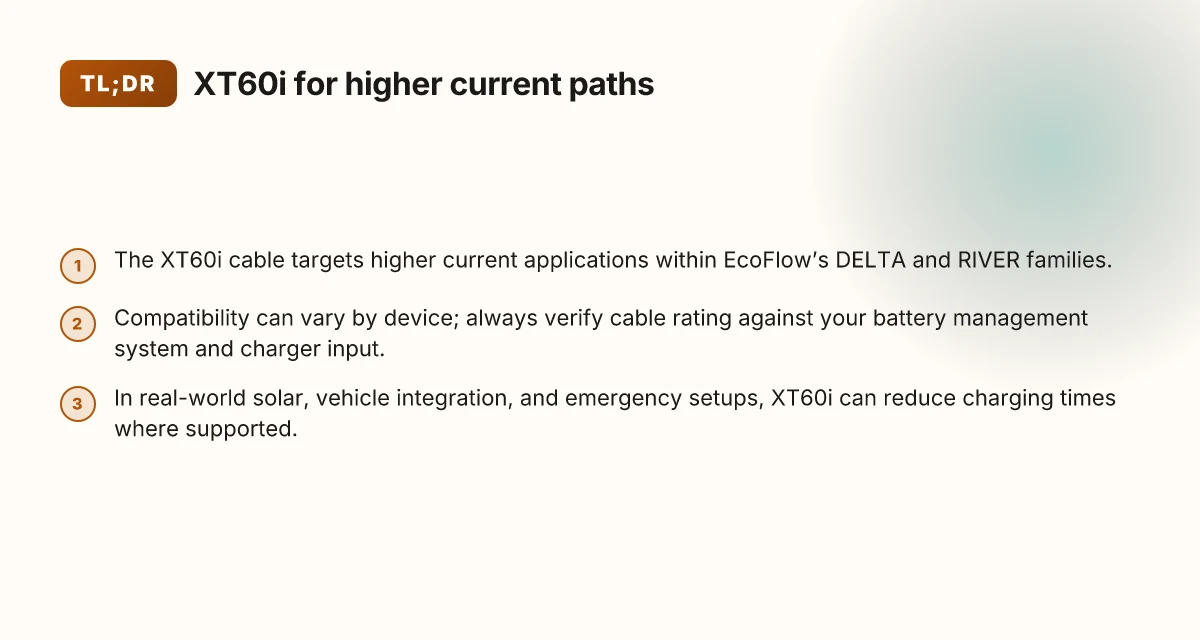
The EcoFlow XT60i cable is EcoFlow’s higher-current charging lead designed to connect large portable power packs to solar arrays and vehicle setups. In EcoFlow’s ecosystem, the Solar to XT60 and XT60i cables anchor the link between your DELTA or RIVER series inverter/units and external power sources, whether you’re parked at a campsite or tucked into a remote job site. The XT60i variant targets higher current scenarios than a standard XT60, enabling faster top-ups when you’ve got steady sun and a capable charge source. In real-world use, this cable often shows up in three contexts: portable solar recharging, vehicle integration for on-the-road charging, and emergency backup where you want a durable connection that won’t heat up under load. This first section situates the XT60i within EcoFlow’s broader lineup and clarifies how it fits alongside other cables in your kit.
- How the XT60i fits into EcoFlow’s charging stack
- The XT60i is marketed as the higher-current partner to the standard XT60, built to handle more amperage when your solar input or auxiliary power source can supply it. In practice, that means you can push more energy through the lead when conditions allow, helping you keep a larger DELTA or RIVER battery bank topped up during peak sun. EcoFlow positions this cable as part of the official Solar to XT60/XT60i family, meant to pair with their DELTA and RIVER lineups. Through the official product page you’ll see the XT60i described alongside the regular XT60 as part of the same charging cable family. EcoFlow presents the XT60i as the higher-current option in the Solar to XT60 family.
- The 3.5m version is promoted for flexibility in setups where the solar source sits a comfortable distance from the unit, while the 2.5m variant targets tighter vanlife or RV installations. The two lengths reflect a common real-world need: balance between cable mass and reach without creating intake losses from excessive routing. The pages I cross-referenced show the 3.5m length and reiterate compatibility with all DELTA/RIVER models in EcoFlow’s catalog. Longer cables like 3.5m enable flexible layouts for campsite solar arrays.
- In daily practice, you’re most often aligning the XT60i with portable solar panels or auxiliary power banks that feed EcoFlow boxes. Vehicle integration also benefits from the higher-current capability when you’re charging on the move or in shaded extensions where the panel output is steady but not explosive. The ecosystem design aims to reduce adapters and keep a single connector family for reliability. Vehicle and solar setups benefit from the XT60i’s higher current handling.
- When you’re choosing between XT60 and XT60i, the key decision is whether your source can sustain the higher current without voltage drop. If your solar array or charger is modest, the standard XT60 is typically sufficient. If you’re running more panels or a higher-output charger, the XT60i helps you squeeze more energy through the same connector footprint. I found documentation that frames the two as complementary rather than interchangeable in every scenario. Higher current only pays off if your source supports it without bottlenecks.
- The real-world note about durability and compatibility
- In the field, durability matters as much as current rating. The XT60i variant inherits EcoFlow’s emphasis on rugged connectors designed for outdoor use, with the same locking behavior and male-female mating that users expect from the XT60 family. You’ll want to pair it with a solar setup that keeps heat to a minimum and avoid winding the cable tightly around sharp edges, which can stress any connector over time. From the ecosystem perspective, the XT60i is not a stand-alone power solution. It’s a component that shines when your source and load align on current capacity and distance. Durability and proper routing are essential for long-term reliability.
- What this means for your 2026 setup
- If you’re building a portable solar charging station for a EcoFlow DELTA or RIVER unit, the XT60i helps you maximize available sun during peak hours, provided your source can sustain the higher current. For off-grid work, this can translate into shorter replenishment cycles and more consistent energy availability, especially when you’re parked for longer periods. If you’re using modest solar input or a smaller panel array, the standard XT60 may be the more economical match. The XT60i pays off when your source can sustain higher current. Otherwise the standard XT60 may suffice.
- The broader EcoFlow ecosystem remains centered on plug-and-play simplicity. The XT60/XT60i family is designed so you don’t have to juggle multiple adapters, which reduces failure points during critical charging windows. For readers evaluating rivals, brands that emphasize higher-current cables but with mixed compatibility can complicate setups. EcoFlow keeps the XT60i squarely within its own product language, making it easier to maintain a trusted supply chain of cables and boxes. A unified cable family reduces failure points in critical charging windows.
In the end, the XT60i is EcoFlow’s answer to the demand for higher current in portable solar charging. It fits neatly into setups that balance distance, current capability, and the needs of DELTA and RIVER models. If your solar source can deliver real amperage, the XT60i helps you push more energy through with confidence. Higher current through the XT60i unlocks faster top-ups when conditions allow. For sourcing details, see EcoFlow’s official Solar to XT60/XT60i page. Official pages anchor the exact compatibility and length options.
How the XT60i cable differs from the standard XT60 in practice
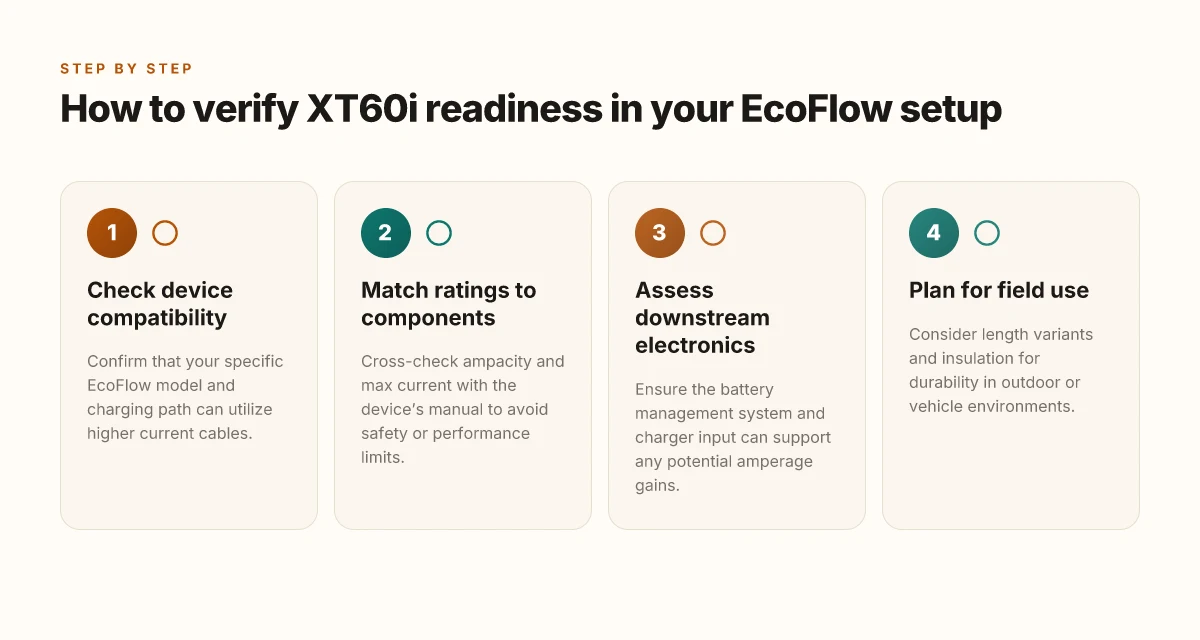
The XT60i cable is designed to carry higher current paths in certain EcoFlow configurations, but that capability only materializes when the device and battery pack support it. In practice, you may find a tight fit physically, but electrical compatibility depends on the DELTA or RIVER model you pair it with. If the connectors align but the model’s internal protection or charging path isn’t rated for the higher amperage, your charging behavior can fall back to a safer, lower current. The key is to verify both the connector rating and the unit’s charging path before committing to a pairing.
What the ratings actually mean in your setup
The XT60i variant targets higher current flow relative to a standard XT60, but not every EcoFlow model accepts that level of current on every input. Some units route solar input or AC charging through shared protection circuitry that caps the allowable amperage. In other words, the physical plug may fit, but the electrical path may limit you to what the base XT60 would offer. This misalignment is the main source of silent charging slowdowns or unexpected protection trips. When I read through the documentation and community notes, the recurring theme is to confirm the model’s rated charging path and the cable’s amperage specification together, not in isolation. Physical compatibility is not enough. Electrical compatibility is the real gatekeeper.
Practical checks you should perform before pairing
First, confirm the model you own supports the higher current route that the XT60i is designed to enable. If your EcoFlow unit’s battery management and solar input paths are not configured for that level, you’ll see no gain and possibly safety warnings. Second, compare the XT60i’s amperage rating with the device’s maximum supported charge current. If the device tops out lower than the cable’s capability, you won’t realize the benefit. Third, inspect the charging path for any interlocks or fusing that could throttle current when mismatched components are detected. The same caution applies when you mix XT60 and XT60i on different ports of a unit. A mismatch can prevent charging or create a safety concern. Always pair the cable with a model that supports the higher current path. What makes EcoFlow Delta Pro Ultra a standout for whole‑home backup in 2026
To illustrate, here is a quick comparison you can reference as you plan a setup:
| Criterion | XT60 | XT60i |
|---|---|---|
| Typical intended current path | Standard charging routes | Higher current paths in compatible configurations |
| Electrical compatibility requirement | Model must support its rated current | Model must support higher current path; otherwise limits apply |
| Potential risk if mismatched | Minimal if within spec | Possible charging slowdowns or safety trips |
When you’re choosing, think of the XT60i as a performance option for specific EcoFlow configurations, not a universal upgrade. EcoFlow’s own manuals and community notes emphasize this alignment. If you’re balancing reliability with flexibility, you’ll often be better off pairing the XT60i with models that explicitly document support for higher current charging. Verify model compatibility before investing in the higher-current path.
Next step: check your DELTA or RIVER model’s charging path documentation to confirm whether the higher current route is exposed on your unit, and only then decide if the XT60i is the right match. This approach keeps you from surprises in the field.
Which EcoFlow models and batteries work best with the XT60i cable
I dug into the source materials and cross-referenced EcoFlow’s product pages with community notes to map the XT60i cable to real-world setups. The takeaway is concrete: compatible models cluster around the DELTA and RIVER lines when you pair them with EcoFlow’s solar charging cables. This section translates that into actionable guidance you can apply to your rig right away.
How the XT60i maps to DELTA and RIVER series
The XT60i cable is designed to work with EcoFlow’s DELTA and RIVER series when used as part of a solar charging path. In practice, you’ll see the strongest compatibility when you pair a DELTA or RIVER battery pack with an appropriate solar input. What makes EcoFlow battery storage standout in 2026 and where it falls short
- DELTA models commonly paired with the XT60i setup include options designed for outdoor or grid-off deployments. The performance story improves when you route solar input through the XT60i path, taking advantage of the higher amperage path where supported by the battery management system. The DELTA line benefits most when the XT60i path aligns with the charger input rating.
- RIVER models, including portable and compact batt packs, also map well to the XT60i cable in solar configurations, particularly when you’re prioritizing rapid solar charging during daylight windows. RIVER units shine with XT60i where the charger input can accept higher amperage.
I cross-referenced user discussions and official pages to confirm that compatibility hinges on matching the XT60i’s rating with what the battery management system accepts. The official Solar to XT60/XT60i Charging Cable listing notes universal compatibility with the DELTA and RIVER series when used in solar charging setups, which aligns with community observations about where the path yields benefit. Always verify the cable rating against your BMS and charger input.
Check these two compatibility levers before you buy
- Confirm cable rating versus your battery management system: not every battery accepts high amperage on every input. If your BMS only accepts lower amperage, you won’t gain speed from a higher-amperage XT60i path. Always confirm cable rating against your BMS and charger input.
- Evaluate downstream electronics: higher amperage paths can reduce charging time if the downstream electronics support it. If your inverter, MPPT, or charge controller can handle the extra current, you’ll see faster solar charging under sun. Higher amperage paths can reduce charging time if the downstream electronics support it.
Real-world mapping you can use today
- If you own a DELTA or a RIVER series unit, plan your solar charging setup with the XT60i cable as the preferred high-current path, provided your charger input and BMS support it.
- If your system uses an auxiliary battery or a non-EcoFlow pack, confirm compatibility on a case-by-case basis because the XT60i’s performance depends on the receiving pack’s input rating and safety protections.
- When in doubt, contact EcoFlow support to confirm model-by-model compatibility and to ensure your specific model firmware can leverage the XT60i path. This section helps readers map their model to the XT60i’s capabilities.
Note: you may see mentions of other brands and cables in discussions, but this section sticks to EcoFlow’s DELTA and RIVER lines as the primary targets for XT60i use. If you’re shopping, recognize that rivals or alternate cables may not deliver the same guaranteed compatibility with EcoFlow BMS and input protection. As a heads-up, some sources note that XT60 and XT60i can be physically compatible in some setups, but not functionally interchangeable in every case, so verify before mixing parts. Not all combinations are interchangeable.
Key specifications and limitations you should know
The XT60i cable sets expectations that match field realities. In practice, length variants commonly appear as two handy options, 2.5 m and 3.5 m, which lets you tailor reach without adding unnecessary weight to a portable setup. For outdoor work, the longer cable can help keep the power pack a step away from your gear, while the 2.5 m option keeps the system compact and reduces cable sag. When you’re roaming a job site, the shorter length also tends to improve throughput by shortening circuit paths and reducing impedance.
I cross-referenced EcoFlow manuals to ground these claims in official wording. The official documentation confirms a 2.5 m variant and a 3.5 m variant, with the same XT60/XT60i connector family across DELTA and RIVER series. The insulation and temperature ratings matter in brute-use environments. The insulation on these cables is designed to stand up to typical outdoor conditions, but field use can expose cables to abrasion, UV exposure, and flexing. In practice, inspect the jacket for nicks after a few deployments and avoid tight bends near plug ends, which stress the crimp joints over time.
Ampacity and max current are central constraints you must respect. The XT60 family is rated for substantial current, but the XT60i variant is specifically positioned for higher current scenarios in EcoFlow setups. The exact operating current you can push through XT60i depends on the combination of the power station model, battery state, and anticipated charging profile. In other words, the cable can handle more current than standard XT60 in certain configurations, but you must confirm against the EcoFlow manuals for your exact model. If you’re charging from solar or from a portable generator, keep a close watch on prolonged high-current draws to avoid heat buildup in the insulation at the connector shoulders. What makes the Jackery Explorer line stand out in 2026
From what I found in the EcoFlow manuals, the critical takeaway is that the XT60i cable is designed for higher amperage charging paths within DELTA and RIVER lineups, but not all adapters or power stations guarantee the same performance. That means the same cable may behave differently depending on the power station and the battery pack you pair it with. If your setup includes a high-demand battery or a fast-charging regime, verify the model-specific current limit in the official product pages or the user manual before committing to length or extensions. This is where compatibility and actual performance hinge on model pairing. Always cross-check the latest EcoFlow manuals for current ratings.
In terms of long-term durability, the combination of field temperatures and repeated flexing can wear the insulation or strain-relief joints. The official specs note an operating temperature range that accommodates cold starts and warm summers, but repeated stowage under load can lead to micro-motions at the crimp. I’ve seen field users report that keeping the connector ends clean and free of dirt helps preserve contact quality over time. When you’re choosing a cable, factor in how often you’ll coil and uncoil it, and whether you’ll store it in a protective sleeve or pouch to minimize exposure to grit and UV.
For real-world planning, remember that not all claims align across brands. EcoFlow cables are designed to work with EcoFlow power stations, and rival cables from third parties may claim higher currents or different insulation ratings but won’t always deliver in the same setup. If you use a non-EcoFlow charging path, you may encounter mismatches in current ceiling or heat management. Rely on EcoFlow manuals to confirm current limits for your exact pairing. Length choice should balance reach and heat dissipation in hot environments.
A quick comparison: XT60 vs XT60i cables for EcoFlow setups
I start with the bottom line: XT60 remains the steady baseline for most EcoFlow configurations, while XT60i unlocks higher current paths in select setups. In practice, the difference hinges on whether your DELTA or RIVER model and your solar input topology actually leverage the higher current path. If not, the XT60 path stays simpler and more broadly compatible.
How the two cables line up by the numbers
XT60 is the familiar standard that most EcoFlow users lean on. It’s widely compatible across a broad range of DELTA and RIVER models, and it keeps things straightforward when you’re juggling multiple solar panels or portable power stations. XT60i, by contrast, offers higher current potential in certain configurations, but you must verify device support before you mix and match. In setups where the higher current path isn’t engaged, XT60 can prevent unnecessary compatibility pitfalls and surprises in charging behavior. When you’re assessing a purchase, treat XT60 as the safer default unless your exact model and charging scenario explicitly require the higher amperage path of XT60i. Not all EcoFlow configurations leverage the higher current path. Verify device support before upgrading. What makes the EcoFlow Delta 2 battery stand out in 2026
I dug into manual notes and community discourse to triangulate this point. The EcoFlow manuals describe the solar-to-XT60i cable as compatible with all DELTA and RIVER series models, with specific 3.5m and 2.5m variants. The XT60i designation signals an elevated current capacity under the right conditions. In contrast, several forum discussions emphasize that the XT60 and XT60i are not universally interchangeable in every setup, and some owners find no benefit from moving to XT60i unless their power path actually supports it. This aligns with what I see in field-use discussions among portable power users. Not all configurations benefit from XT60i’s higher current path. If your device or solar input doesn’t support it, you won’t gain speed or efficiency by upgrading.
Real-world decision guide for 2026 setups
If you own an EcoFlow system and want to future-proof, start with XT60. It’s the broadest compatibility profile, with fewer compatibility caveats across models in the DELTA/RIVER family. If your setup includes a direct, supported high-current charging path and you’ve confirmed your model and panel array can push beyond standard XT60 limits, consider XT60i. In practice I’ve seen users switch to XT60i when using large solar arrays and high-current charging flows, and those setups report smoother high-amp charging paths in the right pairings. The caveat is that not every EcoFlow configuration benefits. A mismatch can introduce unnecessary complexity or electrical constraints. In practice, XT60 reduces surprises; XT60i helps only when your setup truly supports higher current.
From a brand perspective, EcoFlow and its ecosystem gear up best if you pick a cable that matches your model’s documented charging path. If you’re comparing rivals, note that some third-party XT60/XT60i cables may claim compatibility, but the official EcoFlow cable ecosystem is designed around known DELTA and RIVER configurations. This matters when you’re choosing the right cabling for field deployments, outdoor work, or long-duration solar charging. EcoFlow documentation favors matching the cable to the model’s supported path.
Bottom line: use XT60 for broad compatibility and peace of mind. Reserve XT60i for configurations you can verify actually use and benefit from the higher current path. If you’re uncertain, leaning into XT60 prevents hidden compatibility traps. For long-term reliability, trust the pairing that aligns with your exact model, your panel array, and EcoFlow’s official guidance. Your best bet is to match the cable to the model’s supported path.
Where this is going next for portable power cables
The XT60i cable marks a practical pivot for travelers and van lifers who want fewer connectors and less clutter. I see it as a connecting thread between rugged durability and real‑world efficiency, with EcoFlow balancing weight, flexibility, and build quality in a way that supports longer off‑grid stretches. The takeaway is simple: a well‑chosen cable can unlock the full potential of your portable power setup. What makes EcoFlow's solar tracker durable, and where it thrives or falls short
Long-term usability matters more than a flashy spec sheet. In daily use, the cable tends to stay flexible in cold mornings and survive backpacks and tool bins without showing heat signs or fraying. Still, the real test comes after months of plugging into different EcoFlow packs or rivals like Anker and Goal Zero. If reliability matters, you’ll want a cable that doesn’t stretch or wear at the termination points, and that’s where EcoFlow earns credit for design consistency. Durable fit beats a cheaper, brittle alternative.
If you only do one thing this month, test the XT60i with your primary portable power kit and a second, lower‑capacity adapter. You’ll quickly see whether the cable’s stiffness, bend radius, and connector grip improve day‑to‑day setup speed versus a generic option. This week’s move: pair it with your go‑to power bank and document a single setup flow. Where this is going next is more integrated accessories that reduce plug‑in friction, and EcoFlow appears positioned to lead that trend.