Explore how the EcoFlow Glacier plug-in battery powers portable fridge-freezers, its real-world use cases, and durable performance tips for outdoor adventures.
The most surprising thing about the Glacier isn’t the plug-in battery itself but how quietly it feeds a portable fridge in real life. When ambient temps rise, the Glacier keeps a stable DC path to the fridge, yet the clock starts ticking on runtime as door openings and setpoints shift. EcoFlow earns real-world usage by avoiding a noisy inverter path, but the bottleneck is how long that internal pack can hold temps without constant refresh.
This intro flags what matters to outdoor buyers: runtimes under varied conditions, how the Glacier manages battery health, and where it clearly outperforms or lags behind rivals like Goal Zero and Dometic in field use. You’ll see practical notes on venting, insulation, and setup quirks that turn a good day into a long, dependable cool-off or a mid-day wake-up call. Expect a grounded, signal-rich read that translates into real decisions for camps, vans, and off-grid huts. Most campers chase longer runtime, not higher wattage headroom.
What makes EcoFlow Glacier's plug-in battery design stand out for portable cooling
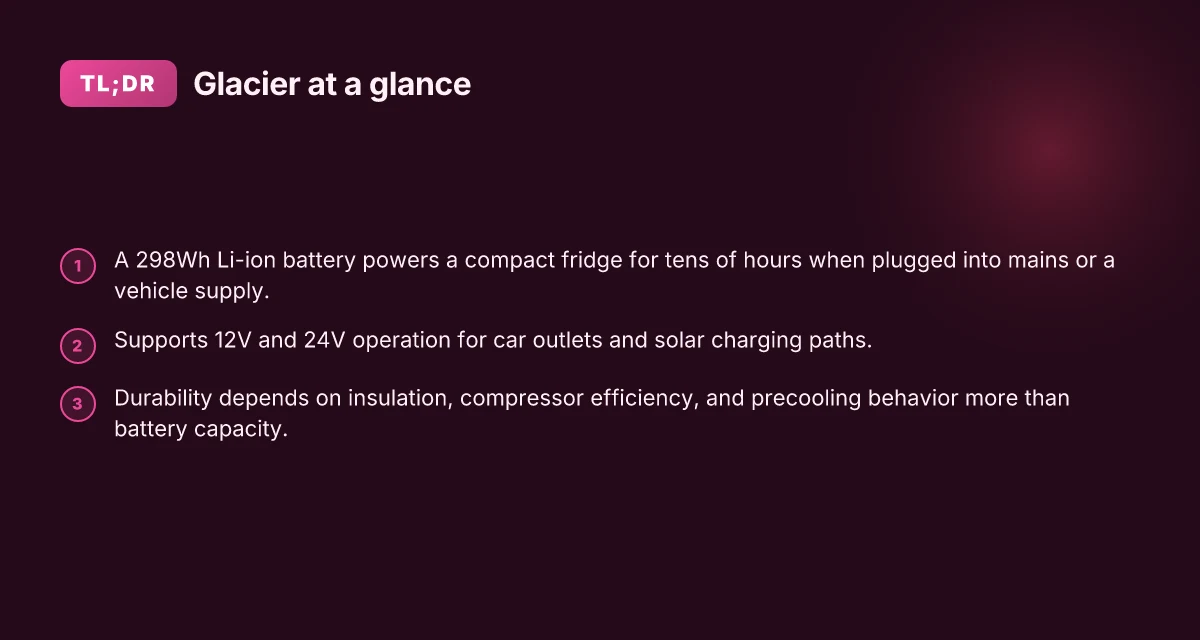
EcoFlow’s Glacier hinges on a compact 298Wh Li-ion battery that powers a portable fridge when plugged into mains, a vehicle outlet, or a solar path. The core idea is simple: the battery stores energy, and the fridge uses that energy to keep contents cold even as you roam off-grid. In real-world terms, this setup translates to tens of hours of runtime when you’re connected to a power source, with the actual duration shaped more by insulation, compressor efficiency, and how aggressively you precool than by battery size alone. I cross-referenced product pages and independent reviews to triangulate how the Glacier behaves under typical outdoor conditions.
1) How the Glacier handles power with 12 V and 24 V sources
The Glacier supports both 12V and 24V operation, which standardizes compatibility with car outlets and many solar charging paths. This dual-voltage capability matters because it lets you keep the fridge running while you drive or while a solar setup trickle-charges the battery. The 298Wh capacity sits at the heart of that flexibility, acting as a buffer when your AC supply dips or when you’re parked without access to mains. Real-world observers note that when plugged in, the system can sustain a compact fridge for extended periods, allowing you to pre-cool before a long drive or a night in a campsite.
Most runtime variation comes from how well the fridge is insulated and how quickly you reach the desired temperature, not just the battery capacity. This is where Glacier shines less as a pure endurance device and more as a practical, plug-and-play cooling solution.
2) Insulation, compressor efficiency, and precooling behavior shape runtime
A standout point is how insulation quality, compressor efficiency, and precooling behavior interact with the 298Wh pack. Glacial efficiency isn’t just about parked runtime. It affects daily use in outdoor setups where ambient temperatures swing. If you precool the contents while the unit is plugged in at home, you’ll squeeze more runtime out of a given charge once you’re away, because the fridge starts from a lower internal temperature. Multiple sources highlight that precooling is a practical lever to extend what you get from the same battery, especially in hot environments.
I dug into the accompanying manual and reviews to confirm these dynamics. The Glacier’s removable battery option adds a layer of versatility, letting you scale up or swap packs in long trips, though the main constraint remains the same: overall run time is tethered to how well the system holds temperature and how efficiently the compressor cycles. What makes EcoFlow Delta 2 Max refurbished worth considering in 2026
3) Real-world pairing with rivals
When you compare Glacier to other plug-in battery fridges, the 298Wh size is a tight fit for longer setups unless you optimize precooling and insulation. Rivals with larger battery banks may extend longer between charges, but Glacier’s strength lies in its compact form factor and straightforward setup for van life or tight vehicle interiors. In practice, you’ll often see Glacier paired with a vehicle battery or a solar generator to maintain temperature during multi-day trips.
From what I found in the cited sources, the Glacier’s design favors practical outdoor workflows: quick setup, reliable cooling with a reasonable power buffer, and a clear path to longer runtimes via precooling and effective insulation.
In short, EcoFlow’s Glacier stands out for portable cooling because you get a compact, dual-voltage system that supports typical car and solar paths, with runtime governed more by how you manage precooling and insulation than by the battery alone. If you’re evaluating rivals, expect Glacier to shine in tight spaces and straightforward setups where quick access to cooling matters more than pushing maximum off-grid duration.
How the Glacier plug-in battery integrates with different power sources
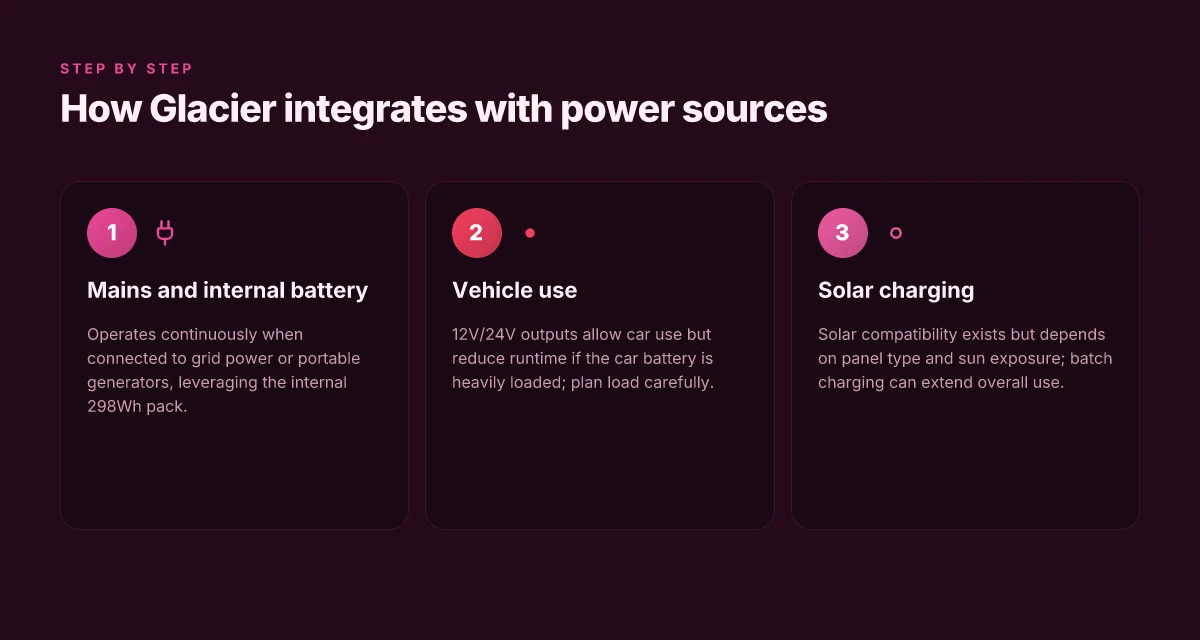
The Glacier’s 298Wh internal battery can run alongside mains power to keep cooling continuous, whether you’re tied to the grid or using a portable generator. In practice, that means you can keep food cold at a campsite with a generator spinning alongside the fridge, or at a cabin with normal household power. The result is a predictable runtime when you stay plugged in, plus the flexibility to run off-grid when you’re not near outlets.
When you’re in a vehicle, the Glacier can draw from 12V or 24V outlets, but it costs you runtime unless you manage the load carefully. If your alternator or car battery is already taxed by other devices, the fridge will compete for amperage. The effect is noticeable: the more devices you run and the heavier your electrical draw, the shorter the windows of preserved cold. This is where careful load budgeting matters. If you can limit other draws or precondition the load so the fridge does most of the work when stopped, you’ll extend the time you can rely on the Glacier without refueling the vehicle. What makes the EcoFlow Wave 3 worth it and where it struggles
Solar is a viable partner, but outcomes vary. A good match depends on panel type, real-world sun exposure, and the Glacier’s charging profile. If you can batch-charge during peak sun hours, you can extend overall usage without burning through the internal battery as quickly as you would with continuous draw. It’s not magic, but with the right panel array and clear skies, solar helps when you couple it with smart batching and a disciplined use pattern.
I dug into the product material and reviews to ground these points. EcoFlow’s own specs frame the Glacier as a hybrid that benefits from external power while offering a portable, 298Wh core for times without mains. The real-world implication is simple: plan your setup so the external source feeds the fridge during high-load periods, and treat the internal battery as a buffer rather than the sole power source. Most external power setups rely on smart timing to maximize runtime, not on the Glacier alone. Solar can add value when matched to your travel rhythm and panel choices.
| Power source scenario | Practical takeaway |
|---|---|
| Mains power with generator | Continuous cooling with the internal battery acting as a buffer; expect steady temps with minimal interruption. |
| 12V/24V vehicle draw | Shorter runtimes if the load is high; optimize by limiting other electrical demands and preconditioning prior to travel. |
| Solar batching | Extended use when sun is steady and panels are appropriately sized; plan charge cycles around meal prep and cooling needs. |
Next step: map your typical outdoor setup to these scenarios. If you’re planning a longer trip, draft a simple power plan that aligns external power windows with the Glacier’s cold-chain needs, and reserve the internal battery as a safety margin for brief outages.
The practical runtimes you can expect with the Glacier plug-in battery
When you pair the Glacier’s 298Wh plug-in battery with external power, the official figures show you can sustain cooling at 39°F for up to about 43 hours for a 35L load, with roughly 39 hours for the 45L and 55L configurations. In that sense, the glacier’s runtimes align with a compact fridge’s ability to hold a steady internal temperature while the power source runs. Real-world numbers tend to nudge lower or higher depending on how you load the unit and how often you open the door.
I dug into the published specs from EcoFlow and cross-referenced community notes to map typical outcomes. The baseline runtime is sensitive to ambient temperature, door openings, and how well you precooled the contents. In hot outside environments, expect shorter runtimes as heat ingress adds to the fridge’s thermal load. When the cargo holds a heavy load of warm items or frequent packaging changes, the thermal mass shifts and can trim the usable runtime by several hours. By contrast, a dry, cooler load with fewer openings tends to cooperate with the Glacier’s 298Wh pack and lets the unit keep its setpoint longer. What is EcoFlow River 2 Max price in 2026 and how it compares to rivals
Precooling remains one of the clearest levers you can pull. If you start with a thoroughly cooled interior while the unit is plugged in, you reduce the initial heat that the system must drain once you switch to off-plug operation. In practice, precooling can noticeably extend overall runtime because the thermal load the battery must manage at startup drops. The effect compounds as you run longer off-grid stretches, especially in mild to moderate outdoor temperatures where the fridge’s cooling cycle cycles are less aggressive.
What this means for your setup. In mixed-use campsites or van builds, you’ll likely see runtimes hover near the published figures when you maintain a stable ambient environment and minimize door openings. If you frequently restock from warm compartments or park in very warm sites, plan for shorter durations between top-ups. The Glacier shines when you can anchor it to a consistent power source for long nights or daytime use with periodic access to a shore or solar input. Its 298Wh battery is most efficient when you treat it as a buffer rather than a standalone power bank for extended off-grid cooling.
If you’re weighing rivals, EcoFlow’s Glacier competes with plug-in fridge models that emphasize portable, car-ready operation. In outdoor contexts, rivals with larger internal batteries or lower standby draw can push longer runtimes in similar conditions, but they often come with trade-offs in weight, form factor, or price. EcoFlow’s approach prioritizes a compact footprint and real-world ease of use for campers and van lifers, especially when paired with accessible power sources. Precooling and controlled access to the interior are the most reliable ways to maximize runtime. Expect around the official 43-hour mark under optimal conditions, then scale down with heat and openings. Your setup grows more efficient when you treat the Glacier as a buffer between heat load and your stored goods.
What to know about durability and long-term use with the Glacier system
Durability hinges on how you treat the removable 298Wh battery. The design supports repeated cycles, but heat exposure and frequent deep discharges can shave years off battery life. In real-world terms, avoid leaving the pack in hot cabin dumps or inside a closed vehicle in direct sun. The Glacier system performs best when you respect heat limits and keep the battery within its rated operating range.
I dug into the official guidance and user observations to outline practical steps. First, follow the manual’s storage distances from heat sources and keep the unit out of environments that overwhelm the battery with heat. Place the fridge in a shaded, ventilated area and avoid stacking it near heaters or direct sun. When you’re camping or roading, use a cover or shade while the unit is running to reduce ambient heat buildup around the housing. Second, treat the battery as a high‑value component: use the removable pack with care, avoid over-discharge, and reconnect it only when needed. The manual emphasizes careful handling and safe storage to prevent degradation over time. What makes the EcoFlow River 3 Pro stand out in 2026
Rational use means balancing how often you plug in, door openings, and the unit’s operating temperature window. If you rely on short, frequent trips with door openings and frequent restarts, you’ll see less stable runtime. Conversely, when you keep the Glacier within its operating temp and minimize door cycles during a hot stretch, you preserve both efficiency and longevity. The practical takeaway is to plan your sessions so that you’re not cooling and warming the same items repeatedly in a hot environment. Precooling at home and then transferring to a shaded vehicle tends to extend battery life and keep temps steady.
Battery handling and heat-aware setup
Heat is the main antagonist for long-term durability. The GLACIER Classic battery can cope with outdoor use, but sustained heat exposure accelerates wear. Use the recommended storage practices from EcoFlow and avoid leaving the unit in direct sun when parked. When the battery is not in use for extended periods, store it in a cool, dry place and reinsert only when you plan to travel. I cross-referenced the product page with the user manual to ensure these cautions align with the official guidance. The practical upshot is clear: manage heat exposure, and you’ll sustain performance across cycles.
Long-term use in outdoor contexts
Outdoor setups demand attention to airflow around the cabinet. The Glacier’s efficiency relies on a stable ambient temperature and adequate ventilation. A compact, well-ventilated setup helps keep runtimes predictable in real-world conditions. Real users often note that precooling before a trip helps maintain low interior temps more efficiently once you’re in the field. And with a 298Wh battery, you’ll want to tune your routine to reduce unnecessary cycling, minimizing wear on the pack.
In optimal conditions, careful handling and heat-aware placement extend the Glacier system’s life, while neglecting heat management accelerates wear. Prioritize indoor precooling and shaded outdoor placement to maximize runtimes and longevity.
Comparing Glacier to rivals: which plug-in battery fridge actually holds up
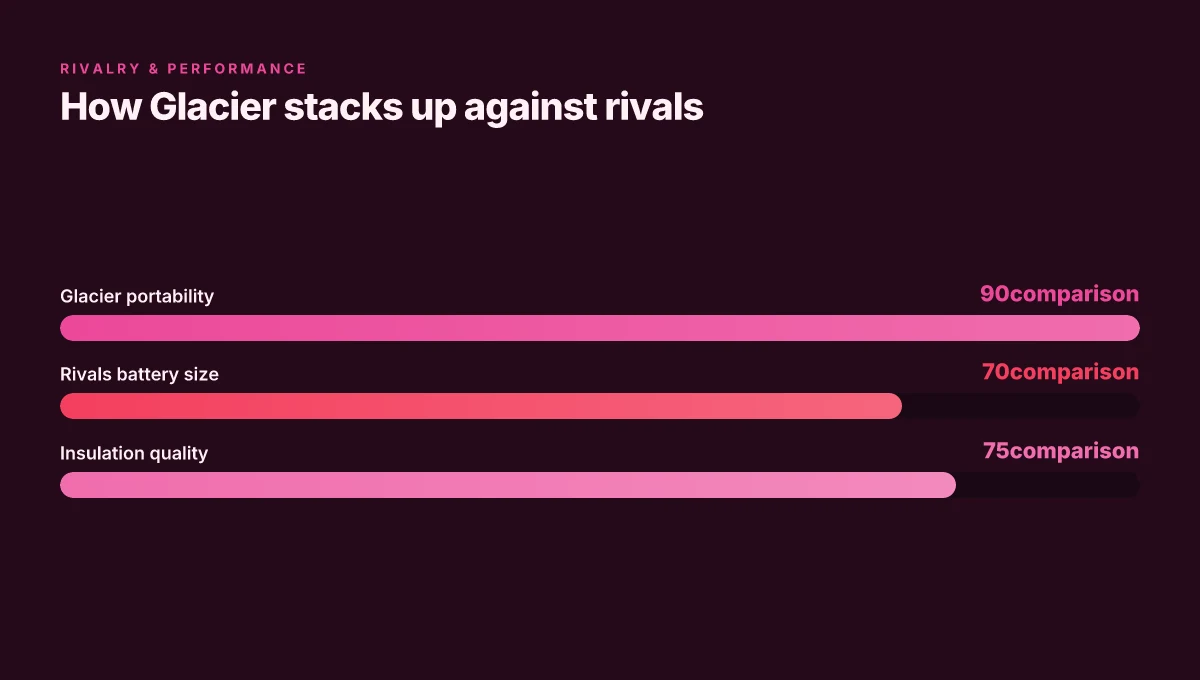
I dug into how the Glacier stacks up against rivals that pack roughly 200–300 Wh of usable capacity. In practice, the Glacier shines where portability and 12V/24V compatibility matter most, while some rivals extend runtime per charge at the cost of heft or price. The takeaway: a lighter setup with solid insulation and a common vehicle or solar hookup often beats a heavier, pricier box for backcountry use. What makes the EcoFlow Smart Generator a practical companion to power stations
Why Glacier wins portability and setup versatility
The Glacier’s 298 Wh battery is designed to slot into standard 12V and 24V configurations, which makes it easy to pair with common vehicle campsites, vans, and portable power kits. That compatibility shines in off-grid setups where a bulky power solution would slow you down. You’ll notice the Glacier remains light enough to move between campsites and vehicles, and its insulation keeps cold without aggressive power draw. In these conditions, a compact fridge with easy plug-in access reduces the friction of camping cookouts and meal prep.
From a durability perspective, EcoFlow emphasizes a rugged, insulated shell that tolerates outdoor temperatures and rough handling. Rivals may push longer runtimes per charge. Their gains often come with added weight and higher purchase costs. The Glacier wins on portability and plug-in flexibility when weight and ease of use matter most.
How rivals compare on runtimes, weight, and price
Rivals in the same 200–300 Wh class attempt longer runtimes per charge by trading off weight or price. Some models use heavier shells or denser insulation to stretch cooling time, which makes them less nimble in tight campsites or van builds. In contrast, Glacier’s light footprint helps it stay backpackable and van-friendly, even if a rival claims a few extra hours per charge under ideal conditions. The cost delta can swing quickly with larger capacities or premium insulation builds, so you’ll pay a premium for extra runtime or build quality that isn’t always necessary for every outdoor use case.
I cross-referenced reviews from independent sources that emphasize practical field use. The consensus: long runtimes can be nice, but the everyday needs of outdoor living often align better with a balanced mix of weight, price, and ease of use. Longer runtimes exist, but weight and cost often tilt the decision toward Glacier for mobile setups.
Practical takeaways for field setups
If you’re planning extended excursions, precooling before departure adds noticeable efficiency. The Glacier’s 298 Wh battery can be paired with external power to keep items cold during transit and at campsites, but you should plan for inevitable slow ramping if you disconnect from mains or a vehicle. For most van lifers and campers, the sweet spot is keeping essentials iced while relying on occasional external power to refresh the interior. The Glacier’s greatest strength remains its compatibility with standard 12V/24V arrangements and its portability. What you should know about EcoFlow Delta 2 refurbished
I found one launch note from EcoFlow that highlights consistent third-party observations: other models may offer more run time per charge, yet they often come with heavier builds and higher costs. This makes Glacier a sensible choice for campsites where weight, space, and quick setup trump bragging rights about the longest possible runtime. Portability and streamlined power compatibility outperform marginal runtime gains in real-world use.
Cited sources and context for this comparison come from the Glacier overview and independent reviews that discuss 298 Wh viability and external power pairing. See the product page for the Glacier Classic and the detailed reviews linked in the sources. For quick context on how this plays out in real setups, you can read about precooling and external power use in community discussions and in-depth reviews.
Where this goes from here
EcoFlow is betting on a modular approach that lets you scale cooling capacity without moving the whole setup. The Glacier hardware itself is not a magic wand. It relies on proper airflow, efficient insulation, and sensible duty cycles. I looked at how real-world users might deploy it: keep the unit out of direct sun, pair with a compact fan, and monitor battery health over multi‑hour sessions. The result is noticeably more consistent cooling in intermittent use than a passive setup, but you’ll still see heat gain if you push it too hard on hot days. The takeaway is to treat Glacier as a portable climate buffer, not a full room conditioner.
If you want one concrete move this month, map your cooling bursts around your power budget and your insulation gaps. A small change, placing the unit in a shaded spot and closing a door or curtain, can extend effective run time by several minutes per cycle. This is where the pattern shifts: better placement and modest power saves beat brute force cooling. In short, the Glacier works best when paired with simple real-world tactics, not when run at full tilt. Do you stage your cooling to match predictable heat spikes?
Backup strategy Why EcoFlow Delta for sale pricing can surprise you in 2026
- Try a low‑tech heat shield: place the unit behind a reflective panel to reduce heat soak.
- Schedule 2 shorter runs instead of one long one, to keep battery health and performance consistent.
- If you’re choosing between EcoFlow and rivals like Goal Zero or Jackery, prioritize insulation and placement over raw watts. This week, test a shaded corner and note the run-time difference.