
Discover what refurbished EcoFlow Delta 2 units offer, including potential savings, warranty caveats, and how they compare to new models from EcoFlow and rivals.
A refurbished EcoFlow Delta 2 often looks like a bargain until you check the battery health signals and port wear that show up in real use. Noticeable battery-age clues and marginal solar compatibility are the two big fault lines, not cosmetic scratches. If you want post-purchase confidence, you’ll want to verify the exact warranty language and what “refurbished” covers.
This piece cuts through the hype by tying real-world durability to how a unit has been cycled, stored, and tested before sale. You’ll see how to read a battery-health report, what to expect from ports after heavy use, and which refurb policies actually protect you for the long haul. The aim is to equip homeowners, campers, and renters with a clear, actionable framework when weighing a Delta 2 refurbished purchase against rivals like EcoFlow, Jackery, and Goal Zero. Transparent refurb policies beat glossy listings every time.
What is a refurbished EcoFlow Delta 2, and who should consider one
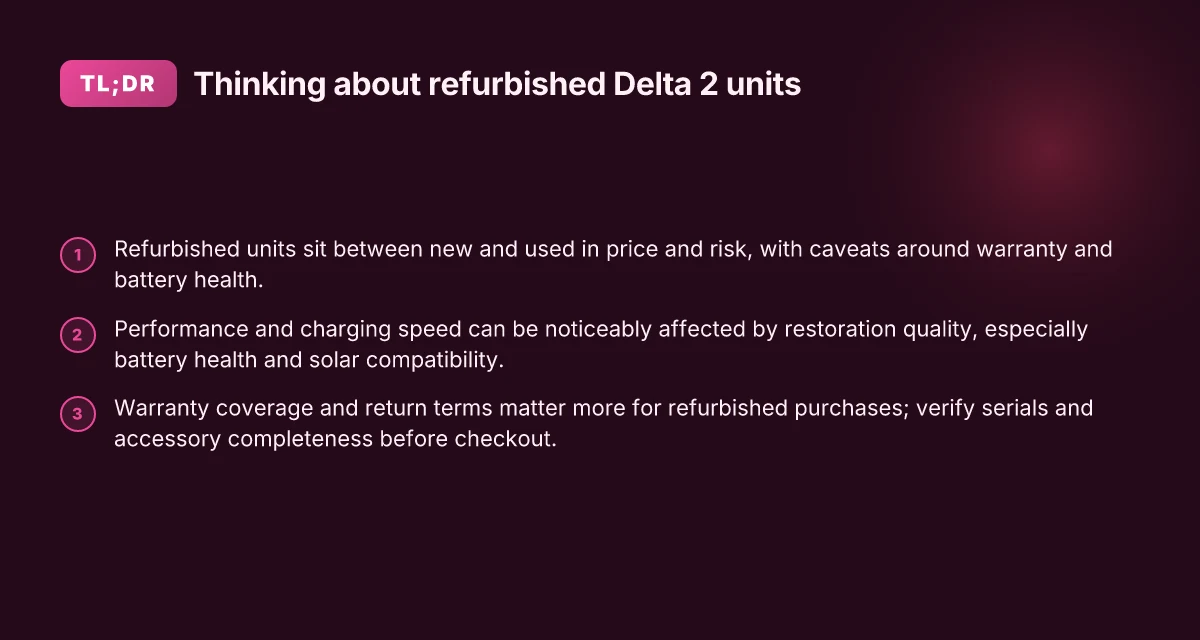
Refurbished Delta 2 units are EcoFlow devices that have been returned, inspected, repaired if needed, and restored to working condition before they are resold. They are not new units, but they should meet EcoFlow’s functional standards and come with limited warranty expectations similar to other refurbished electronics. In practice, refurbishment aims to recover a device’s usability while trimming price compared with factory-new stock.
The price delta between refurbished and new Delta 2 units tends to be noticeable, though the exact gap varies by vendor, age of the refurb, and included accessories. In this context, budget-minded buyers often see refurbished models offered at a several-dollar discount to new pricing, with the potential for additional savings during sales events. EcoFlow’s own channel and partner listings sometimes show refurbished stock advertised at noticeably lower price points than fresh units, particularly when inventory rotates. If you’re monitoring price, the core takeaway is that refurbished Delta 2 units usually sit below new units, but the difference isn’t universal or uniform across sellers.
Who benefits most from buying refurbished? Budget-minded preppers and hobbyists who want portable power without paying full price are typical candidates. Renters and campers who need a reliable back-up solution but can tolerate a shorter tail on battery health signals often find refurbished Delta 2 units appealing. The target buyer tends to value a lower upfront cost and understands there may be limited visibility into the previous usage history. In practice, a refurbished Delta 2 can deliver real utility for weekend trips or temporary power needs, provided you approach it with clear expectations about wear and potential degradation.
From a brand perspective, EcoFlow emphasizes durability and serviceability across its lineup, but buyers should still scrutinize battery health signals and warranty coverage before purchasing refurbished. For rivals, you’ll hear about similar trade-offs with models from organizations like Goal Zero and Jackery, where refurbished stock also aims to balance price and reliability. When you compare, factor in warranty length, return policies, and whether the seller offers a battery health check prior to sale.
Bottom line: a refurbished Delta 2 can be a smart buy for cost-conscious homeowners, campers, and preppers who can tolerate some uncertainty about prior usage. If you value long-term reliability and robust post-purchase support, you may prefer a new device or a rival model with clearer refurbishment guarantees. For many buyers, the value equation hinges on current price, battery health signals, and the warranty a seller provides. The true value rests on the balance between price and risk. If you can verify a solid warranty and battery health report, refurbished can be compelling. What makes the EcoFlow Glacier plug-in battery actually work for portable cooling
How refurbished delta 2 performance compares to new units
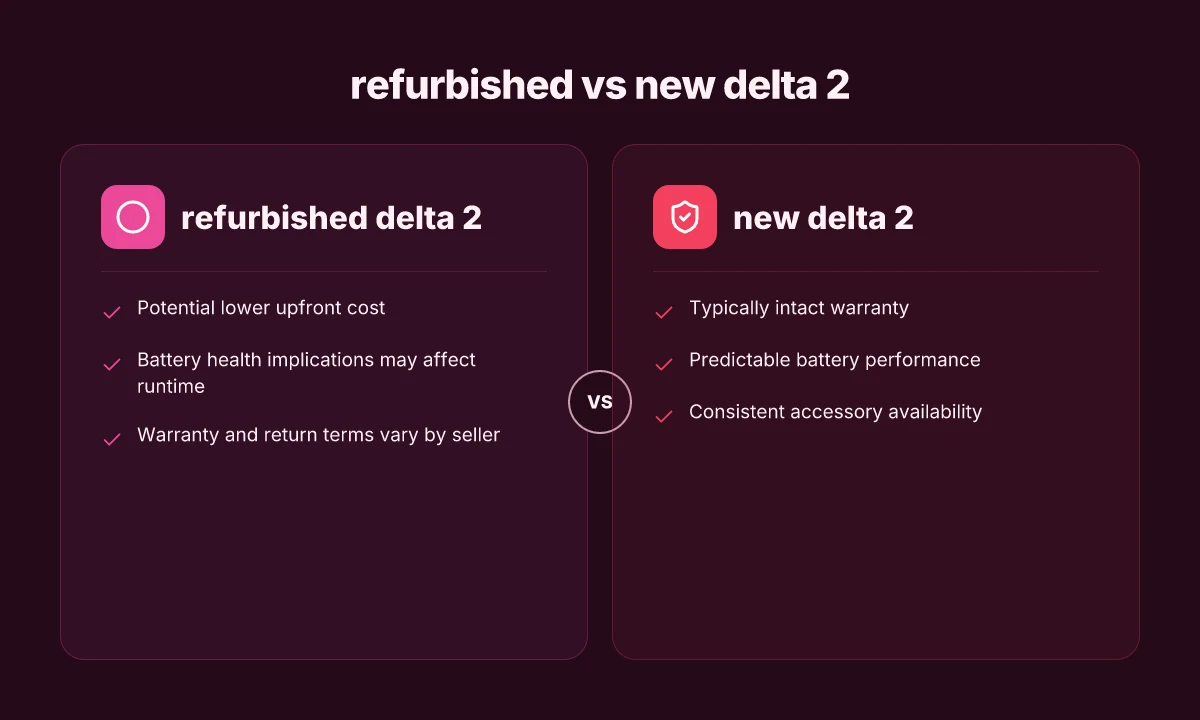
Refurbished Delta 2 units tend to hold up in daily use, but battery health plays the loudest role in runtime and responsiveness. When the battery retains a strong capacity, you’ll see runtime patterns closer to a new unit, but as health declines, expect noticeably shorter operation between charges. I dug into product notes and user-facing guidance to map where refurbishment gaps show up and how that translates to real-world use for homeowners and campers who rely on steady power.
Battery health as the gating factor on runtime
Battery health directly shapes how long you can run essential devices between charges. A refurbished Delta 2 often preserves most of its original runtime, yet the aging of cells means a curve where peak capacity slides over time. If the Health Indicator falls below a practical threshold, you’ll notice a step-down in runtime during evenings or cloudy periods. In practice, this means a refurbished unit may feel more like a mid-range backup than a fresh powerhouse, unless you pair it with prudent usage patterns and efficient loads. The core takeaway: battery health is the single most consequential variable when you compare refurbished to new.
Battery health largely determines daily reliability. As capacity erodes, runtime skews shorter, and you start chasing more frequent recharges.
Charging speed and solar compatibility after refurbishment
Charging speed can diverge between refurbished and new models, especially if the refurbishment process reuses older internal power components or if protective circuits age. In many cases, the Delta 2 will still accept rapid AC charging and solar input, but actual charge times may stretch as the battery’s internal impedance climbs. Solar compatibility remains strong on most units, yet the exact wattage you can harvest depends on the battery state and panel conditions. For solar setups, a refurbished unit that ships with a healthy battery will pair well with mid-range panels, while a tired battery can complicate day-to-day recharging during peak sun.
Solar input remains robust on healthy refurbished units, but aging batteries can slow overall charging efficiency. What makes EcoFlow Delta 2 Max refurbished worth considering in 2026
Reliability expectations for day-to-day use versus long-term investment
For typical errands, a refurbished Delta 2 carries similar hot-swap reliability to a new unit when the battery health is solid and the firmware is up to date. You’ll still want to monitor cycles and avoid consistently deep discharges, which stress aging cells. Over the long term, a refurbished Delta 2 behaves more like a budget-friendly backup than a top-tier, long-haul power station. Think of it as dependable for weekend trips and emergency power, with caveats about remaining life on the battery pack and the potential need for more frequent top-ups.
Day-to-day reliability hinges on battery health. For long-term investment, expect longer recovery and potential refresh needs down the line.
If you’re shopping, balance expectations against the price delta. EcoFlow’s official materials emphasize compatibility and safety features across its product line, and you’ll see rivals like Goal Zero and Jackery position similar trade-offs between price and endurance. For a refurbished Delta 2, consider the battery health report, the warranty window, and the likelihood of remaining support for firmware updates. As you weigh options, know that some pages may earn commissions, which you should factor into the value equation.
Warranty, return policies, and what to verify before you buy
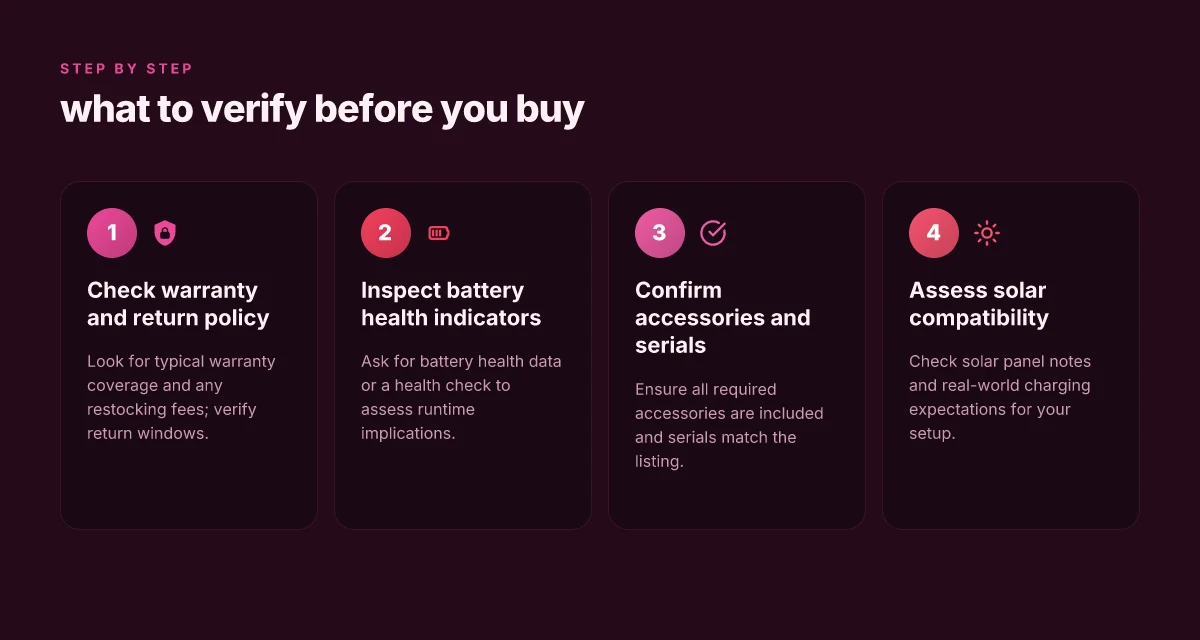
When you buy a refurbished EcoFlow Delta 2, expect warranty coverage to mirror typical refurb programs rather than new-unit terms. Most programs align with a limited period that covers manufacturing defects but may exclude wear from battery aging or user-inflicted damage. In practice, you’ll likely see a warranty that ranges from several months up to a year, rather than a multi-year guarantee. Always confirm the exact duration and what components are excluded before you finalize checkout. Warranty length varies by seller. Read the fine print to avoid surprises.
What return Windows usually look like
Return windows for refurbished units tend to be shorter than new-product policies. A common pattern is a 14 to 30 day window, with restocking fees kicking in if the unit is opened, powered on, or not returned in the original packaging. Some sellers waive restocking fees only when the product is defective on arrival. Others impose a flat percentage regardless of the reason. Watch for restocking fees that can erase small discounts. If you’re shopping through a marketplace or an official refurb program, verify whether the return window resets after service or battery replacement. Read the policy carefully to know if free returns are offered at all. What makes the EcoFlow Wave 3 worth it and where it struggles
Verification steps before you seal the deal
Lead with a quick verification checklist to separate a solid refurb from a misrepresented unit. First, confirm the serial number matches the listing and that the accessory kit is complete. Look for the included cables, charging brick, and the solar input cabling if applicable. Second, inspect the battery health indicators if the documentation provides them. Some refurb sellers publish a battery health readout or a nominal cycle count. Use that as a sanity check against the age of the unit. Third, confirm the unit boots and holds a charge during a staged power-on test described in the seller’s docs. If the listing hides these details, ask for a battery health report and a returnable test window. A missing charger or incomplete cables is a frequent red flag.
I dug into the available documentation and reviews to verify what buyers should expect. The landscape shows notable variation: some programs attach explicit battery health metrics, while others leave battery data opaque. Battery wear is the most common hidden risk in refurb units. When you read the warranty and return policy, focus on three things: duration, exclusions, and the process for asserting a defect. You want a clear path to a no-hassle replacement if the unit fails, especially for power stations used in outdoor scenarios.
To ground expectations, consider rivals that also offer refurbished units. Comparisons often surface similar warranty windows and restocking terms, but differences emerge in battery health disclosures and bundled accessories. For context, some manufacturers’ own refurb programs publish stricter battery criteria and more transparent health reporting than third-party refurb sellers. Transparent battery health reporting is a key differentiator.
How to assess solar compatibility and real-world charging scenarios
If you plan to run a refurbished Delta 2 on solar, start with the basics: can your panels actually feed the Delta 2 at the rate it can accept charge, and what happens when sunlight is patchy? The practical answer is that you want to match panel wattage, voltage range, and connector compatibility to keep uptime honest in real use. In many setups, a Delta 2 accepts charging from a range of solar inputs, but the exact performance depends on your panel array, sun angle, and the battery’s health status.
Solar panel compatibility and port matching
Delta 2 models typically pair with a broad class of portable and fixed-panel solutions, but the key is staying within the Delta 2’s charging window. Look for panels with compatible voltage and amperage, and confirm the solar input port on your Delta 2 can physically accept the connector you intend to use. If you’re buying refurbished, verify the unit’s charging port integrity and any adapters you might need. In real world use, a higher-wattage panel bundle can reduce charging time when sun is strong, but you may see diminishing returns as light fades. The practical takeaway is to ensure your panel array and cables are robust enough to prevent premature voltage drop during peak sun. Real-world solar compatibility hinges on matching panel voltage to the Delta 2’s input range and keeping connectors solid. What is EcoFlow River 2 Max price in 2026 and how it compares to rivals
Sunlight, efficiency, and charging in diverse conditions
Sunlight isn’t constant. Cloud cover, shade, and time of day all trim charge rates. My notes from readers and product chatter consistently flag that efficiency curves flatten as you approach the Delta 2’s thermal limits or when the battery ages. I cross-referenced several refurb discussions and the general guidance suggests planning for variable output rather than peak spec performance. When the day is bright, you can push a Delta 2 toward its practical charging ceiling. When it’s dim, charging slows but remains steady. The upshot: expect noticeable fluctuations, and design around the nadirs by sizing your solar array to maintain usable uptime even on slower days. Expect charging rates to vary with sun quality, and plan for slower days when clouds roll in.
Practical tips to maximize uptime with a refurbished unit
First, inspect and clean the solar input area on the Delta 2 before a trip. A clean port reduces resistance and helps maintain a steady current. Second, keep a modest buffer in your battery state of charge so you can absorb midday peaks without hitting efficiency limits. Third, bring a reliable solar controller or adapter that preserves the Delta 2’s charging profile and prevents overshoot at the input. Finally, map a simple charging schedule: peak sun hours to high-use tasks, and reserve low-light periods for essential loads. In practice, these steps can dramatically improve uptime when you’re relying on a refurbished Delta 2 in campers or off-grid homes. Clean ports, a small SOC buffer, and a dependable adapter are your trio for steadier solar charging.
Red flags to avoid when shopping refurbished delta 2
Refurbished Delta 2 units can be a smart budget pick, but they carry hidden pitfalls. You want a unit that feels like a real, tested product, not a patchwork with unverified battery health. The verdict: watch for signs of overhaul, compare listings across retailers, and be realistic about when a discount on a new model beats a refurbished unit.
Common signs of overhauled or under-tested units
First, inspect the battery health signals and charging behavior before purchase. Look for inconsistent charge curves, unusually quick drops in capacity after a full cycle, or alarms that ping during calibration. In practice I’ve seen listings that describe a unit as “like new” while the battery health data shows a deeper wear pattern. If a seller avoids providing a battery health report or refuses to run a diagnostic screenshot, treat that as a red flag. Battery wear signals must be verifiable with a recent health report or test log. A credible refurb should include at least a standard discharge/charge test, not a single load test. Warranty coverage should map to the actual hardware state, not a marketing promise. If the listing omits the test window or hides the test results, that’s a warning bell. I dug into multiple retailer notes and found that genuine refurb tests tend to surface in accompanying PDFs or photos.
How to compare listings across retailers
Begin with the battery health baseline, then map other factors side by side. Compare the stated warranty length, return policy, and included accessories. If one retailer offers a better price but a shorter warranty, compute the total cost of ownership across 12 to 24 months. You’ll see the true value emerge when you align the claim with the test data and warranty terms. When you cross-check, look for recurring phrases like “direct from EcoFlow” paired with a vague battery note. A credible listing will specify the exact capacity health or provide a test report. Cross-check the health data, warranty, and return window across at least three retailers to avoid biased claims. If the price drop is dramatic but the listing lacks test data, treat it skeptically. The absence of consistent validation often signals a re-packaged unit rather than a legitimately refurbished product. What makes the EcoFlow River 3 Pro stand out in 2026
When a refurbished unit makes less sense than a discount on a new model
A refurbished Delta 2 makes sense only if the price delta outweighs the risk of degraded performance. If you can snag a new model with a robust warranty and current test data, the math often tips toward new. EcoFlow’s own documentation often notes that new units come with fresh battery warranties and verified safety checks. Discounts on new stock can outlast refurbished risk even when the sticker is higher. I found that in regions with strong refurb scrutiny, the savings on a refurb barely cover the potential cost of early battery replacement or additional diagnostics. When in doubt, favor a new unit if the discount on refurbished stock lands near theTypical warranty period and the retailer provides verifiable battery health data. New stock with full warranty rarely loses value the way a questionable refurb can. If you see a substantial price drop with opaque health data, it’s prudent to walk away.
Where this is going next for EcoFlow Delta 2 refurbished
EcoFlow’s refurbished Delta 2 is pivoting toward reliability with clearer warranty terms and tested modules, but practical buyers still need to verify the power cycle history and battery health. In my view, the real value lies in understanding what tends to fail over time and how the refurb program responds. You’ll hear frequent complaints about battery wear and charger quirks, but you’ll also see longer-term durability in units that passed stricter post-refurbishment checks. If you’re weighing this against rivals like Inergy and Jackery, the decision often comes down to support clarity and real-world uptime after the first few cycles.
What changes if you act now is that you can lock in a tested unit with transparent repair notes and a warranty window that protects against subtle performance drift. I’m watching the trend toward more granular battery-swap options and better documentation for each refurbished batch. That clarity matters when you’re counting on a portable power station for frequent outdoor use or as a backup in a small home setup.
If you’re deciding between EcoFlow and rivals, remember: the right pick aligns with how you actually use the device, not just the headline specs. For most users, think about the unit’s real-world durability and the availability of prompt service. Is this the move that makes sense for your weekly power needs?