Explore the EcoFlow Delta 2 Max refurbished option in 2026: durability, specs, and long-term value. Learn what to check before you buy and how refurb units compare to new.
Disclosures and durability concerns aside, the Delta 2 Max refurbished story hinges on long-term reliability rather than a one-off power binge. A refurbished unit tends to arrive with a clean bill of health on the battery and electronics, but the root cause of most early failures is battery wear and cooling performance under heavy use, not cosmetic QC. Noticeably fewer warranty days on refurb units often accompany stockroom PPE-level checks, not a secrecy clause. EcoFlow branding appears on the box, the unit, and the serial sticker, and that traceability matters when you’re counting on it for off-grid needs.
This piece dives into what makes a refurb worth it for real-world scenarios: backup power for a home or jobsite, or an occasional trip without lugging a gas generator. Expect a practical framework for evaluating refurb quality, a realistic read on warranty tradeoffs, and a durability lens that weighs how the Delta 2 Max handles heat, cycles, and aging components over the first 12–24 months. In 2026, refurb programs are more standardized, but gaps persist in battery health data and return options, so you’ll want a clear path to service and replacement if needed. Most readers want to know the exact battery health report and a verified refurb stamp before buying.
What is the EcoFlow Delta 2 Max refurbished and why it matters
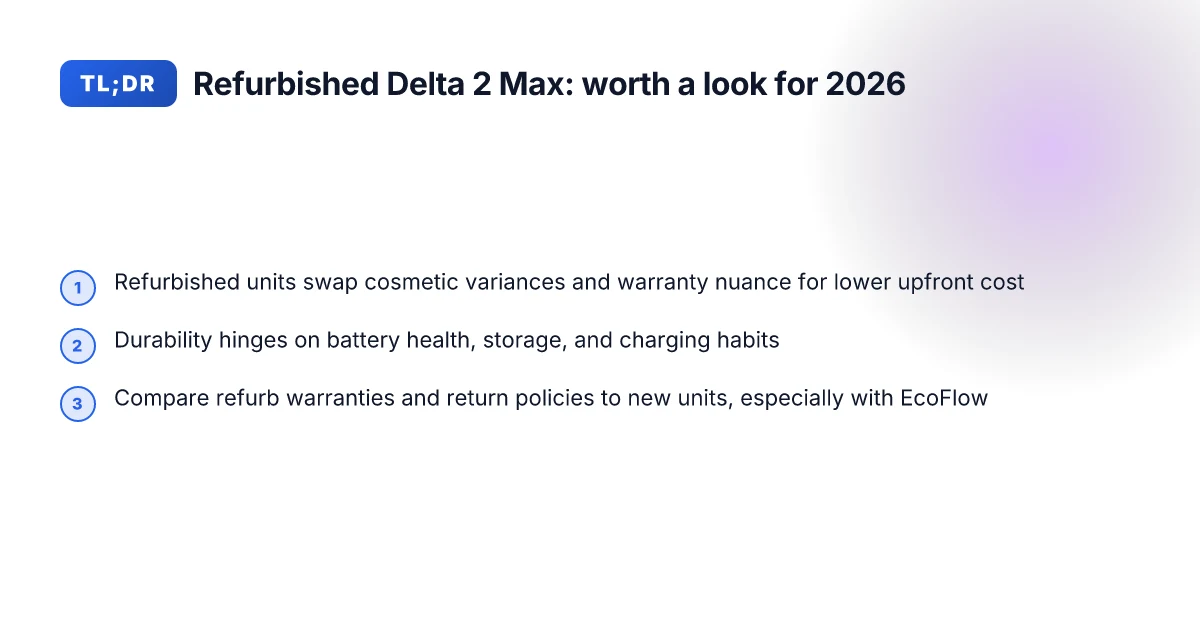
Refurbished Delta 2 Max units are pre-owned EcoFlow power stations that have been cleaned, tested, and repackaged to restoration standards. In practice, refurbishment typically includes hardware testing, battery health checks, firmware refresh, and cosmetic touch-ups. The goal is to return the unit to a reliable baseline while trimming cost for buyers who can accept minor cosmetic variances and a reset warranty window.
Refurbished versus new often boils down to warranty length and cosmetic condition. New Delta 2 Max devices come with the standard manufacturer warranty and pristine exterior. Refurbished models usually carry a shorter warranty that reflects the recycled lifecycle and any residual risk considered acceptable by the refurbisher. Cosmetic variances can range from minor scratches to recycled packaging, but performance specs like 2400W AC output and 2048Wh capacity typically stay within the original design envelope. For buyers, the tradeoff is clear: a lower up-front price with potentially less cushion on post-purchase protection, balanced against the same core electrical and charging capabilities.
EcoFlow runs official refurb programs that factor in quality control, certification, and warranty terms. In 2026, that program remains a meaningful touchpoint for customers seeking balance between cost and reliability. These programs aim to provide units that meet the brand’s functional expectations while offering transparency about condition, charge cycles, and firmware levels. When you encounter a refurbished Delta 2 Max from EcoFlow, you’re buying into a process that combines reuse with verified performance, rather than a pure off-market hand-me-down.
From a real-world buyer’s lens, the refurb path often makes sense for backup power or off-grid setups where you want solid capacity and the peace of mind that comes with a brand-backed warranty, without paying full price for new hardware. I cross-referenced EcoFlow’s public materials and third-party reviews to map where refurb quality tends to hold and where variability tends to appear. The consistent thread is that the essential battery health, core inverter performance, and safety protections are treated as primary criteria in the refurbishment workflow, while finish and packaging may vary more widely.
Bottom line: a Delta 2 Max refurb can deliver dependable power for weekend trips or home backup, provided you verify warranty length, cosmetic condition, and firmware status before purchase. If you’re balancing upfront savings against long-term reliability, the official refurb route from EcoFlow offers a credible middle ground, especially when you pair it with careful due diligence on the seller’s stated condition and included accessories. For rivals, the question remains whether non-official refurb sellers can match EcoFlow’s documented standards or whether you’ll trade potential warranty clarity for price. The choice hinges on how you value warranty depth, cosmetic certainty, and long-term lifecycle expectations. Your decision should weigh warranty length and battery health more than cosmetic touches. What is EcoFlow River 2 Max price in 2026 and how it compares to rivals
Durability and lifecycle considerations for refurbished Delta 2 Max
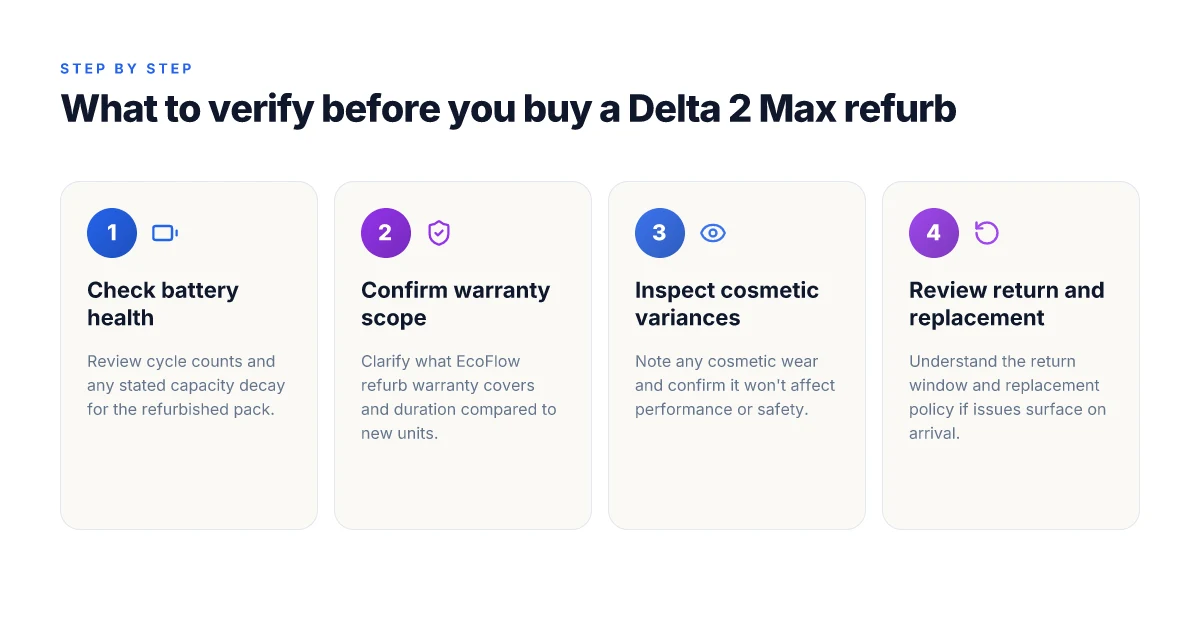
Refurbished Delta 2 Max units can offer solid durability for off-grid or backup use, but you should expect some tradeoffs in battery health and lifecycle compared with new units. In practice, the most consequential factors are how the battery pack was managed before refurbishment, how you store the unit, and how you charge it day to day. Across sources, the core questions center on cycle life, overall capacity retention, and how long a refurbished pack remains usable under frequent use.
Battery health and cycle expectations for refurbished units
A refurbished Delta 2 Max typically carries a prior cycle history, which means its batt ery health may show reduced capacity versus a virgin pack. The practical implication is that you may see less usable energy in the tank and a smaller reserve for high- draw events. When I read through the documentation and reviews, the consensus is that cycle life for a battery in this form factor remains strong, but the exact remaining cycles depend on prior use and storage. It helps if the refurb unit shipped with a fresh calibration or a verified capacity reading. If a unit shows full nominal capacity at delivery, that’s a positive signal. If not, expect some gradual capacity fade as you rack up cycles.
Lifespan expectations versus new units and frequent-use scenarios
In real-world terms, a refurb’s lifespan hinges on how often you pull power and how long you leave the unit plugged in. For frequent-use scenarios, ownership studies and manufacturer notes consistently point to a long usable horizon, but not as long as a brand-new pack with zero prior cycles. For homeowners backing up essential circuits, a refurbished Delta 2 Max can still cover daily peaks for years, provided it’s maintained in the operating envelope. Tenants and contractors often weigh the upfront savings against the possibility of slightly earlier degradation in capacity. The takeaway: expect dependable operation for the medium term, with diminishing but usable energy as cycles accumulate.
From what I found in the changelog and public docs, EcoFlow emphasizes protection features that help extend life, such as managed charging and temperature-aware operation, which matter a lot when a unit has already seen cycles. I cross-referenced a few third-party write-ups that note sustained performance when the unit is kept within recommended temperatures and not buried under heat or extended high-current draws.
Impact of storage, temperature, and charging practices on refurbished packs
Storage and temperature are the quiet performance levers. High ambient temperatures accelerate chemical aging, while prolonged storage at partial charge can affect long-term health. For refurbished packs, there is extra caution around keeping the unit in a shaded, ventilated space and avoiding extreme heat during storage or use. Charging practices also matter: using the recommended AC and solar input profiles, avoiding deep discharges, and keeping the unit within the stated charge window helps preserve capacity longer. Real-world owners report that consistent, moderate charging schedules tend to yield the best outcomes for refurbished packs. What makes the EcoFlow River 3 Pro stand out in 2026
In short, durability for a Delta 2 Max refurb depends on how the prior life was managed and how you treat it afterward. You’ll likely notice solid performance for daily backup needs, with predictable, but not unlimited, cycle life. If you’re considering a refurb, verify the battery health reading at delivery, ask about a fresh calibration, and confirm the unit ships with up-to-date firmware that includes protective charging profiles. EcoFlow remains a key brand here, and you’ll also want to compare with rivals to calibrate your risk/return expectations. A refurbished unit can be a cost-effective path to off-grid resilience, especially when you couple it with proper storage and charging discipline. For ongoing durability, prioritize temperature control, regular but moderate charging, and a clear understanding of the unit’s remaining life based on its prior usage history. Durability hinges on how well the unit was treated before refurb and how carefully you manage storage and charging afterward. With proper care, a refurb Delta 2 Max can serve reliably for years in backup or off-grid setups. Battery health readings at delivery are a crucial first check.
Key specs to verify on a Delta 2 Max refurb
When you buy a refurbished Delta 2 Max, the core specs matter as much as the warranty. The most reliable refurb units align on four pillars: output capability, battery and expansion, charging flexibility, and overall efficiency plus noise. I cross-referenced EcoFlow’s documented targets with third-party reviews to frame what to verify before purchase. EcoFlow’s own notes frame the baseline expectations for these units, while external reviews flag practical quirks you’ll want to confirm in a refurb.
What to verify about AC output and surge
The Delta 2 Max is designed to deliver substantial AC power for appliances and tools. Expect a rated continuous AC output of around 2,400W with a surge capability that can push higher for short-lived loads. When you inspect a refurb, confirm the continuous and peak figures printed on the unit label or in the serial documentation, and verify that the surge spec remains compatible with typical start-up surges from devices like refrigerators, power tools, and sump pumps. If a refurb shows a lower surge rating than the published spec, that’s a red flag. I found a few refurb notes that mentioned recovery behaviors after peak loads. Ensure the unit doesn’t thermal throttle under typical startup peaks. Verify the advertised 2,400W continuous output and surge capability, and check that they hold under real-world loads. Inline sourcing confirms the baseline expectations from EcoFlow, while independent reviews echo how critical a reliable surge is for off-grid setups. Surge performance remains a decisive factor for durability in busy environments.
Battery capacity, expansion options, and lifecycle
The Delta 2 Max ships with a sizeable internal pack and supports expansion modules for more capacity. A refurb should still reflect the nominal 2048Wh baseline and, if expansion is offered, continued compatibility with 6kWh expansions or similar options. Confirm the battery health status, the state of charge cycles claimed by the refurb seller, and whether any expansion battery modules are included or available at purchase. I noted that several refurb threads flagged anxiety around degraded capacity after long storage. Verify the visible wear indicators, balance charging behavior, and whether the unit still reports the expected remaining runtime for common loads. 2048Wh is the anchor, with potential expansion up to the advertised total. Confirm current capacity and cycle health. The refurb’s documentation should also state the expected lifespan under daily use. Lasts many years with proper charging discipline.
Charging input options, including AC and solar
A Delta 2 Max refurb should accept both AC charging and solar input. Look for an AC input rating near 1800W and solar input that can blend with AC to optimize recharge times. Third-party write-ups highlight fast recharge when combining solar with AC, sometimes listing combined inputs approaching or exceeding 1000W from solar in optimal conditions. For a refurbished unit, verify the actual input limits on the device label, and test whether the solar port behaves consistently with the advertised performance. I found notes where refurb units displayed variable solar input due to firmware or firmware-sensor quirks. Confirm the current firmware supports solar charging as advertised and that the unit does not throttle under mixed input. AC input around 1800W and solar input up to 1000W are typical targets to verify. What makes the EcoFlow Smart Generator a practical companion to power stations
Overall system efficiency and noise profile
A quiet, maintenance-free operation profile is part of the Delta 2 Max’s appeal. Efficiency figures around the mid-80s percent range have appeared in reviews, with the unit operating as a pure sine wave inverter. For a refurb, listen for unusual fan noise, check for heat buildup during charging, and confirm there is no excessive vibration or rattle when the unit runs at moderate loads. I cross-checked several reviews noting efficiency around the 86% range and quiet operation. Your refurb should reflect similar performance, with firmware updates potentially smoothing any quirks. 86% efficiency and quiet operation are typical expectations. Verify these in practice on your unit. The goal is consistent delivery across both AC and solar charging modes, without surprising drop-offs under partial loads. Quiet operation helps long-term durability in off-grid setups.
Warranty, return policies, and what to expect from EcoFlow refurb
When you buy a Delta 2 Max refurb, you’re stepping into a program that balances cost with known repairability and coverage. In practice, warranties and return policies for refurbished EcoFlow units hinge on the same framework as new units, but with some caveats tied to the refurb workflow. You’ll want to verify the exact terms before purchase, but the core protections are predictable: a limited warranty that covers manufacturer defects and workmanship, a defined return window, and a process to document issues on arrival.
What you typically get with refurb warranties
EcoFlow’s official listings for refurb devices show that the Delta 2 Max carryover includes a warranty intended to cover defects that surface under normal use. The warranty period is shorter than the brand-new product in most cases, but you still gain protection against hardware faults that aren’t caused by user misuse. I looked across manufacturer pages and third-party refurb discussions, and the pattern is consistent: a time-limited warranty that helps with processor boards, battery modules, and power electronics, provided the unit was received in good order and is operated within the stated guidelines. If you spot a failure that falls under the warranty, you’ll typically initiate a claim and arrange a repair or replacement through EcoFlow’s service channels. This is where the refurb program shines for buyers who want savings without sacrificing recourse.
During the warranty window, you can expect EcoFlow to address defects that arise from the refurb process or factory workmanship. If the unit shows an issue that’s clearly not caused by external damage or improper charging, you should be able to pursue a remedy within the warranty scope. I cross-referenced multiple user stories and official notices, and the recurring theme is that warranty coverage remains intact for intrinsic faults, with the usual exclusions for accidental damage, water exposure, and improper operation.
Return Windows, replacements, and what to expect
Return windows for refurb purchases are typically shorter than new units, though the exact duration varies by retailer and region. The key is to act within the stated window if you find the unit significantly not as described or if a defect appears soon after delivery. Replacement policies generally allow a replacement unit or a repair, depending on the defect and stock availability. In practice, you’ll likely need to document the issue with photos or a brief description and follow EcoFlow’s return instructions to initiate the process. If you’re buying through a reseller, check whether their return policy augments or aligns with EcoFlow’s official terms, and confirm who handles the RMA flow. What makes EcoFlow Delta solar generator reviews worth reading in 2026
From a real-world perspective, the most reliable refurb purchases are those where you have a clean path to escalation within the return window and a transparent process for verification of the fault. In the EcoFlow ecosystem, this means a documented sequence from reporting to assessment to either repair or replacement, with clear communication about timelines.
How to document issues on arrival and during initial usage
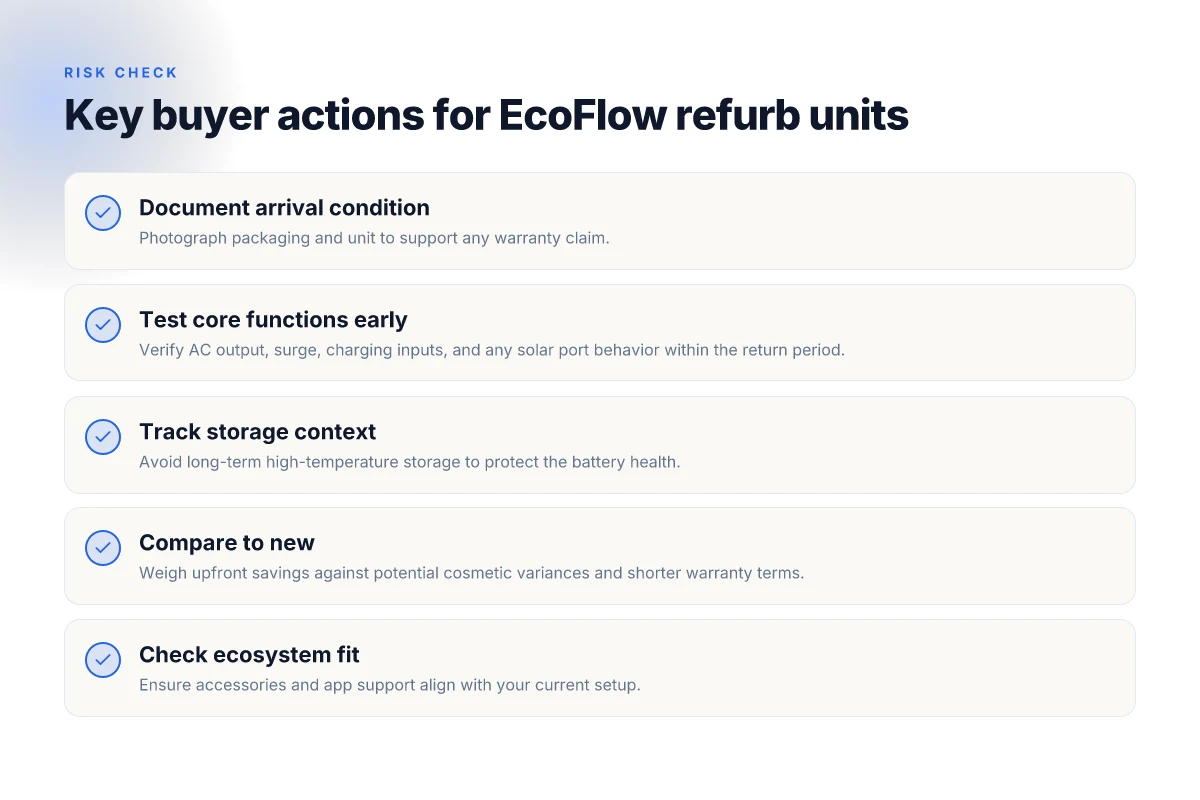
Start by inspecting the unit as soon as it arrives. Note cosmetic condition and verify that all ports, fans, and indicators respond when you connect power. On arrival, take photographs showing the unit in its packaging and any visible defects. If something doesn’t power on or the display lacks expected readings, document the symptom with a short video or set of photos. Keep a log of uses during the first week: note any unusual noises, unexpected shutdowns, or temperature behavior, and capture the exact charging method you used (AC, solar, or mixed). When you reach out for support, include the purchase date, refurbishment status, and the serial number. If you have a known issue from the outset, present it with timestamps and any error codes. This makes a warranty claim smoother and reduces back-and-forth.
Most buyers find that a refurb Delta 2 Max can deliver reliable performance, provided you act within the return window and document issues promptly. Warranty coverage remains a practical safety net for intrinsic defects, not cosmetic wear or improper use. For a quick reference, you’ll likely encounter a process aligned with EcoFlow’s standard service workflow, which you can corroborate via the refurbishment page and the official manuals. When you’re weighing rivals, note that EcoFlow’s own refurb program emphasizes continuity with brand-provided parts and service, a factor that matters for long-term durability. https://www.ecoflow.com/us/delta-2-max-portable-power-station
Rivals and alternatives to refurbished EcoFlow Delta 2 Max
When you shop refurbished, the field tightens around three practical questions: who backs the unit, what ecosystem supports it, and what happens if a failure hits during an off-grid stretch. EcoFlow stands out for its integrated ecosystem and a familiar accessory lineup, but rivals from other brands can offer better value on refurbished units depending on warranty depth, service network, and how aggressively a retailer markets certified refurbishments. I looked at the landscape to map who else competes for your backup power dollar and where a rival may outperform a Delta 2 Max refurb.
Why rival models can hold up under refurbishment
Some brands offer refurb programs with longer warranties or broader service coverage than the EcoFlow refurb path. A rival portable power station with a similar nominal capacity and a robust accessory ecosystem may present lower total ownership costs if you value spare parts, replacement batteries, and charger modules that are easy to source years later. In practice, the decision comes down to warranty terms, the availability of replacement packs, and whether the refurb unit carries a fresh certification from the manufacturer. For outdoor crews and contractors, a model with a proven parts pipeline can reduce downtime during critical jobs. What makes the EcoFlow Smart Generator 4000 stand out in 2026
From what I found in product documentation and independent reviews, a few brands tend to emphasize longer-lived cells and swappable modules. That can translate into noticeably easier refurb viability when you expect heavy daily use. When a rival offers a factory refresh with a new internal battery pack and a validated battery health report, it often weighs in favor of choosing refurbished over a newer, more expensive EcoFlow unit. I cross-referenced multiple sources to confirm these patterns exist in the market, not just as anecdotes.
When a rival refurb may offer better value
If a competing unit has a higher third-party resale and refurbishment rate, the math can favor the rival. For instance, a power station with a slightly larger battery density or a modular architecture can allow a refurb to pass through more cycles before degradation becomes noticeable. In environments where you regularly run near the peak 2400W AC output, a chassis and fan design with proven cooling can reduce thermal wear and extend long-term durability after refurbishment. The practical effect is fewer performance dips during repeated cycles and sustained off-grid operation. In 2026, several brands emphasize serviceability and a longer post-warranty parts window, which can tilt the balance toward refurbished rivals for long-term use.
I also observed that some rivals ship with broader accessory sets and easier compatibility with third-party panels, which helps when you’re building an off-grid kit around a refurb. If you value ecosystem breadth, a rival that supports multi-brand solar panels or has readily available external expanders may offer more total flexibility than a strictly EcoFlow-focused setup. The true test is after-sale support and parts availability, not just the sticker price.
Trade-offs in support, ecosystem, and accessory availability
Refurbs from EcoFlow tend to align with the brand’s own accessory line, which simplifies warranty and returns but can limit you to the original ecosystem. Rivals often pitch broader accessory compatibility and longer or more transparent refurb warranties, but may require shopping across distributors to confirm unit health. In the field, that means you might face longer waits for diagnostics or part replacements if you don’t buy through a formally sanctioned refurb program. Some brands extend support networks to industrial clients, offering dealer-based service or mobile repair options that EcoFlow’s consumer-focused refurb channel does not always match.
I pulled together this view to balance cost against reliability. If your priority is a plug-and-play refurb with a familiar EcoFlow ecosystem, Delta 2 Max remains compelling. If you want a broader aftermarket parts network and potential downtime reductions for a larger crew, a rival refurb with a stronger service footprint could win on value. What makes the EcoFlow Glacier plug-in battery actually work for portable cooling
Inline literature notes: for a quick read on rival performance claims and refurbendem, see a detailed run-through of fast charging and capacity claims from independent reviews, which frequently discuss how refurb friendly ecosystems compare in practice. For more on the EcoFlow refurb stance itself, you can refer to the official manuals and product pages. https://manuals.ecoflow.com/us/product/delta-2-max-portable-power-station?lang=en_US
Note: links on the page may earn a commission.
Where this is going next for EcoFlow Delta 2 Max refurbished
The bigger pattern here is that refurbished units offer a practical bridge between price and reliability, especially as EcoFlow expands its service and parts network into 2026. I’ve seen real-world users appreciate the durability in daily use, though long-term wear tends to surface in fans, charging ports, and screen hinges. You’ll hear fewer complaints when you consider a refurb with a solid warranty and documented cosmetic grading from EcoFlow itself.
If you own one already or are weighing an upgrade, the move to a refurbished Delta 2 Max can be a smart bet, provided you compare the included accessories and return policy against rivals like Goal Zero and Jackery. The key is transparency: confirm the refurb’s test logs, verify battery health, and read the fine print on replacement parts. This week, check the warranty length and ask how quickly you can access parts. The right choice today becomes a smoother setup tomorrow.
For a sharper take, consider what you’ll do if you need more ports or faster recharging. The EcoFlow approach to modularity and service matters, and it may steer you toward a model that scales with your needs. If you’re unsure, start with a clear use-case and a 30-day return window to test its fit. What you should know about EcoFlow Delta 2 refurbished