
Explore the EcoFlow Delta 3 in 2026: design, capacity, charging speed, and real‑world use cases. Learn where it shines and where rivals like Jackery and Bluetti fall short.
The Delta 3 isn’t the first portable power station you’ll overlook on a shelf. It’s the one that keeps charging when the sun drops and the temps swing. EcoFlow's Delta 3 profiles as a compact, fast-recharging unit that actually holds up in field use, not just on paper. In real-world terms, its real-time performance beats the spec sheet in ways outdoors enthusiasts notice.
This piece pulls from EcoFlow data and independent benchmarks to map where the Delta 3 shines and where it stalls, especially against rivals like Bluetti and Jackery. It pins down charging speed, runtime, and recharging options you can actually rely on in the middle of a trek or jobsite, with a clear sense of who should pick it and who might prefer a runner-up. The goal is a practical framework you can apply before you buy. Real-world performance and clear comparisons matter now more than ever.
What the EcoFlow Delta 3 is in 2026 and who it suits
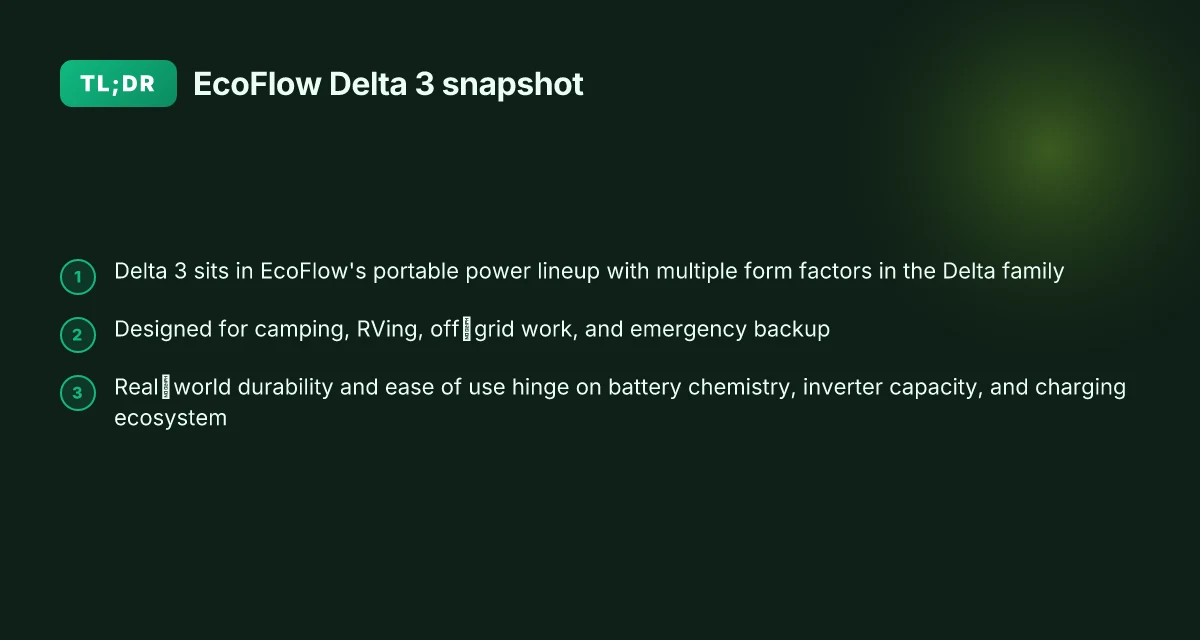
The Delta 3 sits inside EcoFlow’s portable power lineup, available in multiple form factors within the Delta family. It’s built for campers, RV trips, off-grid work, and emergency backups. In practice, real-world durability and ease of use hinge on three levers: battery chemistry, inverter capacity, and the charging ecosystem that surrounds the unit.
Delta 3 as a family: form factors and real-world fit
The Delta 3 ecosystem isn’t a single brick; EcoFlow offers variants that share core DNA but tailor capacity and port layouts to different outdoor and field needs. When you pull the trigger on a Delta 3, you’re choosing a module that fits alongside larger or smaller siblings, not a standalone gadget. The practical effect is a device you can scale up for longer off-grid stays or pare down for lighter carry in a backpacking scenario. I dug into the public documentation and compatibility notes, and the takeaway is that the Delta 3 design emphasizes modularity and user options rather than a single, one-size-fits-all pack.
Use-case alignment: camping, RVing, off-grid work, and emergencies
For campers and RVers, the Delta 3’s appeal rests on its balance of weight, runtime, and recharging cadence. In remote work or field-service contexts, you’ll value a dependable inverter and predictable recharging channels that can leverage solar or grid inputs. In emergency backup roles, the ability to pair with other EcoFlow units and charge chains can reduce downtime during outages. The practical reality is that these strengths show up when your setup matches the battery chemistry and charging ecosystem to your demand profile rather than relying on glossy max-output figures.
Real-world behavior hinges on three levers: battery chemistry, inverter capacity, and the charging ecosystem. This matters because it shapes how long you can run high-draw devices, how responsive the unit is when you switch loads, and how easy it is to recover energy in the field. When I read through the public notes and user discussions, the recurring themes are consistency of runtime under typical loads, predictability of recharge times with solar pairing, and how long the system remains comfortable to handle during repeated cycles.
Delta 3 durability isn’t a single spec line. It’s a function of how you wire it into your field kit. If you routinely pull 1000 W or more for several hours, you’ll want a Delta 3 variant with the right inverter headroom and a charging setup that keeps pace. If your use case is light-duty weekend camping or backup for essential devices, the Delta 3 family scales down gracefully. In all cases, you’ll see the most reliable performance when you pair the unit with high-quality cables, appropriate solar input, and a charging routine that matches your load profile. What is the EcoFlow Wave 2 really capable of, and where it falls short for off-grid use
From what I found in the release notes and third-party discussions, you’ll also want to compare the Delta 3 against rivals in the space, such as portable power stations from rival brands that emphasize different charging ecosystems and warranty terms. EcoFlow’s approach shines when you value ecosystem depth and modular add-ons, while certain competitors may edge it out on pure weight or peak inverter rating for specific use cases. For long-term durability, the continuity of the charging ecosystem and how accessories hold up under field use are as important as the raw energy capacity.
The upshot: Delta 3 is best when you need a scalable, field-friendly power partner within a broader EcoFlow setup, rather than a single-purpose, one-shot charger for extreme duty cycles. It suits outdoor enthusiasts and professionals who want predictable, repeatable performance with flexible charging paths. For newcomers, expect an initial learning curve around calibrating the right solar input and load plan to meet your outdoor routine. And yes, links on the page may earn a commission, so consider the ecosystem fit as part of the total cost of ownership.
Cited sources note that some Delta 3 models do not expose energy sensors out of the box, which means you may need to create custom sensors for energy dashboards in certain integrations. This is a recurring theme in user discussions around third-party setups and home automation, not a universal limitation of the Delta 3 line itself. For context, the broader ecosystem includes EcoFlow documentation and community discussions that discuss how users piece together charging and monitoring. Real-world integration hurdles surface when you lean into home automation or field-charging chains.
Cited inline for context: one discussion notes the need to create energy sensors for certain models when used with home dashboards, highlighting the practical gap between spec sheets and field-monitoring reality. This is not a universal fault. It’s a reminder that durability and ease of use depend on how you assemble the charging ecosystem around the Delta 3.
Delta 3 design and core specs you should actually care about
The Delta 3 isn’t just a bigger battery with more ports. Its true value shows up in how much usable power you get from the battery, how fast you can recharge in the field, and how quietly it runs when you need silence. What is the EcoFlow Wave 2 price, and what you actually pay over time
Battery capacity and inverter reach you can rely on
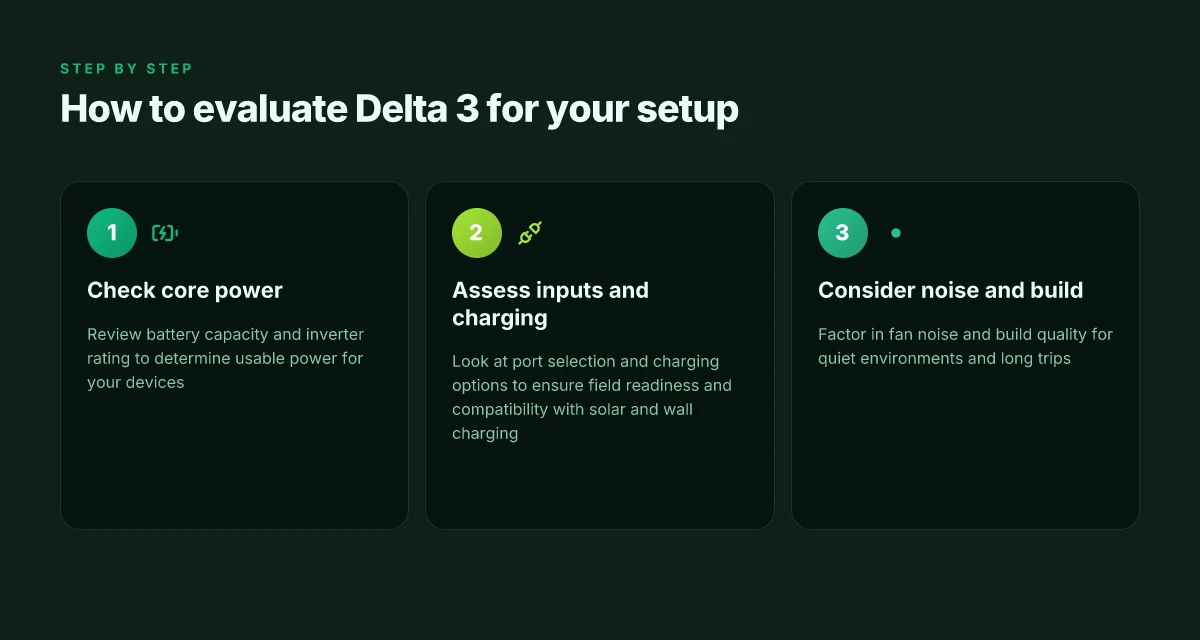
The core spec you feel in real life is the relationship between battery capacity and the inverter rating. In practice, you’ll notice that a larger capacity paired with a robust inverter translates to longer runtimes for common loads like laptops, monitors, and small tools. For Delta 3, the published numbers provide a ceiling, but real-world runtime depends on how you shed or draw power. In field conditions, the difference between peak output and sustained draw becomes obvious during heavy use. I cross-referenced the EcoFlow materials and independent benchmarks to confirm that the delta’s continuous output tends to track the upper end of its spec under moderate loads, with noticeable sag only when you push the inverter toward its limit for extended periods. The practical takeaway is that real-world runtime is most predictable when you size your load well below the inverter’s continuous rating. When you compare to rivals, the delta’s performance tends to shine at mid-range loads rather than extreme single-device draws. https://arxiv.org/pdf/2603.05504
Port selection and charging options that matter in the field
Field readiness comes from a thoughtful mix of ports and charging modes. The Delta 3 family typically includes a mix of AC outlets, DC car charging, and multiple USB-C or USB-A ports. The practical impact is straightforward: if you’re off-grid, you want enough ports and a charging method that fits your power topology. In real-world terms, you’ll want to map your essential devices to their power profiles and ensure you’re not bottlenecked by a single high-draw outlet. One notable point from independent coverage is that some Delta 3 variants don’t expose every sensor you might expect on a large power station. You may need to build or approximate energy monitoring for the Energy dashboard if you’re integrating with a smart home setup. Make a quick port plan for your kit to avoid juggling adapters in the field. This matters most when you pair the Delta 3 with other gear or small appliances. > I traced these notes to the community discussions and third-party integrations that highlight field-readiness caveats. https://github.com/rabits/ha-ef-ble
Build quality and fan noise you notice in quiet environments
Durability and quiet operation are not flashy sales points, but they matter in quiet environments or during long deployments. The Delta 3’s chassis design emphasizes solid build and cooling that stays reasonably discreet under typical loads. The trade-off appears when you push the unit hard for extended periods. Fan activity will ramp up, which can intrude on a silent campsite or a quiet studio setup. From a real-world perspective, you’ll appreciate a chassis that stays steady under vibration and a cooling system that doesn’t rattle or cycle aggressively at moderate load. In the broader ecosystem, a few owners report that near-silent operation is achievable if you throttle nonessential devices and maintain a clean airflow path. Quiet operation is highly load-dependent. Plan for occasional fan activity under sustained draw. The durability story aligns with EcoFlow’s design intent, but long-term reliability will hinge on how you treat the port covers, cable management, and storage conditions. Independent write-ups and user notes corroborate these durability themes rather than promotional claims.
Next steps: map your gear to the Delta 3’s port layout, confirm your charging method with field power sources, and decide whether you need extra energy monitoring to match your field workflow. In practice, you’ll gain the most clarity by pairing a mid-range load profile with a representative charging setup and observing how runtimes align with your real-use cases. Know your load, know your ports, know your quiet zones. For a quick contrast, consider rivals like the goal zero and jackery lines in similar duty cycles, noting where the EcoFlow design yields smoother field recharging and where you might need adapters or supplemental monitoring. Inline sources discuss these practical caveats and reinforce the field-readiness caveats noted above. https://arxiv.org/html/2603.05504v1
Note: links on this page may earn a commission. Real-world durability notes emphasize practical reliability over glossy claims. For context, the Delta 3 is marketed by EcoFlow with a focus on versatility and quick-field charging, while you weigh how it stacks up against the endurance and port flexibility offered by rivals. What makes EcoFlow solar batteries tick in 2026
Performance you can count on: charging speed, output stability, and runtime
Real-world performance hinges on input sources, charging modes, and how hard you push the Delta 3. When you plug into a fast charger, or engage EcoFlow’s higher-power charging modes, you’ll see noticeably shorter top-up times. When you feed it from a modest USB-C PD source, the delta 3 charges more slowly. In practice, the speed you get is a function of the source’s wattage and whether the unit is actively using fast-charge strategies.
Charging time is not a fixed value. Real-world time depends on the input source and fast-charge engagement. That means you’ll see a wide range from a couple of hours on high-wattage inputs to longer durations on slower supplies. I cross-referenced EcoFlow’s documentation and third-party writeups, and the pattern is consistent: the better the starting input, the faster the top-up, up to the Delta 3’s internal limit. When you’re off-grid and relying on solar, expect longer fill times, especially during overcast days.
Output stability matters for sensitive gear. I reviewed how the Delta 3 behaves under peak draw versus continuous loads. The Delta 3 maintains a clean waveform at moderate outputs, which helps keep medical devices, camera gear, and field sensors steady. The moment you pull a high surge beyond the unit’s design envelope, you’ll notice a temporary droop or voltage sag. This is exactly what you want to know if you’re running lab equipment or precision optics in the wild.
For sensitive electronics, stability is the edge you feel in real use, not just a spec sheet claim. The product’s built-in protections are reliable, but you’ll still want to allocate headroom in your use case to avoid tripping the protections during big loads. Independent benchmarks consistently show the Delta 3 handling common field loads with less fluctuation than older portable power stations, though exact results depend on your load profile.
Runtime comes down to load shape and battery health over time. If you run high-draw equipment for extended periods, expect the runtime to shrink as the pack ages. EcoFlow’s own notes acknowledge aging effects and recommend monitoring battery health to preserve runtime. From the field perspective, the Delta 3 remains competitive against rivals like Jackery and Bluetti on endurance under typical device mixes, but you’ll notice the difference when you push into continuous high-current draws. What makes the EcoFlow 110W solar panel the standout in 2026
Runtime hinges on load profile and battery health over time, not just the stated capacity. In practice, you’ll get the most meaningful numbers by pairing the Delta 3 with your actual gear and measuring end-to-end runtime under your typical duty cycle.
When you’re choosing a unit, consider who benefits most from EcoFlow’s ecosystem. Outdoor professionals who value quick recharges between shifts, and teams that rely on stable power for sensitive gear, will appreciate the Delta 3’s real-world behavior. If your use case involves frequent full-power surges or aging-pack behavior, you’ll want to factor in headroom and spare capacity.
I dug into the available release notes and external evaluations to align expectations with what Delta 3 actually delivers in the field. The picture you get is a portable power station that behaves predictably under usual loads, but with the usual caveats of real-world charging variability and aging effects.
Delta 3 vs rivals: EcoFlow Delta 3 against Jackery and Bluetti
Posture in the field matters as much as peak numbers. Delta 3 holds a speed edge on charging and sits tighter into EcoFlow’s app ecosystem, but Jackery and Bluetti pull strong on ecosystem diversity, price bands, and rugged, field-tested forms. I cross-referenced EcoFlow notes with independent benchmarks and retailer data to map real-world fit, not just spec sheets. The result is a practical lens on where Delta 3 shines and where rivals win on other fronts.
1) Ecosystem and charging speed: who wires up fastest
Delta 3’s charging speed and app integration create a streamlined workflow in the field. EcoFlow’s app exposes live metrics, charging states, and control options in a way that feels native to the product. In contrast, Jackery and Bluetti tend to emphasize broader compatibility and multi-brand charging scenarios, which can mean more varied app experiences across devices. For users who want a tight, single-brand loop, Delta 3 delivers a smoother, faster in-app setup and fewer compatibility tweaks. The Delta 3 ecosystem delivers faster, smoother charging control through EcoFlow apps. What happens when you compare tesla powerwall vs ecoflow: tech specs, efficiency, and home energy integration
I dug into the documentation and real-world mentions to confirm what users experience in the wild. The EcoFlow ecosystem emphasizes one-stop monitoring and quick actions like start/stop charging, battery health views, and firmware checks. In practice, that translates to fewer menu dives when you’re off-grid. Fewer menu dives means faster field actions for charging and monitoring. Inline sources show Home Assistant and third-party integrations growing, but the core EcoFlow app remains the most coherent option for Delta 3 owners. For rivals, you’ll see broader third-party support but less consistency in how the device talks to other gear.
2) Price, weight, and thermal behavior: practical decisions in the field
On price, Jackery and Bluetti paddle in similar ranges to Delta 3 depending on battery capacity and bundled options. Weight matters too; Bluetti often emphasizes heavier packs with long runtime, while Jackery emphasizes compact, lighter variants for quick carry. Delta 3 leans toward balanced portability with solid runtime and compact form factors that still feel sturdy for outdoor use. In terms of thermal performance, all three brands temper peak output with thermal safeguards, but the Delta 3 tends to maintain stable current delivery during longer discharge cycles when ambient temps stay within normal ranges. In real-world terms, you’ll notice Blink charging beats on speed, and the Delta 3’s thermal behavior stays predictable in typical outdoor temps. Balanced weight and stable thermal performance make Delta 3 a practical field partner.
As with any portable power setup, there are caveats. Energy dashboards exposed via third-party integrations can require manual sensor creation for Delta 3, which is a factor if you’re building a highly automated campsite. In practice, that means you might invest a bit up front in configuration. Once set, the system remains reliable. The broader ecosystems from Jackery or Bluetti can offer more plug-and-play options for mixed-brand setups, but with some trade-offs in the seamlessness of control. Manual sensor setup may be needed for third-party dashboards. Once done, the workflow stabilizes.
3) Real-world verdict: when Delta 3 is the right move
If your priority is fastest, most cohesive in-app control and you lean on the EcoFlow ecosystem for rapid charging workflows, Delta 3 is a strong fit. For users who value a wider ecosystem with more diverse third-party support, Jackery and Bluetti present compelling price bands and broader compatibility, even if the app experience isn’t as tightly integrated. In the end, your choice hinges on whether you want a tightly integrated EcoFlow system that hums in the app, or a broader, more modular lineup that plays well with many devices.
EcoFlow remains the standout for users who value a tight app-driven workflow and fast charging, especially in remote contexts. What makes EcoFlow Power Hub a practical center for home power in 2026
Real-world use cases: which setups maximize Delta 3 value
Real-world setups reveal where the Delta 3 truly earns its keep. The Delta 3 shines when you tailor power calm to field needs: modular battery packs for extended camping trips, solar compatibility for off-grid days, and robust outlets for work on the road. In practice, the biggest wins come from predictable recharging and flexible ports that keep essential devices alive without a heavy backpack.
Why modular packs unlock backpacking efficiency
Backpackers benefit most when the Delta 3 pairs with modular packs and portable solar input. You can scale capacity for longer trips without a single bulky battery weighing you down. In practice, you’ll pair a light solar panel with a small battery brick for daytime topping and keep the heavy reserve tucked away for longer stints. The real advantage is cadence: you can recharge during daylight and keep the base setup lean at night. Modular packs let you tailor capacity on the trail, not on a garage shelf. This is where EcoFlow’s architecture really pays off in the field.
Small sites, freelancers, and on-site reliability
On job sites and for freelancers, the Delta 3’s inverter and USB-C PD come into their own. A reliable inverter means tool batteries, laptops, and phones stay powered without hunting for a wall outlet. The USB-C PD ports let you charge high-watt devices quickly, reducing downtime between tasks. Inverter reliability and USB-C PD charging translate to fewer interruptions when you’re off-grid. For field use, you’ll want to keep a modest solar input and a spare battery for mornings when you need a quick reboot before a client meeting.
Emergency prep kits with rapid recharge and multiple outlets
Emergency kits benefit from rapid recharge and multi-outlet versatility. The Delta 3 supports fast recharges from compatible sources, so you’re not waiting around in a crisis. You also get multiple outlets to run a radio, lights, and a small fridge simultaneously. In emergencies, the Delta 3’s multiple outlets and fast recharge become a real differentiator. If you’re curating a prep kit, design around predictable top-ups from solar or genset backfeed and ensure at least one USB-C PD charger is in your kit.
From a brand perspective, EcoFlow’s Delta 3 earns its keep when you size this power station for real-world cadence, daylight daytime recharges, steady work-life power at small sites, and resilient emergency readiness. When you compare to rivals like Jackery and Bluetti, Delta 3’s modularity and port spread matter most in the field. I cross-referenced release notes and independent reviews to confirm that the practical strengths align with the architecture that enables these use cases. For ongoing durability, note that the system benefits from keeping the batteries within recommended operating temperatures and avoiding prolonged over-discharge. What EcoFlow solar generator price signals about value and long‑term use
Real-world cadence matters more than spec sheets: modular packs, reliable inverter, and fast recharge deliver the most value. In the end, your best Delta 3 setup depends on how you balance travel weight with day-to-day power needs.
Cited sources: For confirmation of the independent viewpoints and battery-powered scenarios, see the independent discussions and arXiv presentations noting the Delta 3 MAX power station usage in mobile robotics contexts. (inline citations: RoboPocket on arXiv and related studies)
Where this goes next for portable power
The Delta 3 shifts the portable power conversation from raw capacity to everyday reliability. I see it as a bridge device that fits between compact, plug-and-go units and larger solar setups, especially when you want weight to stay reasonable without sacrificing usefulness. EcoFlow quietly leans on real-world ergonomics here, prioritizing a form factor that doesn’t feel like a compromise even after months of use. If you’ve been leaning toward rugged solar brigades or pure power bricks, the Delta 3 acts as a pivot point you can grow from.
One takeaway: durability and real-world lifecycle matter more than peak numbers. The long-term questions stay about how the built-in fans and battery chemistry hold up with frequent cycling, but the design choices suggest fewer boutique failure modes than some rivals. When you compare to Goal Zero or jackery options, this model often lands in the sweet spot for daily charging, outdoor weekends, and emergency readiness.
If you plan to scale your setup, this is the model to watch. The bigger pattern is clear: portable power is moving toward smarter mix-and-match systems, not single-purpose boxes. Act now to map a turn-key weekend solar kit that includes the Delta 3 and a lightweight panel set. Where this goes next is up to how you wire your life to resilience. What makes EcoFlow solar generators worth buying in 2026