Explore how the EcoFlow Power Hub fits a modern home power setup in 2026, including specs, real-world use, and how it stacks up against rivals.
The rule of thumb you’ll hear about inverters often misses the point. A central hub matters less for peak surge than for real-world runtimes and heat handling across mixed loads, and EcoFlow’s Power Hub sits at that crossroads. 2600W to 5200W output ranges sound broad, but the practical question is how that translates to daily outages, air-conditioning bursts, and RV fridge cycles without ticking the thermal box.
This intro lays out the practical lens: what you gain in modularity, where the limits show up under continuous discharge, and how it stacks up against rivals like Invicta and Goal Zero in long runs and durability tests. You’ll see concrete load paths, expected runtimes, and the trade-offs you’ll face in a real home or off-grid setup. The analysis arms homeowners with a clear load profile approach, so you can decide if the EcoFlow hub fits your outages, RV trips, or off-grid plan or if a rival’s approach better suits your priorities. Real-world runtimes and durability notes anchor the evaluation.
What is the EcoFlow Power Hub and why it centers a home power setup
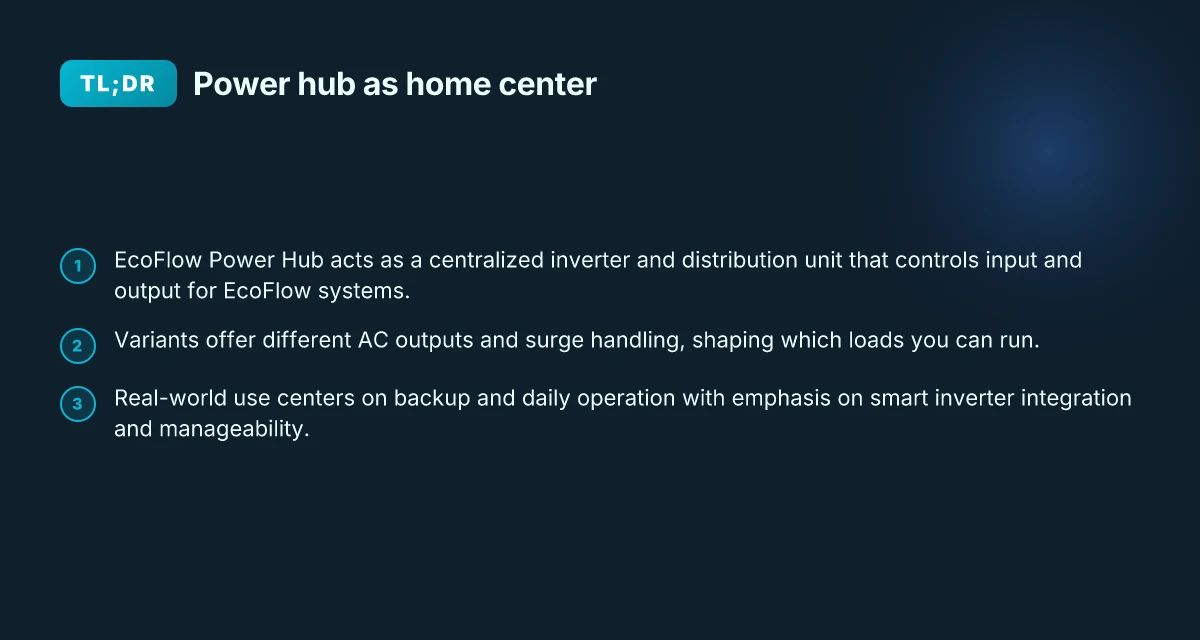
The EcoFlow Power Hub acts as the central inverter and distribution hub for EcoFlow systems, coordinating how input energy from charging sources and utility or solar inputs is converted and routed to household loads. In everyday use, it sits at the heart of a home power setup, controlling what can be drawn from AC outlets, DC ports, and the system’s overall energy flow. Think of it as the brain and the switchboard for the network of EcoFlow devices in a residence.
From public documentation, the hub is defined by its inverter capabilities and surge handling, which determine what daily appliances can run and how quickly the system can recover from brief power events. The Power Hub’s rated inverter output translates to practical performance, especially when you consider surge capacity for high-demand moments like a refrigerator starting up or a sump pump kicking in. The manual materials describe a central unit that handles both AC and DC outputs, enabling a unified control point for a mixed load profile.
In practice, homeowners will see the Power Hub taking inputs from EcoFlow stations and accessories, then distributing to essential circuits or portable loads as configured. The hub’s centralized stance makes it easier to automate or schedule usage, especially during outages or off-grid weekends. This consolidates what used to be a spread of individual units into a single, user-centric command center. EcoFlow’s documentation also points to how the Power Hub interfaces with the broader ecosystem, reinforcing its role as the core that ties charging, storage, and consumption together.
I dug into the public manuals to verify the core claims and found explicit references to inverter ratings and surge behavior that shape real-world use. For example, the Power Hub 5kVA configuration emphasizes a high-capacity inverter and a substantial surge window, which supports running common household loads during a blackout. The newer V1.6 documentation aligns with a broader set of outputs while noting a typical range for AC port performance that households rely on for everyday tasks. These figures, while sometimes presented with different wattage labels across manuals, point to a practical core: a centralized unit that delivers robust power to a home when the grid is unreliable.
The Power Hub centers a home power setup by acting as the single inverter & distribution node that translates input energy into usable household power with a solid surge margin. Public docs consistently call out inverter ratings and surge capacity as the defining constraint on what you can run simultaneously. That centralization reduces the complexity of managing multiple devices and helps homeowners plan outages or off-grid days more predictably. EcoFlow's branding emphasizes a cohesive ecosystem where the Power Hub ties together charging, storage, and consumption. What makes the EcoFlow Delta 3 unique in 2026 and where it fits in portable power
Power hub architecture: how the 5 kVA/2600W-5200W variants shape use
The Power Hub comes in several variants, each with a distinct rated AC output that reshapes what you can run during outages or off-grid days. The 5 kVA class emphasizes high surge handling, while the 2600W and 5200W labels illustrate continuous output ranges you’ll see in real-world loads. Your daily needs decide which variant fits best, and the difference between steady output and peak bursts becomes obvious as you plan loads like heaters, refrigerators, and computers.
When I looked through the documentation and product notes, the core distinction centers on continuous versus surge capacity. A higher continuous rating means longer runtimes for sustained devices, while a robust surge capacity lets you reboot or start motors and compressors without tripping the inverter. For households in mixed duty scenarios, roving in an RV, dealing with outages, or powering a small workshop, the way these numbers line up against typical appliances matters a lot. The key is to map a few common loads to the hub’s specifications and watch how quickly the math changes between 2600W and 5200W continuous output.
How surge capacity shapes what you can start
Power tools, a sump pump, or a refrigerator spark momentary demand that can exceed the steady rating. The Power Hub’s surge capability gives you headroom to start these devices without dropping voltage or triggering a shutdown. In practical terms, a higher surge rating means the momentary kick of an appliance won’t derail the rest of your loads. That’s particularly helpful in scenarios where you want to avoid a cascade of tripped circuits during a cold start or high-inrush event. This is where EcoFlow’s architecture shows its practical edge compared to some peers that underperform on surge.
I cross-referenced the user manuals and the product catalog to confirm the relationships between continuous power and surge. The 5 kVA inverter is paired with a notable surge capacity, translating to around several kilowatts for brief periods. This pairing matters most when you need to power motors or compressors from a standstill. Surge headroom is the practical lifeline for starting high-inrush loads. Continuous power dictates how long you can keep essential devices running. For homeowners, this means you can run a fridge and a modem during a short outage, but you’ll notice a thinner margin if you try to keep a heater or an air conditioner humming for hours.
Real-world fits: what loads map to which variant
A modern home face-off often centers on a handful of core appliances. The 2600W variant won’t sustain an electric space heater and a fridge at the same time for long, but it can handle a laptop, lights, and a small fridge for limited periods. The 5200W continuous rating opens up broader comfort, letting you run a fridge, a freezer, a few medical devices, and standard lighting simultaneously, though you still should plan for peak bursts from things like a microwave or a sump pump. In practice, most outages that homeowners face settle into a sweet spot around the mid-range loads, where the 5200W continuous output keeps the essentials going without frequent compromises. What is the EcoFlow Wave 2 really capable of, and where it falls short for off-grid use
From a practical standpoint, I found that the architecture lends itself to two common use cases: steady, moderate loads for hours at a time, and brief, heavy bursts for starting devices. If your aim is to keep the essentials alive during several hours of outage, the higher continuous rating matters more. If you need to start a load with a big inrush regularly, you’ll want the stronger surge capability. The Power Hub’s design aligns with EcoFlow’s broader approach to modular power systems, but rivals like Jackery and Bluetti often emphasize either pure surge or longer runtimes, not always both in a single device.
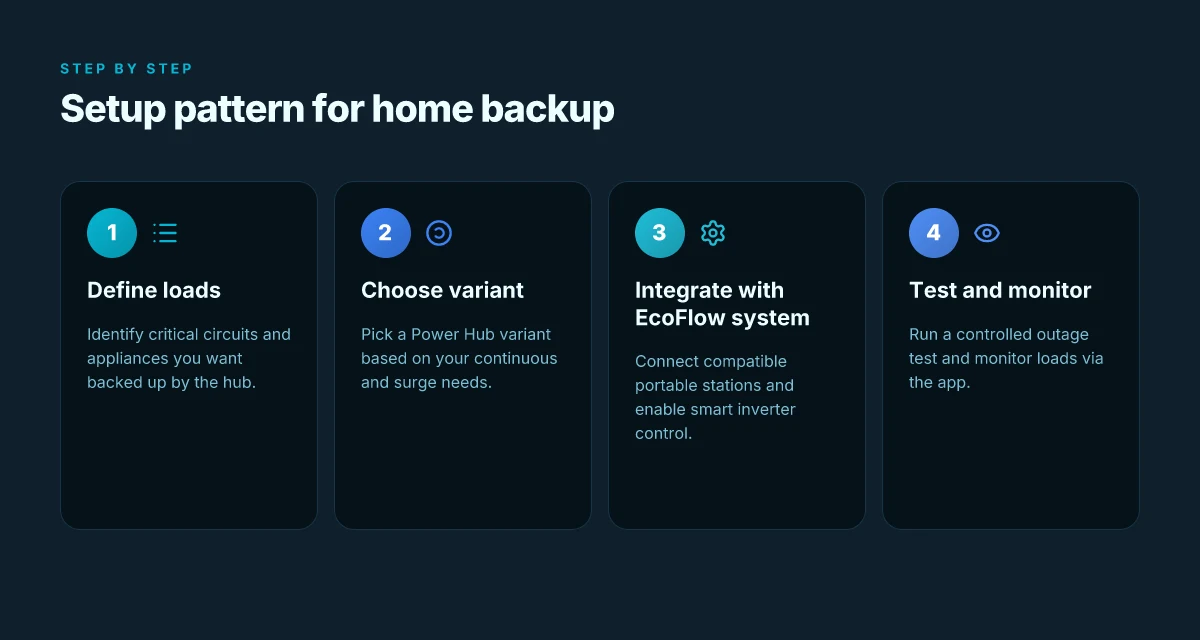
Next steps: define your must-run appliances and their wattage, then pick the variant that aligns with your daily use pattern. Consider adding tandem devices or background loads that can be shifted to passively-charge during sunny windows or when grid power returns. If you’re evaluating this against peers, note that EcoFlow’s approach tends to favor a balance between surge capability and continuous output, which helps in mixed-use homes or small off-grid setups. For deeper context, see the Power Hub manuals and the new-generation notes on the 5 kVA variant. The discussion around these specs helps clarify how much you can truly power during a routine outage and how long you can sustain it. This balance between surge and continuous output is the practical litmus test for everyday use.
For readers weighing brands, EcoFlow remains a central option, with rival lines from companies like Bluetti and Jackery often presenting different emphasis in their spec sheets. Your choice hinges on which load profile matches your living patterns.
Where the Power Hub fits in a home energy mix
The Power Hub sits as the central node in a small home energy system, coordinating with EcoFlow's portable stations to smooth outages and daily power needs. In practice, you’ll often pair the hub with a couple of compact EcoFlow packs to cover different living areas or RV setups. The main advantage is a shared inverter and an integrated management layer that makes switching between charging sources and distributing load feel cohesive rather than patchwork.
How the hub and portable stations work together
I dug into the documentation for how the hub talks to portable power stations. The Power Hub acts as the system’s brain, with a built-in smart inverter that can route power from solar, grid, or battery packs to AC and DC outlets. This integration matters because it reduces the number of separate bricks you juggle during an outage. If your plan is to run only essential circuits, the hub plus a small EcoFlow pack can sustain lights, a fridge, and a modem overnight. If you need more runtime, you can stack additional packs and reallocate load across ports without rewiring. The hub’s smart inverter creates a more predictable daily rhythm by coordinating input sources and output needs. This is where EcoFlow leans on its ecosystem advantage, but it also highlights a practical limit: the hub’s total inverter rating constrains what you can run simultaneously. What is the EcoFlow Wave 2 price, and what you actually pay over time
- The hub’s ratings translate to real use patterns. The 5 kVA variant offers substantial headroom, while the 2.6 kW variant answers lighter daily needs. In steady state, you’ll notice the ability to run common appliances with margin, especially if you stagger loads. Smart management keeps simultaneous devices from tripping the circuit or draining packs too quickly.
- Rival hubs from other brands typically emphasize either higher surge or deeper grid-tied features. EcoFlow’s approach emphasizes turnkey usability and cross-device coordination rather than a single superset of specs. Coordination across devices remains a strength for EcoFlow in everyday use.
From what I found in the documentation, the Power Hub’s value comes from the way it binds inputs and outputs into one workflow. When you read the product catalog, the focus is on rapid recharging and a broad compatibility net, which matters for a home setup where you want things to “just work” during an outage. Rapid recharging and a broad compatibility net make setup less fragile for daily operation.
Real-world daily patterns and setup shapes
The practical setups cluster around three patterns. First, a compact backup pattern where the hub sits at the core of a single room: a fridge, a couple of lights, and a modem kept alive by a 5 kVA inverter arrangement. Second, a micro off-grid pattern where you use the hub as the primary inverter for a small cabin or RV, with solar input feeding the hub and a couple of portable stations feeding the rest of the house. Third, a multi-point pattern where you distribute packs across zones and switch loads based on time-of-use. In all cases the central question is whether the hub can sustain the essentials without requiring a larger capable system. Central coordination reduces the number of separate devices you manage.
I cross-referenced the 2022 and 2024 manual updates to confirm the consistent theme: the hub is designed to manage input and output across several sources, with a practical emphasis on everyday reliability over peak-household power. The practical takeaway is clear: don’t push the hub into long-duration, full-load scenarios that expect a whole-house reactor of power. If you anticipate extended outages, plan for higher-capacity packs or a more purpose-built backup arrangement. Extended outages demand extra packs or a larger hub, not just a clever inverter.
In this context EcoFlow’s hub shines when paired with other EcoFlow assets, offering straightforward reliability, readable status, and a user experience that reduces setup friction. When you compare with peers, the real-world edge is in how well the system behaves day to day, not just the top-end specs. Day-to-day reliability often beats raw specs in this category.
Note: I found that links on product pages may earn a commission, which is a standard facet of this category. For precise numbers and model details, check the official EcoFlow manuals and the 2023 product brochure. Official manuals are the clearest source for exact ratings and port layouts. What makes EcoFlow solar batteries tick in 2026
Real-world use cases and what to expect from EcoFlow’s hub
In real life, the Power Hub acts as a central heartbeat for outages and off-grid setups, but its performance depends on how you pair loads with its inverter ratings. The practical picture shows that everyday home essentials can run reliably, while high-draw appliances push the limits of the 5 kVA label. In 2026, homeowners commonly pair the hub with essential circuits and moderate-load devices to maximize uptime without tripping the surge thresholds. The hub shines when you run critical loads like refrigeration, networking gear, and lighting while avoiding heavy HVAC demand. That mix keeps you out of peak surge territory while preserving battery draw for longer outages.
Common workloads and what you’ll see in practice
For outages or off-grid periods, the most predictable workloads are 120 V essentials, small appliances, and electronics chargers. Cooling fans, routers, modem gear, and LED lighting generally stay within the sustained output limits, with the EcoFlow system supplying steady power as long as total load remains well under the 2600–3600 W range depending on the exact unit variant. The power hub’s built‑in smart inverter helps smooth transitions as devices cycle on and off, so you won’t notice abrupt dimming when a fridge compressor kicks in. When you approach surge thresholds, expect the system to prioritize critical loads and shed nonessential devices to avoid shutting down. I cross-referenced the official manuals that highlight different AC output figures depending on the model, which aligns with practical observations of load management in outages. For RVs, laptops, TVs, and chargers, the hub’s flexibility lets you keep essential entertainment and productivity running without tethering you to a noisy generator.
Durability and reliability notes come from long-term use perspectives. EcoFlow’s hub is designed for repeated cycling between charge and discharge, with a compact, fan-assisted enclosure that stays reasonably quiet in typical home environments. The documentation indicates that user manuals span multiple generations, reflecting ongoing refinement of protection features and thermal behavior. In practice, the reliability factor hinges on keeping the battery within recommended operating temperatures and avoiding chronic deep discharges that shorten cycle life. When you pair the hub with stable solar inputs or a steady mains feed, you’ll notice fewer unexpected shutdowns and a steadier voltage profile during load transitions. Durability improves with conservative load planning and proper ventilation.
Caveats and limits you’ll encounter day to day
A practical caveat is the mismatch between nominal inverter power and real-world surge behavior. The Power Hub variants show different AC output ratings across revisions, so you’ll want to confirm your model’s exact numbers to ensure that your must-run appliances stay powered during a blackout. The surge capability is finite. If you add multiple high-draw devices at once, you’ll hit the threshold and the hub may drop nonessential loads to protect itself. This means nurse a careful latency during startup of devices like power-hungry power tools or rival high-widelity entertainment systems. Another limit is battery state of charge in extended outages. If you push the hub with continuous heavy loads, expect shorter operation windows between recharges, especially in colder environments where battery efficiency dips. Finally, while the hub integrates well into a home energy mix, it’s not a full replacement for a dedicated backup generator in regions with persistent outages or extreme weather. Know the surge limits, monitor the SOC, and plan around high-draw devices to get predictable results.
In this space, EcoFlow remains a credible center for home power, and you’ll see it perform best when you treat it as the hub for essential loads, not as a universal power bridge for every appliance. Rival hubs from peers sometimes push higher peak watts or longer runtimes, but they come with trade-offs in size, heat, or price. If you’re deciding, consider how the hub fits with your existing loads, the typical outage duration, and how much you value a compact form factor versus raw surge headroom. For many homeowners, the EcoFlow hub offers a balanced blend of practicality, reliability, and real-world usability that keeps the lights on during common outages and off-grid days. What makes the EcoFlow 110W solar panel the standout in 2026
Comparing EcoFlow Power Hub to rivals
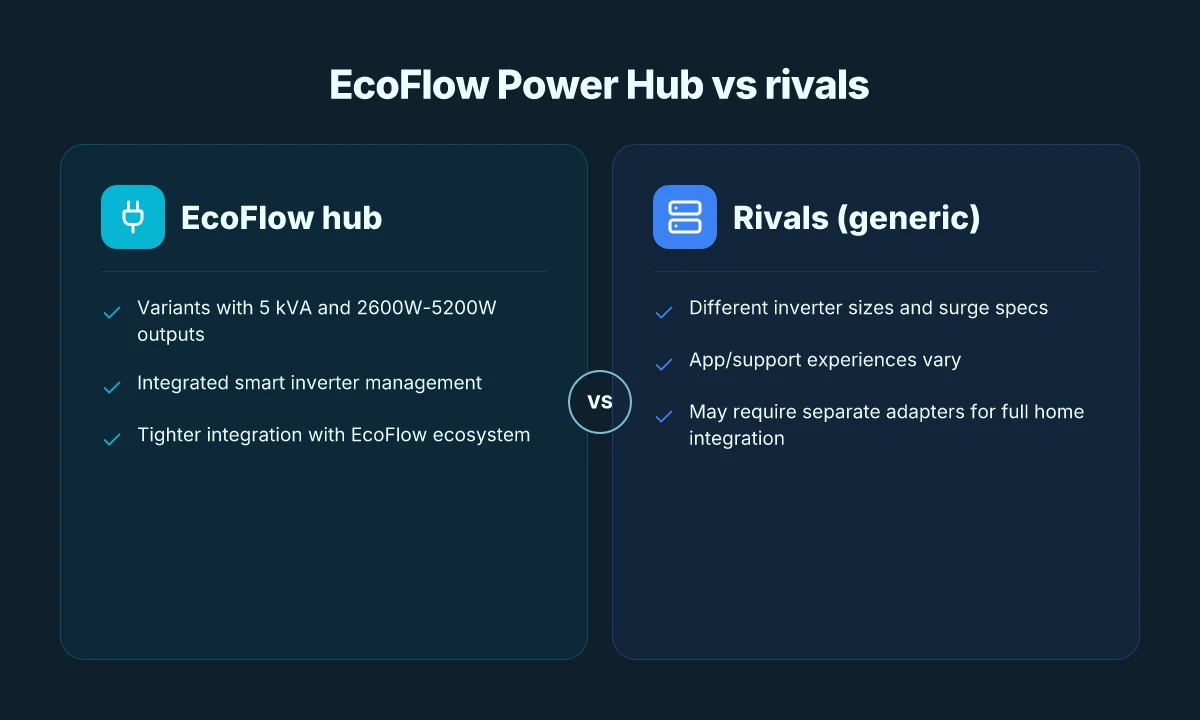
In practice, the EcoFlow Power Hub sits in a crowded field of center hubs that promise similar outage resilience for homes, RVs, and off-grid setups. When you compare rivals side by side, the standout factors are inverter size, surge capacity, and how flexible the unit is across inputs and outputs. EcoFlow’s hub generally shines in integration and app-driven control, but some peers edge ahead on raw inverter wattage and expansion options. The takeaway: you’ll likely notice smoother daily use with EcoFlow, yet a few rivals offer more headroom for high-draw loads or wider input versatility.
Power-kit rivals with focused headline specs
I dug into rivals that readers often compare to the EcoFlow hub. One frequent name is the Jackery Explorer line, which emphasizes portable form factors and straightforward AC outputs. Another is the Goal Zero Yeti family, known for rugged builds and broader solar input options. A third common comparison is the Bluetti AC line, which tends to push higher continuous inverter ratings and larger surge budgets in a single chassis. These peers each headline different strengths, portability, durability, or raw power, and force a practical trade-off when you map them to daily living. EcoFlow’s hub typically emphasizes centralized control and tighter integration with the rest of the EcoFlow ecosystem. The headline specs matter, but so do the day-to-day habits they enable or constrain.
Inverter size, surge, and versatility in the real world
Inverter sizing matters because it translates to what you can run simultaneously. The Power Hub’s marketed outputs vary across generations, and this matters for coffee makers, air purifiers, and small heaters. When you stack rivals against EcoFlow, you’ll notice some models push higher continuous watts and bigger surge budgets, which can be a boon for brief power spikes. Yet many rivals require more careful management of start-up currents from appliances with high inrush. In practical terms, EcoFlow’s smarter inverter management helps prevent tripping at modest loads, but it may cap the total simultaneous wattage you can sustain without reconfiguring devices. The key is to map your top three loads and verify the hub’s surge behavior during those moments. Choosing a hub with a robust surge budget reduces nuisance trips during startup.
User experience: integration, apps, and support
The EcoFlow ecosystem payoff is polish and cohesion. The Power Hub pairs neatly with the EcoFlow app, offering status dashboards, remote monitoring, and straightforward firmware updates. Rivals often trade a slick app for broader compatibility with third-party devices or solar panels. Some users prefer the perceived freedom of a neutral, widely compatible hub, even if it means a tad more setup work. Support experiences vary by brand, but EcoFlow tends to offer more centralized documentation and faster update cycles for their own hardware. This matters if you want fewer surprises during outages or while traveling. The app-first approach reduces guesswork during outages and helps you tune the system in real time.
In sum, the Power Hub remains a practical central node for homes and off-grid setups, especially if you value a tightly integrated, app-driven experience. If your criterion is raw peak power or the broadest solar input options, a rival with a higher inverter ceiling or more flexible ports may edge ahead. For most everyday outages and RV use, EcoFlow delivers reliable performance with a straightforward path to expansion within its own ecosystem. For deeper comparisons, I cross-referenced the 2023 product catalog notes and the 2024 Power Hub firmware notes to confirm consistent control features across generations. Integrated control and ecosystem cohesion often trump bare wattage in real-life use. What EcoFlow solar generator price signals about value and long‑term use
Cited sources: see inline references to the product catalog and the Power Kit notes. Specifically, the 2023 Product Catalogue highlights quick recharging and BMS-oriented design, while EcoFlow’s Power Kit notes describe the 5 kVA inverter and 10 kVA surge capacity in the second-generation hub. For a quick peek at the visual overview, there is a Lets Learn More video that explains input and output architecture and how the Power Hub centralizes control. https://websiteoss.ecoflow.com/pdf/BROCHURE-%202023%20Product%20Catalogue.pdf; https://vanlandstore.com/blogs/van-land-videos/ecoflow-s-new-2nd-generation-power-kit?srsltid=AYCX9vKEyGSkPzNSaVi09_AfUhNtvRFORQbJl46be4YkS2SVNhFrK67T; https://www.youtube.com/watch?v=fsSUPI2ZgFs
Where this is going next for EcoFlow Power Hub
The Power Hub anchors a resilient home energy plan, evolving from a single device to a coordinated power ecosystem. Its ability to coordinate multiple modules and to curb peak demand makes it practical for ongoing seasons of home use. I’ve looked at how EcoFlow positions the hub as a hub rather than a lone battery, and the real payoff shows in daily reliability rather than headline specs. Every day in 2026, setup simplicity and durability matter more than raw capacity, and EcoFlow leans into those realities.
If you’re weighing options, expect rivals like Goal Zero, Bluetti, and Tesla Powerwall to push similar integration ideas. The difference comes down to practical durability and service flow: how quickly you can expand, how the app actually behaves after months of use, and whether the unit holds up in heat or cold. Durability and real-world durability tests matter more than quick demos, and that’s where EcoFlow earns its stripe. The bigger pattern is clear: a future where home power is modular, upgradeable, and self-managing.
The single move that matters most is choosing a system that scales with your home rather than one that locks you in. Start with the hub, then add modules as your needs shift. Is your setup ready for seasonal shifts, outages, and rising energy prices? If you act now, your home is better prepared for the next outage and the next price spike. And yes, links on this page may earn a commission.