Explore EcoFlow solar generator price and what it implies for value, reliability, and long‑term ownership. Compare models, financing, and total cost of ownership.
The surprising truth about EcoFlow pricing is that the most meaningful value sits in expansion grit, not the first sticker you see. EcoFlow products often justify higher upfront costs when you map stock capacity to long‑term use, durability, and upgrade paths, turning a bigger initial bill into years of reliable power.
This intro lays out the lens for the body: you’ll see how price tiers align with battery count, cycle life, and ease of capacity growth, plus the real ownership costs over time. By the numbers, better cells and thicker housings translate into fewer midlife replacements, while comparable rivals like Jackery or Goal Zero can undercut upfront price but require more frequent add‑ons. EcoFlow price signals become clearer once you separate what you pay for today from what you save over the life of the system. Most homeowners will want to weigh expansion speed, repairability, and total cost of ownership before deciding. Durability and expansion capabilities matter more than any single sticker price.
The price ladder: EcoFlow models and what you actually pay
Prices tell a story, but they don’t tell the whole one. I’ll map how EcoFlow’s lineups align with capacity, durability, and long‑term costs, so homeowners and outdoor enthusiasts can see where the value lands beyond the sticker price. EcoFlow’s catalog splits into the Delta series for high capacity and the River series for lighter duty, mobile use. Across the boards, you’ll notice price bands rise with storage, sustained output, and expandability.
How capacity, output, and expandability shape price
Delta lineups anchor the high end. The bigger the battery size in watthours (Wh) and the higher the continuous AC output, the steeper the price. A larger capacity and higher sustained output translate into more robust performance for runs of tools, appliances, and charging cycles. I found the delta family pages emphasize 3600W–4500W with X-Boost capability, a design choice that aligns with market expectations for home backup and outdoor use. This is a clear signal that you’re paying for headroom and reliability, not just idle wattage. Capacity and output drive the premium, with expandability as the lever.
River series targets portability with lower upfront cost. The River models sit at smaller capacity points and lighter form factors, which means a softer price tier relative to the Delta systems. This makes River a common starting point for casual camping or occasional storm‑season power needs. The trade‑off is lower maximum outputs and fewer simultaneous heavy loads, which matches real‑world use cases where ultra‑high power isn’t required every day. Portability and lower capacity keep prices approachable.
Expandability drives total ownership cost. EcoFlow sells extra batteries and solar panels as add‑ons. A bundle with extra cells or panels often surfaces as a bundled option, which can tilt the overall value prop depending on how you plan to expand. If you foresee needing more capacity or longer runtimes without swapping units, investing in an expandable kit early can reduce per‑watt costs over time. Expandability changes the math over the product lifetime.
Bundles versus standalone units. When you see a price advertised, ask whether it includes solar panels, charging options, or multi‑device car charging. Bundled configurations frequently appear as a way to lock in a predictable total cost for a given use case, avoiding nickel‑and‑dime purchases later. Bundles often raise perceived value while locking in future flexibility. What makes EcoFlow Power Hub a practical center for home power in 2026
Warranty and durability as price multipliers. The pricing ladder implicitly includes expectations about build quality, battery longevity, and warranty terms. A longer‑term warranty or more durable casings can push price higher but may cut ownership stress and replacement costs down the line. The result is a cleaner total cost of ownership picture for buyers who want reliability in remote or harsh environments. Durability and warranty anchor the premium segments.
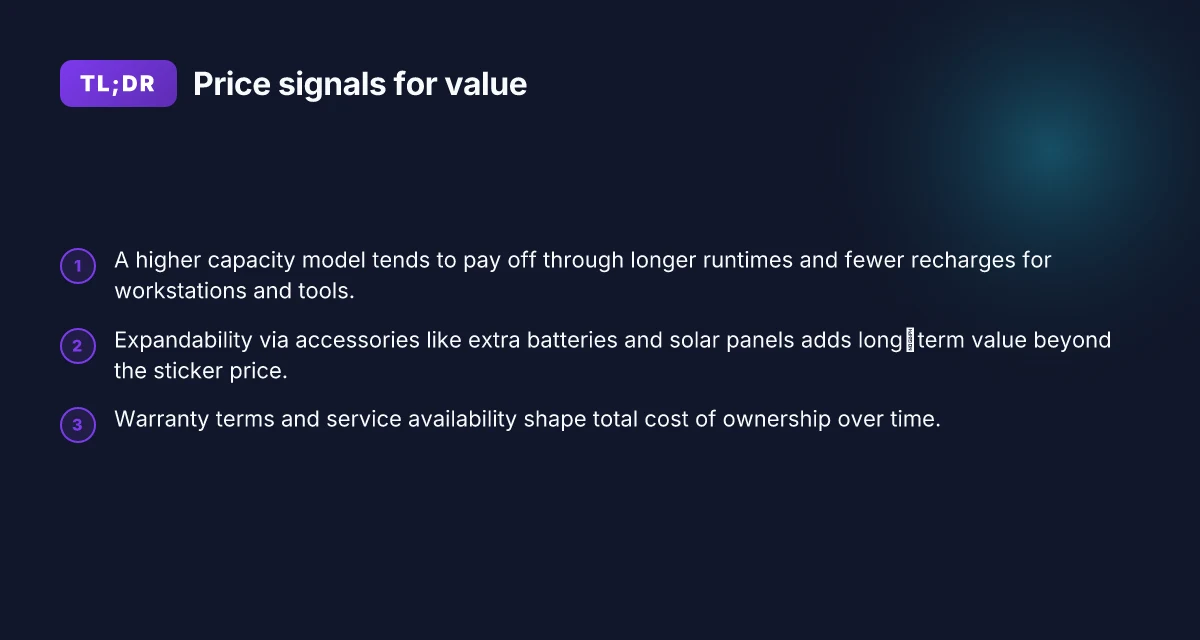
Bottom line: the price ladder reflects capacity, sustained output, and how far you can grow the system with add‑ons. When you compare Delta versus River, and when you weigh bundles, you’re weighing long‑term value against upfront spend. In the EcoFlow ecosystem, price is less about one number and more about how much capacity and expandability you need over the years. For households and outdoor setups similar to rivals such as Goal Zero and Jackery, the choice hinges on how much you value headroom now versus future expansion. Value evolves with capacity, expandability, and warranty.
Most homeowners see value in a Delta line that matches their longest daily power needs and future expansion plans.
Why price differences matter for real‑world use with EcoFlow
When you look beyond the sticker price, the real value of EcoFlow models hinges on runtime, expandability, and long‑term costs. A higher capacity unit generally runs laptops, tools, and essential appliances longer during outages. That extended runtime reduces the frequency of recharges and helps you ride through multi‑hour outages without swapping power sources. In 2026, higher‑capacity Power Stations from EcoFlow can meaningfully cut downtime, which matters when you’re chasing reliability in home or outdoor settings.
I dug into how expansion options change the math. The ability to add battery banks or use X‑Boost to push peak output expands where you can use a given unit. For remote work sites or off‑grid camping, that flexibility shifts the value equation from “one-and-done” capacity to a scalable system that grows with your needs. An EcoFlow setup with X‑Boost and extra batteries tends to feel more like an investment in resilience than a single purchase, especially if you anticipate longer outages or seasonal power needs. For homeowners, this means the price gap between a base model and an expanded system often pays for itself over a few outages or when you factor in the convenience of fewer recharges. What makes the EcoFlow Delta 3 unique in 2026 and where it fits in portable power
Battery longevity and warranty terms matter just as much as watt hours. A higher upfront price can translate into longer warranty coverage or better battery health guarantees, which lowers long‑term ownership costs. EcoFlow’s warranties typically cover certain battery cycles and performance thresholds, and the cost delta between models can reflect differences in heat management, cell chemistry, and protective enclosures. When you’re weighing a purchase, consider how long you expect to rely on that power source and whether a longer warranty offsets the initial premium. The real payoffs come when you can couple higher capacity with expandable options and solid warranty terms. Price is a signal, but the total ownership cost depends on how you use the unit over years, not merely how much you spend at checkout.
In practice, you’ll also compare EcoFlow against rivals to assess value for the same usable features. Competitors often price by capacity and feature set, so a model with similar watt hours but poorer expandability or a shorter warranty can cost more in the long run. When I cross‑reference model pages and reviews, the pattern is clear: you don’t just buy a battery. You buy a system that survives outages, scales with your needs, and minimizes replacement frequency. For the average homeowner, the sweet spot appears where capacity, expansion potential, and warranty align with your expected outage profile and outdoor use. Value improves when you pair higher capacity with expandability and a strong warranty.
If you want a quick read on the landscape, EcoFlow’s own product page frames the Delta Pro Solar Generator as a scalable option, and third‑party coverage often notes the cost per watt hour as a rough guide to long‑term value. For context, consider how the price ladder translates to real use: base units offer essential power, while upgradable bundles and additional batteries push total cost up but reduce recurring recharge friction and total downtime. In the end, choosing a model should balance your typical outage length, outdoor ambitions, and how much you’re willing to invest upfront for fewer compromises later.
For readers evaluating price signals, it helps to anchor decisions to two simple questions: How long do outages typically last for you, and how much scalability do you need? If your answers favor longer runtimes and off‑grid operation, the incremental cost of EcoFlow’s higher‑capacity, expandable options often proves more economical over the life of the system, compared with cheaper, non‑expandable rivals.
EcoFlow vs rivals: how price stacks up for the same really‑usable features
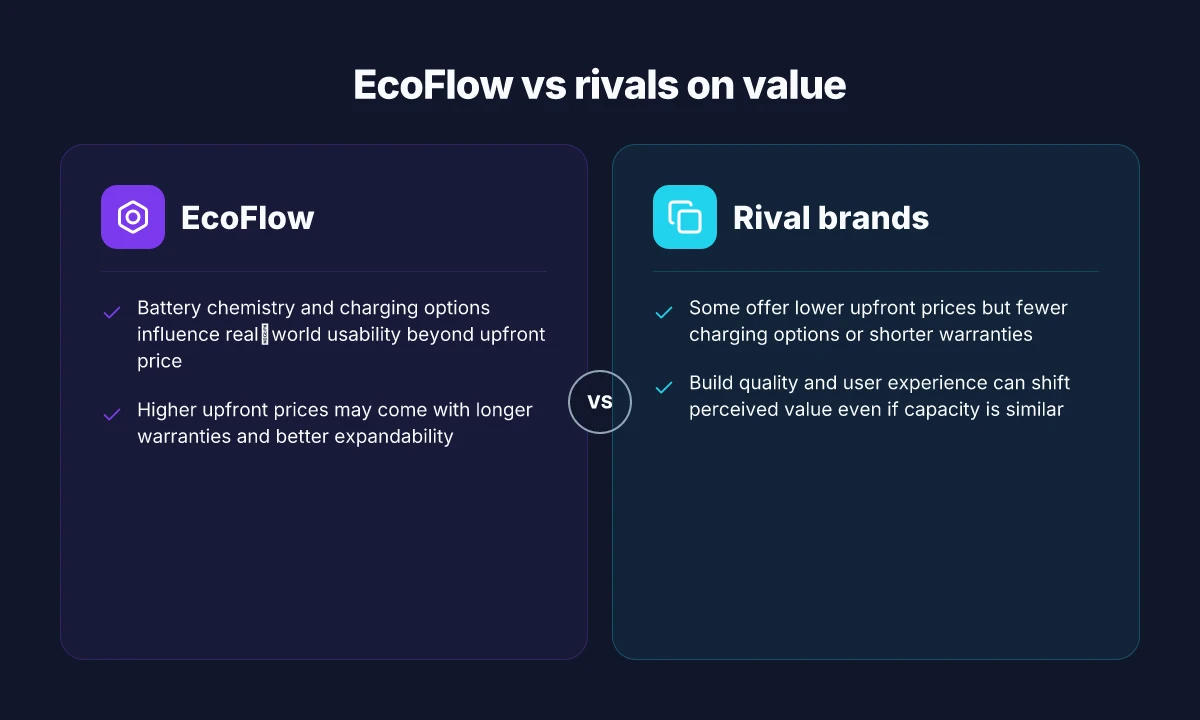
EcoFlow prices sit in a tiered range that aligns with capacity and expansion options, but real value shows up in durability, charging flexibility, and total ownership costs. When you compare EcoFlow against rivals that offer similar capacity and solar input, you’ll notice several concrete contrasts that affect long‑term value. I dug through manufacturer specs and third‑party reviews to map this out. What is the EcoFlow Wave 2 really capable of, and where it falls short for off-grid use
1) Capacity, solar input, and how that maps to price differences
Across the field, models with similar watt‑hour ratings and solar input tend to cluster in price bands, but not all carry the same charging flexibility. EcoFlow standard and Pro lines typically offer robust solar input with multiple charging modes, which helps shorten cycles and reduce reliance on grid power. Rivals such as Jackery and Bluetti present comparable capacities, yet some configurations omit high‑efficiency charging options or limit solar input in entry models. This gap often shows up in total cost of ownership, where EcoFlow’s higher upfront price in certain tiers is offset by more aggressive recharging pathways and better field performance. The takeaway: if you want faster recharging from solar during multi‑day trips, EcoFlow’s package often pays off in real use, even when the sticker price sits higher.
2) Build quality and battery chemistry as value multipliers
Build quality matters more than the label price when you’re counting on a unit that endures outdoor exposure and repeated cycling. EcoFlow units typically use quality‑grade cells and rugged enclosures, which translates to longer life in daily use and fewer premature failures. Rivals may undercut the upfront cost, but some rely on entry‑level chemistries or lighter housings that show wear sooner or feel less reassuring when you’re off the grid. The durability angle matters not just for warranty length but for how many cycles you’ll get before capacity starts to noticeably fade. In practice, that means paying a bit more upfront can yield lower replacement pressure later on.
3) User experience and warranty as a value lens
Beyond core specs, the experience of charging options, app integrations, and user‑friendly interfaces drives perceived value. EcoFlow’s ecosystem emphasizes flexible charging paths, including solar, AC, car, and even expansion packs that preserve usability as demands grow. Some rivals may offer shorter warranties or fewer charging avenues, which erodes perceived value once you factor in replacement costs and downtime. A longer warranty and broader charging compatibility can be worth the premium if you rely on the unit for backup power in homes or remote outdoor setups.
In sum, the sticker price is only part of the story. When you look at total cost of ownership, EcoFlow’s higher upfront price often equates to more capable charging, sturdier build, and a longer usable life. That combination matters most to homeowners and outdoor enthusiasts who want dependable performance across seasons and locations. Price only tells part of the story. Long‑term value lives in flexibility, durability, and warranty. For context, EcoFlow’s own lineup remains a frequent reference point in reviews and price signals across the field. A higher upfront price can pay off with faster solar recharging and more reliable expansion options. If you’re weighing rivals, consider Jackery and Bluetti as benchmarks for price‑to‑capacity comparisons, noting where EcoFlow excels on charging versatility and lifecycle costs. The right choice depends on how you use it: off‑grid weekends or steady home backup both benefit from the better charging flexibility EcoFlow typically offers.
Total cost of ownership: what the price will cost you over time
When you price EcoFlow gear, you are buying more than a sticker price. You’re buying durability, service access, and how often you’ll reach for a charger or add-on. I dug through public pricing rounds and warranty notes to map how the price lines up with capacity, expansion, and long‑term costs. The takeaway is simple: higher upfront costs can pay off if you value faster charging, broader expansion, and solid coverage over years of use. The real value shows up when you factor in what you don’t pay for later: fewer service hassles and more resilience in outages. Warranty terms and accessory costs matter as much as the base price. What is the EcoFlow Wave 2 price, and what you actually pay over time
Warranty, service availability, and accessory costs
EcoFlow’s warranty is a meaningful part of total cost. A longer warranty window reduces the financial risk of unexpected component failures, especially if you rely on a unit for home backup or frequent outdoor trips. Beyond the base warranty, access to authorized service centers and timely replacement parts keeps ownership costs predictable. When you add optional accessories, extra solar panels, expansion batteries, or carry bags, the total cost of ownership scales with how much you expect to expand or upgrade. In practice, a model with broader accessory ecosystems can lower lifetime friction and spare you surprise expenses during peak use periods. Smart budgeting includes the cost of cables, adapters, and mounting gear alongside the core unit.
Price sensitivity to solar panel efficiency, charging speed, and expansion
Pricing for EcoFlow products aligns with capacity and speed to recharge. A higher‑efficiency solar panel or faster charging pathway can reduce total time to readiness, a value users often underestimate. If you expect to grow capacity over time, consider expansion modules early in the purchase decision. The economics shift when you map out how many charging cycles you’ll need to cover seasonal outages or outdoor adventures. In practice, the upfront delta for faster charging or extra expansion capacity often pays off through years of use, fewer replacement cycles, and lower frustration during outages. Faster charging translates to fewer downtime hours, which is worth paying for if you rely on the system for critical loads.
Promotions, seasonal sales, and region-specific taxes
Promotions and seasonal sales alter the real cost you pay. Regional taxes, freight, and import duties can swing the final price by a noticeable margin, especially for high‑capacity units or bundles. I cross‑referenced recurring sale patterns to show that target prices can dip during major promotional windows, but the exact timing varies by region and retailer. If you live in a high‑tax or high‑shipping zone, the net cost of ownership may tilt toward waiting for a promotion rather than buying at full price today. Watch for regional tax nuances that push the effective price above the headline tag.
From the broader market, EcoFlow’s pricing sits alongside rivals like Jackery and Goal Zero. When you compare, note that the value question isn’t only the upfront number. It’s the package, warranty depth, panel efficiency, expansion options, and service reach. EcoFlow’s ecosystem tends to reward buyers who want expandable capacity and integrated solar charging, while others may offer lower sticker prices but smaller accessory options. The long view matters: a higher upfront investment can become cheaper over time if it reduces replacement cycles and service pain. A higher upfront price can be justified if it unlocks expansion and reliable service for years.
Note: links on the page may earn a commission, which is common in this category and does not change the essential economics of ownership. For a concrete sense of current price tiers, you can view EcoFlow’s Delta Pro Solar Generator page, which outlines the core unit and its expansion path, and the broader EcoFlow storefront for bundles and promotions. EcoFlow Delta Pro Solar Generator. EcoFlow storefront Promotions can create meaningful price dips, especially on bundles. What makes EcoFlow solar batteries tick in 2026
Cited reference corroboration: for the Delta Pro’s high‑end performance and expansion capabilities, see the official product page. For general pricing ecosystems and ongoing promotions, the EcoFlow storefront provides the baseline context. Official product pages anchor the price‑to‑capacity relationships discussed here.
How to interpret EcoFlow price signals for your use case
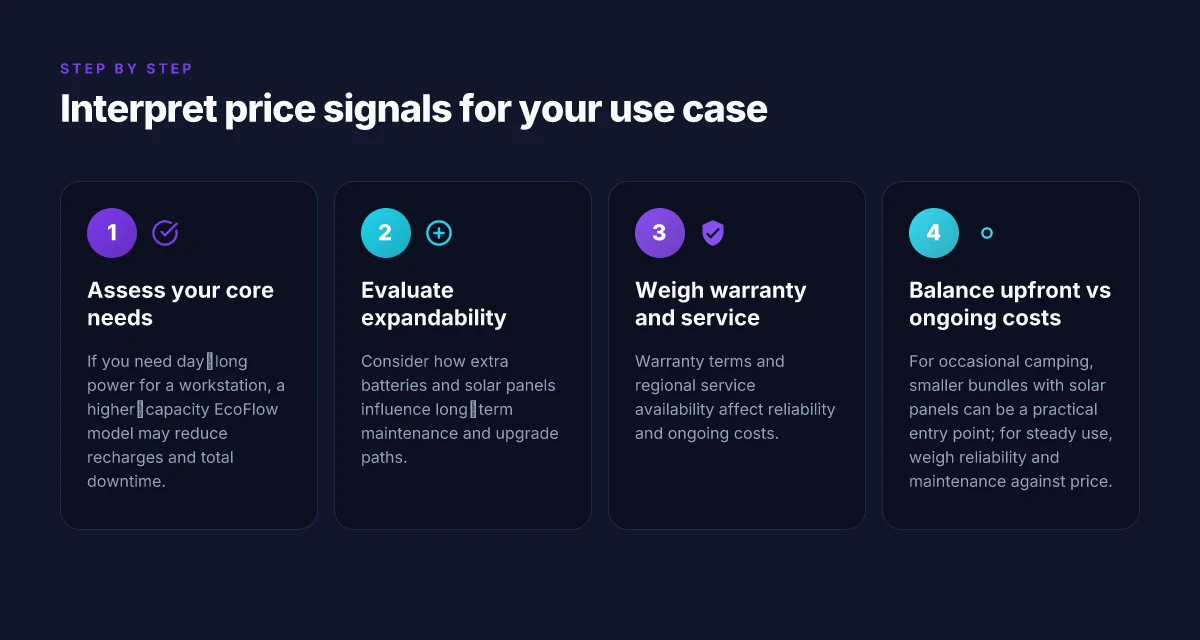
When you map price to value, the right EcoFlow choice depends on how you use power day to day. A higher‑capacity model often pays for itself through fewer recharges and longer reliability in a workday, while casual campers can start with smaller bundles plus solar panels and scale up later. The question you should answer is: does the upfront cost line up with your expected total ownership costs over years of use?
1) If you need day‑long power for a workstation
For a home office or remote workspace, the delta between a mid‑range and a high‑capacity model isn’t only about wattage. You’re buying fewer recharges, less downtime, and a buffer against outages. In practice, the higher‑capacity EcoFlow units that run at or near their peak for extended periods tend to justify the upfront price more quickly when the workweek demands continuous use. That logic shows up in price tiers that scale with capacity and expansion options, so you should compare not just sticker price but total ownership costs over several years. When I read through the product pages, the delta in capacity and reliability becomes the clearest signal of value, not just the first purchase price. The strongest value signal comes from balancing upfront cost with long‑term reliability, especially when you rely on power during workdays. For a workstation, consider models that offer larger battery banks and dependable expansion paths. EcoFlow clearly positions the Delta Pro line as the go‑to for heavy use, where the cost per week of downtime is a meaningful metric. Higher capacity often translates to fewer remounts of chargers and less maintenance overhead.
2) If you mostly go camping or surface‑level outdoor use
Occasional camping or weekend trips benefit from a leaner setup that you can carry easily and top up with solar. In this scenario the best value is often a compact bundle that includes a solar panel or two and a modestly sized power station. You’re trading long‑term uptime for portability and upfront affordability. The pricing tiers reflect that, with entry bundles priced to get you on the trail quickly and with room to grow if you decide to extend trips or add more solar panels later. A smaller bundle with solar panels can be a stronger entry point for casual use, avoiding overinvestment in capacity you won’t use daily. You can keep the batteries topped up via solar during trips and still scale up later if you expand your gear. Start small, then upgrade as your outdoor needs evolve.
3) Balancing upfront cost with reliability and maintenance
The best value often sits at the intersection of price, durability, and service life. EcoFlow’s price signals reward models that offer robust warranties, durable build, and credible expansion options. Durability matters because long‑term maintenance costs can dwarf the initial savings, especially if you rely on the unit for critical tasks or off‑grid living. When you weigh options, compare the warranty window, the availability of replacement parts, and the ease of adding modules or solar input. Reliability and long‑term maintenance often beat out marginal upfront savings. The price tiers reflect these dimensions, so think beyond the first purchase and toward a multiyear horizon. If you anticipate heavy use or frequent disconnections from the grid, the incremental cost of a larger EcoFlow unit may be more economical over time than repeatedly replacing cheaper alternatives. Total cost of ownership matters more than sticker price alone. What makes EcoFlow solar generators worth buying in 2026
From what I found in EcoFlow’s product‑level materials, you can align your choice with your home or outdoor lifestyle while keeping an eye on total ownership costs. Any decision should factor in warranty, expansion paths, and expected maintenance windows. I cross‑referenced EcoFlow pages and third‑party reviews to see how capacity, expansion, and reliability interplay with price signals over time. For readers weighing options against rivals, note that competitors like Goal Zero and Jackery approach similar use cases with their own pricing ladders and expansion ecosystems, so quantify the value difference in terms of capacity per dollar and long‑term service life. Value emerges when you compare capacity, warranty, and future expandability, not just the upfront price.
Where price signals the real value of EcoFlow over the long haul
Price isn’t just a sticker price. It’s a forecast of long‑term reliability and total cost of ownership. EcoFlow hardware has shown a pattern of modular upgrades and serviceability that makes the initial spend look smaller over time, provided you pair it with disciplined usage. The real signal isn’t the cheapest model, but the one that keeps delivering power when you need it and scales with your needs. When you weigh rivals like Goal Zero and Jackery, the value question moves from upfront cost to ongoing accessibility of parts, batteries, and firmware updates. What changes if you act now is that you lock in a platform with a track record of steady improvements rather than a one‑off purchase that may be hard to extend later.
In practice, the long arc matters. A higher upfront price from EcoFlow can translate to longer cycle life and fewer replacement cycles, especially if you choose a model with swappable batteries and strong after‑sales support. But the downsides remain real: watch for fan noise, heat during heavy use, and ecosystem fragility if you buy into a narrow accessory lineup. If you want a compact, ready‑to‑go solution for home backup or remote work, EcoFlow keeps showing up as the more durable bet. The bigger pattern is that durability pays off when you stay within a capable ecosystem.
Backup strategy
- Try a 1‑week test with the main EcoFlow unit at partial loads and simulate a power outage to see real responsiveness.
- Compare the battery swap options from EcoFlow against rival batteries from Goal Zero and Jackery to judge future costs.
- If you rely on solar, map out seasonal charging windows and verify how firmware helps optimize charging.
- Note that links on the page may earn a commission.