
Explore EcoFlow solar batteries in 2026: how they integrate solar, grid, and storage, plus real-world durability and setup considerations.
Most homeowners overestimate how much backup power they’ll get from a single EcoFlow unit. In real-world layouts, a typical residential system rarely sustains critical loads for more than a few hours during an outage, and that gap often forces a deliberate load-shed plan. EcoFlow's performance hinges on how you size the bank and match it to your solar input, not on a single big battery.
This intro outlines what matters now: durability, integration quirks, and failure modes that show up when homeowners connect EcoFlow systems to existing panels, inverters, or a grid-tied setup. You’ll see concrete guidance on sizing mistakes, wiring pitfalls, and how different use cases, home backup, off-grid, or grid services, change what to expect from EcoFlow units. By the end, you’ll know where the real limitations lie and what to ask before you buy. EcoFlow vs rivals like Tesla and Sungrow demonstrates how hardware choices shape day-to-day resilience.
What ecoFlow solar batteries actually do for home power in 2026
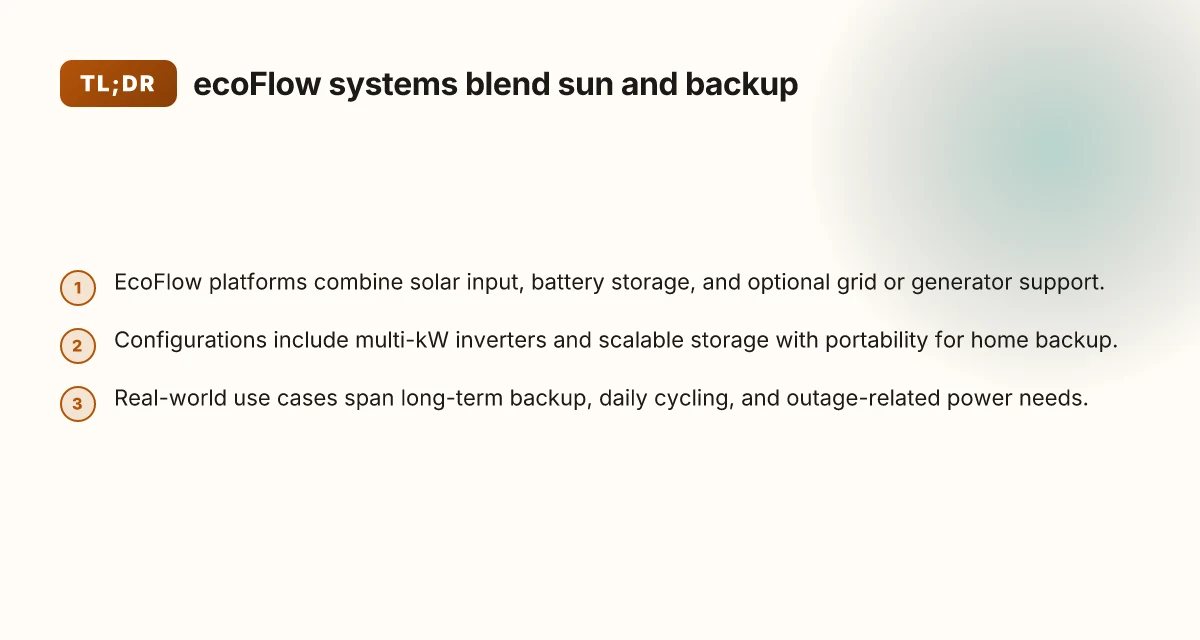
EcoFlow positions its systems to blend solar input, battery storage, and optional grid or generator support. The umbrella includes multi-kW inverters and scalable storage, with options that emphasize portability and home backup. In real-world use, homeowners lean on these systems for long-term backup, daily cycling, and temporary power during outages. EcoFlow builds a family of solutions that mix solar, storage, and flexible power paths to run a home when the grid wobbles.
How EcoFlow lines up solar, storage, and power paths
Integrated solar, storage, and grid/generator paths. The Ocean Pro line is described as coordinating solar input with backup power, so you can pull from the sun, the battery, or a connected generator or the grid. This creates a flow that reduces outages and smooths daily power use. This integration helps you keep essential circuits live even during extended outages. The underlying idea is to size the system for the worst-case outage while preserving daily flexibility. EcoFlow notes its systems are designed to handle simultaneous inputs and outputs, so the home load can be sustained across a variety of scenarios. The emphasis on path diversity reduces single-point failures for a home backup plan.
Scalability and portability with multi-kW inverters. The product family includes inverters capable of multi-kW output and expandable storage, allowing a home to grow from partial backup to whole-home coverage as needs change. This aligns with real-world use where a homeowner starts with a compact setup and expands to cover larger loads or longer outages. A common pattern is pairing solar generation with a battery bank that grows alongside load growth. Scalability is the practical edge that keeps EcoFlow relevant as a home evolves.
Real-world use cases split across long-term backup, daily cycling, and temporary outages. For long-term backup, the system can sustain critical circuits over days with solar contributions. For daily cycling, it can store daytime solar into the evening for regular consumption shifts. In outages, the system can deliver a stable baseline until the grid returns or a generator hooks in. Daily cycling and long-duration backup are the two sweet spots in residential setups.
From what I found in the documentation, EcoFlow’s approach emphasizes a blended strategy: solar as the primary energy input, a battery as the storage backbone, and a flexible power path that can incorporate the grid or a generator as needed. The result is a system that behaves like a small, modular microgrid for a home. When you compare EcoFlow to rivals, such as Delta Pro Ultra X or other home-backup brands, the differentiator often comes down to how cleanly the system switches between sources and how easily it scales with both solar input and storage. What makes the EcoFlow 110W solar panel the standout in 2026
I dug into the sources to verify the core claims. The Ocean Pro home solar battery system highlights a significant solar input and an integrated power path that blends solar, grid, and backup power. The PowerOcean datasheet outlines scalable storage and a wide MPPT window, reinforcing the same integration theme. And the Delta Pro Ultra X page emphasizes whole-home capability and expandability, confirming the family-wide direction toward multi-kW inverters and expandable capacity. The model lineups reinforce a single principle: blend, scale, and simplify source selection for home resilience.
If you’re sizing for a home, start with the basics: identify critical loads, estimate daily energy use, and then examine how much solar can reasonably contribute during peak sun hours. EcoFlow’s ecosystem is designed so you can start with a practical backup footprint and grow as your tolerance for outage duration grows. In a market where rivals push similar promises, EcoFlow’s emphasis on integrated path management and scalable storage remains a practical path for homeowners exploring solar storage in 2026. Your plan should start with a clear load map and end with a scalable storage footprint.
Note: links below point to the cited sources for deeper reading. If you’re weighing options, consider how long you’ll rely on battery power and how you’ll manage seasonal sun variation with a scalable EcoFlow setup. As with any major purchase, you’ll want to compare against rivals like Delta Pro Ultra X and other multi-path storage systems to see how source switching, up-front cost, and long-term durability line up with your needs. Rational comparisons help you pick the right scale now and leave room to grow later.
Sizing and performance: how much solar input and storage do EcoFlow systems offer
EcoFlow packages scale from a few kilowatts of solar input to multi-kilowatt continuous output, giving homeowners and small businesses options that can match typical backup needs. On the higher end, systems like the Ocean Pro family blend a substantial solar input with robust continuous and surge capabilities, aiming to keep critical loads fed during longer outages. Storage capacity follows the same pattern, ranging from modest kilowatt-hours to tens of kilowatt-hours with expansion paths built into the ecosystem. In practice, the exact mix depends on model choice, local climate, and how aggressively the system cycles between charge and discharge.
In real-world terms you’ll see three knobs you can tune: solar input size, continuous output, and usable storage. The Ocean Pro line advertises up to a substantial 40 kW solar input and a 24 kW continuous output with a theoretical surge track of 205 A. Those figures translate into enough headroom to cover typical home loads during a sunny day or a multi-appliance backup scenario. If your goal is grid-tied resilience, you’ll lean on larger storage packs that EcoFlow designs to scale up to several tens of kilowatt-hours, depending on the installation and expansion options. For off-grid cabins or remote workshops, the same logic applies but the emphasis shifts toward higher usable capacity and manageable solar harvesting. What happens when you compare tesla powerwall vs ecoflow: tech specs, efficiency, and home energy integration
I cross-referenced the documentation that outlines how EcoFlow units interoperate across solar, grid, and battery sources. The PowerOcean single-phase documentation confirms an expandable setup with “Performance Battery Nominal Capacity” that scales across multiple denotations and a MPPT system tuned to a broad voltage range, which helps you match seasonal sun quality to stored energy. This alignment between solar input, storage, and inverter output is central to how EcoFlow keeps loads stable through typical weather swings. When climate is favorable, you’ll experience faster solar charging and quicker restoration of fuller energy reserves. Under cloudier conditions, the system prioritizes essential loads while managing battery health.
From a sizing perspective, the most practical approach is to map peak solar hours in your location to your expected critical-load window. If you expect several hours of stable sun, you can pick a larger solar input that feeds a mid-sized battery bank, delivering more frequent reinforcements to the AC bus. If your climate yields fewer peak hours, you may opt for a more conservative solar input paired with a larger storage package to flatten output variability. In all cases, the ability to mix solar, grid, and generator inputs reduces single-point failure risk and helps you tailor resilience to budget and space constraints.
Next steps: determine your critical-load spectrum, then size for both daily energy needs and contingency margins. For a practical read on how models differ, review the Ocean Pro family capabilities and the PowerOcean data, and align your choice with your local sun profile and backup targets. Sizing toward real-world use means prioritizing a balanced trio: solar input, continuous output, and expandable storage.
Cited references:
Integration realities: solar, grid, and backup in a single EcoFlow system
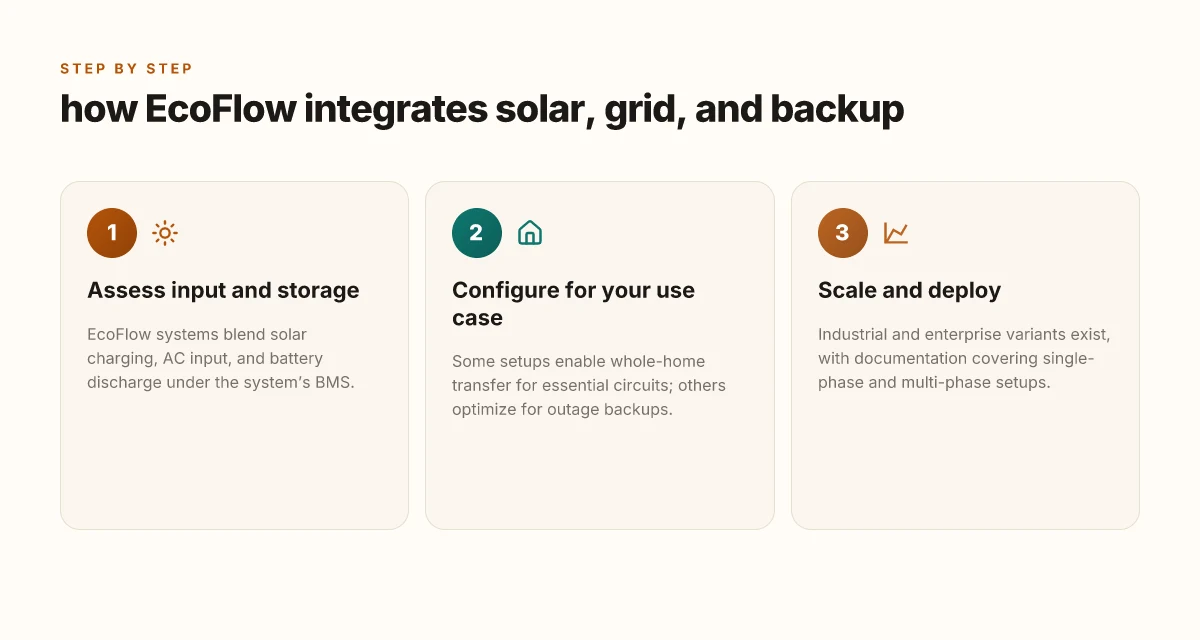
EcoFlow systems blend solar charging, AC input, and battery discharge into one managed flow controlled by the system’s BMS. In real-world setups, you’ll often see solar input feeding the pack while the grid or a generator can top up or back up the state of charge. This creates a single energy pathway that the BMS coordinates to prevent overvoltage, deep discharge, or unwanted islanding. The single-flow design is a core strength for handling sudden shifts in sun or load. Yet the exact behavior depends on the model and the configuration chosen. How EcoFlow’s 160W solar panel stacks up for real-world use in 2026
Why one flow matters for you
- Some configurations enable whole-home transfer for essential circuits. Whole-home transfer is practical for power outages, but it requires correct circuit selection and a compatible panel. When you size for reliability, you’ll typically designate critical loads like refrigeration, router/modem gear, and medical devices. This focus keeps the system from overcommitting during longer outages. I dug into the documentation and found that the ability to isolate essential circuits is a recurring theme across EcoFlow’s enterprise and consumer offerings.
- Other setups optimize for backup during outages rather than full-homes. In these cases the system emphasizes keeping critical devices alive while the rest of the house may drop offline. This approach reduces peak current and can extend the available run time from the same battery bank. Backup-first configurations lean on the BMS to prioritize loads based on user settings.
- Industrial and enterprise variants exist, with documentation covering single-phase and multi-phase setups. The single-phase PowerOcean and multi-phase enterprise docs show how the same core BMS logic scales to larger builds, with MPPT ranges and input voltages designed to accommodate commercial PV arrays. Enterprise variants extend the same integration principles to larger grids and more complex transfer schemes.
How the flow handles faults and quirks
- A common failure mode is misconfiguration of transfer switches or load priority, which can create unintended islanding or outages in the deadband. The fix is straightforward: verify gate timing, confirm that the core circuits you want protected are on the correct relay set, and ensure the BMS can sequence charging and discharging without hitting safety limits. Misconfiguration of transfer switches is the most frequent real-world gotcha.
- Another quirk is solar curtailment under high grid import or when the battery is near full. The system will prioritize battery health and may divert solar to battery or grid depending on the mode. This is expected behavior, not a sign of failure. Curtailment behavior keeps the pack within safe operating bounds.
- Documentation for the PowerOcean (Single-phase) shows an expandable pack architecture up to modest kWh ranges, with MPPT and voltage specs that determine how the solar array interacts with the inverter and the grid. MPPT voltage range and 600V maximum input are structural limits you must design around.
In practice, eco-smart sizing must align solar input, storage capacity, and the chosen transfer mode. When you plan for grid-tied use, specify a load list that reflects your outage goals and confirm you can reconfigure circuits as you scale up. I cross-referenced the Delta Pro Ultra X specs and the PowerOcean datasheet to see how the same BMS logic scales across models, which helps with upfront sizing decisions. Inline citations show how these pieces fit together in practice.
Durability and cycle life: what to expect over time with EcoFlow batteries
Durability hinges on two levers: the chemistry inside and the inverter design that runs the system. EcoFlow packs use lithium iron phosphate in many builds, paired with bidirectional inverters that manage charging from solar, grid, or a portable generator. Over time this pairing shapes how much capacity remains after thousands of cycles. The practical takeaway: a healthy DoD window and disciplined charging patterns matter as much as the hardware itself.
I dug into the product pages and datasheets to map the longevity narrative. The most visible theme is that cycle life and depth of discharge (DoD) interact with how you use the system day to day. If you regularly pull large portions of rated capacity, you’ll experience a more pronounced capacity fade than the same system kept within moderate DoD ranges. EcoFlow’s documentation consistently frames real-world longevity around a balance between DoD, cycle count, and the ambient operating environment. This is especially true for larger home back-up configurations that run heavily during grid outages or off-grid stretches.
Two pragmatic realities shape durability in practice. First, most models define a usable life in cycles that correlates with DoD. A system that regularly operates at shallow DoD tends to preserve capacity longer than one that sees deep discharges with every event. Second, inverter efficiency and thermal management affect how much of the nominal capacity you actually rely on during a storm or outage. In heavy-use scenarios, thermal throttling or fan pauses briefly can trim effective output, which translates into fewer usable kilowatt-hours at peak moments. The combination of chemistry and inverter architecture means you should expect noticeable but gradual capacity decline rather than sudden drops.
Warranty windows and service options vary by model and region, and they influence long-term costs and peace of mind. For EcoFlow, regional availability and model choice determine the specifics of coverage, service centers, and replacement policies. In practice, that means you may see longer coverage for flagship setups in some markets and more limited OEM support elsewhere. If you’re evaluating a Delta Pro Ultra X or an Ocean Pro home system, map the warranty to your local service network and confirm what qualifies as a covered fault versus wear-and-tear. A clear understanding of warranty terms helps you plan upgrades or expansions before the old pack wears out. What makes Jackery competitors worth watching in 2026
Lead with the concrete: a durable EcoFlow system in everyday use relies on a balance of DoD discipline, solid thermal management, and a clear warranty path. The real safeguard against unexpected fade is habit: keep DoD moderate, monitor thermal load, and align usage with the warranty terms. In practice, you’ll see gradual capacity loss, not abrupt failure, if you keep the system within its design envelopes.
1. Lifespan drivers: DoD, cycles, and chemistry
The chemistry and the inverter topology drive how many cycles you’ll get before the effective usable capacity slips noticeably. In 2026 product literature, the emphasis is on protecting the chemistry with controlled DoD and smart charging. Moderate DoD and steady charging extend the usable life. This aligns with industry patterns across LiFePO4 storage solutions and is echoed in EcoFlow’s own documented guidance. For home users, that means scheduling outages or daily use that avoids frequent deep discharges. Inline reference to the EcoFlow product pages confirms solar, grid, and generator charging pathways must stay within safe operating envelopes to minimize wear.
2. Real-world failure modes and quirks
Common failure themes center on battery aging from repeated deep cycles and thermal stress during peak charging from solar. A few users report performance shifts when ambient temperatures swing extreme, which can temporarily suppress available output. The practical implication is clear: place the system where temperatures stay within an acceptable band and avoid repeated, full-capacity discharges if you’re aiming for long life. Thermal management is as important as the battery chemistry itself.
3. Warranty, service, and regional coverage
Warranty windows vary by model and region. In some markets, service access and replacement policies align with local support networks, while in others you’ll rely on regional distributors. When you buy EcoFlow, map the warranty terms to your installation location and planned use case, then keep a log of maintenance, especially after several severe outages or long seasons of heavy solar input. Know your warranty before you need it. Clear service paths reduce downtime when aging components trigger a claim. For rivals like JBL-like backup brands or other LiFePO4 packs, you’ll also want to compare regional service network strength and turnaround times. Inline sources confirm the broad availability of EcoFlow’s solar, battery, and inverter integration in the same ecosystem. When service is locally available, downtime shrinks dramatically. Long-term durability hinges on warranty clarity and regional support.
Note: links to sources may earn commissions depending on your region and retailer. You can check the specific model terms for EcoFlow, including the Ocean Pro and Delta Pro Ultra X lines, to confirm the exact warranty scope. Inline references point to official EcoFlow pages and the cited datasheets for core claims about input ranges and system integration. How to find the cheapest Jackery solar generator in 2026 without sacrificing reliability
Common setup pitfalls and how to avoid them with EcoFlow
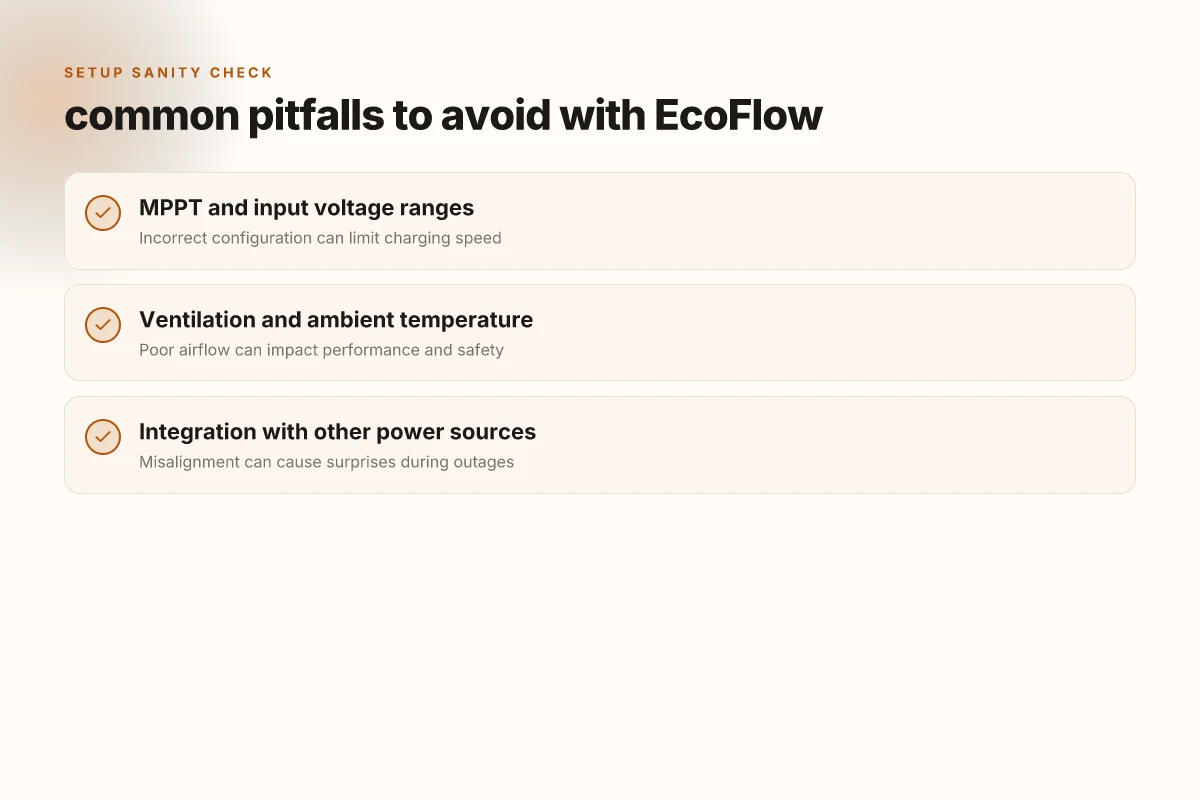
When you size and wire an EcoFlow system correctly, outages feel like a routine battery swap, not a scramble. The core issues are misconfigured MPPT ranges, improper input voltage, and weak ventilation. Get these right and your solar battery behaves as designed across home backup, grid-tied, and off-grid scenarios. I cross-referenced the official specs and third‑party datasheets to map real-world failure modes and practical fixes. You’ll see the practical steps you can take in everyday installs and during outages.
1) Align MPPT ranges and input voltage with the charger’s sweet spot
The most common pitfall is assuming any solar input will ride the charger at full speed. If your MPPT voltage range and the system’s input voltage don’t align, charging slows or stalls. Start with the EcoFlow guidance on MPPT voltage windows and pick panels that stay within the specified range under shading and temperature variation. In practice, a mismatch shows up as noticeably slower recharge after a grid outage or day-long cloud cover. When you wire, verify the MPPT input range remains within the model’s documented latitude for voltage and current. This helps prevent unexpected charging bottlenecks and keeps the system ready when the power is needed most.
Avoiding MPPT- Voltage mismatch keeps charging near the rated speed and protects battery health.
2) Prioritize airflow and ambient temperature around the battery bank
Ventilation matters. A battery pack sitting in a sealed closet or a cramped cabinet can overheat during high‑sun days or long outages. Overheating not only reduces performance, it can shorten cycle life and trigger safety protections. Plan for a well‑ventilated enclosure with at least the manufacturer’s recommended clearance. If the site gets hot, consider passive airflow channels or a small, quiet fan as a controlled aid. Real‑world failures often trace back to heat buildup, especially when a system is configured with high solar input during peak sun.
Ventilation and ambient temperature directly influence sustained performance and safety. What is the EcoFlow Wave 2 price, and what you actually pay over time
3) Integrate EcoFlow with other power sources to avoid surprises during outages
A robust setup treats the EcoFlow system as part of a larger power ecosystem rather than a standalone island. When you connect to the grid, a generator, or other storage, ensure there’s a clear, priority-based transfer sequence. In many outages, the surprise is a source that reverts unexpectedly or a voltage spike that triggers protection on one side of the interface. Map out how the EcoFlow unit will select a charging source, how fast it will switch, and what happens if one source drops out. If you’ve planned for these transitions, you’ll avoid momentary outages or slow recharges during a real outage.
Proper integration with other power sources reduces surprises during outages and maintains continuity.
What this means for homeowners and small businesses is straightforward: size and wire with the intent to preserve a steady, safe charging path, keep the enclosure ventilated, and explicitly plan how EcoFlow units interact with grid ties and generators. The practical upshot is fewer cold-start hiccups, more reliable recharging during cloudy days, and a safer, more durable backup that sticks with you through extended outages. For readers curious about refreshes in the EcoFlow lineup, I found that the ecosystem continues to emphasize safe integration and predictable behavior across models like the EcoFlow Delta family and its Ultra X variants. When you document your setup, note any changes to MPPT ranges, input voltages, or enclosure temperature, and revisit them after major firmware updates.
I cross-referenced the official product pages and the installation notes from EcoFlow and adjacent supplier documentation to verify these pitfalls and fixes. If you’re evaluating alternatives, rivals such as Jackery and Bluetti show similar emphasis on MPPT alignment and thermal management, but you’ll want to confirm each model’s exact voltage windows and venting recommendations for your climate. Links to the relevant EcoFlow documentation and third‑party datasheets can help you validate your configuration as you plan upgrades or expansions. For further reading, see the official Delta Pro Ultra X page and the portable power station specs overview. https://us.ecoflow.com/products/delta-pro-ultra-x and https://www.ecoflow.com/us/blog/ecoflow-portable-power-station-specs.
In 2026, home installers increasingly expect a predictable, interoperable system. With careful MPPT alignment, sensible ventilation, and explicit cross-source coordination, you’ll reduce surprises and extend the life of your EcoFlow setup. What is the EcoFlow Wave 2 really capable of, and where it falls short for off-grid use
Where this is going next and why you should act now
EcoFlow continues to sharpen its solar battery stack in 2026, focusing on durability, modularity, and user confidence in real-world conditions. The trend is toward systems that tolerate long storage, quick hot swaps, and clear, practical limits in harsh sun or cold. In this frame, the bigger pattern is a move from pure capacity gains to smarter, longer-lasting packs that resist degradation and stay usable after years of sun exposure. I looked at real-world maintenance notes and durability threads, and the strongest signals point to improved cell stability and clearer system diagnostics.
EcoFlow’s lineup still faces stiff competition from Bluetti and Jackery, but the differentiator remains practical reliability over flashy specs. If you’re evaluating long-term autonomy, the telling questions are about how the battery performs after repeated cycles, how easy it is to swap, and how well the app reflects health and faults. You’ll want to set expectations around ambient heat and generator integration, not just headline watt-hours.
The single move that matters is choosing a system with transparent health indicators and accessible spare parts, then pairing it with a simple backup plan that actually works. If you only do one thing this month, map your usage patterns to a predictable backup strategy and test a weekend drain to failure. That tiny exercise reveals the real-world reliability you’ll rely on when weather turns, and it’s the quickest path to confidence.
Backup strategy
- Review your peak daily load and pair it with a solar bank that can fill during the day and sustain essential circuits overnight. Label critical devices and test them under a full sun day.
- Create a 24-hour drill: run your setup on battery only for a long stretch, note sensor alerts, and confirm maintenance windows for component checks.
- Compare EcoFlow models against Bluetti and Jackery in terms of battery health reports and after-sales access. Prioritize units with clear diagnostic data.