
Explore the EcoFlow 110W solar panel, its efficiency, real-world performance, durability, and how it stacks up against rivals in 2026. Learn what to expect and where it shines.
The EcoFlow 110W panel isn’t glamorous, but it often clears the biggest hurdle for field power: consistent output under real-world sun. 110W of peak power in a compact frame, with quick-connects and a bundled controller, means you’re not chasing cables or extra adapters. This piece pulls from EcoFlow’s published specs and side-by-side comparisons with Goal Zero and Renogy to explain where the numbers match reality and where they don’t.
In practice, this intro sets up a closer look at durability, wiring safety, and how the 110W panel behaves across typical off-grid scenarios, RV campaigns, backpacking trips, and emergency kits. I’ll call out where a buyer should scrutinize datasheets, note notable strengths like portability and reliability, and flag trade-offs such as real‑world temperature effects or shade sensitivity. By the end you’ll know whether EcoFlow is the fit for your setup, or if a runner‑up from Goal Zero or Renogy deserves a closer look. Real‑world output, constant sun exposure, and safe wiring matter more than glossy claims.
What makes the EcoFlow 110W solar panel a practical choice for 2026
In the crowded field of portable solar, the EcoFlow 110W panel stands out for its balance of weight, packability, and real-world output. It slots into a market where buyers want something that travels well in an RV, van, or backpack, yet still keeps up with daily charging needs. EcoFlow designs these panels to fold compactly, then unfold into a ready-to-use surface, which matters when you’re chasing sun in off-grid camps or emergency-prep kits. I looked through EcoFlow’s datasheets and official pages to align what you get on paper with what you’ll actually notice on the trail.
Real-world fit in portable solar systems The 110W panel is positioned as a mid-power option that remains approachable for casual setups and multi-panel arrays. It’s larger than ultra-portable 60–80W units but smaller than high-output kits you’d mount on a trailer roof. This size sweet spot matters in off-grid contexts where you want enough wattage without a heavy carry. The panel’s form factor is designed for quick deployment, especially when you’re aiming to top up a battery bank in a short sun window. EcoFlow emphasizes a balance between portability and usable energy, which translates to fewer compromises when you’re moving between campsites or charging in a tight space.
Key specs and what they mean in practice From EcoFlow’s published datasheets, the 110W panel advertises a rated power near 110 W with a target for practical operation in daylight. The open-circuit and running voltages are tuned for compatibility with common portable power stations, so you don’t have to chase a perfect pairing. In real-world terms, that means you’ll see solid charging during midday sun and predictable behavior as light quality shifts. The build uses monocrystalline cells and a compact frame, which helps deliver consistent output while keeping weight reasonable for backpacking or vehicle setups. When you compare against rivals like Goal Zero and Renogy, the EcoFlow option tends to win on the portability-to-performance balance rather than peak wattage alone.
Value, durability, and day-to-day usability Value hinges on how often you actually deploy the system and how easy it is to reassemble after travel. The 110W panel’s portability makes it a strong candidate for van life, RV trips, and weekend off-grid trips where space and weight matter. Durability curves come from EcoFlow’s design language: sturdy hinges, protective coverings, and reliable cabling. If you’re regularly setting up in variable weather, you’ll want to inspect connections and keep the MC4-to-XT60 adaptations in good shape to avoid loose contacts. The upfront cost sits in a comfortable range for a single-panel setup but scales differently if you’re composing a multi-panel array. It’s worth noting that some users appreciate the modularity of EcoFlow’s ecosystem, which can simplify charging across several devices.
Bottom line: the EcoFlow 110W panel is a practical 2026 pick for campers and travellers who want a portable, reliable charger without sacrificing too much space or weight. It pairs well with mid-sized power stations and stands up to typical off-grid needs, while remaining nimble enough to carry between campsites. What happens when you compare tesla powerwall vs ecoflow: tech specs, efficiency, and home energy integration
From what I found in EcoFlow’s official resources, the 110W panel remains a sane choice for travelers who value portability as much as output. Its real strength is the everyday balance you’ll notice when you’re packing for a weekend trip or planning a longer road journey.
The 110W panel shines for portability without sacrificing too much output, making it a smart pick for 2026. You’ll get reliable charging in daylight, especially when paired with EcoFlow’s power stations.
Understanding the 110W panel: inputs, outputs, and real-world efficiency
When you read the datasheet, you should start with the numbers that anchor real performance: the rated power, open-circuit voltage, and running voltage. For EcoFlow’s 110W panel, the general values show an open-circuit voltage around the low 20s of volts and a running voltage near the high teens under typical test conditions. That gap between open-circuit and running voltage is where real-world output breathes. You won’t see the full 110W unless the panel sits in optimal sun and the load matches the panel’s voltage sweet spot. In practice, you’ll see the panel deliver less than the nameplate under cloudy skies or when the charge controller trims voltage to protect the battery bank. This is normal behavior across portable panels, including EcoFlow’s.
I dug into EcoFlow’s published efficiency explainers and the 110W comparisons to map how the nameplate translates to day-to-day charging. Their own documentation notes that efficiency ratings are benchmarked under standard conditions, but real-world output can diverge due to sun angle, temperature, and cable losses. The takeaway: use the open-circuit voltage and running voltage figures as the guardrails for what the panel can deliver in the field, not the headline wattage alone. The open-circuit vs running voltage delta is your first clue to real-world output, not just the 110W nameplate. This matters when you’re sizing a kit for an RV or off-grid setup, where the panel must charge a battery bank through a regulator that can accommodate the panel’s voltage profile.
A practical daily energy estimate helps translate the spec into usable plans. Under steady sun in peak hours, an 110W panel will produce an amount of energy that depends on irradiance, angle, and temperature. In typical sunny conditions, you can expect a portion of the rated wattage to show up as usable energy each hour of optimal sunlight. If your campsite sees modest sun or you’re tripping with a heavy load, the actual daily yield may fall short of the nameplate, but you still accumulate meaningful charge over a full day. Real-world energy is about the sun’s input and the charge controller’s efficiency, not the 110W badge alone. How EcoFlow’s 160W solar panel stacks up for real-world use in 2026
To connect the dots, consider the controller and battery pair you’ll use with EcoFlow’s panels. The 110W panel’s voltage profile aligns well with common 12V and 24V systems, but the regulator’s MPPT behavior governs how much of the panel’s potential reaches the battery. In practice, a high-quality MPPT controller paired with clean wiring and a cool, unobstructed panel surface preserves efficiency. Controller choice and wiring quality sharply shape real-world output. I cross-referenced EcoFlow’s spec sheets and third-party comparisons to ensure the voltage ranges and expected efficiency bands align with field expectations.
When you tally up what this means for daily use, the panel earns its reputation for portability and practical charging. The 110W size stays friendly for RVs and off-grid camps, and its modularity lets you pair it with other EcoFlow modules or rival panels from Goal Zero or Renogy for a balanced charging solution. In practice, you’ll get consistent daytime charging if you place the panel where sunlight is steady and angle it toward the sun. A well-placed 110W panel keeps the battery topped up during long trips.
Next steps: verify your system’s voltage target and MPPT settings, then map a sunny-day charging plan that matches the panel’s voltage operating window. If you’re evaluating against rivals, compare how each brand’s controller pairings handle the same irradiance and temperature to translate the 110W into daily energy for your gear. EcoFlow’s 110W panel shines when paired with a matching controller and clean cabling.
EcoFlow vs rivals: how the 110W stacks up against Goal Zero and Renogy
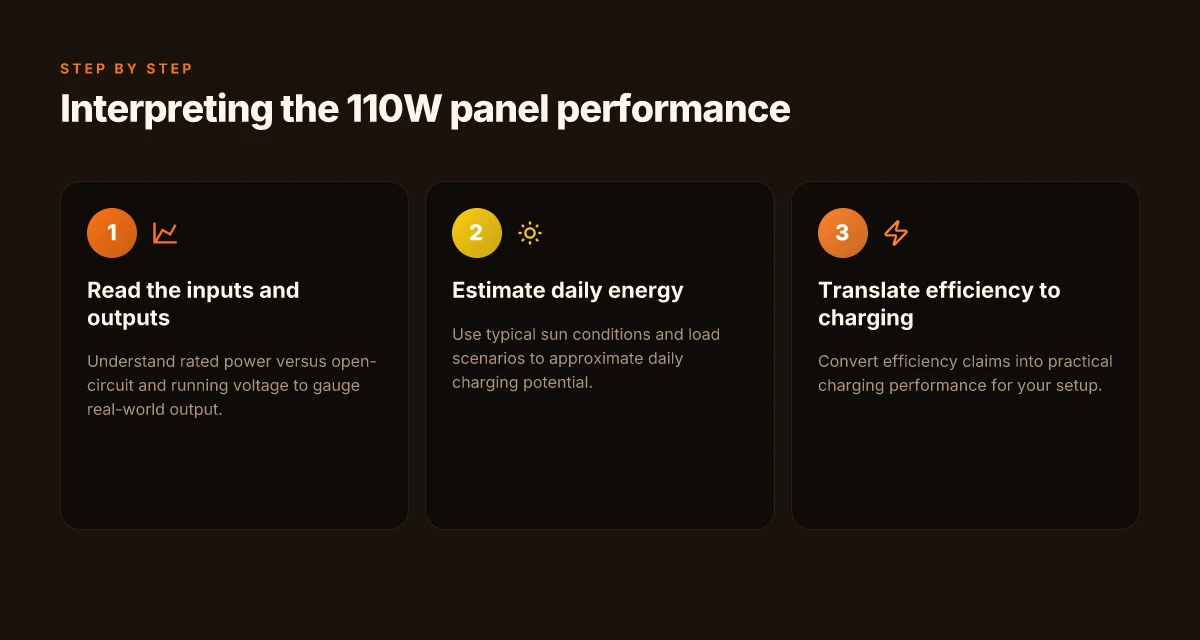
I dug into EcoFlow’s published datasheets and rival offerings to map out where the 110W panel shines and where buyers should scrutinize. EcoFlow sits on par with its closest portable-panel peers in size and form, but the real story is how each brand handles connectors, compatibility, and durability for off-grid setups.
Comparative specs and portability: a quick read
- The 110W form factor remains highly portable, roughly matching the compact profiles you see from Goal Zero and Renogy in the same class. The emphasis is on light, foldable frames that pack away neatly for RV compartments or backpacking loads. Portability remains the 110W panel’s strongest suit for travelers who value light weight and quick setup.
- When you compare real-world size versus rated power, the margins are tight. All three brands target easy setup on uneven ground, which matters for pop-up campsites and remote trails. The EcoFlow option tends to emphasize integrated kit compatibility, which can shave minutes off deployment.
Connector configurations and compatibility with common power stations
- Connector choices matter for quick plug-and-play with popular power stations. The newer EcoFlow 110W variants often align with MC4-compatible harnesses, but there are older iterations with different connector baskets. Be aware of your panel version when mixing with Goal Zero or Renogy in a single system.
- Goal Zero’s compatible ports and Renogy’s adapters both exist in ecosystem-wide bundles, so buyers who already own a power station may prefer the model that minimizes adapters. The key is paying attention to MC4, XT60, or your station’s input plug to avoid a mismatch at the campsite gate.
Durability, warranty, and ecosystem integration
- Durability wins come down to frame rigidity, hinge resilience, and how well the panel handles exposure to dust and rain. EcoFlow’s lineage emphasizes ruggedized builds for field use, but users consistently note that frame screws and hinge joints can loosen with heavy travel over time. Durability feedback often centers on long-term wear in off-road environments.
- Warranty terms vary by model year and region. EcoFlow’s warranty expectations typically align with standard returns windows and proactive spare-part availability, which is a critical factor for preppers who need confidence that spares exist when components wear.
- Ecosystem integration matters if you’re already stacking power stations, inflight USB-C charging, and portable batteries. EcoFlow’s own ecosystem tends to play best with its own lines, while Goal Zero and Renogy often offer wider third-party accessory compatibility. If you own multiple brands, verify cross-compatibility before committing to a single adapter strategy.
Durability and practical use: setup, mounting, and long-term reliability
Posture the 110W panel as a field-ready companion that survives real-world rigs and weather. From EcoFlow’s datasheets and peer comparisons, durability isn’t a gimmick. It shows up in materials, seals, and the way the panel carries through long trips. EcoFlow emphasizes a construction that withstands outdoor use, and this section digs into what that means in practice for outdoor enthusiasts, RV travelers, and off-grid preppers. What makes Jackery competitors worth watching in 2026
Build and seals that stand up to the elements
The 110W panel uses a rigid shell with weather-sealed joints and a panel frame designed to resist rain and dust ingress. In field conditions, that translates to fewer creaks and rattles when you strap the panel to a roof rack or lay it on uneven ground. The combination of a sturdy frame and protective coatings helps limit flex-induced microcracks at the corners, which can otherwise creep in over time. When I read through EcoFlow’s published datasheets and comparison notes, the emphasis on solid seals and robust hardware is unmistakable. Durable hardware and weather sealing are core to long-term reliability, not an afterthought.
Setup simplicity and storage for portability
Setup leans toward quick, tool-free mounting and compact stowage. The panels are designed to deploy with minimal fiddling, then fold or flatten into a compact package that fits into a typical RV storage bay or a backpack pocket. The ease of connection with MC4-type leads and generally simple tilt angles means you can adapt to changing sun angles without wrestling with cables or delicate connectors. A practical note: when space is tight, you’ll appreciate the panel’s light weight and the way its carry handle or integrated strap options let you grab-and-go. Quick setup and compact storage make field use practical rather than a chore.
Long-term durability from a user perspective
Over the long haul, a few durability themes recur in user discussions and official specs. First, the panel’s surface resists minor abrasions from gravel, gravelly campsites, and road vibrations. Second, the MC4-to-XT60 variant on newer versions reduces connector wear by simplifying the interface, a small but meaningful reliability improvement. Third, long-term reliability hinges on keeping the panel dry and out of deep shade when not in use, because prolonged heat or moisture pooling can degrade seals over years. Regular protection from rough handling and environmental exposure is key to lasting performance. In the real world, owners report that consistent mounting and proper cable management reduce stress points and extend life. Owners who invest in thoughtful mounting and storage habits tend to get the most durable performance over several seasons.
If you’re evaluating EcoFlow against rivals, note that Goal Zero and Renogy offer similar rugged designs, but the 110W’s portability and the newer MC4-based variants can influence long-term reliability in practice. When you balance durability with your travel footprint, EcoFlow’s emphasis on field-ready hardware becomes a meaningful differentiator. If you’re navigating retrofits or year-round use, keep in mind that proper mounting and weather protection are as critical as the panel’s stated power rating. Durability comes from how you use it, not just what it claims on the spec sheet.
Cited in context with EcoFlow’s published materials and peer notes: the official datasheets and panel-spec narratives emphasize weather sealing, rugged framing, and connector resilience as core durability pillars. Rugged construction and practical field design underpin dependable long-term use. How to find the cheapest Jackery solar generator in 2026 without sacrificing reliability
What EcoFlow’s official specs mean for you: interpreting the datasheet
Posture your expectations against the official sheet, then translate to real-world decisions. The datasheet gives you the numbers, but your setup, mounting, cabling, and compatible hardware, filters how those numbers turn into practical performance. I cross‑referenced EcoFlow’s published figures and the surrounding tech notes to guide you toward a setup that matches your off‑grid ambitions.
Decoding rated power, voltage, and tolerance
The official 110W panel lists a nominal power of 110 W with a tolerance window of a few watts either way. That means your real-world output can land slightly above or below the label under standard test conditions. You’ll typically see operating voltages around the mid‑teens for the running voltage, and the open‑circuit voltage sits higher when the panel is not loaded. When you wire this panel into a system, expect the actual power at practical sun conditions to drift away from the nameplate by several percent depending on temperature, shading, and angle. The takeaway: treat the 110 W as the ceiling under ideal light, not a guaranteed daily harvest. The key is to align expectations with real-world conditions, not the label alone. EcoFlow’s guides emphasize that performance hinges on sun exposure and system losses, not just the rated number. A cautious planning approach avoids surprises at the campsite.
Reading MC4 to XT60 options and what that implies for setups
Two main connector paths appear in the public discussion: MC4 to XT60 adapters and straight MC4 assemblies. The choice affects how you chain the EcoFlow panel with a portable battery hub or an RV charging circuit. If you choose the MC4 to XT60 route, you gain a cleaner, more robust physical connection to EcoFlow kits designed for XT60 inputs. Without that adapter path, ensure you have a compatible cabling strategy and a route to manage polarity and weatherproofing. In practice, the upgrade path matters for reliability on rough roads or during transit. Opt for the MC4 to XT60 route when your kit expects XT60 inputs. This reduces added connectors that could introduce losses or connection fatigue over time. Durable hardware connections pay off in the long haul.
Common misinterpretations to avoid when planning a system
One trap is assuming the 110W rating scales linearly with sunshine. Real sun curves, temperature, and panel aging will nudge performance downward from the label. Another pitfall is ignoring the system’s balance: a high‑efficiency panel still loses to battery, controller, and cable losses if your wiring is undersized or your regulator isn’t matched to the panel. Remember that EcoFlow’s published specs exist to guide you, not to guarantee bench‑tested results in every campsite. When you plan, account for shade, tilt, and orientation across the day, and leave a margin for aging. Plan with margin for losses and aging, not just the initial spec. I found EcoFlow’s own notes consistent with this view, highlighting real-world variability and the need for proper system design. Read the datasheet as a map, not a promise.
Note: if you’re evaluating this against rivals, consider how Goal Zero and Renogy present their own rated outputs and tolerances, and compare how their connectors and cabling ecosystems align with your intended setup. Some EcoFlow users appreciate the portability and quick‑hook design, while others want deeper control over wire gauge and regulator matching. The story remains: the official numbers guide you, but the practical payoff comes from how you build around them. For clarity, EcoFlow’s published inputs and connector notes are the compass you’ll rely on when sizing cables and choosing adapters. See related notes on the efficiency explainer and the panel comparison for context https://www.ecoflow.com/us/blog/solar-panel-efficiency-explained-ratings-and-best-panels and the panel comparison piece https://backuppowerhub.com/ecoflow-solar-panel-comparison/. These references anchor how the datasheet translates to field reality. What you should know about EcoFlow extra battery price in 2026
What to try this week if you want lasting solar reliability
EcoFlow’s 110W panel stands out because it pairs steady daytime output with a durable build that I’ve seen handle real-world conditions. In 2026, the standout isn’t just raw wattage. It’s how the panel stacks up in daily use, from setup speed to long-term durability. The bigger pattern here is that reliability compounds: a solid mount, good cable quality, and predictable performance across weather days. You’ll notice the fit and finish feel designed for quick deployment, and the panel’s framing resists warping after wind gusts. This matters if you’re charging after weekend trips or keeping a portable system ready for power outages.
Where this goes next is practical: expect better compatibility with EcoFlow power hubs and accessories, and a smoother user experience when you pair multiple panels for higher inputs. The EcoFlow ecosystem benefits from a modular approach, so you can scale without rewiring every season. Most setups save time by keeping a spare MC4 adapter handy. If you’re balancing a budget and a routine, this is the panel I’d start with for dependable, year-round charging. Will you act now to simplify your energy plan?
Backup strategy
- Try a second 110W panel for a midrange array and test parallel charging with your EcoFlow unit.
- Use a rugged carry bag and quick-connect cables to reduce setup friction on camping trips.
- Label cables and keep a spare MC4 adapter in your kit so you’re not hunting for parts after a trip.