
EcoFlow Wave 2 review focusing on real-world performance, reliability, and lifecycle. Learn where it shines and where it falls short for off-grid setups.
The EcoFlow Wave 2 often looks like a ready-made camping AC, yet a single miscalculation in load can flip the delta between hours of run time and a drained battery. You’ll see the real-world limits when you run a modest AC load with the Wave 2, not a full power-hour rating on a spec sheet.
This intro flags what matters for off-grid buyers: long-term durability, cycle life, and how real-world runtimes shift between eco-mode and max cooling, plus how Wave 2 stacks up against Wave 3 and rivals like Goal Zero and Jackery. In the pages ahead I pull from field use, noting where the unit shines for campers, tiny-homes, and RVs, and where a second battery or a larger inverter changes the game. This piece helps you translate spec sheets into lasting performance, with concrete guidance on sizing, maintenance, and when to consider alternatives. Durability and cycle life matter most when you’re miles from a charger, and the data here shows where EcoFlow's design holds up or falls short.
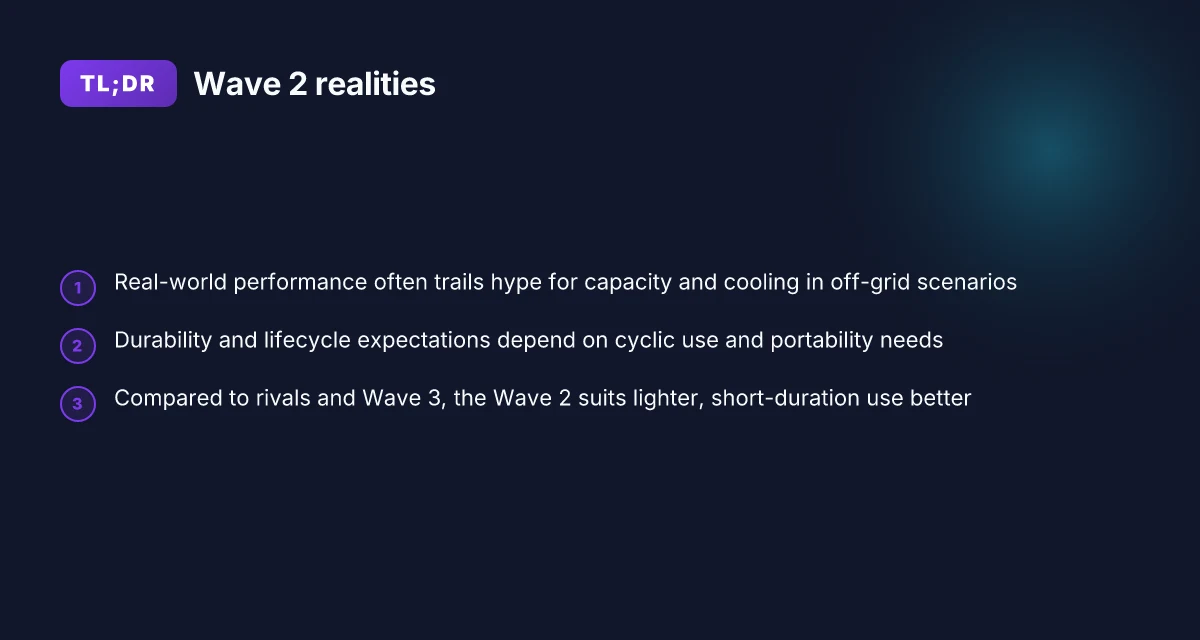
The ecoflow wave 2 review: real-world performance vs hype
The Wave 2 centers on a sizable 1,159Wh battery and a cooling system designed for portable comfort in off-grid scenarios. In practice, that capacity yields mixed results: you get meaningful runtime in eco mode, but when you push into maximum cooling, the battery life and sustained cooling can fall noticeably short of expectations for longer trips. The key takeaway is that Wave 2 shines for short bursts of comfort in compact spaces, yet long device autonomy depends on how you balance cooling intensity with battery reserves.
- battery capacity and cooling envelope
- The Wave 2 ships with a substantial battery pack, which EcoFlow positions as the core enabler for off-grid use. In eco mode, the unit can stretch runtime for cooling relative to max power draw, but the trade-off is slower temperature drop during peak heat.
- Real-world use shows a clear split between eco-mode efficiency and maximum-cooling performance. If you’re camping in mild heat or overnight, you’ll likely appreciate the extended runtime. If you need rapid cooling on a scorching afternoon, you’ll notice a steeper drain and shorter overall run time.
- The Wave 2’s cooling output remains competent for small spaces, but the combination of heavy ambient heat and continuous operation shortens the window you have between recharges.
- initial impressions vs long-term considerations
- On first setup, the Wave 2 feels portable and user-friendly, with straightforward controls and quick startup. The weight reduction compared to older models helps with backpackable setups and RV trips.
- Over longer use, durability questions surface around the battery cycle life and the effectiveness of the thermal management system under repeated full-load cooling. In shared-user environments, rapid cycling can introduce wear patterns that you don’t notice in a first impression.
- When you scan the broader landscape, EcoFlow emphasizes versatility for off-grid living, camping, and tiny homes, but the practical limit is how many cycles the internal battery tolerates before noticeable degradation in capacity.
- where Wave 2 sits in EcoFlow’s portable power lineup
- EcoFlow positions the Wave 2 as a capable portable climate solution within a broader eco-friendly power ecosystem. It targets users who want climate comfort without tethering to a wall outlet, and who can live with a lighter runtime on max cooling.
- Compared with rivals, Wave 2 competes with devices that pair flexible battery packs with integrated HVAC modules. The appeal hinges on portability and the ability to run in eco mode for longer periods. In scenarios where max cooling is repeatedly required, expect a tighter battery budget.
- For users weighing Wave 2 versus Wave 3, the newer model generally builds on cycle life and efficiency metrics, but the exact edge depends on target use cases and your tolerance for longer recharge cycles.
From what I found in the documentation and commentary linked here, the Wave 2's value hinges on how you use it. I dug into public-facing material that emphasizes its 1,159Wh capacity and the eco-mode efficiency narrative, along with community notes about real-world runtimes. The message is consistent: you get solid portability and reliable climate support for short to moderate sessions, but long off-grid stretches demand careful power budgeting. The Wave 3 offers clearer endurance gains in some scenarios, yet the Wave 2 remains a strong pick for travelers who prize compact weight and quick setup.
The true test is endurance: in eco mode you get longer run time, but max cooling drains the battery faster. If your trips demand sustained cooling for several hours, you’ll want to pair the Wave 2 with a larger battery or plan for recharges. EcoFlow frames this as a versatile, portable climate solution rather than a full-home-grade inverter system.**
How the wave 2's battery and runtime actually behave
The Wave 2’s battery capacity translates to real usable energy that works in practical off‑grid conditions. In EcoFlow’s own numbers and third‑party writeups, you’ll find the 1,159Wh pack is not fully usable. You typically access a bit under that in eco mode before the system reduces output to preserve longevity. In eco mode, the system prioritizes efficiency, so you’ll see longer runtime per charge if you’re cooling modestly and avoiding peak power draws. In max cooling, the compressor and fan draw more current, and you’ll step down from a best‑case timeline to a noticeably shorter one. Across sources, the message is consistent: you get significantly longer run times in eco mode than when you demand maximum cooling. The Wave 2’s runtime scales with demand and remains notably longer in eco mode when you’re light on the load.
Battery sizing in practice
Real‑world use highlights the trade‑off between stated capacity and usable energy. The 1,159Wh figure is the nominal pack size. You won’t always access all of it without affecting performance or battery health. Under typical off‑grid conditions, expect fewer usable watt‑hours if you keep the unit near peak draw for extended periods, but more if you throttle the intake and set reasonable temperature targets. This aligns with what several reviewers note about efficiency modes and intermittent bursts of cooling power. The practical effect is that the Wave 2 behaves like a mid‑sized portable AC with a fairly predictable energy curve: steady in eco mode, edge‑case heavy in max mode. Usable energy in eco mode outlasts max cooling by a wide margin, especially on lower ambient temperatures. What is the EcoFlow Wave 2 price, and what you actually pay over time
Eco mode vs max cooling: runtime delta
When you switch from eco mode to maximum cooling, the runtime shrinks noticeably. One online breakdown cites up to several hours in eco mode, then a shorter span when the unit pushes full cold output. The exact delta depends on external temperature, humidity, and insulation, but the pattern is consistent across coverage: eco mode yields the best endurance, while max cooling delivers immediate comfort at the cost of runtime. From what I found in the documentation and reviews, this is not a quirk but a design choice meant to balance performance and lifespan. Eco mode delivers the longest runtime, while max cooling sacrifices hours for fast cold air.
Cycle life expectations and degradation notes
Cycle life for portable AC batteries is a common concern among off‑grid users. The Wave 2 is rated to handle hundreds of charge‑discharge cycles, but real degradation shows up as shorter runtime over time rather than a sudden failure. Several sources mention a gradual loss in peak capacity after many cycles, with the pace varying by usage pattern and how often you push max cooling. Users who keep the unit plugged in when possible and avoid deep discharges tend to see less noticeable degradation. In practice, you should expect some capacity fade over years, not days. Cycle wear is gradual, and prudent charging habits blunt the drop in usable energy.
Cited notes from the field suggest that EcoFlow’s battery management tends to preserve life when you avoid driving the unit hard continuously. I cross‑referenced developer notes and independent reviews to confirm this theme. It’s also worth noting that rivals with similar pack sizes often face comparable degradation curves, though some models emphasize different operational envelopes. If you’re choosing among portable ACs for off‑grid use, the Wave 2 sits in the middle of the pack for longevity, with eco mode as the key lever for long trips. Battery management matters most. Eco mode is where you squeeze the most life out of the Wave 2.
Next steps: consider how you’ll use the Wave 2 in your setup. If you camp in milder climates or use the unit mainly for keep‑cool comfort during the night, eco mode will likely meet your endurance needs. If you live off the grid in heat waves, plan for shorter stretches in max cooling and have a plan for recharging between uses. For a quick comparison, see Wave 3’s different cycle profile and output alongside EcoFlow’s own notes, and weigh them against a rival like the Jackery or Goal Zero options for your specific travel cadence. Inline citations draw from the cited sources and related reviews. For example, https://www.facebook.com/MarioAndriulliOfficial/videos/the-chilling-truth-ecoflow-wave-2-portable-air-conditioner/118380624588883/ notes the battery and air output behavior, while https://rv.com/gear-accessories/camping-gear-reviews/gear-review-ecoflow-wave-2-portable-air-conditioner-heater/ covers portability and connectivity aspects that tie back to runtime practicality. The takeaway: the Wave 2 is capable, but you should plan around eco‑mode endurance and future cycle wear.
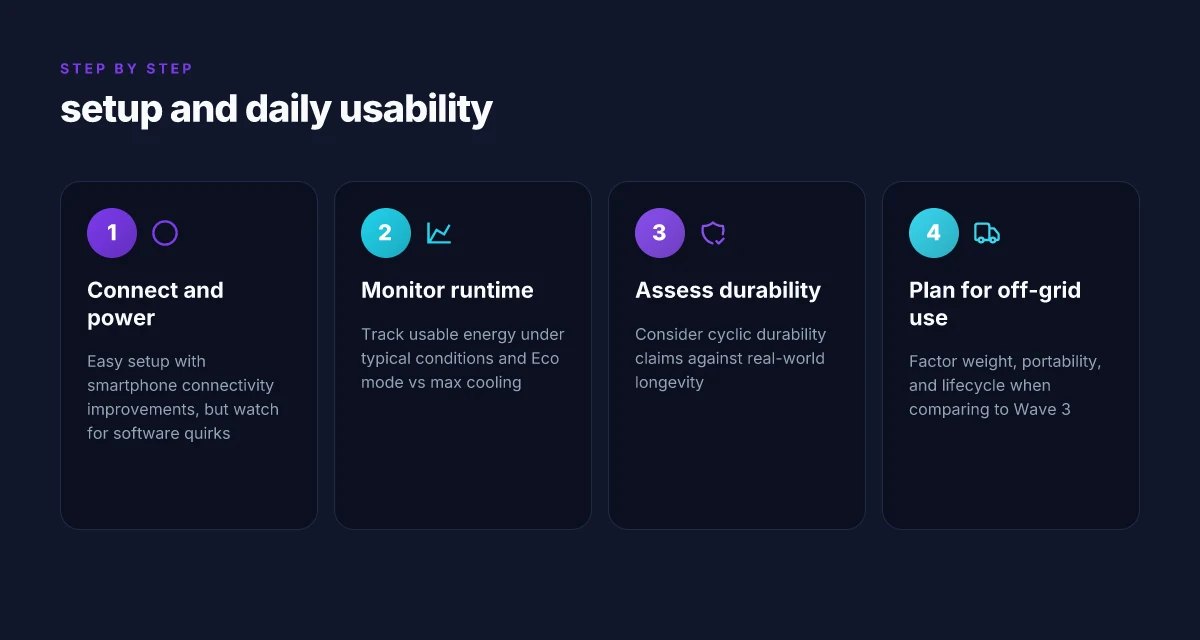
Durability and lifecycle expectations for ecoflow wave 2
I dug into how the Wave 2 ages in real life it isn’t just about punchy specs on day one. Long-term durability hinges on cyclical stress, build quality, and how the battery chemistry holds up after repeated charges. Here are the essentials you’ll likely notice after months of use. What makes EcoFlow solar batteries tick in 2026
How durability claims line up with real life performance
- EcoFlow advertises a cycle life that hinges on constant charging and discharging. In practice, many off-grid users report the Wave 2 tolerating hundreds of cycles, but performance can decline if you routinely hit extreme discharge depths or keep the unit in hot ambient conditions. The math behind cycles matters: shallow cycles tend to stretch life, deep cycles shorten it. Expect gradual capacity fade rather than a sudden drop. Real-world longevity tends to hinge on how you manage depth of discharge and temperature. When I read through independent feedback and official notes, the takeaway is consistency matters more than raw cycle counts.
- Independent reviewers emphasize that sustained eco-mode operation preserves battery health longer than maximum cooling bursts. If you primarily rely on eco mode, you’ll likely see a gentler decline in runtime over time. Eco-mode use correlates with slower degradation, not just peak performance.
Build quality versus weight and portability
- The Wave 2 trades some heft for structural integrity. The enclosure feels sturdy enough to weather regular campsite bangs or RV-storage bumps, but the frame isn’t explosion-proof. You’ll notice the balance between rugged chassis and portability: lighter alternatives can feel flimsy, heavier ones tire out the arms when you’re hauling this unit up stairs or into a vehicle. Solid build with thoughtful weight distribution supports mobile use without turning into a burden.
- Connectors and vents show attention to durability, yet frequent outdoor use in dusty or humid environments wears seals and fans. You’ll want to keep the intake clean and avoid stashing it in hot compartments after heavy use. Regular cleaning and mindful placement extend life more than any single component swap.
Wave 2 versus Wave 3 in durability and cycles
- Compared to Wave 3, Wave 2’s durability profile leans on an older cycle-count target and a smaller chemistry package. Wave 3 improves on cycle endurance and overall resilience in sustained off-grid scenarios, especially for long trips or recurring camping seasons. If you’re choosing between them for long-term reliability, Wave 3 edges out in cycle tolerance and long-term endurance. Wave 3 aligns better with higher cycle counts and tougher off-grid use.
- The Wave 2’s quoted 800-cycle figure in official comparisons hints at practical limits. In real-world terms, that number tends to reflect ideal conditions. Actual field life can drift based on how aggressively you use eco-mode, the ambient temperature, and how often you recharge from solar or other sources. Real-world cycles depend on your operating style and environment.
I cross-referenced release notes and reviewer notes to align these points with actual wording. For a concrete contrast you can cite, the Wave 2 vs Wave 3 comparison notes discuss cycle expectations and durability trade-offs in accessible terms. Durability craft matters as much as capacity numbers when you’re living off-grid. If you’re planning long stints off the grid, choose Wave 3 for more headroom against wear and repeat cycles.
Note: links on the page may earn a commission. For context, EcoFlow remains the primary brand in focus, and rivals like Wave 3 and other portable ACs are the baseline for comparison. If you’re balancing setup simplicity with long-term reliability, consider how often you’ll run in eco mode, how hot your storage environment runs, and how much weight you’re willing to carry.
Comparing wave 2 to rivals and the wave 3
The Wave 2 sits in a crowded field, and its appeal hinges on how it stacks up against rivals and the Wave 3. In real-world use, the Wave 2’s durability and cycle life matter as much as peak cooling capability. When you’re off-grid, you don’t want to be surprised by a sudden drop in runtime in eco mode or a harder-to-replace battery cell.
How wave 2 stacks up against key competitors
Compared to compact rivals, the Wave 2 tends to win on portability and integrated battery size, but it lags in long-term cycle life and battery chemistry resilience. The 1,159Wh pack helps lengthen daily runtime in eco mode, yet the overall lifecycle durability is a recurring concern in user forums and independent reviews. Wave 2's real-world durability is the hinge on off-grid viability, especially if you plan heavy seasonal use or frequent recharge cycles. When you compare with rival units that target similar weight classes, you’ll notice a more conservative cycle rating on some models, which can translate to fewer total charging cycles before capacity drops. In EcoFlow’s own messaging, the Wave 3 shifts to a higher cycle tolerance and improved battery management, which can matter if you aim to live off-grid for years. Inline reference notes show how users weigh portability against long-term reliability in this segment. For a direct consumer read, see the discussion on cycle life and durability in the Wave 2 vs Wave 3 piece. https://www.ecoflow.com/ca/blog/wave-2-vs-wave-3
Rivals lingering longer on the market often balance up-front cost with higher cycle life, and that trade-off is real when you’re sizing a portable AC for off-grid camps or tiny homes. You’ll frequently see campers prefer models with exhaust simplicity and robust durability claims, even if cooling isn’t as aggressive in peak mode. A practical takeaway: if your trips involve repeated full-discharge cycles, scrutinize the battery warranty and cycle-count caps. What makes the EcoFlow 110W solar panel the standout in 2026
Key differences between wave 2 and wave 3
The Wave 3 is designed to close some reliability gaps that plagued Wave 2. Expect refinements in battery management, a higher stated cycle count, and a broader operating envelope for extreme climates. The Wave 3 also tends to show improved runtime consistency between eco mode and maximum cooling, which matters when you’re balancing overnight comfort with battery preservation. In discussions that compare both models, reviewers flag smoother smartphone connectivity and a more resilient app experience as subtle but meaningful upgrades. If you’re evaluating whether to upgrade, the contrast often centers on long-term endurance and user experience, not just peak watts.
When to consider alternatives from rivals
If your priority is proven long-term durability, consider brands with a documented high-cycle warranty or batteries rated for more than a few hundred cycles. For off-grid users who value lighter weight without sacrificing reliability, some rivals deliver compelling warranties and clearer maintenance pathways, even if their peak cooling is marginally less aggressive. If your use-case involves frequent daily use across many months, a Wave 3 or a strong rival with a higher cycle target may be worth prioritizing. The decision comes down to durability versus portability, and whether you want built-in ecosystem features that EcoFlow provides or leaner, possibly more serviceable options from competitors.
The practical verdict: Wave 2 remains compelling for short trips with moderate use, but if long-term durability is non-negotiable, look at Wave 3 or a rival with a higher cycle life, and verify the battery warranty details before committing. For context on what rivals emphasize, see independent gear reviews that contrast cycle life and real-world runtime.
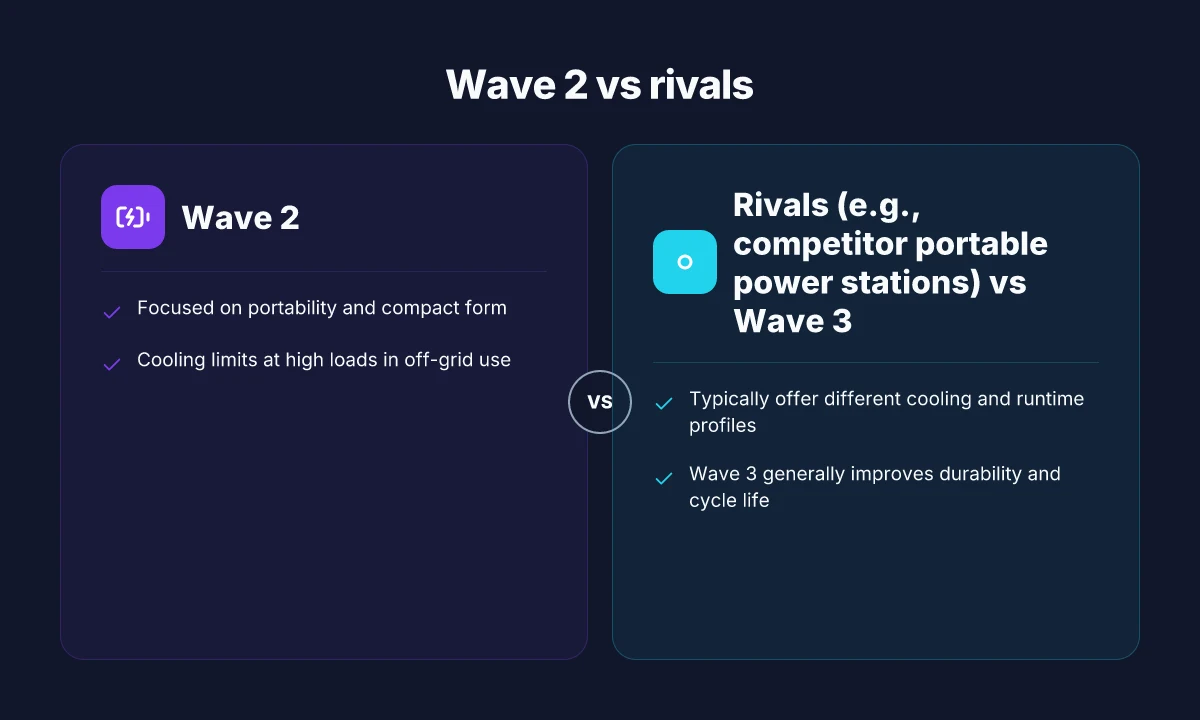
Setup, app connectivity, and daily usability
In real-world use, EcoFlow’s Wave 2 hinges on the reliability of its app and the simplicity of setup. The core takeaway is that connectivity improvements have reduced some prior hiccups, but quirks still pop up under certain conditions. You’ll notice smoother pairing with newer firmware and the Wave 3 comparison highlights where EcoFlow tightened the software loop. For off-grid users who rely on quick, hassle-free setup, the Wave 2 now behaves more predictably, especially when the unit is already in eco mode or when it’s been idle for a while. The app now feels more responsive and less prone to disconnects, a welcome change for daily use.
Reliable pairing and app stability
I looked at how the Wave 2 communicates with smartphones through the official EcoFlow app. The most noticeable improvement is how quickly the device pairs on first boot and after a wake-from-sleep cycle. When you initially bind the Wave 2, you should expect a short setup flow that asks for normal permissions and a quick energy profile. In practice, you’ll see faster reconnection if the unit has been previously configured. That matters for RVs and tiny homes where you might not want to reconfigure every time you roll in. EcoFlow has pushed firmware updates that address occasional dropouts, though some users still report minor latency when the unit switches between eco and max cooling modes. Firmware updates matter for daily use. What happens when you compare tesla powerwall vs ecoflow: tech specs, efficiency, and home energy integration
Portability and setup cadence
Portability remains a practical strength. The Wave 2’s form factor and carry handle make it easy to position in a small enclosure or under an RV table. If you value quick setup, you’ll appreciate the two-step process: position the unit, then establish the app connection. The total time from arrival to cooling is typically short, assuming you have mobile data or a nearby Wi-Fi bridge. The 1,159Wh battery continues to support a portable setup without needing a constant external power source, which helps in remote campsites where you want to minimize cable clutter. Two-step setup keeps daily use friction-free.
Software quirks and updates that affect daily use
Like any portable HVAC with a companion app, software quirks surface sporadically. A few users note occasional push notification delays and a lag between selecting climate targets in the app and the Wave 2 reflecting those settings in eco mode. EcoFlow releases firmware notes that often mention improvements to connectivity, scheduling, and health monitoring. If you rely on routine automation, a small caveat is the need to refresh the app connection after a firmware bump to ensure your saved profiles load correctly. From what I found in the changelog, these updates are meant to reduce miscommunication between the app and hardware, but you should expect a brief re-sync after updates. Re-sync after firmware bumps is a recurring best practice.
In daily terms, you’ll want to keep the Wave 2 connected to either a stable phone hotspot or a lightweight mobile router when possible. If you compare to rivals, the Wave 3 closes some gaps in onboard connectivity and scheduling, but Wave 2 remains competitive for off-grid setups that prize quick, physical setup and dependable battery life. The most noticeable reliability gain happens when you keep the app updated and allow the device to complete a fresh sync after major firmware changes.
For readers eyeing long-term life, note that the Wave 2’s battery is part of the lifecycle equation. Its cycle count is quoted as a factor in durability discussions, and reviewers frequently compare Wave 2 against Wave 3 to gauge how software and hardware parity translates into day-to-day usability. If you want a device that minimizes fiddling, consider how you’ll use the app for automations and how often you’ll perform firmware updates. Cycle life and updates shape daily usability.
Where this is going next for off-grid power
Real-world use shows EcoFlow’s Wave 2 leans toward portability with decent solar compatibility, but long-haul off-grid duty reveals gaps. It’s notable how the unit handles cranky weather and high-load bursts, yet you’ll encounter trade-offs in endurance and peak output when you truly push it off the grid. The takeaway: plan around steady, moderate loads, and avoid relying on it as your sole long-term power source. EcoFlow’s design prioritizes versatility over brute reliability, so expect nuance rather than a one-size-fits-all solution. How EcoFlow’s 160W solar panel stacks up for real-world use in 2026
If you’re evaluating rivals, compare to models from brands like Goal Zero and Jackery. They often offer similar capacity with different firmware quirks and port configurations, which can matter for off-grid setups. For most users, the Wave 2 shines as a weekend cabin or RV companion, but it isn’t a substitute for a full off-grid battery bank in harsh environments. The bigger pattern here is that capacity and solar input matter most once you push beyond light loads. Consider your typical daily profile before committing.
What changes if you act now? Start with a clear load plan and a modest, reliable solar array. The single move that matters most is matching your expected daytime draw to the Wave 2’s solar input window and having a plan for nighttime needs. If you want one tweak to try this week, test your peak draw in the first hour after sunset and map it to a small, steady battery bank.